Luận án tiến sĩ nghiên cứu khả năng hấp phụ một số hợp chất hữu cơ trên các vật
Luận án: Luận án tiến sĩ nghiên cứu khả năng hấp phụ một số hợp chất hữu cơ trên các vật liệu tio2 và khoáng sét. Xem tóm tắt và tải về tại LuanAn.net
Physical and Theoretical Chemistry
Luan An
Doctoral Dissertation
Năm xuất bản
Số trang
163
Thời gian đọc
25 phút
Lượt xem
0
Lượt tải
0
Phí lưu trữ
50 Point
Tổng quan nhanh
- Chủ đề:
- Nghiên cứu khả năng hấp phụ hợp chất hữu cơ trên vật liệu.
- Số trang:
- 163 trang
- Trường:
- Trường Đại học Quy Nhơn
- Chuyên ngành:
- Physical and Theoretical Chemistry
- Tác giả:
- Nguyen Ngoc Tri
- Năm:
- 2021
Tóm tắt nội dung luận án
I.
Luận án tập trung nghiên cứu khả năng hấp phụ của các hợp chất hữu cơ trên bề mặt vật liệu. Các vật liệu hấp phụ như TiO2 và khoáng sét được khảo sát. Mục tiêu là làm rõ cơ chế tương tác ở cấp độ phân tử. Công trình này cung cấp hiểu biết sâu sắc về hiện tượng hấp phụ, hỗ trợ phát triển các giải pháp xử lý môi trường hiệu quả. Hiểu biết về quá trình hấp phụ rất quan trọng trong nhiều lĩnh vực.
1.1. Hấp phụ các dẫn xuất benzen trên bề mặt TiO2.
Luận án khảo sát quá trình hấp phụ của các dẫn xuất benzen trên bề mặt TiO2 rutile (110) và anatase (101). Các khía cạnh năng lượng của quá trình hấp phụ được phân tích chi tiết. Vai trò của các tương tác liên phân tử trong việc hình thành liên kết bề mặt được làm rõ. TiO2 là một vật liệu hấp phụ tiềm năng cao. Các mô hình tính toán đã chứng minh hiệu quả hấp phụ.
1.2. Hấp phụ phân tử hữu cơ trên khoáng sét kaolinit.
Nghiên cứu mở rộng sang hấp phụ phân tử hữu cơ trên bề mặt khoáng sét kaolinit (001). Đặc biệt, hấp phụ trên bề mặt kaolinit (001) được hỗ trợ bởi ion K+ cũng được xem xét. Điều này mô phỏng các điều kiện môi trường thực tế. Khoáng sét là chất hấp phụ tự nhiên, có nhiều ứng dụng. Phân tích năng lượng cung cấp thông tin quý giá về quá trình.
1.3. Vai trò tương tác liên phân tử trong quá trình hấp phụ.
Tương tác liên phân tử đóng vai trò then chốt trong quá trình hấp phụ. Các tương tác này bao gồm liên kết van der Waals, liên kết hydro và tương tác pi-pi. Công trình sử dụng phân tích hóa học lượng tử để xác định bản chất và độ mạnh của các tương tác. Hiểu rõ các tương tác này giúp tối ưu hóa hiệu suất của vật liệu hấp phụ. Cơ chế hấp phụ được giải thích rõ ràng hơn.
II.
Luận án sử dụng các phương pháp hóa học tính toán để đánh giá cơ chế hấp phụ của phân tử hữu cơ. Cách tiếp cận này cung cấp cái nhìn sâu sắc ở cấp độ nguyên tử và phân tử. Nó giúp giải thích các quá trình phức tạp diễn ra trên bề mặt chất hấp phụ. Phân tích định lượng và định tính được thực hiện. Việc này giúp xác định động học hấp phụ và nhiệt động học hấp phụ. Hiểu cơ chế là chìa khóa cho thiết kế vật liệu mới.
2.1. Phân tích năng lượng và liên kết hấp phụ.
Các khía cạnh năng lượng của quá trình hấp phụ được phân tích kỹ lưỡng. Năng lượng hấp phụ, độ bền của phức hợp bề mặt được tính toán. Điều này giúp đánh giá tính khả thi và hiệu quả của vật liệu. Phân tích liên kết hóa học cung cấp thông tin về bản chất của tương tác. Hóa học lượng tử là công cụ chính cho phân tích này.
2.2. Cơ chế hấp phụ và tương tác trên bề mặt vật liệu.
Luận án tập trung vào việc làm sáng tỏ cơ chế hấp phụ cụ thể. Các con đường tương tác của phân tử hữu cơ với bề mặt vật liệu được mô phỏng. Sự hình thành các liên kết mới hoặc tăng cường liên kết hiện có được nghiên cứu. Các yếu tố như cấu trúc bề mặt và đặc tính phân tử chất hấp phụ đều ảnh hưởng. Cơ chế hấp phụ được trình bày một cách chi tiết.
2.3. Vai trò của hóa học lượng tử trong giải mã hấp phụ.
Hóa học lượng tử là công cụ mạnh mẽ để giải mã các hiện tượng hấp phụ. Nó cho phép nghiên cứu hệ thống ở cấp độ điện tử. Các phương pháp như Atoms In Molecules (AIM) và Natural Bond Orbitals (NBO) được áp dụng. Những phương pháp này giúp phân tích phân bố điện tích và bản chất liên kết. Hiểu biết này là nền tảng để tối ưu hóa vật liệu hấp phụ.
III.
Luận án mở rộng nghiên cứu đến khả năng hấp phụ của các phân tử kháng sinh. Kháng sinh là chất ô nhiễm mới nổi trong môi trường nước. Vật liệu TiO2 và khoáng sét được đánh giá tiềm năng làm chất hấp phụ. Công trình này cung cấp dữ liệu quan trọng để xử lý nước thải chứa kháng sinh. Khảo sát chi tiết đặc tính hấp phụ của các loại kháng sinh khác nhau. Việc này hỗ trợ cho các ứng dụng xử lý môi trường thực tế.
3.1. Hấp phụ enrofloxacin trên bề mặt TiO2 rutile.
Phân tử kháng sinh enrofloxacin được nghiên cứu hấp phụ trên bề mặt TiO2 rutile (110). Các khía cạnh năng lượng của quá trình này được phân tích kỹ lưỡng. Đặc điểm tương tác trên bề mặt được xác định rõ ràng. Kết quả cho thấy TiO2 có khả năng hấp phụ tốt enrofloxacin. Đây là một bước tiến quan trọng trong xử lý chất ô nhiễm kháng sinh.
3.2. Hấp phụ ampicillin amoxicillin tetracycline trên TiO2.
Ngoài enrofloxacin, các kháng sinh phổ biến khác như ampicillin, amoxicillin và tetracycline cũng được khảo sát. Khả năng hấp phụ của chúng trên bề mặt TiO2 rutile (110) được đánh giá. Các đặc tính tương tác và khía cạnh năng lượng được xác định. So sánh hiệu quả hấp phụ giữa các loại kháng sinh khác nhau được thực hiện. TiO2 là một vật liệu hấp phụ đa năng.
3.3. Ảnh hưởng của vật liệu khoáng sét đến hấp phụ kháng sinh.
Nghiên cứu cũng xem xét hấp phụ kháng sinh trên bề mặt vermiculite, một loại khoáng sét. Sự có mặt của ion kim loại nặng hoặc các ion khác có thể ảnh hưởng đến quá trình hấp phụ. Khả năng hấp phụ của khoáng sét đối với kháng sinh có ý nghĩa lớn trong xử lý môi trường. Các yếu tố ảnh hưởng đến quá trình hấp phụ được thảo luận. Vật liệu hấp phụ từ khoáng sét là giải pháp bền vững.
IV.
Khả năng hấp phụ của vật liệu đóng vai trò quan trọng trong xử lý môi trường. Luận án nhấn mạnh tiềm năng ứng dụng của TiO2 và khoáng sét. Chúng có thể loại bỏ hiệu quả các chất ô nhiễm hữu cơ và kháng sinh khỏi nước thải. Nghiên cứu này cung cấp cơ sở khoa học để phát triển công nghệ xử lý nước tiên tiến. Ứng dụng hấp phụ là một phương pháp bền vững. Nó góp phần bảo vệ sức khỏe con người và hệ sinh thái.
4.1. Tiềm năng của vật liệu hấp phụ trong xử lý nước thải.
TiO2 và khoáng sét thể hiện tiềm năng lớn làm chất hấp phụ trong xử lý nước thải. Chúng có thể loại bỏ nhiều loại chất ô nhiễm, bao gồm cả kim loại nặng (nếu có) và hợp chất hữu cơ. Nghiên cứu sâu về động học hấp phụ và nhiệt động học hấp phụ giúp tối ưu hóa quy trình. Phát triển vật liệu hấp phụ thế hệ mới là mục tiêu. Điều này hướng tới hiệu suất cao và chi phí thấp.
4.2. Giải pháp hiệu quả cho ô nhiễm hữu cơ và kháng sinh.
Quá trình hấp phụ cung cấp giải pháp hiệu quả cho vấn đề ô nhiễm hữu cơ và dư lượng kháng sinh. Việc hiểu rõ cơ chế hấp phụ giúp thiết kế các hệ thống xử lý chuyên biệt. Các công nghệ dựa trên hấp phụ có thể tích hợp vào các nhà máy xử lý hiện có. Điều này giúp cải thiện chất lượng nước đầu ra. Loại bỏ chất ô nhiễm là ưu tiên hàng đầu.
4.3. Phát triển chất hấp phụ mới cho môi trường.
Các kết quả từ luận án đóng góp vào việc phát triển chất hấp phụ mới. Kiến thức về cấu trúc và tương tác bề mặt là nền tảng. Các vật liệu có tính chọn lọc cao và khả năng tái sử dụng đang được nghiên cứu. Mục tiêu là tạo ra các chất hấp phụ thân thiện môi trường. Việc này giúp giải quyết thách thức ô nhiễm toàn cầu. Tối ưu hóa chất hấp phụ là liên tục.
V.
Luận án sử dụng phương pháp hóa học tính toán làm công cụ chính. Các kỹ thuật này cho phép nghiên cứu chi tiết cơ chế hấp phụ ở cấp độ phân tử. Chúng vượt qua những hạn chế của phương pháp thực nghiệm. Việc áp dụng hóa học lượng tử mang lại độ chính xác cao. Nó cung cấp cái nhìn toàn diện về các tương tác bề mặt. Phương pháp này là không thể thiếu trong nghiên cứu vật liệu tiên tiến.
5.1. Giới thiệu lý thuyết hóa học lượng tử.
Các nguyên tắc cơ bản của hóa học lượng tử được áp dụng. Điều này bao gồm phương trình Schrödinger, gần đúng Born-Oppenheimer và nguyên lý loại trừ Pauli. Những lý thuyết này tạo nền tảng cho mọi tính toán. Chúng giúp mô tả hành vi của các điện tử và hạt nhân. Hiểu biết sâu sắc về lý thuyết là cần thiết để diễn giải kết quả.
5.2. Ứng dụng lý thuyết phiếm hàm mật độ DFT .
Lý thuyết phiếm hàm mật độ (DFT) là một công cụ tính toán chủ đạo. Các định lý Hohenberg-Kohn và phương trình Kohn-Sham là trung tâm của DFT. Các gần đúng mật độ địa phương (LDA) và gần đúng gradient tổng quát (GGA) được sử dụng. DFT cho phép tính toán chính xác cấu trúc điện tử và năng lượng hệ thống. Nó rất hiệu quả cho hệ thống lớn.
5.3. Phân tích Atoms In Molecules và Natural Bond Orbitals.
Các phương pháp phân tích nâng cao như Atoms In Molecules (AIM) và Natural Bond Orbitals (NBO) được áp dụng. AIM phân tích mật độ điện tử để xác định liên kết và ranh giới nguyên tử. NBO cung cấp thông tin về sự chuyển giao điện tích và bản chất liên kết. Các phân tích này làm sáng tỏ các tương tác phức tạp. Chúng là chìa khóa để hiểu cơ chế hấp phụ.
Tải xuống file đầy đủ để xem toàn bộ nội dung
Tải đầy đủ (163 trang)Trích đoạn nội dung luận án
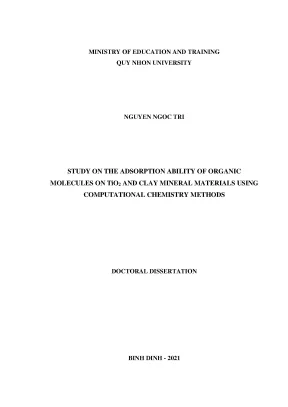
Tải xuống để đọc toàn bộMINISTRY OF EDUCATION AND TRAINING QUY NHON UNIVERSITY NGUYEN NGOC TRI STUDY ON THE ADSORPTION ABILITY OF ORGANIC MOLECULES ON TiO2 AND CLAY MINERAL MATERIALS USING COMPUTATIONAL CHEMISTRY METHODS DOCTORAL DISSERTATION BINH DINH - 2021 MINISTRY OF EDUCATION AND TRAINING QUY NHON UNIVERSITY Nguyen Ngoc Tri STUDY ON THE ADSORPTION ABILITY OF ORGANIC MOLECULES ON TiO2 AND CLAY MINERAL MATERIALS USING COMPUTATIONAL CHEMISTRY METHODS Major : Physical and Theoretical Chemistry Code No. Pham Tran Nguyen Nguyen Reviewer 2 : Assoc. Tran Van Tan Reviewer 3 : Assoc. Pham Vu Nhat Supervisors: 1.
Nguyen Tien Trung 2. Minh Tho Nguyen BINH DINH - 2021 Declaration This thesis was completed at the Department of Chemistry, Faculty of Natural Sciences, Quy Nhon University (QNU) under the supervision of Assoc. Nguyen Tien Trung (QNU, Vietnam) and Prof. Minh Tho Nguyen (KU Leuven, Belgium).
I hereby declare that the results presented in this thesis are new and original. While most of them were published in peer-reviewed journals, the other part has not been published elsewhere. Binh Dinh, 2021 Supervisors Ph. Nguyen Tien Trung Prof.
Minh Tho Nguyen Nguyen Ngoc Tri Acknowledgements First of all, I would like to express my sincerest thanks to the supervisors, Assoc. Nguyen Tien Trung and Prof. Minh Tho Nguyen, for their patient guidance, genius support, and warm encouragement. I would also like to thank them for their valuable comments, suggestions, and corrections.
In fact, without their help, this thesis could not have been achievable. I am grateful to all LCCM members for their help and valuable discussion during my research time. I am very thankful to my friend, Dai Q. Ho, for his help during my graduate study.
I would like to thank Prof. Carvalho, University of Evora, Portugal, for his valuable comments, revisions, and computing facilities. I am thankful to Quy Nhon University and KU Leuven for providing me with such a great opportunity to pursue my doctoral program. My thanks are extended to all staff at the Faculty of Natural Sciences, Quy Nhon University and the Department of Chemistry, KU Leuven for their help and supports during my PhD time.
My acknowledgements also go to my friends and colleagues for their time and friendship. Furthermore, I would also like to thank the VLIR-TEAM project awarded to Quy Nhon University with Grant number ZEIN2016PR431 (2016-2020) and the VINIF scholarship with code number VINIF.73 for the financial supports during my doctoral studies. Lastly and most importantly, I am forever grateful to my family for all their love and support through the numerous difficulties I have been facing. Binh Dinh, 2021 Nguyen Ngoc Tri TABLE OF CONTENTS List of Symbols and Notations List of Figures List of Tables INTRODUCTION.
Object and scope of this study. Novelty, scientific and practical significance. Organic pollutants and antibiotics residues in wastewaters. TiO2 nanomaterial and its applications.
Clay minerals and their applications in the treatment of pollutants. Investigations on materials surfaces using computational chemistry. THEORETICAL BACKGROUND AND COMPUTATIONAL METHODS. Quantum chemical approaches.
Schrödinger equations. The Born - Oppenheimer approximation and Pauli’s exclusion principle. Born – Oppenheimer approximation. Pauli’s exclusion principle.
The variational principle. Slater and Gaussian orbitals. Some popular basis sets. Hartree-Fock approximation.
Density functional theory. The Hohenberg-Kohn theorem. Kohn-Sham equations. Local density approximation.
General gradient approximation. Van der Waals functionals. Pseudopotential and plane-wave methods. Atoms In Molecules and Natural Bond Orbitals approaches.
Atoms In Molecules analysis. Natural Bond Orbitals analysis. Clay mineral systems. Adsorption of organic molecules on kaolinite surfaces.
Adsorption of antibiotics on vermiculite surface. Quantum chemical analyses. RESULTS AND DISCUSSION. ADSORPTION OF ORGANIC MOLECULES ON MATERIALS SURFACES.
Adsorption of organic molecules on rutile-TiO2 (110) surface. The quantum chemical analysis for the interactions on surface. Adsorption of benzene derivatives on rutile-TiO2 (110) and anatase-TiO2 (101) surfaces. Energetic aspects of the adsorption process.
Formation and role of intermolecular interactions. Adsorption of benzene derivatives on kaolinite (001) surface. Energetic aspects of the adsorption process. Formation and role of intermolecular interactions.
Adsorption of benzene derivatives on a K+-supported kaolinite (001) surface. AIM and NBO analyses. ADSORPTION OF ANTIBIOTIC MOLECULES ON TiO2 AND VERMICULITE SURFACES. Adsorption of enrofloxacin molecule on rutile-TiO2 (110) surface.
Energetic aspects of the adsorption process. Characteristics of interactions on the surface. Adsorption of ampicillin, amoxicillin, and tetracycline molecules on rutile-TiO2 (110) surface. Energetic aspects of the adsorption process.
Characteristic properties of intermolecular interactions. Adsorption of ampicillin and amoxicillin molecules on anatase-TiO2 (101) surface. AIM and NBO analyses. Adsorption of chloramphenicol molecule on a vermiculite surface.
Adsorption, interaction, and deformation energies. Characteristics of stable interactions upon adsorption process. Adsorption of β-lactam antibiotics on vermiculite surface. Energetic aspects of the adsorption process.
Existence and role of different interactions upon complexation .116 CONCLUSIONS AND OUTLOOK .119 LIST OF PUBLICATIONS CONTRIBUTES TO THIS THESIS .121 Appendix LIST OF SYMBOLS AND NOTATIONS Symbol Description 2(ρ(r)) : Laplacian of electron density AIM : Atoms in Molecules theory AP : Ampicillin a-TiO2 : Anatase-TiO2 (101) surface AX : Amoxicillin BCP : Bond critical point BP : Benzylpenicillin CP : Chloramphenicol d : Distance of contact DFT : Density Functional Theory DPE : Deprotonation enthalpy Eads : Adsorption energy EB : Hydrogen bond energy Edef-mol : Deformation energy for molecules Edef-surf : Deformation energy for surfaces EDT : Electron density transfer Eint : Interaction energy ER : Enrofloxacin H(r) : Total of electron density energy H-slab : Hydrogen-rich facet of kaolinite (kaolinite (001) surface) K+-slab : K+-supported kaolinite (001) surface MEP : Molecular Electrostatic Potential NBO : Natural Bond Orbitals O-slab : Oxygen-rich facet of kaolinite (kaolinite (00 1 ) surface) PA : Proton affinity PBE : Perdew–Burke-Ernzerhof (density functional) q : Net charge at atom r-TiO2 : Rutile-TiO2 (110) surface TC : Tetracycline VASP : Vienna Ab initio Simulation Package vdW : Van der Waals α : Bond angle Δr : Change of bond length ρ(r) : Electron density (at BCP) LIST OF FIGURES Page Figure 1. The radial part of the 3s atomic orbit of the Na atom 27 Figure 2. Schematic drawing of a 3s-derived Bloch function of one- 27 dimensional crystals of Na atoms Figure 3. The graph shows the first random substitution for two alkali 28 metals Na, Cs according to Hellmann Figure 4.
The slab models of rutile-TiO2 (110) and anatase-TiO2 (101) 33 surfaces Figure 5. The structure of kaolinite surfaces 35 Figure 6. The model slab of vermiculite surface (red, yellow, grey, pink, 36 and white colors displayed for O, Mg, Si, Al, and H atoms, respectively) Figure 1. Stable complexes for the adsorption of organic molecules on 38 rutile-TiO2 (110) surface Figure 1.
The charge density between adsorbent and adsorbates in stable 42 complexes Figure 1. The topological analysis for the first-layered structures 42 Figure 1. Stable complexes of adsorption of benzene derivatives on 45 rutile-TiO2 (110) surface Figure 1. Stable structures of adsorption of benzene derivatives on 47 anatase-TiO2 (101) surface Figure 1.
MEP maps of benzene derivatives (isovalue = 0.02 au, charge 50 region taken in the range of 2. Topological geometry of the first-layered structures of the most 53 stable complexes for rutile systems Figure 1. Topological geometry of the first-layered structures of the most 53 stable complexes for anatase systems Figure 1. EDT maps of investigated structures for rutile system 53 Figure 1.
EDT maps of investigated structures for anatase system 53 Figure 1. Stable structures of adsorption of derivatives on H-slab 57 Figure 1. Topological geometry of the most stable complexes for 62 adsorption of organic molecules on H-slab Figure 1. Schematic of total electron density of complexes at the 64 B3LYP/6-31+G(d,p) level Figure 1.
The stable complexes of molecules adsorption on K+-slab 65 Figure 1. The topological geometries of the stable complexes for K+- 68 slab systems Figure 1. The EDT maps of the stable complexes for K+-slab systems 68 Figure 2. Optimized structures of enrofloxacin, rutile-TiO2 (110) surface, 71 and two stable adsorption configurations Figure 2.
The topology and electron density transfer maps for the first- 75 layered structures of ER1 and ER2 at the B3LYP/6-31+G(d, p) level Figure 2. Stable complexes for adsorption of antibiotic molecules on 77 rutile-TiO2 (110) surface Figure 2. DOS plot of rutile-TiO2 (110) surface and HOMO, LUMO 84 levels of adsorbed antibiotic molecules Figure 2. a) Topological critical points and b) electronic charge density 85 transfer of the most stable complexes Figure 2.
Optimized structures of anatase-TiO2 (101) surface and 87 ampicillin, amoxicillin molecules Figure 2. The optimized structures of ampicillin, amoxicillin adsorbed on 87 anatase-TiO2 (101) surface Figure 2. The topological geometries and EDT maps of the first-layered 90 structures Figure 2. Optimized structures of a) vermiculite surface, and b) 93 chloramphenicol molecule, and c) the MEP map of chloramphenicol (electron density of 0.
Stable adsorption configurations of chloramphenicol on the 94 vermiculite surface Figure 2. Topological features for the first layered structures of 99 complexes Figure 2. Total electron density distributions of the first-layered 101 structures Figure 2. Stable complexes of adsorption of AP, AX and BP on a 104 vermiculite surface Figure 2.
Molecular electrostatic potential (MEP) of free antibiotic 110 molecules Figure 2. Topological features for the most stable adsorption 112 configurations Figure 2. Total electron density maps of most stable complexes 115 LIST OF TABLES Page Table 1. Charge distribution in molecules at the B3LYP/6-31+G(d,p) 38 level Table 1.
Some selected parameters of stable complexes at PBE functional 39 (distance (r) in Å; angle (α) in degree) Table 1. Adsorption, interaction, and deformation energies (all in 40 kcal.mol-1) for the adsorption processes on rutile-TiO2 (110) surface Table 1. The characteristic parameters for topological analysis (all in au) 43 Table 1. Some selected parameters of molecules and TiO2 surfaces 45 Table 1.
Interaction distance (d, Å), bond angle (α, o), and changes in 46 length of bonds (r, Å) following the adsorption process for rutile systems Table 1. Distance of intermolecular interactions (d, Å), bonding angle (α, 46 ), and changes of bond length (Δr, Å) upon adsorption process for anatase o systems Table 1. Adsorption, interaction, and deformation energies of adsorption 48 of benzene derivatives on rutile-TiO2 (110) surface (all in kcal. Energetic aspects of adsorption of benzene derivatives on 49 anatase-TiO2 (101) surface (all in kcal.
NBO charges at atoms in functional groups involved in 51 interactions in complexes Table 1. Proton affinity (PA) at O and N atoms and deprotonation 52 enthalpy (DPE) of O-H and N-H bonds in functional groups and C-H bonds in the benzene ring of derivatives (in kcal. Characteristic parameters for topological geometry (ρ(r), 54 2(ρ(r)), H(r), in au), EDT (in e) for rutile systems Table 1. Characteristic parameters for topological geometry (ρ(r), 55 2(ρ(r)), H(r), in au), EDT (in e) for anatase systems Table 1.
Distances of intermolecular contacts (d), changes in the bond 58 lengths (Δr) involved in interactions in complexes (all in Å) Table 1. Energetic parameters of complexes, molecules and surface 59 upon adsorption processes (in kcal. Characteristics of topological geometries (ρ(r), ρ(r), H(r), in 62 au) and EDT (in e) at the B3LYP/6-31+G(d,p) level Table 1. The adsorption energy of the stable complexes (in kcal.
The characteristics for topology analysis and total of electron 69 density transfer (EDT) for K+-slab systems at the B3LYP/6-31+G(d,p) level Table 2. Some selected parameters for two stable complexes using PBE 72 functional Table 2. Energies for adsorption of Enrofloxacin on rutile-TiO2 (110) 73 surface (in kcal. The topological analysis and EDT of investigated structures at 75 the B3LYP/6-31+G(d, p) level Table 2.
Some selected parameters for stable adsorption configurations 78 Table 2. Energies for adsorption processes using both PBE and optPBE- 80 vdW functionals (kcal. Some characteristic parameters of the stable complexes 88 Table 2. Adsorption energy (Eads, kcal.mol-1) of stable complexes 89 Table 2.
Nội dung được bảo vệ bản quyền — Tải xuống đầy đủ
Trích dẫn luận án này
Nguyen Ngoc Tri (2021). Luận án tiến sĩ nghiên cứu khả năng hấp phụ một số hợp chất [Luận án tiến sĩ, Quy Nhon University]. LuanAn.net. https://luanan.net/tai-lieu-khac/tio2-va-khoang-set
Câu hỏi thường gặp
Luận án "Luận án tiến sĩ nghiên cứu khả năng hấp phụ một số hợp chất" nghiên cứu về vấn đề gì?
Luận án: Luận án tiến sĩ nghiên cứu khả năng hấp phụ một số hợp chất hữu cơ trên các vật liệu tio2 và khoáng sét. Xem tóm tắt và tải về tại LuanAn.net
Luận án "Luận án tiến sĩ nghiên cứu khả năng hấp phụ một số hợp chất" được bảo vệ tại trường nào?
Luận án này được bảo vệ tại Quy Nhon University. Năm bảo vệ: 2021.
Luận án "Luận án tiến sĩ nghiên cứu khả năng hấp phụ một số hợp chất" thuộc chuyên ngành gì?
Luận án "Luận án tiến sĩ nghiên cứu khả năng hấp phụ một số hợp chất" thuộc chuyên ngành Physical and Theoretical Chemistry. Danh mục: Tài liệu khác.
Luận án "Luận án tiến sĩ nghiên cứu khả năng hấp phụ một số hợp chất" có bao nhiêu trang?
Luận án "Luận án tiến sĩ nghiên cứu khả năng hấp phụ một số hợp chất" có 163 trang. Bạn có thể xem trước một phần tài liệu ngay trên trang web trước khi tải về.
Cách tải luận án "Luận án tiến sĩ nghiên cứu khả năng hấp phụ một số hợp chất" về máy như thế nào?
Để tải luận án về máy, bạn nhấn nút "Tải xuống ngay" trên trang này, sau đó hoàn tất thanh toán phí lưu trữ. File sẽ được tải xuống ngay sau khi thanh toán thành công. Hỗ trợ qua Zalo: 0559 297 239.