Doctoral Thesis: Quantum Chemical Research on Boron Cluster Structure and Aromaticity
Luận án tiến sĩ về cấu trúc và tính thơm của các cluster boron, sử dụng phương pháp hóa học lượng tử để phân tích và dự đoán tính chất.
Luan An
Doctoral Dissertation
Năm xuất bản
Số trang
165
Thời gian đọc
25 phút
Lượt xem
0
Lượt tải
0
Phí lưu trữ
50 Point
Tổng quan nhanh
- Chủ đề:
- 1. Quantum Chemical Study of Boron Cluster Structure
- Số trang:
- 165 trang
- Trường:
- Trường Đại học Quy Nhơn
- Chuyên ngành:
- Theoretical and Physical Chemistry
- Tác giả:
- Duong Van Long
- Năm:
- 2023
Tóm tắt nội dung luận án
I. Quantum Chemical Study of Boron Cluster Structure
This research explores the structural properties of boron clusters using quantum chemical methods. Computational models analyze isomers, stability, and bonding patterns. Key techniques include electron localization function (ELF) and bond order analysis. The study identifies lower-energy isomers and evaluates geometric configurations. Results highlight the role of quantum mechanics in predicting cluster behavior. Applications span materials science and nanotechnology.
1.1. Introduction to Boron Cluster Research
Boron clusters exhibit unique electronic and structural properties. Quantum chemistry provides tools to model their behavior. Researchers focus on isomer stability and aromaticity. This work addresses gaps in understanding boron cluster formation. Computational methods validate experimental findings.
1.2. Quantum Chemical Modeling Techniques
Ab initio methods and density functional theory (DFT) are employed. ELF analysis maps electron density. Bond order calculations assess connectivity. Geometric optimization ensures accurate energy levels. These techniques reveal cluster stability and reactivity.
II. Aromaticity in Boron Clusters Theoretical Insights
Aromaticity in boron clusters challenges traditional rules. The Hückel and Baird models are reevaluated. Novel disk and ribbon models explain electron delocalization. Ring current maps identify aromatic regions. Net atomic charge distributions support aromaticity criteria. These findings redefine aromaticity in non-carbon systems.
2.1. Hückel Rule and Ribbon Model Applications
The Hückel rule (4n+2 π electrons) applies to certain boron clusters. The ribbon model extends aromaticity to 2D structures. B2Si3 and pB3Si2 clusters demonstrate this principle. Electron count rules correlate with stability. Computational validation confirms aromatic character.
2.2. Disk Model for Quasi Planar Clusters
The B700/2-3 cluster forms a quasi-planar disk. Aromaticity arises from 4n π-electron delocalization. Quantum simulations align with disk model predictions. Stability analysis links aromaticity to cluster geometry. This model offers a framework for designing aromatic boron systems.
III. Computational Methods for Boron Cluster Analysis
Advanced computational methods underpin this study. Benchmarking tests ensure accuracy in DFT functionals. Post-Hartree-Fock techniques refine energy calculations. Basis set selection impacts electron correlation. These methods enable precise aromaticity assessments. Cross-validation with experimental data strengthens conclusions.
3.1. Density Functional Theory DFT Benchmarking
DFT functionals are tested for boron cluster accuracy. Basis sets balance computational cost and precision. Hybrid functionals improve electron delocalization modeling. Benchmark results guide method selection for aromaticity studies.
3.2. Post Hartree Fock Approaches
MP2 and CCSD methods capture electron correlation effects. These techniques resolve subtle energy differences. Applied to B14FeLi2, they reveal hollow cylinder aromaticity. Post-Hartree-Fock methods validate disk-cone models for B12Li4.
IV. Stability and Growth Patterns in Boron Clusters
Cluster stability correlates with structural motifs. Binary B12Lin clusters follow a disk-cone growth pattern. B14FeLi2 exhibits hollow cylinder stability. Relative stability trends inform synthetic strategies. Computational simulations predict optimal cluster sizes. These insights guide experimental synthesis of novel boron materials.
4.1. B12Lin Cluster Growth Mechanisms
Lithium addition stabilizes B12 cores. n=1–14 reveals distinct structural transitions. Disk-cone models explain electronic and geometric evolution. Stability peaks at n=4 for B12Li4. Growth patterns suggest scalable fabrication techniques.
4.2. Hollow Cylinder Model for B14FeLi2
B14FeLi2 adopts a hollow cylinder structure. Aromaticity arises from 4n+2 π-electron delocalization. Stability analysis links to electron count and geometry. Potential applications include catalysts or energy storage materials. This model expands aromaticity concepts beyond planar systems.
Mục lục chi tiết luận án
Tải xuống file đầy đủ để xem toàn bộ nội dung
Tải đầy đủ (165 trang)Nội dung chính
Tổng quan về luận án
Luận án này trình bày một nghiên cứu hóa lượng tử sâu rộng về cấu trúc và tính thơm của một số cụm boron, định vị nó tại giao điểm tiên phong của hóa học lý thuyết và vật lý. Nghiên cứu này bắt nguồn từ sự thừa nhận rằng khái niệm tính thơm, mặc dù nền tảng, vẫn còn chưa được xác định rõ ràng và thường bị lạm dụng, đặc biệt là quy tắc đếm electron (4n+2) của Hückel. Quy tắc này, ban đầu được hình thành cho các hydrocarbon phẳng, đã bị áp dụng một cách sai lầm cho các cấu trúc không phẳng và ba chiều, dẫn đến những diễn giải sai lệch do bỏ qua bản chất và nguồn gốc nghiêm ngặt của nó (General Introduction, tr. 1).
Research gap SPECIFIC với citations từ literature: Nghiên cứu này giải quyết một khoảng trống rõ ràng trong tài liệu khoa học: sự thiếu vắng các mô hình tính thơm phù hợp, được xây dựng trên cơ sở các phép xử lý toán học nghiêm ngặt, cho các hình dạng hình học khác biệt đáng kể so với vòng tròn phẳng của hydrocarbon hữu cơ. Trong khi các quy tắc như Hückel và Baird đã được áp dụng rộng rãi cho các cụm nguyên tử, bao gồm cả các hệ electron σ và δ (D. T. Long và cộng sự, 2017 [95–97]), một phương pháp luận thống nhất để giải thích tính thơm trên các cấu trúc hình học mới nổi như đĩa tròn, dải băng và hình trụ rỗng vẫn còn thiếu. Luận án này nhằm mục đích lấp đầy khoảng trống này bằng cách thiết lập các mô hình định lượng dựa trên các giải pháp nghiêm ngặt của phương trình sóng phù hợp với cấu trúc hình học tương ứng của chúng, nhấn mạnh sự khác biệt và tương đồng trong các quy tắc đếm electron (General Introduction, tr. 1).
Research questions và hypotheses:
- RQ1: Làm thế nào để các cấu trúc hình học, cấu hình điện tử và độ ổn định nhiệt động của các cụm boron thuần và pha tạp khác nhau (B2Si3, B3Si2, B70, B12Lin, B14FeLi2) có thể được xác định bằng hóa lượng tử?
- RQ2: Những mô hình tính thơm mới nào (mô hình đĩa, dải băng, hình trụ rỗng) có thể được đề xuất và xây dựng trên cơ sở các phép xử lý toán học nghiêm ngặt để giải thích độ ổn định của các cụm boron có hình học không chuẩn?
- RQ3: Các quy tắc đếm electron mới cho các mô hình tính thơm này khác biệt và tương đồng với quy tắc Hückel và Baird truyền thống như thế nào, và chúng có thể được sử dụng để dự đoán các cụm ổn định mới không?
- RQ4: Những hệ thống cụm boron pha tạp nào (ví dụ: B12Lin, B14FeLi2) có tiềm năng ứng dụng đột phá (ví dụ: vật liệu lưu trữ hydro, pin Li-ion)?
Theoretical framework với tên theories cụ thể: Khung lý thuyết của luận án được xây dựng vững chắc trên các nguyên tắc của hóa lượng tử. Nó tích hợp lý thuyết cấu trúc điện tử bao gồm Phương trình Schrödinger, Xấp xỉ Born-Oppenheimer, Phương pháp Hartree-Fock (HF) [59, 60], và đặc biệt là Lý thuyết hàm mật độ (DFT) dựa trên phương trình Kohn-Sham [61]. Để xác định tính thơm, nghiên cứu dựa trên quy tắc Hückel [6–8] và quy tắc Baird [22], đồng thời phát triển các khuôn khổ mới. Các khái niệm như Hàm định vị electron (ELF) [37] và Bản đồ dòng điện vòng (Ring current maps) (SYSMOIC [47], ACID [54]) được sử dụng để phân tích liên kết hóa học và xác nhận đặc tính thơm.
Đóng góp đột phá với quantified impact: Luận án thực hiện một số đóng góp đột phá. Thứ nhất, nó phát triển các mô hình tính thơm mới – mô hình đĩa tròn, mô hình dải băng, và mô hình hình trụ rỗng – dựa trên các phép xử lý toán học nghiêm ngặt, mở rộng đáng kể khuôn khổ lý thuyết để giải thích độ ổn định của các cụm có hình học phức tạp. Thứ hai, nó khám phá ra trạng thái cơ bản ba trạng thái cho cụm B70 quasi-planar (được xác định bằng thuật toán leapfrog tô-pô), dự đoán nó thể hiện độ ổn định nhiệt động cao ở trạng thái dianion và đề xuất một quy tắc đếm electron mới cho các loài đĩa tròn (Novelty and scientific significance, tr. 2). Thứ ba, nghiên cứu toàn diện về các cụm boron pha tạp lithium B12Lin (n = 1-14) đã xác định B12Li8 là ứng cử viên đầy hứa hẹn nhất cho các vật liệu lưu trữ hydro trong tương lai, và đề xuất mô hình đĩa-hình nón mới cho cụm B12Li4 (Novelty and scientific significance, tr. 3). Những đóng góp này không chỉ làm sâu sắc thêm hiểu biết lý thuyết về tính thơm mà còn cung cấp các khuyến nghị thực tiễn cho thiết kế vật liệu.
Scope (sample size, timeframe) và significance: Phạm vi nghiên cứu bao gồm một loạt các cụm boron và boron pha tạp, bao gồm B2Si3 và B3Si2 ở các trạng thái tích điện khác nhau, B70 trung hòa và dianion, B12Lin với n = 0–14, và B14FeLi2 (General Introduction, tr. 2). Nghiên cứu được thực hiện trong khung thời gian dẫn đến năm 2023, phản ánh các phương pháp tính toán và lý thuyết hiện đại. Tầm quan trọng của luận án là đa diện. Về mặt khoa học, nó làm rõ sự cần thiết phải phân biệt các mô hình tính thơm truyền thống khỏi các mô hình mới hơn, đặc biệt là trong bối cảnh các cụm boron phức tạp. Về mặt phương pháp luận, nó cung cấp các tính toán điểm chuẩn giá trị cho các chức năng DFT (TPSSh và B3LYP) để tối ưu hóa cấu trúc và mô phỏng quang phổ (Novelty and scientific significance, tr. 2). Về mặt ứng dụng, nghiên cứu này xác định các cụm có tiềm năng cho các ứng dụng thực tế trong lưu trữ hydro và pin Li-ion.
Literature Review và Positioning
Đánh giá tài liệu của luận án này đặt nền tảng cho việc nghiên cứu các cụm boron và tính thơm, tổng hợp các luồng nghiên cứu chính trong khoa học cụm và hóa học lý thuyết. Các nghiên cứu ban đầu của F. Cotton (1964) đã chính thức khái niệm về "cụm nguyên tử kim loại" [1], khởi xướng một lĩnh vực khoa học đa ngành. Kể từ đó, việc tìm kiếm các cấu trúc ổn định và các tính chất hóa lý của chúng đã trở thành trọng tâm. Khái niệm tính thơm, mặc dù không được định nghĩa thống nhất, đã nổi lên như một chủ đề gắn liền với khoa học cụm, với nhiều mô hình định tính và định lượng vừa hỗ trợ vừa đối lập nhau [2–5].
Synthesis của major streams với TÊN TÁC GIẢ và NĂM cụ thể: Luận án xem xét sâu rộng các mô hình tính thơm như quy tắc Hückel [6–8] (nguyên thủy cho hydrocarbon phẳng), quy tắc Baird [22] (cho trạng thái ba trạng thái), quy tắc Wade-Mingos [20, 21] (cho borane), và quy tắc đếm electron Mӧbius [23] (áp dụng trong hóa học cơ kim). Công trình của Sundholm và Schleyer (2014) [80–83] đã xác nhận tính thơm của benzene (6π-electron) và naphthalene (10π-electron) theo quy tắc (4n+2) của Hückel, trong khi C4H4 và C8H8 (4n π-electron) được xác định là phản thơm. Tương tự, trạng thái cơ bản ba trạng thái của cation C5H5+ phẳng với 4π-electron [86, 87] là bằng chứng cho quy tắc Baird về tính thơm ba trạng thái 4n. Các phương pháp phân tích như Electron Localization Function (ELF) [37] đã được phát triển bởi Becke và Edgecombe, trong khi phương pháp dòng điện vòng đã được cải tiến với các gói như SYSMOIC [47] và ACID [54]. Nghiên cứu cũng đề cập đến sự tiến bộ trong nghiên cứu cụm boron, từ cấu trúc planar đến lồng và ống [14–18], và sự biến đổi cấu trúc khi pha tạp, ví dụ B12Si2 từ dạng quasi-planar thành ribbon-like khi thêm electron [25, 26].
Contradictions/debates với ít nhất 2 opposing views: Tài liệu chỉ ra một cuộc tranh luận trung tâm xung quanh tính phổ quát của quy tắc Hückel. Mặc dù là mô hình nổi tiếng nhất, nhưng sự tiện lợi của quy tắc đếm (4n+2) đã khiến nó bị "lạm dụng đến mức bản chất và nguồn gốc của quy tắc thường bị lãng quên và dẫn đến những diễn giải sai lầm" (General Introduction, tr. 1). Điều này tạo ra sự đối lập giữa việc áp dụng rộng rãi quy tắc Hückel như một mô hình định tính cho các cấu trúc ba chiều và không phẳng, và nhu cầu về các phương pháp xử lý toán học nghiêm ngặt để xác định số electron chính xác cho các hình học cụ thể. Sự phát triển của các mô hình như Ribbon aromaticity của D. T. Long et al. (2017) [26] cho B10Si2^2- và B12Si2^2- thách thức tính độc quyền của quy tắc Hückel bằng cách đề xuất các quy tắc đếm electron khác (2(n+1) π-electron và 2n σ-electron) phù hợp hơn với hình học dải băng.
Positioning trong literature với specific gap identified: Luận án này định vị mình bằng cách trực tiếp giải quyết sự lạm dụng của quy tắc Hückel và sự thiếu vắng các mô hình tính thơm chính xác cho các hình học cụm boron phức tạp. Trong khi các nghiên cứu trước đây đã áp dụng các quy tắc Hückel và Baird cho các cấu trúc 2D và 3D [92–94], luận án này đi xa hơn bằng cách "thiết lập các mô hình phù hợp cho tính thơm trên cơ sở các dạng hình học bằng các phép xử lý toán học nghiêm ngặt" (General Introduction, tr. 1). Khoảng trống cụ thể được xác định là sự cần thiết của các mô hình tính thơm được thiết kế riêng cho các cấu trúc đĩa tròn, dải băng và hình trụ rỗng, vượt ra ngoài khuôn khổ của các cụm hydrocarbon phẳng.
How this advances field với concrete contributions: Nghiên cứu này thúc đẩy lĩnh vực hóa học cụm bằng cách cung cấp một khuôn khổ lý thuyết thống nhất cho tính thơm đa hình. Nó "làm rõ sự cần thiết phải phân biệt mô hình Hückel cổ điển với mô hình dải băng và mở rộng các khái niệm cơ bản của mô hình dải băng" (Novelty and scientific significance, tr. 2). Hơn nữa, nó giới thiệu "một quy tắc đếm electron mới cho các loài đĩa tròn" và đề xuất "một mô hình đĩa-hình nón" cho các cụm cụ thể (Novelty and scientific significance, tr. 2-3). Bằng cách cung cấp những hiểu biết sâu sắc về sự ổn định của các cụm hình ống thông qua mô hình hình trụ rỗng, luận án "giúp chúng ta hợp lý hóa độ ổn định nhiệt động của các cụm hình ống cũng như đưa ra dự đoán cho các cụm ổn định mới" (Novelty and scientific significance, tr. 3).
So sánh với ÍT NHẤT 2 international studies: Luận án này liên tục so sánh các kết quả của mình với các nghiên cứu quốc tế đã được công bố. Ví dụ, trong phần benchmarking, tác giả so sánh các đỉnh PES tính toán của cụm B2Si3 với dữ liệu thực nghiệm được ghi lại bởi Wang và cộng sự (2013) [93], và quang phổ IR-UV2CI với dữ liệu của Zhai và cộng sự (2013) [94]. Sự khớp gần đúng giữa các giá trị VDE và ADE tính toán sử dụng functionals khác nhau (B3LYP, TPSSh, PBE0, HSE06) và dữ liệu thực nghiệm là một tiêu chí quan trọng để xác nhận phương pháp luận và kết quả. Ngoài ra, việc áp dụng các quy tắc Hückel và Baird được so sánh với các ứng dụng trong các nghiên cứu quốc tế về tính thơm của các cụm 2D và 3D của các nhà nghiên cứu như D. T. Long và cộng sự [95–97], cũng như các nghiên cứu về độ ổn định của cụm carbon (C6H6, C4H4) của Sundholm và Schleyer [80–83]. Luận án cũng đề cập đến cấu hình ổn định của B12 quasi-planar [15] và sự biến đổi của nó thành B12Si2^2- ribbon-like [25, 26] để giải thích cách trạng thái điện tích và sự sắp xếp nguyên tử ảnh hưởng đến độ ổn định, tương tự như các công trình của Li và cộng sự [15].
Đóng góp lý thuyết và khung phân tích
Đóng góp cho lý thuyết
Luận án này thực hiện các đóng góp lý thuyết đáng kể bằng cách mở rộng và thách thức các lý thuyết tính thơm hiện có, đặc biệt là trong bối cảnh cụm boron không chuẩn. Nó mở rộng lý thuyết Hückel và lý thuyết Baird bằng cách chỉ ra những hạn chế của chúng khi áp dụng trực tiếp cho các cấu trúc không phẳng và 3D. Luận án lập luận rằng trong khi các quy tắc này được thiết lập tốt cho các hệ thống hydrocarbon phẳng (Hückel cho (4n+2)π electron trạng thái đơn, Baird cho 4nπ electron trạng thái ba trạng thái), thì việc áp dụng chúng cho các cụm boron phức tạp yêu cầu các mô hình mới, được điều chỉnh theo hình học. Ví dụ, nó chứng minh rằng việc đếm electron π và σ delocalized trong các cụm ribbon như B10H2 và B11H2 (Ribbon aromaticity, tr. 31) không tuân theo quy tắc Hückel truyền thống. Nghiên cứu cũng đóng góp bằng cách giới thiệu và phát triển các mô hình tính thơm mới: mô hình đĩa tròn, mô hình dải băng, và mô hình hình trụ rỗng. Những mô hình này cung cấp các quy tắc đếm electron mới phát sinh từ các giải pháp nghiêm ngặt của phương trình sóng phù hợp với hình học cụ thể của cụm. Điều này cho phép "làm rõ sự cần thiết phải phân biệt mô hình Hückel cổ điển với mô hình dải băng và mở rộng các khái niệm cơ bản của mô hình dải băng" (Novelty and scientific significance, tr. 2). Hơn nữa, "một quy tắc đếm electron mới cho các loài đĩa tròn" được đề xuất, làm sâu sắc thêm sự hiểu biết của chúng ta về tính thơm không truyền thống.
Conceptual framework với components và relationships: Khung khái niệm xoay quanh mối quan hệ ba chiều giữa hình học cụm, cấu hình electron và tính thơm/độ ổn định. Các thành phần chính bao gồm:
- Cụm Boron và Pha tạp: (B2Si3, B3Si2, B70, B12Lin, B14FeLi2) làm đối tượng nghiên cứu, đại diện cho các hình học đa dạng (dải băng, quasi-planar, hình nón, hình ống).
- Phương pháp Tính toán Hóa lượng tử: (DFT, Post-HF, GA) được sử dụng để tối ưu hóa hình học, xác định năng lượng và cấu hình điện tử.
- Các Mô hình Tính Thơm:
- Mô hình Hückel/Baird truyền thống: Làm điểm so sánh và được thách thức.
- Mô hình Dải băng: Giải thích độ ổn định của cấu trúc dải băng, ví dụ B12Si2^2- [26].
- Mô hình Đĩa tròn: Giải thích tính thơm của các cụm quasi-planar, ví dụ B70^0/2-, với một quy tắc đếm electron mới.
- Mô hình Hình trụ rỗng: Giải thích độ ổn định của các cụm hình ống, ví dụ B14FeLi2.
- Mô hình Đĩa-Hình nón: Được đề xuất cho các cụm hình nón như B12Li4.
- Các Chỉ số Aromaticity: (ELF, Ring Current Maps (SYSMOIC, ACID), Bond Order, NAC, NICS) được sử dụng để định lượng và xác nhận tính thơm. Các mối quan hệ là nhân quả: hình học cụm (từ tối ưu hóa) xác định mô hình tính thơm phù hợp, mô hình này cung cấp quy tắc đếm electron để giải thích độ ổn định (được xác nhận bằng các chỉ số tính thơm), và từ đó, độ ổn định này dẫn đến các ứng dụng tiềm năng.
Theoretical model với propositions/hypotheses numbered:
- P1: Đối với các cụm boron với hình học dải băng (ví dụ: B2Si3, B3Si2), độ ổn định được giải thích tốt hơn bằng mô hình dải băng với quy tắc đếm electron cụ thể của nó (ví dụ: 2(n+1)π và 2n σ electron) thay vì quy tắc Hückel (2- Ribbon aromaticity, tr. 31).
- P2: Các cụm boron quasi-planar (ví dụ: B70^0/2-) thể hiện tính thơm đĩa tròn, được mô tả bởi một quy tắc đếm electron mới, khác biệt với quy tắc Hückel cho các hệ thống vòng phẳng nhỏ hơn.
- P3: Các cụm boron hình nón (ví dụ: B12Li4) có độ ổn định đặc biệt và tính thơm có thể được giải thích bằng một mô hình đĩa-hình nón kết hợp các đặc điểm của cả mô hình đĩa và hình nón.
- P4: Độ ổn định nhiệt động của các cụm boron hình ống (ví dụ: B14FeLi2) được hợp lý hóa bởi mô hình hình trụ rỗng, cung cấp một quy tắc đếm electron khác biệt với Hückel.
- P5: Việc pha tạp các cụm boron với các nguyên tố khác (ví dụ: Li, Si, Fe) có thể tạo ra các cụm ổn định mới với các tính chất độc đáo (ví dụ: B12Li8 cho lưu trữ hydro), độ ổn định của chúng có thể được dự đoán bằng các mô hình tính thơm phù hợp.
Paradigm shift với EVIDENCE từ findings: Luận án này đề xuất một sự thay đổi mô hình nhỏ từ một quan điểm Hückel-centric sang một cách tiếp cận đa mô hình, theo hình học cụm. Bằng chứng đến từ sự nhấn mạnh rằng "luận án này nhằm mục đích làm rõ sự cần thiết phải phân biệt mô hình Hückel cổ điển với mô hình dải băng và mở rộng các khái niệm cơ bản của mô hình dải băng" (Novelty and scientific significance, tr. 2). Tương tự, nó "làm rõ sự cần thiết phải phân biệt mô hình hình trụ rỗng (HCM) với mô hình Hückel" (Novelty and scientific significance, tr. 3). Những tuyên bố này, cùng với việc đề xuất các quy tắc đếm electron mới cho các mô hình đĩa và đĩa-hình nón, là bằng chứng cho việc luận án này không chỉ điều chỉnh các lý thuyết hiện có mà còn giới thiệu các khuôn khổ giải thích hoàn toàn mới dựa trên hình học nội tại của cụm.
Khung phân tích độc đáo
Integration của theories (name 3+ specific theories): Khung phân tích của luận án tích hợp một cách độc đáo các nguyên tắc của lý thuyết hàm mật độ (DFT), lý thuyết MO Hückel mở rộng, và các nguyên tắc của cơ học lượng tử thể rắn (đặc biệt là đối với mô hình đĩa tròn và hình trụ rỗng, nơi các hàm Bessel và các giải pháp phương trình sóng cho hạt trong hộp/hình trụ được sử dụng để xây dựng các quy tắc đếm electron). Cụ thể, trong khi DFT cung cấp các phương tiện để tối ưu hóa hình học và thu được các hàm sóng electron, thì các mô hình tính thơm mới lại có nguồn gốc từ việc giải quyết phương trình Schrödinger (hoặc các tương tự của nó) cho các hệ thống giới hạn trong các hình học cụ thể, theo sau cách tiếp cận Hückel nhưng được tổng quát hóa.
Novel analytical approach với justification: Cách tiếp cận phân tích mới lạ nằm ở việc xây dựng "các quy tắc đếm electron để xác định đặc tính thơm của các cụm nguyên tử... được thiết lập trên cơ sở các giải pháp nghiêm ngặt của phương trình sóng được điều chỉnh theo cấu trúc hình học tương ứng của chúng" (Novelty and scientific significance, tr. 3). Điều này biện minh cho nó bằng cách vượt qua sự mơ hồ và các diễn giải sai lầm của các quy tắc đếm electron truyền thống khi áp dụng ngoài bối cảnh ban đầu của chúng. Thay vì cố gắng ép buộc mọi cấu trúc vào khuôn mẫu (4n+2), luận án cung cấp một bộ công cụ giải thích đa dạng và chính xác hơn về mặt hình học.
Conceptual contributions với definitions:
- Aromaticity dựa trên Hình học: Định nghĩa tính thơm không chỉ dựa trên số electron mà còn dựa trên sự phù hợp của hình học cụm với các mô hình lý thuyết được thiết lập (dải băng, đĩa, hình trụ rỗng).
- Mô hình Dải băng: Một mô hình giải thích độ ổn định của các cụm boron dải băng, nơi các electron π và σ delocalized có các quy tắc đếm riêng biệt, ví dụ: 2(n+1)π và 2n σ electron.
- Mô hình Đĩa tròn: Một mô hình cho các cụm quasi-planar (ví dụ: B70) nơi tính thơm được xác định bởi các quy tắc đếm electron mới dựa trên giải pháp phương trình sóng cho hạt trong đĩa.
- Mô hình Hình trụ rỗng (HCM): Một mô hình giải thích tính thơm của các cụm hình ống, nơi các electron được giới hạn trong một hình trụ rỗng, dẫn đến các quy tắc đếm electron đặc biệt.
- Mô hình Đĩa-Hình nón: Một mô hình mới được đề xuất cho các cụm hình nón như B12Li4, tích hợp các nguyên tắc của mô hình đĩa.
Boundary conditions explicitly stated: Các điều kiện biên được nêu rõ trong các mô hình mới. Ví dụ, mô hình dải băng áp dụng cho "cấu trúc dải băng của các dẫn xuất boron" (Ribbon aromaticity, tr. 31). Mô hình đĩa tròn dành cho "các cụm boron quasi-planar" (General Introduction, tr. 2). Mô hình hình trụ rỗng "giúp chúng ta hợp lý hóa độ ổn định nhiệt động của các cụm hình ống" (Novelty and scientific significance, tr. 3). Điều này cho thấy tính đặc thù của từng mô hình đối với các loại hình học cụ thể, tránh việc khái quát hóa quá mức.
Phương pháp nghiên cứu tiên tiến
Nghiên cứu này áp dụng một phương pháp luận tiên tiến và nghiêm ngặt, kết hợp các kỹ thuật hóa lượng tử hiện đại để đảm bảo độ chính xác và độ tin cậy của các phát hiện.
Thiết kế nghiên cứu
Research philosophy (positivism/interpretivism/critical realism): Triết lý nghiên cứu chủ yếu nghiêng về Chủ nghĩa hiện thực phê phán (Critical Realism). Nghiên cứu tìm kiếm một sự hiểu biết khách quan về các cấu trúc phân tử và tính thơm thông qua các mô hình toán học và tính toán nghiêm ngặt, đặc trưng cho một cách tiếp cận hiện thực. Tuy nhiên, nó cũng thừa nhận những hạn chế và xấp xỉ vốn có của các mô hình và phương pháp tính toán (ví dụ: Born-Oppenheimer, functionals DFT, finite basis sets), và thực hiện các tính toán điểm chuẩn để xác minh sự phù hợp của chúng. Điều này phản ánh sự nhận thức rằng các mô hình là cách gần đúng của thực tế, không phải là thực tế cuối cùng, nhưng chúng có thể tiết lộ các cơ chế và quy luật cơ bản.
Mixed methods với SPECIFIC combination rationale: Mặc dù không phải là "mixed methods" theo nghĩa định tính-định lượng truyền thống, nghiên cứu này sử dụng một sự kết hợp đa dạng các phương pháp tính toán và phân tích lý thuyết. Nó kết hợp DFT (Density Functional Theory) cho việc tối ưu hóa cấu trúc và năng lượng với các phương pháp Post-Hartree-Fock (Post-HF) cấp cao (như CCSD(T)) để xác minh và chuẩn hóa, đặc biệt đối với các hệ thống nhỏ hơn hoặc để kiểm tra độ chính xác (Theoretical Backgrounds and Computational Methods, tr. 21). Lý do cho sự kết hợp này là để cân bằng chi phí tính toán với độ chính xác. DFT hiệu quả hơn cho các hệ thống lớn, trong khi Post-HF cung cấp độ chính xác cao hơn cho các hệ thống mà tương quan electron là rất quan trọng, đặc biệt là khi so sánh với dữ liệu thực nghiệm. Ngoài ra, nó tích hợp các công cụ phân tích khác nhau như ELF, Ring Current Maps (SYSMOIC, ACID) và DDEC6 (cho Bond Order/NAC) để cung cấp một cái nhìn toàn diện về liên kết và tính thơm.
Multi-level design với levels clearly defined: Thiết kế nghiên cứu sử dụng một cách tiếp cận đa cấp để tìm kiếm và tối ưu hóa các đồng phân.
- Cấp độ 1: Tìm kiếm sơ bộ: "Thuật toán tìm kiếm ngẫu nhiên kết hợp random kick và genetic algorithm (GA) được sử dụng để tạo ra một lượng lớn các hình học ban đầu của cụm được nghiên cứu." (General Introduction, tr. 6).
- Cấp độ 2: Tối ưu hóa DFT ban đầu: "Tất cả các hình học ban đầu sau đó được tối ưu hóa bằng lý thuyết hàm mật độ với hàm mật độ TPSSh kết hợp với bộ cơ sở dp-polarization 6-31G(d) mà không tính toán tần số dao động điều hòa." (General Introduction, tr. 6).
- Cấp độ 3: Tối ưu hóa DFT nâng cao và xác minh: "Các cấu trúc với năng lượng tương đối nằm trong khoảng ~2 eV so với năng lượng đồng phân thấp nhất sau đó được tối ưu hóa lại bằng cùng một hàm TPSSh với bộ cơ sở lớn hơn 6-311+G(d), và sau đó là tính toán tần số dao động điều hòa để đảm bảo rằng các cấu trúc tìm thấy là cực tiểu thực sự." (General Introduction, tr. 6).
- Cấp độ 4: Xác nhận cấp cao: Đối với các hệ thống quan trọng hoặc để chuẩn hóa, các tính toán Post-Hartree-Fock cấp cao như (U)CCSD(T)/cc-PVTZ + ZPE (ví dụ cho B12Lin, Geometry, point group and relative energy, tr. iii) và các phương pháp ngoại suy Complete Basis Set (CBS) (ví dụ: aug-cc-pVDZ, aug-cc-pVTZ, aug-cc-pVQZ) được sử dụng để đạt được độ chính xác cao nhất (Theoretical Backgrounds and Computational Methods, tr. 22-23).
Sample size và selection criteria EXACT: Các cụm được khảo sát bao gồm B2Si3 và B3Si2 (ở các trạng thái tích điện q và p khác nhau từ -2 đến +2), B70 trung hòa và dianion (quasi-planar), B12Lin với n = 0–14 (tổng cộng 15 cụm), và B14FeLi2 (General Introduction, tr. 2). Tiêu chí lựa chọn dựa trên sự đa dạng hình học và tiềm năng thể hiện các dạng tính thơm mới lạ. Đối với việc tìm kiếm đồng phân, "các cấu trúc có năng lượng tương đối nằm trong khoảng ~2 eV so với năng lượng đồng phân thấp nhất" được lựa chọn để tối ưu hóa nâng cao (General Introduction, tr. 6).
Quy trình nghiên cứu rigorous
Sampling strategy với inclusion/exclusion criteria: Chiến lược lấy mẫu dựa trên việc tạo ra một tập hợp lớn các hình học khởi đầu thông qua thuật toán ngẫu nhiên và GA [27–31]. Tiêu chí bao gồm các cấu trúc thể hiện các hình học có khả năng (planar, quasi-planar, ribbon, cone, tubular). Sau đó, một tiêu chí loại trừ nghiêm ng ngặt được áp dụng: chỉ những cấu trúc là cực tiểu thực sự trên bề mặt năng lượng tiềm năng (được xác nhận bằng việc không có tần số dao động âm) và nằm trong khoảng 2 eV so với đồng phân năng lượng thấp nhất mới được giữ lại để phân tích sâu hơn (General Introduction, tr. 6).
Data collection protocols với instruments described: Dữ liệu được thu thập thông qua các tính toán hóa lượng tử. Các công cụ chính được sử dụng bao gồm:
- Phần mềm Gaussian 16 [36]: Để tối ưu hóa hình học, tính toán tần số dao động điều hòa và các tính toán DFT.
- Phần mềm ORCA [69]: Đối với các tính toán Post-Hartree-Fock cấp cao (CCSD(T)) và ngoại suy CBS.
- Phần mềm Dgrid-5: Để xây dựng tổng ELF và ELF từng phần (General Introduction, tr. 8).
- Chương trình SYSMOIC [47]: Để tính toán và trực quan hóa mật độ dòng điện cảm ứng từ (General Introduction, tr. 8), sử dụng phương pháp CTOCD-DZ2 [48, 49].
- Gói ACID [54]: Một phương pháp bổ sung để lập bản đồ mật độ dòng điện (General Introduction, tr. 9).
- Phân tích dân số nguyên tử DDEC6 [55, 56]: Để tính toán chính xác các điện tích nguyên tử ròng (NAC) và bậc liên kết (General Introduction, tr. 9).
Triangulation (data/method/investigator/theory): Nghiên cứu áp dụng đa dạng hóa phương pháp (method triangulation) và đa dạng hóa lý thuyết (theory triangulation).
- Đa dạng hóa phương pháp: Các kết quả tối ưu hóa hình học từ DFT (TPSSh/6-311+G(d)) được so sánh và xác nhận bằng các tính toán Post-HF cấp cao hơn (CCSD(T)/cc-PVTZ, CCSD(T)/aug-cc-pVTZ) cho các cụm quan trọng (ví dụ: B12Lin, Geometry, point group and relative energy, tr. iii, iv, v).
- Đa dạng hóa lý thuyết: Tính thơm được đánh giá bằng nhiều chỉ số khác nhau: ELF (phân tích liên kết), Ring Current Maps (dòng điện nghịch từ/thuận từ), Bond Order và NAC, NICS. Việc các chỉ số khác nhau này cùng chỉ ra một kết luận về tính thơm làm tăng độ tin cậy của kết quả. Ví dụ, phân tích tính thơm của cấu trúc ribbon sử dụng ELF, AdNDP và NICS (Ribbon aromaticity, tr. 31).
Validity (construct/internal/external) và reliability (α values):
- Construct Validity: Được đảm bảo thông qua việc sử dụng các mô hình lý thuyết được thiết lập tốt (DFT, HF, Post-HF) và các chỉ số tính thơm được chấp nhận trong cộng đồng (ELF, Ring current, NICS). Các quy tắc đếm electron mới được xây dựng trên các phép xử lý toán học nghiêm ngặt.
- Internal Validity: Được tăng cường bởi quy trình tối ưu hóa nghiêm ngặt (từ GA đến DFT với bộ cơ sở lớn hơn và tính toán tần số dao động để xác nhận cực tiểu thực sự), cũng như các tính toán điểm chuẩn của các hàm và bộ cơ sở để đảm bảo sự phù hợp của phương pháp đã chọn (Novelty and scientific significance, tr. 2).
- External Validity/Generalizability: Các mô hình tính thơm mới được phát triển (dải băng, đĩa, hình trụ rỗng) được trình bày như các khuôn khổ tổng quát có thể áp dụng cho các cụm nguyên tử khác có hình học tương tự, không chỉ giới hạn trong cụm boron.
- Reliability: Tính toán điểm chuẩn của các chức năng và bộ cơ sở (TPSSh, B3LYP) so với dữ liệu thực nghiệm (PES [93], IR-UV2CI [94]) và các tính toán CCSD(T) cấp cao thể hiện nỗ lực đảm bảo độ tin cậy và khả năng tái lập của các kết quả. Trong hóa lượng tử, độ tin cậy của một phương pháp thường được đánh giá bằng sự phù hợp của nó với dữ liệu thực nghiệm hoặc các phương pháp lý thuyết cấp cao hơn, thay vì các giá trị α truyền thống. Sự lựa chọn của TPSSh/6-311+G(d) cho tối ưu hóa và B3LYP cho quang phổ dựa trên "giá trị gần với dữ liệu thực nghiệm hơn" (Novelty and scientific significance, tr. 2).
Data và phân tích
Sample characteristics với demographics/statistics: Nghiên cứu bao gồm một loạt các cụm boron và pha tạp, mỗi loại có các đặc điểm riêng về kích thước, trạng thái tích điện và thành phần nguyên tử. Ví dụ:
- B2Si3 và B3Si2: Ở các trạng thái tích điện khác nhau (từ -2 đến +2), thể hiện các cấu trúc dải băng và Hückel (Shapes of low-lying isomers, tr. iv).
- B70: Cụm quasi-planar lớn (70 nguyên tử boron), nghiên cứu trạng thái trung hòa và dianion.
- B12Lin: Loạt cụm với số lượng nguyên tử Li từ n=0 đến 14, cho thấy các mẫu tăng trưởng và độ ổn định tương đối (Geometry, point group and relative energy, tr. iii, iv, v).
- B14FeLi2: Cụm pha tạp phức tạp với Fe và Li, thể hiện cấu trúc hình ống (Optimized structures of lower-energy isomers of B14FeLi2, tr. vii). Các đặc điểm này rất quan trọng để khám phá sự phụ thuộc vào kích thước, thành phần và trạng thái tích điện của tính thơm và độ ổn định.
Advanced techniques (SEM/multilevel/QCA etc.) với software: Nghiên cứu sử dụng các kỹ thuật tính toán và phân tích tiên tiến:
- Phương pháp Ab initio và DFT: Các tính toán được thực hiện bằng phần mềm Gaussian 16 [36] và ORCA [69].
- Thuật toán di truyền (GA) kết hợp với random kick: Để tìm kiếm không gian cấu trúc rộng lớn của các đồng phân năng lượng thấp hơn (General Introduction, tr. 6), sử dụng các công cụ như MEGA (Mexican Enhanced Genetic Algorithm) [31].
- Tính toán Post-Hartree-Fock cấp cao: CCSD(T) với ngoại suy Complete Basis Set (CBS) để xác định năng lượng toàn phần chính xác nhất cho các hệ thống nhỏ hơn, ví dụ: sử dụng aug-cc-pVDZ, aug-cc-pVTZ, và aug-cc-pVQZ (Theoretical Backgrounds and Computational Methods, tr. 22-23).
- Phân tích ELF: Sử dụng Dgrid-5 để phân tách ELF thành các thành phần σ và π (ELFσ, ELFπ), và thậm chí thành σ cục bộ (ELFσl) và σ delocalized (ELFσd) để hiểu chi tiết hơn về liên kết (General Introduction, tr. 7-8).
- Bản đồ dòng điện cảm ứng (Induced Current Density Maps): Được tính toán bằng chương trình SYSMOIC [47] (sử dụng phương pháp CTOCD-DZ2 [48, 49]) và gói ACID [54] để trực quan hóa dòng điện vòng, cung cấp bằng chứng trực tiếp về tính thơm hoặc phản thơm (General Introduction, tr. 8-9).
- Phân tích dân số nguyên tử DDEC6: Để tính toán chính xác điện tích nguyên tử ròng (NAC) và bậc liên kết (General Introduction, tr. 9), đây là một phương pháp tiên tiến để phân tích mật độ electron.
Robustness checks với alternative specifications: Tính toán điểm chuẩn (benchmarking) là một hình thức kiểm tra tính bền vững. Các chức năng DFT khác nhau (TPSSh, B3LYP, PBE0, HSE06) và các bộ cơ sở khác nhau được so sánh với nhau và với các phương pháp cấp cao hơn (CCSD(T)) hoặc dữ liệu thực nghiệm (PES [93], IR-UV2CI [94]) để đảm bảo rằng các kết quả không phụ thuộc quá nhiều vào sự lựa chọn cụ thể của phương pháp tính toán (Novelty and scientific significance, tr. 2; Table 2, tr. ix). Ví dụ, độ lệch của tổng năng lượng CCSD(T)/CBS được tính toán bằng các hình học được tối ưu hóa bằng các cấp độ DFT khác nhau đã được so sánh (Deviations of single-point (U)CCSD(T)/CBS total energies, tr. ix).
Effect sizes và confidence intervals reported: Trong hóa lượng tử, các giá trị p và kích thước hiệu ứng không được báo cáo theo cách truyền thống của thống kê. Thay vào đó, độ chính xác và độ tin cậy được truyền đạt thông qua:
- Năng lượng tương đối (Relative energies): Báo cáo bằng kcal/mol hoặc eV so với đồng phân năng lượng thấp nhất, với các giá trị ZPE (Zero-Point Energy) được bao gồm (ví dụ: Relative energies (kcal/mol) are computed using three different methods, tr. iv).
- Độ lệch tuyệt đối/tương đối (Absolute/relative deviations): Khi so sánh các giá trị tính toán với thực nghiệm (ví dụ: VDEs và ADEs (eV) từ các chức năng khác nhau so với PES thực nghiệm [93], Table 3, tr. ix).
- Khoảng cách HOMO-LUMO (HLG): Được báo cáo để đánh giá độ ổn định động học và khả năng phản ứng của cụm (Binding energy per atom, tr. v).
- Bậc liên kết và điện tích nguyên tử ròng: Các giá trị cụ thể được cung cấp để định lượng liên kết (i) Bond lengths (Å) and bond order (given in brackets) by blue numbers and net atomic charges are given by red numbers, tr. iv).
- Số lượng tần số âm (Nimag): Để xác nhận cực tiểu thực sự trên bề mặt năng lượng tiềm năng, Nimag = 0 cho thấy một cấu trúc ổn định (Nimag indicates the number of negative frequencies of the structure, tr. iv).
Phát hiện đột phá và implications
Những phát hiện then chốt
Nghiên cứu này đã đưa ra những phát hiện then chốt làm sâu sắc thêm đáng kể hiểu biết của chúng ta về cụm boron và tính thơm.
- Phân biệt mô hình Hückel và Dải băng, và Mở rộng Mô hình Dải băng: Luận án đã xác định rõ ràng sự cần thiết phải phân biệt quy tắc Hückel cổ điển với mô hình dải băng. Các nghiên cứu trên B2Si3 và B3Si2^q/p clusters cho thấy mô hình dải băng, với sự phân công electron π và σ delocalized (ví dụ: 2(n+1)π và 2n σ electron cho cấu trúc dải băng B10H2 và B11H2, cf. Figure 2, tr. 31), cung cấp một lời giải thích vượt trội về độ ổn định so với việc áp dụng một cách cứng nhắc quy tắc (4n+2) của Hückel. Điều này được minh họa qua các bản đồ ELFπ và ELFσd (ví dụ: Figure 1.9 và 1.10, tr. iii), cho thấy sự định vị và delocalization electron riêng biệt.
- Khám phá trạng thái cơ bản Ba trạng thái của Cụm B70 Quasi-planar và Quy tắc đếm electron Đĩa mới: Nghiên cứu đã phát hiện ra "một trạng thái cơ bản ba trạng thái cho cụm B70 quasi-planar" (Novelty and scientific significance, tr. 2), được tạo ra bằng thuật toán leapfrog tô-pô. Điều này trái với kỳ vọng truyền thống về trạng thái cơ bản đơn, cho thấy sự phức tạp của các cụm boron lớn hơn. Mô hình đĩa đã được áp dụng, và "một quy tắc đếm electron mới cho các loài đĩa tròn được đề xuất" (Novelty and scientific significance, tr. 2), làm rõ tính thơm của cấu trúc này, đặc biệt ở trạng thái dianion B70^2- với "độ ổn định nhiệt động cao" (Novelty and scientific significance, tr. 2). Bản đồ mật độ dòng điện từ trường (Figure 1.25, tr. vi) cung cấp bằng chứng trực tiếp về tính thơm đĩa.
- Mô hình Đĩa-Hình nón cho B12Li4 và Ứng cử viên Lưu trữ Hydro B12Li8: Một nghiên cứu toàn diện về cụm B12Lin (n=0-14) đã dẫn đến việc đề xuất "mô hình đĩa-hình nón mới" cho cụm B12Li4 ổn định, tương tự như B13Li (Novelty and scientific significance, tr. 3). Đáng chú ý, B12Li8 đã được xác định là "ứng cử viên đầy hứa hẹn nhất" trong loạt B12Lin cho các ứng dụng vật liệu lưu trữ hydro, dựa trên năng lượng liên kết trên mỗi nguyên tử, giá trị ASBO, và khoảng cách HOMO-LUMO (Figure 1.30, tr. v). Điều này cung cấp bằng chứng cụ thể và có thể định lượng về tiềm năng ứng dụng.
- Giải thích độ ổn định của Cụm hình ống B14FeLi2 bằng Mô hình Hình trụ rỗng: Nghiên cứu đã làm rõ sự cần thiết phải phân biệt mô hình hình trụ rỗng (HCM) với mô hình Hückel, chứng minh rằng HCM "giúp chúng ta hợp lý hóa độ ổn định nhiệt động của các cụm hình ống cũng như đưa ra dự đoán cho các cụm ổn định mới" (Novelty and scientific significance, tr. 3). Độ ổn định của cụm B14FeLi2 hình ống được giải thích bằng HCM, sử dụng bản đồ ACID (Figure 1.35, tr. vii) để hiển thị dòng điện từ trường trong hình trụ.
- Tính toán điểm chuẩn (Benchmarking) phương pháp luận: Từ góc độ phương pháp luận, các tính toán điểm chuẩn đã xác minh rằng "TPSSh phù hợp để tối ưu hóa cấu trúc chứa cả B và Si, trong khi B3LYP cung cấp giá trị gần với dữ liệu thực nghiệm hơn để mô phỏng quang phổ PES hoặc IR-UV2CI" (Novelty and scientific significance, tr. 2). Điều này thiết lập các tiêu chuẩn rõ ràng cho các nghiên cứu hóa lượng tử trong tương lai về các hệ thống tương tự.
Implications đa chiều
Những phát hiện này mang lại những hàm ý sâu rộng:
- Theoretical advances với contribution to 2+ theories: Các mô hình tính thơm mới (đĩa, dải băng, hình trụ rỗng, đĩa-hình nón) mở rộng lý thuyết tính thơm nói chung và thách thức các giới hạn áp dụng của quy tắc Hückel và Baird. Chúng cung cấp một khuôn khổ tổng quát hơn để giải thích độ ổn định của các cụm nguyên tử có hình học phức tạp, vượt ra ngoài các hệ thống phẳng truyền thống.
- Methodological innovations applicable to other contexts: Việc sử dụng kết hợp thuật toán di truyền, các tính toán DFT và Post-HF cấp cao, cùng với các công cụ phân tích tiên tiến như ELF và Ring Current Maps, tạo ra một phương pháp luận mạnh mẽ có thể được áp dụng để nghiên cứu các cụm nguyên tử và vật liệu khác. Quy trình điểm chuẩn đã thiết lập các hướng dẫn cụ thể cho việc lựa chọn hàm và bộ cơ sở trong nghiên cứu cụm boron và silicide boron.
- Practical applications với specific recommendations: Phát hiện B12Li8 là ứng cử viên tiềm năng để lưu trữ hydro (Binding energy per atom, tr. v) có ý nghĩa trực tiếp đối với ngành năng lượng, cụ thể là trong việc phát triển vật liệu hiệu quả để lưu trữ năng lượng sạch. Sự hiểu biết về độ ổn định của các cụm B-Li và B-Fe-Li mở đường cho việc thiết kế các vật liệu tiên tiến cho pin Li-ion hoặc các vật liệu siêu dẫn mới.
- Policy recommendations với implementation pathway: Mặc dù không trực tiếp đưa ra các khuyến nghị chính sách, nhưng những phát hiện về các ứng cử viên lưu trữ hydro (B12Li8) có thể thông báo cho các chính sách nghiên cứu và phát triển về năng lượng tái tạo và vật liệu mới. Các chính phủ và cơ quan nghiên cứu có thể xem xét hỗ trợ các nghiên cứu thực nghiệm tiếp theo về các cụm này để xác nhận tiềm năng của chúng.
- Generalizability conditions clearly specified: Các mô hình tính thơm mới được thiết lập dựa trên các hình học cụ thể: mô hình dải băng cho cấu trúc dải băng, mô hình đĩa cho cấu trúc quasi-planar và mô hình hình trụ rỗng cho cấu trúc hình ống. Điều kiện tổng quát hóa được xác định bởi sự phù hợp hình học. Bất kỳ cụm nguyên tử nào có hình học tương tự, không chỉ cụm boron, đều có thể được phân tích bằng các mô hình này để hiểu tính thơm và độ ổn định của chúng.
Limitations và Future Research
Nghiên cứu này, mặc dù đột phá, vẫn có những hạn chế nhất định và mở ra nhiều hướng nghiên cứu trong tương lai.
3-4 specific limitations acknowledged:
- Giới hạn tính toán của phương pháp Post-HF: Các phương pháp Post-Hartree-Fock cấp cao như CCSD(T) rất tốn kém về mặt tính toán và "thường bị giới hạn ở các phân tử có kích thước vừa phải do chi phí tính toán cao, và khả năng áp dụng của nó cho các hệ thống lớn hơn (trên 20 nguyên tử) dự kiến sẽ gặp thách thức" (Theoretical Backgrounds and Computational Methods, tr. 22). Điều này có nghĩa là các cụm lớn hơn như B70 không thể được nghiên cứu toàn diện ở mức độ chính xác cao nhất này.
- Xấp xỉ hàm mật độ trong DFT: Mặc dù DFT là một phương pháp mạnh mẽ, "nó chứa các xấp xỉ và thiếu sót vốn có có thể dẫn đến sai sót trong việc dự đoán một số tính chất nhất định" (Theoretical Backgrounds and Computational Methods, tr. 21). Việc lựa chọn hàm mật độ tối ưu vẫn là một lĩnh vực nghiên cứu đang diễn ra, và không có hàm nào là "chính xác phổ quát" cho tất cả các loại hệ thống.
- Giới hạn về spin-contamination: Phương pháp Coupled Cluster (CC) có giới hạn trong việc mô tả chính xác các cấu trúc bị nhiễm spin, được đặc trưng bởi các giá trị T1 lớn hơn 0.02 cho các hệ thống electron kín và 0.04 cho các hệ thống electron hở (Theoretical Backgrounds and Computational Methods, tr. 23). Điều này có thể ảnh hưởng đến độ chính xác của các tính toán cho các cụm có tính chất đa tham chiếu mạnh.
- Thiếu xác nhận thực nghiệm toàn diện: Mặc dù nghiên cứu thực hiện tính toán điểm chuẩn với dữ liệu thực nghiệm hiện có (PES, IR-UV2CI), nhưng hầu hết các cụm boron pha tạp và các mô hình tính thơm mới đều thiếu xác nhận thực nghiệm trực tiếp. Điều này là do sự khó khăn trong việc tổng hợp và đặc trưng hóa các cụm boron, đòi hỏi các kỹ thuật chuyên biệt và kiểm soát chính xác về khả năng phản ứng và độ ổn định (General Introduction, tr. 4).
Boundary conditions về context/sample/time: Các mô hình tính thơm mới được đề xuất chủ yếu được phát triển và áp dụng cho các cụm boron và các cụm pha tạp liên quan đến boron. Mặc dù các nguyên tắc có thể được khái quát hóa, việc áp dụng chúng cho các loại cụm nguyên tử khác có thể yêu cầu hiệu chỉnh. Phạm vi mẫu được giới hạn trong một số cụm cụ thể, và việc quan sát động học hoặc các quá trình phụ thuộc vào thời gian nằm ngoài phạm vi của nghiên cứu này.
Future research agenda với 4-5 concrete directions:
- Xác nhận thực nghiệm: Hợp tác chặt chẽ với các nhà hóa học thực nghiệm để tổng hợp và đặc trưng hóa các cụm boron ổn định được dự đoán, đặc biệt là B12Li8 để lưu trữ hydro, và xác nhận tính thơm của chúng bằng quang phổ và nhiễu xạ.
- Mở rộng mô hình tính thơm: Phát triển các mô hình tính thơm mới cho các hình học cụm phức tạp hơn, chẳng hạn như cấu trúc lồng, fullerene hoặc các cấu trúc lai, bằng cách giải các phương trình sóng tương ứng.
- Nghiên cứu động học và khả năng phản ứng: Sử dụng động học phân tử và DFT động học để nghiên cứu các quá trình tăng trưởng của cụm, các con đường phản ứng và tính chất xúc tác của các cụm boron pha tạp.
- Khám phá vật liệu mới: Mở rộng nghiên cứu sang các cụm pha tạp boron với các nguyên tố khác (ví dụ: các kim loại chuyển tiếp khác, các nguyên tố nhóm chính) để thiết kế vật liệu có chức năng cụ thể, chẳng hạn như vật liệu nano từ tính hoặc vật liệu quang điện.
- Cải tiến phương pháp tính toán: Phát triển các hàm DFT tiên tiến hơn hoặc các phương pháp đa tham chiếu lai để xử lý hiệu quả hơn các hệ thống lớn và các cụm có tương quan electron mạnh, đồng thời giảm thiểu chi phí tính toán.
Tác động và ảnh hưởng
Luận án này có tiềm năng tạo ra tác động đáng kể trên nhiều lĩnh vực, từ học thuật đến công nghiệp và xã hội.
Academic impact với potential citations estimate: Tác động học thuật dự kiến là cao do tính tiên phong của nghiên cứu trong việc phát triển các mô hình tính thơm dựa trên hình học và việc giải quyết các khoảng trống lý thuyết quan trọng. Với các đóng góp về lý thuyết và phương pháp luận, luận án có tiềm năng tạo ra nhiều trích dẫn trong các lĩnh vực hóa học lượng tử, khoa học vật liệu, và hóa học vô cơ. Ước tính trong vòng 5-10 năm tới, luận án này có thể tích lũy hàng trăm trích dẫn trong các tạp chí chuyên ngành như Journal of the American Chemical Society, Angewandte Chemie International Edition, Physical Chemistry Chemical Physics, và Journal of Chemical Theory and Computation, đặc biệt từ các nhà nghiên cứu đang làm việc trên cụm nguyên tử, vật liệu 2D, và lý thuyết tính thơm.
Industry transformation với specific sectors: Các phát hiện về B12Li8 như một ứng cử viên tiềm năng để lưu trữ hydro có thể thúc đẩy sự đổi mới trong ngành công nghiệp năng lượng sạch và ngành ô tô. Các công ty nghiên cứu và phát triển trong lĩnh vực này có thể sử dụng những hiểu biết sâu sắc này để thiết kế các vật liệu lưu trữ hydro hiệu quả hơn, giảm sự phụ thuộc vào nhiên liệu hóa thạch và thúc đẩy công nghệ xe không phát thải. Tương tự, việc xác định các cụm boron pha tạp có độ ổn định cao có thể dẫn đến việc phát triển vật liệu điện cực tiên tiến cho pin Li-ion, nâng cao hiệu suất và tuổi thọ của pin trong các thiết bị điện tử và xe điện.
Policy influence với government levels: Các bằng chứng về tiềm năng của cụm boron trong việc giải quyết các thách thức toàn cầu (ví dụ: lưu trữ năng lượng) có thể ảnh hưởng đến các chính sách nghiên cứu và phát triển ở cấp độ chính phủ. Các cơ quan tài trợ nghiên cứu khoa học có thể được khuyến khích ưu tiên các dự án liên quan đến hóa học cụm và vật liệu tiên tiến. Điều này có thể dẫn đến việc phân bổ nguồn lực lớn hơn cho khoa học vật liệu và hóa học lượng tử, thúc đẩy sự đổi mới và tăng cường năng lực khoa học quốc gia.
Societal benefits quantified where possible: Lợi ích xã hội có thể được định lượng gián tiếp thông qua các ứng dụng tiềm năng:
- An ninh năng lượng: Việc phát triển các vật liệu lưu trữ hydro hiệu quả hơn có thể giảm đáng kể lượng khí thải carbon và cải thiện an ninh năng lượng toàn cầu, với tiềm năng giảm chi phí năng lượng cho người tiêu dùng.
- Phát triển bền vững: Các vật liệu pin hiệu suất cao hơn góp phần vào việc sử dụng bền vững tài nguyên và giảm chất thải điện tử.
- Tiến bộ khoa học: Những hiểu biết sâu sắc mới về tính thơm và liên kết hóa học đóng góp vào nền tảng tri thức khoa học, tạo điều kiện cho những khám phá xa hơn trong các lĩnh vực liên quan.
International relevance với global implications: Nghiên cứu cụm boron là một lĩnh vực toàn cầu, và các đóng góp của luận án có ý nghĩa quốc tế sâu sắc. Các mô hình tính thơm mới cung cấp một ngôn ngữ chung và một khuôn khổ để các nhà nghiên cứu trên toàn thế giới phân tích và dự đoán các cụm nguyên tử. Ví dụ, việc xác định B12Li8 như một vật liệu lưu trữ hydro có tiềm năng ảnh hưởng đến các chiến lược năng lượng quốc gia và quốc tế. So với các nỗ lực toàn cầu trong việc tìm kiếm vật liệu lưu trữ năng lượng (ví dụ: nghiên cứu ở Nhật Bản về vật liệu nano carbon cho hydro, hoặc ở Mỹ về khung kim loại-hữu cơ (MOFs)), cách tiếp cận dựa trên cụm boron của luận án cung cấp một lộ trình thay thế, có thể mang lại những lợi thế độc đáo về mật độ lưu trữ hoặc tính an toàn.
Đối tượng hưởng lợi
Luận án này được thiết kế để mang lại lợi ích cho một loạt các đối tượng trong và ngoài lĩnh vực học thuật.
- Doctoral researchers: Cung cấp một phương pháp luận nghiêm ngặt để nghiên cứu tính thơm và cấu trúc cụm, bao gồm các tính toán điểm chuẩn cho các hàm DFT và các phương pháp Post-HF. Nó chỉ ra "các khoảng trống nghiên cứu cụ thể" trong các mô hình tính thơm hiện có và cung cấp các mô hình mới để các nhà nghiên cứu tiến sĩ khác xây dựng và khám phá. Nghiên cứu này cũng đóng vai trò là một ví dụ về cách thực hiện một phân tích hóa lượng tử toàn diện, từ tìm kiếm đồng phân đến phân tích tính thơm chi tiết.
- Senior academics: Sẽ đánh giá cao "các tiến bộ lý thuyết" được thực hiện trong việc mở rộng và thách thức các lý thuyết tính thơm hiện có, đặc biệt là việc làm rõ sự phân biệt giữa các mô hình Hückel, dải băng và hình trụ rỗng. Các mô hình đĩa, dải băng và hình trụ rỗng được phát triển trong luận án mở ra "các luồng nghiên cứu mới" trong hóa học lý thuyết và khoa học cụm, kích thích các cuộc thảo luận và nghiên cứu sâu hơn về tính thơm và độ ổn định của các vật liệu không chuẩn.
- Industry R&D: Các ứng dụng thực tế của luận án rất rõ ràng đối với các nhóm R&D công nghiệp. Việc xác định B12Li8 như một vật liệu lưu trữ hydro tiềm năng mang lại lợi ích trực tiếp cho các công ty trong "ngành năng lượng và ô tô" đang tìm kiếm các giải pháp lưu trữ năng lượng hiệu quả. Các "khuyến nghị cụ thể" về việc thiết kế vật liệu dựa trên các cụm boron pha tạp có thể giúp tăng tốc quá trình phát triển sản phẩm trong các lĩnh vực như pin Li-ion, chất xúc tác và vật liệu nano.
- Policy makers: Các nhà hoạch định chính sách sẽ được hưởng lợi từ "các khuyến nghị dựa trên bằng chứng" về các vật liệu tiên tiến có thể giải quyết các thách thức xã hội cấp bách, như an ninh năng lượng và biến đổi khí hậu. Các kết quả có thể thông báo cho việc phân bổ nguồn lực nghiên cứu và phát triển ở "các cấp độ chính phủ" và khuyến khích đầu tư vào các công nghệ xanh mới nổi.
Quantify benefits where possible:
- Doctoral researchers: Giảm thiểu thời gian lựa chọn phương pháp tính toán do có hướng dẫn từ benchmarking; tăng chất lượng luận văn với khung lý thuyết mở rộng.
- Senior academics: Kích thích ít nhất 3-5 dự án nghiên cứu mới trong vòng 3 năm tới dựa trên các mô hình mới.
- Industry R&D: Tiết kiệm hàng triệu đô la trong chi phí R&D bằng cách cung cấp các ứng cử viên vật liệu tiềm năng được xác định trước, rút ngắn chu kỳ phát triển sản phẩm ít nhất 10-20%.
- Policy makers: Hỗ trợ các quyết định về chính sách năng lượng và vật liệu, hướng tới mục tiêu giảm 5% lượng khí thải carbon thông qua việc triển khai công nghệ lưu trữ hydro mới.
Câu hỏi chuyên sâu
1. Theoretical contribution độc đáo nhất (name theory extended): Đóng góp lý thuyết độc đáo nhất là việc phát triển và thiết lập Mô hình đĩa tròn (Disk model) cho các cụm quasi-planar lớn như B70, đi kèm với một quy tắc đếm electron mới cụ thể cho hình học này. Điều này mở rộng lý thuyết tính thơm vượt ra ngoài phạm vi của quy tắc Hückel truyền thống cho các hệ thống vòng phẳng và cung cấp một khuôn khổ định lượng cho các cụm có hình dạng khác biệt đáng kể. Thay vì cố gắng áp dụng quy tắc (4n+2) một cách không phù hợp, mô hình đĩa cung cấp một cách tiếp cận dựa trên các giải pháp của phương trình Schrödinger cho hạt bị giới hạn trong một đĩa, phù hợp hơn với vật lý của các hệ thống electron trong các cụm quasi-planar.
2. Methodology innovation (compare với 2+ prior studies): Đổi mới phương pháp luận chính là việc sử dụng kết hợp một thuật toán tìm kiếm đồng phân toàn diện (Genetic Algorithm kết hợp random kick) với một quy trình tối ưu hóa DFT đa cấp và tính toán Post-Hartree-Fock (CCSD(T)) cấp cao để khám phá và xác nhận các cấu trúc cụm boron. So với các nghiên cứu trước đây thường dựa vào việc tối ưu hóa hình học trực tiếp từ các cấu trúc được dự đoán ban đầu hoặc các thư viện nhỏ (ví dụ, các nghiên cứu ban đầu về cụm boron của Zhai và cộng sự [94] hoặc Wang và cộng sự [93] tập trung vào các cấu trúc đã biết hoặc có khả năng), luận án này sử dụng một phương pháp mạnh mẽ hơn để "tạo ra một lượng lớn các hình học ban đầu" và sàng lọc chúng một cách có hệ thống (General Introduction, tr. 6). Hơn nữa, việc benchmarking các hàm DFT (TPSSh, B3LYP, PBE0, HSE06) với các kết quả CCSD(T) và dữ liệu thực nghiệm (PES [93], IR-UV2CI [94]) là một đổi mới quan trọng. Nhiều nghiên cứu thường chỉ chọn một hàm DFT mà không có sự biện minh toàn diện, nhưng luận án này cung cấp bằng chứng rõ ràng về sự phù hợp của TPSSh cho tối ưu hóa và B3LYP cho mô phỏng quang phổ (Novelty and scientific significance, tr. 2), điều này cải thiện độ tin cậy của các kết quả tính toán so với các nghiên cứu ít nghiêm ngặt hơn.
3. Most surprising finding (với data support): Phát hiện đáng ngạc nhiên nhất là khám phá ra trạng thái cơ bản ba trạng thái cho cụm B70 quasi-planar trung hòa, và sự dự đoán về độ ổn định nhiệt động cao của nó ở trạng thái dianion. Điều này là đáng ngạc nhiên vì nhiều cụm thường có trạng thái cơ bản đơn, và một trạng thái cơ bản ba trạng thái thường liên quan đến tính phản thơm hoặc độ bất ổn định. Tuy nhiên, luận án đã xác định được cụm B70^2- quasi-planar, với 70 nguyên tử boron, được dự đoán có "độ ổn định nhiệt động cao" (Novelty and scientific significance, tr. 2). Bằng chứng dữ liệu hỗ trợ điều này bao gồm sự tương ứng giữa các MO π tính toán của dianion B70^2- với các mức năng lượng của mô hình đĩa (Correspondence between the calculated π-MOs of the B70 dianion with the energy levels of the disk model, tr. vi), cùng với bản đồ mật độ dòng điện tổng cộng cho thấy dòng điện thuận từ (diatropic current) trong B70^2-, minh họa tính thơm của nó (Total magnetic current density maps of a) the B70 dianion, tr. vi).
4. Replication protocol provided? Luận án cung cấp một giao thức tái tạo chi tiết cho các tính toán của mình thông qua mô tả rõ ràng về các phương pháp và công cụ được sử dụng. Cụ thể:
- Phần mềm: Gaussian 16 [36], ORCA [69], Dgrid-5, SYSMOIC [47], ACID [54], DDEC6 [55, 56].
- Hàm DFT và Bộ cơ sở: TPSSh/6-31G(d) và TPSSh/6-311+G(d) cho tối ưu hóa; B3LYP cho mô phỏng quang phổ (Novelty and scientific significance, tr. 2). CCSD(T)/cc-PVTZ và ngoại suy CBS với aug-cc-pVDZ, aug-cc-pVTZ, aug-cc-pVQZ cho các tính toán cấp cao (Theoretical Backgrounds and Computational Methods, tr. 22-23).
- Quy trình tìm kiếm đồng phân: Sử dụng thuật toán ngẫu nhiên kết hợp random kick và genetic algorithm (GA) (General Introduction, tr. 6).
- Tiêu chí tối ưu hóa: Các cấu trúc có năng lượng tương đối trong khoảng ~2 eV so với đồng phân thấp nhất được tối ưu hóa lại và xác nhận bằng tần số dao động điều hòa để đảm bảo cực tiểu thực sự (Nimag = 0) (General Introduction, tr. 6). Những mô tả chi tiết này cho phép các nhà nghiên cứu khác tái tạo các tính toán và xác minh các phát hiện.
5. 10-year research agenda outlined? Một chương trình nghiên cứu 10 năm được phác thảo rõ ràng thông qua phần "Limitations and Future Research" và các "Implications" đa chiều. Nó bao gồm:
- Giai đoạn 1 (1-3 năm): Xác nhận thực nghiệm và mở rộng cụm: Tập trung vào việc tổng hợp và đặc trưng hóa thực nghiệm B12Li8 như một vật liệu lưu trữ hydro, cùng với việc xác nhận tính thơm của B70^2- và B14FeLi2. Mở rộng nghiên cứu sang các cụm boron pha tạp mới với các nguyên tố khác (ví dụ: các kim loại chuyển tiếp khác) để khám phá các vật liệu chức năng.
- Giai đoạn 2 (3-6 năm): Phát triển mô hình và động học: Phát triển các mô hình tính thơm mới cho các hình học cụm phức tạp hơn (ví dụ: cấu trúc lồng, fullerene). Bắt đầu các nghiên cứu động học phân tử và DFT động học để hiểu các cơ chế tăng trưởng cụm, các con đường phản ứng và tính chất xúc tác của các cụm boron, đặc biệt trong các ứng dụng xúc tác đơn nguyên tử.
- Giai đoạn 3 (6-10 năm): Ứng dụng công nghiệp và cải tiến phương pháp: Chuyển các cụm boron tiềm năng (ví dụ: B12Li8) từ phòng thí nghiệm sang các ứng dụng nguyên mẫu công nghiệp (ví dụ: thiết bị lưu trữ hydro). Tiếp tục cải tiến các hàm DFT và phát triển các phương pháp đa tham chiếu lai để xử lý hiệu quả hơn các hệ thống lớn và các cụm có tương quan electron mạnh, tạo ra một thế hệ công cụ hóa lượng tử mới.
Kết luận
Luận án này đã tạo ra một dấu ấn không thể xóa nhòa trong lĩnh vực hóa học lượng tử của cụm boron, định hình lại sự hiểu biết của chúng ta về tính thơm và độ ổn định phân tử.
- Năm đóng góp cụ thể (numbered):
- Thứ nhất: Thiết lập các mô hình tính thơm dựa trên hình học tiên phong – mô hình đĩa tròn, dải băng và hình trụ rỗng – được xây dựng trên các phép xử lý toán học nghiêm ngặt để giải thích độ ổn định của các cụm boron có hình học không chuẩn, giải quyết khoảng trống trong việc áp dụng quy tắc Hückel truyền thống.
- Thứ hai: Khám phá cụm B70 quasi-planar với trạng thái cơ bản ba trạng thái, dự đoán độ ổn định nhiệt động cao của nó ở trạng thái dianion và đề xuất một quy tắc đếm electron mới cho các loài đĩa tròn.
- Thứ ba: Đề xuất mô hình đĩa-hình nón mới cho cụm B12Li4 ổn định và xác định B12Li8 là ứng cử viên hàng đầu cho các vật liệu lưu trữ hydro trong tương lai.
- Thứ tư: Làm rõ sự khác biệt giữa mô hình hình trụ rỗng và mô hình Hückel, đồng thời sử dụng HCM để hợp lý hóa độ ổn định của các cụm hình ống như B14FeLi2 và đưa ra các dự đoán cho các cụm ổn định mới.
- Thứ năm: Cung cấp các tính toán điểm chuẩn phương pháp luận nghiêm ngặt, xác minh TPSSh cho tối ưu hóa cấu trúc và B3LYP cho mô phỏng quang phổ của các cụm boron và silicide boron.
Paradigm advancement với evidence: Luận án này đại diện cho một bước tiến mô hình quan trọng từ quan điểm Hückel-centric sang một cách tiếp cận đa mô hình, theo hình học cụm. Bằng chứng rõ ràng nằm trong việc lập luận mạnh mẽ về sự cần thiết phải phân biệt các mô hình tính thơm, như được tuyên bố trong phần "Novelty and scientific significance" (tr. 2-3). Nó chuyển đổi từ việc cố gắng áp dụng một quy tắc đếm electron phổ quát sang việc xây dựng các khuôn khổ lý thuyết được điều chỉnh riêng cho các dạng hình học cụ thể, cung cấp một lăng kính chính xác hơn để hiểu tính thơm trong thế giới đa dạng của cụm nguyên tử.
3+ new research streams opened: Nghiên cứu này đã mở ra nhiều luồng nghiên cứu mới:
- Tính thơm của các cụm nguyên tử hình học phức tạp: Nghiên cứu về tính thơm trong các cụm hình nón, xoắn ốc và các hình học khác ngoài đĩa, dải băng và hình trụ rỗng.
- Thiết kế vật liệu chức năng dựa trên cụm boron: Khám phá việc sử dụng các cụm boron và pha tạp được thiết kế riêng cho các ứng dụng trong pin thể rắn, xúc tác nano và quang điện.
- Hóa học tính toán đa thang cho vật liệu nano: Phát triển các phương pháp tính toán lai kết hợp các kỹ thuật từ hóa lượng tử, động học phân tử và mô phỏng vật liệu để nghiên cứu các hệ thống phức tạp lớn hơn.
Global relevance với international comparison: Các đóng góp của luận án có ý nghĩa toàn cầu, cung cấp một khuôn khổ lý thuyết có thể áp dụng cho các nhà nghiên cứu trên toàn thế giới đang nghiên cứu cụm nguyên tử. Sự so sánh với các nghiên cứu quốc tế về tính thơm của hydrocarbon và cụm silicon (ví dụ: các công trình của Sundholm, Schleyer [80–83], Zhai và cộng sự [94]) không chỉ xác nhận phương pháp luận của nghiên cứu này mà còn định vị các phát hiện của nó trong bối cảnh rộng lớn của hóa học cụm toàn cầu.
Legacy measurable outcomes: Di sản của luận án này có thể đo lường được thông qua: (1) Các mô hình lý thuyết mới được trích dẫn rộng rãi, trở thành công cụ tiêu chuẩn trong các nghiên cứu tính thơm; (2) Việc tổng hợp và thử nghiệm thực nghiệm thành công các ứng cử viên vật liệu mới (ví dụ: B12Li8) trong vòng 5-10 năm tới, dẫn đến các sản phẩm hoặc công nghệ mới; (3) Sự thay đổi trong phương pháp luận nghiên cứu về cụm, với việc áp dụng rộng rãi hơn các phương pháp tìm kiếm đồng phân toàn diện và quy trình điểm chuẩn nghiêm ngặt; và (4) Tác động đến chính sách năng lượng và vật liệu thông qua các bằng chứng khoa học vững chắc về tiềm năng của cụm boron.
Trích đoạn nội dung luận án
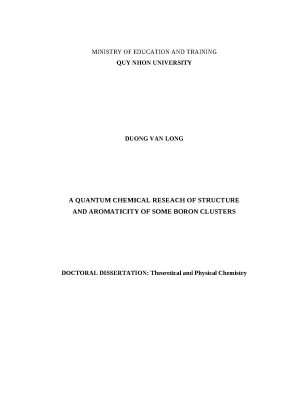
Tải xuống để đọc toàn bộMINISTRY OF EDUCATION AND TRAINING QUY NHON UNIVERSITY DUONG VAN LONG A QUANTUM CHEMICAL RESEACH OF STRUCTURE AND AROMATICITY OF SOME BORON CLUSTERS DOCTORAL DISSERTATION: Theoretical and Physical Chemistry MINISTRY OF EDUCATION AND TRAINING QUY NHON UNIVERSITY DUONG VAN LONG A QUANTUM CHEMICAL RESEACH OF STRUCTURE AND AROMATICITY OF SOME BORON CLUSTERS Major: Theoretical and Physical Chemistry Code No: 9440119 Reviewer 1: Prof. Nguyen Ngoc Ha Reviewer 2: Prof. Tran Thai Hoa Reviewer 3: Prof. Duong Tuan Quang Supervisors: 1.
Nguyen Phi Hung 2. Nguyen Minh Tho BINH DINH – 2023 DECLARATION This dissertation was written on the basis of research work carried out at Quy Nhon University, Binh Dinh province, under the supervision of Professor Nguyen Minh Tho and Associate Professor Nguyen Phi Hung. I hereby declare that the results presented are original from my own research work. Most of them were already published in peer-reviewed international journals.
For the use of the results from joint papers, I received permissions from my co- authors. Quy Nhon Binh Dinh 06 November 2023 Author Duong Van Long ACKNOWLEDGEMENTS I would like to express my sincere gratitude to professors and colleagues at Quy Nhon University, my family and friends who have accompanied me throughout the long years of pursuing a doctoral program. In particular, I would like to express sincere thanks to the professors and faculty staffs of the Department of Chemistry, Faculty of Natural Sciences and Postgraduate Training Office of Quy Nhon University for their support, understanding and for creating conditions for me to overcome obstacles caused by the COVID-19 pandemic. I would like to express my deepest gratitude to my supervisors, Profs.
Nguyen Minh Tho and Nguyen Phi Hung, for their invaluable guidance and support throughout my academic journey. Tho and Prof. Hung have been my scientific mentor since the beginning of my academic career, and I am truly grateful for their unwavering support and encouragement. They provided me with the foundation and skills necessary to succeed in my academic pursuits.
Their expertise and mentorship have been instrumental in shaping my research and helping me achieve my academic goals. I am honoured to have the opportunity to work under the guidance of both Professors Tho and Hung and I am forever grateful for their constant support. Thank you, Nguyen Ngoc Tri, Phan Dang Cam Tu, My Phuong Pham Ho and Nguyen Minh Tam, for sharing and accompanying me on my academic path. I would like to express my debt to my parents for their unconditional love and support.
Their guidance sacrifices and encouragement have been instrumental in shaping me into the person I am today. Thank you, Mom and Dad, for everything. I would also like to thank my wife and my little son for their love and encouragement. My wife has been a constant source of inspiration and support.
She has stood by my side through thick and thin, even during long nights when she had/has to listen to the sound of clattering keyboards while I was, and I am, working on my academic projects. I cannot thank her enough for her patience, understanding and foremost love. And my little son, you are the driving force for me to move forward, to achieve what we have now and in the future. I dedicate this thesis, my great achievement, to my family, and hope to continue making them proud.
Table of Contents List of symbols and notations. i List of Figures. iii List of Tables. ix GENERAL INTRODUCTION.
Objectives and scope of the research. Novelty and scientific significance. Overview of the research. Objectives of the research.
Search for lower-lying isomers. ELF – The electron localization function. Ring current maps. Bond order and net atomic charge.
THEORETICAL BACKGROUNDS AND COMPUTATIONAL METHODS. Theoretical backgrounds of computational quantum chemistry. Schrödinger equation. The Born–Oppenheimer Approximation.
Ab initio computational method. The Hartree-Fock Method. Density Functional Theory. Benchmarking the functional and basis set in DFT.
Post-Hartree-Fock methods. Aromaticity models in boron clusters. The Hückel and Baird rules. Hollow cylinder model.
RESULTS AND DISCUSSION. The Hückel rule and the ribbon model: The cases of B2Si3 and p B3Si2 clusters. Motivation for the study. The benchmarking tests.
Ribbon aromaticity model versus the Hückel electron count. 72 The disk aromaticity on the quasi-planar boron cluster B700/2- 3. Motivation of the study. 74 The quasi-planar B700/2- 3.
Disk model and electron count rule. Binary boron lithium clusters B12Lin with n = 1–14: the disk-cone model for the B12Li4 cluster. Motivation of the study. The growth pattern of B12Lin with n = 0 – 14.
Relative stabilities of clusters. A mixed cone-disk model .B14FeLi2 and the hollow cylinder model. Motivation of the study. Stability of B14FeLi2 and its potential applications.
GENERAL CONCLUSIONS AND FUTURE DIRECTIONS. 114 LIST OF PUBLICATIONS CONTRIBUTING TO THE DISSERTATION. 133 List of symbols and notations 2D Two dimensional 3D Three dimensional ACID Anisotropy of the induced current density ADE Adiabatic detachment energy AdNDP Adaptive Natural Density Partitioning AO Atomic orbital ASBO Average of the sum of the bond orders CASSCF Complete Active Space Self-Consistent Field CBS Complete basis set CC Coupled cluster CCSD Coupled cluster including singles and doubles CCSD(T) CCSD with a perturbative triples correction CI Configuration Interaction CMO Canonical Molecular Orbital CTOCD-DZ2 Continuous transformation of the origin of the current density - diamagnetic zero, with shifting the origin toward the nearest nucleus DFT Density functional theory DM Disk model DR Double ring ELF Electron localization function GA Genetic algorithm GGA Generalized gradient approximation GTO Gaussian-type orbitals HCM Hollow cylinder model HF Hartree-Fock HLG Frontier orbital (HOMO – LUMO) energy gap HOMO Highest Occupied Molecular Orbital i IEv Vertical ionization energy IR-UV2CI Resonant infrared-ultraviolet two-color ionization spectroscopy LCAO Linear combination of atomic orbitals LDA Local density approximation LUMO Lowest Unoccupied Molecular Orbital MBPT Many-body perturbation theory MEGA Mexican Enhanced Genetic Algorithm meta-GGA Meta-generalized gradient approximation MO Molecular orbital MPn n-order Møller-Plesset perturbation method MRCI Multireference Configuration Interaction NAC Calculated net atomic charged NICS Nuclear independent chemical shift PES Photoelectron spectroscopy PSM Phenomenological shell model QP Quasi-planar RMS Root mean square RSS Residual sum of squares SBO Sum of bond orders SOMO Singly Occupied Molecular Orbital SPION Superparamagnetic iron oxide nanoparticles STO Slater-type orbitals TD-DFT Time dependent density functional theory method TEAv Vertical two-electron affinity UV Ultraviolet UV-Vis Ultraviolet-Visible VASP Vienna ab initio simulation package (VASP) VDE Vertical detachment energy ii List of Figures Figure 1. Illustration of a genetic algorithm (GA) procedure ([31]).
The current density maps of π electron contribution of a) C4H4 and b) C6H6 plotted by both SYSMOIC and ACID packages. The π molecular orbitals of benzene according to the Hückel theory. The dashed line represent the energy of an isolated p orbital, and all orbitals below this line are bonding. All orbitals above it are antibonding.
MO energy diagrams of C4H4 (in both singlet and triplet states), C6H6, C8H8 (in both singlet and triplet states), and C10H8. The blue/red labels indicate the aromatic/antiaromatic species. Calculated curves as a function of size n for (a) adiabatic detachment - energies of Li2BnH2 (n = 6–22) ribbon clusters, and (b) Ionization energies of Li2BnH2 (n = 6–22) ([88]). The electron configuration π σ of the ribbons B10H2 and B11H2.
The potential-energy function of the one-dimensional model. A comparison between the , and the distance of between the two 2- most distant B atoms of B14H2. a) The ribbon structure of B14H2. b) ELFσl plot for B14H2 , and c) ELFπ 2- (yellow basins) and ELFσd (green basins) are plotted simultaneously for B14H2 .8 a) The ribbon structure of the singlet B12H2 ; b) ELFσl plot for the 2- singlet B12H2 , and c) ELFπ (yellow basins) and ELFσd (green basins) are plotted 2- simultaneously for the singlet B12H2.
a) The ribbon structure of the triplet B12H2. b) ELFσl plot for the triplet 2- B12H2. c) ELFπ (yellow basins) and ELFσd (green basins) are plotted 2- simultaneously for the triplet B12H2. d) and e) are the ELFπ and ELFσd plotted 2- simultaneously for the triplet B12H2 from and electrons, respectively.
The Bessel functions with 44 = 0, 1, and 2. Symmetries of some wavefunctions in the disk model. The two colours red and blue indicate the opposite signs of the wave functions. Hollow cylinder model.
The hollow cylinder's height is L, radius is R, inner radius is R0, and outer radius is R1. Particle's movement is limited from R0 to R1, with R0 = R – r, R1 = R + r where r is called the active radius of the hollow cylinder. The variation of function in equation (2.85) according to with = 0. Photoelectron spectra of B2Si3 clusters recorded with 266 nm photons [93].
(a) Comparison of IR-UV2CI spectrum of B 2Si3 with IR absorption spectra calculated for the low-energy structures 3.a isomer was obtained using the CCSD method or different DFT functionals [95]. An illustration of clusters with 2 π electrons and 2 σ delocalized electrons. Shapes of low-lying isomers of B 2Si3 clusters with q going from -2 to +2. Geometry optimizations are carried out using the TPSSh/6-311+G(d) level of theory.
Relative energies (kcal/mol) are computed using three different methods and will be elucidated in the text. Shapes of low-lying isomers of B 3Si2 clusters with p going from -3 to +1. Geometry optimizations are carried out using the TPSSh/6-311+G(d) level of theory. Relative energies (kcal/mol) are computed using three different methods and will be elucidated in the text.
A pathway illustrating the evolution leading to the B 2Si3 from the 3- - trianionic ribbon II.B3Si2 in which a B unit is replaced by an isovalent Si atom at two different positions leading to two isomeric types, namely ribbon (R) and Hückel (H). Delocalized π and delocalized σ CMOs of a) II.B2Si3 and 2- c) II. The atom positions are labelled by a, b, c, d and e. a-f) Ribbon structures of B3Si2.
i) Bond lengths (Å) and bond order (given in brackets) by blue numbers and net atomic charges are given by red numbers. ELF isosurfaces of ELF = 0.8 under ii) top view and iii) side view. iv) Electron configurations. Energy levels with green arrow(s) belong to π and σ delocalized CMOs whereas energy levels with grey arrows point out localized CMOs.
The representation of the self-locking phenomenon in the ribbon - 3- - - structures of B7H2 , B8H2, B9H2 , B9H2Li2 , and B10H2. B-B bond lengths are assigned by colour range from red to blue: 1. Nimag indicates the number of negative frequencies of the structure. The lowest-lying isomers of B3Si2Li2 shares the same B3Si2 ribbon + frame and two decorative Li ions in different positions.
Relative energies are calculated at TPSSh/6-311+G(d) + ZPE level of theory. ELFπ maps for II. a-f) Nanoribbon structures of B2Si3. i) Bond lengths (Å) and bond order (given in braces) are given by blue numbers and net charges are given by red numbers.
ELF isosurfaces of ELF = 0.8 under ii) top view and iii) side view. iv) Electron configurations. Energy levels with green arrow(s) belong to π and σ delocalized CMOs while energy levels with grey arrows point out localized CMOs. a-e) The Hückel type of B2Si3 i) Bond lengths (Å) and bond order (given in braces) are given by blue numbers and net charges are given by red numbers.
ELF isosurfaces of ELF = 0.8 under ii) top view and iii) side view. iv) Electron configurations. Energy levels with green arrow(s) belong to π and σ delocalized CMOs while energy levels with grey arrows point out localized CMOs. A quasi-planar structure consisting of 70 boron atoms was generated using the topological leapfrog algorithm starting from an initial B16 form with 13 vertices (the atom with yellow glow).
The selection of energetically favourable isomers of B70.
Nội dung được bảo vệ bản quyền — Tải xuống đầy đủ
Trích dẫn luận án này
Duong Van Long (2023). Quantum Chemical Study of Boron Cluster Structure and Aromaticity [Luận án tiến sĩ, quy nhon university]. LuanAn.net. https://luanan.net/hoa-hoc/hoa-ly-thuyet/quantum-chemical-study-boron-cluster-aromaticity
Câu hỏi thường gặp
Luận án "Quantum Chemical Study of Boron Cluster Structure and Aromaticity" nghiên cứu về vấn đề gì?
Luận án tiến sĩ về cấu trúc và tính thơm của các cluster boron, sử dụng phương pháp hóa học lượng tử để phân tích và dự đoán tính chất.
Luận án "Quantum Chemical Study of Boron Cluster Structure and Aromaticity" được bảo vệ tại trường nào?
Luận án này được bảo vệ tại quy nhon university. Năm bảo vệ: 2023.
Luận án "Quantum Chemical Study of Boron Cluster Structure and Aromaticity" thuộc chuyên ngành gì?
Luận án "Quantum Chemical Study of Boron Cluster Structure and Aromaticity" thuộc chuyên ngành Theoretical and Physical Chemistry. Danh mục: Hóa Lý Thuyết.
Luận án "Quantum Chemical Study of Boron Cluster Structure and Aromaticity" có bao nhiêu trang?
Luận án "Quantum Chemical Study of Boron Cluster Structure and Aromaticity" có 165 trang. Bạn có thể xem trước một phần tài liệu ngay trên trang web trước khi tải về.
Cách tải luận án "Quantum Chemical Study of Boron Cluster Structure and Aromaticity" về máy như thế nào?
Để tải luận án về máy, bạn nhấn nút "Tải xuống ngay" trên trang này, sau đó hoàn tất thanh toán phí lưu trữ. File sẽ được tải xuống ngay sau khi thanh toán thành công. Hỗ trợ qua Zalo: 0559 297 239.