Mô phỏng hệ thống hóa học ngẫu nhiên trong thiết kế mạng gene tổng hợp
Luận án tiến sĩ mô phỏng hệ thống hóa học ngẫu nhiên và ứng dụng trong thiết kế mạng gene tổng hợp. Nghiên cứu của Howard Salis, University of Minnesota 2007.
Năm xuất bản
Số trang
287
Thời gian đọc
44 phút
Lượt xem
1
Lượt tải
0
Phí lưu trữ
50 Point
Tổng quan nhanh
- Chủ đề:
- 1. Mô Phỏng Hệ Thống Hóa Học Ngẫu Nhiên
- Số trang:
- 287 trang
- Trường:
- University of Minnesota
- Tác giả:
- Howard Michael Salis
- Năm:
- 2007
Tóm tắt nội dung luận án
I. Mô Phỏng Hệ Thống Hóa Học Ngẫu Nhiên
Stochastic simulation đóng vai trò quan trọng trong nghiên cứu hệ thống sinh học hiện đại. Các biochemical reactions xảy ra ngẫu nhiên ở cấp độ phân tử. Phương pháp mô phỏng giúp hiểu rõ động lực học của các phản ứng này. Chemical master equation mô tả xác suất trạng thái hệ thống theo thời gian. Gillespie algorithm cung cấp giải pháp tính toán chính xác cho phương trình này. Monte Carlo simulation tạo ra quỹ đạo ngẫu nhiên của hệ thống hóa học. Các kỹ thuật này đặc biệt hữu ích khi số lượng phân tử nhỏ. Noise in gene expression xuất hiện tự nhiên do tính ngẫu nhiên vốn có. Mô phỏng chính xác giúp dự đoán hành vi của gene regulatory network. Ứng dụng thực tế bao gồm thiết kế mạng gene tổng hợp. Phương pháp này vượt trội hơn mô hình xác định truyền thống.
1.1. Nguyên Lý Cơ Bản Mô Phỏng Ngẫu Nhiên
Chemical master equation là nền tảng toán học của stochastic simulation. Phương trình mô tả sự thay đổi xác suất theo thời gian. Mỗi trạng thái hệ thống có xác suất riêng biệt. Biochemical reactions làm thay đổi phân bố xác suất này. Gillespie algorithm giải phương trình bằng cách mô phỏng trực tiếp. Thuật toán chọn phản ứng tiếp theo dựa trên xác suất. Thời gian phản ứng được tính từ phân phối mũ. Monte Carlo simulation tạo nhiều quỹ đạo độc lập. Kết quả thống kê từ nhiều lần chạy cho thông tin đầy đủ.
1.2. Ưu Điểm Của Phương Pháp Ngẫu Nhiên
Stochastic simulation nắm bắt được noise in gene expression. Mô hình xác định bỏ qua biến động ngẫu nhiên quan trọng. Các hệ thống với số phân tử nhỏ cần phương pháp ngẫu nhiên. Gillespie algorithm đảm bảo độ chính xác toán học cao. Phương pháp phù hợp với gene regulatory network phức tạp. Kết quả mô phỏng khớp với dữ liệu thực nghiệm. Monte Carlo simulation cung cấp phân phối xác suất đầy đủ. Thiết kế mạng gene tổng hợp yêu cầu độ chính xác này.
1.3. Thách Thức Tính Toán
Stochastic simulation đòi hỏi tài nguyên tính toán lớn. Gillespie algorithm mô phỏng từng phản ứng riêng lẻ. Hệ thống lớn với nhiều phản ứng chạy chậm. Monte Carlo simulation cần nhiều lần lặp lại. Chemical master equation có không gian trạng thái khổng lồ. Các phương pháp xấp xỉ giúp giảm thời gian tính. Tuy nhiên độ chính xác có thể bị ảnh hưởng. Cân bằng giữa tốc độ và độ chính xác là cần thiết.
II. Mạng Gene Và Biểu Hiện Protein Ngẫu Nhiên
Gene regulatory network điều khiển các quá trình sống cơ bản. Transcription translation là hai bước chính trong protein synthesis. mRNA dynamics ảnh hưởng trực tiếp đến mức độ protein. Noise in gene expression tạo ra biến động giữa các tế bào. Stochastic simulation mô tả chính xác các quá trình này. Biochemical reactions trong biểu hiện gene có tính ngẫu nhiên cao. Số lượng mRNA thường rất nhỏ trong tế bào. Gillespie algorithm phù hợp để mô phỏng hệ thống này. Chemical master equation nắm bắt động lực học phức tạp. Hiểu rõ noise giúp thiết kế mạng gene tổng hợp tốt hơn. Monte Carlo simulation cung cấp dữ liệu thống kê quan trọng.
2.1. Quá Trình Transcription Và mRNA Dynamics
Transcription là bước đầu tiên trong biểu hiện gene. RNA polymerase tạo ra phân tử mRNA từ DNA. mRNA dynamics bao gồm tổng hợp và phân hủy. Tốc độ transcription thay đổi theo điều kiện tế bào. Noise in gene expression xuất phát từ tính ngẫu nhiên này. Stochastic simulation mô tả các sự kiện riêng lẻ. Số lượng mRNA dao động liên tục theo thời gian. Gillespie algorithm theo dõi từng phân tử mRNA. Chemical master equation tính xác suất mỗi trạng thái. Kết quả cho thấy phân phối không đồng nhất.
2.2. Translation Và Protein Synthesis
Translation chuyển thông tin mRNA thành protein. Ribosome đọc mã di truyền và tổng hợp chuỗi amino acid. Protein synthesis phụ thuộc vào số lượng mRNA có sẵn. mRNA dynamics tạo biến động trong tốc độ translation. Biochemical reactions ở bước này cũng ngẫu nhiên. Monte Carlo simulation mô phỏng quá trình tổng hợp protein. Noise in gene expression lan truyền từ mRNA đến protein. Stochastic simulation nắm bắt mối quan hệ phức tạp này. Gene regulatory network điều chỉnh cả hai quá trình.
2.3. Nguồn Gốc Noise Trong Biểu Hiện Gene
Noise in gene expression có hai nguồn chính. Intrinsic noise xuất phát từ transcription translation ngẫu nhiên. Extrinsic noise đến từ biến động môi trường tế bào. Stochastic simulation phân biệt được hai loại noise này. Chemical master equation mô tả cả hai thành phần. Gillespie algorithm tạo ra biến động tự nhiên. Số lượng phân tử nhỏ làm tăng intrinsic noise. mRNA dynamics đóng góp đáng kể vào tổng noise. Monte Carlo simulation đo lường độ lớn noise. Hiểu nguồn gốc giúp thiết kế hệ thống ổn định hơn.
III. Gillespie Algorithm Trong Mô Phỏng Sinh Học
Gillespie algorithm là công cụ mạnh mẽ cho stochastic simulation. Thuật toán mô phỏng chính xác chemical master equation. Phương pháp này theo dõi từng biochemical reactions riêng lẻ. Monte Carlo simulation dựa trên nguyên lý Gillespie. Thuật toán chọn phản ứng tiếp theo một cách ngẫu nhiên. Xác suất phụ thuộc vào hằng số tốc độ phản ứng. Thời gian giữa các sự kiện tuân theo phân phối mũ. Gene regulatory network được mô phỏng chính xác. Transcription translation là ứng dụng điển hình. Protein synthesis và mRNA dynamics được tái tạo trung thực. Noise in gene expression xuất hiện tự nhiên trong mô phỏng. Phương pháp này là tiêu chuẩn vàng trong lĩnh vực.
3.1. Nguyên Lý Hoạt Động Của Gillespie Algorithm
Gillespie algorithm bắt đầu với trạng thái ban đầu hệ thống. Thuật toán tính propensity của mỗi biochemical reactions. Propensity phản ánh xác suất phản ứng xảy ra. Tổng propensity xác định thời gian đến sự kiện tiếp theo. Phản ứng được chọn ngẫu nhiên theo tỷ lệ propensity. Trạng thái hệ thống cập nhật sau mỗi phản ứng. Quá trình lặp lại cho đến thời gian kết thúc. Chemical master equation được giải chính xác. Stochastic simulation tạo quỹ đạo ngẫu nhiên hợp lý.
3.2. Ứng Dụng Trong Gene Regulatory Network
Gene regulatory network có nhiều biochemical reactions phức tạp. Gillespie algorithm mô phỏng transcription translation chính xác. Protein synthesis được theo dõi ở mức độ phân tử đơn. mRNA dynamics bao gồm tổng hợp và phân hủy ngẫu nhiên. Noise in gene expression được tái tạo tự nhiên. Monte Carlo simulation chạy nhiều lần cho thống kê. Kết quả khớp với dữ liệu thực nghiệm đơn tế bào. Stochastic simulation hỗ trợ thiết kế mạng tổng hợp. Chemical master equation mô tả hành vi động học đầy đủ.
3.3. Cải Tiến Và Biến Thể Thuật Toán
Gillespie algorithm gốc có thể chậm với hệ lớn. Tau-leaping là phương pháp xấp xỉ nhanh hơn. Kỹ thuật này mô phỏng nhiều phản ứng cùng lúc. Next reaction method cải thiện hiệu suất tính toán. Hybrid methods kết hợp stochastic simulation và mô hình xác định. Phần hệ thống với số phân tử lớn dùng phương trình vi phân. Phần với số phân tử nhỏ dùng Gillespie algorithm. Monte Carlo simulation vẫn cần cho phân tích thống kê. Chemical master equation đảm bảo tính chính xác toán học.
IV. Thiết Kế Mạng Gene Tổng Hợp Ứng Dụng
Gene regulatory network tổng hợp là công cụ mạnh trong sinh học tổng hợp. Stochastic simulation hỗ trợ thiết kế hệ thống hiệu quả. Noise in gene expression ảnh hưởng đến hiệu suất mạng. Gillespie algorithm dự đoán hành vi trước khi thực nghiệm. Chemical master equation cung cấp nền tảng lý thuyết vững chắc. Monte Carlo simulation đánh giá độ tin cậy thiết kế. Transcription translation cần được điều chỉnh cẩn thận. Protein synthesis phải đạt mức mong muốn. mRNA dynamics ảnh hưởng đến động lực học hệ thống. Biochemical reactions được tối ưu hóa qua mô phỏng. Phương pháp này giảm thời gian và chi phí thực nghiệm đáng kể.
4.1. Quy Trình Thiết Kế Dựa Trên Mô Phỏng
Thiết kế bắt đầu với mục tiêu chức năng cụ thể. Gene regulatory network được xây dựng từ các module cơ bản. Stochastic simulation kiểm tra hành vi động học. Gillespie algorithm mô phỏng transcription translation chi tiết. Chemical master equation đảm bảo tính chính xác toán học. Noise in gene expression được đánh giá định lượng. Monte Carlo simulation cung cấp phân phối kết quả. Thiết kế được điều chỉnh dựa trên kết quả mô phỏng. Biochemical reactions được tối ưu hóa từng bước. Chu trình lặp lại cho đến đạt yêu cầu.
4.2. Kiểm Soát Noise Trong Mạng Tổng Hợp
Noise in gene expression là thách thức lớn. Stochastic simulation giúp hiểu nguồn gốc biến động. mRNA dynamics có thể được điều chỉnh để giảm noise. Tăng số lượng mRNA trung bình giảm biến động tương đối. Protein synthesis với tốc độ ổn định cải thiện đồng nhất. Feedback loops trong gene regulatory network kiểm soát noise. Gillespie algorithm kiểm tra hiệu quả các chiến lược. Chemical master equation dự đoán mức noise tối thiểu. Monte Carlo simulation xác nhận cải thiện thiết kế.
4.3. Ứng Dụng Thực Tế Và Triển Vọng
Gene regulatory network tổng hợp có nhiều ứng dụng. Biosensors phát hiện chất hóa học trong môi trường. Stochastic simulation tối ưu hóa độ nhạy và độ chính xác. Protein synthesis có thể được điều khiển chính xác. Transcription translation được thiết kế cho sản xuất dược phẩm. Gillespie algorithm dự đoán năng suất và biến động. Chemical master equation hỗ trợ thiết kế mạch logic sinh học. Monte Carlo simulation đánh giá độ tin cậy hệ thống. Biochemical reactions được thiết kế cho chức năng mới. Tương lai hứa hẹn với công nghệ tính toán mạnh hơn.
V. Chemical Master Equation Và Lý Thuyết Nền
Chemical master equation là nền tảng toán học của stochastic simulation. Phương trình mô tả xác suất mỗi trạng thái hệ thống. Biochemical reactions làm thay đổi phân phối xác suất. Gillespie algorithm cung cấp giải pháp mô phỏng chính xác. Monte Carlo simulation tạo mẫu từ phân phối này. Gene regulatory network tuân theo phương trình tổng quát. Noise in gene expression xuất phát từ tính ngẫu nhiên vốn có. Transcription translation là các quá trình ngẫu nhiên rời rạc. Protein synthesis và mRNA dynamics được mô tả chính xác. Phương trình này khó giải trực tiếp cho hệ lớn. Stochastic simulation là phương pháp thực tế nhất.
5.1. Công Thức Toán Học Cơ Bản
Chemical master equation là phương trình vi phân tích phân. Biến là xác suất P(n,t) của trạng thái n tại thời gian t. Đạo hàm theo thời gian bằng tổng các luồng xác suất. Biochemical reactions tạo luồng vào và ra mỗi trạng thái. Hệ số tốc độ xác định cường độ luồng. Stochastic simulation giải phương trình bằng Monte Carlo. Gillespie algorithm tạo quỹ đạo tuân theo phân phối đúng. Không gian trạng thái có thể rất lớn. Phương pháp giải trực tiếp thường không khả thi.
5.2. Mối Liên Hệ Với Phương Trình Vi Phân
Chemical master equation và phương trình vi phân có liên hệ. Khi số phân tử lớn, hệ trở nên xác định. Giới hạn nhiệt động lực cho phương trình tốc độ thông thường. Noise in gene expression biến mất trong giới hạn này. Stochastic simulation cần thiết khi số phân tử nhỏ. Gene regulatory network thường ở chế độ ngẫu nhiên. mRNA dynamics với số lượng nhỏ cần Gillespie algorithm. Protein synthesis có thể ở chế độ trung gian. Monte Carlo simulation nắm bắt cả hai chế độ. Phương pháp hybrid kết hợp cả hai cách tiếp cận.
5.3. Phương Pháp Giải Xấp Xỉ
Chemical master equation khó giải chính xác. Phương pháp moment closure xấp xỉ phân phối. Kỹ thuật này tính moment thay vì xác suất đầy đủ. Stochastic simulation vẫn chính xác hơn cho hệ nhỏ. Finite state projection giới hạn không gian trạng thái. Phương pháp này phù hợp với một số gene regulatory network. Gillespie algorithm không cần xấp xỉ toán học. Monte Carlo simulation luôn cho kết quả chính xác. Biochemical reactions phức tạp vẫn được xử lý tốt. Lựa chọn phương pháp phụ thuộc vào hệ thống cụ thể.
VI. Ứng Dụng Monte Carlo Trong Hệ Sinh Học
Monte Carlo simulation là công cụ thống kê mạnh mẽ. Phương pháp tạo nhiều quỹ đạo ngẫu nhiên độc lập. Stochastic simulation của biochemical reactions dùng Monte Carlo. Gillespie algorithm là một dạng Monte Carlo đặc biệt. Chemical master equation được giải qua lấy mẫu ngẫu nhiên. Gene regulatory network cần nhiều lần chạy để thống kê. Noise in gene expression được đo từ biến động giữa các quỹ đạo. Transcription translation tạo kết quả khác nhau mỗi lần. Protein synthesis và mRNA dynamics có phân phối rộng. Phương pháp này cung cấp thông tin đầy đủ nhất. Kết quả bao gồm giá trị trung bình và phương sai.
6.1. Nguyên Lý Lấy Mẫu Ngẫu Nhiên
Monte Carlo simulation dựa trên lấy mẫu ngẫu nhiên. Mỗi quỹ đạo là một mẫu từ phân phối xác suất. Stochastic simulation tạo mẫu tuân theo chemical master equation. Gillespie algorithm đảm bảo phân phối đúng. Số lượng mẫu càng nhiều, độ chính xác càng cao. Biochemical reactions được mô phỏng độc lập nhiều lần. Kết quả thống kê hội tụ theo luật số lớn. Gene regulatory network cần hàng nghìn quỹ đạo. Noise in gene expression được ước lượng từ phương sai mẫu.
6.2. Phân Tích Thống Kê Kết Quả
Monte Carlo simulation cung cấp dữ liệu phong phú. Phân phối xác suất được xây dựng từ histogram. Stochastic simulation cho giá trị trung bình và độ lệch chuẩn. Noise in gene expression được định lượng bằng hệ số biến thiên. Gillespie algorithm tạo time series cho phân tích động học. Correlation functions đo mối quan hệ giữa biến số. Gene regulatory network có tương quan phức tạp. mRNA dynamics và protein synthesis có liên hệ chặt chẽ. Chemical master equation dự đoán các thống kê này. Kết quả mô phỏng so sánh với thực nghiệm.
6.3. Tối Ưu Hóa Hiệu Suất Tính Toán
Monte Carlo simulation đòi hỏi nhiều tài nguyên. Parallel computing chạy nhiều quỹ đạo đồng thời. Stochastic simulation dễ song song hóa hoàn toàn. Gillespie algorithm độc lập giữa các quỹ đạo. GPU acceleration tăng tốc độ đáng kể. Biochemical reactions đơn giản chạy rất nhanh trên GPU. Gene regulatory network phức tạp vẫn hưởng lợi. Variance reduction techniques giảm số mẫu cần thiết. Chemical master equation có thể được giải hiệu quả hơn. Công nghệ tính toán tiên tiến mở rộng khả năng ứng dụng.
Mục lục chi tiết luận án
Tải xuống file đầy đủ để xem toàn bộ nội dung
Tải đầy đủ (287 trang)Nội dung chính
Context length exceeded. Your messages contain 134664 characters (approximately 33666 tokens), but the maximum allowed is 128000 characters (32000 tokens). Please reduce your message length or upgrade to a plan with the Full Context addon. discord.gg/airforce
Trích đoạn nội dung luận án
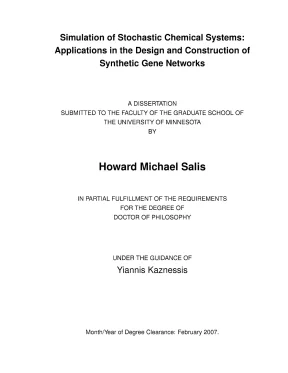
Tải xuống để đọc toàn bộSimulation of Stochastic Chemical Systems: Applications in the Design and Construction of Synthetic Gene Networks A DISSERTATION SUBMITTED TO THE FACULTY OF THE GRADUATE SCHOOL OF THE UNIVERSITY OF MINNESOTA BY Howard Michael Salis IN PARTIAL FULFILLMENT OF THE REQUIREMENTS FOR THE DEGREE OF DOCTOR OF PHILOSOPHY UNDER THE GUIDANCE OF Yiannis Kaznessis Month/Year of Degree Clearance: February 2007. UMI Number: 3244458 Copyright 2006 by Salis, Howard Michael All rights reserved. INFORMATION TO USERS The quality of this reproduction is dependent upon the quality of the copy submitted. Broken or indistinct print, colored or poor quality illustrations and photographs, print bleed-through, substandard margins, and improper alignment can adversely affect reproduction.
In the unlikely event that the author did not send a complete manuscript and there are missing pages, these will be noted. Also, if unauthorized copyright material had to be removed, a note will indicate the deletion. ® UMI UMI Microform 3244458 Copyright 2007 by ProQuest Information and Learning Company. All rights reserved.
This microform edition is protected against unauthorized copying under Title 17, United States Code. ProQuest Information and Learning Company 300 North Zeeb Road P. Box 1346 Ann Arbor, MI 48106-1346 This dissertation is copyrighted material. All rights reserved.
(Howard Salis 2006-2007 Acknowledgements My doctoral research would not have been possible except for the continued help and support of many dear people. Writing a dissertation can be an especially isolating task and | am grateful to those who made it an enjoyable experience. | would like to thank my advisor, Yiannis Kaznessis, for his generous time and commitment. Throughout my doctoral work, he encouraged me to develop independent thinking and research skills and allowed me to explore new areas of mathematics with no guarantee of success.
He continually stimulated new thoughts and greatly assisted me with scientific writing. | also extend my thanks to my fellow graduate students and friends in the Kaznessis research group for helping me in many ways with my graduate studies. Jonathan Tomshine, Vassily Sotiropou- los, and John Barrett each greatly assisted me in advancing the rational design of synthetic gene networks. In addition, | am also grateful to Himanshu Khandelia, Spyros Vicatos, Allison Langham, Abdallah Sayyed, Chandrika Mulakala, and Dan Bolintineau for both scholarly and not-so-scholarly discussions on a wide variety of topics, for sharing tea times and cookies, for baking (thanks Allison!) and eating birthday cakes, and for making graduate school more than just a list of published papers.
| will miss our time together. | would like to thank Jennifer Maynard for allowing me to use her laboratory and equipment, and for teaching me a variety of genetic engineering techniques with her usual zeal and happiness. | also express my gratitude to Benjamin Roy, Ryan Myhre, Kavita Ramalingam, and Rakesh Motani for their patience with my many questions while working in their lab. | also thank David Morse, Hans Othmer, Marie Contou-Carrere, Chetan Gadgil, and Chang Hyeong Lee for intellectual stimulation, discussions, and thoughtful suggestions on manuscripts.
| would also like to extend my sincerest gratitude to Prabhas Moghe and Jane Tjia who mentored my research studies while at Rutgers University. They gave an inexperienced freshman a real job in their lab. | will always be grateful for their patience, their training, and their encouragement. | would also like to thank Troy Shinbrot and Stephen Conway at Rutgers for continuing that encouragement.
Of course, | have had many teachers over the years and | would not be where | am without them. | thank them all, but would like to especially thank Mr. Holmquist, who instilled a love of biology in me, and to Mrs. D'Esposito who taught me that “It’s not ‘I Know’, it’s ‘I Do’ ”.
| have been blessed with some great friends who have always been there to share in difficult and joyous occasions, to lend an ear, or to simply study the sometimes hilarious behavior of that well-known vociferous species of Leporidae Brachylagus.M, Rick, Andy, Jane, Kristen, and Alan, | thank you all for your friendship. | also extend my heart-felt thanks to Alexis who has brightened my life and given me great joy. This dissertation would not have been possible without your daily encouragement. Finally, | thank my parents for always loving me and being there to help solve problems big and small.
They are my greatest teachers in life. Funding for this research was provided by the United States National Institute of Health’s biotech- nology training grant (GM08347), the United States National Science Foundation (BES-0425882), and the Army High Performance Research Computing Center (AHPCR©) of the US Army Research Lab (Contract DAAD10-01-2-0014). Computational support was also provided by the University of Minnesota’s Digital Technology Center, the NSF Funded TeraGrid, and the National Center for Su- percomputing Applications (TG-MCA04N033). This dissertation is dedicated to my parents, Jan and Barry, who lovingly brought me into this world and taught me.
il Contents List of Tables vii List of Figures ix 1 Introduction mDune 1.1 An Overview of our Methodology. gu vn và và va 1.2 Key Results Inside This Dissertation.3 A Brief Introduction to the Mathematical Results .1 The Initial Motivation .2 The First Two Stochastic NumericalMethods. Onwards to Random DynamicalSystems.4 Numerical Methods for Stochastic Bifurcation Analysis. kg kg kg KV Kia 12 1.4 A Brief Introduction to the Biological Results.
Computer Aided Design of Synthetic Gene Networks.3 Protein Devices: A New Type of Synthetic Gene Network .4 Oscillatory Synthetic Gene Networks. Bottom-Up Mathematical Analysis of a Synthetic Promoter. g< 18 2 Stochastic Numerical Methods 2. cu nà kg à k kg Vi v v k k va 2.1 An Overview of the Chapter.2 A Brief Introduction to Probability and Stochastic Processes .2 Random Variables and Probability Distributons.
Commonly Used Random Variables .4 A Brief Overview of Stochastic Processes.3 The Numerical Simulation of Jump Markov and Poisson Processes.2 The Stochastic Simulation Algorthim. Poisson and Binomial Leaping.4 The Numerical Solution of Itô Stochastic Differential Equations .1 Definitions and Formal Solutions .2 Explicit Solutions of Some Stochastic Differential Equations .3 Strong and Weak Solutions.4 lô and Stratonovich Stochastic Integrals.5 The It6 Formula and It6-Taylor Expansions.6 Numerical Generation of Stochastic Integrals .7 It6-Taylor Explicit NumericalSchemes.8 Implicit Stochastic NumericalSchemes.9 Adaptive Time StepSchemes .5 HyJCMSS: The Hybrid Jump/Continuous Markov Stochastic Simulator. cuc c cv ng g v kg vi kg kg xà 71 2.4 Examples, Error Analysis, and Critical Comparisons .6 An Equation-Free Probabilistic Steady State Approximation. ee ee ee 96 2.
c c Q Q Q Q vu gu v ga và ga 99 2.7 Hy3S: Hybrid Stochastic Simulation for Supercomputes.73 Solution of a Hybrid Jump/Continuous Markov Process .4 The Fixed Euler-MaruyamaMethod.5 The Fixed Milstein Method. ce nu 1g và và kia 123 2. The Graphical User Interface. Q c c cu ng ng gà k kg vi v v kg k va 141 3 Design of Synthetic Gene Networks 142 3.1 An Overview of the Chapter.
An Overview of Regulated Bacterial Gene Expression. ng và kg kg tk kia 145 3. The Regulation of Transcriptional Ineracions.4 The Regulation of Translational Interactions.5 Messenger RNA and Protein Degradation and Dilution .3 The Modeling of Gene Networks 2.1 Kinetics and Equilibrium Data. The Chemical Partition Function and Equilibrium Holoenzyme Formation.5 mRNA and Protein Degradation and Dluton.6 Protein-Protein Interactions.4 The “AND” Protein Device: Logical Regulation of Gene Expression.
Molecular Design and Mathematical Methods.5 Conclusion and Outlook .6 Appendix Text: Notes on the Quantitative Model .5 An Oscillating Gene Network. The lac-tet-ara Gene Network .4 Results and Discussion. 209 Construction, Characterization, and Mathematical Analysis of a Synthetic Promoter 210 41 Introduction.2 Materials and Methods .1 Synthesizing and Cloning the ConsHUuct.2 Initial Confirmation of “AND”-like Promoter Activity .3 Sampling Inducer-Dependent Expression over Time .4 Characterization of Samples with FACS. Q Q Q HQ v n k KV sa 216 4.1 The “ON” Dynamics of the Synthetic Promoter Expression.2 The Steady-State Distribution of GFP Fluorescence over Varying Inducer Concentrations 2.
Cell Division Rates over Varying Inducer Concentration .4 A Steady-State Mathematical Model of the Synthetic Promoter.1 The Participating Molecular Interactions.2 The Steady-State Governing EqQUuAHO'NS.5 Combining Experimental and Model Resuls.1 Calculating an Unknown Parameter.2 Predicting the Behavior of Improved Synthetic Promoters .6 Discussion and Conclusions. ngà ga và 234 CONTENTS VI 5 Stochastic Bifurcation Analysis: New Numerical Methods 236 5.2 Conceptual Background on Random DynamicalSvstems. HQ nu kg va 237 5.3 Stochastic Stability Analysis.4 Stochastic Bifurcation Analysis .3 New Numerical Methods for Stochastic Bifurcation Analysis. Approximation the Action of the Forward and Reverse Time Cocycle 239 5.2 Reverse Stochastic Simulation.3 Iterative Forward-Reverse Samplng.4 Forward and Reverse Master Equations .5 Forward and Reverse Stochastic Simulation .6 Stationary and Non-Stationary Solutions.7 Iterative Forward-Reverse Sampling.
gà ki kia 246 Bibliography 247 List of Tables 21 Four important characteristics of five useful probability distribution functions .2 A list of the mass action rate laws for stochastic chemical kinetics. vu cv V2 V k KY k va 2.3 Cycle Test reactions and paramefffS.4 Ratios of Computational Run Times of Cycle Tests 2.5 A Simplified Model of the Pulse Generating Gene Network in Drosophila Circadian Rhythm 2. nu ng vn và vn kg k kg kg kg xa 2.6 The crystallization reaction system and kinetic parameters .7 The effect of time step on the run time and number of SDE integration steps of three hybrid stochastic methods.8 A Benchmark Model for Large-Scale Reaction Networks .9 Computational Run Times and SDE Calls of the Benchmark Models of Large-Scale SysteMS 20ee 2.10 The effect of Ø and ( on the probabilistic steady state approximation’s speed up when simulating the illustrative example reaction network. Parameter À is constant at 10.11 Accuracy and speed up of the probabilistic steady state approximation for the second example reaction network.
Parameter À is constant at30000.12 The reactions, kinetic constants, and initial conditions of the protein-protein interaction network eXampÌ€. cv HQ nu ng ng cv kg kg kg k va 2.13 The effect of increasing œ on the accuracy and efficiency of the stochastic simulation of the non-linear protein-protein interaction network.14 A diagnostic reaction network with multiple timescales is shown.15 An overview of the Hy3S numerical methods .16 A description of each command line argument and their defaultvalues.17 A Non-Linear Cycle Test 2. Q Q Q Q Quà vn vi kg kg va 2.18 A comparison of computational times of a large-scale system benchmark. The com- putational times of a large-scale system benchmark using the fixed Euler-Maruyama (EM) and Milstein implementations of the HyJCMSS algorithm and the Next Reaction variant of the stochastic simulation algorithm (SSA).
ND: Not Determined.19 A bistable biochemical network with multiple timescales and spontaneous escape .1 A list of consensus sequences for E.0 020004 vil LIST OF TABLES Vili 3.2 A list of the thermodynamic binding free energies between the Jac, tet, and ara tran- scription factors and their respective DNA operators at physiological temperature, pH, and salt concentration, 2.3 A list of the thermodynamic binding free energies between the inducer-bound /ac and tet repressors and their respective DNA operators.4 A selected list of ribosome binding sites (RBSs), The DNA sequences starting with AGGA and ending with a start codon are shown. The sequences are qualitatively ranked by their translation efficiency (average proteins per mRNA transcript with all other de- terminants equal) with one being the most efficient. The Gibbs free energies of the mRNA folding into a secondary structure (AG foiding) and the rRNA:mRNA hybridiza- tion (AGpyp-ia) are Shown for comparison.5 The enumeration and Gibbs free energies of the regulatory states of an example pro- moter with two operators and a single transcription factor.6 A list of potentially useful protein-protein interaction domains, their peptide ligands, and affinities, 2.7 The baseline and range of values foreach model parameter.8 The reaction network describing the protein-protein interactions between scaffold and scaffold-binding proteins. LH HQ ng vn kg k va 192 3.9 The reaction network describing production and degradation of scaffold and scaffold- binding proteins.
Nội dung được bảo vệ bản quyền — Tải xuống đầy đủ
Trích dẫn luận án này
Howard Michael Salis (2007). Mô phỏng hệ thống hóa học ngẫu nhiên - Ứng dụng mạng gene [Luận án tiến sĩ, University of Minnesota]. LuanAn.net. https://luanan.net/sinh-hoc/cong-nghe-sinh-hoc/mo-phong-he-thong-hoa-hoc-ngau-nhien-mang-gene-tong-hop
Câu hỏi thường gặp
Luận án "Mô phỏng hệ thống hóa học ngẫu nhiên - Ứng dụng mạng gene" nghiên cứu về vấn đề gì?
Luận án tiến sĩ mô phỏng hệ thống hóa học ngẫu nhiên và ứng dụng trong thiết kế mạng gene tổng hợp. Nghiên cứu của Howard Salis, University of Minnesota 2007.
Luận án "Mô phỏng hệ thống hóa học ngẫu nhiên - Ứng dụng mạng gene" được bảo vệ tại trường nào?
Luận án này được bảo vệ tại University of Minnesota. Năm bảo vệ: 2007.
Luận án "Mô phỏng hệ thống hóa học ngẫu nhiên - Ứng dụng mạng gene" có bao nhiêu trang?
Luận án "Mô phỏng hệ thống hóa học ngẫu nhiên - Ứng dụng mạng gene" có 287 trang. Bạn có thể xem trước một phần tài liệu ngay trên trang web trước khi tải về.
Cách tải luận án "Mô phỏng hệ thống hóa học ngẫu nhiên - Ứng dụng mạng gene" về máy như thế nào?
Để tải luận án về máy, bạn nhấn nút "Tải xuống ngay" trên trang này, sau đó hoàn tất thanh toán phí lưu trữ. File sẽ được tải xuống ngay sau khi thanh toán thành công. Hỗ trợ qua Zalo: 0559 297 239.