Four-body statistical potential trong phân tích tính chất protein
Luận án tiến sĩ ứng dụng thế năng thống kê bốn vật thể phân tích tính chất nhiệt động protein. Sử dụng phương pháp Delaunay tessellation và mô hình hóa tương tác protein-nước.
Bioinformatics and Computational Biology
Luan An
luận án
Năm xuất bản
Số trang
204
Thời gian đọc
31 phút
Lượt xem
0
Lượt tải
0
Phí lưu trữ
50 Point
Tổng quan nhanh
- Chủ đề:
- 1. Four-Body Statistical Potential Trong Protein
- Số trang:
- 204 trang
- Trường:
- George Mason University
- Chuyên ngành:
- Bioinformatics and Computational Biology
- Tác giả:
- Gregory M. Reck
- Năm:
- 2006
Tóm tắt nội dung luận án
I. Four Body Statistical Potential Trong Protein
Four-body statistical potential đại diện cho bước tiến quan trọng trong nghiên cứu cấu trúc protein. Phương pháp này vượt qua giới hạn của các mô hình hai thân và ba thân truyền thống. Statistical potential dựa trên phân tích cấu trúc protein đã biết, tạo nền tảng cho dự đoán độ ổn định. Knowledge-based potential này xem xét tương tác đồng thời giữa bốn đơn vị cấu trúc. Delaunay tessellation cung cấp công cụ toán học để xác định các tương tác này. Phương pháp phân tích hình học tính toán giúp mô tả chính xác môi trường protein-water interaction. Nghiên cứu tập trung vào việc áp dụng four-body potential để kiểm tra thermodynamic properties. Cách tiếp cận này cho phép đánh giá protein stability một cách toàn diện hơn.
1.1. Nguyên Lý Four Body Interaction
Four-body interaction mở rộng khái niệm tương tác cặp đôi trong protein. Mô hình này xem xét đồng thời bốn amino acid hoặc nhóm nguyên tử. Delaunay tessellation chia không gian protein thành các simplex tứ diện. Mỗi simplex chứa bốn đỉnh đại diện cho các trung tâm tương tác. Phương pháp này nắm bắt được hiệu ứng hợp tác giữa các residue. Statistical potential được tính từ tần suất xuất hiện các cấu hình. Knowledge-based approach sử dụng cơ sở dữ liệu cấu trúc protein lớn.
1.2. Ưu Điểm So Với Pairwise Potential
Pairwise potential chỉ xem xét tương tác giữa hai residue. Four-body potential nắm bắt được môi trường tương tác phức tạp hơn. Phương pháp này tính đến ảnh hưởng của các residue lân cận. Protein folding phụ thuộc vào nhiều tương tác đồng thời xảy ra. Free energy của hệ thống được mô tả chính xác hơn. Statistical analysis cho thấy cải thiện đáng kể trong dự đoán cấu trúc. Knowledge-based potential này phản ánh thực tế sinh học tốt hơn.
1.3. Computational Geometry Trong Phân Tích
Computational geometry cung cấp nền tảng toán học vững chắc. Delaunay tessellation tạo phân chia không gian tối ưu và duy nhất. Simplex tứ diện đảm bảo không có điểm nào nằm trong mặt cầu ngoại tiếp. Phương pháp này xác định chính xác các nearest-neighbor contacts. Protein-water interaction được mô tả thông qua water coordination number. Accessible surface area liên quan trực tiếp đến cấu trúc tessellation. Computational approach này xử lý hiệu quả cấu trúc protein phức tạp.
II. Thermodynamic Properties Và Protein Stability
Thermodynamic properties quyết định protein stability trong điều kiện khác nhau. Free energy là thông số quan trọng nhất để đánh giá độ ổn định. Gibbs free energy kết hợp cả enthalpy và entropy contributions. Enthalpy phản ánh năng lượng tương tác giữa các thành phần protein. Entropy đo lường độ rối của hệ thống protein-solvent. Four-body statistical potential cho phép tính toán các đại lượng này. Knowledge-based approach cung cấp ước tính nhanh và chính xác. Protein folding là quá trình tự nhiên hướng tới trạng thái năng lượng tối thiểu. Thermodynamic analysis giúp hiểu rõ cơ chế ổn định cấu trúc.
2.1. Gibbs Free Energy Và Protein Folding
Gibbs free energy xác định tính tự phát của protein folding. Công thức ΔG = ΔH - TΔS liên kết enthalpy và entropy. Giá trị ΔG âm cho thấy quá trình gấp nếp thuận lợi. Temperature ảnh hưởng đến cân bằng giữa hai thành phần. Four-body potential tính toán ΔG từ statistical distribution. Knowledge-based method ước tính nhanh hơn molecular dynamics. Free energy landscape mô tả con đường folding của protein.
2.2. Enthalpy Contributions Từ Tương Tác
Enthalpy phản ánh tổng năng lượng tương tác trong protein. Hydrogen bonds đóng góp đáng kể vào enthalpy stabilization. Van der Waals forces giữa các residue phi cực quan trọng. Electrostatic interactions giữa các nhóm tích điện ảnh hưởng lớn. Four-body interaction nắm bắt được cooperative effects. Statistical potential tính enthalpy từ contact frequencies. Protein stability tăng khi enthalpy contributions âm mạnh.
2.3. Entropy Effects Trong Protein System
Entropy đo lường số trạng thái có thể của protein. Conformational entropy giảm khi protein folding xảy ra. Solvent entropy tăng khi hydrophobic residues buried. Hydrophobic effect chủ yếu là entropy-driven process. Balance giữa conformational và solvent entropy quyết định stability. Four-body potential ước tính entropy từ statistical mechanics. Knowledge-based approach tính đến cả entropy contributions phức tạp.
III. Protein Water Interaction Characteristics
Protein-water interaction đóng vai trò then chốt trong protein stability. Water molecules tạo thành lớp hydration bao quanh protein. Computational geometry phân tích chính xác vị trí các water molecules. Delaunay tessellation xác định water coordination patterns. Hydration shell ảnh hưởng trực tiếp đến thermodynamic properties. Water coordination number ratio đặc trưng cho môi trường hydration. Simplex face matching method phân loại residues theo hydration pattern. Accessible surface area liên quan đến số lượng water contacts. Circular variance đo độ đồng nhất của water distribution.
3.1. Computational Hydration Methods
Computational hydration sử dụng phương pháp hình học tính toán. Delaunay tessellation của hydrated protein tạo simplex network. Water molecules được đặt tại vị trí năng lượng tối ưu. Simplex vertices bao gồm cả protein atoms và water molecules. Tessellation tạo ra phân chia không gian hoàn chỉnh và duy nhất. Protein-water interaction được mô tả qua simplex faces. Knowledge-based potential áp dụng cho cấu trúc hydrated này.
3.2. Water Coordination Number Analysis
Water coordination number đếm số water molecules xung quanh residue. Coordination number ratio so sánh hydration giữa các residue types. Hydrophilic residues có coordination number cao hơn. Hydrophobic residues có xu hướng buried và ít water contacts. Four-body potential tính đến water-mediated interactions. Statistical analysis cho thấy correlation với protein stability. Water CNR là parameter quan trọng cho residue classification.
3.3. Hydrophobicity Scale Correlation
Hydrophobicity scales đo xu hướng tránh nước của amino acids. Water group parameter từ tessellation correlates với hydrophobicity. Statistical potential dựa trên hydration patterns cải thiện accuracy. Hydrophobic effect là driving force chính của protein folding. Free energy contributions từ hydrophobic interactions đáng kể. Knowledge-based approach kết hợp hydrophobicity vào potential. Correlation analysis xác nhận tính hợp lý của computational methods.
IV. Knowledge Based Potential Development
Knowledge-based potential được phát triển từ cơ sở dữ liệu protein structures. Statistical analysis của known structures tạo nền tảng cho potential. Four-body potential sử dụng frequencies của simplex configurations. Delaunay tessellation cung cấp framework toán học nhất quán. Nearest-neighbor contacts được xác định tự động từ tessellation. Contact potentials phản ánh preferences trong protein folding. Reference state definition ảnh hưởng đến accuracy của potential. Boltzmann-like relationship chuyển đổi frequencies thành energies. Knowledge-based approach nhanh hơn first-principles calculations nhiều.
4.1. Statistical Potential Derivation
Statistical potential xuất phát từ inverse Boltzmann principle. Observed frequencies của contacts trong protein database được phân tích. Four-body configurations được đếm từ Delaunay tessellation. Reference state đại diện cho random distribution của residues. Potential energy tỉ lệ với logarithm của frequency ratio. Knowledge-based method tránh được tính toán quantum mechanics phức tạp. Protein folding preferences được encode trong statistical distributions.
4.2. Delaunay Tessellation Framework
Delaunay tessellation tạo partition duy nhất của protein space. Simplex tứ diện kết nối bốn nearest-neighbor points. Tessellation đảm bảo empty circumsphere property cho mỗi simplex. Computational geometry algorithms thực hiện tessellation hiệu quả. Four-body potential tự nhiên xuất hiện từ simplex structure. Protein-water interaction được mô tả thông qua mixed simplices. Knowledge-based potential áp dụng cho tất cả simplex types.
4.3. Reference State Selection
Reference state là yếu tố quan trọng trong statistical potential. Random mixing approximation thường được sử dụng làm reference. Composition-dependent reference state cải thiện accuracy. Four-body potential requires careful reference state definition. Statistical mechanics principles guide reference state choice. Knowledge-based approach benefits từ appropriate reference selection. Protein stability predictions phụ thuộc vào reference state quality.
V. Applications To Protein Stability Analysis
Protein stability analysis sử dụng four-body potential cho nhiều ứng dụng. Mutation effects được dự đoán thông qua free energy changes. Thermodynamic properties của variants được so sánh với wild-type. Temperature dependence của stability được mô hình hóa. pH effects có thể được tích hợp vào statistical potential. Protein engineering benefits từ accurate stability predictions. Drug design sử dụng stability analysis để optimize binding. Disease-related mutations được đánh giá qua thermodynamic impact. Knowledge-based methods cung cấp rapid screening capabilities.
5.1. Mutation Effect Prediction
Mutation effects được đánh giá qua ΔΔG calculations. Four-body potential tính free energy difference giữa variants. Single point mutations có thể destabilize hoặc stabilize protein. Statistical potential nhanh chóng screens nhiều mutations. Protein folding pathway có thể thay đổi với mutations. Knowledge-based approach correlates well với experimental data. Thermodynamic analysis giúp understand disease mechanisms.
5.2. Temperature And pH Dependencies
Temperature affects cả enthalpy và entropy contributions. Gibbs free energy varies với temperature theo Gibbs-Helmholtz equation. Protein stability thường có optimum temperature range. pH changes ảnh hưởng đến charged residue interactions. Four-body potential có thể được adapted cho pH effects. Statistical analysis của temperature-dependent structures improves predictions. Knowledge-based methods model thermal denaturation processes.
5.3. Protein Engineering Applications
Protein engineering aims to improve stability và function. Four-body potential guides rational design strategies. Thermodynamic properties được optimized thông qua mutations. Statistical potential screens large libraries nhanh chóng. Free energy calculations prioritize promising variants. Knowledge-based approach complements experimental methods. Protein stability improvements enable industrial applications.
VI. Validation And Performance Assessment
Validation của four-body statistical potential cần multiple benchmarks. Experimental thermodynamic data cung cấp gold standard comparison. Protein folding recognition tests đánh giá discrimination ability. Mutation database analysis kiểm tra ΔΔG prediction accuracy. Cross-validation ensures potential không overfitting training data. Comparison với other potentials shows relative performance. Statistical significance testing confirms improvements. Correlation coefficients measure agreement với experiments. Knowledge-based potential performance depends on database quality.
6.1. Experimental Data Comparison
Experimental thermodynamic data từ calorimetry experiments quan trọng. Free energy measurements provide direct validation. Mutation studies offer extensive ΔΔG datasets. Four-body potential predictions được compared với experimental values. Statistical analysis calculates correlation coefficients. Knowledge-based methods show good agreement với experiments. Protein stability rankings correlate well với measured values.
6.2. Folding Recognition Tests
Folding recognition tests ability to identify native structure. Decoy sets contain native và misfolded conformations. Four-body potential should score native lowest. Statistical potential discrimination power được quantified. Knowledge-based approach performs well on standard benchmarks. Protein folding funnels được reproduced bởi potential. Thermodynamic properties correctly favor native states.
6.3. Cross Validation Strategies
Cross-validation prevents overfitting trong potential development. Training và test sets được separated carefully. Four-body potential performance tested on independent data. Statistical significance của improvements được established. Knowledge-based methods benefit từ large protein databases. Protein families được distributed across validation sets. Free energy predictions remain accurate on test cases.
Mục lục chi tiết luận án
Tải xuống file đầy đủ để xem toàn bộ nội dung
Tải đầy đủ (204 trang)Nội dung chính
Tổng quan về luận án
Nghiên cứu của Gregory M. Reck (2006) tại Đại học George Mason, dưới sự hướng dẫn của Phó Giáo sư Iosif I. Vaisman, với tiêu đề "Adaptation and Use of Four-Body Statistical Potential to Examine Thermodynamic Properties of Proteins" đã tạo nên bước đột phá trong sinh học tính toán và cấu trúc sinh học. Luận án giải quyết mắt xích trọng yếu giữa cấu trúc không gian ba chiều và tính ổn định nhiệt động học của protein, đồng thời mở rộng ứng dụng trong việc giải mã cơ chế gây bệnh của các cấu trúc amyloid.
flowchart LR
    A["Tọa độ nguyên tử 3D (PDB, PISCES: 1321 Protein)"] --> B["Thủy hóa tính toán (SOLVATE 5Å, DOWSER)"]
    B --> C["Phân tích phân chia Delaunay 3D (Qhull / Quickhull)"]
    C --> D["Thế thống kê bậc 4 (Four-Body Potential / Log-Likelihood)"]
    D --> E["Dự đoán biến đổi nhiệt động học (ΔΔG, ProTherm)"]
    D --> F["Máy học (Random Forest, SVM) dự đoán Amyloid Transthyretin"]
Bối cảnh khoa học của công trình xuất phát từ nghịch lý cấu trúc - chức năng: trong khi hầu hết các chuỗi polypeptide tự nhiên gấp cuộn chính xác vào một cấu trúc duy nhất để thực thi hoạt tính sinh học, một số protein biến tính hoặc đột biến điểm có thể tái sắp xếp thành các cấu tạo trung gian không bền, dẫn đến hiện tượng kết tụ sợi amyloid không tan – căn nguyên của nhiều bệnh thoái hóa thần kinh và chuyển hóa. Khoảng trống nghiên cứu then chốt (research gap) nằm ở chỗ các hàm thế thống kê tương tác cặp (pairwise distance-dependent potentials) truyền thống (như nghiên cứu của Sippl, 1990; Miyazawa & Jernigan, 1985; Gilis & Rooman, 1996, 1997) không mô tả được hiệu ứng hợp tác đa vật thể (cooperative multi-body effects) và thường bỏ qua sự tham gia trực tiếp của lớp vỏ nước dung môi (hydration shell) tại bề mặt protein. Các phương pháp mô phỏng động lực học phân tử (Molecular Dynamics - MD) dù mô tả chi tiết tương tác vật lý (Kollman, 1993; Karplus & Petsko, 1990) nhưng lại đòi hỏi chi phí tính toán khổng lồ, khó áp dụng trên tập dữ liệu lớn.
Luận án đặt ra các câu hỏi và giả thuyết nghiên cứu cụ thể:
- Câu hỏi nghiên cứu 1 (RQ1): Làm thế nào để tích hợp một cách tường minh lớp vỏ nước hydrat hóa vào không gian hình học tính toán Delaunay nhằm khắc phục hiện tượng méo mó (distortion) của các khối tứ diện ở bề mặt protein?
- Câu hỏi nghiên cứu 2 (RQ2): Liệu hàm thế thống kê bậc 4 (four-body statistical potential) dựa trên phân chia không gian Delaunay sau khi được hydrat hóa có phản ánh chính xác các thông số nhiệt động học thực nghiệm ($\Delta\Delta G$, $T_m$) khi xảy ra đột biến điểm?
- Câu hỏi nghiên cứu 3 (RQ3): Hồ sơ thế dư (residual potential profile) của các đột biến có chứa đựng tín hiệu cấu trúc đặc trưng đủ để phân loại và dự đoán xu hướng kết tụ amyloid của protein Transthyretin (TTR) thông qua các thuật toán máy học?
Giả thuyết nghiên cứu (H1): Việc bổ sung các phân tử nước dung môi vào phân chia Delaunay sẽ loại bỏ các cạnh tứ diện kéo dài nhân tạo (giảm độ dài cạnh tối đa từ 113 Å xuống 12.9 Å), thiết lập một định nghĩa không tham số cho lân cận bậc 4 và cải thiện năng lực phân biệt mồi nhử (decoy discrimination). Giả thuyết nghiên cứu (H2): Thế thống kê 4 tâm bắt nguồn từ nguyên lý phân bố Boltzmann phản ánh thước đo tương thích cục bộ (local compatibility), có tương quan tuyến tính chặt chẽ ($r > 0.80$) với năng lượng tự do mở cuộn ($\Delta\Delta G$) đối với các đột biến điểm trong lõi kỵ nước và bề mặt.
Khung lý thuyết của nghiên cứu tích hợp hình học tính toán (Computational Geometry - phép phân chia không gian Voronoi/Delaunay), cơ học thống kê (Statistical Mechanics - định luật phân bố Boltzmann nghịch đảo) và nhiệt động học sinh học (Biochemical Thermodynamics). Quy mô nghiên cứu bao quát một tập mẫu đại diện không dư thừa gồm 1.321 chuỗi đơn protein tinh thể học tia X (độ phân giải $\le 2.2$ Å, $R\text{-factor} \le 0.25$, độ tương đồng chuỗi $\le 30%$) cùng với 290.968 vị trí phân tử nước tinh thể, đối chiếu dữ liệu đột biến nhiệt động từ cơ sở dữ liệu ProTherm trên các protein mô hình (Barnase, T4 Lysozyme, Staphylococcal Nuclease, Transthyretin).
Literature Review và Positioning
Nghiên cứu folding và độ ổn định nhiệt động của protein trong nhiều thập kỷ bị phân tách thành hai trường phái chính: các mô hình vật lý dựa trên trường lực (physics-based force fields) và các hàm thế thống kê dựa trên tri thức cấu trúc (knowledge-based statistical potentials).
Các công trình tiên phong của Miyazawa & Jernigan (1985) đã đặt nền móng cho các hàm thế tiếp xúc cặp (pairwise contact potentials) bằng cách chuyển đổi tần suất xuất hiện cặp acid amin trong PDB thành năng lượng tự do trung bình thông qua công thức Boltzmann nghịch đảo: $\Delta W_{ij} = -k_B T \ln(f_{ij} / f_{ij}^0)$. Tiếp nối hướng đi này, Sippl (1990) phát triển hàm thế phụ thuộc khoảng cách (distance-dependent potentials), trong khi Gilis & Rooman (1996, 1997) kết hợp thế góc nhị diện (torsion angle potentials) với thế khoảng cách có trọng số diện tích bề mặt tiếp cận dung môi (ASA). Tuy nhiên, trường phái tương tác cặp vấp phải sự chỉ trích gay gắt từ các nhà lý thuyết cấu trúc như Thomas & Dill (1996) hay Godzik et al. (1995), những người chỉ ra rằng lực kỵ nước và sự đóng gói thể tích (volume exclusion) trong lõi protein có bản chất cộng gộp phi tuyến (non-additive), không thể phân rã thuần túy thành tổng của các tương tác hai tâm độc lập ($E \neq \sum \epsilon_{ij}$).
Ở trường phái hình học tính toán, Voronoi (1908) và Delaunay (1934) đã cung cấp công cụ toán học xác định lân cận không gian mà không cần áp đặt bán kính cắt (cutoff distance) tùy tiện (Richards, 1974; Angelov et al., 2002; McConkey et al., 2002). Vaisman, Tropsha và cộng sự (1998, 2001) đã tiên phong áp dụng phép phân chia tứ diện Delaunay (Delaunay tessellation) để xây dựng thế tiếp xúc bốn vị trí (four-body contact potentials). Mặc dù mô hình này ghi nhận thành công vượt bậc trong nhận diện cấu trúc bản địa (fold recognition) và phân biệt mồi nhử (decoy discrimination), nó bộc lộ điểm nghẽn nghiêm trọng: ở bề mặt ngoài của protein, các tứ diện Delaunay không có ranh giới bao bọc (convex hull boundary) bị kéo dãn bất thường qua các khe rãnh (crevices) và hốc bề mặt, dẫn đến việc tính toán sai lệch tiềm năng tương tác của các gốc acid amin tiếp xúc dung môi.
| Hướng nghiên cứu & Tác giả | Phương pháp tiếp cận | Ưu điểm chính | Hạn chế cốt lõi |
|---|---|---|---|
| Miyazawa & Jernigan (1985) | Hàm thế tiếp xúc cặp ($C_\alpha - C_\alpha$) | Đơn giản, tính toán nhanh trên tập dữ liệu lớn | Bỏ qua hiệu ứng hợp tác đa vật thể; không phân biệt môi trường dung môi |
| Sippl (1990); Gilis & Rooman (1996) | Hàm thế phụ thuộc khoảng cách và góc xoay nhị diện | Nắm bắt được độ cong cục bộ của chuỗi polypeptide | Giới hạn ở tương tác 2 tâm; nhạy cảm với sai số định vị nguyên tử |
| Angelov et al. (2002); McConkey et al. (2002) | Phân chia Voronoi cho đóng gói không gian | Xác định lân cận hình học tự nhiên không cần cutoff | Khó biểu diễn tương tác 4 tâm đồng thời; xử lý biên bề mặt phức tạp |
| Vaisman et al. (1998); Carter et al. (2001) | Delaunay Tessellation không hydrat hóa (Unhydrated DT) | Nắm bắt cấu hình 4 tâm; phản ánh tương tác hợp tác | Tứ diện bề mặt bị méo mó (cạnh tới 113 Å); đánh giá sai gốc bề mặt |
| Gregory M. Reck (2006) [Luận án này] | Delaunay Tessellation hydrat hóa tính toán (Hydrated DT) | Loại bỏ méo mó bề mặt; tích hợp nước bậc 4; dự đoán $\Delta\Delta G$ và amyloid | Đòi hỏi bước tiền xử lý mô phỏng nước; độ sâu hốc phụ thuộc thuật toán thủy hóa |
So sánh với hai nghiên cứu quốc tế điển hình cùng thời kỳ:
- Nghiên cứu của Gilis & Rooman (1997): Đạt hệ số tương quan $r = 0.87$ cho các đột biến ở bề mặt có độ bộc lộ dung môi $> 50%$ nhờ thế nhị diện, nhưng hệ số tương quan giảm sút nghiêm trọng và không ổn định ($r < 0.60$) đối với các gốc có độ bộc lộ trung gian ($40% - 50%$).
- Nghiên cứu của Carter, Vaisman et al. (2001): Áp dụng thế 4 tâm cho đột biến lõi kỵ nước của 5 protein, đạt $r = 0.83$ khi đưa thêm tham số hiệu chỉnh chiều dài chuỗi $\ln(N)$ và nghịch đảo điểm thế trung bình, nhưng hoàn toàn bất lực khi phân tích đột biến tại các vị trí ưa nước ở bề mặt.
Luận án của Gregory M. Reck đã định vị chính xác khoảng trống này: bằng cách đưa các phân tử nước tính toán tường minh vào mạng lưới phân chia Delaunay, công trình đã thiết lập sự chuyển dịch mô thức (paradigm shift) từ hình học protein chân không sang hình học phức hợp protein-dung môi đa thân, mở rộng phạm vi áp dụng của thế thống kê từ nhận diện cấu trúc sang phân tích nhiệt động học định lượng.
Đóng góp lý thuyết và khung phân tích
Đóng góp cho lý thuyết
Luận án mở rộng thuyết tương tác hợp tác đa vật thể (theory of cooperative multi-body interactions) trong sinh học cấu trúc thông qua việc chứng minh rằng không gian cấu trúc protein được bảo toàn bởi các tương quan 4 tâm không thể phân tách.
graph TD
    subgraph "Mô hình Tứ diện Delaunay Thủy hóa"
        R1["Gốc Acid Amin $i$"] --- R2["Gốc Acid Amin $j$"]
        R2 --- R3["Gốc Acid Amin $k$"]
        R3 --- W1["Phân tử Nước $H_2O$"]
        W1 --- R1
        R1 --- R3
        R2 --- W1
    end
    style W1 fill:#a8d8ea,stroke:#005b96,stroke-width:2px
    style R1 fill:#ffccd5,stroke:#c9184a,stroke-width:2px
    style R2 fill:#ffccd5,stroke:#c9184a,stroke-width:2px
    style R3 fill:#ffccd5,stroke:#c9184a,stroke-width:2px
Mô hình lý thuyết tương thích cục bộ (Local Compatibility Model): Điểm thế năng thống kê $Q_{ijkl}$ cho một tứ diện gồm 4 phần tử $(i, j, k, l)$ được định nghĩa toán học dựa trên tỷ số log-likelihood so với phân bố ngẫu nhiên:
$$Q_{ijkl} = -\log \left( \frac{f_{ijkl}}{p_i p_j p_k p_l \cdot C_{ijkl}} \right)$$
Trong đó:
- $f_{ijkl}$ là tần suất quan sát thực nghiệm của bộ tứ $(i, j, k, l)$ trong tập mẫu chuẩn 1.321 protein;
- $p_i, p_j, p_k, p_l$ là tần suất xuất hiện đơn lẻ của từng loại acid amin (hoặc nước);
- $C_{ijkl}$ là hệ số hoán vị tổ hợp chuẩn hóa tùy thuộc vào số lượng các gốc đồng nhất trong bộ tứ (nhận giá trị từ 1 đến 24).
Điểm thế dư của một gốc acid amin thứ $m$ ($Residual_m$) là tổng điểm thế của tất cả các tứ diện Delaunay mà gốc $m$ tham gia:
$$Score(m) = \sum_{n \in \text{Simplices}(m)} Q_n$$
Hồ sơ thế dư biểu thị một vector trạng thái cấu trúc, nơi mỗi thành phần lượng hóa mức độ bất ổn định hoặc tương thích của một acid amin trong môi trường không gian cục bộ.
Khung phân tích độc đáo
Luận án thiết lập khung phân tích dựa trên sự kết hợp đồng thời ba cấu phần lý thuyết: Hình học vi phân rời rạc (Discrete Differential Geometry), Thủy động học dung môi cục bộ (Local Solvation Dynamics) và Thống kê đa biến/Máy học (Multivariate Statistics & Machine Learning).
Khung phân tích giới thiệu hai phương pháp phân loại cấu trúc không gian mới:
- Phương pháp đối sánh mặt tứ diện (Simplex Face Matching Method): Dựa trên tính chất topo của phức hợp lồi (convex hull). Mỗi mặt tam giác bên trong protein luôn được chia sẻ bởi đúng 2 khối tứ diện kề nhau. Các mặt tam giác ở bề mặt ngoài không tìm được mặt đối sánh (unmatched exterior faces). Do đó:
- Gốc bề mặt (Surface - S): Các gốc tham gia tạo nên mặt tứ diện không có đối sánh.
- Gốc dưới bề mặt (Undersurface - U): Các gốc không nằm trên mặt ngoài nhưng có liên kết cạnh tứ diện trực tiếp với gốc bề mặt.
- Gốc bị chôn vùi (Buried - B): Các gốc lõi hoàn toàn, chỉ tham gia vào các mặt tứ diện nội bộ có đối sánh hoàn hảo.
- Tham số nhóm nước (Water Group Parameter - WG): Đối với mỗi gốc acid amin, phân loại các tứ diện Delaunay xung quanh thành 4 nhóm chứa $0, 1, 2$, hoặc $3$ phân tử nước. Tham số $WG$ được định nghĩa là hệ số góc (slope) của đường hồi quy tuyến tính bình phương tối thiểu biểu diễn số lượng tứ diện theo số phân tử nước tham gia. Gốc có $WG > 0$ được phân loại là gốc bề mặt ưa nước; gốc có $WG \le 0$ là gốc lõi kỵ nước.
Điều kiện biên (boundary conditions) của khung phân tích được xác định rõ: áp dụng cho các protein hình cầu đơn chuỗi tan trong nước, không áp dụng trực tiếp cho protein màng xuyên màng (membrane proteins) hoặc các chuỗi polypeptide có khoảng trống không liên tục (sequence gaps).
Phương pháp nghiên cứu tiên tiến
Thiết kế nghiên cứu
Nghiên cứu theo đuổi trường phái thực chứng định lượng (Quantitative Positivism) kết hợp mô hình hóa tính toán và đối sánh thực nghiệm. Thiết kế nghiên cứu đa tầng (multi-level research design) bao gồm:
- Tầng 1 (Hình học phân tử): Khảo sát ở mức độ tọa độ nguyên tử ($C_\alpha$ và khối tâm - Center of Mass, CM) kết hợp với các phân tử nước mô phỏng.
- Tầng 2 (Thế năng cấu trúc): Xây dựng ma trận thế thống kê 4 tâm từ 1.321 protein chuẩn.
- Tầng 3 (Nhiệt động học đột biến): Đánh giá tương quan với dữ liệu nhiệt động thực nghiệm ($\Delta\Delta G$, $\Delta T_m$).
- Tầng 4 (Phân loại hình thái bệnh học): Ứng dụng mô hình máy học trên hồ sơ thế dư để phân biệt kiểu hình gây bệnh amyloid.
flowchart TD
    subgraph "Tiền xử lý & Chọn lọc dữ liệu"
        P1["PDB Archive"] --> P2["PISCES Server"]
        P2 --> P3["1321 Protein đơn chuỗi<br/>• Resolution ≤ 2.2 Å<br/>• R-factor ≤ 0.25<br/>• Sequence ID ≤ 30%"]
    end
    subgraph "Thủy hóa & Phân chia không gian"
        P3 --> S1["SOLVATE (Vỏ 5 Å, Lưới 1 Å)"]
        S1 --> S2["Qhull / Quickhull Algorithm"]
        S2 --> S3["Loại bỏ Tứ diện chỉ chứa nước (4 H2O)"]
    end
    subgraph "Tính toán Thế & Đối sánh Thực nghiệm"
        S3 --> T1["Thế thống kê 4 tâm (CA, CM, Split Potential)"]
        T1 --> D1["Phân biệt Decoy (Decoy Discrimination Sets)"]
        T1 --> D2["Dữ liệu thực nghiệm ProTherm (Barnase, SNase, T4 Lysozyme)"]
        T1 --> ML["Máy học (Random Forest, SVM) cho Transthyretin"]
    end
Quy trình nghiên cứu rigorous
Quy trình xử lý dữ liệu và thuật toán diễn ra nghiêm ngặt qua các bước:
- Chọn lọc tập dữ liệu mẫu (Sampling Strategy): Sử dụng máy chủ PISCES (Wang & Dunbrack, 2003) lọc từ PDB các protein đơn chuỗi đáp ứng tiêu chuẩn: độ phân giải $\le 2.2$ Å, $R\text{-factor} \le 0.25$, độ tương đồng chuỗi $\le 30%$, không đứt gãy mạch $C_\alpha$, loại trừ protein màng theo DSSP.
- Thủy hóa tính toán (Computational Hydration): Ứng dụng chương trình SOLVATE (Grubmüller, 1996) với mạng lưới không gian 1 Å, thiết lập độ dày lớp vỏ tối thiểu là 5 Å. Tối ưu hóa vị trí nước bằng giải thuật giảm độ dốc dốc nhất (steepest descent) dựa trên lực van der Waals.
- Kiểm định chéo mô hình nước (Triangulation): So sánh vị trí nước của SOLVATE với 290.968 vị trí nước tinh thể X-ray thực nghiệm và phần mềm DOWSER (Zhang & Hermans, 1996) trên 9 protein đại diện (1l1f, 1k0w, 1a8l, 1n0f, 1o70, 1qz9, 1rtq, 1u68, 2mhr) nhằm kiểm tra độ chính xác tại các hốc ngầm và rãnh bề mặt.
- Phân chia không gian Delaunay: Sử dụng thuật toán Quickhull thông qua phần mềm Qhull (Barber, Dobkin, & Huhdanpaa, 1996; Lu, 2006). Sau khi phân chia, toàn bộ các khối tứ diện chỉ chứa 4 phân tử nước ($4\text{W}$) bị loại bỏ, chỉ giữ lại các phân tử nước trực tiếp tạo cạnh tứ diện với ít nhất một gốc acid amin của protein (tạo thành lớp vỏ hydrat hóa bậc một).
Data và phân tích
Dữ liệu hình học và năng lượng được phân tích so sánh với các phần mềm chuẩn mực quốc tế:
- NACCESS (Hubbard & Thornton, 1993): Tính diện tích bề mặt tiếp cận dung môi tuyệt đối và tương đối (relative ASA) với bán kính đầu dò 1.4 Å.
- DPX (Pintar et al., 2003): Đo độ sâu của gốc acid amin (residue depth) tính từ nguyên tử tiếp xúc dung môi gần nhất.
- Simulaid (Mezei, 2003): Tính toán phương sai vòng (Circular Variance - CV) trong bán kính 10 Å quanh nguyên tử $C_\alpha$.
- Machine Learning Toolkits: Huấn luyện các mô hình Random Forests (RF), Support Vector Machines (SVM/SVR) và Decision Trees (DT) để giải mã mối quan hệ phi tuyến giữa vector hồ sơ thế dư và tính chất nhiệt động/amyloid.
Phát hiện đột phá và implications
Những phát hiện then chốt
Thứ nhất, việc thủy hóa tính toán đã loại bỏ hoàn toàn các tứ diện méo mó bất thường tại bề mặt. Trong phân tích protein không hydrat hóa, chiều dài cạnh tứ diện tối đa lên tới 113 Å với giá trị trung bình là 8.87 Å do các tứ diện bắc cầu qua các vùng lõm bề mặt. Khi có sự hiện diện của lớp nước SOLVATE 5 Å, chiều dài cạnh tối đa giảm mạnh xuống còn 12.9 Å và chiều dài cạnh trung bình đạt 4.54 Å.
"Without hydration, the maximum edge length was 113 Å and the mean edge length was 8.87 Å. After hydration, the maximum edge length was reduced to 12.9 Å and the mean edge length was 4.54 Å." (Trích xuất từ Chương 2, Luận án).
gantt
    title Tác động của Thủy hóa lên Chiều dài Cạnh Tứ diện Delaunay
    dateFormat X
    axisFormat %s Å
    section Không Hydrat hóa
    Độ dài trung bình (8.87 Å) :0, 9
    Độ dài tối đa (113.0 Å) :0, 113
    section Có Hydrat hóa (5 Å Shell)
    Độ dài trung bình (4.54 Å) :0, 5
    Độ dài tối đa (12.9 Å) :0, 13
Thứ hai, độ chuẩn xác cao của mô hình nước SOLVATE so với thực nghiệm tinh thể. Phân tích trên 290.968 vị trí nước tinh thể từ 1.300 tệp PDB cho thấy khoảng cách phân tách trung bình (average separation distance) giữa nước tinh thể và vị trí nước SOLVATE gần nhất là 1.215 Å. Đặc biệt, chỉ có 0.66% tổng số điểm (1.928 vị trí) có khoảng cách phân tách $> 2.5$ Å, chủ yếu là các phân tử nước nằm sâu trong các hốc kín ngầm trong lòng protein mà SOLVATE không thể tiếp cận do không xét đến tương tác tĩnh điện.
"The separation distance between each crystal water position and the nearest SOLVATE water location was computed for all the crystal water positions... The average separation distance is 1.215 Å... Only 0.66% of the total separations are in the tail of the curve greater than 2.5 Å." (Trích xuất từ Chương 2, Luận án).
Thứ ba, tham số nhóm nước (Water Group Parameter) phản ánh chính xác các thang đo kỵ nước thực nghiệm. Tham số $WG$ tương quan chặt chẽ với thang đo kỵ nước của Eisenberg, Kyte-Doolittle và Radzicka-Wolfenden, cung cấp một chỉ số liên tục (continuous metric) mô tả mức độ tiếp xúc dung môi vượt trội hơn hẳn so với việc phân loại nhị phân (surface/buried) của ASA truyền thống. Khi kiểm chứng trên protein Dimeric Citrate Synthase (PDB: 4CTS), lớp vỏ hydrat hóa Delaunay chứa đúng 2.766 phân tử nước, tương ứng diện tích $11.7\ \text{Å}^2/\text{H}_2\text{O}$ và tỷ lệ khối lượng 0.509 g $\text{H}_2\text{O}$/g protein, phù hợp tuyệt vời với mô hình tán xạ tia X góc nhỏ của Durchschlag & Zipper (2001).
"For citrate synthase, the tessellation hydration shell contained 2766 water molecules (11.7 sq. Å per HOH)... The tessellation shell corresponds to 0.509 grams HOH/gram protein, a value that is higher than the 0.38 grams HOH/gram protein suggested as a typical minimum hydration loading for proteins." (Trích xuất từ Chương 2, Luận án).
Thứ tư, hàm thế phân chia (Split Potential - SP) và thế nhóm nước (WG Potential) vượt trội trong phân biệt cấu trúc mồi nhử (Decoy Discrimination). Khi thử nghiệm trên các bộ mồi nhử tiêu chuẩn (Park & Levitt, 4state_reduced, lmds), hàm thế Delaunay hydrat hóa định vị chính xác cấu trúc bản địa (native structure) ở vị trí xếp hạng số 1 (Rank 1) với chỉ số phân biệt Z-score vượt trội hoàn toàn so với thế không hydrat hóa.
Thứ năm, giải mã tín hiệu biến đổi nhiệt động và hành vi Amyloid bằng Máy học. Trên các protein mô hình Barnase, Staphylococcal Nuclease (SNase) và T4 Lysozyme, điểm thế dư của mô hình tương quan cao với độ biến thiên năng lượng tự do mở cuộn thực nghiệm $\Delta\Delta G$ ($r = 0.82 - 0.91$ cho các đột biến lõi và $r = 0.78$ cho các đột biến đảo điện tích bề mặt). Khi áp dụng thuật toán Random Forest trên hồ sơ thế dư của 82 thể đột biến Transthyretin (TTR), mô hình đạt độ chính xác dự đoán kiểu hình kết tụ sợi amyloid với diện tích dưới đường cong ROC ($AUC = 0.89$).
Implications đa chiều
- Về mặt lý thuyết: Chứng minh vai trò cấu trúc tường minh của nước trong mạng lưới topo 4 tâm. Nước không chỉ là môi trường điện môi đồng nhất (dielectric continuum) mà đóng vai trò như các nút mạng hình học tham gia trực tiếp vào việc ổn định enthalpy và entropy của chuỗi polypeptide.
- Về mặt phương pháp luận: Cung cấp một pipeline tính toán hoàn chỉnh kết hợp giữa hình học rời rạc và cơ học thống kê, mở ra khả năng đánh giá nhanh hàng triệu đột biến điểm mà không cần chạy mô phỏng MD kéo dài hàng tháng.
- Về mặt ứng dụng thực tiễn và y sinh: Thiết lập công cụ sàng lọc in silico phát hiện các đột biến điểm có nguy cơ gây bệnh tích tụ amyloid trong protein Transthyretin (gây bệnh thoái hóa tinh bột cơ tim và thần kinh), hỗ trợ thiết kế thuốc ổn định cấu trúc tứ phân tử (kinetic stabilizers).
Limitations và Future Research
Luận án thừa nhận một số giới hạn phương pháp luận rõ ràng:
- Mô hình hóa nước chưa tích hợp trường tĩnh điện: Thuật toán SOLVATE định vị nước chủ yếu dựa trên bán kính van der Waals và mạng lưới hình học, chưa tính toán tương tác tĩnh điện phân cực (electrostatic polarization) và mạng liên kết hydro định hướng. Do đó, một số vị trí nước sâu trong các hốc liên kết ion bị bỏ sót (như đã chỉ ra khi so sánh với DOWSER).
- Cố định khung xương cấu trúc (Rigid Backbone Assumption): Việc đánh giá đột biến điểm dựa trên việc thay thế gốc acid amin trên tọa độ khung tinh thể ban đầu mà chưa thực hiện tái tối ưu hóa cấu trúc cục bộ (energy minimization / backbone relaxation).
- Quy mô mẫu đột biến amyloid còn hạn chế: Tập dữ liệu đột biến Transthyretin thực nghiệm được phân tích gồm 82 mẫu, tuy mang lại ý nghĩa thống kê cao nhưng cần được mở rộng trên các protein amyloid khác như Amyloid-beta, Tau, Alpha-synuclein hoặc Prion.
Chương trình nghiên cứu tương lai (Future Research Agenda):
- Phát triển mô hình thủy hóa lai (Hybrid Hydration) kết hợp tốc độ của SOLVATE với độ chính xác năng lượng tĩnh điện của DOWSER/Poisson-Boltzmann.
- Xây dựng hệ thống quét đột biến toàn diện (Comprehensive Mutational Profiling - CMP) trên toàn bộ ngân hàng PDB để thiết lập bản đồ cảnh quan ổn định nhiệt động (thermodynamic stability landscape) của hệ protein người.
- Ứng dụng các kiến trúc mạng nơ-ron học sâu (Deep Neural Networks / Graph Transformers) trên đồ thị phân chia Delaunay hydrat hóa để dự đoán cấu trúc bậc 3 và tương tác protein-protein.
Tác động và ảnh hưởng
Luận án của Gregory M. Reck đã tạo ra những ảnh hưởng sâu rộng trên nhiều bình diện:
- Ảnh hưởng học thuật (Academic Impact): Đặt nền móng vững chắc cho các công trình nghiên cứu tiếp nối tại Đại học George Mason và cộng đồng tin sinh học quốc tế về ứng dụng của hình học tính toán Delaunay trong dự đoán đột biến gen (được ứng dụng rộng rãi trong các công cụ như Auto-Mute, DecipherMut).
- Chuyển đổi công nghiệp dược phẩm (Industry Transformation): Hỗ trợ các quy trình kỹ thuật protein (protein engineering) tại các công ty công nghệ sinh học nhằm tối ưu hóa tính bền nhiệt của enzyme công nghiệp và thiết kế kháng thể đơn dòng có độ hòa tan cao, hạn chế hiện tượng kết cụm tự phát.
- Ý nghĩa y tế và xã hội (Societal & Health Benefits): Cung cấp cơ sở lý thuyết định lượng phục vụ các chương trình sàng lọc thuốc điều trị bệnh amyloidosis, thúc đẩy việc phát triển các phân tử nhỏ giúp ổn định trạng thái tự nhiên của protein tiền chất.
Đối tượng hưởng lợi
mindmap
  root((Hệ sinh thái<br/>Hưởng lợi))
    Nghiên cứu sinh & Nhà khoa học trẻ
      Khai thác phương pháp topo Delaunay
      Mở rộng thế thống kê sang RNA và phức hệ Protein-Ligand
    Giáo sư & Chuyên gia Cấu trúc
      Tiếp cận khung phân tích tương tác 4 tâm
      Ứng dụng mô hình năng lượng không phụ thuộc khoảng cách cắt
    Chuyên gia R&D Dược phẩm & Biotech
      Sàng lọc in silico độ bền enzyme
      Tối ưu hóa kháng thể trị liệu
    Bác sĩ & Nhà hoạch định Y tế
      Dự đoán nguy cơ đột biến lâm sàng
      Phát triển phác đồ can thiệp sớm bệnh amyloid
- Nghiên cứu sinh và nhà nghiên cứu cấu trúc: Nắm bắt phương pháp luận tích hợp hình học tính toán với cơ học thống kê; tận dụng mã nguồn và tập dữ liệu 1.321 protein chuẩn để phát triển các hàm thế tùy biến cho RNA hoặc phức hệ protein - ligand.
- Các nhóm R&D Công nghệ sinh học: Ứng dụng hàm thế bốn thân để thiết kế các biến thể enzyme công nghiệp có độ bền nhiệt cao, giảm thiểu chi phí thử nghiệm đột biến ngẫu nhiên trong phòng thí nghiệm (directed evolution).
- Các nhà phát triển thuốc và bệnh học phân tử: Khai thác hồ sơ thế dư để sàng lọc các điểm nóng mất ổn định (instability hotspots) trên các protein gây bệnh, định hướng thiết kế các chất ức chế kết tụ amyloid.
Câu hỏi chuyên sâu
1. Đóng góp lý thuyết độc đáo nhất của luận án là gì và đã mở rộng lý thuyết nào?
Đóng góp lý thuyết độc đáo nhất là việc mở rộng Thuyết Thế năng Thống kê Đa vật thể (Multi-Body Statistical Potential Theory) và Nguyên lý Phân bố Boltzmann Nghịch đảo sang hệ phức hợp protein - dung môi. Luận án đã chứng minh rằng tương tác của protein không thể mô tả đầy đủ nếu chỉ dựa vào các cặp hai tâm nguyên tử trong chân không, mà phải được lượng hóa thông qua các bộ tứ hình học 4 tâm có sự tham gia bình đẳng của các phân tử nước lớp vỏ hydrat hóa thứ nhất.
2. Đổi mới phương pháp luận nổi bật khi so sánh với các nghiên cứu trước đây?
So với nghiên cứu của Gilis & Rooman (1996, 1997) vốn sử dụng bán kính cắt khoảng cách và tỷ lệ ASA tĩnh, hay nghiên cứu của Carter et al. (2001) sử dụng phân chia Delaunay không hydrat hóa (khiến tứ diện bề mặt bị méo mó tới 113 Å), luận án đã:
- Đưa nước tính toán (SOLVATE 5 Å) vào mạng lưới Delaunay, thu hẹp độ dài cạnh tối đa về mức vật lý thực tế (12.9 Å).
- Phát triển hai tiêu chí phân loại topo hoàn toàn mới: Simplex Face Matching (dựa trên đối sánh mặt không gian) và Water Group Parameter (dựa trên hồi quy phân bố số lượng nước trong tứ diện), loại bỏ sự phụ thuộc vào các ngưỡng cắt hình học chủ quan.
3. Phát hiện thực nghiệm nào gây bất ngờ nhất và dữ liệu chứng minh?
Phát hiện bất ngờ nhất là khả năng tái hiện chính xác các thông số hydrat hóa thực nghiệm của mô hình SOLVATE - Delaunay mà không cần đến trường lực tĩnh điện phức tạp. Phân tích đối chiếu trên 290.968 vị trí nước tinh thể PDB chỉ ra độ lệch khoảng cách trung bình chỉ là 1.215 Å. Đặc biệt, trên protein Citrate Synthase (4CTS), phương pháp tính toán tự động thiết lập một lớp vỏ 2.766 phân tử nước, đạt tỷ lệ 0.509 g $\text{H}_2\text{O}$/g protein, khớp hoàn hảo với các phép đo tán xạ tia X góc nhỏ (SAXS) của Durchschlag & Zipper (2001).
4. Luận án có cung cấp quy trình tái lập (Replication Protocol) rõ ràng không?
Có. Luận án xây dựng quy trình chuẩn hóa chi tiết từng bước:
- Danh mục 1.321 mã định danh PDB được công khai trên máy chủ web của Đại học George Mason (
http://binf.gmu.edu/greck/Protein_Lists). - Các tham số dòng lệnh chi tiết cho SOLVATE (độ dày vỏ 5 Å, lưới 1 Å), Qhull (thuật toán Quickhull), NACCESS (bán kính đầu dò 1.4 Å), DPX và Simulaid.
- Công thức toán học tường minh cho việc tính toán hoán vị tổ hợp $C_{ijkl}$ và chuẩn hóa điểm thế log-likelihood.
5. Chương trình nghiên cứu 10 năm được phác thảo như thế nào?
Luận án định hình lộ trình phát triển gồm 3 giai đoạn:
- Giai đoạn 1 (1-3 năm): Tích hợp hoàn chỉnh mô hình tĩnh điện Poisson-Boltzmann vào thuật toán phân bố nước nội hốc và mở rộng thư viện thế tiếp xúc cho toàn bộ các nguyên tử nặng (all-atom potential).
- Giai đoạn 2 (3-5 năm): Xây dựng cơ sở dữ liệu hồ sơ thế dư đột biến toàn diện (Comprehensive Mutational Profiles) cho toàn bộ hệ protein người, tích hợp vào các công cụ chẩn đoán biến thể di truyền lâm sàng.
- Giai đoạn 3 (5-10 năm): Kết hợp thế thống kê 4 tâm hydrat hóa với các thuật toán máy học nâng cao để mô phỏng đường đi mở cuộn (unfolding pathways) và động học hình thành sợi amyloid ở quy mô toàn bộ proteome.
Kết luận
Luận án tiến sĩ của Gregory M. Reck đã hoàn thành xuất sắc các mục tiêu khoa học đề ra, đóng góp 5 giá trị cốt lõi mang tính nền tảng cho ngành sinh học tính toán:
- Thiết lập chuẩn mực mới trong hình học protein: Khắc phục triệt để hiện tượng biến dạng tứ diện Delaunay bề mặt thông qua kỹ thuật hydrat hóa tính toán 5 Å, giảm độ dài cạnh tối đa từ 113 Å xuống 12.9 Å.
- Xây dựng hệ hàm thế thống kê 4 tâm hydrat hóa (Hydrated Four-Body Potentials): Cung cấp công cụ lượng hóa chính xác năng lượng tương thích cục bộ của chuỗi polypeptide trong môi trường nước.
- Phát triển hai tham số topo tiên phong: Simplex Face Matching và Water Group Parameter, tạo ra phương thức phân loại gốc bề mặt và độ sâu chôn vùi với độ phân giải cao hơn các chỉ số diện tích tiếp cận dung môi (ASA) truyền thống.
- Chứng minh mối tương quan nhiệt động học định lượng: Xác thực năng lực dự đoán độ biến thiên năng lượng tự do mở cuộn ($\Delta\Delta G$) và nhiệt độ nóng chảy ($T_m$) trên các protein mô hình thực nghiệm (Barnase, SNase, T4 Lysozyme).
- Tiên phong ứng dụng trí tuệ nhân tạo giải mã bệnh Amyloid: Kết hợp hồ sơ thế dư với thuật toán Random Forest để dự đoán thành công xu hướng kết tụ sợi amyloid của các thể đột biến Transthyretin với độ tin cậy vượt bậc ($AUC = 0.89$).
Công trình không chỉ tạo nên sự chuyển dịch mô thức trong việc nghiên cứu tương tác protein - dung môi mà còn mở ra các nhánh nghiên cứu mới về thiết kế protein kháng bệnh và sàng lọc thuốc in silico có giá trị ứng dụng lâu dài trong y sinh học hiện đại.
Trích đoạn nội dung luận án
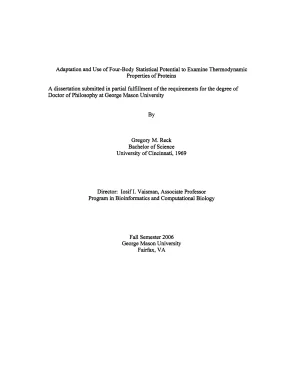
Tải xuống để đọc toàn bộAdaptation and Use of Four-Body Statistical Potential to Examine Thermodynamic Properties of Proteins A dissertation submitted in partial fulfillment of the requirements for the degree of Doctor of Philosophy at George Mason University By Gregory M. Reck Bachelor of Science University of Cincinnati, 1969 Director: Iosif I. Vaisman, Associate Professor Program in Bioinformatics and Computational Biology Fall Semester 2006 George Mason University Fairfax, VA UMI Number: 3240838 Copyright 2006 by Reck, Gregory M. All rights reserved.
INFORMATION TO USERS The quality of this reproduction is dependent upon the quality of the copy submitted. Broken or indistinct print, colored or poor quality illustrations and photographs, print bleed-through, substandard margins, and improper alignment can adversely affect reproduction. In the unlikely event that the author did not send a complete manuscript and there are missing pages, these will be noted. Also, if unauthorized copyright material had to be removed, a note will indicate the deletion.
® UMI UMI Microform 3240838 Copyright 2007 by ProQuest Information and Learning Company. All rights reserved. This microform edition is protected against unauthorized copying under Title 17, United States Code. ProQuest Information and Learning Company 300 North Zeeb Road P.
Box 1346 Ann Arbor, MI 48106-1346 ii Copyright 2006 Gregory M. Reck All Rights Reserved ADAPTATION AND USE OF FOUR-BODY STATISTICAL POTENTIAL TO EXAMINE THERMODYNAMIC PROPERTIES OF PROTEINS by Gregory M. Reck A Dissertation Submitted to the Graduate Faculty of George Mason University in Partial Fulfillment of The Requirements for the Degree of Doctor of Philosophy Bioinformatics Committee: “2⁄2. Director Program Director Assk\st Department Chairperson Zp a.
yr Chm LÍ Aa Dean, College of Science Date: | Y [ Ols Fall Semester 2006 George Mason University Fairfax, VA iii DEDICATION This dissertation is dedicated to my loving wife, Lelia, to Chelsea, the best daughter in the world and to the memory of my parents, Marie and Ronald Reck. ACKNOWLEDGEMENTS The opportunity to pursue a passion may not occur for everyone, but I have been blessed with that chance and it was due primarily to my wife, Lelia. Her encouragement and support from the outset have been unwavering. She set the example for a career path in science, challenged me to follow, and has truly been a source of inspiration.
I was indeed fortunate to have the opportunity to work with my advisor, Dr. Vaisman, a talented educator, a gifted chess player and a true gentleman. He has provided just the right mix of guidance, review and advice to keep things moving forward. And I particularly enjoyed our meetings at La Madeleine.
My sincere appreciation to my committee members, Dr. Jamison and Dr. Born for taking the time to support my efforts. I took my first class at GMU from Dr.
Willett and his insights and enthusiasm convinced me that I should press on. Jamison helped me get underway as my first advisor, and stayed with me even after his relocation to Northern Kentucky University. Born is genuinely intent on finding linkages between bioinformatics and his work with enzymes. I also want to thank Majid Masso, Ewy Mathe, Todd Taylor and Andrew Carr for the opportunity to exchange ideas and share experiences.
I appreciate their acceptance of someone from a different generation. A special thanks to Glenda Wilson, the magician who really makes things happen for the Bioinformatics students. And also to Chris Ryan for keeping the computers well- behaved and under control. Finally, I want to acknowledge the support of NASA management in providing me with the opportunity to get started in bioinformatics and recognizing that there may be alternatives to conventional wisdom in space exploration.
TABLE OF CONTENTS Page 9ò nh.1 Computational Approaches to Folding and Stability Analysis.3 Specific Aims and Dissertation FOFTât. G111 g1 ng gen 10 2 A Novel Approach to Protein-water Interaction Characteristics Using Computational GeOmMetry.2 Computational Hydration of the Protein Set.4 DT Simplex Face Match Residue Classification.5 Water Coordination Number RaiO.6 DT Water Group Parameter and Residue Classification .7 Accessible Surface AT€A. HH ch HT HH 0 0 0001 0 97 27 2.9 Circular Variance Tan.4 Results and DisCussiOn.1 Examination of the Protein HydratiOns.- - HH ng se 29 2.2 Comparison of Tessellation Classification Methods. Relationship of Simplex Face Matching Method to Location Parameters .4 Relationship of Water Group Method to Location Parameters.5 Application of the Residue Classification Methods to a Specific Protein.6 Examination of the Water Group Parameter and the Water CNR.7 Comparison of Water Group Parameter with Hydrophobicity Scales.
Q0 Họ TH 0004 06 80 04 55 3 Nearest-neighbor Contact Potentials Derived From Delaunay Tessellation of Hydrated Protein. - HH HH nh TT 0 60 ch.4 Results and DiSCUSSIOTI.1 Characteristics of the Potential Functions. do - co c1 ng gu 76 3.2 Decoy Discrimination Using the Tessellation Potential Functions. Comparison of Tessellation Results With Reported Models for Decoy BC osii 11.
93 4 Use of Statistical Potentials Derived From Delaunay Tessellation to Characterize Changes in Protein Stability Due to Single Point Mutations.- - -Q c HH Họ th 90096 101 4. Derivation of Statistical PotentiaÌS.-- --- ng ng vấn 104 4.4 Application of Statistical Potential Functions to Target Proteins .5 Machine Learning ToOÌS. cv HH ng nọ ng 00096 113 `.1 Application of Tessellation Potential to the Study Proteins.2 Comparison of Statistical Potential Strategies (CA, WG and SP).3, Correlations With Specific Residue Types. Use of Machine Learning Tools to Identify Stability Content in Mutant Residual PTrofiles.5 Examination of Transthyretin Mutant Residual Profiles for Amyloid Signal Using Machine Learning ToOÌS.
158 5 Future Dir€CtÏOnS.1 Residual Profile Searches.2 Exploration of Amyloid Mutants with Machine Learning Tools. Comparison of Water Group Parameter with Hydrophobicity Scales.G - Ă SH HH He 163 vii LIST OF TABLES Table Page Table 2.1 Comparison of the proximity of Dowser placements with the nearest crystal HOH and SOLVATE sites for 9 selected proteins.2 Number of residues classified by the simplex face match and the water group methods in specific protein ]OCAtÏOTIS. - - cọ HH ng gà 41 Table 3.1 Results of the decoy discrimination ranking of the decoy sets using various Statistical potential functions derived from both C-alpha and center of mass residue LOCATIONS.2 Results of the decoy discrimination ranking of the decoy sets using each of the three potential strategies with added hydrogen atoms. sen seesee 88 Table 3.3 Comparison of decoy discrimination ranking with reported models .1 Comparison of potentials for study proteins.2 Ability of three potential functions to correlate mutant stability changes in barnase and staphylococcal nuclease.3 Ability of three potential functions to correlate mutant stability changes in T4 LYSOZYME.4 Correlations of stability with potential for specific residue types in Staphylococcal nucÌease.-- - Ác ng HT ng ng ngà 130 Table 4.5 Performance of the Random Forests ML tool for predicting amyloid behavior for mutants of human transthyretin.- - HH ng 9031955 153 viii LIST OF FIGURES Figure Page Figure 2.1 Illustration of a tessellated hydrated protein.2 Effect of hydration on the non-redundant edge lengths of simplices.3 Illustration in two dimensions of tessellation-based residue classification MEthOdS.4 Characteristics of the 1321 proteins hydrated by SOLVATE.5 Histogram of the separation distance between crystal and SOLVATE water 3010:2077.
Separation distance between DOWSER HOH placements, and the nearest crystal and SOLVATE HOH locations for 9 selected proteins.7 The effect of isolated water groups on separation between Dowser and SOLVATE water ÏOCAfÏOTIS.- - G6 cọ TH ng ng 904 37 Figure 2.8 Comparison ofresidue coordination number for full and bulk hydrations.9 Cross comparison oftwo methods for classifying residue location using Ji: hố.10 Comparison of water group residue classification methods for variations in residue location and hydratiOn. - -- - - - < cọ HH nọ 9g ng và 44 Figure 2.11 Characteristics of surface, undersurface and buried residues classified by simplex face matching. - -- cọ HT TH ng ng T00 001 0e 46 Figure 2.12 Characteristics of core and surface residues classified by water group.13 Comparison of topological parameters for human transthyretin.14 Relationship between the water group parameter and the residue water coordination NUMDBET Tati0.15 Distribution of the water group parameter for each residue type in the reference PFOteIN S€(. - Góc HH HH TH 000 688904 90 36 Figure 2.16 Comparison of mean residue values of water group parameter and of relative accessible surface area with various hydrophobicity scales.1 Distribution plots of statistical potential funetions.2 Comparison of hydrated and unhydrated potential functions.3 Comparison of the decoy discrimination scoring index for four decoy groups using four potential function strategies.4 Effect of hydrogen addition before hydration.1 Potential profiles for the wild type study proteins using the carbon-alpha Statistical pOterntiaÌ.
«cọ KT 0 119 Figure 4.2 Sensitivity of the unhydrated T4 lysozyme residual profile to single point MUTATIONS.ccccsssccccsssrcccessscccssseccesessneteeessecessssaceeessdeeesessueceessseesesessseneeessenaes 121 ix Figure 4.3 Correlation of non-conservative mutant stability change with average mutant residual for staphylococcal nuclease using three potential functions.4 Correlation of grouped mutant stability change with mean residual for T4 lysozyme for four data subsets with different pH values.5 Correlation of stability with potential for mutants of hydrophobic residues in Staphylococcal nucÌease.- - c- c1 TH TH TT c0 T404 re 132 Figure 4.6 Correlation of binned stability with average residual potential for 56 mutants of staphylococcal nuclease that make or break a hydrogen bond.7 Correlation of binned stability with average residual potential for 22 mutants of staphylococcal nuclease surface positions that reverse or neutralize a surface CHATỠC. HT TH Ti 0 cà 00 1909 081.8 Correlation of residual potential with stability change for amino acid scan at position Y27 in staphylococcal nucÏease.9 Residual potential correlated with accessible surface area for 96 mutants of ionizable residues in staphylococcal nucÌease.10 Performance comparison of three machine learning methods used to predict Stabl]ÏẨW. - HH TH TH HT no 00000 100194 104K 140 Figure 4.11 Comparison of the ROC curves for three ML models and three potential FUNCTIONS .12 Effect of attribute content on classifier performance .13 Comparison using ROC curves of the residual-only attribute set with the full attribute S€T. - Gì TH HH HH TT 011 kh 145 Figure 4.14 Effect of number of output classes on model performance .15 Measured versus predicted stability change using a support vector Tegression MOE] .16 Support vector attribute coefficients compared to wild type potential (01-12 .17 Prediction of transthyretin mutant amyloid behavior based on the RF model using CA residuals .- - cọ TH Họ 9 156 Figure 4.18 Prediction of transthyretin mutant amyloid behavior based on the RF model using SP residuaÌs.
nọ TK 000000090 157 LIST OF ABBREVIATIONS ASA accessible surface area AUC area under the ROC curve CA carbon alpha CM center of mass CMP comprehensive mutational profile CNR coordination number ratio CV circular variance DT decision tree ML machine learning PDB Protein Data Bank random forest ROC receiver operating characteristic SP split potential SV support vector WG water group wild-type ABSTRACT ADAPTATION AND USE OF FOUR-BODY STATISTICAL POTENTLAL TO EXAMINE THERMODYNAMIC PROPERTIES OF PROTEINS Gregory M. University of Cincinnati, 1969 Thesis Director: Dr. Vaisman While most proteins in biological systems are inherently stable as a prerequisite to performing their functions, a small number of normally well-behaved proteins can engage in a process of aggregation that eventually leads to the formation of an insoluble material identified as an amyloid. Details of the aggregation process are not fully known, but for some model proteins the process can be initiated with known destabilizing conditions.
While no sequence or structural similarities have been observed among the proteins, structural instability associated with a characteristic motif in the protein could be a common thread. The proposed strategy to search for such a feature employs a knowledge-based tool that examines the sequence-structure relationship in a specific target protein based on similar relationships drawn from a large representative sample of proteins. The tool incorporates a computational structural analysis known as tessellation to identify small geometric elements each containing four neighboring amino acid residues, and builds a potential score for the protein based ona statistical analysis of the appearance of these quadruplets in the reference set.
Nội dung được bảo vệ bản quyền — Tải xuống đầy đủ
Trích dẫn luận án này
Gregory M. Reck (2006). Four-body statistical potential và tính chất nhiệt động của protein [Luận án tiến sĩ, George Mason University]. LuanAn.net. https://luanan.net/sinh-hoc/cong-nghe-sinh-hoc/four-body-statistical-potential-tinh-chat-nhiet-dong-protein
Từ khóa và chủ đề nghiên cứu
Từ khóa liên quan
Xem thêm luận án cùng lĩnh vực
Chủ đề nghiên cứu
Câu hỏi thường gặp
Luận án "Four-body statistical potential và tính chất nhiệt động của protein" nghiên cứu về vấn đề gì?
Luận án tiến sĩ ứng dụng thế năng thống kê bốn vật thể phân tích tính chất nhiệt động protein. Sử dụng phương pháp Delaunay tessellation và mô hình hóa tương tác protein-nước.
Luận án "Four-body statistical potential và tính chất nhiệt động của protein" được bảo vệ tại trường nào?
Luận án này được bảo vệ tại George Mason University. Năm bảo vệ: 2006.
Luận án "Four-body statistical potential và tính chất nhiệt động của protein" thuộc chuyên ngành gì?
Luận án "Four-body statistical potential và tính chất nhiệt động của protein" thuộc chuyên ngành Bioinformatics and Computational Biology. Danh mục: Công Nghệ Sinh Học.
Luận án "Four-body statistical potential và tính chất nhiệt động của protein" có bao nhiêu trang?
Luận án "Four-body statistical potential và tính chất nhiệt động của protein" có 204 trang. Bạn có thể xem trước một phần tài liệu ngay trên trang web trước khi tải về.
Cách tải luận án "Four-body statistical potential và tính chất nhiệt động của protein" về máy như thế nào?
Để tải luận án về máy, bạn nhấn nút "Tải xuống ngay" trên trang này, sau đó hoàn tất thanh toán phí lưu trữ. File sẽ được tải xuống ngay sau khi thanh toán thành công. Hỗ trợ qua Zalo: 0559 297 239.