The development of loop based cinematic techniques in twentieth c
Khám phá kỹ thuật làm phim dựa trên vòng lặp trong thế kỷ 20. Phân tích sự phát triển và ảnh hưởng của chúng.
Film Production / English
Luan An
Luận án tiến sĩ
Năm xuất bản
Số trang
162
Thời gian đọc
25 phút
Lượt xem
1
Lượt tải
0
Phí lưu trữ
50 Point
Tổng quan nhanh
- Chủ đề:
- Historical Evolution of Loop Animation in Cinema Techniques
- Số trang:
- 162 trang
- Trường:
- University of Central Florida
- Chuyên ngành:
- Film Production / English
- Tác giả:
- David Scoma
- Năm:
- 2008
Tóm tắt nội dung luận án
I.Historical Evolution of Loop Animation in Cinema Techniques
Repetition served as a vital element in art for centuries. Duplication and looping became significant tools for artisans across various creative formats. Within film, however, standard narrative aesthetics often overlooked these approaches. The Griffith and Eisenstein models largely disregarded looping techniques. This oversight persisted despite consistent historical use of repetition in cinema. Loop animation existed in various forms long before digital advances. Early practitioners utilized repetitive film techniques for specific effects. The artistic palette always included forms of duplication. Mainstream cinematic editing favored linear storytelling. This pushed experimental film loops to the periphery. Theorists sometimes propose looping as a sudden digital breakthrough. This perspective ignores its deep historical roots. Many practitioners maintained that technology alone enabled modern loops. This view undervalues early innovators. Avant-garde cinema often explored non-linear structures. Repetitive film techniques were central to these experiments. The artistic landscape was broader than typically acknowledged. The dissertation questions whether repetitive visuals are simply modern technical manifestations. It explores their presence throughout film history. Cyclical video editing predates the digital era. Its application in early cinema demonstrates its foundational role. Loop-based cinematic techniques were employed in diverse ways. Their evolution spans the entire 20th century. This history provides context for current digital practices. Understanding the past enriches contemporary understanding of loop animation.
1.1. Early Cinematic Repetition Overlooked Artistic Tools
Repetition served as a vital element in art for centuries. Duplication and looping became significant tools for artisans across various creative formats. Within film, however, standard narrative aesthetics often overlooked these approaches. The Griffith and Eisenstein models largely disregarded looping techniques. This oversight persisted despite consistent historical use of repetition in cinema. Loop animation existed in various forms long before digital advances. Early practitioners utilized repetitive film techniques for specific effects. The artistic palette always included forms of duplication.
1.2. Dominant Narratives vs. Experimental Film Loops
Mainstream cinematic editing favored linear storytelling. This pushed experimental film loops to the periphery. Theorists sometimes propose looping as a sudden digital breakthrough. This perspective ignores its deep historical roots. Many practitioners maintained that technology alone enabled modern loops. This view undervalues early innovators. Avant-garde cinema often explored non-linear structures. Repetitive film techniques were central to these experiments. The artistic landscape was broader than typically acknowledged.
1.3. Pre Digital Roots of Cyclical Video Editing
The dissertation questions whether repetitive visuals are simply modern technical manifestations. It explores their presence throughout film history. Cyclical video editing predates the digital era. Its application in early cinema demonstrates its foundational role. Loop-based cinematic techniques were employed in diverse ways. Their evolution spans the entire 20th century. This history provides context for current digital practices. Understanding the past enriches contemporary understanding of loop animation.
II.Digital Cinema s Embrace of Repetitive Film Techniques
Digital cinema brought renewed attention to looping. Technology advanced, making loop animation more accessible. This led to a surge in creative applications. Cinemagraphs emerged as a popular form, blending still images with subtle motion loops. These short, repetitive videos gained widespread use in digital media. GIF art also experienced a renaissance, driven by simple, engaging loops. The digital format provided new avenues for repetitive film techniques. Artists could now experiment with greater ease. The influx of digital tools transformed video art installations. Looping became a core aesthetic component. Artists leveraged technology to create immersive, cyclical experiences. Video art installations frequently employ repetitive film techniques. These installations often defy traditional narrative structures. The visual language embraced continuous, unbreaking motion. History of digital loops shows a natural progression. Technological advancement facilitated more complex and varied applications. The perception of loops as a recent digital breakthrough is incomplete. Digital cinema certainly amplified their presence. Yet, the underlying principles of repetitive visuals have a long history. Early digital applications built upon these existing concepts. The evolution of digital loops is continuous, not sudden. Its integration into modern storytelling and artistic expression continues to grow. This growth highlights the enduring power of cyclical video editing.
2.1. The Rise of Loop Animation and Cinemagraphs
Digital cinema brought renewed attention to looping. Technology advanced, making loop animation more accessible. This led to a surge in creative applications. Cinemagraphs emerged as a popular form, blending still images with subtle motion loops. These short, repetitive videos gained widespread use in digital media. GIF art also experienced a renaissance, driven by simple, engaging loops. The digital format provided new avenues for repetitive film techniques. Artists could now experiment with greater ease.
2.2. Technology s Role in Modern Video Art Installations
The influx of digital tools transformed video art installations. Looping became a core aesthetic component. Artists leveraged technology to create immersive, cyclical experiences. Video art installations frequently employ repetitive film techniques. These installations often defy traditional narrative structures. The visual language embraced continuous, unbreaking motion. History of digital loops shows a natural progression. Technological advancement facilitated more complex and varied applications.
2.3. History of Digital Loops A Continuous Evolution
The perception of loops as a recent digital breakthrough is incomplete. Digital cinema certainly amplified their presence. Yet, the underlying principles of repetitive visuals have a long history. Early digital applications built upon these existing concepts. The evolution of digital loops is continuous, not sudden. Its integration into modern storytelling and artistic expression continues to grow. This growth highlights the enduring power of cyclical video editing.
III.Challenging Film Education Beyond Standard Editing Models
Students frequently learn only standard industry procedures. Educational practices often neglect alternative aesthetic or editorial options. This creates a knowledge gap for aspiring filmmakers. Film curricula rarely explore the history of digital loops comprehensively. They overlook the diverse applications of repetitive film techniques. Broader instruction is needed to prepare students for diverse creative fields. Current education models limit understanding of cinematic possibilities. Students interested in varying techniques must often learn independently. This independent exploration can challenge traditional academic views. Instructors sometimes prioritize standard methods, discouraging experimentation. Encouraging experimental film loops fosters innovation. Education needs to support diverse approaches. This includes techniques outside common narrative means. Providing resources for avant-garde cinema helps students expand their horizons. The dissertation asks how education can inform students of non-standard techniques. It seeks strategies to enlighten practitioners about early cinema practices. These practices include the historical loop. Curricula can integrate modules on loop animation and GIF art. Workshops focusing on cyclical video editing could broaden skills. Exploring video art installations offers practical exposure. 'The Ten Minute Film School' concept suggests accessible learning paths.
3.1. Addressing Gaps in Standard Film Curriculum
Students frequently learn only standard industry procedures. Educational practices often neglect alternative aesthetic or editorial options. This creates a knowledge gap for aspiring filmmakers. Film curricula rarely explore the history of digital loops comprehensively. They overlook the diverse applications of repetitive film techniques. Broader instruction is needed to prepare students for diverse creative fields. Current education models limit understanding of cinematic possibilities.
3.2. Empowering Exploration of Experimental Film Loops
Students interested in varying techniques must often learn independently. This independent exploration can challenge traditional academic views. Instructors sometimes prioritize standard methods, discouraging experimentation. Encouraging experimental film loops fosters innovation. Education needs to support diverse approaches. This includes techniques outside common narrative means. Providing resources for avant-garde cinema helps students expand their horizons.
3.3. Strategies for Broader Technique Instruction
The dissertation asks how education can inform students of non-standard techniques. It seeks strategies to enlighten practitioners about early cinema practices. These practices include the historical loop. Curricula can integrate modules on loop animation and GIF art. Workshops focusing on cyclical video editing could broaden skills. Exploring video art installations offers practical exposure. 'The Ten Minute Film School' concept suggests accessible learning paths.
IV.Understanding Loop Taxonomy Variety in Cyclical Video Editing
The loop taxonomy outlines various forms and praxis. Classic loops involve straightforward, continuous repetition of a segment. Superimposed loops layer multiple repetitive elements, creating complex visuals. Division loops break down a sequence into smaller, repeating parts. These categories provide a framework for understanding loop animation. Each type offers distinct aesthetic possibilities. They demonstrate the versatility of repetitive film techniques. Iconic loops feature a recognizable, often short, repeating action or image. These become memorable visual motifs. Homage loops reference or imitate established cinematic loops. They pay tribute to historical instances of repetition. This categorization helps analyze loop-based cinematic techniques. It offers insight into their stylistic applications. Cyclical video editing extends beyond simple repetition. A systematic classification helps both students and practitioners. Understanding loop varieties facilitates creative choices. The framework includes diverse forms of visual repetition. This taxonomy aids in exploring the history surrounding loop applications. It also informs potential future uses. From GIF art to elaborate video art installations, categorization is key. Motion graphics loops benefit from clear definitions.
4.1. Defining Classic Superimposed and Division Loops
The loop taxonomy outlines various forms and praxis. Classic loops involve straightforward, continuous repetition of a segment. Superimposed loops layer multiple repetitive elements, creating complex visuals. Division loops break down a sequence into smaller, repeating parts. These categories provide a framework for understanding loop animation. Each type offers distinct aesthetic possibilities. They demonstrate the versatility of repetitive film techniques.
4.2. Exploring Iconic and Homage Loop Implementations
Iconic loops feature a recognizable, often short, repeating action or image. These become memorable visual motifs. Homage loops reference or imitate established cinematic loops. They pay tribute to historical instances of repetition. This categorization helps analyze loop-based cinematic techniques. It offers insight into their stylistic applications. Cyclical video editing extends beyond simple repetition.
4.3. Categorizing Repetitive Film Techniques
A systematic classification helps both students and practitioners. Understanding loop varieties facilitates creative choices. The framework includes diverse forms of visual repetition. This taxonomy aids in exploring the history surrounding loop applications. It also informs potential future uses. From GIF art to elaborate video art installations, categorization is key. Motion graphics loops benefit from clear definitions.
V.Future of Loop Based Cinematics Avant Garde Motion Graphics
The loop's importance as a digital language tool continues to grow. This is especially true with the evolution of digital cinema. GIF art thrives on concise, engaging loops. Loop animation finds increasing applications in web content and social media. These forms demonstrate the technique's accessibility and impact. They represent a significant part of contemporary visual culture. Repetitive film techniques are far from stagnant. Avant-garde cinema always challenged conventional narrative. It continues to embrace loop-based techniques. Experimental film loops offer unique ways to explore time and perception. This genre provides a fertile ground for innovation. Video art installations frequently draw from avant-garde traditions. The cyclical nature of loops aligns with many experimental artistic goals. Motion graphics heavily rely on seamless loops. These loops create dynamic backgrounds, transitions, and infographics. They are essential in advertising, branding, and user interface design. Motion graphics loops represent a powerful digital language tool. Their prevalence will only increase with technological advancements. The history of digital loops provides a foundation for these modern applications. The future of loop-based visuals is expansive.
5.1. The Growing Importance of GIF Art and Loop Animation
The loop's importance as a digital language tool continues to grow. This is especially true with the evolution of digital cinema. GIF art thrives on concise, engaging loops. Loop animation finds increasing applications in web content and social media. These forms demonstrate the technique's accessibility and impact. They represent a significant part of contemporary visual culture. Repetitive film techniques are far from stagnant.
5.2. Avant Garde Cinema s Continued Use of Loops
Avant-garde cinema always challenged conventional narrative. It continues to embrace loop-based techniques. Experimental film loops offer unique ways to explore time and perception. This genre provides a fertile ground for innovation. Video art installations frequently draw from avant-garde traditions. The cyclical nature of loops aligns with many experimental artistic goals.
5.3. Motion Graphics Loops A Digital Language Tool
Motion graphics heavily rely on seamless loops. These loops create dynamic backgrounds, transitions, and infographics. They are essential in advertising, branding, and user interface design. Motion graphics loops represent a powerful digital language tool. Their prevalence will only increase with technological advancements. The history of digital loops provides a foundation for these modern applications. The future of loop-based visuals is expansive.
Mục lục chi tiết luận án
Tải xuống file đầy đủ để xem toàn bộ nội dung
Tải đầy đủ (162 trang)Trích đoạn nội dung luận án
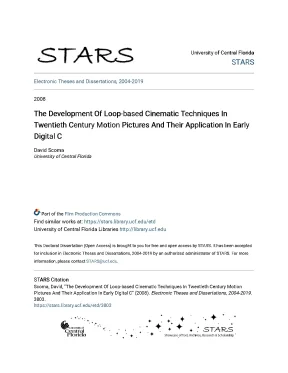
Tải xuống để đọc toàn bộUniversity of Central Florida STARS Electronic Theses and Dissertations, 2004-2019 2008 The Development Of Loop-based Cinematic Techniques In Twentieth Century Motion Pictures And Their Application In Early Digital C David Scoma University of Central Florida Part of the Film Production Commons Find similar works at: https://stars.edu/etd University of Central Florida Libraries http://library.edu This Doctoral Dissertation (Open Access) is brought to you for free and open access by STARS. It has been accepted for inclusion in Electronic Theses and Dissertations, 2004-2019 by an authorized administrator of STARS. For more information, please contact STARS@ucf. STARS Citation Scoma, David, "The Development Of Loop-based Cinematic Techniques In Twentieth Century Motion Pictures And Their Application In Early Digital C" (2008).
Electronic Theses and Dissertations, 2004-2019.edu/etd/3803 THE DEVELOPMENT OF LOOP-BASED CINEMATIC TECHNIQUES IN TWENTIETH CENTURY MOTION PICTURES AND THEIR APPLICATION IN EARLY DIGITAL CINEMA DAVID SCOMA B. Loyola University New Orleans 1990 M. State University of New York at Buffalo 1994 A dissertation submitted in partial fulfillment of the requirements for the degree of Doctor of Philosophy in the Department of English in the College of Arts and Humanities at the University of Central Florida Orlando, Florida Fall Term 2008 Major Professor: Blake Scott Copyright 2008 David Scoma ii ABSTRACT For centuries, repetition in one form or another has been seen as a significant element in the artistic palette. In numerous formats of expression, duplication and looping became a significant tool utilized by artisans in a multitude of creative formats.
Yet within the realm of film, the Griffith and Eisenstein models of cinematic editing techniques (as the most popular-- and near-monolithic--narrative aesthetic criteria) effectively disregarded most other approaches, including looping. Despite the evidence for the consistent use of repetition and looping in multiple ways throughout the course of cinematic history, some theorists and practitioners maintain that the influx of the technique within digital cinema in recent years represents a sudden breakthrough, one that has arrived simply because technology has currently advanced to a point where their utilization within digital formats now makes sense both technologically and aesthetically. This situation points to a cyclical problem. Students of film and video frequently are not taught aesthetical or editorial options other than standard industry procedures.
Those who are interested in varying techniques are therefore put in the position of having to learn alternative practices on their own. When they do look beyond visual norms to try applying different approaches in their projects, they risk going against the views of their instructors who are only interested in implementations of the standard methods which have been in the forefront for so long. Yet the loop’s importance and prevalence as a digital language tool will only likely grow with the evolution of digital cinema. With this is mind, the dissertation addresses the following questions: To what extent can various forms of repetitive visuals be found throughout film iii history, and are not simply technical manifestations that have merely emerged within digital cinema? How might current educational practices in the realm of film and video work to inform students of techniques outside of the common narrative means? Finally, what other sources or strategies might be available to enlighten students and practitioners exploring both the history surrounding--and possible applications of--techniques based upon early cinema practices such as the loop? iv ACKNOWLEDGEMENTS For lending technical expertise to this project, I would like to thank Sean O’Brien, Jason Lange and Casey Capshaw.
I would also like to express my gratitude to the members of the committee: Glenda Gunter, Melody Bowdon, Karla Kitalong and Anthony Grajeda. Most especially I would like to thank my committee chair, Blake Scott. v TABLE OF CONTENTS LIST OF FIGURES….1 CHAPTER ONE: THE LOOP TAXONOMY – VARIETY IN FORMS AND PRAXIS…………….18 CHAPTER TWO: THE LOOP IN THE 20TH CENTURY – AN OVERVIEW.48 CHAPTER THREE: DIGITAL VIDEO PRACTICES IN CURRENT CINEMA.77 CHAPTER FOUR: THE STATE OF DIGITAL VIDEO PRACTICES IN INDUSTRY AND EDUCATION.………………………………………………………………………101 CONCLUSION: THE TEN MINUTE FILM SCHOOL.142 LIST OF REFERENCES.……………………………………………………………146 vi LIST OF FIGURES FIGURE 1: CLASSIC LOOP…………………………….11, 143 FIGURE 2: SUPERIMPOSED LOOP…………….……12, 143 FIGURE 3: DIVISION LOOP……….13, 144 FIGURE 4: ICONIC LOOP.14, 144 FIGURE 5: HOMAGE LOOP…………….15, 145 vii INTRODUCTION In 1915, D. Griffith released his film The Birth of a Nation.
This movie proved to be important not only for its controversial portrayal of the Klan and the Civil War-era South, but also for its use of visual techniques. Griffith is credited with introducing elements to motion picture production such as the close-up, the long shot, and the medium shot. To the technique of mis-en-scene, he is credited with framing the action so as to facilitate concise editing procedures that would eventually lead to smoother “storytelling” on the screen. To the field of montage, he is given credit for utilizing a close-up of a face looking away, before cutting to another object that the face in the first shot must be gazing at (Gianetti 41).
Griffith, of course, was not solely responsible for bringing these techniques into existence. Nor was he even close to being the first director to put into practice the individual elements listed above within the realm of film making. What Griffith brought to the cinematic equation, for which he has thus been given his due for over ninety years, was the way in which he captured and arranged those elements sequentially through both production and postproduction. In other words, Griffith was instrumental in the fusing of these rudimentary units to become interdependent.
As a result, it was the way this melding ended up being viewed as an early stab at a coherent narrative “language” that is perhaps Griffith’s primary contribution to the field of cinema. As just mentioned, numerous film makers had put these various individual elements to use within their films before 1915. Close-ups, medium shots, and long shots can be found in works ranging from those of Zecca in drama and Porter in early documentary, to the comedies of Mack Sennett. Prior to Griffith, though, the individual elements were implemented by directors primarily as tools for simply capturing the individual shots.
In essence, before Griffith, directors 1 would strive to get the scene on film and then worry about how those shots would be thrown together in editing later. Within this mindset, the concern for capturing the action via the framing of the actors dictated where the camera was put--either right up beside the talent, or backed up far enough to take in a large panorama. If the initially desired original shot was not captured during principal photography, an alternate narrative solution would have to be found during editing. These approaches to mis-en-scene and aesthetics appeared to rule the day.
Under that format, chaos, it seemed, was often the order of the day. For example, Lillian Gish recounted in her autobiography that when battle scenes were staged and shot in movies previous to Griffith’s, it was nearly impossible to distinguish one opposing army from the other within the bedlam onscreen (Gish and Pinchot 141). This changed with Griffith, she said, because during the shooting process he began to implement his ideas regarding how the final assembled shots would appear to the audience in the ultimate version of the film. By organizing the action on the set, Griffith could figure out how the scenes could best be filmed in order to facilitate, assist, and even enhance the storytelling options in the editing room.
By staging the action so that the Confederate army always entered the view of the camera on the left hand side and the Union always entered on the right, the audience would be given a much greater chance to keep up with the unfolding battle scene (Gish and Pinchot 140). While shooting with this template opened up numerous stylistic options for Griffith, it also saddled him with a number of aesthetic rules for the editing phase. Since the Confederacy had always been filmed from the left, Griffith needed to continually assemble the individual clips so that they matched up to that directional flow. This he did--from the closest hand-to-hand combat to the longest possible shot of the battlefield.
When audiences went to see the film, they eventually became used to this left-right pattern, as well as the ease it provided in distinguishing armies. 2 However, other innovations of Griffith in this film--though they are now part-and-parcel of the narrative toolbox - did not catch on quite as easily. A number of Griffith’s camera innovations were startling for the time. Take, for example, digging a hole deep enough to place a camera and operator in, then aiming the lens at the sky before having a group of horsemen gallop right overhead (Gish and Pinchot 146).
Yet it may be the subtler, even preliminarily confusing implementations for which the director will always be remembered. The importance of the close-up technique described earlier was to the overall development of the cinematic narrative language cannot be overstated (Gish and Pinchot 146). Though initial audiences did not always catch on to this right away, Griffith effectively used both the initial shooting and the final sequential editing of the shots in a fresh manner. (For another example, a close-up shows a man turning his face and looking to the right.
The next shot edited in shows a child on a swing. The two shots together leave the audience with the impression that the man in the first shot is looking at the child on the swing in the second shot.) This approach, combined with Griffith’s manner of on-set filming, are well-developed early examples of critical developments within the field of visual narrative techniques (Gianetti 119). Though unknown to Griffith or anyone else at the time, these approaches would all but define the way that cinematic narrative entertainment would be shot, watched, and finally interpreted by both film makers and audiences for the rest of the century (Gianetti 117). Griffith, however, was not alone in this developmental mindset.
Soviet film maker and cinema theorist Sergei Eisenstein began creating the works--both celluloid and written--which would eventually bring him renown only a few years after Griffith completed Birth. Eisenstein experimented with, expanded upon, wrote about, and published cinematic theory based upon these techniques first started by Griffith. Even at that early stage of film history (not yet thirty 3 years in), the narrative traits of Griffith and Eisenstein had quickly developed into standard operating procedure across the cinematic world (Gianetti 42). In the decades since, application of the narrative editing techniques based upon those principles have become universally entrenched in the motion picture industry.
As a result, they have also been “learned” by audience members who have repeatedly viewed the techniques through their consumption of films and television programs alike. The terms that were coined have themselves found their way into the vocabulary of individuals who will never pick up a camera or sit in an editing bay. With this historical framework in mind, we can ask the question “What, in fact are loops, and why are they of any significance?” Though the cinematic “language” tools of Griffith (as well as those initial similar practices used by some of his predecessors, from Mélìes to the short comedic films of Mack Sennet) have been the domineering force in motion pictures for nearly a century, they certainly are not the only ones available, and definitely were not the first. The loop (and additionally, cinematic visuals based upon kaleidoscopic principles) holds a specific and, in fact, vital role in the canon of cinematic expression.
Visuals of this type have appeared consistently in motion pictures ever since the days of the zoetrope. The loop, in its classic pre- cinematic form, consisted of a collection of individual film frames. After running their course from start to finish, the celluloid strand would then repeat, starting again from the very first frame.
Nội dung được bảo vệ bản quyền — Tải xuống đầy đủ
Trích dẫn luận án này
David Scoma (2008). The development of loop based cinematic techniques in twenti [Luận án tiến sĩ, University of Central Florida]. LuanAn.net. https://luanan.net/san-khau-dien-anh/the-development-of-loop-based-cinematic-techniques-in-twentieth-c
Câu hỏi thường gặp
Luận án "The development of loop based cinematic techniques in twenti" nghiên cứu về vấn đề gì?
Khám phá kỹ thuật làm phim dựa trên vòng lặp trong thế kỷ 20. Phân tích sự phát triển và ảnh hưởng của chúng.
Luận án "The development of loop based cinematic techniques in twenti" được bảo vệ tại trường nào?
Luận án này được bảo vệ tại University of Central Florida. Năm bảo vệ: 2008.
Luận án "The development of loop based cinematic techniques in twenti" thuộc chuyên ngành gì?
Luận án "The development of loop based cinematic techniques in twenti" thuộc chuyên ngành Film Production / English. Danh mục: Sân Khấu - Điện Ảnh.
Luận án "The development of loop based cinematic techniques in twenti" có bao nhiêu trang?
Luận án "The development of loop based cinematic techniques in twenti" có 162 trang. Bạn có thể xem trước một phần tài liệu ngay trên trang web trước khi tải về.
Cách tải luận án "The development of loop based cinematic techniques in twenti" về máy như thế nào?
Để tải luận án về máy, bạn nhấn nút "Tải xuống ngay" trên trang này, sau đó hoàn tất thanh toán phí lưu trữ. File sẽ được tải xuống ngay sau khi thanh toán thành công. Hỗ trợ qua Zalo: 0559 297 239.