Injection locked semiconductor lasers for realization of novel rf
Mô tả về các laser bán dẫn được khóa bằng tiêm để đạt được sự hiện thực hóa của "nov"
Optics and Photonics
Luan An
Luận án tiến sĩ
Năm xuất bản
Số trang
129
Thời gian đọc
20 phút
Lượt xem
0
Lượt tải
0
Phí lưu trữ
40 Point
Tổng quan nhanh
- Chủ đề:
- Injection-Locked Semiconductor Lasers: RF Photonics Foundation
- Số trang:
- 129 trang
- Trường:
- University of Central Florida
- Chuyên ngành:
- Optics and Photonics
- Tác giả:
- Nazanin Hoghooghi
- Năm:
- 2012
Tóm tắt nội dung luận án
I.Injection Locked Semiconductor Lasers RF Photonics Foundation
Nghiên cứu này khám phá ứng dụng của các laser bán dẫn khóa tần số (injection-locked semiconductor lasers) trong phát triển các thành phần photonics RF (radio frequency) mới. Công nghệ injection locking là trọng tâm, cải thiện đáng kể hiệu suất của các hệ thống quang học. Luận văn giới thiệu hai thành phần chính: bộ điều biến giao thoa tuyến tính (linear interferometric modulator) và bộ tách sóng pha trực tiếp (direct phase detector) với khả năng lọc kênh. Các laser diode được khóa tần số đóng vai trò thiết yếu trong việc đạt được các tính năng này. Mục tiêu là giải quyết các thách thức trong photonics RF, cung cấp các giải pháp hiệu quả hơn. Các laser bán dẫn được lựa chọn vì tính nhỏ gọn và khả năng điều chỉnh linh hoạt. Việc sử dụng injection locking giúp ổn định tần số, giảm độ rộng vạch phổ laser (laser linewidth reduction) và triệt tiêu nhiễu pha (phase noise suppression). Những cải tiến này là cần thiết cho các ứng dụng đòi hỏi độ chính xác cao trong truyền thông quang tốc độ cao (high-speed optical communication) và hệ thống lidar.
1.1. Vai trò của Injection Locking trong Photonics RF
Injection locking là một kỹ thuật mạnh mẽ. Nó buộc tần số của một laser phụ (slave laser) phải khớp với tần số của một laser chủ (master laser). Quá trình này giúp ổn định tần số và pha của laser bán dẫn. Kết quả là giảm đáng kể độ rộng vạch phổ laser và nhiễu pha. Điều này rất quan trọng đối với các ứng dụng photonics RF cần tín hiệu quang học chất lượng cao. Nó cũng mở ra khả năng cho các hệ thống phức tạp hơn, như kết hợp chùm tia đồng bộ (coherent beam combining). Các laser bán dẫn được hưởng lợi đặc biệt từ kỹ thuật này, khắc phục các hạn chế vốn có về độ ổn định. Việc ứng dụng injection locking giúp nâng cao hiệu suất tổng thể của các hệ thống truyền thông quang học.
1.2. Ứng dụng đột phá trong Thành phần Quang học
Nghiên cứu này tập trung vào việc hiện thực hóa các thành phần quang học mới. Laser bán dẫn khóa tần số được dùng để tạo ra bộ điều biến giao thoa tuyến tính và bộ tách sóng pha trực tiếp. Các thành phần này có ý nghĩa quan trọng đối với các hệ thống RF photonics. Chúng cung cấp các chức năng nâng cao như điều biến cường độ hiệu quả và phát hiện pha không cần bộ dao động cục bộ. Những đổi mới này mở đường cho các giải pháp hiệu quả hơn. Chúng cũng cải thiện hiệu suất trong các lĩnh vực như truyền thông và cảm biến. Việc tích hợp các laser diode vào các thiết kế này tạo ra các hệ thống nhỏ gọn và đáng tin cậy. Các hệ thống lidar cũng có thể hưởng lợi từ các thành phần này.
II.Thiết kế Hiệu suất Bộ Điều biến Giao thoa Tuyến tính
Một bộ điều biến cường độ quang học giao thoa tuyến tính mới đã được giới thiệu. Thiết kế này dựa trên việc sử dụng laser khóa tần số (injection-locked laser) như một bộ điều biến pha arcsine. Hiệu suất của các hệ thống quang học được cải thiện đáng kể với một bộ điều biến cường độ tuyến tính. Các thiết kế bộ điều biến tuyến tính hóa hiện có đã được xem xét. Mô hình số đã mô phỏng phản ứng pha và biên độ của laser bán dẫn khóa tần số. Mô hình này sau đó được mở rộng. Nó nghiên cứu ảnh hưởng của tỷ lệ khóa tần số (injection ratio), phản ứng khoang không tuyến tính, độ sâu điều biến pha và biên độ. Các yếu tố này ảnh hưởng đến dải động không nhiễu giả (spur-free dynamic range - SFDR) của bộ điều biến khoang cộng hưởng bán dẫn tuyến tính. Các kết quả thực nghiệm đã chứng minh hiệu suất vượt trội. Các laser bán dẫn Fabry-Perot đa mode được sử dụng làm khoang cộng hưởng. Hiệu suất bộ điều biến cũng được nghiên cứu bằng cách sử dụng laser phát xạ bề mặt khoang đứng (Vertical Cavity Surface Emitting Laser - VCSEL) làm khoang cộng hưởng.
2.1. Mô phỏng Số và Tối ưu hóa Thiết kế Modulator
Các mô phỏng số chi tiết đã được thực hiện. Chúng phân tích phản ứng pha và biên độ của laser bán dẫn khóa tần số. Mục tiêu là hiểu rõ hoạt động của bộ điều biến pha arcsine. Mô hình số đã được mở rộng. Nó khám phá các yếu tố chính ảnh hưởng đến hiệu suất của bộ điều biến. Các yếu tố này bao gồm tỷ lệ khóa tần số, phản ứng khoang không tuyến tính, và độ sâu điều biến pha và biên độ. Việc nghiên cứu các tham số này giúp tối ưu hóa thiết kế. Nó đảm bảo dải động không nhiễu giả cao. Phân tích này là rất quan trọng để đạt được sự tuyến tính mong muốn. Nó cũng giúp duy trì hiệu suất trong các ứng dụng truyền thông quang tốc độ cao. Các laser diode được dùng làm thành phần chính.
2.2. Kết quả Thực nghiệm và Hiệu suất Vượt trội
Kết quả thực nghiệm đã xác nhận hiệu suất của bộ điều biến tuyến tính. Giá trị Vπ cực thấp, chỉ khoảng 1 mV, đã được đo trực tiếp sau bộ điều biến. Điều này cho thấy hiệu quả cao trong việc điều biến. Băng thông đa gigahertz (-10 dB băng thông 5 GHz) cũng được đạt được. Dải động không nhiễu giả (SFDR) là 120 dB.Hz2/3. Các kết quả này vượt trội so với các thiết kế hiện có. Hiệu suất của bộ điều biến trong một liên kết analog cũng được điều tra. Không có sự suy giảm tuyến tính của bộ điều biến sau 1 km sợi quang đơn mode (SMF). Việc sử dụng VCSEL làm khoang cộng hưởng cũng được nghiên cứu. Các phát hiện này mở đường cho các hệ thống truyền thông quang tốc độ cao và lidar tiên tiến.
III.Phát hiện Pha Trực tiếp Lọc Kênh bằng Diode Lasers
Nghiên cứu đã chuyển trọng tâm sang các ứng dụng của laser bán dẫn khóa tần số như một bộ tách sóng pha trực tiếp và bộ lọc kênh. Kỹ thuật phát hiện pha này có một lợi thế đáng kể. Nó không yêu cầu một bộ dao động cục bộ. Điều này làm đơn giản hóa đáng kể thiết kế hệ thống và giảm chi phí. Các laser diode được khóa tần số cho thấy khả năng phát hiện pha hiệu quả. Chúng cũng thể hiện khả năng lọc kênh trong một hệ thống ba kênh. Tín hiệu điện được phát hiện có tỷ lệ tín hiệu trên nhiễu (SNR) tốt hơn 60 dB/Hz. Điều này chỉ ra một chất lượng tín hiệu cao. Khả năng lọc kênh cho phép tách các kênh tín hiệu khác nhau. Điều này rất quan trọng đối với các ứng dụng truyền thông quang tốc độ cao. Các giải pháp này cũng có tiềm năng trong hệ thống lidar và các ứng dụng đòi hỏi độ ổn định tần số cao. Kỹ thuật này giảm thiểu sự phức tạp và tối ưu hóa hiệu suất.
3.1. Ưu điểm của Phát hiện Pha không Bộ Dao động Cục bộ
Phương pháp phát hiện pha trực tiếp này độc đáo. Nó loại bỏ sự cần thiết của một bộ dao động cục bộ. Bộ dao động cục bộ thường làm tăng sự phức tạp và chi phí của hệ thống. Việc bỏ qua thành phần này giúp đơn giản hóa đáng kể kiến trúc hệ thống. Nó cũng giảm yêu cầu về công suất. Điều này rất quan trọng đối với các ứng dụng yêu cầu thiết bị nhỏ gọn và hiệu quả năng lượng. Việc sử dụng các laser bán dẫn khóa tần số làm cho điều này khả thi. Nó cung cấp một giải pháp đáng tin cậy để tách pha tín hiệu. Các ứng dụng như truyền thông quang tốc độ cao và hệ thống lidar sẽ được hưởng lợi.
3.2. Hiệu suất Lọc Kênh và Tỷ lệ Tín hiệu trên Nhiễu
Các kết quả thực nghiệm đã chứng minh khả năng phát hiện và lọc kênh. Một hệ thống ba kênh đã được sử dụng để trình diễn. Tín hiệu điện được phát hiện có tỷ lệ tín hiệu trên nhiễu (SNR) cao. SNR đạt được tốt hơn 60 dB/Hz. Điều này là dấu hiệu của chất lượng tín hiệu tuyệt vời. Khả năng lọc kênh cho phép chọn lọc các kênh mong muốn. Nó loại bỏ nhiễu từ các kênh lân cận. Đây là một tính năng quan trọng đối với các hệ thống truyền thông mật độ cao. Các laser diode khóa tần số đóng vai trò trung tâm trong việc đạt được hiệu suất này. Việc triệt tiêu nhiễu pha cũng góp phần vào SNR cao. Điều này mở ra các ứng dụng mới cho quang học tần số vô tuyến.
IV.Nghiên cứu Triệt tiêu Nhiễu Pha trong VCSELs Khóa Tần số
Nghiên cứu cũng tập trung vào nhiễu pha được thêm vào bởi một laser phát xạ bề mặt khoang đứng khóa tần số (injection-locked VCSEL). Nhiễu pha là một yếu tố quan trọng ảnh hưởng đến hiệu suất của các hệ thống quang học. Nó đặc biệt quan trọng trong truyền thông quang tốc độ cao và các ứng dụng đồng bộ. Kỹ thuật tự dao động dị tần (self-heterodyne technique) đã được sử dụng để nghiên cứu nhiễu pha. Kỹ thuật này cho phép đo lường chính xác các đặc tính nhiễu pha. Các kết quả đã chỉ ra sự phụ thuộc của nhiễu pha thêm vào. Sự phụ thuộc này là vào tỷ lệ khóa tần số (injection ratio) và tần số lệch (detuning frequency). Việc hiểu rõ các mối quan hệ này là rất quan trọng. Nó giúp tối ưu hóa hiệu suất của các laser bán dẫn khóa tần số. Mục tiêu là giảm thiểu nhiễu pha và cải thiện độ ổn định tần số. Điều này có lợi cho việc tạo ra các lược tần số quang học (optical frequency combs) chất lượng cao và các hệ thống lidar chính xác hơn.
4.1. Kỹ thuật Tự Dao động Dị tần để Đo Nhiễu Pha
Kỹ thuật tự dao động dị tần (self-heterodyne technique) được áp dụng. Nó nghiên cứu nhiễu pha thêm vào bởi VCSELs khóa tần số. Kỹ thuật này có hiệu quả cao trong việc đo độ rộng vạch phổ laser và nhiễu pha. Nó cho phép phân tích chi tiết các đặc tính phổ của laser. Bằng cách sử dụng phương pháp này, các nhà nghiên cứu có thể xác định chính xác các thành phần nhiễu pha. Thông tin này là cần thiết để phát triển các chiến lược triệt tiêu nhiễu pha hiệu quả. Mục tiêu là cải thiện độ ổn định tần số và giảm độ rộng vạch phổ laser. Điều này có ý nghĩa quan trọng đối với truyền thông quang tốc độ cao. Nó cũng quan trọng cho các ứng dụng đòi hỏi độ chính xác về tần số.
4.2. Phụ thuộc của Nhiễu Pha vào Tỷ lệ Khóa Tần số và Tần số Lệch
Các kết quả nghiên cứu đã tiết lộ sự phụ thuộc của nhiễu pha. Nó phụ thuộc vào tỷ lệ khóa tần số (injection ratio) và tần số lệch (detuning frequency). Tỷ lệ khóa tần số là cường độ của tín hiệu laser chủ vào laser phụ. Tần số lệch là sự khác biệt giữa tần số của laser chủ và tần số tự do của laser phụ. Việc điều chỉnh các tham số này có thể ảnh hưởng lớn đến mức độ nhiễu pha. Sự hiểu biết này cho phép tối ưu hóa hoạt động của laser bán dẫn khóa tần số. Nó giúp đạt được triệt tiêu nhiễu pha tối đa. Điều này rất quan trọng đối với các ứng dụng đòi hỏi độ ổn định tần số và độ chính xác pha cao, như hệ thống lidar và lược tần số quang học.
V.Hướng Phát triển Tương lai cho các Thành phần Photonics RF
Nghiên cứu này cũng vạch ra các hướng phát triển tương lai. Các công việc tiếp theo sẽ tập trung vào bộ điều biến cường độ giao thoa tuyến tính. Một lĩnh vực chính là việc tích hợp bộ điều biến lên một chip bán dẫn. Việc tích hợp này sẽ dẫn đến các thiết bị nhỏ gọn hơn, hiệu quả hơn. Nó cũng giảm chi phí sản xuất. Một hướng khác là thiết kế bộ điều biến cho ánh sáng xung đầu vào. Điều này mở rộng phạm vi ứng dụng của bộ điều biến. Nó cho phép sử dụng trong các hệ thống yêu cầu xử lý tín hiệu xung tốc độ cao. Các laser bán dẫn khóa tần số sẽ tiếp tục là công nghệ cốt lõi. Những tiến bộ này sẽ củng cố vai trò của photonics RF trong các ứng dụng khác nhau. Các khả năng bao gồm truyền thông quang tốc độ cao và hệ thống lidar. Việc tập trung vào tích hợp và tính linh hoạt sẽ thúc đẩy đổi mới hơn nữa. Nó giúp hiện thực hóa các lược tần số quang học và kết hợp chùm tia đồng bộ tiên tiến hơn.
5.1. Tích hợp Bộ Điều biến trên Chip Bán dẫn
Một mục tiêu chính trong tương lai là tích hợp bộ điều biến. Nó sẽ được tích hợp trực tiếp lên một chip bán dẫn. Việc tích hợp này mang lại nhiều lợi ích đáng kể. Nó bao gồm giảm kích thước, giảm trọng lượng và giảm tiêu thụ năng lượng. Nó cũng cải thiện độ tin cậy của thiết bị. Việc tạo ra các chip quang học tích hợp giúp sản xuất hàng loạt. Điều này giảm chi phí tổng thể của hệ thống. Các thiết bị tích hợp sẽ rất quan trọng đối với các ứng dụng thương mại. Các hệ thống yêu cầu photonics RF nhỏ gọn và hiệu quả sẽ được hưởng lợi. Các laser diode khóa tần số là lý tưởng cho việc tích hợp này.
5.2. Thiết kế Modulator cho Ánh sáng Xung Đầu vào
Một hướng phát triển quan trọng khác là thiết kế bộ điều biến. Nó cần được tối ưu hóa cho ánh sáng xung đầu vào. Điều này mở rộng đáng kể các ứng dụng tiềm năng của bộ điều biến. Nó cho phép sử dụng trong các hệ thống truyền thông quang tốc độ cao dựa trên xung. Nó cũng hữu ích trong các hệ thống lidar xung và các lược tần số quang học. Việc xử lý hiệu quả ánh sáng xung đòi hỏi các điều chỉnh đặc biệt. Các điều chỉnh này liên quan đến đáp ứng động và tuyến tính của bộ điều biến. Việc phát triển này sẽ tăng cường tính linh hoạt. Nó cũng mở rộng khả năng của các thành phần photonics RF. Các laser bán dẫn khóa tần số cung cấp nền tảng cần thiết cho những tiến bộ này.
Mục lục chi tiết luận án
Tải xuống file đầy đủ để xem toàn bộ nội dung
Tải đầy đủ (129 trang)Trích đoạn nội dung luận án
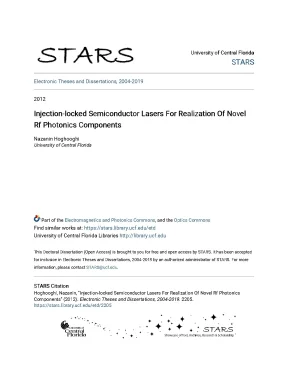
Tải xuống để đọc toàn bộUniversity of Central Florida STARS Electronic Theses and Dissertations, 2004-2019 2012 Injection-locked Semiconductor Lasers For Realization Of Novel Rf Photonics Components Nazanin Hoghooghi University of Central Florida Part of the Electromagnetics and Photonics Commons, and the Optics Commons Find similar works at: https://stars.edu/etd University of Central Florida Libraries http://library.edu This Doctoral Dissertation (Open Access) is brought to you for free and open access by STARS. It has been accepted for inclusion in Electronic Theses and Dissertations, 2004-2019 by an authorized administrator of STARS. For more information, please contact STARS@ucf. STARS Citation Hoghooghi, Nazanin, "Injection-locked Semiconductor Lasers For Realization Of Novel Rf Photonics Components" (2012).
Electronic Theses and Dissertations, 2004-2019.edu/etd/2205 INJECTION-LOCKED SEMICONDUCTOR LASERS FOR REALIZATION OF NOVEL RF PHOTONICS COMPONENTS by NAZANIN HOGHOOGHI B. Iran University of Science and Technology, 2005 M. Rose-Hulman Institute of Technology, 2007 A dissertation submitted in partial fulfillment of the requirements for the degree of Doctor of Philosophy in CREOL, The College of Optics and Photonics at the University of Central Florida Orlando, Florida Summer Term 2012 Major Professor: Peter J. © 2012 Nazanin Hoghooghi ii ABSTRACT This dissertation details the work has been done on a novel resonant cavity linear interferometric modulator and a direct phase detector with channel filtering capability using injection-locked semiconductor lasers for applications in RF photonics.
First, examples of optical systems whose performance can be greatly enhanced by using a linear intensity modulator are presented and existing linearized modulator designs are reviewed. The novel linear interferometric optical intensity modulator based on an injection-locked laser as an arcsine phase modulator is introduced and followed by numerical simulations of the phase and amplitude response of an injection-locked semiconductor laser. The numerical model is then extended to study the effects of the injection ratio, nonlinear cavity response, depth of phase and amplitude modulation on the spur-free dynamic range of a semiconductor resonant cavity linear modulator. Experimental results of the performance of the linear modulator implemented with a multi-mode Fabry-Perot semiconductor laser as the resonant cavity are shown and compared with the theoretical model.
The modulator performance using a vertical cavity surface emitting laser as the resonant cavity is investigated as well. Very low Vπ in the order of 1 mV, multi-gigahertz bandwidth (-10 dB bandwidth of 5 GHz) and a spur-free dynamic range of 120 dB.Hz2/3 were measured directly after the modulator. The performance of the modulator in an analog link is experimentally investigated and the results show no degradation of the modulator linearity after a 1 km of SMF. The focus of the work then shifts to applications of an injection-locked semiconductor laser as a direct phase detector and channel filter.
This phase detection technique does not iii require a local oscillator. Experimental results showing the detection and channel filtering capability of an injection-locked semiconductor diode laser in a three channel system are shown. The detected electrical signal has a signal-to-noise ratio better than 60 dB/Hz. In chapter 4, the phase noise added by an injection-locked vertical cavity surface emitting laser is studied using a self-heterodyne technique.
The results show the dependency of the added phase noise on the injection ratio and detuning frequency. The final chapter outlines the future works on the linear interferometric intensity modulator including integration of the modulator on a semiconductor chip and the design of the modulator for input pulsed light. iv To my family v ACKNOWLEDGMENTS I would like to thank past and present members of Ultrafast Photonics group for all their continuous supports. They are Prof.
Peter Delfyett, Dr. Sarper Ozharar, Dr. Frank Quinlan, Dr. Ji-Myoung Kim, Dr.
Ibrahim Ozdur, Dr. Dimitrios Mandridis, Mohammad Umar Piracha, Charles Williams, Sharad Bhooplapur, Abhijeet Ardey, Dat Nguyen, Josue Davila-Rodriguez, Marcus Bagnell, Edris Sarailou, Anthony Klee, and Kristina Bagnell. I would particularly like to emphasize the importance of Prof. Peter Delfyett, Dr.
Ibrahim Ozdur and Josue Davila-Rodriguez without whom none of what follows would have been possible. vi TABLE OF CONTENTS LIST OF FIGURES .x LIST OF TABLES. xviii CHAPTER 1: INTRODUCTION .1 Injection locking of lasers .2 Applications of injection locked lasers. 4 CHAPTER 2: RESONANT CAVITY LINEAR INTERFEROMETRIC INTENSITY MODULATOR .2 Intensity modulation techniques .1 Direct modulation of light intensity .2 External modulation of light intensity .1 Predistortion linearization scheme .2 Feedforward linearization scheme .3 Linearized ring resonator assisted Mach-Zehnder modulators .4 Dual parallel Mach-Zehnder modulator.5 Cascaded Mach-Zehnder modulators .6 Directional coupler with two passive biases .4 Resonant cavity linear interferometric intensity modulator.1 Phase response of an injection locked semiconductor laser .2 Dynamic stability of an injection locked semiconductor laser .3 Linearity of modulator response .1 Resonant cavity linear modulator with a Fabry-Pérot laser as the resonant cavity .2 Resonant cavity linear modulator with a VCSEL as the resonant cavity .3 Measurements of the linear modulator SFDR .4 SFDR measurements of an analog optical link with the linear modulator .6 Discussions and conclusion.
78 CHAPTER 3: DIRECT DEMODULATION AND CHANNEL FILTERING OF PHASE MODULATED OPTICAL SIGNALS .4 Application in a cross connect switch. 93 CHAPTER 4: PHASE NOISE OF AN INJECTION LOCKED SEMICONDUCOTR LASER .1 Self-heterodyne setup. 100 CHAPTER 5: FUTURE WORKS.1 Monolithic integration of the linear modulator .2 Resonant cavity linear interferometric modulator for pulsed light .106 ix LIST OF FIGURES Figure 1. Injection locking of two lasers.
Behavior of the slave laser when the injection seed is tuned inside or outside the locking range [3]. Analog link in a remote antenna system. Block diagram of a SCM-WDM system. Block diagram of a conventional OEO.
A typical electro-optic intensity modulator. A Pockel cell is placed between two crossed polarizers. Output modulated light intensity versus the modulating voltage of an electro-optic modulator. An integrated Mach-Zehnder optical intensity modulator.
Calculation of SFDR from the fundamental and third-order intermodulation power vs. input RF power plot. Plot of maximum achievable SNR as a function of average photocurrent. Thermal noise and shot noise limits are shown in blue and red lines, respectively.
The green line is the maximum achievable SNR for a system with -155 dBc/Hz RIN. Predistortion linearizer system[35]. Block diagram of a feedforward linearization system. Schematic of a dual RRMZM optical intensity modulator in push–pull configuration [31].
A hybrid RRMZM modulator. γ is the coupling coefficient of the ring resonator. The phase modulator and the ring resonator are driven by the same RF signal with a power split ratio of F and 1-F[30]. Schematic of a dual parallel Mach-Zehnder modulator [32].
Schematic of a cascaded Mach-Zehnder modulator[33]. Schematic of a directional coupler with two passive biases [43]. Resonant cavity linear interferometric intensity modulator setup. Simulation results: (a) SFDR vs.
depth of modulation (b) SFDR vs. bias point of the modulator at 10% depth of modulation. Normalized output power of an injection-locked semiconductor laser as a function of frequency detuning (α =1).Graphical representation of the resonant cavity frequency shift and its relative phase to the master laser at different detuning frequencies across the locking range. Normalized output power of an injection-locked semiconductor laser as a function of frequency detuning (α =0).
Phasor diagram of the master and slave laser electric fields within the locking range for α=0. Normalized output power of an injection locked laser for α= 0, 1, 2, and 3. frequency detuning for different injection ratios and for (a) α =0 and (b) α =3. The unlocked regions are shown by dashed lines in (b).
Stability plot of an injection locked semiconductor laser with parameters listed in Table 1. Surface plot of signal-to-intermodulation ratio as a function of depth of modulation and injection ratio for α =3. (a) Signal-to-intermodulation ratio vs. injection ratio at 40% depth of modulation, (b) Signal-to-intermodulation vs.
depth of phase modulation at 0. Signal-to-intermodulation ratio vs. injection ratio for a nonlinear (red) and linear (blue) cavity responses. Experimental setup for measuring the signal-to-intermodulation ratio of the modulator.
BS: Beam splitter; WP: Waveplate; FPL: Fabry–Pérot laser; RFSA: Radio frequency spectrum analyzer; OSA: Optical spectrum analyzer. Optical spectra of the Fabry-Pérot laser (a) not injection locked (b) injection locked. (a)-(d)Evolution of the undamped relaxation oscillation frequencies within the locking range. Detected RF power spectra (a) fundamental frequencies (b) one of the third- order intermodulation frequencies (200 MHz).
Theoretically calculated and measured values of signal-to-intermodulation ratio at different input RF drive powers with 0. Structure of a VCSEL device. Characteristics of the VCSEL device used in the experiment (a) L-I curve (b) frequency tunablity curve. System diagram: VCSEL: Vertical cavity surface emitting laser, VOA: Variable optical attenuator, PZT: Piezo electric transducer, PC: Polarization controller, Iso: Isolator, CIR: Circulator, PD: Photodetector, RFSA: Radio frequency spectrum analyzer, High-res OSA: High resolution optical spectrum analyzer.Static phase shift plot of the injection-locked VCSEL.
(a) Detected intensity modulated signal at the output of the resonant cavity modulator at 20 MHz modulation frequency and (b) frequency response of the linear modulator. The -10 dB bandwidth is ~5 GHz. SFDR measurements: (a) Power spectrum at the output of the two-tone SFDR measurement using 300 and 400 MHz tones (b) Low resolution bandwidth (1 Hz) spectrum of the 500 MHz third order intermodulation tone. Frequency stability measurement setup.
Free running VCSEL beating with a stable source (Orbits lightwave). Injection-locked VCSEL beating with a stable source (Orbits lightwave). System diagram of the linear modulator with a simple bias point locking scheme. Iso: Isolator; VOA: Variable optical attenuator; PC: Polarization controller; VCSEL: Vertical cavity surface emitting laser; PZT: piezoelectric transducer (fiber stretcher); EDFA: Erbium-doped fiber amplifier; PD: Photodetector; OSA: Optical spectrum analyzer, PID: proportional-integral-differential controller; RFA: Radio frequency amplifier; RFSA: Radio frequency spectrum analyzer.
Error signal before and after locking the bias point of the modulator taken over 10 second. Sample photodetected RF spectrum of the modulator at -36 dBm input RF power. Fundamental and third-order intermodulation power vs. input RF power to the modulator.
Measured RIN of the injection seed laser, free running VCSEL and injection locked VCSEL at 5. Measured SFDR directly after the modulator vs. bias point of the modulator. System diagram of an analog optical link with a linear modulator.
Iso: Isolator; VOA: Variable optical attenuator; PC: Polarization controller; VCSEL: Vertical cavity surface emitting laser; PZT: piezoelectric transducer (fiber stretcher); EDFA: Erbium-doped fiber amplifier; PD: Photodetector; High-res OSA: High resolution optical spectrum analyzer, PID: proportional-integral-differential controller; RFA: Radio frequency amplifier; RFSA: Radio frequency spectrum analyzer. Sample photodetected RF spectrum at the receiver side. Fundamental and third-order intermodulation power vs. input RF power to the modulator.
The analog link SFDR is calculated to be 120 dB. (a) Phase and amplitude response within the locking range, (b)Change of the voltage across the active region of the injection locked semiconductor laser by changing the master laser frequency in time. Change of the voltage across the active region of injection locked VCSEL (a) schematic of setup (b) Measured voltage vs. Schematic of a single channel system with injection locked VCSEL as the receiver.
ISO: isolator, PC: polarization controller, PM: phase modulator, VOA: variable optical attenuator, CIR: circulator, OSA: optical spectrum analyzer, RF Amp.: radio frequency amplifier, RFSA: radio frequency spectrum analyzer. Measured optical and RF power spectra. (a)-(b) the phase modulated signal is injected to the VCSEL but outside the locking range.(c)-(d) the VCSEL is locked to the phase modulated signal. Real-time oscilloscope traces of the detected phase modulated signal (solid line) and the drive signal of the phase modulator (dash line).
Note that the drive signal is scaled down for better comparison. Schematic of a three-channel back-to-back link with the injection locked VCSEL as a wavelength selective element and phase detector. IM: Intensity modulator, PM: Phase modulator, CIR: Circulator, VCSEL: Vertical cavity surface emitting laser, OSA: Optical spectrum analyzer, RFSA: Radio frequency spectrum analyzer. Optical spectrum of the VCSEL and the phase modulated signals injected to its cavity.
The VCSEL is not locked to any of the channels. Note the phase modulation side bands of the received optical carriers.9 GHz and 1 GHz are the phase modulation frequencies of channels 1 to 3, respectively.
Nội dung được bảo vệ bản quyền — Tải xuống đầy đủ
Trích dẫn luận án này
Nazanin Hoghooghi (2012). Injection locked semiconductor lasers for realization of nov [Luận án tiến sĩ, University of Central Florida]. LuanAn.net. https://luanan.net/ky-thuat-dien-dien-tu/injection-locked-semiconductor-lasers-for-realization-of-novel-rf
Câu hỏi thường gặp
Luận án "Injection locked semiconductor lasers for realization of nov" nghiên cứu về vấn đề gì?
Mô tả về các laser bán dẫn được khóa bằng tiêm để đạt được sự hiện thực hóa của "nov"
Luận án "Injection locked semiconductor lasers for realization of nov" được bảo vệ tại trường nào?
Luận án này được bảo vệ tại University of Central Florida. Năm bảo vệ: 2012.
Luận án "Injection locked semiconductor lasers for realization of nov" thuộc chuyên ngành gì?
Luận án "Injection locked semiconductor lasers for realization of nov" thuộc chuyên ngành Optics and Photonics. Danh mục: Kỹ Thuật Điện - Điện Tử.
Luận án "Injection locked semiconductor lasers for realization of nov" có bao nhiêu trang?
Luận án "Injection locked semiconductor lasers for realization of nov" có 129 trang. Bạn có thể xem trước một phần tài liệu ngay trên trang web trước khi tải về.
Cách tải luận án "Injection locked semiconductor lasers for realization of nov" về máy như thế nào?
Để tải luận án về máy, bạn nhấn nút "Tải xuống ngay" trên trang này, sau đó hoàn tất thanh toán phí lưu trữ. File sẽ được tải xuống ngay sau khi thanh toán thành công. Hỗ trợ qua Zalo: 0559 297 239.