Plugging up the leaky stem pipeline with a stereotype threat ment
Khắc phục rò rỉ hệ thống bằng cách đối phó với mối đe dọa định kiến. Giúp giữ chân nhân tài hiệu quả và công bằng hơn.
Industrial Organizational Psychology
Luan An
Luận án tiến sĩ
Năm xuất bản
Số trang
321
Thời gian đọc
49 phút
Lượt xem
0
Lượt tải
0
Phí lưu trữ
60 Point
Tổng quan nhanh
- Chủ đề:
- Tác động của Định kiến đe dọa đến Nữ giới STEM
- Số trang:
- 321 trang
- Trường:
- University of Central Florida
- Chuyên ngành:
- Industrial Organizational Psychology
- Tác giả:
- Luiz Francisco Xavier
- Năm:
- 2014
Tóm tắt nội dung luận án
I.Tác động của Định kiến đe dọa đến Nữ giới STEM
Định kiến đe dọa ảnh hưởng sâu sắc đến nữ giới trong các lĩnh vực khoa học, công nghệ, kỹ thuật và toán học (STEM). Đây là áp lực bổ sung mà một người cảm thấy khi phải bác bỏ một định kiến tiêu cực áp dụng cho nhóm của họ. Trong môi trường STEM, định kiến này có thể là về khả năng kém hơn của phụ nữ trong các môn khoa học khó. Áp lực này làm suy yếu hiệu suất và sự quan tâm. Nó cũng góp phần vào hiện tượng "leaky STEM pipeline". Hiện tượng leaky STEM pipeline mô tả sự mất mát liên tục của phụ nữ và các nhóm thiểu số khỏi các lĩnh vực STEM. Từ đó dẫn đến tỷ lệ đại diện thấp của phụ nữ trong STEM. Nghiên cứu chỉ ra rằng định kiến đe dọa là một yếu tố then chốt gây ra sự sụt giảm này. Nó gây ra sự không tự tin, giảm động lực và tăng khả năng rời bỏ ngành. Việc hiểu rõ tác động này là cần thiết để giải quyết gender gap in STEM và giảm attrition in STEM.
1.1. Hiểu về Định kiến Đe dọa trong STEM
Định kiến đe dọa xuất hiện khi một cá nhân thuộc nhóm bị định kiến tiêu cực. Cụ thể, trong STEM, định kiến này liên quan đến khả năng của phụ nữ. Áp lực vô hình này có thể làm giảm hiệu suất thực tế. Nó cũng làm suy yếu niềm tin vào bản thân. Điều này không chỉ ảnh hưởng đến kết quả thi cử. Nó còn tác động đến sự quan tâm lâu dài của sinh viên. Sinh viên có thể từ bỏ con đường STEM do định kiến này. Việc nhận diện và giảm thiểu stereotype threat in STEM là rất quan trọng.
1.2. Mối liên hệ với Hiện tượng Leaky Pipeline
Hiện tượng "leaky STEM pipeline" mô tả quá trình mất dần nhân tài nữ. Từ giáo dục đến nghề nghiệp, phụ nữ rời bỏ lĩnh vực STEM ở nhiều giai đoạn. Định kiến đe dọa là một trong những nguyên nhân chính. Nó làm giảm tỷ lệ retention in STEM. Khi phụ nữ liên tục đối mặt với định kiến, họ cảm thấy không thuộc về môi trường đó. Điều này dẫn đến attrition in STEM. Giải quyết định kiến đe dọa có thể "bịt lỗ hổng" của leaky STEM pipeline. Điều này sẽ tăng cường diversity in STEM.
1.3. Hậu quả đối với Nữ giới trong STEM
Nữ giới trong STEM thường phải chịu áp lực cao. Họ phải chứng minh rằng họ không khớp với định kiến tiêu cực. Điều này dẫn đến căng thẳng, lo âu và kiệt sức. Kết quả là, nhiều người mất đi hứng thú với các lĩnh vực STEM. Hậu quả trực tiếp là sự duy trì thấp và underrepresentation in STEM. Nó tạo ra một gender gap in STEM đáng kể. Việc giải quyết vấn đề này là cần thiết để đạt được equity in STEM. Nó cũng thúc đẩy inclusion in STEM, tạo môi trường học tập và làm việc công bằng hơn.
II.Can thiệp Định hướng Giảm Định kiến Đe dọa
Nghiên cứu này tập trung vào việc so sánh các chương trình định hướng khác nhau. Mục tiêu là giảm cảm giác định kiến đe dọa ở phụ nữ trong STEM. Một can thiệp định hướng cụ thể được thiết kế. Nó nhắm vào việc giải quyết trực tiếp stereotype threat. Các sinh viên nữ bậc thấp trong STEM tham gia như những người được định hướng. Sinh viên bậc cao (nam và nữ) làm người định hướng. Họ tham gia các buổi gặp mặt trực tuyến hàng tuần. Mỗi buổi kéo dài 30 phút trong ba tuần. Các nhóm định hướng khác nhau được thiết lập. Mục đích là để đánh giá hiệu quả của từng loại can thiệp. Giả thuyết đặt ra là can thiệp tập trung vào định kiến đe dọa sẽ hiệu quả nhất. Nó sẽ giảm định kiến và tăng ý định duy trì trong các lĩnh vực STEM, góp phần vào STEM retention.
2.1. Thiết kế Nghiên cứu và Các Chương trình Định hướng
Nghiên cứu sử dụng thiết kế thử nghiệm có kiểm soát. Người định hướng và người được định hướng được phân bổ vào ba điều kiện. Một là điều kiện stereotype threat reduction. Ở đây, các cuộc thảo luận tập trung vào việc bác bỏ định kiến. Điều kiện thứ hai là điều kiện học thuật. Cuộc thảo luận tập trung vào mục tiêu và thách thức học tập. Điều kiện thứ ba là điều kiện phi học thuật. Nó khuyến khích thảo luận về cân bằng cuộc sống và học tập. Thiết kế này giúp phân biệt hiệu quả của từng loại can thiệp mentoring.
2.2. Mục tiêu của Can thiệp Định hướng
Mục tiêu chính của can thiệp là giảm stereotype threat. Đồng thời, nghiên cứu muốn tăng ý định duy trì trong các lĩnh vực STEM (retention in STEM). Can thiệp cũng nhắm đến việc thay đổi niềm tin về trí thông minh. Cụ thể, can thiệp muốn tăng cường niềm tin vào thuyết trí tuệ gia tăng (incremental theory of intelligence). Thuyết này cho rằng trí thông minh có thể phát triển thông qua làm việc chăm chỉ. Ngược lại, nó muốn giảm niềm tin vào thuyết trí tuệ thực thể (entity theory of intelligence). Thuyết này cho rằng trí thông minh là bẩm sinh và không thay đổi được.
2.3. Cấu trúc và Người tham gia Nghiên cứu
Người định hướng là 36 nam và 74 nữ sinh viên STEM bậc cao. Người được định hướng là 137 nữ sinh viên STEM bậc thấp. Các cặp gặp nhau trực tuyến. Họ duy trì liên lạc 30 phút mỗi tuần, trong ba tuần. Tất cả các sinh viên đều đến từ Đại học Central Florida. Cấu trúc này cho phép thu thập dữ liệu về hiệu quả định hướng. Dữ liệu này được dùng để đánh giá mức độ định kiến đe dọa. Nó cũng giúp đo lường ý định duy trì trong STEM.
III.Kết quả Nghiên cứu về Giảm Định kiến Đe dọa
Kết quả nghiên cứu cung cấp bằng chứng mạnh mẽ. Định hướng tập trung vào giảm định kiến đe dọa rất hiệu quả. Cả người định hướng và người được định hướng đều báo cáo cảm thấy ít stereotype threat hơn. Điều này xảy ra trong các lớp STEM của họ. Hiệu quả này rõ rệt hơn so với các chương trình định hướng khác. Thảo luận về các thuyết tự thân cũng đóng vai trò quan trọng. Nó giúp giảm định kiến đe dọa. Điều này cho thấy tầm quan trọng của các cuộc trò chuyện cụ thể. Chúng cần được thiết kế để chống lại định kiến. Nghiên cứu này khẳng định giá trị của việc chủ động giải quyết stereotype threat in STEM. Đặc biệt là thông qua các can thiệp định hướng có cấu trúc.
3.1. Hiệu quả của Định hướng Giảm Định kiến Đe dọa
Những người tham gia trong điều kiện stereotype threat reduction mentoring báo cáo tích cực. Họ cảm thấy ít định kiến đe dọa hơn trong các lớp STEM. Kết quả này nhất quán ở cả người định hướng và người được định hướng. Điều này cho thấy cách tiếp cận mục tiêu có hiệu quả. Nó giảm bớt áp lực tâm lý liên quan đến định kiến. Hiệu quả này vượt trội so với các mô hình định hướng chung khác. Điều này nhấn mạnh tầm quan trọng của sự tập trung cụ thể.
3.2. Ảnh hưởng đến Thuyết Trí tuệ Gia tăng và Thực thể
Người tham gia trong nhóm định hướng giảm định kiến đe dọa cũng cho thấy sự thay đổi. Họ ủng hộ incremental theories of intelligence nhiều hơn. Đồng thời, họ ít tin vào entity theories of intelligence hơn. Thuyết gia tăng coi trí thông minh có thể phát triển. Thuyết thực thể lại cho rằng trí thông minh là cố định. Sự thay đổi này rất quan trọng. Nó liên quan đến sự kiên trì và hứng thú trong STEM. Việc thay đổi niềm tin về trí thông minh có thể củng cố sự gắn bó.
3.3. Tầm quan trọng của Thảo luận về Bản thân
Tần suất thảo luận về các thuyết tự thân có vai trò trung gian. Nó gián tiếp làm giảm cảm giác định kiến đe dọa. Điều này cho thấy việc khuyến khích các cuộc trò chuyện sâu sắc là cần thiết. Những cuộc trò chuyện này giúp sinh viên nhìn nhận bản thân và khả năng của mình. Thảo luận có thể giúp xây dựng niềm tin vào sự phát triển cá nhân. Nó tăng cường sự tự tin và resilience. Các yếu tố tâm lý này là chìa khóa cho sự engagement trong STEM.
IV.Đóng góp của Định hướng trong Phát triển STEM
Phát hiện của nghiên cứu này có ý nghĩa quan trọng. Nó cung cấp một giải pháp thực tế để cải thiện sự đại diện của phụ nữ trong STEM. Chương trình định hướng giảm định kiến đe dọa là một công cụ hiệu quả. Nó giúp giải quyết vấn đề underrepresentation in STEM. Bằng cách giảm định kiến đe dọa và thúc đẩy tư duy phát triển. Chương trình có thể tăng cường sự quan tâm và hiệu suất. Từ đó, nó góp phần xây dựng một lực lượng lao động STEM đa dạng hơn. Điều này hỗ trợ sự tăng trưởng và đổi mới trong các lĩnh vực khoa học. Việc áp dụng các chương trình như vậy là cần thiết. Nó giúp tạo ra môi trường STEM toàn diện và công bằng hơn, thúc đẩy diversity in STEM và inclusion in STEM.
4.1. Ứng dụng để Cải thiện Tỷ lệ Giữ chân Sinh viên
Việc giảm định kiến đe dọa có liên quan đến sự gia tăng hứng thú. Nó cũng liên quan đến hiệu suất tốt hơn trong STEM. Do đó, các chương trình định hướng này có thể là can thiệp giáo dục quan trọng. Chúng giúp cải thiện tỷ lệ retention in STEM. Bằng cách cung cấp một hệ thống hỗ trợ tích cực. Chương trình giúp sinh viên nữ vượt qua thách thức. Nó giảm thiểu attrition in STEM. Từ đó, sinh viên có thể đạt được thành công học tập lâu dài.
4.2. Xây dựng Môi trường STEM Toàn diện và Bình đẳng
Việc triển khai các can thiệp định hướng này đóng góp vào mục tiêu lớn hơn. Đó là tạo ra một môi trường STEM toàn diện và bình đẳng. Khi định kiến đe dọa giảm, sinh viên cảm thấy được chào đón hơn. Họ cảm thấy thuộc về cộng đồng STEM hơn. Đây là bước đi quan trọng để thúc đẩy equity in STEM. Nó khuyến khích sự tham gia của tất cả mọi người. Các chiến lược giảm định kiến nên được tích hợp vào giáo dục STEM. Điều này tạo ra một sự thay đổi văn hóa sâu sắc và tăng cường inclusion in STEM.
4.3. Hướng tới Đa dạng và Bao trùm hơn trong Khoa học
Tăng cường sự diversity in STEM là mục tiêu cốt lõi. Bằng cách "bịt lỗ hổng" của leaky STEM pipeline. Chúng ta có thể giải quyết vấn đề underrepresentation in STEM. Đặc biệt là đối với phụ nữ và các nhóm thiểu số khác. Một lực lượng lao động STEM đa dạng hơn mang lại nhiều lợi ích. Nó thúc đẩy sự đổi mới và giải quyết vấn đề sáng tạo. Đầu tư vào các chương trình định hướng như thế này là đầu tư vào tương lai. Nó giúp xây dựng một lực lượng lao động khoa học công bằng và mạnh mẽ hơn, giảm gender gap in STEM và racial disparities in STEM.
Tải xuống file đầy đủ để xem toàn bộ nội dung
Tải đầy đủ (321 trang)Trích đoạn nội dung luận án
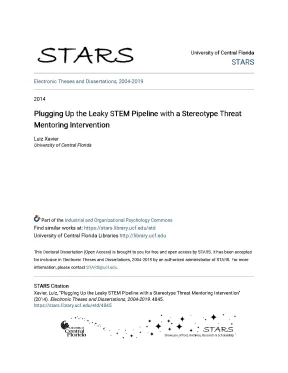
Tải xuống để đọc toàn bộUniversity of Central Florida STARS Electronic Theses and Dissertations, 2004-2019 2014 Plugging Up the Leaky STEM Pipeline with a Stereotype Threat Mentoring Intervention Luiz Xavier University of Central Florida Part of the Industrial and Organizational Psychology Commons Find similar works at: https://stars.edu/etd University of Central Florida Libraries http://library.edu This Doctoral Dissertation (Open Access) is brought to you for free and open access by STARS. It has been accepted for inclusion in Electronic Theses and Dissertations, 2004-2019 by an authorized administrator of STARS. For more information, please contact STARS@ucf. STARS Citation Xavier, Luiz, "Plugging Up the Leaky STEM Pipeline with a Stereotype Threat Mentoring Intervention" (2014).
Electronic Theses and Dissertations, 2004-2019.edu/etd/4845 PLUGGING UP THE LEAKY STEM PIPELINE WITH A STEREOTYPE THREAT MENTORING INTERVENTION by LUIZ FRANCISCO XAVIER B. San Francisco State University, 2006 M. San Francisco State University, 2008 A dissertation submitted in partial fulfillment of the requirements for the degree of Doctor of Philosophy in Industrial Organizational Psychology in the Department of Psychology in the College of Sciences at the University of Central Florida Orlando, Florida Summer Term 2014 Major Professor: Barbara Fritzsche © 2014 Luiz Francisco Xavier ii ABSTRACT The present study compared the effectiveness of different mentoring programs at reducing feelings of stereotype threat experienced by women in science, technology, engineering, and math (STEM) fields. Stereotype threat refers to the extra pressure a person feels to disprove a negative stereotype that applies to him or her.
Because stereotype threat has been found to undermine performance and interest in stereotyped domains, it may be a key factor contributing to female underrepresentation in STEM fields. Mentors and protégés were placed in either a stereotype threat reduction condition in which mentors and protégés were encouraged to participate in discussions designed to reduce stereotype threat, an academic condition in which mentors and protégés were encouraged to discuss academic goals and challenges, or a non- academic condition in which mentors and protégés were encouraged to discuss the challenges of balancing non-school commitments. It was hypothesized that mentoring that focused specifically on stereotype threat reduction would be the most effective in reducing stereotype threat and increasing intentions to remain in STEM fields. In addition, it was hypothesized that stereotype threat reduction mentoring would be the most effective at increasing beliefs in an incremental theory of intelligence (i., the belief that intelligence can be developed through hard work) and decreasing beliefs in an entity theory of intelligence (i., the belief that intelligence is innate and is unalterable).
Mentors were 36 male and 74 female upper-level STEM college students and protégés were 137 female lower-level STEM college students. Participants met online for 30 minutes, once per week, for 3 weeks. Results indicated that both mentors and protégés in the stereotype threat reduction mentoring condition reported feeling less stereotype threat in their STEM classes than mentors and protégés in the other mentoring conditions. Additionally, the iii frequency in which self-theories were discussed in the mentoring sessions partially mediated the effects of the stereotype threat reduction condition on protégés’ feelings of stereotype threat in their STEM classes.
Mentors and protégés in the stereotype threat reduction mentoring condition also reported endorsing incremental theories of intelligence more and endorsing entity theories of intelligence less than mentors and protégés in the other conditions. In summary, the present study’s findings suggest that in order maximum stereotype threat reduction to occur in a mentoring relationship, mentors and protégés engage in activities and discussions designed to reduce stereotype threat. Given that prior research has found that decreased stereotype threat, decreased entity theories of intelligence, and increased incremental theories of intelligence are associated with greater interest and performance in STEM domains, the utilization of a stereotype threat reduction mentoring program can help address the underrepresentation of women in science, technology, engineering, and math related fields iv ACKNOWLEDGMENTS I would like to thank Dr. Barbara Fritzsche for your patience and support throughout the years.
Without your guidance my dissertation would not be possible. I would like to thank Dr. Ben-Zeev for inspiring me to pursue a Ph. and for being an integral part of my undergraduate honor’s thesis, my master’s thesis, and my dissertation.
I would also like to thank Dr. Kimberly Smith-Jentsch and Dr. James Szalma for your invaluable input and feedback. I would also like to thank my exceptional research assistants, Estefany Sabrina Bologna, Kara Corallo, Lisa Ellis, Eurachia Gibson, Alexandra Lexi Gorman, Haily Fowler, Adam Leisher, Willow McGinty, Halona Ng, Kalan Norris, Sara Ruiz, Taylor Scotese, Palak Shah, and Katelyn Stiller.
Without your dedication and hard work, the STEM Peer Mentoring program would not have been successful. I would like to thank Iliana Castro and Melissa Dagley for contacting students on my behalf. I would like to thank Kyle Heyne for taking the time to brainstorm ways of analyzing my data and for putting your research assistants at my disposal. I would like to thank Quincy for being a good dissertation dog.
Lastly, I would like to thank my lab members, Dorey Chaffee, Lindsay Dhanani, Michael Reeves, Elizabeth Sanz, Brandon Scholar, Nicholas Smith, and Amanda Wolcott, for your help and support. v TABLE OF CONTENTS LIST OF FIGURES. ix LIST OF TABLES .x CHAPTER ONE: INTRODUCTION .1 Statement of the Problem .1 The Underrepresentation of Women in STEM Majors in College .2 The Attrition of Women from STEM Majors in College .3 CHAPTER TWO: LITERATURE REVIEW.6 Gender Differences in Abilities .6 Gender Differences in Mathematical Ability .6 Gender Differences in Mathematical Admissions Tests .8 Gender Differences in Visual-Spatial Ability. 10 Gender Differences in Verbal Ability.
12 Gender Differences in Interests. 14 Ability and Interest. 18 Prior Explanations for Gender Differences in Abilities and Interests. 19 Stereotype Threat Theory.
20 Tests of Stereotype Threat Theory. 21 Generalizability of Stereotype Threat. 23 The Effects of Stereotype Threat on Women’s Performance. 25 The Effects of Stereotype Threat on Women’s Interests.
29 Stereotype Threat Risk Factors. 34 Existence of Stereotypes. 41 The Mediators of the Stereotype Threat-Performance Relationship. 47 Performance-Avoidance Goals.
51 The Mediators of the Stereotype Threat-Interest Relationship. 56 Stereotype Threat Interventions. 60 Adopting an Incremental View of Intelligence. 73 Summary of Stereotype Threat Intervention Research.
79 Outcomes Associated with Mentoring. 90 An Integrated Stereotype Threat Intervention. 100 CHAPTER THREE: METHODS. 110 Stereotype Threat Reduction.
113 Non-Academic-Control. 114 Theories of Intelligence. 114 Stereotype Threat Experienced in Classes. 115 Sense of Belonging.
116 Intentions of Remaining In STEM. 116 Stereotype Threat during Testing. 117 Performance-Avoidance Goals during Testing. 117 Worry during Testing.
118 Academic Career Development. 118 Academic Psychosocial Support. 121 CHAPTER FOUR: RESULTS. 156 vii Research Question 1.
183 CHAPTER FIVE: DISCUSSION. 189 Summary of Results. 199 APPENDIX A: BIOLOGICAL AND ENVIRONMENTAL EXPLANATIONS FOR GENDER DIFFERENCES IN STEM ABILITIES AND INTERESTS. 201 APPENDIX B: IRB APPROVAL LETTER.
215 APPENDIX C: PROTÉGÉ/MENTOR PROFILE. 217 APPENDIX D: DEMOGRAPHIC QUESTIONAIRE. 219 APPENDIX E: SELF-AFFIRMATION EXERCISE. 222 APPENDIX F: SELF-AFFIRMATION PROMPT.
225 APPENDIX G: MISATTRIBUTION PROMPT. 227 APPENDIX H: INCREMENTAL THEORY OF INTELLIGENCE PROMPT. 229 APPENDIX I: ACDEMIC CONTROL DISCUSSION PROMPTS. 231 APPENDIX J: NON-ACDEMIC CONTROL DISCUSSION PROMPTS.
234 APPENDIX L: STEREOTYPE THREAT EXPERIENCED IN CLASS QUESTIONNAIRE. 237 APPENDIX M: SENSE OF BELONGING QUESTIONNAIRE. 241 APPENDIX N: STEREOTYPE THREAT DURING TESTING QUESTIONNAIRE. 245 APPENDIX O: PERFORMANCE-AVOIDANCE GOALS DURING TESTING QUESTIONNAIRE.
247 APPENDIX P: WORRY DURING TESTING QUESTIONNAIRE. 249 APPENDIX Q: MATH TEST. 251 APPENDIX R: ACADEMIC CAREER DEVELOPMENT. 259 APPENDIX S: PSYCHOSOCIAL SUPPORT.
262 APPENDIX K: SELF-THEORIES QUESTIONAIRE. 265 viii LIST OF FIGURES Figure 1: Graphical Representation of the Mediators of the Stereotype Threat-Performance Relationship. 56 Figure 2: Graphical Representation of Hypothesized Relationships. 105 Figure 3: Protégés’ Incremental Theory of Intelligence across Conditions.
133 Figure 4: Protégé Incremental Theory Mediation Analysis. 136 Figure 5: Protégés’ Entity Theory of Intelligence across Conditions. 137 Figure 6: Protégé Entity Theory Mediation Analysis. 140 Figure 7: Protégés’ Stereotype Threat in STEM Classes across Conditions.
141 Figure 8: Protégé Stereotype Threat in STEM Classes Mediation Analysis. 145 Figure 9: Protégé Math Test Mediation Analyses. 156 Figure 10: Mentors’ Incremental Theory of Intelligence across Conditions. 159 Figure 11: Mentors’ Incremental Theory of Intelligence by Gender.
160 Figure 12: Female Mentors’ Incremental Theory of Intelligence across Conditions. 161 Figure 13: Male Mentors’ Incremental Theory of Intelligence across Conditions. 162 Figure 14: Mentor Incremental Theory Mediation Analysis. 165 Figure 15: Mentors’ Entity Theory of Intelligence across Conditions.
166 Figure 16: Mentors’ Entity Theory of Intelligence by Gender. 167 Figure 17: Mentor Entity Theory Mediation Analysis. 169 Figure 18: Mentors’ Stereotype Threat in STEM Classes across Conditions. 170 Figure 19: Mentors’ Stereotype Threat in STEM Classes by Gender.
171 Figure 20: Mentor Stereotype Threat Mediation Analysis. 175 Figure 21: Mentor Math Test Mediation Analyses. 186 ix LIST OF TABLES Table 1: Academic Majors of Mentors and Protégés. 110 Table 2: Means, Standard Deviations, and Intercorrelations among Protégé Pre-Mentoring Variables.
125 Table 3: Means, Standard Deviations, and Intercorrelations among Protégé Post-Mentoring Variables. 126 Table 4: Means, Standard Deviations, and Intercorrelations among Mentor Pre-Mentoring Variables. 128 Table 5: Means, Standard Deviations, and Intercorrelations among Mentor Post-Mentoring Variables. 129 Table 6: Analysis of Covariance for Protégés’ STEM Intentions.
147 Table 7: Mediation Analysis for Protégés’ STEM Intentions. 149 Table 8: Analysis of Covariance for Mentors’ STEM Intentions. 177 Table 9: Mediation Analysis for Mentors’ STEM Intentions. 179 Table 10: Summary of Results of Study Hypotheses.
187 x CHAPTER ONE: INTRODUCTION Statement of the Problem Continued scientific progress is vital to maintaining the quality of life and economic competitiveness of the United States (Committee on Equal Opportunities in Science and Engineering, 2000; National Science Board, 2003). In order to maintain scientific progress, people must enter science, technology, engineering, and mathematics (STEM) fields in sufficient numbers. Unfortunately, the number of people currently entering into STEM careers is insufficient to meet the demands of these fields (Fassinger, 2008; Holden, 1989; National Science Board, 2003; Widnall, 1988). The current shortage of STEM workers is compounded by the likely increase in future demand for STEM employees.
Estimates indicate that the number of new jobs in STEM fields will be at least three times greater than the number of new jobs in other fields (Committee on Equal Opportunities in Science and Engineering, 2000; National Science Board, 2003). Furthermore, a large portion of the STEM workforce is expected to retire within the next two decades (National Science Board, 2003). One way of potentially addressing the current and future demands for STEM employees is to focus efforts on fully utilizing the entire workforce population. At present, STEM fields are overrepresented by Caucasian men.
Despite representing 42% of the U. workforce, Caucasian men represent 68% of the STEM workforce (Committee on Equal Opportunities in Science and Engineering, 2000). Further reliance on Caucasian men to fill the ranks of STEM fields may prove unviable in the future as Caucasian men are predicted to represent only 26% of the U. Because the number of Caucasian men pursuing STEM careers in the future may be insufficient to meet the demand for STEM employees, increasing the number of women 1 who pursue STEM careers may be one way of meeting future employment demands.
In addition to women, ethnic minorities such as African Americans and Latinos are also underrepresented in STEM fields (National Science Board, 2003). Efforts to increase the number of ethnic minorities who pursue STEM fields can also help address the shortage of STEM workers. However, this study will focus primarily on improving the retention rates of women in STEM fields because they represent a potentially larger pool of future employees. Despite representing 46% of the U.
Nội dung được bảo vệ bản quyền — Tải xuống đầy đủ
Trích dẫn luận án này
Luiz Francisco Xavier (2014). Plugging up the leaky stem pipeline with a stereotype threat [Luận án tiến sĩ, University of Central Florida]. LuanAn.net. https://luanan.net/giao-duc-hoc/tam-ly-hoc-giao-duc/plugging-up-the-leaky-stem-pipeline-with-a-stereotype-threat-ment
Câu hỏi thường gặp
Luận án "Plugging up the leaky stem pipeline with a stereotype threat" nghiên cứu về vấn đề gì?
Khắc phục rò rỉ hệ thống bằng cách đối phó với mối đe dọa định kiến. Giúp giữ chân nhân tài hiệu quả và công bằng hơn.
Luận án "Plugging up the leaky stem pipeline with a stereotype threat" được bảo vệ tại trường nào?
Luận án này được bảo vệ tại University of Central Florida. Năm bảo vệ: 2014.
Luận án "Plugging up the leaky stem pipeline with a stereotype threat" thuộc chuyên ngành gì?
Luận án "Plugging up the leaky stem pipeline with a stereotype threat" thuộc chuyên ngành Industrial Organizational Psychology. Danh mục: Tâm Lý Học Giáo Dục.
Luận án "Plugging up the leaky stem pipeline with a stereotype threat" có bao nhiêu trang?
Luận án "Plugging up the leaky stem pipeline with a stereotype threat" có 321 trang. Bạn có thể xem trước một phần tài liệu ngay trên trang web trước khi tải về.
Cách tải luận án "Plugging up the leaky stem pipeline with a stereotype threat" về máy như thế nào?
Để tải luận án về máy, bạn nhấn nút "Tải xuống ngay" trên trang này, sau đó hoàn tất thanh toán phí lưu trữ. File sẽ được tải xuống ngay sau khi thanh toán thành công. Hỗ trợ qua Zalo: 0559 297 239.