Hiệu ứng Thực tế & Tác động: Lịch sử Văn hóa Kỹ xảo Điện ảnh của Jae Hyung Ryu
Khám phá lịch sử văn hóa kỹ xảo điện ảnh qua "Hiệu ứng Thực tế": Nguồn gốc, phát triển và tác động đến nghệ thuật kể chuyện.
Luan An
Luận án tiến sĩ
Năm xuất bản
Số trang
250
Thời gian đọc
38 phút
Lượt xem
0
Lượt tải
0
Phí lưu trữ
50 Point
Tổng quan nhanh
- Chủ đề:
- 1. Lịch sử kỹ xảo điện ảnh: Thay đổi thực tế điện ảnh
- Số trang:
- 250 trang
- Trường:
- Georgia State University
- Chuyên ngành:
- Communication
- Tác giả:
- Jae Hyung Ryu
- Năm:
- 2007
Tóm tắt nội dung luận án
I. Lịch sử kỹ xảo điện ảnh Thay đổi thực tế điện ảnh
Tài liệu này khám phá sự phát triển của kỹ xảo điện ảnh. Nghiên cứu định hình cách kỹ xảo điện ảnh thay đổi nhận thức về thực tế. Mục tiêu tạo ra hiệu ứng thực tế mạnh mẽ. Phân tích lịch sử kỹ xảo điện ảnh rộng hơn. Nghiên cứu xem xét bối cảnh công nghiệp. Bối cảnh kinh tế ảnh hưởng đến kỹ xảo điện ảnh. Các đặc điểm thẩm mỹ của hiệu ứng thực tế được phân tích. Phương pháp luận so sánh kỹ xảo điện ảnh với lý thuyết hiện đại/hậu hiện đại. Phân tích văn bản sâu để hiểu ý nghĩa. Sự chuyển đổi kỹ thuật kỹ xảo điện ảnh phản ánh biến đổi văn hóa. Từ hiện đại sang hậu hiện đại. Kỹ xảo điện ảnh phát triển cùng hệ thống sản xuất. Tiến bộ công nghệ thúc đẩy sự thay đổi. Điều này tạo nên lịch sử kỹ xảo điện ảnh phong phú.
1.1. Mục đích nghiên cứu Định hình thực tế điện ảnh
Luận án này tập trung vào sự phát triển của kỹ xảo điện ảnh. Mục đích chính là làm rõ cách kỹ xảo điện ảnh định hình lại tầm nhìn về thực tế trong điện ảnh đại chúng. Việc tạo ra hiệu ứng thực tế mạnh mẽ là trọng tâm. Nghiên cứu này phân tích lịch sử kỹ xảo điện ảnh ở nhiều khía cạnh.
1.2. Phát triển kỹ xảo Ảnh hưởng văn hóa kinh tế
Nghiên cứu khảo sát bối cảnh công nghiệp và kinh tế của kỹ xảo điện ảnh. Nó cũng xem xét các đặc điểm thẩm mỹ của hiệu ứng thực tế. Phương pháp luận so sánh kỹ xảo điện ảnh với diễn ngôn hiện đại và hậu hiện đại. Phân tích văn bản chặt chẽ giúp hiểu ý nghĩa. Sự thay đổi trong kỹ thuật kỹ xảo điện ảnh phản ánh sự chuyển đổi văn hóa.
1.3. Chuyển đổi công nghệ Từ cơ khí đến kỹ thuật số
Kỹ xảo điện ảnh đã phát triển nhờ thích ứng với sự thay đổi của hệ thống sản xuất. Tiến bộ công nghệ đóng vai trò quan trọng. Sự chuyển đổi này diễn ra từ hiện đại hóa sang hậu hiện đại. Lịch sử kỹ xảo điện ảnh chứng kiến sự dịch chuyển từ các kỹ thuật analog sang kỹ thuật số.
II. Tiên phong kỹ xảo Hiệu ứng vật lý kỹ thuật số
Điện ảnh Hollywood cổ điển bị kiểm soát bởi hệ thống studio. Hệ thống sản xuất Fordist thống trị. Kỹ xảo điện ảnh ban đầu chủ yếu là hiệu ứng vật lý. Các kỹ thuật như trick photography, chiếu hậu, chiếu trước phổ biến. Chúng tạo ra ảo ảnh mà không cần máy tính. Đây là những tiên phong kỹ xảo sơ khai. Kỹ thuật matte painting cũng được sử dụng rộng rãi. Mô hình thu nhỏ tạo ra cảnh quan hùng vĩ. Sự phá vỡ chủ nghĩa cổ điển Hollywood mở đường cho kỹ xảo kỹ thuật số. Khái niệm phim bom tấn xuất hiện. Công nghệ máy tính phát triển mạnh mẽ. Kỹ xảo kỹ thuật số bao gồm rotoscoping, hoạt hình CGI. Chúng mang lại khả năng sáng tạo vô hạn. CGI đã thay đổi hoàn toàn lịch sử kỹ xảo điện ảnh. Thẩm mỹ của kỹ xảo analog giống với hệ thống sản xuất Fordist. Ngược lại, hiệu ứng kỹ thuật số dựa vào thao tác CGI. Chúng là ví dụ về tích lũy linh hoạt. Sự chuyển đổi này thể hiện sự thay đổi sâu rộng. Nó định hình lại cách kể chuyện điện ảnh. Các practical effects vẫn có chỗ đứng riêng. Hiệu ứng stop-motion từng là đỉnh cao. Hóa trang đặc biệt tiếp tục đóng vai trò quan trọng.
2.1. Kỹ xảo analog Nền tảng hiệu ứng vật lý
Điện ảnh Hollywood cổ điển hoạt động dưới hệ thống studio Fordist. Kỹ xảo analog là trung tâm. Các kỹ thuật như trick photography, chiếu hậu và chiếu trước được sử dụng. Chúng tạo ra hiệu ứng thực tế mà không cần điện toán. Đây là những tiên phong kỹ xảo ban đầu. Kỹ thuật matte painting và mô hình thu nhỏ cũng rất quan trọng. Hiệu ứng vật lý là yếu tố chính.
2.2. Kỹ thuật số ra đời Kỷ nguyên CGI rotoscoping
Sự suy yếu của chủ nghĩa cổ điển Hollywood dẫn đến sự ra đời của kỹ xảo kỹ thuật số. Khái niệm phim bom tấn thúc đẩy nhu cầu. Công nghệ máy tính phát triển nhanh chóng. Rotoscoping và hoạt hình CGI là những kỹ thuật tiên tiến. Chúng đại diện cho kỷ nguyên mới. Kỹ xảo kỹ thuật số định hình lại lịch sử kỹ xảo điện ảnh.
2.3. Sự đối lập Hiệu ứng vật lý và kỹ thuật số
Thẩm mỹ của kỹ xảo analog không có máy tính. Nó có thể so sánh với hệ thống sản xuất Fordist. Kỹ xảo kỹ thuật số dựa nhiều vào thao tác CGI. Chúng là ví dụ về tích lũy linh hoạt. Sự đối lập này phản ánh sự thay đổi lớn. Các practical effects như hiệu ứng stop-motion và hóa trang đặc biệt vẫn giữ giá trị.
III. Kỹ xảo điện ảnh Văn hóa Bối cảnh công nghiệp thẩm mỹ
Hệ thống studio Hollywood cổ điển chi phối ngành. Mô hình sản xuất Fordism áp dụng vào điện ảnh. Việc sản xuất phim diễn ra có quy trình. Sự kiểm soát chặt chẽ đối với mọi khía cạnh. Điều này ảnh hưởng đến sự phát triển của kỹ xảo điện ảnh. Sự sụp đổ của chủ nghĩa cổ điển Hollywood mở ra kỷ nguyên mới. Khái niệm bom tấn ra đời, thúc đẩy nhu cầu kỹ xảo điện ảnh phức tạp. Sự phát triển công nghệ máy tính là yếu tố then chốt. Từ đó, kỹ xảo kỹ thuật số trở thành trung tâm. Điều này đánh dấu sự chuyển đổi văn hóa. Chuyển đổi kỹ thuật tạo kỹ xảo điện ảnh phản ánh văn hóa. Từ chủ nghĩa hiện đại sang hậu hiện đại. Kỹ xảo điện ảnh thích ứng với thay đổi cấu trúc sản xuất. Tiến bộ công nghệ là động lực chính. Sự biến đổi này định hình lại thẩm mỹ điện ảnh. Nó ảnh hưởng đến văn hóa điện ảnh toàn cầu.
3.1. Hệ thống studio Hollywood Kỷ nguyên Fordism
Hệ thống studio kiểm soát chặt chẽ điện ảnh Hollywood cổ điển. Hệ thống sản xuất kinh tế hiện đại của Fordism là nền tảng. Nó định hình cách thức sản xuất phim. Điều này ảnh hưởng đến việc sử dụng và phát triển kỹ xảo điện ảnh trong thời kỳ đó.
3.2. Hậu hiện đại và kỹ xảo Thay đổi sản xuất
Sự sụp đổ của chủ nghĩa cổ điển Hollywood là một bước ngoặt. Nó dẫn đến sự xuất hiện của kỹ xảo kỹ thuật số. Điều này đồng thời với sự trỗi dậy của khái niệm bom tấn. Sự phát triển công nghệ máy tính đóng vai trò quyết định. Sự chuyển đổi này phản ánh một thay đổi văn hóa lớn.
3.3. Đặc điểm thẩm mỹ Từ hiện đại đến hậu hiện đại
Sự chuyển đổi trong kỹ thuật tạo kỹ xảo điện ảnh phản ánh sự biến đổi văn hóa. Từ hiện đại sang hậu hiện đại. Kỹ xảo điện ảnh phát triển bằng cách thích ứng với cấu trúc sản xuất. Tiến bộ công nghệ là yếu tố thúc đẩy. Điều này định hình lại thẩm mỹ và văn hóa điện ảnh.
IV. Hiệu ứng thực tế Nén thời gian không gian trong điện ảnh
Đặc trưng của quá trình chuyển đổi là nén thời gian-không gian. Từ Fordism sang tích lũy linh hoạt. Điều này phản ánh rõ ràng sự nén đa tầng. Nén thời gian và không gian. Nó được tạo ra trong quá trình phát triển kỹ xảo điện ảnh. Kỹ xảo analog, không dùng máy tính, tương đương Fordist. Các kỹ thuật như trick, chiếu hậu và chiếu trước. Chúng tạo ra ảo ảnh một cách cơ học. Đây là giai đoạn tiên phong kỹ xảo ban đầu. Hiệu ứng vật lý là trọng tâm. Kỹ xảo kỹ thuật số dựa nhiều vào thao tác CGI. Chúng là ví dụ về tích lũy linh hoạt. Rotoscoping và hoạt hình CGI mở ra khả năng mới. Chúng phá vỡ giới hạn không gian, thời gian. Điều này định nghĩa lại hiệu ứng thực tế trong điện ảnh.
4.1. Khái niệm nén thời gian không gian Lý thuyết
Đặc điểm của quá trình chuyển đổi là nén thời gian-không gian. Nó xảy ra trong quá trình từ Fordism sang tích lũy linh hoạt. Điều này phản ánh sự nén đa tầng của thời gian và không gian. Nó hình thành trong sự phát triển của kỹ xảo điện ảnh.
4.2. Kỹ xảo analog Mô hình sản xuất Fordist
Thẩm mỹ của kỹ xảo analog không có máy tính. Nó có thể so sánh với hệ thống sản xuất Fordist. Các kỹ thuật như trick, chiếu hậu và chiếu trước là ví dụ. Hiệu ứng vật lý đóng vai trò chính. Đây là giai đoạn tiên phong kỹ xảo, tập trung vào các phương pháp cơ học.
4.3. Kỹ xảo kỹ thuật số Tập hợp linh hoạt
Kỹ xảo kỹ thuật số dựa nhiều vào thao tác CGI. Chúng là ví dụ về tích lũy linh hoạt. Các kỹ thuật như rotoscoping và hoạt hình CGI mang lại khả năng mới. Chúng nén thời gian và không gian một cách phức tạp. Điều này tái định nghĩa hiệu ứng thực tế trong kỷ nguyên số.
V. Sức mạnh kỹ xảo Phim bom tấn kỹ xảo điện ảnh Hàn Quốc
Phim bom tấn Hàn Quốc hướng tới quy mô lớn. Các cảnh quay ngoạn mục đòi hỏi kỹ xảo điện ảnh nặng nề. Phong cách này thường bị coi là kiểu Hollywood. Nhu cầu về kỹ xảo đặc biệt tăng cao. Sự kết hợp nghịch lý này thể hiện rõ. Các chủ đề đặc trưng của Hàn Quốc. Phong cách Hollywood được áp dụng. 'Shiri', 'Tae Guk Gi', 'Welcome to Dongmakgol' là ví dụ. '2009 Lost Memories' cũng sử dụng nhiều kỹ xảo điện ảnh. Đây là một hình thức 'cultural jujitsu.' Tận dụng sức mạnh của văn hóa thống trị. Nhằm chống lại và phá vỡ nó. Điều này thể hiện sự sáng tạo trong văn hóa điện ảnh. Lịch sử kỹ xảo điện ảnh tiếp tục phát triển.
5.1. Kỷ nguyên bom tấn Nhu cầu kỹ xảo quy mô lớn
Phim bom tấn Hàn Quốc theo đuổi quy mô lớn. Chúng trình bày các cảnh ngoạn mục. Điều này đòi hỏi sự phụ thuộc lớn vào kỹ xảo đặc biệt. Phong cách này thường được coi là kiểu Hollywood. Nhu cầu về kỹ xảo điện ảnh tiên tiến ngày càng tăng.
5.2. Điện ảnh Hàn Quốc Ứng dụng kỹ xảo Hollywood
Sự kết hợp nghịch lý giữa chủ đề Hàn Quốc và phong cách Hollywood. Các phim như 'Shiri' và 'Tae Guk Gi' là ví dụ. 'Welcome to Dongmakgol' và '2009 Lost Memories' cũng sử dụng kỹ xảo điện ảnh. Việc ứng dụng này cho thấy sự linh hoạt trong sản xuất.
5.3. Chiến lược Cultural Jujitsu Kháng cự văn hóa
Sự kết hợp này được xem như một hình thức 'cultural jujitsu'. Nó tận dụng sức mạnh của văn hóa thống trị. Mục tiêu là kháng cự và phá vỡ nó. Điều này thể hiện sự độc đáo trong văn hóa điện ảnh Hàn Quốc. Lịch sử kỹ xảo điện ảnh được viết lại thông qua sự sáng tạo này.
Tải xuống file đầy đủ để xem toàn bộ nội dung
Tải đầy đủ (250 trang)Trích đoạn nội dung luận án
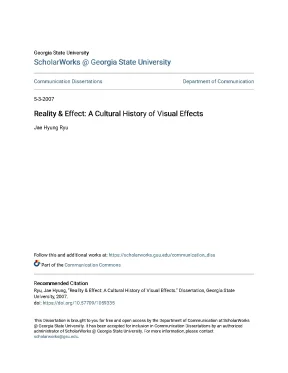
Tải xuống để đọc toàn bộGeorgia State University ScholarWorks @ Georgia State University Communication Dissertations Department of Communication 5-3-2007 Reality & Effect: A Cultural History of Visual Effects Jae Hyung Ryu Follow this and additional works at: https://scholarworks.edu/communication_diss Part of the Communication Commons Recommended Citation Ryu, Jae Hyung, "Reality & Effect: A Cultural History of Visual Effects." Dissertation, Georgia State University, 2007. doi: https://doi.57709/1059335 This Dissertation is brought to you for free and open access by the Department of Communication at ScholarWorks @ Georgia State University. It has been accepted for inclusion in Communication Dissertations by an authorized administrator of ScholarWorks @ Georgia State University. For more information, please contact scholarworks@gsu.
REALITY & EFFECT: A CULTURAL HISTORY OF VISUAL EFFECTS by JAE HYUNG RYU Under the Direction of Ted Friedman ABSTRACT The purpose of this dissertation is to chart how the development of visual effects has changed popular cinema’s vision of the real, producing the powerful reality effect. My investigation of the history of visual effects studies not only the industrial and economic context of visual effects, but also the aesthetic characteristics of the reality effect. In terms of methodology, this study employs a theoretical discourse which compares the parallels between visual effects and the discourse of modernity/postmodernity, utilizing close textual analysis to understand the symptomatic meanings of key texts. The transition in the techniques and meanings of creating visual effects reflects the cultural transformation from modernism to postmodernism.
Visual effects have developed by adapting to the structural transformation of production systems and with the advance of technology. The studio system strongly controlled the classical Hollywood cinema by means of the modern economic production system of Fordism. Breakdown of Hollywood classicism as a production system gave rise to the creation of digital effects with the rise of the concept of the blockbuster and with the development of computer technologies. I argue that the characteristic feature of time-space compression, occurring in the process of the transition from Fordism to flexible accumulation, clearly reflects that of compression of multi-layered time and space, generated in the development process from analog visual effects, such as trick, rear and front projection, to the digital effects, such as rotoscoping and CGI animation.
While the aesthetics of analog visual effects, without computing, can be compared to a Fordist production system, digital effects, which hugely rely on CGI manipulation, are examples of flexible accumulation. As a case study of the local resistance or alternative of Hollywood today, I examine the effects-oriented Korean nationalist blockbuster. The Korean nationalist blockbuster films have sought large-scale filmmaking and presentation of spectacular scenes, including heavy dependence on the use of special effects, which is frequently considered a Hollywood style. This paradoxical combination of peculiar Korean subjects and Hollywood style can be viewed as a form of cultural jujitsu, taking advantage of the force of the dominant culture in order to resist and subvert it.
INDEX WORDS: Special Effects, Visual Effects, Digital Effects, CGI, Tricks, Modernism, Fordism, Postmodernism, Reality Effect, Time-space Compression, Trickality, Korean Blockbuster, Cultural Jujitsu, Korean Wave, Hallyu, Shiri, Tae Guk Gi: The Brotherhood of War, Welcome to Dongmakgol, 2009 Lost Memories REALITY & EFFECT: A CULTURAL HISTORY OF VISUAL EFFECTS by JAE HYUNG RYU A Dissertation Submitted in Partial Fulfillment of the Requirements for the Degree of Doctor of Philosophy in the College of Arts and Sciences Georgia State University 2007 Copyright by Jae Hyung Ryu 2007 REALITY & EFFECT: A CULTURAL HISTORY OF VISUAL EFFECTS by JAE HYUNG RYU Major Professor: Ted Friedman Committee: Kathy Fuller-Seeley Angelo Restivo Alisa Perren Jung-Bong Choi Electronic Version Approved: Office of Graduate Studies College of Arts and Sciences Georgia State University May 2007 iv ACKNOWLEDGEMENTS I would like to thank, foremost, my advisor, Dr. Ted Friedman, for his unconditional support, guidance, and generosity. He is a dedicated teacher, but at times, I look to him as an older brother, and a good friend. If my advisor was not him, I could not stand here now.
I love his passion for fostering scholarship, his consideration of students, and I admire his belief in his advisees. Friedman will be a model for my way of scholarship. I also wish to thank my everlasting mentor, Dr. Yong-soo Kim, who is Professor of School of Communication at Sogang University, Korea.
He is a father in my academic life. He opened my eyes to film studies and led me to the way of learning. His continuous consideration and encouragement have provided the vital energy for my struggle in overseas. Kim has been and will be the cornerstone of my way of learning.
I am grateful to my committee members, Dr. Kathy Fuller-Seeley for her kind mentoring and warm encouragement, Dr. Angelo Restivo for his precise reading and acute comments on the earlier draft of the Korean film chapter, Dr. Jung-Bong Choi for the critical suggestions derived from his wide range of knowledge, and Dr.
Alisa Perren for her helpful comments and suggestions on the earlier drafts. Finally, infinite thanks go to my family: my parents, RYU Jong Yeol and PARK Kyung Sook; parents-in-law, CHOI Dong Kwon and RA Ssang Ju; my wife, CHOI Won-Jeong; my daughter, Jennifer Yujin RYU; and my soon-to-be son, Jason, who will arrive this June; my brother and brother-in-law, RYU Jae Yong and CHOI Hyuk Seung. Words cannot express how much I am loved by them and I love them. I wish to live as repaying their love.
I dedicate my humble dissertation to my wonderful family. v TABLE OF CONTENTS ACKNOWLEDGEMENTS………………………………………………………………… iv LIST OF TABLES…………………………………………………………………………. VISUAL EFFECTS OF EARLY HOLLYWOOD……….1 Train Arriving at a Station (Louis and Auguste Lumières, 1895)……… 52 2.2 A Trip to the Moon (Georges Méliès, 1902)…………………………….3 The Thief of Bagdad (Raoul Walsh, 1924)……. MODERNIST VISUAL EFFECTS…….1 Forbidden Planet (Fred M.
POSTMODERNIST VISUAL EFFECTS………………………….2 Terminator 2: Judgment Day (James Cameron, 1991)…………………. DIGITAL EFFECTS as CULTURAL JUJITSU: FUNCTIONS of DIGITAL EFFECTS in KOREAN NATIONALIST BLOCKBUSTER FILMS ………….1 New Relationship between Hollywood and the Korean Film Industry in the Digital Empire………………………………………………….2 Korean Nationalist Blockbuster Films, Cultural Jujitsu…….3 Cultural Jujitsu: Healing Trauma through Korean Nationalism with Hollywood Style……………………………………………………… 199 6. 227 vii LIST OF TABLES Table 1. Attendances and Market Share of Korean and Foreign Films…………………….
The Productions and Screenings of Korean and Foreign Films…………………… 176 Table 3. The Average Production Cost of Korean Films……………………………………. The State of the Export of Korean Films’s Remake Copyright to Hollywood……. Top Local Movies………………………………………………………………….
Selected Awards from Major International Film Festivals………………………….1 Overview Special effects in cinema have presented the cutting edge technologies of their eras. They have even functioned as harbingers of future reality. Through examination of the direction of visual effects history, from the past to the present, we can imagine what the visual effects of the future may entail. The representation of the future by means of visual effects provides us with a vision of future reality.
Thus, visual effects function as a measure of the times, of contemporaneous visions of reality and technology. The purpose of this dissertation is to chart how the development of visual effects has changed popular cinema’s vision of the real, producing an ever more powerful “reality effect.” I will examine the implications of visual effects in film, in particular in science fiction films (SF), and inquire about the function of their reality effect in contemporary culture. Key Terms In this project, I follow the industrial definition of the terms “visual effects” and “physical effects.” “Visual effects” are “any visual manipulation of motion picture frames, whether accomplished in cameras, projectors, optical printers, aerial image printers, front and rear screen systems” (Smith, 1986, p. 270), and in digital composition with computers including computer graphic imagery (CGI).
“Physical effects,” on the other hand, are “mechanical effects or practical effects that take place on the set during filming, such as explosions, wire tricks, bullet hits, etc. I employ the term “reality effect” to describe the cinematic illusion of reality created by visual effects. Visual effects make impossible events seem realizable. This process produces a 2 perceptual effect: the audience perceives the artificial representation of impossible events as reality.
The origin of the term reality effect derives from Roland Barthes. In examining the realist novels of writers such as Flaubert, Barthes (1982) argued that through the accumulation of so many “concrete details,” the signifier becomes alienated from the referent; the more the referent is concretely described, the more the signifier is distanced from the referent; the signified, the concept of the signifier, is “expelled from the sign”; as a result, the referent survives alone within the narrative. This is the “referential illusion” of realist literature (p. At the moment that the signified is eliminated from the sign and that “the referent stands as or for itself in the midst of narrative line,” “language disappears” (Cole, 2005, p.
What remains is the illusion of reality. This is the reality effect. Although realist novels are fictional constructions, their writing conventions hide their artificiality and create the illusion of reality. Barthes writes “It suffices to recall that for the ideology of our time, obsessive reference to the ‘concrete’ is always brandished as a weapon against meaning…” (p.
It means that the concrete detail does not show reality itself but represent only “vraisemblable/verisimilitude” as the meaningless illusion of reality. It is Barthes’ criticism on the reality effect to attack the authoritative Authors and Literatures as the cultural agents and implication that reality is our ideological screen. In filmmaking, visual effects produce excessive cinematic details to make impossible scenes possible. As a result, the relationship between signifiers and their referents is blurred.
In the middle of this blurring, cinematic illusion is created. Thus, the term reality effect can refer to the perceptually illusionist effect of reality in both literature and film. I want to limit the use of the term reality effect to the aesthetic aspects of the cinematic 3 illusion. Barthes’ original intention of the term was to criticize the function of verisimilitude that hides ideological construction.
However, the reality effect of visual effects in SF genre films, which is the major object of my dissertation, provides, in most cases, the clear cultural window of the present view on technology—in particular computer technology—that our anxiety and expectation coexist, rather than represents and reinforces the present ideology by means of meaningless visual illusion. In this sense, I believe that the directors and digital effects engineers in the contemporary effects-oriented films are not the objects of political criticism from the aspect of extension of 1968 French movement’s critique of traditional authority. Thus, my use of the term reality effect does not imply Barthes’ ideological criticism on the Author but merely indicate the effect of cinematic illusion that visual effects create. The reason why I focus on visual effects, not physical effects, has much to do with the term reality effect.
Although scenes with physical effects that present exploding cars or rampaging monsters provide the audience with a plausible mise-en-scene, they do not inspire perceptual illusion of the effects among viewers because the audience is watching a scene that really did happen in one contiguous physical space. However, scenes with visual effects that portray Superman flying, T-1000’s finger-morphing to the sharp gimlet, and Trinity transferring through the phone line all produce the reality effect. In comparison to the wire action in the 1950s and 1960s, 1978’s Superman produces a different kind of visual illusion, because the scene is impossible in the real world. It was created by the combination of live-action footage and pre-filmed scenery, through the visual effect of rear projection.
I cannot say that all kinds of physical effects never produce a reality effect. However, in majority of cases, visual effects are much more related to the reality effect than physical effects. Visual effects include rear/front projection, rotoscoping, and, more recently, digital effects such as CGI digital composition. 4 Naturalism indicates the effects-added shot or scene’s perceptual indistinguishableness from live-action footages.
Visual effects have developed with seeking naturalism of the reality effect in the effects-added scene. Naturalism depends on the plausibility of the effects-added scene.
Nội dung được bảo vệ bản quyền — Tải xuống đầy đủ
Trích dẫn luận án này
Jae Hyung Ryu (2007). Hiệu ứng Thực tế: Lịch sử Văn hóa Kỹ xảo Điện ảnh [Luận án tiến sĩ, Georgia State University]. LuanAn.net. https://luanan.net/san-khau-dien-anh/hieu-ung-thuc-te-lich-su-van-hoa-ky-xao-dien-anh
Câu hỏi thường gặp
Luận án "Hiệu ứng Thực tế: Lịch sử Văn hóa Kỹ xảo Điện ảnh" nghiên cứu về vấn đề gì?
Khám phá lịch sử văn hóa kỹ xảo điện ảnh qua "Hiệu ứng Thực tế": Nguồn gốc, phát triển và tác động đến nghệ thuật kể chuyện.
Luận án "Hiệu ứng Thực tế: Lịch sử Văn hóa Kỹ xảo Điện ảnh" được bảo vệ tại trường nào?
Luận án này được bảo vệ tại Georgia State University. Năm bảo vệ: 2007.
Luận án "Hiệu ứng Thực tế: Lịch sử Văn hóa Kỹ xảo Điện ảnh" thuộc chuyên ngành gì?
Luận án "Hiệu ứng Thực tế: Lịch sử Văn hóa Kỹ xảo Điện ảnh" thuộc chuyên ngành Communication. Danh mục: Sân Khấu - Điện Ảnh.
Luận án "Hiệu ứng Thực tế: Lịch sử Văn hóa Kỹ xảo Điện ảnh" có bao nhiêu trang?
Luận án "Hiệu ứng Thực tế: Lịch sử Văn hóa Kỹ xảo Điện ảnh" có 250 trang. Bạn có thể xem trước một phần tài liệu ngay trên trang web trước khi tải về.
Cách tải luận án "Hiệu ứng Thực tế: Lịch sử Văn hóa Kỹ xảo Điện ảnh" về máy như thế nào?
Để tải luận án về máy, bạn nhấn nút "Tải xuống ngay" trên trang này, sau đó hoàn tất thanh toán phí lưu trữ. File sẽ được tải xuống ngay sau khi thanh toán thành công. Hỗ trợ qua Zalo: 0559 297 239.