Động lực chia sẻ tri thức trong nhóm dịch vụ chuyên nghiệp - Luận án TS Nguyễn Lan Ngọc
Khám phá động lực thúc đẩy chia sẻ tri thức trong nhóm dịch vụ chuyên nghiệp, nâng cao hiệu quả và sự hợp tác.
Luan An
Luận án tiến sĩ
Năm xuất bản
Số trang
211
Thời gian đọc
32 phút
Lượt xem
0
Lượt tải
0
Phí lưu trữ
50 Point
Tổng quan nhanh
- Chủ đề:
- 1. Động lực Chia sẻ Tri thức Nhóm Dịch vụ Chuyên nghiệp
- Số trang:
- 211 trang
- Trường:
- Trường Đại học Kinh tế Quốc dân
- Chuyên ngành:
- Business Administration
- Tác giả:
- Nguyen Lan Ngoc
- Năm:
- 2022
Tóm tắt nội dung luận án
I. Động lực Chia sẻ Tri thức Nhóm Dịch vụ Chuyên nghiệp
Phần này giới thiệu khái niệm chia sẻ tri thức trong nhóm dịch vụ chuyên nghiệp. Nó định nghĩa các loại hình công ty dịch vụ chuyên nghiệp. Nó nhấn mạnh vai trò cốt lõi của việc chia sẻ tri thức. Thảo luận mở rộng về các dạng tri thức, đặc biệt là tri thức tường minh và tri thức ngầm. Hiểu biết các yếu tố cơ bản này là thiết yếu. Nó giúp nắm bắt động lực rộng hơn của việc trao đổi tri thức. Chia sẻ tri thức thúc đẩy đổi mới, giải quyết vấn đề. Nó tăng cường năng lực nhóm và giá trị khách hàng.
1.1. Khái niệm và Vai trò Chia sẻ Tri thức
Chia sẻ tri thức là quá trình trao đổi thông tin, kinh nghiệm. Nó diễn ra giữa các thành viên trong nhóm. Đặc biệt trong nhóm dịch vụ chuyên nghiệp, chia sẻ tri thức có vai trò quan trọng. Nó thúc đẩy sự hợp tác nhóm và cải thiện chất lượng dịch vụ. Tri thức được coi là tài sản cốt lõi. Việc trao đổi tri thức giúp nâng cao năng lực cạnh tranh. Nó còn hỗ trợ giải quyết vấn đề phức tạp. Các nhóm chuyên nghiệp dựa vào tri thức để đạt hiệu suất cao. Quản lý tri thức hiệu quả là yếu tố then chốt.
1.2. Phân loại Tri thức Ngầm và Tường minh
Tri thức có hai dạng chính: tri thức ngầm và tri thức tường minh. Tri thức ngầm là kinh nghiệm cá nhân, khó diễn đạt thành lời. Nó thường được học hỏi qua thực hành. Tri thức tường minh là thông tin dễ mã hóa, lưu trữ. Ví dụ: tài liệu, hướng dẫn. Trong nhóm dịch vụ, cả hai loại tri thức đều quan trọng. Chia sẻ tri thức ngầm đòi hỏi sự tin tưởng và tương tác trực tiếp. Chia sẻ tri thức tường minh dễ dàng hơn qua các hệ thống. Việc nhận diện và chuyển giao cả hai dạng tri thức là cần thiết. Nó giúp tối ưu hóa hiệu suất nhóm.
II. Yếu tố Quyết định Động lực Chia sẻ Tri thức
Các động lực thúc đẩy hoặc cản trở việc chia sẻ tri thức rất đa dạng. Nghiên cứu này dựa trên lý thuyết nhóm như hệ thống phức tạp và lý thuyết khuyến khích. Các lý thuyết này giúp phân tích các yếu tố ảnh hưởng. Chúng bao gồm động lực nội tại và động lực bên ngoài. Văn hóa tổ chức và mức độ sự tin tưởng trong nhóm cũng đóng vai trò quan trọng. Hiểu rõ các yếu tố này giúp xây dựng môi trường thuận lợi. Môi trường đó khuyến khích hoạt động quản lý tri thức.
2.1. Động lực Nội tại và Bên ngoài
Động lực nội tại phát sinh từ cá nhân. Nó bao gồm niềm vui học hỏi, mong muốn giúp đỡ đồng nghiệp. Động lực bên ngoài đến từ các yếu tố bên ngoài. Ví dụ: chính sách khen thưởng, áp lực công việc, sự công nhận. Cả hai loại động lực đều ảnh hưởng đến hành vi chia sẻ tri thức. Một môi trường làm việc tích cực củng cố động lực nội tại. Chính sách khen thưởng rõ ràng khuyến khích động lực bên ngoài. Sự cân bằng giữa chúng là chìa khóa. Nó thúc đẩy sự hợp tác nhóm hiệu quả.
2.2. Văn hóa Tổ chức và Sự Tin tưởng
Văn hóa tổ chức định hình cách tri thức được chia sẻ. Văn hóa mở, khuyến khích học hỏi là rất quan trọng. Sự tin tưởng giữa các thành viên là yếu tố then chốt. Thiếu sự tin tưởng cản trở việc chia sẻ tri thức ngầm. Các nhóm cần một môi trường an toàn. Môi trường đó cho phép chia sẻ rủi ro và thất bại. Văn hóa tổ chức hỗ trợ sự tin tưởng. Điều này tăng cường khả năng hợp tác nhóm. Nó cũng nâng cao hiệu suất nhóm.
III. Phương pháp Nghiên cứu Động lực Chia sẻ Tri thức
Nghiên cứu sử dụng phương pháp hỗn hợp. Phương pháp này kết hợp định tính và định lượng. Mục tiêu là khám phá sâu sắc động lực chia sẻ tri thức. Bối cảnh nghiên cứu là ngành kiểm toán tại Việt Nam. Đây là ngành dịch vụ chuyên nghiệp đặc thù. Phương pháp tiếp cận này cung cấp cái nhìn toàn diện. Nó giúp xác định các yếu tố tương tác. Cách thức thu thập và phân tích dữ liệu được trình bày chi tiết. Điều này đảm bảo tính khách quan và độ tin cậy của kết quả.
3.1. Thiết kế Nghiên cứu Hỗn hợp
Phương pháp nghiên cứu hỗn hợp được chọn. Nó bao gồm giai đoạn khám phá định tính và kiểm định định lượng. Giai đoạn định tính sử dụng phỏng vấn sâu. Giai đoạn này thu thập dữ liệu phong phú. Giai đoạn định lượng sử dụng khảo sát. Nó giúp kiểm tra các mô hình lý thuyết. Sự kết hợp này mang lại cái nhìn sâu sắc. Nó còn tăng cường tính tổng quát của phát hiện. Phương pháp này phù hợp để nghiên cứu các hệ thống phức tạp như nhóm làm việc.
3.2. Bối cảnh Ngành Kiểm toán Việt Nam
Nghiên cứu tập trung vào ngành kiểm toán Việt Nam. Ngành này là một ví dụ điển hình của nhóm dịch vụ chuyên nghiệp. Các nhóm kiểm toán thường làm việc theo dự án. Họ cần chia sẻ tri thức ngầm và tri thức tường minh liên tục. Đặc thù ngành kiểm toán cung cấp dữ liệu giá trị. Nó cho phép quan sát động lực chia sẻ tri thức thực tế. Các phát hiện có thể áp dụng cho các nhóm dịch vụ chuyên nghiệp khác. Nó cung cấp bài học về quản lý tri thức.
IV. Phân tích Động lực Chia sẻ Tri thức Thực tế
Phần này trình bày kết quả phân tích dữ liệu. Các phát hiện định tính và định lượng được tích hợp. Nó cho thấy các yếu tố ảnh hưởng đến chia sẻ tri thức. Mô hình động lực chia sẻ tri thức tổng thể được xây dựng. Mô hình này mô tả sự tương tác giữa các yếu tố. Đặc biệt, nó tập trung vào các giai đoạn khác nhau của dự án. Hiểu biết này giúp nhóm dịch vụ chuyên nghiệp cải thiện quá trình quản lý tri thức. Nó cũng nâng cao hiệu suất nhóm.
4.1. Tương tác Yếu tố Chia sẻ Tri thức theo Giai đoạn
Quá trình chia sẻ tri thức không đồng nhất. Nó biến đổi theo các giai đoạn dự án. Giai đoạn lập kế hoạch, thực hiện và hoàn thành có các yêu cầu khác nhau. Sự tương tác giữa các yếu tố thay đổi. Ví dụ: sự tin tưởng quan trọng ở giai đoạn đầu. Chính sách khen thưởng có thể thúc đẩy ở giai đoạn sau. Các yếu tố như động lực nội tại và động lực bên ngoài cũng thay đổi vai trò. Phát hiện này cung cấp hiểu biết chi tiết. Nó về cách duy trì hợp tác nhóm liên tục.
4.2. Mô hình Động lực Chia sẻ Tri thức Tổng thể
Dựa trên dữ liệu, một mô hình tổng thể được đề xuất. Mô hình này làm rõ mối quan hệ nhân quả. Nó kết nối các yếu tố như văn hóa tổ chức, sự tin tưởng. Nó cũng bao gồm động lực nội tại, động lực bên ngoài. Mô hình giải thích cách các yếu tố này tác động. Chúng ảnh hưởng đến việc chia sẻ tri thức ngầm và tri thức tường minh. Mô hình này cung cấp khuôn khổ. Nó giúp các nhà quản lý quản lý tri thức hiệu quả hơn. Nó còn tối ưu hóa hiệu suất nhóm trong các dự án.
V. Tăng cường Hiệu suất Nhóm qua Quản lý Tri thức
Phần cuối cùng thảo luận về các hàm ý thực tiễn. Nó đưa ra các khuyến nghị cụ thể. Khuyến nghị dành cho cấp độ cá nhân, nhóm và tổ chức. Mục tiêu là thúc đẩy động lực chia sẻ tri thức. Từ đó, nâng cao hiệu suất làm việc của nhóm. Việc áp dụng các chính sách phù hợp là rất quan trọng. Nó giúp xây dựng văn hóa hợp tác. Điều này đảm bảo tri thức được lưu thông hiệu quả. Nó góp phần vào sự phát triển bền vững của tổ chức.
5.1. Khuyến nghị Cấp độ Cá nhân và Nhóm
Ở cấp độ cá nhân, khuyến khích sự tự nguyện. Nâng cao nhận thức về lợi ích của chia sẻ tri thức. Phát triển kỹ năng giao tiếp và làm việc nhóm. Ở cấp độ nhóm, xây dựng sự tin tưởng và an toàn tâm lý. Tổ chức các buổi chia sẻ kinh nghiệm thường xuyên. Tạo không gian cho hợp tác nhóm. Điều này thúc đẩy cả tri thức ngầm và tri thức tường minh. Lãnh đạo nhóm cần làm gương và hỗ trợ.
5.2. Chính sách Khen thưởng và Văn hóa Hợp tác
Tổ chức cần phát triển chính sách khen thưởng rõ ràng. Chính sách này công nhận nỗ lực chia sẻ tri thức. Nó không chỉ dựa vào kết quả cá nhân. Nó cũng chú trọng đến sự hợp tác nhóm. Xây dựng một văn hóa tổ chức cởi mở. Văn hóa này khuyến khích học hỏi và chia sẻ. Quản lý tri thức cần được tích hợp vào chiến lược. Điều này sẽ củng cố động lực nội tại và bên ngoài. Nó sẽ nâng cao hiệu suất nhóm và lợi thế cạnh tranh.
Tải xuống file đầy đủ để xem toàn bộ nội dung
Tải đầy đủ (211 trang)Trích đoạn nội dung luận án
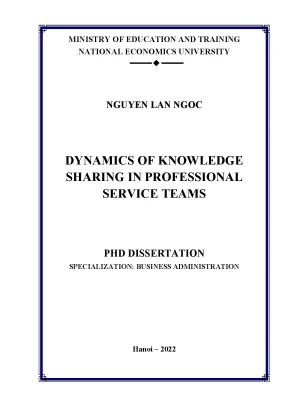
Tải xuống để đọc toàn bộMINISTRY OF EDUCATION AND TRAINING NATIONAL ECONOMICS UNIVERSITY NGUYEN LAN NGOC DYNAMICS OF KNOWLEDGE SHARING IN PROFESSIONAL SERVICE TEAMS PHD DISSERTATION SPECIALIZATION: BUSINESS ADMINISTRATION Hanoi – 2022 MINISTRY OF EDUCATION AND TRAINING NATIONAL ECONOMICS UNIVERSITY NGUYEN LAN NGOC DYNAMICS OF KNOWLEDGE SHARING IN PROFESSIONAL SERVICE TEAMS SPECIALIZATION: BUSINESS ADMINISTRATION SPECIALIZATION CODE: 9340101 PHD DISSERTATION Supervisor: Assoc. Phan Thi Thuc Anh Hanoi - 2022 DECLARATION I have read and understood the University’s policy on plagiarism. I hereby declare on my honor that this research proposal is my own work and does not violate the regulations on good academic practices. PhD candidate i Table of Contents 1.
Research objectives and research questions. Subjects and scope of the research. Original contributions of the research. Structure of the dissertation .9 CHAPTER 1 – LITERATURE REVIEW.
Overview of work teams and project teams. Definitions and types of work teams. Definitions and characteristics of project teams. Overview of knowledge, knowledge sharing, team knowledge sharing.
Definitions and Types of knowledge. Definitions of knowledge sharing, team knowledge sharing, and dynamics of team knowledge sharing. Roles of team knowledge sharing. Factors influencing team knowledge sharing.
Overview of motivation and motivations of team knowledge sharing. Overview of professional service firms. Definition and types of professional service firms. Importance of team knowledge sharing in professional service firms.
Research Gaps in Team knowledge sharing literature. 43 SUMMARY OF CHAPTER 1. 46 CHAPTER 2 – THEORETICAL FOUNDATION. Rationales for the choice of Groups as complex systems theory and Incentive theory.
Key ideas of Groups as complex systems theory and Incentive theory. Key ideas of Group as complex systems theory. Key ideas of Incentive theory. Applications of Groups as complex systems theory and Incentive theory in prior studies.
Application of Groups as complex system theory in prior studies. Application of Incentive theory in prior studies. Applications of Groups as complex systems theory and Incentive theory for Dynamics of Knowledge sharing in professional service project teams. Modes of project life in professional service project teams.
Team knowledge sharing and Functions of professional service project teams. Team knowledge sharing and Composition of professional service project teams. Team knowledge sharing and the causal dynamics in professional service project teams. 61 SUMMARY OF CHAPTER 2.
62 CHAPTER 3 – RESEARCH METHODOLOGY. Reasons for choosing the exploratory sequential mixed methods research 64 3. Mixed method research design. Research context – Audit industry in Vietnam and audit project teams.
General mixed methods research design. Qualitative data collection and data analysis. Qualitative data collection procedures. Qualitative data analysis.
Data quality procedures. Quantitative data collection and data analysis. 92 SUMMARY OF CHAPTER 3. 92 CHAPTER 4 – FINDINGS AND ANALYSIS.
Qualitative data analysis and findings. Interactions of team knowledge sharing elements at Stage 1 – Planning 93 4. Interactions of team knowledge sharing elements at Stage 2 – Execution. Interactions of team knowledge sharing elements at Stage 3 – Completion.
General model of Team knowledge sharing dynamics. Quantitative data analysis and findings. Measure reliability and validity. 119 SUMMARY OF CHAPTER 4.
131 CHAPTER 5 – DISCUSSIONS AND IMPLICATIONS. Recommendations for team leaders or project leaders at team level. Recommendations for team members at individual level. Recommendations for top managers at organization level.
147 SUMMARY OF CHAPTER 5. 153 APPENDIX 1: INTERVIEW GUIDE. 184 APPENDIX 2: SURVEY QUESTIONNAIRE. 186 APPENDIX 3: EXAMPLE OF PRELIMINARY MANUAL CODING PROCESS.
190 APPENDIX 4: EXAMPLE OF CODING LEVEL 1. 191 APPENDIX 5: EXAMPLE OF CODING LEVEL 2. 192 APPENDIX 6: EXAMPLE OF CODING LEVEL 3. 193 APPENDIX 7: EXAMPLES OF THE CODING RESULTS.
194 iv LIST OF TABLES AND FIGURES Table 1.1: Summary of representative studies on taxonomy of knowledge .2: A summary of the empirical studies on the roles of team knowledge sharing .3: A summary of empirical studies on factors influencing knowledge sharing within teams .1: Number of audit firms in Vietnam in the period 2019ậ2020 .2: Workforce of audit firms in Vietnam in the period 2019ậ2020 .3: Data collection methods .4: Profile of Interviewees .5: Definitions and coding scheme .6: Profile of respondents.7: Measurement scales of variables .1: Summary of hypotheses on Team Knowledge sharing Dynamics .2: Validity and Reliability of Variables .4: Mauchly’s test of sphericity .7: Summary of the research findings.1: The exploratory mixed methods research design .1: Model of Team knowledge sharing dynamics. Rationale In the era of knowledge economy, knowledge sharing is central to firms’ growth and success (Cavaliere & Lombardi, 2015; Prusak & Davenport, 1998). As a significant constituent of knowledge management (Riege, 2005), knowledge sharing helps individuals to contribute to knowledge application, innovation, and achieving sustainable competitive advantage (Jackson et al. Knowledge sharing has been found to be positively related with reduced production costs, faster completion of new product development projects, team performance, firm innovation capabilities, and firm performance including sales growth and revenue from new products and services (Arthur & Huntley, 2005; Collins & Smith, 2006; Cummings, 2001; Lin, 2007; Mesmer- Magnus & DeChurch, 2009).
Thus, a large body of research has produced extensive explanations of the knowledge sharing processes (e., Bruton et al., 2007; Huang et al., 2008; Lin, 2011; Ma & Yu, 2010; Sechi et al. It has done so using various angles, levels of analysis, and by paying attention to various selected aspects (Kepczyk, 2000; Sergeeva & Andreeva, 2016). The previous studies have made significant contributions to our understanding of knowledge sharing within organizations. Particularly, in the context of team which is considered as the crucial building block in today’s knowledge-based organizations, knowledge sharing is an important factor affecting team performance because for attainment of common goals, team members with unevenly distributed expertise and knowledge need to interact regularly and depend on each other.
In professional service firms, where most work is done by project teams delivering customized client services, project teams are becoming more commonly used to take advantage of resources and enhance competitive advantages (Batistič & Kenda, 2018; Fu et al. Professional service firms have received widespread attention from both practitioners and researchers because professional services are an increasingly important driver of economic activity in the knowledge economy (Hertog, 2000; Kox, 2004), and in this setting, the process of sharing knowledge has been identified as a key source of competitive advantage (Carmel, 2005). Processes within project teams for coordinating resources to solve 1 problems, implement procedures, and complete tasks has attracted the attention of both researchers and practitioners in the past decade (Carter et al. Among these processes, there are an increasing number of studies on the importance of productive knowledge sharing behavior (Zhang & Min, 2019) that plays significant roles in team performance and project delivery (Ahmad & Karim, 2019; Calamel et al.
Professional service firms are characterized by knowledge intensity, low capital intensity, and professionalized workforce (Von Nordenflycht, 2010), and categorized into technology developers, professional campuses, neo professional service firms and classical professional service firms (von Nordenflycht, 2014). On the base of technical aspect, technology developers, professional campuses are technical professional service firms with enough capital, they can invest in unique machinery, tools or equipment to deliver services. Neo professional service firms and classical professional service firms are nontechnical professional service firms which rely more on their internal and external management of knowledge. However, most empirical studies of knowledge sharing are focused on technical professional service firms or technological perspective (Wang & Noe, 2010).
Among the non-technical professional service firms, audit firms have the most comprehensive characteristics of professional service firms. Knowledge sharing is especially vital in auditing firms, as these firms depend on the quality of services provided by their professionals to succeed (Curtis & Taylor, 2018; Vera Munoz et al. To be specific, audit firms are put under high pressure to improve quality, efficiency, and effectiveness of audit process because of regulatory environment, updating auditing standards, and scandal events related to financial fraud. Furthermore, in each audit engagement, knowledge about the client’s environment, industry, business model, and operations are typically distributed unevenly among audit team members (Harding & Trotman, 1999; Kerr & Murthy, 2004).
Therefore, knowledge sharing capability of industry-specific trends, accounting, auditing, regulatory issues determine the outcome of the audit services. Despite the potential importance of knowledge sharing to auditing firms, accounting practitioners and scholars have made little progress in understanding its anatomy (Vera Munoz et al. 2 While knowledge sharing and its related processes in teams are inherently dynamic (Heizmann & Olsson, 2015; Kwok & Gao, 2005), prior research has mostly explained these team processes through static models. Especially at different stages of the project team life cycle, these team processes have been studied at a certain stage of a project rather than considering their impacts at different project stages (Zhang & Guo, 2019).
Few have actually studied project teams over time to uncover work processes in a real life setting (Jørgensen, 2018). Failing to address team knowledge sharing dynamics can lead to insufficiently understanding the nature of this team process and hampers practical measures as different managerial interventions may be required at different project stages. In professional service teams, team members interact at all stages of the project to generate solutions and deliver customized services to clients (Gardner, 2015). Effective interactions among team members promote knowledge sharing along with new knowledge generation (Morris, 2001).
There raises a question that how team knowledge sharing changes in its dimensions as the project moves from one stage to the next. One of the most frequently studied dimensions of knowledge sharing is why people share knowledge. This dimension is criticized for being not clearly delineated (Nguyen et al., 2019; Stenius et al., 2016) and managerially impractical (Foss et al. Empirically, how to motivate professionals to share their knowledge is still challenging, especially in professional service teams (Fu et al.
As knowledge sharing in teams is both goal driven and social exchange (Zhao et al., 2021), what motivate people to contribute their efforts and resources during the project time are contingent upon the nature of team goals, tasks, and social interactions among team members. Hence, the economic, sociological, and psychological aspects should simultaneously be brought into the picture of motivation to share knowledge within project teams. What people share as the other important dimension of knowledge sharing has suggested to be different at each project stage (Gomes et al. While knowledge in team process exists in different typologies, it has been mostly treated as one single construct in the team knowledge sharing literature (Ahmad & Karim, 2019).
This is unfortunate since the nature and relevance of knowledge shared for a specific task are critical for the achievement of team goals (Ahmad & Karim, 2019). Thus, without 3 consideration of sharing different knowledge types, there may lead to the insufficient explanation of team knowledge sharing. The theory of groups as complex systems (Arrow et al., 2000) provides some insights on the dynamics of team knowledge sharing. This theory proposes that groups are complex and dynamic systems in which the group behaviors change over the group life course, yielding temporal patterns of development.
The group behaviors involve interactions across at least three levels including constituent elements of groups, the group as an entity, and the contexts in which a group is embedded. Besides, the theory proposes that the priorities a group placed on its various functions do not remain static but interplay dynamically over time. In this view, the nature of knowledge sharing among team members changes over the project stages to complete the project tasks, fulfill members’ needs, and maintain the team integrity. However, it has not been clear that what and how team elements related to knowledge sharing interact and change as the project teams move from one stage to the next.
Nội dung được bảo vệ bản quyền — Tải xuống đầy đủ
Trích dẫn luận án này
Nguyen Lan Ngoc (2022). Động lực chia sẻ tri thức trong nhóm dịch vụ chuyên nghiệp [Luận án tiến sĩ, National Economics University]. LuanAn.net. https://luanan.net/quan-tri-kinh-doanh/quan-tri-nguon-nhan-luc/dong-luc-chia-se-tri-thuc-trong-nhom-dich-vu-chuyen-nghiep
Câu hỏi thường gặp
Luận án "Động lực chia sẻ tri thức trong nhóm dịch vụ chuyên nghiệp" nghiên cứu về vấn đề gì?
Khám phá động lực thúc đẩy chia sẻ tri thức trong nhóm dịch vụ chuyên nghiệp, nâng cao hiệu quả và sự hợp tác.
Luận án "Động lực chia sẻ tri thức trong nhóm dịch vụ chuyên nghiệp" được bảo vệ tại trường nào?
Luận án này được bảo vệ tại National Economics University. Năm bảo vệ: 2022.
Luận án "Động lực chia sẻ tri thức trong nhóm dịch vụ chuyên nghiệp" thuộc chuyên ngành gì?
Luận án "Động lực chia sẻ tri thức trong nhóm dịch vụ chuyên nghiệp" thuộc chuyên ngành Business Administration. Danh mục: Quản Trị Nguồn Nhân Lực.
Luận án "Động lực chia sẻ tri thức trong nhóm dịch vụ chuyên nghiệp" có bao nhiêu trang?
Luận án "Động lực chia sẻ tri thức trong nhóm dịch vụ chuyên nghiệp" có 211 trang. Bạn có thể xem trước một phần tài liệu ngay trên trang web trước khi tải về.
Cách tải luận án "Động lực chia sẻ tri thức trong nhóm dịch vụ chuyên nghiệp" về máy như thế nào?
Để tải luận án về máy, bạn nhấn nút "Tải xuống ngay" trên trang này, sau đó hoàn tất thanh toán phí lưu trữ. File sẽ được tải xuống ngay sau khi thanh toán thành công. Hỗ trợ qua Zalo: 0559 297 239.