Luận án tiến sĩ nghiên cứu so sánh bản dịch anh việt văn bản kinh doanh
Luận án tiến sĩ: Nghiên cứu so sánh bản dịch Anh-Việt. Phân tích các phương pháp, đánh giá chất lượng, đề xuất hướng cải tiến.
Luan An
Luận án tiến sĩ
Năm xuất bản
Số trang
212
Thời gian đọc
32 phút
Lượt xem
0
Lượt tải
0
Phí lưu trữ
50 Point
Tổng quan nhanh
- Chủ đề:
- 1. Nghiên cứu bản dịch Anh-Việt văn bản kinh doanh
- Số trang:
- 212 trang
- Trường:
- Hanoi Open University
- Chuyên ngành:
- English Linguistics
- Tác giả:
- Nguyễn Thị Hồng Hà
- Năm:
- 2022
Tóm tắt nội dung luận án
I. Nghiên cứu bản dịch Anh Việt văn bản kinh doanh
Luận án tập trung vào nghiên cứu so sánh bản dịch Anh-Việt. Đối tượng là văn bản kinh doanh. Nghiên cứu đánh giá mức độ tương đương của các nhóm danh từ và nhóm động từ. Các nhóm này liên quan đến phân khúc thị trường và chiến lược tiếp thị. Thay đổi ngữ nghĩa được phân tích từ góc độ chức năng-thực dụng. Dữ liệu được trích xuất từ văn bản gốc "Marketing 4.0: Moving from Traditional to Digital" (2017). Văn bản đích là "Tiếp thị 4.0: Dịch chuyển từ Truyền thống sang Công nghệ số" (2018). Phương pháp định tính được áp dụng. Các quy trình mô tả, so sánh, và diễn giải được sử dụng. Luận án mô tả các đơn vị ngôn ngữ trong văn bản gốc. Sau đó so sánh chúng với văn bản dịch. Cuối cùng, diễn giải các thay đổi ngữ nghĩa. Nghiên cứu cung cấp đánh giá toàn diện về tính tương đương.
1.1. Mục tiêu và phạm vi nghiên cứu bản dịch.
Nghiên cứu này có mục tiêu chính là đánh giá mức độ tương đương trong bản dịch Anh-Việt. Trọng tâm là các nhóm danh từ và nhóm động từ. Những nhóm này xuất hiện trong lĩnh vực kinh doanh, cụ thể là tiếp thị. Nghiên cứu phân tích cách các thay đổi ngữ nghĩa xảy ra. Cách tiếp cận là từ góc độ chức năng-thực dụng. Phạm vi dữ liệu rõ ràng. Một văn bản tiếp thị gốc tiếng Anh được chọn. Bản dịch tiếng Việt của nó là đối tượng so sánh. Sự tập trung vào "Marketing 4.0" cho phép phân tích chuyên sâu. Nghiên cứu xác định các vấn đề dịch thuật cụ thể. Nó cũng khám phá các giải pháp dịch thuật thực tế. Mục tiêu bao gồm việc hiểu rõ hơn quá trình dịch.
1.2. Dữ liệu văn bản kinh doanh sử dụng.
Dữ liệu nghiên cứu được chọn lọc cẩn thận. Văn bản gốc là "Marketing 4.0: Moving from Traditional to Digital". Cuốn sách này xuất bản năm 2017. Văn bản đích là bản dịch tiếng Việt, "Tiếp thị 4.0: Dịch chuyển từ Truyền thống sang Công nghệ số". Bản dịch này ra đời năm 2018. Việc chọn một cặp văn bản như vậy đảm bảo tính chính xác. Nó đại diện cho lĩnh vực kinh doanh đương đại. Các văn bản này chứa nhiều thuật ngữ chuyên ngành. Chúng cũng có các cấu trúc ngôn ngữ phức tạp. Các nhóm danh từ và động từ liên quan đến phân khúc thị trường được thu thập. Các chiến lược tiếp thị cũng được khảo sát. Việc sử dụng dữ liệu thực tế mang lại giá trị thiết thực. Nó đảm bảo kết quả nghiên cứu đáng tin cậy.
1.3. Phương pháp tiếp cận so sánh mô tả.
Nghiên cứu sử dụng phương pháp định tính. Các bước bao gồm mô tả, so sánh và diễn giải. Đầu tiên, các nhóm danh từ và động từ trong văn bản gốc được mô tả. Mô tả này dựa trên Register và Genre. Sau đó, những đơn vị ngôn ngữ này được so sánh giữa văn bản gốc và văn bản dịch. Quy trình diễn giải phân tích các thay đổi ngữ nghĩa. Cuối cùng, đánh giá mức độ tương đương được cung cấp. Phương pháp này cho phép phân tích sâu sắc. Nó giúp xác định sự khác biệt và tương đồng. Nó cũng làm rõ nguyên nhân của các thay đổi. Cách tiếp cận này đảm bảo sự khách quan. Nó tạo nền tảng cho các kết luận vững chắc.
II. Phương pháp đánh giá tương đương dịch thuật hiệu quả
Nghiên cứu sử dụng khung phân tích mạnh mẽ. Mô hình của House (2015) là nền tảng chính. Mô hình này được kết hợp với tài nguyên Attitudinal và Gradational của lý thuyết Appraisal (Martin và White, 2005). Mô hình của House bắt đầu với ngôn ngữ trong văn bản. Sau đó, Register được phân tích. Genre của văn bản được mô tả. Trong Register, thành phần Field kết hợp với tài nguyên Gradational. Thành phần Tenor tích hợp với tài nguyên Attitudinal từ lý thuyết Appraisal. Sự kết hợp này mang lại cái nhìn toàn diện. Nó giúp đánh giá tính tương đương từ nhiều khía cạnh. Phương pháp này đặc biệt hiệu quả. Nó xử lý các văn bản phi văn học.
2.1. Ứng dụng mô hình House và lý thuyết Appraisal.
Mô hình dịch thuật của House (2015) là công cụ chính. Nó giúp đánh giá chất lượng bản dịch. Mô hình này được tích hợp cùng lý thuyết Appraisal (Martin và White, 2005). Lý thuyết Appraisal cung cấp tài nguyên về thái độ (Attitudinal) và thang độ (Gradational). Sự kết hợp này tăng cường khả năng phân tích. Nó cho phép xem xét không chỉ nghĩa đen. Nó còn bao gồm các sắc thái biểu cảm. Việc này rất quan trọng trong bản dịch kinh doanh. Nó giúp dịch giả truyền tải chính xác thông điệp. Nó đảm bảo tính phù hợp với người đọc đích. Ứng dụng này mang lại một cái nhìn đa chiều. Nó vượt ra ngoài sự tương đương từ ngữ đơn thuần.
2.2. Phân tích Register và Genre trong dịch thuật.
Phân tích Register và Genre là bước quan trọng. Register bao gồm Field, Tenor và Mode. Field liên quan đến chủ đề của văn bản. Tenor là mối quan hệ giữa người viết và người đọc. Mode là cách thức giao tiếp. Trong nghiên cứu này, Field được kết hợp với tài nguyên Gradational. Gradational giúp phân tích mức độ nhấn mạnh. Tenor được tích hợp với tài nguyên Attitudinal. Attitudinal giúp hiểu thái độ của tác giả. Genre mô tả loại văn bản. Ví dụ, văn bản kinh doanh có Genre riêng. Việc phân tích kỹ lưỡng các yếu tố này giúp hiểu ngữ cảnh. Nó cũng giúp đánh giá sự phù hợp của bản dịch.
2.3. Quy trình đánh giá tính tương đương ngữ nghĩa.
Quy trình đánh giá tương đương rất chi tiết. Nó bắt đầu bằng việc mô tả các nhóm ngôn ngữ. Cụ thể là nhóm danh từ và động từ. Các đơn vị này được xem xét trong ngữ cảnh gốc. Sau đó, so sánh chúng với bản dịch. Các thay đổi về ngữ nghĩa được ghi nhận. Việc này bao gồm cả sự thêm bớt hoặc thay đổi nghĩa. Bước diễn giải phân tích lý do của các thay đổi. Nó đánh giá ảnh hưởng của chúng. Cuối cùng, mức độ tương đương được xác định. Mức độ này có thể là tương đương hoàn toàn, tương đương một phần, hoặc mất tương đương. Quy trình này cung cấp một khuôn khổ rõ ràng. Nó cho phép đánh giá chất lượng bản dịch một cách khách quan.
III. Phát hiện thay đổi ngữ nghĩa và chiến lược dịch
Kết quả nghiên cứu cho thấy những phát hiện quan trọng. Trong số 661 trường hợp nhóm danh từ và 392 nhóm động từ từ văn bản gốc, có 553 trường hợp chứa thay đổi ngữ nghĩa. Sự thay đổi này xảy ra trong bản dịch. Một lượng lớn các trường hợp cho thấy xu hướng "tăng cấp" về mức độ tương đương. Xu hướng "giảm cấp" chỉ chiếm một tỷ lệ nhỏ. Các chiến lược dịch thuật áp dụng rất đa dạng. Chúng bao gồm sử dụng từ đồng nghĩa, diễn giải. Ghi chú cuối trang và ẩn dụ cũng được sử dụng. Sự gia tăng tương đương được thấy qua nhiều cách. Ví dụ, sử dụng các diễn đạt hình tượng. Sử dụng trạng từ "mạnh" hơn, động từ tình thái. Từ ngữ trang trọng hơn. Các diễn đạt dài hơn văn bản gốc. Các ẩn dụ được đặt trong dấu ngoặc kép cẩn thận.
3.1. Mức độ thay đổi ngữ nghĩa nhóm danh từ động từ.
Nghiên cứu đã thu thập 661 trường hợp nhóm danh từ. 392 trường hợp nhóm động từ cũng được thu thập từ văn bản gốc. Kết quả cho thấy 553 trường hợp có thay đổi ngữ nghĩa trong bản dịch. Đây là một con số đáng kể. Nó chứng tỏ việc dịch thuật không đơn thuần là chuyển đổi từ vựng. Nó liên quan đến sự điều chỉnh nghĩa. Đa số các trường hợp cho thấy xu hướng "tăng cấp" tương đương. Điều này có nghĩa là bản dịch được cải thiện. Nó trở nên rõ ràng hơn hoặc mạnh mẽ hơn. Một số ít trường hợp có xu hướng "giảm cấp". Điều này dẫn đến sự mất mát ý nghĩa. Việc này giúp hiểu rõ hơn về các thách thức dịch thuật. Nó cũng chỉ ra các điểm cần chú ý.
3.2. Đa dạng chiến lược dịch thuật áp dụng.
Các dịch giả đã áp dụng nhiều chiến lược đa dạng. Mục tiêu là đạt được tính tương đương. Một số chiến lược phổ biến bao gồm sử dụng từ đồng nghĩa. Diễn giải cũng là một phương pháp hiệu quả. Ghi chú cuối trang được thêm vào. Điều này giúp giải thích các thuật ngữ phức tạp. Ẩn dụ cũng được sử dụng. Các ẩn dụ này được đặt trong dấu ngoặc kép. Điều này để duy trì sự rõ ràng. Bản dịch còn cho thấy sự gia tăng tương đương. Điều này đạt được thông qua các biểu thức hình tượng. Việc sử dụng trạng từ "mạnh" hơn cũng được ghi nhận. Động từ tình thái và từ ngữ trang trọng hơn cũng xuất hiện. Các diễn đạt dài hơn văn bản gốc đôi khi được ưu tiên. Điều này giúp truyền tải đầy đủ ý nghĩa.
3.3. Tương đương thực dụng và lọc văn hóa.
Tính tương đương thực dụng được đạt được trong nhiều trường hợp. Cụ thể là ở các nhóm danh từ và động từ. Đặc biệt, khi sử dụng ẩn dụ trong bản dịch, các bộ lọc văn hóa được áp dụng. Việc này giúp ẩn dụ trở nên quen thuộc hơn. Nó phù hợp với người đọc mục tiêu. Đối với các thuật ngữ trừu tượng, có thể gây nhầm lẫn. Các ghi chú giải thích được thêm vào cuối trang. Chúng được đặt cẩn thận ngay trên từng trang. Điều này thể hiện sự tôn trọng đối với độc giả. Nó cũng nâng cao chức năng giao tiếp của bản dịch. Sự mất mát một phần tương đương nghĩa đen và nghĩa biểu thái rất ít. Điều này xảy ra khi có sự tỉnh lược tính từ. Hoặc khi tên riêng được giữ nguyên.
IV. Đóng góp lý thuyết và thực tiễn dịch thuật chuyên ngành
Nghiên cứu mang lại những đóng góp đáng kể. Nó góp phần vào lý thuyết và thực tiễn dịch thuật. Về mặt lý thuyết, nghiên cứu chứng minh. Mô hình của House có thể được áp dụng hiệu quả. Nó giúp khám phá tính tương đương. Cụ thể là trong bản dịch Anh-Việt của văn bản phi văn học. Mô hình cũng cho thấy hiệu quả khi tích hợp. Nó được kết hợp với lý thuyết Appraisal của Martin và White (2005). Sự kết hợp này làm phong phú thêm ngành dịch thuật học. Về mặt thực tiễn, các đóng góp rất rõ ràng. Nghiên cứu cung cấp hướng dẫn giá trị cho dịch giả. Nó cũng hữu ích cho chương trình đào tạo dịch thuật. Đặc biệt là trong việc dịch các văn bản phi văn học. Các phát hiện giúp nâng cao chất lượng dịch thuật.
4.1. Cải tiến ứng dụng mô hình House trong dịch thuật.
Nghiên cứu này đã góp phần cải tiến. Nó nâng cao cách ứng dụng mô hình của House. Mô hình này được dùng để phân tích tính tương đương. Đặc biệt là trong dịch thuật Anh-Việt của văn bản phi văn học. Nghiên cứu chứng minh tính hiệu quả của mô hình. Nó còn cho thấy sức mạnh khi tích hợp. Sự kết hợp với lý thuyết Appraisal là một điểm nhấn. Lý thuyết Appraisal của Martin và White (2005) tăng cường khả năng phân tích. Nó giúp nhìn nhận sâu sắc hơn về nghĩa và thái độ. Sự kết hợp này mở ra hướng đi mới. Nó làm phong phú thêm các phương pháp nghiên cứu dịch thuật. Nó cũng cung cấp một khung phân tích mạnh mẽ hơn.
4.2. Giá trị cho dịch giả và chương trình đào tạo.
Các phát hiện của nghiên cứu có giá trị thực tiễn cao. Chúng hữu ích cho các dịch giả chuyên nghiệp. Dịch giả có thể áp dụng các chiến lược được phân tích. Họ có thể hiểu rõ hơn về các thay đổi ngữ nghĩa. Nghiên cứu cũng cung cấp thông tin quý giá. Thông tin này dành cho các chương trình đào tạo dịch thuật. Các nhà giáo dục có thể sử dụng kết quả này. Họ cải thiện giáo trình và phương pháp giảng dạy. Đặc biệt là trong việc dịch văn bản phi văn học. Các sinh viên dịch thuật sẽ được trang bị tốt hơn. Họ sẽ có kỹ năng cần thiết để xử lý các văn bản phức tạp. Mục tiêu là nâng cao chất lượng dịch thuật tổng thể.
4.3. Nâng cao chất lượng dịch văn bản phi văn học.
Một trong những đóng góp quan trọng là nâng cao chất lượng. Cụ thể là chất lượng dịch văn bản phi văn học. Các văn bản kinh doanh là một ví dụ điển hình. Nghiên cứu chỉ ra các yếu tố quan trọng. Các yếu tố này ảnh hưởng đến tính tương đương. Nó cũng đề xuất các chiến lược hiệu quả. Việc áp dụng các bộ lọc văn hóa là cần thiết. Ghi chú giải thích cũng rất quan trọng. Điều này giúp truyền tải thông điệp chính xác. Nó đảm bảo tính phù hợp với người đọc mục tiêu. Kết quả nghiên cứu giúp dịch giả tránh sai sót. Họ có thể tạo ra các bản dịch chất lượng cao. Bản dịch không chỉ đúng nghĩa. Nó còn truyền tải được sắc thái và mục đích giao tiếp.
Mục lục chi tiết luận án
Tải xuống file đầy đủ để xem toàn bộ nội dung
Tải đầy đủ (212 trang)Trích đoạn nội dung luận án
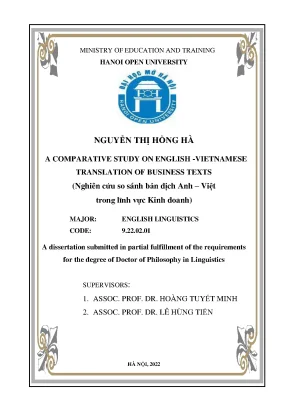
Tải xuống để đọc toàn bộMINISTRY OF EDUCATION AND TRAINING HANOI OPEN UNIVERSITY NGUYỄN THỊ HỒNG HÀ A COMPARATIVE STUDY ON ENGLISH -VIETNAMESE TRANSLATION OF BUSINESS TEXTS (Nghiên cứu so sánh bản dịch Anh – Việt trong lĩnh vực Kinh doanh) MAJOR: ENGLISH LINGUISTICS CODE: 9.01 A dissertation submitted in partial fulfillment of the requirements for the degree of Doctor of Philosophy in Linguistics SUPERVISORS: 1. HOÀNG TUYẾT MINH 2. LÊ HÙNG TIẾN HÀ NỘI, 2022 STATEMENT OF AUTHORSHIP The thesis entitled “A comparative study on English-Vietnamese translation of Business texts” has been submitted for the degree of Doctor of Philosophy. I, the undersigned, hereby declare that I am the sole author of this thesis, I have fully acknowledged and referenced the ideas and work of others in this thesis.
The thesis does not contain work extracted from a thesis, dissertation or research paper previously presented for another degree or diploma at this or any other university. Signature NGUYỄN THỊ HỒNG HÀ i ABSTRACT This descriptive, comparative, and evaluative research attempts to assess the equivalence extent of nominal groups and verbal groups related to market segments and marketing strategies with their semantic modifications in an English- Vietnamese translation of a marketing text from the functional- pragmatic perspective. The data are extracted from the Source text (ST) “Marketing 4.0: Moving from Traditional to Digital”, published in 2017 and from the Target text (TT) “Tiếp thị 4.0: Dịch chuyển từ Truyền thống sang Công nghệ số”, published in 2018. The qualitative method is applied to the study, in which descriptive, comparative and interpretive procedures are adopted in which the nominal groups and verbal groups of the ST are described in terms of Register and Genre, followed by the comparison of these language units between the ST and TT.
Finally, the interpretive steps are applied to analyze the semantic modifications before the evaluation of equivalence extent is provided. The sources of data are analyzed and assessed from the functional- pragmatic perspective of House’s model (2015) incorporated with the Attitudinal and Gradational resources of Appraisal theory (Martin and White, 2005). House’s model begins with language embedded in the text, then Register is analyzed and Genre is described. On Register, component Field is combined with Gradational resources while component Tenor is integrated with Attitudinal resources from Appraisal theory.
The findings show that, among the 661 cases of the nominal groups and 392 verbal groups collected from the source text, 553 cases (both nominal and verbal groups) contain semantic modification in the translation, in which a large number of cases show an ‘upscaled’ trend of equivalence extent while the ‘downscaled’ trend accounts for a small proportion. The translation strategies applied are diverse including synonymy, paraphrasing, using end-of-page note, metaphors,… Moreover, a gain in equivalence can be seen in the way of figurative expressions, using ‘stronger’ adverbs, modal verbs, more formal words, resorting the longer ii expressions than the source text and applying metaphors which are carefully put in double quotation mark. Especially, when using metaphors in the translation, the cultural filters are employed to be more familiar to the target readers. Besides, for the abstract terms which may raise confusion for the target readers, notes of explanation at the end of the page is also carefully added right away to each page, revealing a respectful attitude towards the readership and enhancing the interpersonal function of the translation.
Additionally, the pragmatic equivalence is reached in several cases of the nominal and verbal groups in the translation. The partial loss in denotative and connotative equivalence occurs just very little in the translation when there is a phenomenon of ellipsis in some adjectives preceding the noun, weakening the supplementary meaning or lowering the meaning of elements in the group or when the proper names in the original text are completely remained the same as in the translated text in spite of their translatability. This probably seems to be the translators’ purposeful intention of retaining the identity and aesthetics of the source language. The findings of this study can make some theoretical contributions to applying House’s model in uncovering the equivalence of an English-Vietnamese translation of non-literary text.
Also, the model shows the effectiveness when integrated with another theory, particularly with the Appraisal theory of Martin and White (2005) in translation studies. The practical contributions are for translators, and translator training programme, especially in translating non- literarty texts. iii ACKNOWLEDGEMENTS This thesis would not have been made possible without the guidance and the support of individuals who contributed and extended their valuable assistance in the preparation and completion of this study. I would like to express my heartfelt gratitude to my supervisors, Assoc.
Lê Hùng Tiến and Assoc. Hoàng Tuyết Minh, who inflame the fervent passion inside me towards the research topic and research progress. Without their continuously constructive feedback and encouragement, the thesis could not come into being. Additionally, I am deeply grateful to Dr.
Huỳnh Anh Tuấn, whose guidance and insightful comments are of profound significance during my research completion. I also wish to extent my gratitude to Assoc. Hồ Ngọc Trung, Assoc. Phan Văn Quế, Dr.
Phạm Thị Thủy, Assoc. Phạm Thị Thanh Thùy, Dr. Nguyễn Việt Hùng, Dr. Nguyễn Thị Vân Đông, Dr.
Nguyễn Đăng Sửu, Dr. Lưu Thị Kim Nhung and Dr. Lê Phương Thảo, who gave practical comments on my research proposal and presentations, and provided me with many valuable suggestions to develop my research effectively. My sincere thanks also go to the colleagues and friends at the English Faculties of Hanoi University of Business and Technology for their continuous motivation, support, and valuable advice for me across the path.
I will never forget strong support from Mr. Lê Công Phú, Ms. Trần Thị Thúy Hà, Mr. Nguyễn Việt Xô, Mr.
Phạm Đức Diễn, Ms. Đào Thị Thu Nga, Ms. Vi Thị Hồng Ngân, Ms. Nguyễn Thị Phương Anh, Ms.
Nguyễn Thanh Nhàn, Mr. Nguyễn Việt Tiệp, Ms. Nguyễn Thị Hảo, Ms. Đỗ Thị Kim Dung, and Ms.
Lê Thị Kiều Oanh. They have always supported me to overcome the obstacles during my research completion. Last but not least, I would like to thank my warm-hearted parents, my enthusiastic brothers, my sisters-in-law and my family with their restless assistance, especially my daughter and my son for their immense tenderness, deep empathy, strong inspiration, and firm support to motivate me throughout upheavals and realize the life values. iv TABLE OF CONTENTS STATEMENT OF AUTHORSHIP i ABSTRACT ii ACKNOWLEDGEMENTS iv LIST OF FIGURES AND TABLES x LIST OF ABBREVIATIONS xiii CHAPTER 1: INTRODUCTION 1 Rationale 1 2 Research aim and objectives of the study 3 3 Research question 4 4 Scope of the study 5 5 Methods of the study 6 6 Significance of the study 6 7 Organization of the thesis 7 CHAPTER 2: LITERATURE REVIEW 9 2.1 Translation Studies as a discipline 9 2.
Central Issues of Translation Studies 11 2. Issue of translation equivalence 13 2. Approaches of Translation Assessment 17 2. Response-based approach 18 2.
Linguistics-based approach 19 2. Two popular models of Translation Assessment 20 2. Newmark’s model of translation assessment (1988) 20 2. House’s model of translation assessment (2015) 22 2.
Procedure of House’s model 22 2. Texts and contexts 25 2. Components of House’s model 26 2. Overt, covert translation and cultural filters 28 v 2.
Adaptation of House’s model for the research aim 31 2. Appraisal theory by Martin and White (2005) in House’s model 35 2. Attitudinal resources of the Appraisal theory 35 2. Gradational resources of the Appraisal theory 41 2.5 Nominal groups and Verbal groups 45 2.
Business and Marketing texts 50 2. Market segments and Marketing Human-centric strategy 56 2. Marketing Human-centric strategy 57 58 2. Review of previous studies 58 2.
Previous studies on Comparative Translation Studies 63 2. Previous studies on Marketing Texts 65 2. Summary CHAPTER 3: RESEARCH METHODOLOGY 3. Interpretive, explanatory and evaluative steps 70 3.
Data collection and procedures of data analysis 76 3. Selection of the source text and target text 76 3. Collection of nominal groups and verbal groups 78 3. Procedures of data analysis 80 3.4 Summary 82 vi CHAPTER 4.
TRANSLATION EQUIVALENCE OF NOMINAL GROUPS AND 83 VERBAL GROUPS RELATED TO MARKET SEGMENTS 4.1 Translation equivalence of nominal groups and verbal groups related to market 84 segments 4. Nominal groups related to young, women, netizens’ market segment 84 4.2 Verbal groups related to young, women, netizens’ market segment 92 4. Translation equivalence of nominal groups and verbal groups related to young 99 market segment 4. Nominal groups related to the young market segment 99 4.2 Verbal groups related to the young market segment 109 4.3 Translation equivalence of nominal groups and verbal groups related to women’s 117 market segment 4.1 Nominal groups related to women’s market segment 117 4.
Verbal groups related to women’s market segment 126 4.4 Translation equivalence of nominal groups and verbal groups related to netizens’ 133 market segment 4.1 Nominal groups related to netizens’ market segment 133 4. Verbal groups related to netizens’ market segment 141 4.5 Summary of translation equivalence of nominal groups and verbal groups related 150 to market segments CHAPTER 5: TRANSLATION EQUIVAENCE OF NOMINAL GROUPS AND 152 VERBAL GROUPS RELATED TO HUMAN-CENTRIC MARKETING STRATEGY 5. Translation equivalence of nominal groups related to human-centric marketing 152 strategy 5. Analysis of nominal groups related to human-centric marketing strategy in the 152 source text 5.
Comparison of nominal groups related to human-centric marketing strategy in 157 the source text and target text 5. Translation equivalence of verbal groups related to human-centric marketing 164 strategy 5. Analyses of verbal groups related to human-centric marketing strategy in the 164 vii source text 5. Comparison of verbal groups related to human-centric marketing strategy in the 168 source text and target text 5.
Summary of translation equivalence of nominal groups and verbal groups related 171 to human-centric marketing strategy CHAPTER 6: CONCLUSION 175 6. Recapitulation of the study 175 6. English-Vietnamese translation of nominal groups and verbal groups related to 176 market segments 6. English-Vietnamese translation of nominal groups and verbal groups related to 179 human-centric marketing strategy 6.
Contributions of the study 180 6. Limitations and suggestions for further research 183 REFERENCES 186 RESEARCHER’S ARTICLES RELATED TO THE THESIS 197 APPENDIXES APPDENDIX A. Nominal groups and verbal groups related to market segments I APPDENDIX B. Gradational resources embedded in nominal groups related to XI the young market segment APPDENDIX C.
The authors’ attitudes embedded in nominal groups related to XII the young market segment APPDENDIX D. Process and graduation embedded in verbal groups related to XIV the young segment APPDENDIX E. The authors’ attitude embedded in verbal groups related to the XVII young segment APPDENDIX F. Gradational resources of nominal groups related to human- XIX centric marketing strategy viii APPDENDIX G.
The authors’ attitude embedded in nominal groups related to XXV human-centric marketing strategy APPDENDIX H. Some of the end-of-page explanation for nominal groups in the XXIX Target text APPDENDIX I. Equivalence extent in translating nominal groups related to human- XXXIII centric marketing strategy APPDENDIX J Process and graduation embedded in the verbal groups related to XL human-centric marketing strategy APPDENDIX K. The authors’ attitude embedded in verbal groups related human- XLIII centric marketing strategy APPENDIX L.
Equivalence extent in translating verbal groups related to human- XLV centric marketing strategy APPENDIX M1. Equivalence extent in semantic modification of Nominal groups and XLVII Verbal groups related to market segments APPENDIX M2 Equivalence extent in semantic modification of Nominal groups and LX Verbal groups related to human-centric marketing strategy Previous comparative translation studies APPENDIX N. Previous studies on marketing texts LXXVII ix LIST OF FIGURES AND TABLES FIGURES Figure 2. Relation between language and social context (Martin and Rose, 24 2008:10) Figure 2.
Three levels of text analysis (Martin and Rose, 2008:17) 25 Figure 2. House’s model of translation quality assessment (House 2015:127) 29 Figure 2. Theoretical framework of the study 33 Figure 2. The Appraisal framework (Martin and White, 2005) 37 Figure 2.
Nội dung được bảo vệ bản quyền — Tải xuống đầy đủ
Trích dẫn luận án này
Nguyễn Thị Hồng Hà (2022). Luận án tiến sĩ nghiên cứu so sánh bản dịch anh việt văn bản [Luận án tiến sĩ, Hanoi Open University]. LuanAn.net. https://luanan.net/ngon-ngu-hoc/ngon-ngu-hoc-doi-chieu/luan-an-tien-si-nghien-cuu-so-sanh-ban-dich-anh-viet-van-ban-kinh-doanh
Câu hỏi thường gặp
Luận án "Luận án tiến sĩ nghiên cứu so sánh bản dịch anh việt văn bản" nghiên cứu về vấn đề gì?
Luận án tiến sĩ: Nghiên cứu so sánh bản dịch Anh-Việt. Phân tích các phương pháp, đánh giá chất lượng, đề xuất hướng cải tiến.
Luận án "Luận án tiến sĩ nghiên cứu so sánh bản dịch anh việt văn bản" được bảo vệ tại trường nào?
Luận án này được bảo vệ tại Hanoi Open University. Năm bảo vệ: 2022.
Luận án "Luận án tiến sĩ nghiên cứu so sánh bản dịch anh việt văn bản" thuộc chuyên ngành gì?
Luận án "Luận án tiến sĩ nghiên cứu so sánh bản dịch anh việt văn bản" thuộc chuyên ngành English Linguistics. Danh mục: Ngôn Ngữ Học Đối Chiếu.
Luận án "Luận án tiến sĩ nghiên cứu so sánh bản dịch anh việt văn bản" có bao nhiêu trang?
Luận án "Luận án tiến sĩ nghiên cứu so sánh bản dịch anh việt văn bản" có 212 trang. Bạn có thể xem trước một phần tài liệu ngay trên trang web trước khi tải về.
Cách tải luận án "Luận án tiến sĩ nghiên cứu so sánh bản dịch anh việt văn bản" về máy như thế nào?
Để tải luận án về máy, bạn nhấn nút "Tải xuống ngay" trên trang này, sau đó hoàn tất thanh toán phí lưu trữ. File sẽ được tải xuống ngay sau khi thanh toán thành công. Hỗ trợ qua Zalo: 0559 297 239.