Luận án tiến sĩ: Nhân tố tác động đến tranh chấp lao động FDI Hàn Quốc tại Việt Nam - Trường Đại học Kinh tế Đà Nẵng
Nghiên cứu nhân tố tác động tranh chấp lao động của doanh nghiệp FDI Hàn Quốc tại Việt Nam. Phân tích sâu, đề xuất giải pháp phòng ngừa hiệu quả.
Đại học Kinh tế - Đại học Đà Nẵng
Luan An
Luận án tiến sĩ
Năm xuất bản
Số trang
176
Thời gian đọc
27 phút
Lượt xem
0
Lượt tải
0
Phí lưu trữ
50 Point
Tổng quan nhanh
- Chủ đề:
- 1. Giới Thiệu Tranh Chấp Lao Động FDI
- Số trang:
- 176 trang
- Trường:
- Đại học Kinh tế - Đại học Đà Nẵng
- Chuyên ngành:
- Quản trị kinh doanh
- Tác giả:
- Kim Tae Kyu
- Năm:
- 2022
Tóm tắt nội dung luận án
I. Giới Thiệu Tranh Chấp Lao Động FDI
Tranh chấp lao động là vấn đề quan trọng trong quan hệ lao động tại các doanh nghiệp FDI Hàn Quốc tại Việt Nam.
1.1. Khái Niệm Tranh Chấp Lao Động
Tranh chấp lao động là sự bất đồng giữa người lao động và người sử dụng lao động về các vấn đề liên quan đến lao động.
1.2. Nguyên Nhân Tranh Chấp Lao Động
Nguyên nhân tranh chấp lao động bao gồm tiền lương và phúc lợi, điều kiện làm việc, văn hóa doanh nghiệp Hàn Quốc, phong cách quản lý Hàn Quốc.
II. Các Nhân Tố Tác Động Đến Tranh Chấp Lao Động
Các nhân tố tác động đến tranh chấp lao động tại các doanh nghiệp FDI Hàn Quốc tại Việt Nam bao gồm lao động, công đoàn, quản lý, công ty, môi trường.
2.1. Nhân Tố Lao Động
Nhân tố lao động bao gồm số lượng lao động, chất lượng lao động, trình độ lao động.
2.2. Nhân Tố Công Đoàn
Nhân tố công đoàn bao gồm vai trò của công đoàn, hoạt động của công đoàn.
III. Tình Hình Tranh Chấp Lao Động Tại Doanh Nghiệp FDI Hàn Quốc
Tình hình tranh chấp lao động tại các doanh nghiệp FDI Hàn Quốc tại Việt Nam đang diễn ra phức tạp.
3.1. Tình Hình Tranh Chấp Lao Động Tại Việt Nam
Tình hình tranh chấp lao động tại Việt Nam đang diễn ra phức tạp do nhiều nguyên nhân.
3.2. Tình Hình Tranh Chấp Lao Động Tại Doanh Nghiệp FDI Hàn Quốc
Tình hình tranh chấp lao động tại các doanh nghiệp FDI Hàn Quốc tại Việt Nam đang diễn ra phức tạp do nhiều nguyên nhân.
IV. Phương Pháp Nghiên Cứu
Phương pháp nghiên cứu được sử dụng trong đề tài này là phương pháp nghiên cứu định lượng và định tính.
4.1. Phương Pháp Thu Thập Dữ Liệu
Phương pháp thu thập dữ liệu được sử dụng trong đề tài này là phương pháp thu thập dữ liệu qua khảo sát.
4.2. Phương Pháp Phân Tích Dữ Liệu
Phương pháp phân tích dữ liệu được sử dụng trong đề tài này là phương pháp phân tích dữ liệu bằng cách sử dụng các công cụ thống kê.
V. Kết Quả Nghiên Cứu
Kết quả nghiên cứu cho thấy các nhân tố tác động đến tranh chấp lao động tại các doanh nghiệp FDI Hàn Quốc tại Việt Nam.
5.1. Kết Quả Phân Tích Dữ Liệu
Kết quả phân tích dữ liệu cho thấy các nhân tố tác động đến tranh chấp lao động tại các doanh nghiệp FDI Hàn Quốc tại Việt Nam.
5.2. Kết Quả Kiểm Định Mẫu
Kết quả kiểm định mẫu cho thấy các nhân tố tác động đến tranh chấp lao động tại các doanh nghiệp FDI Hàn Quốc tại Việt Nam.
VI. Kết Luận Và Kiến Nghị
Kết luận và kiến nghị cho các doanh nghiệp FDI Hàn Quốc tại Việt Nam để giảm thiểu tranh chấp lao động.
6.1. Kết Luận
Kết luận về các nhân tố tác động đến tranh chấp lao động tại các doanh nghiệp FDI Hàn Quốc tại Việt Nam.
6.2. Kiến Nghị
Kiến nghị cho các doanh nghiệp FDI Hàn Quốc tại Việt Nam để giảm thiểu tranh chấp lao động.
Mục lục chi tiết luận án
Tải xuống file đầy đủ để xem toàn bộ nội dung
Tải đầy đủ (176 trang)Trích đoạn nội dung luận án
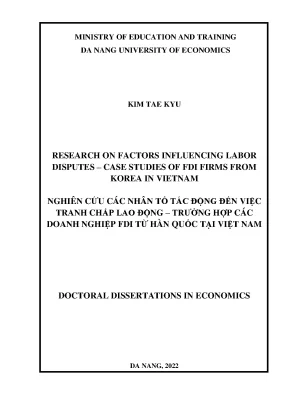
Tải xuống để đọc toàn bộMINISTRY OF EDUCATION AND TRAINING DA NANG UNIVERSITY OF ECONOMICS KIM TAE KYU RESEARCH ON FACTORS INFLUENCING LABOR DISPUTES – CASE STUDIES OF FDI FIRMS FROM KOREA IN VIETNAM NGHIÊN CỨU CÁC NHÂN TỐ TÁC ĐỘNG ĐẾN VIỆC TRANH CHẤP LAO ĐỘNG – TRƯỜNG HỢP CÁC DOANH NGHIỆP FDI TỪ HÀN QUỐC TẠI VIỆT NAM DOCTORAL DISSERTATIONS IN ECONOMICS DA NANG, 2022 luan an MINISTRY OF EDUCATION AND TRAINING DA NANG UNIVERSITY OF ECONOMICS KIM TAE KYU RESEARCH ON FACTORS INFLUENCING LABOR DISPUTES – CASE STUDIES OF FDI FIRMS FROM KOREA IN VIETNAM NGHIÊN CỨU CÁC NHÂN TỐ TÁC ĐỘNG ĐẾN VIỆC TRANH CHẤP LAO ĐỘNG – TRƯỜNG HỢP CÁC DOANH NGHIỆP FDI TỪ HÀN QUỐC TẠI VIỆT NAM MAJOR: BUSINESS ADMINISTRATION CODE: 62.02 DOCTORAL DISSERTATIONS IN ECONOMICS SUPERVISORS: 1: Pro. Nguyen Truong Son 2: Assoc. Nguyen Phuc Nguyen DA NANG, 2022 luan an AUTHOR’S DECLARATION I declare that this thesis “Research on factors influencing labor disputes – case studies of FDI firms from Korea in Vietnam” has been composed solely by myself and that it has not been submitted, in whole or in part, in any previous application for a degree. Except where states otherwise by reference or acknowledgment, the work presented is entirely my own.
Da Nang, 2022 Declarer Kim Tae Kyu iii | P a g e luan an TABLE OF CONTENTS AUTHOR’S DECLARATION. III TABLE OF CONTENTS. IV LIST OF ABBREVIATIONS. VIII LIST OF TABLES.
IX LIST OF FIGURES. XI CHAPTER 1: GENERAL INTRODUCTION OF RESEARCH. RATIONALE OF THE RESEARCH. RESEARCH OBJECTIVES AND QUESTIONS.
RESEARCH SUBJECTS AND SCOPE. SIGNIFICANCE OF THE RESEARCH. New theoretical contributions. New practical contributions.
DESIGN OF THE RESEARCH. 6 CHAPTER 2: THEORETICAL BACKGROUND AND CONCEPTUAL FRAMEWORK. THE DEFINITION, RELATED THEORIES AND CONTENT OF LABOR DISPUTES. The definition of labor disputes.
The content of TC. IMPACTS OF TC. LITERATURE REVIEW ON TC AND REVIEW RESULTS. Literature review on TC.
Literature review results. RESEARCH CONCEPTUAL FRAMEWORK. Research concepts and hypothesis development. 34 iv | P a g e luan an 2.
Labor-related factor (LD). Trade unions factor (CD). Manager-related factor (NSLD). Company-related factor (DN).
Labor-living related factor (SHLD). Internally environmental factor (MTN). Externally environmental factor (MTNG). 51 CONCLUSION OF CHAPTER 2.
55 CHAPTER 3: OVERVIEW OF KOREAN FDI AND THE CURRENT SITUATION OF LABOR DISPUTES AT KOREAN FDI IN VIETNAM. OVERVIEW OF FDI INTO VIETNAM. Korean FDI in Vietnam. The contributions of Korean FDI to Vietnam’s socio-economic development.
THE CURRENT SITUATION OF TC AT KOREAN FDI IN VIETNAM. The current situation of TC in Vietnam. The current situation of TC at Korean FDI in Vietnam. 66 CONCLUSION OF CHAPTER 3.
68 CHAPTER 4: RESEARCH METHODOLOGY. Data collection method. Qualitative research in detail. Questionnaire design and scale formulation.
Sample and sampling method. Description of the overall survey. 90 v|Page luan an 4. Data analysis methods.
Cronbach’s Alpha test. Exploratory Factor Analysis. Confirmatory Factor Analysis. Research model and hypothesis adjustment.
Correlation and regression analysis. Testing violations of the model fit assumptions. 93 CONCLUSION OF CHAPTER 4. 94 CHAPTER 5: DATA ANALYSIS AND RESULTS.
CHARACTERISTICS OF SAMPLES. General descriptive statistics. Description of respondent demographics. Cronbach’s Alpha reliability analysis of the scales.
Exploratory Factor Analysis. Confirmative Factor Analysis. TESTING RESEARCH MODEL AND HYPOTHESES. Testing research model.
Testing violations of goodness of fit assumptions. Testing the linear relationship between the dependent variable and independent variables as well as heteroscedasticity. Assumptions about the normal distribution of the residuals. Testing the hypotheses.
117 vi | P a g e luan an 5. TESTING THE DIFFERENCE BETWEEN CONTROL VARIABLES AND TC. Gender difference affecting TC. Marital difference affecting TC.
Age difference affecting TC. Difference in education affecting TC. Difference in working period affecting TC. Difference in working positions affecting TC.
Hometown location difference affecting TC. Difference in income affecting TC. 125 CONCLUSION OF CHAPTER 5. 126 CHAPTER 6: CONCLUSIONS, DISCUSSIONS AND MANAGERIAL IMPLICATIONS.
MANAGERIAL IMPLICATIONS AND RECOMMENDATIONS. For the State and regulatory agencies. For employers and firms. For trade unions.
LIMITATIONS AND DIRECTIONS FOR FUTURE RESEARCH. 145 THE AUTHOR’S PUBLISHED ARTICLE LISTS. 155 vii | P a g e luan an LIST OF ABBREVIATIONS CD Trade unions CFA Confirmatory factor analysis CSR Corporate social responsibility DN Company-related EFA Exploratory factor analysis FDI Foreign direct investment FIA Foreign Investment Agency LD Labor-related NSLD Manger-related MTN Internally environmental MTNG Externally environmental SHLD Labor-living related TC Labor disputes VCCI Vietnam Chamber of Commerce and Industry VGCL The General Confederation of Labor of Vietnam viii | P a g e luan an LIST OF TABLES Table 1: Strikes by ownership, 2000-2018. 63 Table 2: Strikes by industrial sector, 2014-2018.
64 Table 3: Cause of strikes, 2014-2018. 65 Table 4: Strikes by FDI nationality, 2014-2018. 66 Table 5: The first consolidation of factors influencing TC. 72 Table 6: The second consolidation of factors influencing TC.
73 Table 7: Interview design and details. 75 Table 8: The evaluation of factors influencing TC. 77 Table 9: The third consolidation of factors influencing TC. 78 Table 10: The original scales of factors influencing TC.
79 Table 11: The official scale of factors influencing TC. 83 Table 12: 5-point Likert scale. 88 Table 13: The control variables and coding. 89 Table 14: Response rate.
96 Table 15: Respondents’ demographics summary. Deviation of each item. 100 Table 17: Reliability analysis results. 102 Table 18: KMO and Bartlett’s test for independent variables.
104 Table 19: Total Variance Explained. 104 Table 20: Rotated Component Matrixa. 105 Table 21: KMO and Bartlett’s test for dependent variable. 107 Table 22: Total Variance Explained.
107 Table 23: Component Matrixa. 109 Table 25: RMR, GFI. 109 Table 26: Baseline Comparisons (Incremental fit index). 110 Table 28: Standardized Regression Weights.
110 ix | P a g e luan an Table 29: Discriminant validity analysis result. 111 Table 30: Correlations test result. 112 Table 31: Model Summary. 114 Table 34: Independent samples test - Gender.
120 Table 35: Independent samples test – Marriage Status. 120 Table 36: Descriptive – Marriage status. 121 Table 37: Test of Homogeneity of Variances – Age. 121 Table 38: Robust Tests of Equality of Means - Age.
121 Table 39: Descriptive - Age. 122 Table 40: Test of Homogeneity of Variances – Educational level. 122 Table 41: ANOVA – Educational level. 122 Table 42: Descriptive - Educational level.
122 Table 43: Test of Homogeneity of Variances – Years of Experience. 123 Table 44: ANOVA – Years of Experience. 123 Table 45: Descriptive - Years of Experience. 123 Table 46: Test of Homogeneity of Variances - Position.
124 Table 47: Robust Tests of Equality of Means - Position. 124 Table 48: Descriptive - Position. 124 Table 49: Test of Homogeneity of Variances – Hometown location. 124 Table 50: ANOVA - Hometown location.
125 Table 51: Test of Homogeneity of Variances – Wage level. 125 Table 52: ANOVA – Wage level. 125 Table 53: Descriptive – Wage level. 125 x|Page luan an LIST OF FIGURES Figure 1: Research model of Jeremy Brecher.
17 Figure 2: Research model of Jie Shen. 19 Figure 3: Research model of Duong Van Sao. 22 Figure 4: Research model of Do Quynh Chi et al. 23 Figure 5: Research model of Vuong Vinh Hiep.
28 Figure 6: Research model. 54 Figure 7: Registered Capital of FDI in Vietnam, US$ billions. 57 Figure 8: FDI inflows to Vietnam by country in 2019. 58 Figure 9: Cumulative FDI inflows to Vietnam by country.
60 Figure 10: Number of strikes, 2000-2018. 62 Figure 11: Research procedure. 69 Figure 12: CFA result for the model. 115 Figure 15: Normal P-P Plot.
116 xi | P a g e luan an CHAPTER 1: GENERAL INTRODUCTION OF RESEARCH 1. Rationale of the research The Vietnamese Government issued the FDI law in 1987. FDI law shows that the Vietnamese Government encourages foreign companies to make investments in major industries such as manufacturing, automobile assembly, pharmaceutical and healthcare treatments, etc. In this context, the influx of FDI into the country has increased and largely contributed to social development.
The latest data from the FIA of Vietnam shows that FDI in Vietnam in 2019 reached US$38.2 billion, an increase of more than 7 percent as compared to the same period in 2018. Around 3,883 new projects were licensed with a total registered capital of US$362. The Vietnam Briefing (2019) reveals that FDI accounts for approximately 70 percent of the country’s total export turnover and according to FIA, FDI contributed an average of 25 percent of total Vietnam’s GDP and created 10 million jobs in 2019. In terms of the investment relationship between Vietnam and Korea, it is reported by KOTRA that the cooperation between two countries results in a successful investment story (KOTRA, 2020).
According to the report, cumulative FDI investment of Korean firms to Vietnam is ranked No.1 and stands at US$67.7 billion with 8,467 projects in the period of 1988-2019. Around 9,000 Korean FDI firms have invested in Vietnam, and they contributed more than 30 percent of Vietnam’s exports and provided around 700,000 jobs domestically (Invest Vietnam, 2020). Despite these achievements, the number of TC in Korean FDI firms forms the majority of the total TC according to VGCL. The lowest contribution of Korean FDI firms to the total number of TC in FDI firms in Vietnam is recorded in 2015 (32.46%) while the highest record is 46.12% in 2017 with 113 out of 245 cases of TC (Kim, 2019).
Almost 40% of TC during 2014-2018 happened in Korean FDI firms (Kim, 2021) and have still taken a rather larger proportion than other FDI nationality. In 2020, a labor strike took place at the Korean FDI firm where a director who the author knows well. According to him, his company paid an average of VND 9 million a month for their employees with various allowances so that the wages were far higher than other FDI nationalities and the minimum wage (VND 4.42 million regulated Dong Nai’s minimum wage in 2020), but the TC took place. Given this situation, the author has a 1|Page luan an question as to whether TC still occur because of economic reasons that have been identified as the cause of TC at Korean FDI firms in numerous previous studies conducted until 2014.
Are there other possible reasons behind economic reasons? Is it because of the so-called ‘Korean style’ inappropriate management method? Or has the company neglected some emerging responsibilities such as CSR? If the number of TC in Korean FDI firms has not decreased, it needs to be clarified whether the solutions suggested by previous studies were effective or not. This research has begun to find answers to the above questions. Although TC have not abated since 2014, there has been relatively little research on TC in Korean FDI firms since 2014, and in particular, there was no research conducted by any Korean since Jeoung Yoo Kyung in 2013. For the above reasons, the author selects the thesis topic: “Research on factors influencing labor disputes – case studies of FDI firms from Korea in Vietnam”.
Nội dung được bảo vệ bản quyền — Tải xuống đầy đủ
Trích dẫn luận án này
Kim Tae Kyu (2022). Nghiên cứu nhân tố tác động đến tranh chấp lao động FDI Hàn Quốc tại Việt Nam [Luận án tiến sĩ, Đại học Kinh tế - Đại học Đà Nẵng]. LuanAn.net. https://luanan.net/luat-hoc/luat-kinh-te/nghien-cuu-nhan-to-tac-dong-den-tranh-chap-lao-dong-fdi-han-quoc-tai-viet-nam
Câu hỏi thường gặp
Luận án "Nghiên cứu nhân tố tác động đến tranh chấp lao động FDI Hàn Quốc tại Việt Nam" nghiên cứu về vấn đề gì?
Nghiên cứu nhân tố tác động tranh chấp lao động của doanh nghiệp FDI Hàn Quốc tại Việt Nam. Phân tích sâu, đề xuất giải pháp phòng ngừa hiệu quả.
Luận án "Nghiên cứu nhân tố tác động đến tranh chấp lao động FDI Hàn Quốc tại Việt Nam" được bảo vệ tại trường nào?
Luận án này được bảo vệ tại Đại học Kinh tế - Đại học Đà Nẵng. Năm bảo vệ: 2022.
Luận án "Nghiên cứu nhân tố tác động đến tranh chấp lao động FDI Hàn Quốc tại Việt Nam" thuộc chuyên ngành gì?
Luận án "Nghiên cứu nhân tố tác động đến tranh chấp lao động FDI Hàn Quốc tại Việt Nam" thuộc chuyên ngành Quản trị kinh doanh. Danh mục: Luật Kinh Tế.
Luận án "Nghiên cứu nhân tố tác động đến tranh chấp lao động FDI Hàn Quốc tại Việt Nam" có bao nhiêu trang?
Luận án "Nghiên cứu nhân tố tác động đến tranh chấp lao động FDI Hàn Quốc tại Việt Nam" có 176 trang. Bạn có thể xem trước một phần tài liệu ngay trên trang web trước khi tải về.
Cách tải luận án "Nghiên cứu nhân tố tác động đến tranh chấp lao động FDI Hàn Quốc tại Việt Nam" về máy như thế nào?
Để tải luận án về máy, bạn nhấn nút "Tải xuống ngay" trên trang này, sau đó hoàn tất thanh toán phí lưu trữ. File sẽ được tải xuống ngay sau khi thanh toán thành công. Hỗ trợ qua Zalo: 0559 297 239.