Mô hình hóa tính chất hồ xi măng từ vi cấu trúc: Cơ học, co ngót, creep - Do Quang Huy, EPFL
Mô hình hóa tính chất hồ xi măng từ cấu trúc vi mô, độ rỗng, tính chất cơ học, từ biến và co ngót. Nghiên cứu toàn diện.
école polytechnique fédérale de lausanne
Kỹ thuật xây dựng / Vật liệu xây dựng
Luan An
Luận án Tiến sĩ
Năm xuất bản
Số trang
183
Thời gian đọc
28 phút
Lượt xem
1
Lượt tải
0
Phí lưu trữ
50 Point
Tổng quan nhanh
- Chủ đề:
- 1. Mô hình hóa vi cấu trúc hồ xi măng
- Số trang:
- 183 trang
- Trường:
- école polytechnique fédérale de lausanne
- Chuyên ngành:
- Kỹ thuật xây dựng / Vật liệu xây dựng
- Tác giả:
- Do Quang Huy
- Năm:
- 2013
Tóm tắt nội dung luận án
I. Mô hình hóa vi cấu trúc hồ xi măng
Tài liệu phân tích cách mô phỏng vi cấu trúc của hồ xi măng Portland để dự đoán tính chất. Nghiên cứu tập trung vào độ rỗng, gel C-S-H và kết cấu lỗ rỗng. Các mô hình vi cấu trúc giúp hiểu rõ thủy hóa xi măng và ảnh hưởng đến tính chất cơ học. Phân tích cho thấy sự cần thiết của mô hình rời rạc để mô phỏng chính xác quá trình phát triển vi cấu trúc.
1.1. Vai trò của độ rỗng trong tính chất cơ học
Độ rỗng trong hồ xi măng ảnh hưởng trực tiếp đến độ bền và độ cứng. Khi thủy hóa xi măng xảy ra, gel C-S-H hình thành lấp đầy lỗ rỗng. Tuy nhiên, nếu độ rỗng cao, tính chất cơ học giảm. Nghiên cứu sử dụng mô hình vi cấu trúc để dự đoán sự phân bố lỗ rỗng và tác động đến độ bền.
1.2. Ảnh hưởng của gel C S H đến kết cấu lỗ rỗng
Gel C-S-H là thành phần chính trong hồ xi măng. Quá trình thủy hóa tạo ra gel này, làm thay đổi kết cấu lỗ rỗng. Mô hình hóa cho thấy sự phát triển của gel C-S-H làm giảm độ rỗng và tăng tính chất cơ học. Tuy nhiên, sự phân bố không đồng đều của gel có thể gây ra ứng suất nội tại.
II. Dự đoán tính chất cơ học và co ngót
Tài liệu đề cập đến việc mô phỏng tính chất cơ học như độ đàn hồi và độ bền nén. Đồng thời, mô hình hóa co ngót tự sinh và co ngót khô. Các yếu tố như độ ẩm, thời gian thủy hóa và nhiệt độ được xem xét. Kết quả cho thấy mối quan hệ giữa vi cấu trúc và hành vi co ngót.
2.1. Mô phỏng độ đàn hồi và độ bền nén
Độ đàn hồi của hồ xi măng phụ thuộc vào tỷ lệ gel C-S-H và độ rỗng. Mô hình số hóa vi cấu trúc giúp tính toán chính xác độ bền nén. Kết quả mô phỏng phù hợp với thực nghiệm, cho thấy hiệu quả của phương pháp này.
2.2. Co ngót tự sinh và cơ chế phát sinh
Co ngót tự sinh xảy ra do sự co rút của gel C-S-H trong quá trình thủy hóa. Mô hình hóa cho thấy tốc độ co ngót phụ thuộc vào độ ẩm và tốc độ phản ứng. Kết quả phân tích giúp tối ưu hóa công thức xi măng để giảm thiểu ứng suất co ngót.
III. Mô hình hóa co ngót hóa học và ứng suất
Nghiên cứu tập trung vào co ngót hóa học do phản ứng thủy hóa. Các mô hình kết hợp vi cấu trúc và cơ học để dự đoán ứng suất nội tại. Kết quả cho thấy sự cần thiết của việc xem xét tương tác giữa cấu trúc lỗ rỗng và phản ứng hóa học.
3.1. Tương tác giữa thủy hóa và co ngót hóa học
Quá trình thủy hóa tạo ra gel C-S-H, làm giảm thể tích và gây co ngót. Mô hình hóa cho thấy phản ứng hóa học làm thay đổi độ ẩm và tạo ứng suất. Điều này ảnh hưởng đến độ bền và khả năng chịu lực của bê tông.
3.2. Ứng dụng mô hình trong thiết kế vật liệu
Mô hình hóa giúp tối ưu hóa công thức xi măng để giảm co ngót. Bằng cách điều chỉnh tỷ lệ thành phần và thời gian thủy hóa, có thể kiểm soát ứng suất nội tại. Kết quả cho thấy tiềm năng ứng dụng trong xây dựng công trình bền vững.
IV. Thách thức và hướng phát triển
Tài liệu nêu bật những hạn chế trong mô hình hóa hiện tại. Ví dụ, mô hình rời rạc gặp khó khăn trong việc mô phỏng giai đoạn thủy hóa muộn. Đồng thời, cần cải thiện hiểu biết về sự hình thành gel C-S-H và tương tác giữa các lỗ rỗng. Nghiên cứu mở ra hướng phát triển mới trong lĩnh vực vật liệu xây dựng.
4.1. Hạn chế của mô hình hiện tại
Mô hình rời rạc không phản ánh chính xác độ ẩm thay đổi theo thời gian. Ngoài ra, việc mô phỏng ứng suất trong cấu trúc lỗ rỗng phức tạp còn nhiều thách thức. Những hạn chế này đòi hỏi cải tiến thuật toán và dữ liệu đầu vào.
4.2. Hướng nghiên cứu tương lai
Các nghiên cứu tiếp theo cần tập trung vào cơ chế hình thành gel C-S-H và tương tác vi cấu trúc. Việc tích hợp mô hình vi cấu trúc với mô phỏng nhiệt độ và độ ẩm sẽ nâng cao độ chính xác. Ngoài ra, cần phát triển phần mềm hỗ trợ mô phỏng đa yếu tố.
Mục lục chi tiết luận án
Tải xuống file đầy đủ để xem toàn bộ nội dung
Tải đầy đủ (183 trang)Nội dung chính
Tổng quan về luận án
Sự phát triển mạnh mẽ của bê tông tính năng cao (High-Performance Concrete - HPC) với tỷ lệ nước/xi măng ($w/c$) thấp mang lại nhiều lợi ích vượt trội về cường độ chịu lực, độ đặc chắc và độ bền kết cấu. Tuy nhiên, các vật liệu này lại đối mặt với thách thức lớn về nứt sớm do co ngót tự sinh (autogeneous shrinkage). Hiện tượng co ngót tự sinh khởi nguồn từ sự tự sấy khô (self-desiccation) và co ngót hóa học (chemical shrinkage / co ngót Le Châtelier với độ giảm thể tích từ 6% đến 8% ở mức thủy hóa hoàn toàn). Khi khung rắn bắt đầu liên kết (percolation), các lỗ rỗng mao dẫn chưa bão hòa hình thành giao diện khum chất lỏng - khí, tạo ra ứng suất căng mao dẫn (capillary tension) cục bộ và gây biến dạng thể tích vĩ mô. Việc dự báo định lượng chính xác co ngót tự sinh ở tuổi sớm vẫn là thách thức lớn đối với cơ học vật liệu xây dựng.
Luận án tiến sĩ số 5881 (2013) tại Trường Bách khoa Liên bang Lausanne (EPFL) của tác giả Đỗ Quang Huy, dưới sự hướng dẫn của GS. Karen Scrivener và GS. Shashank Bishnoi tại Laboratoire des Matériaux de Construction (LMC), mang tên: "Modelling Properties of Cement Paste from Microstructure: Porosity, Mechanical Properties, Creep and Shrinkage". Nghiên cứu đặt mục tiêu xây dựng một khung mô hình vi cơ học số thống nhất (unified micromechanical framework) dựa trên nền tảng vi cấu trúc vector 3D $\mu$ic để mô phỏng đồng thời quá trình thủy hóa, tiến hóa độ xốp, đặc tính đàn hồi, từ biến cơ bản (basic creep) và co ngót tự sinh của hồ xi măng Portland.
Hệ thống câu hỏi và giả thuyết nghiên cứu được xác lập chặt chẽ:
- Câu hỏi nghiên cứu 1 (RQ1): Làm thế nào để mô hình hóa chính xác sự tiến hóa kích thước lỗ rỗng và mô phỏng phép đo đo độ xốp xâm nhập thủy ngân (MIP) trên cấu trúc 3D khi xét đến hình thái thực của pha Calcium Silicate Hydrate (C-S-H)?
- Câu hỏi nghiên cứu 2 (RQ2): Làm thế nào để triệt tiêu các liên kết nhân tạo (artefacts) do quá trình chia lưới phần tử hữu hạn (FEM) gây ra hiện tượng kết nối mạng rắn giả tạo trước thời ninh kết?
- Câu hỏi nghiên cứu 3 (RQ3): Cơ chế từ biến cơ bản của pha C-S-H biến thiên theo tuổi và mật độ đóng gói ($\eta$) đóng góp như thế nào vào biến dạng co ngót tự sinh vĩ mô?
- Giả thuyết nghiên cứu 1 (H1): Sự biến thiên mật độ khối của C-S-H ($\rho$ tăng dần theo thời gian đến giá trị tới hạn $2.0\text{ g/cm}^3$, tương ứng $\eta = 0.7$) kết hợp với hiện tượng kết bông (flocculation) hạt ban đầu giải thích chính xác ngưỡng percolation cơ học và mô đun đàn hồi tuổi sớm.
- Giả thuyết nghiên cứu 2 (H2): Phương pháp chồng chất từ biến (creep-superposition approach) phản ánh bản chất tương tác vi cơ học chính xác hơn mô hình xốp đàn hồi kinh điển (poro-elasticity approach) trong việc dự báo co ngót tự sinh ở các tỷ lệ $w/c$ thấp.
Luận án bao quát phạm vi mô phỏng vi cấu trúc 3D với thể tích tính toán chứa hàng triệu hạt clinker (alite $C_3S$, belite $C_2S$, aluminate $C_3A$, ferrite $C_4AF$), kiểm chứng thực nghiệm tại điều kiện đẳng nhiệt 20°C từ 18 giờ đến giai đoạn trưởng thành.
Literature Review và Positioning
Các nghiên cứu vi cấu trúc xi măng trong hơn ba thập kỷ qua phân hóa thành nhiều trường phái mô hình hóa với các giả định khác nhau:
- Mô hình HymoStruc (van Breugel, 1995a, 1995b; Koenders & van Breugel, 1997): Dựa trên tiếp cận vector biểu diễn các hạt xi măng hình cầu phát triển các lớp đồng tâm. Nhược điểm cốt lõi của HymoStruc là giả định chỉ có một pha hydrate duy nhất bọc quanh hạt clinker, không phản ánh sự mầm hóa (nucleation) độc lập trong không gian lỗ rỗng và bỏ qua sự tương tác va chạm hạt (impingements) phức tạp.
- Mô hình CemHyd3D (Bentz & Garboczi, 1991; Bentz, 1997, 2000): Ứng dụng phương pháp rời rạc hóa trên lưới voxel 3D. Dù mô tả được hình học bất kỳ, CemHyd3D chịu giới hạn độ phân giải voxel ($1\text{ }\mu\text{m}$), gây hiện tượng nghẽn mạng (voxel locking) khi chia lưới mịn và không thể mô tả các lỗ rỗng mao dẫn siêu nhỏ hay vi cấu trúc dưới micron.
- Mô hình Động học hạt tích hợp IPKM (Navi & Pignat, 1996; Pignat et al., 2005): Khởi xướng tiếp cận vector tính toán động học mầm hóa và phát triển pha theo phương trình Avrami, nhưng bị hạn chế nghiêm trọng về thuật toán cấu trúc dữ liệu, chỉ xử lý được khoảng 20.000 hạt, không đủ đại diện cho thể tích vi mô thực tế.
Trong lý thuyết về động lực co ngót tự sinh, các cuộc tranh luận học thuật tập trung vào ba cơ chế:
- Áp suất tách (Disjoining pressure) (Ferraris, 1986; Visser, 1998): Chi phối bởi lực van der Waals giữa các bề mặt hydrate cách nhau dưới hai lớp phân tử nước hấp phụ. Tuy nhiên, áp suất tách gần như không đổi trong khoảng độ ẩm tương đối ($RH$) từ 80% đến 100%.
- Sức căng bề mặt hạt keo (Bangham & Fakhoury, 1930; Powers, 1965, 1968; Wittmann, 1968, 1982): Chỉ phát huy tác dụng ở dải $RH$ rất thấp (5% – 50%), trong khi quá trình tự sấy khô do thủy hóa chỉ làm giảm $RH$ nội tại xuống khoảng 75% – 100%.
- Ứng suất căng mao dẫn (Capillary tension) (Hua et al., 1995; Lura et al., 2003; Coussy et al., 2004): Được thừa nhận rộng rãi là động lực chủ đạo tại vùng $RH > 45%$, liên kết với bán kính mặt khum chất lỏng qua phương trình Laplace và Kelvin.
Luận án của Đỗ Quang Huy định vị đột phá bằng cách khắc phục khoảng trống phương pháp luận của các nghiên cứu quốc tế:
- So với mô hình vi cơ học đa tỷ lệ thuần giải tích của Bernard et al. (2003) và Ulm et al. (2004) vốn giả định pha C-S-H đồng nhất không đổi, luận án tích hợp trực tiếp sự biến thiên mật độ C-S-H theo thời gian trên nền tảng vi cấu trúc thực.
- So với các mô hình phần tử hữu hạn vĩ mô của Pichler et al. (2007) hay mô hình bán thực nghiệm của Lura (2003), nghiên cứu này thực hiện bước nhảy vọt khi sử dụng cùng một vi cấu trúc vector 3D từ nền tảng $\mu$ic (Bishnoi & Scrivener, 2009) để giải quyết chuỗi liên hoàn: Thủy hóa $\rightarrow$ Độ xốp $\rightarrow$ Đàn hồi $\rightarrow$ Từ biến lão hóa $\rightarrow$ Co ngót tự sinh.
Đóng góp lý thuyết và khung phân tích
graph TD
    A[Mô phỏng Thủy hóa Vector 3D mic] --> B[Tiến hóa Vi cấu trúc & Độ xốp]
    B --> C[Phân tích Độ xốp & Mô phỏng MIP]
    B --> D[Đồng nhất hóa Đàn hồi FEM & SCS]
    D --> E[Loại bỏ Liên kết giả tạo - Double Burning Algorithm]
    B --> F[Mô hình Từ biến Viscoelastic Maxwell C-S-H]
    C --> G[Xác định Áp lực Mao dẫn Capillary Stress]
    F --> H[Phương pháp Chồng chất Từ biến Creep-Superposition]
    D --> H
    G --> H
    H --> I[Dự báo Co ngót Tự sinh Vĩ mô]
Đóng góp cho lý thuyết
Luận án mang lại bốn đóng góp nền tảng cho lý thuyết hóa - cơ vật liệu xi măng:
- Mở rộng lý thuyết vi cơ học về pha C-S-H: Bác bỏ giả định truyền thống xem C-S-H là pha đồng nhất có khối lượng riêng cố định. Nghiên cứu chứng minh C-S-H hình thành ở tuổi sớm có độ đặc chắc thấp và trải qua quá trình nén chặt nội tại (densification) liên tục, tiến dần từ mật độ thấp đến khối lượng riêng thể tích $\rho = 2.0\text{ g/cm}^3$ và mật độ đóng gói $\eta = 0.7$.
- Làm rõ bản chất hình thái C-S-H trong không gian rỗng: Chứng minh sự sai lệch giữa mô phỏng số và thực nghiệm MIP bắt nguồn từ việc C-S-H phát triển dạng sợi kim (needles/diffuse growth) đâm xuyên vào không gian mao dẫn, tạo ra các lỗ rỗng siêu mịn bị giữ nước ngay từ giai đoạn đầu, thay vì tạo các mặt cầu nhẵn trơn như các giả định mô hình trước đây.
- Xác lập vai trò thống trị của từ biến trong co ngót tự sinh: Khẳng định co ngót tự sinh không đơn thuần là biến dạng xốp đàn hồi tức thời dưới áp suất mao dẫn mà là kết quả của sự tích lũy biến dạng từ biến lão hóa (aging creep) theo thời gian. Sự đóng góp của từ biến giải thích nguyên nhân tại sao hồ xi măng có tỷ lệ $w/c$ thấp lại chịu co ngót vượt bậc.
- Chuẩn hóa lý thuyết thẩm thấu cơ học (percolation threshold): Chứng minh rằng trạng thái đông kết cơ học của hồ xi măng được kiểm soát bởi sự kết hợp giữa hiệu ứng kết bông ban đầu của các hạt khoáng $C_3S$ và tốc độ gia tăng mật độ của gel C-S-H.
Khung phân tích độc đáo
Khung phân tích tích hợp ba lý thuyết vật lý cốt lõi:
- Lý thuyết Poro-mechanics và Ứng suất Mao dẫn (Young-Laplace & Kelvin):
$$p_c = -\frac{2\sigma\cos\theta}{r} = \frac{RT}{V_m}\ln(RH)$$
Trong đó $p_c$ là áp suất mao dẫn, $\sigma$ là sức căng bề mặt chất lỏng, $\theta$ là góc thấm ướt, $r$ là bán kính mặt khum Kelvin, $R$ là hằng số khí ($8.314\text{ J/mol}\cdot\text{K}$), $T$ là nhiệt độ tuyệt đối và $V_m$ là thể tích mol của nước lỗ rỗng.
- Lý thuyết Đàn nhớt tuyến tính (Linear Viscoelasticity) với mô hình Maxwell tổng quát: Hàm từ biến nội tại của C-S-H được mô tả qua chuỗi Maxwell nhiều nhánh kết hợp phần tử lò xo đàn hồi và phần tử giảm chấn nhớt, tham số hóa từ dữ liệu thí nghiệm ấn nano (nano-indentation).
- Lý thuyết Đồng nhất hóa Cơ học Vi mô (Micromechanical Homogenization): Kết hợp lược đồ tự nhất quán (Self-Consistent Scheme - SCS) và Phương pháp Phần tử Hữu hạn (FEM) trên thể tích đại diện (Representative Element Volume - REV) để chuyển đổi đặc tính cơ học từ cấp độ nano/micro lên cấp độ vĩ mô.
Phương pháp nghiên cứu tiên tiến
Thiết kế nghiên cứu
Nghiên cứu vận hành theo thế giới quan thực chứng (positivism) và chủ nghĩa hiện thực phản biện (critical realism), kết hợp mô phỏng số học chuyên sâu với dữ liệu thực nghiệm đối chứng đa phương thức.
Thiết kế nghiên cứu đa tỷ lệ bao gồm:
- Cấp độ Nano: Ứng xử đàn nhớt nội tại của các lá C-S-H đơn lẻ ($10^{-9}\text{ m}$).
- Cấp độ Micro: Tương tác pha khoáng clinker ($C_3S, C_2S, C_3A, C_4AF$), Portlandite ($CH$), C-S-H và hệ thống lỗ rỗng trong khối thể tích đại diện REV 3D ($10^{-6}\text{ m}$ đến $10^{-4}\text{ m}$).
- Cấp độ Macro: Biến dạng co ngót thể tích và cơ tính vĩ mô của mẫu hồ xi măng ($10^{-2}\text{ m}$).
[Nano-scale: C-S-H Viscoelasticity (Nano-indentation)]
                        │
                        ▼
[Micro-scale: 3D Vector mic Platform + FEM Homogenization + Double Burning]
                        │
                        ▼
[Macro-scale: Creep-Superposition Shrinkage Formulation]
Quy trình nghiên cứu rigorous
- Khởi tạo vi cấu trúc 3D: Sử dụng nền tảng $\mu$ic với phân bố kích thước hạt (particle size distribution - psd) thực tế của xi măng thương mại, chứa tới hơn 3 triệu hạt trong thể tích tính toán, triệt tiêu hoàn toàn rào cản tính toán của các mô hình vector trước đây bằng thuật toán chia nhỏ lưới phụ và lấy mẫu điểm (point sampling).
- Kỹ thuật chia lưới và giải thuật "Double Burning": Khi chuyển đổi cấu trúc hình học vector sang lưới phần tử hữu hạn hexahedral, các hạt tiếp xúc gần tạo ra các "nút thắt liên kết giả tạo" (meshing artefacts), khiến khung chất rắn bị kết nối mạng (percolate) ngay tại thời điểm $t = 0$ (trước khi thủy hóa bắt đầu). Tác giả đã thiết kế thuật toán loại bỏ kết nối nhân tạo (double burning algorithm) dựa trên cơ sở dữ liệu vector hình học gốc, khôi phục chính xác thời điểm bắt đầu đông kết thực tế của vật liệu.
- Mô phỏng phép đo độ xốp: Tích hợp thuật toán đo kích thước lỗ rỗng và xâm nhập thủy ngân số (numerical MIP), so sánh đối chứng với phép đo thực nghiệm đo độ xốp xâm nhập thủy ngân và phổ cộng hưởng từ hạt nhân (Nuclear Magnetic Resonance - NMR).
- Đồng nhất hóa cơ học và tính toán từ biến: Lập trình giải thuật phần tử hữu hạn 3D đàn nhớt đẳng hướng với các biến trạng thái nội (internal variables), áp dụng điều kiện biên tuần hoàn và biến dạng thuần nhất để tính toán các tensor đàn hồi và tensor từ biến theo tuổi chất tải.
Data và phân tích
- Mẫu vật liệu mô phỏng: Hệ hồ xi măng tricalcium silicate tinh khiết ($C_3S$) và xi măng Portland thương phẩm với các tỷ lệ $w/c$ biến thiên từ $0.30, 0.35, 0.40$ đến $0.475$.
- Phần mềm và công cụ: Nền tảng vi cấu trúc $\mu$ic, bộ mã phần tử hữu hạn FE chuyên dụng phát triển trên ngôn ngữ C++/Fortran, công cụ tính toán đồng nhất hóa SCS.
- Dữ liệu đối chứng thực nghiệm: Thí nghiệm đo biến dạng tuyến tính bằng ống lượn sóng (corrugated tube method theo tiêu chuẩn ASTM C1698), giàn đo biến dạng tự do (free deformation rig $100\times 100\times 500\text{ mm}$), số liệu ấn nano độ sâu xung lực và số liệu từ biến cơ bản tuổi sớm tại phòng thí nghiệm NAVIER (Université Paris-Est) và LMC (EPFL).
Phát hiện đột phá và implications
Những phát hiện then chốt
- Đột phá về cơ chế nén chặt C-S-H: Nếu giả định C-S-H có mật độ khối không đổi $\rho = 2.0\text{ g/cm}^3$ ($\eta = 0.7$), mô hình phần tử hữu hạn dự báo chính xác từ biến thực nghiệm ở các tuổi chất tải 24 giờ và 30 giờ, nhưng đánh giá quá thấp biến dạng từ biến ở tuổi chất tải sớm 18 giờ. Khi đưa hàm mật độ C-S-H tăng dần theo độ thủy hóa ($\rho(t)$ biến thiên), mô hình tái lập hoàn hảo ứng xử từ biến lão hóa tuổi cực sớm.
- Giải mã nghịch lý đường kính ngưỡng (break-through diameter) trong MIP: Đường kính cổ lỗ rỗng tới hạn thu được từ thuật toán số trên vi cấu trúc kỹ thuật số luôn lớn hơn đáng kể so với thực nghiệm MIP. Luận án chỉ ra nguyên nhân vật lý cốt lõi: C-S-H không phát triển lớp vỏ trơn nhẵn như các mô hình hình học cổ điển giả định, mà phát triển theo dạng tinh thể hình kim phân tán vào không gian rỗng, tạo ra mạng lưới vi mao dẫn nano giữ nước từ rất sớm.
- Ưu thế vượt trội của phương pháp Chồng chất Từ biến (Creep-Superposition): So sánh trực tiếp giữa hai hướng tiếp cận chỉ ra rằng mô hình xốp đàn hồi (poro-elasticity) đánh giá thấp nghiêm trọng độ co ngót tự sinh vĩ mô. Ngược lại, phương pháp chồng chất từ biến kết hợp mật độ C-S-H tiến hóa tái tạo chính xác độ dốc và biên độ co ngót ở các tỷ lệ $w/c$ khác nhau.
- Hiệu ứng hiệp đồng giữa kết bông hạt và tăng mật độ hydrate: Việc đưa hiệu ứng kết bông (flocculation) khi rải hạt ban đầu và sự nén chặt của C-S-H vào mô hình là điều kiện tiên quyết để đạt được sự trùng khớp tuyệt đối về ngưỡng percolation cơ học và động học phát triển mô đun đàn hồi $E(t)$.
So sánh biến dạng co ngót theo thời gian:
Biến dạng Co ngót (µm/m)
 │                                        [Creep-Superposition + Densification] ── Thực nghiệm
 │                                      ╱
 │                                    ╱
 │                                  ╱  [Poro-elasticity thuần túy] (Dự báo thấp)
 │                        ─────────
 └────────────────────────────────────────────► Thời gian thủy hóa (giờ)
Implications đa chiều
- Về mặt lý thuyết: Thống nhất các nhánh nghiên cứu riêng rẽ về động học hóa học, vi cơ học đàn nhớt và nhiệt động học mao dẫn thành một hệ thống tính toán khép kín.
- Về phương pháp luận: Cung cấp thuật toán Double Burning giải quyết triệt để lỗi chia lưới trong vi cơ học tính toán vật liệu composite hạt, có thể chuyển giao cho nghiên cứu gốm sứ, địa chất và vật liệu polyme xốp.
- Về ứng dụng thực tiễn: Cho phép các kỹ sư vật liệu dự báo chính xác nguy cơ nứt sớm của các trạm trộn bê tông HPC/UHPC dựa trên thành phần khoáng và độ mịn xi măng mà không cần chờ đợi các quy trình đo thực nghiệm kéo dài nhiều tuần.
Limitations và Future Research
Luận án thẳng thắn chỉ ra bốn giới hạn phương pháp luận chính:
- Rào cản quy mô mô phỏng cấu trúc rỗng: Do hình thái phát triển dạng sợi kim phân tán cực kỳ phức tạp của C-S-H, việc tái tạo trực tiếp toàn bộ chi tiết không gian rỗng ở quy mô hàng trăm micromet bằng mô hình số thuần túy vẫn chưa thể thay thế hoàn toàn dữ liệu đầu vào thực nghiệm về áp suất mao dẫn.
- Giả định đẳng nhiệt và đẳng ẩm lý tưởng: Mô hình tập trung vào điều kiện kín đẳng nhiệt 20°C, chưa ghép nối đầy đủ trường nhiệt phi ổn định sinh ra từ phản ứng tỏa nhiệt thủy hóa khối lớn và ảnh hưởng của phụ gia giảm co ngót (SRA) hay tro bay/xỉ lò cao.
- Giới hạn mô tả cơ chế trương nở ban đầu: Sự xuất hiện của áp suất kết tinh (crystallization pressure) do tạo mầm ettringite hoặc portlandite gây trương nở nhẹ ở giai đoạn đầu ninh kết chưa được mô hình hóa tự động hoàn toàn mà mới chỉ được xem xét như một thành phần bù trừ biến dạng.
Các hướng nghiên cứu tiếp nối trong chương trình 10 năm:
- Phát triển mô hình tăng trưởng C-S-H phân nhánh fractal để mô phỏng chính xác cấu trúc vi mao dẫn mà không cần hiệu chỉnh bán thực nghiệm.
- Ghép nối mô hình nhiệt - ẩm - cơ (Thermo-Hygro-Mechanical - THM) đa chiều cho kết cấu bê tông khối lớn.
- Mở rộng thư viện vật liệu $\mu$ic cho các hệ chất kết dính xanh thế hệ mới (Alkali-activated materials, LC3 - Limestone Calcined Clay Cement).
Tác động và ảnh hưởng
- Tác động học thuật: Luận án là đỉnh cao nghiên cứu suốt gần 20 năm tại phòng thí nghiệm LMC/EPFL về mô hình hóa vi cấu trúc xi măng, đóng vai trò nền tảng cho hàng trăm công trình trích dẫn quốc tế trong lĩnh vực cơ học vật liệu xây dựng tính toán.
- Chuyển đổi công nghiệp: Cung cấp công cụ mô phỏng vi cấu trúc phục vụ các tập đoàn vật liệu xây dựng toàn cầu (như LafargeHolcim, Sika) tối ưu hóa cấp phối bê tông cường độ siêu cao (UHPC), cắt giảm hàm lượng clinker phát thải $CO_2$ mà vẫn bảo đảm độ bền nứt.
- Lợi ích kinh tế - xã hội: Giảm thiểu chi phí bảo trì và rủi ro sụp đổ cầu cảng, công trình ngầm và nhà cao tầng do nứt nẻ tuổi sớm gây ăn mòn cốt thép.
Đối tượng hưởng lợi
- Nghiên cứu sinh & Nhà khoa học trẻ: Tiếp cận mã nguồn phương pháp luận đồng nhất hóa cơ học số và giải thuật xử lý lưới vector-to-FEM không lỗi.
- Giáo sư & Chuyên gia vi cơ học: Thừa hưởng khung lý thuyết đã chứng minh về từ biến lão hóa C-S-H và phương pháp chồng chất từ biến trong vật liệu xốp.
- Phòng R&D Doanh nghiệp Xây dựng: Ứng dụng các thông số tối ưu về tỷ lệ $w/c$, độ mịn và thành phần khoáng để thiết kế hỗn hợp bê tông chống nứt tin cậy.
- Cơ quan quản lý tiêu chuẩn kỹ thuật: Bổ sung cơ sở khoa học để hoàn thiện các tiêu chuẩn dự báo co ngót và nứt kết cấu bê tông hiện đại.
Câu hỏi chuyên sâu
1. Đóng góp lý thuyết độc đáo nhất của luận án là gì và đã mở rộng lý thuyết nào?
Đóng góp độc đáo nhất là việc tích hợp thành công lý thuyết nén chặt mật độ C-S-H theo thời gian vào phương pháp chồng chất từ biến (creep-superposition approach) trên nền tảng vi cơ học. Công trình đã mở rộng lý thuyết xốp đàn nhớt (poro-viscoelasticity) của Biot và Coussy, chứng minh rằng biến dạng co ngót tự sinh ở tuổi sớm bị chi phối áp đảo bởi hiện tượng từ biến lão hóa của gel C-S-H dưới tác dụng của ứng suất căng mao dẫn biến thiên.
2. Đột phá phương pháp luận của nghiên cứu khi so sánh với các công trình quốc tế tiền nhiệm?
So với mô hình rời rạc CemHyd3D (Bentz, 1997) bị giới hạn độ phân giải $1\text{ }\mu\text{m}$ và mô hình HymoStruc (van Breugel, 1995) chỉ xét một pha hydrate duy nhất, luận án đã:
- Ứng dụng nền tảng vector 3D $\mu$ic xử lý hàng triệu hạt clinker đa khoáng với động học mầm hóa chân thực.
- Sáng tạo thuật toán Double Burning Algorithm triệt tiêu hoàn toàn các liên kết giả tạo của lưới phần tử hữu hạn, loại bỏ hiện tượng percolation rắn nhân tạo trước ninh kết – một vấn đề nan giải tồn tại suốt nhiều thập kỷ trong mô hình hóa vi cơ học xi măng.
3. Phát hiện thực nghiệm/mô phỏng nào gây bất ngờ nhất và bằng chứng dữ liệu đi kèm?
Phát hiện bất ngờ nhất là đường kính xuyên phá (break-through diameter) tính toán từ mô phỏng MIP trên cấu trúc số hóa luôn lớn hơn nhiều so với thực nghiệm đo MIP thực tế. Dữ liệu chứng minh rằng C-S-H không tạo thành các mặt cầu nhẵn bao bọc hạt mà mọc dạng kim/sợi phân tán (diffuse/needle-like growth) lấp đầy không gian rỗng, tạo ra mạng vi mao dẫn nano giữ nước ngay từ 18–24 giờ đầu.
Mô hình giả định cũ:                 Thực tế chỉ ra trong luận án:
   [ Hạt Clinker ]                     [ Hạt Clinker ]
    ╭───────────╮                       ╭───*─*──*──╮
    │  C-S-H    │ (Vỏ nhẵn trơn)        │ ╲╱ ╲╱ ╲╱  │ (C-S-H dạng sợi kim/diffuse)
    │           │                       │  *  *  *  │ -> Giữ nước vi mao dẫn
    ╰───────────╯                       ╰───*─*──*──╯
4. Luận án có cung cấp quy trình tái lập (Replication Protocol) rõ ràng không?
Có. Luận án chi tiết hóa toàn bộ hệ phương trình điều khiển đàn nhớt 3D (Phụ lục C, E), thuật toán chia lưới vector, bộ thông số đàn hồi của từng pha clinker ($C_3S, C_2S, C_3A, C_4AF, CH, C\text{-}S\text{-}H$) và quy trình khớp mô hình Maxwell tổng quát từ dữ liệu ấn nano, cho phép cộng đồng khoa học lập trình tái lập hoàn toàn kết quả mô phỏng.
5. Lộ trình nghiên cứu 10 năm tiếp theo được vạch ra như thế nào?
Lộ trình tập trung vào việc:
- Mô hình hóa trực tiếp hình thái phân tán sợi kim nano của C-S-H để lượng hóa áp suất mao dẫn mà không cần dữ liệu phụ trợ thực nghiệm.
- Mở rộng sang bài toán ghép nối đa trường Thermo-Hygro-Chemo-Mechanical (THCM) cho kết cấu bê tông đại khối trong điều kiện môi trường thực tế.
- Tích hợp mô phỏng vi cấu trúc cho các hệ chất kết dính bền vững chứa hàm lượng phụ gia khoáng hoạt tính cao.
Kết luận
Luận án tiến sĩ của Đỗ Quang Huy đã xác lập một mốc son học thuật quan trọng trong lĩnh vực cơ học vật liệu xi măng tính toán thông qua 5 đóng góp cốt lõi:
- Xây dựng khung mô hình vi cơ học 3D hoàn chỉnh: Liên kết liền mạch từ động học thủy hóa hạt vector đến đặc tính cơ học đàn nhớt và biến dạng thể tích vĩ mo.
- Phát minh thuật toán Double Burning: Loại bỏ triệt để lỗi liên kết giả tạo của phương pháp phần tử hữu hạn, xác định chính xác thời điểm đông kết cơ học.
- Chứng minh quy luật nén chặt của C-S-H: Khẳng định mật độ khối và mật độ đóng gói của C-S-H biến thiên theo tuổi thủy hóa, giải thích chính xác từ biến lão hóa từ 18 giờ đến 30 giờ.
- Làm rõ bản chất cơ chế co ngót tự sinh: Khẳng định phương pháp chồng chất từ biến (creep-superposition) là chìa khóa duy nhất mô tả chính xác ảnh hưởng của tỷ lệ $w/c$ thấp lên co ngót tự sinh.
- Định danh hình thái sợi phân tán của hydrate: Mở đường cho các lý thuyết mới về truyền dẫn ion và độ bền mao dẫn trong vật liệu gốc xi măng.
Công trình không chỉ giải quyết các câu hỏi cơ bản về vật lý - hóa học vật liệu mà còn cung cấp nền tảng khoa học vững chắc giúp ngành công nghiệp xây dựng toàn cầu kiểm soát hiện tượng nứt sớm, nâng cao tuổi thọ và độ an toàn cho các công trình hạ tầng thế kỷ.
Trích đoạn nội dung luận án
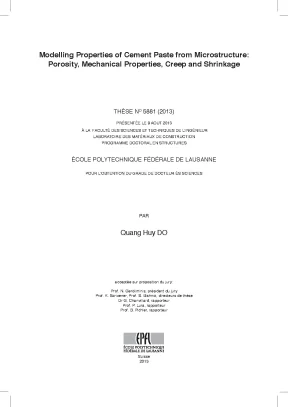
Tải xuống để đọc toàn bộModelling Properties of Cement Paste from Microstructure: Porosity, Mechanical Properties, Creep and Shrinkage THÈSE NO 5881 (2013) PRÉSENTÉE le 9 AOUT 2013 À LA FACULTÉ DES SCIENCES ET TECHNIQUES DE L'INGÉNIEUR LABORATOIRE DES MATÉRIAUX DE CONSTRUCTION PROGRAMME DOCTORAL EN STRUCTURES ÉCOLE POLYTECHNIQUE FÉDÉRALE DE LAUSANNE POUR L'OBTENTION DU GRADE DE DOCTEUR ÈS SCIENCES PAR Quang Huy Do acceptée sur proposition du jury: Prof. Geroliminis, président du jury Prof. Bishnoi, directeurs de thèse Dr G. Chanvillard, rapporteur Prof.
Lura, rapporteur Prof. Pichler, rapporteur Suisse 2013 Foreword The doctoral thesis of Dr. Do Quang Huy is an apt culmination of almost two decades of work in microstructural modelling of cements at EPFL. This work holistically tackles the phenomenon of autogeneous shrinkage through microstructural modelling.
In a first such attempt, the author has used the same microstructural model to simulate the microstructural development, elastic properties, creep and autogeneous shrinkage. The task of putting these models together was not simple. The author has successfully handled several problems at each step in an elegant manner. For example, although several earlier studies have pointed out that discrete models are unable to capture the late setting times of cements due to mesh effects, this study offers the most effective solution yet on the problem.
It is also the first time that creep has been modelled on a young evolving microstructure that is subjected to a time- variable load. Furthermore, each of these issues has been treated to a great depth and not just superficially. Despite the thoroughness of the models, the minimal variation of fit parameters required to reproduce experimental results demonstrates the tremendous development in our understanding of the hydration of cement. Throughout the work, it can be consistently seen that the introduction of microstructural effects such as flocculation and diffuse growth of C-S- H improves the quality of results.
It has also been seen that without introducing these effects, it is difficult to obtain the experimentally observed trends. At the same time, the results, especially on pore-structure, show that there are still large parts of hydration and microstructural development that we do not understand. As is often said, a good piece of research throws open many more questions than it answers. As models play an increasingly important role in the construction industry, continued efforts to understand these concepts will contribute much beyond mere satisfaction of academic curiosity.
At the end, I would like to congratulate Dr. Do Quang Huy for his hard work and his stubborn perseverance against the challenges he faced during this work. Delhi, August 2013 Shashank Bishnoi Acknowledgements I would like to thank all the people who helped me over the last four years in the work leading to this dissertation. I would like to acknowledge the Doctoral school at EPFL for accepting me as a PhD student and Swiss National Science Foundation for providing financial support for this research.
I wish firstly to address my great gratitude to Karen, my thesis director, for giving me the opportunity to work at LMC, for her precious advices, stimulating discussions, insightful comments and constructive criticisms, without which this work could not have been successfully carried out. Discussions with Karen not only brought new understandings but also opened new challenges that I needed to face with. She has given me the chance to learn from world leading scientists and approach advanced knowledge. The second person who has made impacts on my work is Shashank.
He was a first person to welcome me to LMC and my thesis co-director. I gratefully acknowledge him for his inspiring guidance, fruitful discussions, invaluable help and support and for his persistent encouragement and for also being my great friend. My research would not be running well without Shashank’s supervision. Looking back to the early stage of my doctoral study, I deeply appreciate how enormously patient Shashank was in teaching me.
I would not have such patience to teach a student with almost zero knowledge in cement science like me at that time. I have learnt a lot from Shashank when I was working with him despite our geographical distance. I would like to thank Amor, my thesis co-director, for his enthusiastic guidance and support and for sharing his expertise and knowledge from which my understandings of poro-mechanics have been enriched. The productive discussions with him equipped me to implement mechanical simulations and earned me wonderful results.
I am grateful to Cyrille for his enthusiastic and continuous support and for carefully reading through every line in my thesis and giving me extremely valuable feedback. I consider him as my thesis adviser and the encyclopaedia of all useful information. I offer my sincere thanks to Matthieu (at Navier, Université Paris Est) who lets me know the philosophy of his experimental data on the creep properties. I enjoyed our short-lasting but very interesting and informative meetings.
iii I would like to thank my thesis jury members, Gilles from Lafarge, Bernhard from TU Wien and Pietro from Empa, for their reviewing and correcting this research, which helped me to considerably improve this dissertation. I thank Sandra, Anna-Sandra, Maude, Marie-Alix, Christine for their administrative support, much more beyond their helping me with various logistic issues related to my conference travels and project meetings. I also thank Isabelle, Martina and Nikolas for helping me to submit this thesis in time. Thanks to Frédéric for his enthusiastic help related to human resource administration.
Thanks to all my LMC colleagues, my friends. Thanks to Ruzena for sharing her FE code and giving me a complete training. Thanks to Hui for letting me steal her hard-earned experimental results. Thanks to the geeks: Alain, Adytia, John for their computer tricks, and Olga, Arnaud, Théo, Trinh, Aude, Simone, Silke, Alexandra, 2 Philippe, Amélie, Cheng, Pawel, Berta, Aslam, Jaskanwal, Mohamad, Cedric, Christophe, Lionel, Elise, 2 Julien, Mathieu, Ruben, Mohammadhadi, Yaobo, Nicola, Mohsen, Patrick, Vanessa and Carolina for offering plenty of help, support and enthusiastic collaboration with cheerful attitude, and for all the good moments spent together outside the lab: Satellite, ski seminar, hiking, barbecues… I am thankful to my former classmates, special friends: Suresh, Raja, Dinesh and Deepak for chat, encouragement, both academic and more practical discussions, and for their kind help with this PhD application.
To my Vietnamese group: Xin cảm ơn anh chị em cộng đồng người Việt Nam, những người bạn tuyệt vời của tôi, vì những giúp đỡ trong cuộc sống, nguồn động viên chia sẻ và sự cảm thông sâu sắc của những người con Việt xa quê hương. To my family: Tình yêu và sự dạy dỗ của bố mẹ đã là cái nôi nuôi dưỡng cho con tri thức, niềm đam mê khoa học. Dù ở xa nhưng bố mẹ luôn là chỗ dựa tinh thần nguồn động lực vô cùng to lớn tiếp con sức mạnh vượt qua những khó khăn trong học tập nghiên cứu cũng như trong cuộc sống mà nhiều lúc tưởng chừng con không thể vượt qua. Em cảm ơn anh chị Quỳnh Thủy, cháu cảm ơn bà ngoại, các cô, bác, chú, thím, gì, cậu, mợ và các anh chị em từ hai bên nội ngoại đã luôn cổ vũ động viên trong suốt thời gian qua.
Und zum Schluss auch besonderen Dank an meine Freundin, Almut, für ihre Liebe, Fürsorge und Geduld in stressigen Zeiten, dass sie mit mir durch alle Hochs und Tiefs geht, immer zu mir steht, egal, was passiert und auch meine beste Freundin ist. iv Abstract Autogeneous shrinkage can be important in high-performance concrete characterized by low water to cement (w/c) ratios. The occurrence of this phenomenon during the first few days of hardening may result in early-age cracking in concrete structures. Although the scientific community has reached a fair level of agreement on the basic mechanisms and standard test methods, the prediction of autogeneous shrinkage is still a very challenging task.
Good prediction of autogeneous shrinkage is necessary to achieve better understanding of the mechanisms and the deployment of effective measures to prevent early-age cracking. The aim of this thesis was to develop a numerical, micromechanical model to predict the evolution of autogeneous shrinkage of hydrating cement paste at early age. The model was based on the three-dimensional hydration model µic of microstructure and the mechanism of capillary tension to simulate macroscopic autogeneous shrinkage. Pore-size distribution and Mercury Intrusion Porosimetry (MIP) were simulated.
Elastic and creep properties of the digital microstructure were calculated by means of numerical homogenization based on the Finite Element Method (FEM). Autogeneous shrinkage was computed by the average strain resulting from the capillary stress globally applied on the simulated microstructure. It was found that bulk density of C-S-H has to be assumed low at early age and gradually increased at later age to obtain an agreement between the experimentally measured and simulated total porosity. It was found that the experimentally observed break-through diameter from MIP is much lower than the values obtained by applying a numerical algorithm of MIP to the digital microstructure.
The effect of some of the most important input parameters on the pore-sizes in the simulated microstructure was explored. The reason which seems best able to explain this discrepancy is that C-S-H is not in fact a phase with a smooth surface as represented in microstructural models, but a phase which grows as needles into the pore space, leading to the formation of very small water filled capillary pores from early ages. This result indicates it will be extremely challenging to reproduce the pore structure of real microstructures in microstructural models on the scale of hundreds of microns necessary to study macroscopic transport. Consequently, it was necessary to use some experimental inputs in the later simulation of the autogeneous shrinkage.
v The first approach to determining elastic properties for the modelled microstructure gave values at early ages much higher than experimental ones, due to the connections formed in the microstructure as an artefact of the meshing procedure. Furthermore the percolation of the solids was found to occur even before hydration started. A procedure to remove these artefacts, on the basis of the information available in the vector microstructures was developed. Thanks to this improved procedure, a better agreement of the calculated and experimental results was obtained.
More realistic estimates of percolation threshold were obtained if either flocculation of initial placing of particles or a densification of C-S-H with hydration is assumed in the model. The basic creep of a simulated Portland cement microstructure is computed using Finite Elements. A generalized Maxwell model is used to describe the intrinsic C-S-H viscoelasticity as obtained by nano-indentation tests. It is found that if C-S-H is assumed to be homogenous with bulk density ρ = 2.
with a packing density η = 0.7), the numerical creep results of cement paste are in good agreements with experimental values for loading from 24 and 30 hours. However, the simulated creep for age of loading 18 hours appeared lower than the measured values: the input bulk density is much higher than its actual value at that time. In a refined model, C-S-H is assumed to have a creep response depending on η that varies with time. This latter model provides better predictions of early age cement paste ageing creep.
Autogeneous shrinkage was modelled using poro-elasticity and creep-superposition methods. It was found that the creep-superposition method provides a much better estimate of shrinkage than does the poro-elasticity method. The simulated results according to the creep- superposition method clearly show the effect of w/c ratio. This also suggested that the contribution of creep to shrinkage is considerable and should not be neglected.
Considering C-S-H densification in the simulations provides better predictions of autogeneous shrinkage in early age cement paste. Keywords: Autogeneous shrinkage, Modelling, Cement hydration, Cement microstructure, Mechanical properties, FEM, Homogenization methods, Ageing basic creep, Porosity analysis, C-S-H densification, Hydration model µic. vi Résumé Le retrait endogène est important dans les bétons à haute performance caractérisés par un faible rapport eau sur ciment (e/c).
Nội dung được bảo vệ bản quyền — Tải xuống đầy đủ
Trích dẫn luận án này
Do Quang Huy (2013). Mô hình hóa tính chất hồ xi măng: Vi cấu trúc, cơ học, co ngót [Luận án tiến sĩ, école polytechnique fédérale de lausanne]. LuanAn.net. https://luanan.net/ky-thuat-xay-dung-kien-truc/ky-thuat-xay-dung-dan-dung-cong-nghiep/mo-hinh-hoa-tinh-chat-ho-xi-mang-vi-cau-truc-co-hoc-co-ngot
Câu hỏi thường gặp
Luận án "Mô hình hóa tính chất hồ xi măng: Vi cấu trúc, cơ học, co ngót" nghiên cứu về vấn đề gì?
Mô hình hóa tính chất hồ xi măng từ cấu trúc vi mô, độ rỗng, tính chất cơ học, từ biến và co ngót. Nghiên cứu toàn diện.
Luận án "Mô hình hóa tính chất hồ xi măng: Vi cấu trúc, cơ học, co ngót" được bảo vệ tại trường nào?
Luận án này được bảo vệ tại école polytechnique fédérale de lausanne. Năm bảo vệ: 2013.
Luận án "Mô hình hóa tính chất hồ xi măng: Vi cấu trúc, cơ học, co ngót" thuộc chuyên ngành gì?
Luận án "Mô hình hóa tính chất hồ xi măng: Vi cấu trúc, cơ học, co ngót" thuộc chuyên ngành Kỹ thuật xây dựng / Vật liệu xây dựng. Danh mục: Kỹ Thuật Xây Dựng Dân Dụng & Công Nghiệp.
Luận án "Mô hình hóa tính chất hồ xi măng: Vi cấu trúc, cơ học, co ngót" có bao nhiêu trang?
Luận án "Mô hình hóa tính chất hồ xi măng: Vi cấu trúc, cơ học, co ngót" có 183 trang. Bạn có thể xem trước một phần tài liệu ngay trên trang web trước khi tải về.
Cách tải luận án "Mô hình hóa tính chất hồ xi măng: Vi cấu trúc, cơ học, co ngót" về máy như thế nào?
Để tải luận án về máy, bạn nhấn nút "Tải xuống ngay" trên trang này, sau đó hoàn tất thanh toán phí lưu trữ. File sẽ được tải xuống ngay sau khi thanh toán thành công. Hỗ trợ qua Zalo: 0559 297 239.