Luận án tiến sĩ: Mô hình hóa đất mềm cải thiện DCM - Trường Đại học Bách khoa Hồng Kông
Luận án tiến sĩ về mô hình hóa đất mềm cải thiện bằng phương pháp trộn xi măng sâu. Phân tích lún nền, khả năng chịu tải và thoát nước của cột DCM.
The Hong Kong Polytechnic University
Civil and Structural Engineering
Luan An
Luận án
Năm xuất bản
Số trang
341
Thời gian đọc
52 phút
Lượt xem
1
Lượt tải
0
Phí lưu trữ
60 Point
Tổng quan nhanh
- Chủ đề:
- 1. Phương Pháp Trộn Xi Măng Sâu Cải Thiện Đất Yếu
- Số trang:
- 341 trang
- Trường:
- The Hong Kong Polytechnic University
- Chuyên ngành:
- Civil and Structural Engineering
- Tác giả:
- Zhen Fang
- Năm:
- 2006
Tóm tắt nội dung luận án
I. Phương Pháp Trộn Xi Măng Sâu Cải Thiện Đất Yếu
Phương pháp trộn xi măng sâu (Deep Cement Mixing - DCM) là giải pháp công nghệ tiên tiến để cải thiện nền đất yếu. Công nghệ này được áp dụng rộng rãi trong xây dựng công trình trên nền đất sét yếu. Nghiên cứu tập trung vào hai khía cạnh chính: hành vi cố kết và khả năng chịu tải thẳng đứng của nền đất. Mô hình hóa vật lý và số trị cung cấp cái nhìn toàn diện về cơ chế hoạt động của cọc xi măng đất. Kết quả nghiên cứu có giá trị ứng dụng cao cho các công trình nhẹ, đất san lấp và đường đắp. Phương pháp DMM tạo ra cột xi măng đất có cường độ cao, cải thiện đáng kể tính chất cơ học của nền. Quá trình trộn xi măng với đất yếu tạo thành vật liệu composite có khả năng chịu lực tốt hơn.
1.1. Nguyên Lý Hoạt Động Của Cột Xi Măng Đất
Cột DCM hoạt động như một cống thoát nước thẳng đứng một phần. Chức năng này tương tự như tấm thoát nước thẳng đứng đúc sẵn (PVD) hoặc cọc cát. Cơ chế thoát nước giúp tăng tốc quá trình cố kết của đất xung quanh. Áp lực nước lỗ rỗng dư tiêu tán nhanh hơn so với nền đất không cải thiện. Khả năng thoát nước phụ thuộc vào độ thấm của cột xi măng và đất xung quanh.
1.2. Cơ Chế Tập Trung Ứng Suất Trên Cột DCM
Dưới tải trọng cứng, áp lực từ đất xung quanh chuyển dần sang cột DCM. Quá trình này làm tăng tỷ số tập trung ứng suất theo thời gian. Tỷ số tập trung ứng suất phụ thuộc vào áp lực bên ngoài và mức độ cố kết của đất. Modulus đàn hồi cao hơn của cột DCM so với đất yếu tạo ra sự chênh lệch về biến dạng. Hiện tượng này dẫn đến phân bố lại ứng suất trong hệ thống nền - cột.
1.3. So Sánh DCM Với Phương Pháp PVD
Áp lực nước lỗ rỗng dư trong đất có cột DCM tiêu tán nhanh hơn đất có PVD. Sự khác biệt chủ yếu do mô hình thay đổi tải trọng khác nhau. Tải trọng trên đất có PVD gần như không đổi trong suốt quá trình thử nghiệm. Ngược lại, tải trọng trên đất có cột DCM giảm dần theo thời gian. Cột DCM vừa thoát nước vừa chịu lực, trong khi PVD chỉ có chức năng thoát nước.
II. Mô Hình Vật Lý Nghiên Cứu Cột Xi Măng Đất
Ba mô hình vật lý được thiết kế để nghiên cứu toàn diện hành vi của nền đất cải thiện bằng deep mixing method. Mô hình 1 sử dụng cấu hình đối xứng trục với một cột DCM đơn để khảo sát quá trình cố kết. Mô hình 2 áp dụng thiết kế tương tự nhưng thay cột DCM bằng tấm PVD để so sánh. Mô hình 3 là mô hình biến dạng phẳng với chín cột DCM mini để đánh giá khả năng chịu tải. Các thiết bị đo được bố trí để ghi nhận lún bề mặt, áp lực nước lỗ rỗng và ứng suất. Dữ liệu thu thập từ ba mô hình cung cấp cơ sở cho phân tích phần tử hữu hạn sau này.
2.1. Thiết Kế Mô Hình Đối Xứng Trục Mô Hình 1
Mô hình 1 mô phỏng nền đất sét yếu có một cột DCM đơn ở trung tâm. Cấu hình đối xứng trục đơn giản hóa điều kiện biên và phân tích kết quả. Các cảm biến đo lún được đặt tại bề mặt để theo dõi biến dạng thẳng đứng. Cảm biến áp lực nước lỗ rỗng được lắp đặt ở nhiều vị trí khác nhau trong đất. Áp lực do đất và cột DCM chịu được đo riêng biệt trong suốt thử nghiệm.
2.2. Thiết Kế Mô Hình So Sánh Với PVD Mô Hình 2
Mô hình 2 có cấu hình giống Mô hình 1 nhưng sử dụng tấm PVD thay cho cột DCM. Mục đích là so sánh cơ chế tiêu tán áp lực nước lỗ rỗng dư giữa hai phương pháp. Cùng mức tăng tải được áp dụng cho cả hai mô hình để đảm bảo tính so sánh. Kết quả cho thấy tốc độ tiêu tán áp lực nước lỗ rỗng khác biệt rõ rệt. Sự khác biệt này phản ánh vai trò kép của cột DCM: thoát nước và chịu lực.
2.3. Thiết Kế Mô Hình Nhóm Cột Mô Hình 3
Mô hình 3 áp dụng điều kiện biến dạng phẳng với chín cột DCM mini. Các cột được phủ bởi lớp cát mỏng và tấm cứng trước khi chịu tải thẳng đứng. Mô hình này khảo sát khả năng chịu tải và cơ chế phá hoại của nhóm cột. Đường cong tải - chuyển vị cho thấy hiện tượng mềm hóa rõ rệt. Phản ứng áp lực nước lỗ rỗng phụ thuộc vào cả điều kiện thoát nước và cơ chế phá hoại.
III. Hành Vi Cố Kết Của Nền Đất Cải Thiện DCM
Quá trình cố kết của đất sét yếu có cột DCM diễn ra phức tạp và đa giai đoạn. Lún bề mặt giảm dần theo thời gian khi áp lực nước lỗ rỗng dư tiêu tán. Tốc độ cố kết nhanh hơn đáng kể so với nền đất không cải thiện. Cột DCM đóng vai trò kép: đường thoát nước thẳng đứng và cấu kiện chịu lực. Sự tương tác giữa đất và cột thay đổi liên tục trong quá trình cố kết. Mức độ cố kết ảnh hưởng trực tiếp đến phân bố ứng suất trong hệ thống. Hiểu rõ hành vi cố kết giúp tối ưu hóa thiết kế nền móng trên đất yếu.
3.1. Tiêu Tán Áp Lực Nước Lỗ Rỗng Dư
Áp lực nước lỗ rỗng dư xuất hiện ngay khi tải trọng được áp dụng lên nền đất. Cột DCM tạo đường thoát nước ngắn hơn so với thoát nước thẳng đứng tự nhiên. Gradient thủy lực tăng cao xung quanh cột DCM, thúc đẩy dòng chảy nước. Tốc độ tiêu tán phụ thuộc vào hệ số thấm của cột và đất xung quanh. Áp lực nước lỗ rỗng tại các vị trí khác nhau giảm với tốc độ không đồng đều.
3.2. Biến Dạng Lún Theo Thời Gian
Lún bề mặt ban đầu xảy ra nhanh do biến dạng đàn hồi tức thời. Giai đoạn cố kết chính diễn ra khi nước thoát ra khỏi lỗ rỗng đất. Lún thứ cấp có thể xảy ra do từ biến của đất sét yếu. Cột DCM giảm đáng kể tổng lượng lún so với nền đất không cải thiện. Tốc độ lún giảm dần khi mức độ cố kết tăng lên.
3.3. Ảnh Hưởng Của Độ Cứng Tương Đối
Tỷ số modulus đàn hồi giữa cột DCM và đất xung quanh quyết định hiệu quả cải thiện. Độ cứng cao hơn của cột DCM thu hút nhiều ứng suất hơn từ đất. Cường độ chịu nén của cột DCM thường gấp nhiều lần đất sét yếu. Sự chênh lệch độ cứng tạo ra vùng ứng suất tập trung quanh cột. Thiết kế cần cân nhắc tỷ số độ cứng để tối ưu hiệu quả kinh tế.
IV. Khả Năng Chịu Tải Thẳng Đứng Của Nhóm Cột
Khả năng chịu tải thẳng đứng là thông số thiết kế quan trọng cho nền cải thiện bằng deep soil mixing. Mô hình 3 cung cấp dữ liệu thực nghiệm về hành vi chịu tải của nhóm chín cột DCM. Đường cong tải - chuyển vị cho thấy ba giai đoạn rõ rệt: đàn hồi, chảy dẻo và phá hoại. Hiện tượng mềm hóa sau đỉnh tải chỉ ra phá hoại tiến triển của nhóm cột. Cơ chế phá hoại phụ thuộc vào cả cường độ cột và đất xung quanh. Lớp cát và tấm cứng phân bố đều tải trọng lên các cột. Kết quả thử nghiệm là cơ sở để xác định hệ số an toàn trong thiết kế.
4.1. Đường Cong Tải Trọng Chuyển Vị
Giai đoạn đầu đường cong gần như tuyến tính, phản ánh hành vi đàn hồi. Độ dốc ban đầu đại diện cho độ cứng tổng hợp của hệ thống nền - cột. Khi tải tăng, đường cong bắt đầu cong, báo hiệu biến dạng dẻo. Tải đỉnh đạt được khi một hoặc nhiều cột bắt đầu phá hoại. Sau đỉnh, khả năng chịu tải giảm dần do phá hoại tiến triển.
4.2. Cơ Chế Phá Hoại Tiến Triển
Phá hoại không xảy ra đồng thời trên tất cả các cột trong nhóm. Cột chịu ứng suất cao nhất phá hoại trước, sau đó lan sang các cột khác. Hiện tượng mềm hóa sau đỉnh là bằng chứng của phá hoại tiến triển. Đất xung quanh cột cũng góp phần vào cơ chế phá hoại tổng thể. Phá hoại có thể do chịu nén, chịu cắt hoặc kết hợp cả hai.
4.3. Vai Trò Của Lớp Cát Và Tấm Cứng
Lớp cát mỏng trên đỉnh cột giúp phân bố đều tải trọng. Tấm cứng đảm bảo các cột chịu lực đồng đều trong giai đoạn đầu. Hệ thống này mô phỏng điều kiện thực tế của móng cứng trên nhóm cột. Độ dày lớp cát ảnh hưởng đến hiệu quả truyền tải. Tấm cứng cũng hạn chế biến dạng không đồng đều giữa các cột.
V. Mô Hình Số Trị Phân Tích Phần Tử Hữu Hạn
Phân tích phần tử hữu hạn (FEM) bổ sung cho mô hình vật lý trong nghiên cứu nền cải thiện DCM. Mô hình số trị cho phép mô phỏng các điều kiện khó thực hiện trong phòng thí nghiệm. Phần mềm FEM tính toán phân bố ứng suất, biến dạng và áp lực nước lỗ rỗng. Kết quả số trị được hiệu chỉnh và kiểm chứng bằng dữ liệu thực nghiệm. Mô hình constitutive của đất và cột DCM cần được lựa chọn phù hợp. Phân tích tham số giúp đánh giá ảnh hưởng của các yếu tố thiết kế. Mô hình số trị đã được kiểm chứng có thể dự báo hành vi của công trình thực tế.
5.1. Lựa Chọn Mô Hình Vật Liệu
Đất sét yếu thường được mô hình hóa bằng mô hình đàn - dẻo như Mohr-Coulomb hoặc Cam-Clay. Cột xi măng đất có thể sử dụng mô hình đàn hồi tuyến tính hoặc đàn - dẻo. Tham số vật liệu được xác định từ thí nghiệm trong phòng thí nghiệm. Cường độ chịu nén, góc ma sát và cohesion là các tham số quan trọng. Modulus đàn hồi và hệ số Poisson ảnh hưởng đến phân bố ứng suất.
5.2. Điều Kiện Biên Và Lưới Phần Tử
Điều kiện biên phải phản ánh chính xác ràng buộc của mô hình vật lý. Đáy mô hình thường được cố định cả hai phương ngang và đứng. Các mặt bên cho phép biến dạng đứng nhưng hạn chế biến dạng ngang. Kích thước lưới ảnh hưởng đến độ chính xác và thời gian tính toán. Vùng gần cột DCM cần lưới mịn hơn để nắm bắt gradient ứng suất cao.
5.3. Hiệu Chỉnh Và Kiểm Chứng Mô Hình
Kết quả mô phỏng được so sánh với dữ liệu đo đạc từ mô hình vật lý. Các tham số vật liệu có thể được điều chỉnh để cải thiện độ khớp. Lún bề mặt, áp lực nước lỗ rỗng và tỷ số tập trung ứng suất là các chỉ tiêu kiểm chứng. Mô hình được kiểm chứng tốt có thể mở rộng cho các điều kiện khác. Phân tích độ nhạy giúp đánh giá ảnh hưởng của sai số tham số.
VI. Ứng Dụng Thực Tiễn Trong Cải Thiện Nền Đất Yếu
Kết quả nghiên cứu có giá trị ứng dụng cao cho các dự án xây dựng trên nền đất yếu. Phương pháp DMM phù hợp cho công trình nhẹ, đường đắp và đất san lấp. Thiết kế nhóm cột DCM cần xem xét khoảng cách, đường kính và chiều dài cột. Tỷ số diện tích cột trên tổng diện tích nền ảnh hưởng đến hiệu quả cải thiện. Cường độ xi măng đất phụ thuộc vào hàm lượng xi măng và thời gian bảo dưỡng. Giám sát thi công và kiểm soát chất lượng đảm bảo hiệu quả cải thiện. Phương pháp này tiết kiệm chi phí so với đào đắp thay thế hoặc cọc khoan nhồi.
6.1. Tiêu Chí Thiết Kế Nhóm Cột DCM
Khoảng cách giữa các cột ảnh hưởng đến tương tác và hiệu quả chịu tải. Khoảng cách quá lớn làm giảm hiệu quả cải thiện, quá nhỏ tăng chi phí. Đường kính cột thường từ 0.5m đến 1.0m tùy điều kiện địa chất. Chiều dài cột cần đủ để xuyên qua lớp đất yếu hoặc neo vào tầng tốt. Bố trí cột có thể theo hình vuông, tam giác hoặc tùy chỉnh theo hình dạng móng.
6.2. Kiểm Soát Chất Lượng Thi Công
Hàm lượng xi măng thường từ 10% đến 20% khối lượng đất khô. Tốc độ trộn và số lần trộn ảnh hưởng đến độ đồng nhất của cột. Mẫu xi măng đất được lấy để thí nghiệm cường độ chịu nén không hạn chế. Kiểm tra tính liên tục của cột bằng phương pháp phi phá hủy. Thời gian bảo dưỡng tối thiểu 28 ngày trước khi chịu tải toàn phần.
6.3. So Sánh Hiệu Quả Kinh Tế
Chi phí phương pháp DMM thường thấp hơn cọc khoan nhồi 30-50%. Thời gian thi công nhanh hơn phương pháp đào đắp thay thế. Không cần vận chuyển đất thải ra khỏi công trường, giảm tác động môi trường. Thiết bị thi công đơn giản, dễ vận hành và bảo dưỡng. Phương pháp này đặc biệt hiệu quả cho diện tích lớn với tải trọng vừa phải.
Mục lục chi tiết luận án
Tải xuống file đầy đủ để xem toàn bộ nội dung
Tải đầy đủ (341 trang)Nội dung chính
Tổng quan về luận án
Sự gia tăng nhanh chóng của các dự án cơ sở hạ tầng giao thông và đô thị lấn biển trên nền đất sét yếu có tính nén lún cao đặt ra thách thức lớn đối với ngành kỹ thuật địa kỹ thuật hiện đại. Phương pháp Trộn sâu Xi măng (Deep Cement Mixing - DCM) đã khẳng định vị thế là một giải pháp gia cố nền đất kinh tế và hiệu quả so với móng cọc sâu truyền thống. Tuy nhiên, các phân tích thiết kế kinh điển chủ yếu xem xét cọc xi măng đất như một kết cấu cản nước hoàn toàn và chỉ chú trọng đến cường độ nén đơn trục ($q_u$), bỏ qua tương tác cố kết thủy lực và tính nhớt phụ thuộc thời gian (creep/viscosity) của sét xung quanh cọc. Luận án tiến sĩ mang tên "Physical and Numerical Modelling of the Soft Soil Ground Improved by Deep Cement Mixing Method" của nghiên cứu sinh Zhen Fang, dưới sự hướng dẫn của Giáo sư Jian-Hua Yin tại Đại học Bách khoa Hồng Kông (The Hong Kong Polytechnic University, 2006), đại diện cho một công trình tiên phong giải quyết toàn diện các khoảng trống học thuật này thông qua mô hình vật lý nâng cao và mô phỏng số học 3D đàn dẻo nhớt (Elastic Visco-Plastic - EVP).
Khoảng trống nghiên cứu (Research Gap) được luận án định vị cụ thể từ tổng quan y văn bao gồm:
- Thiếu bằng chứng thực nghiệm trực tiếp về chức năng thoát nước của cọc DCM trong quá trình cố kết của đất sét yếu xung quanh (Terashi & Tanaka 1983; Lorenzo & Bergado 2003; Chew et al. 2004).
- Sự hiểu biết còn hạn chế về diễn biến động lực học của áp lực nước lỗ rỗng thặng dư (excess pore water pressure) và cơ chế truyền tải ứng suất (stress transfer mechanism) khi cọc DCM bị phá hoại cục bộ hoặc phá hoại lũy tiến (progressive failure) dưới tải trọng nhóm cọc (Kitazume & Yamamoto 1998; Bouassida & Porbaha 2004).
- Hạn chế mang tính hệ thống của các mô hình phần tử hữu hạn (FE) truyền thống khi chỉ áp dụng mô hình đàn - dẻo tiêu chuẩn (Elasto-Plastic - EP) như Modified Cam-Clay (MCC), vốn hoàn toàn bỏ qua ứng xử phụ thuộc tốc độ biến dạng và từ biến của đất sét yếu tự nhiên (Graham et al. 1983; Leroueil & Marques 1996).
Để giải quyết triệt để các hạn chế trên, luận án thiết lập hệ thống câu hỏi nghiên cứu và giả thuyết khoa học:
- Câu hỏi nghiên cứu 1 (RQ1): Cọc DCM có thực sự hoạt động như một rãnh thoát nước thẳng đứng bán phần hay toàn phần (partial/full vertical drain) để gia tốc quá trình cố kết đất sét xung quanh tương tự bấc thấm PVD hay không?
- Câu hỏi nghiên cứu 2 (RQ2): Ứng xử truyền ứng suất, hệ số tập trung ứng suất (stress concentration ratio - $n$), và cơ chế phá hoại của nhóm cọc DCM dưới điều kiện biến dạng phẳng (plane strain) diễn ra như thế nào?
- Câu hỏi nghiên cứu 3 (RQ3): Làm thế nào để tích hợp đầy đủ tính nhớt đàn dẻo (EVP) của đất sét và đặc tính làm mềm biến dạng (strain-softening) của cọc xi măng vào một giải thuật phần tử hữu hạn thống nhất để dự báo chính xác độ lún dài hạn?
- Giả thuyết 1 (H1): Hệ số thấm của cọc đất xi măng ($k_{DCM}$) lớn hơn độ thấm của đất sét biển nguyên trạng ($k_{soil}$), cho phép cọc đóng vai trò vừa chịu tải vừa là đường thoát nước cục bộ.
- Giả thuyết 2 (H2): Dưới gia tải cứng, ứng suất chuyển dịch liên tục từ đất mềm sang cọc DCM, làm tăng tỷ số $n$ theo thời gian cố kết, và sự phá hoại của nhóm cọc diễn ra theo cơ chế nêm trượt cắt lũy tiến (wedge-shaped failure).
- Giả thuyết 3 (H3): Mô hình cấu hủy 3 chiều Elastic Visco-Plastic (3-D EVP) kết hợp mô hình Mohr-Coulomb làm mềm (strain-softening) mô phỏng chính xác hơn hẳn mô hình Cam-Clay biến đổi (MCC) trong việc tái hiện diễn biến áp lực nước lỗ rỗng và độ lún cố kết dài hạn.
Khung lý thuyết của nghiên cứu kết hợp lý thuyết biến dạng dòng chảy nhớt 3-D EVP của Yin & Graham (1999), mô hình phá hoại trượt dẻo Mohr-Coulomb có suy giảm lực dính kết ($c$) theo biến dạng dẻo lệch ($\varepsilon_p^d$), cùng lý thuyết cố kết hướng tâm và phân tích tải trọng giới hạn (Limit Analysis). Phạm vi nghiên cứu bao gồm 3 mô hình vật lý kiểm soát nghiêm ngặt với đất sét biển Hồng Kông (Hong Kong Marine Clay - HKMC), lập trình thuật toán số UMAT FORTRAN trong ABAQUS, và kiểm chứng với 2 trường hợp công trình thực địa quy mô lớn (Bangna-Bangpakong Highway và Bangkok Test Embankment, Thái Lan).
Literature Review và Positioning
Lịch sử phát triển của công nghệ trộn sâu (Deep Mixing - DM) ghi nhận các mốc quan trọng từ những năm 1970 tại Viện Nghiên cứu Cảng biển Nhật Bản (PHRI) và Viện Địa kỹ thuật Thụy Điển (SGI) (Porbaha 1998; Broms 1979). Tại Nhật Bản và Đông Nam Á, phương pháp cọc xi măng đất (DCM) được ứng dụng rộng rãi trong các dự án lấn biển, đê bao, và đường đắp trên nền đất yếu (Ando et al. 1991; Coastal Development Institute of Technology 2002).
Các dòng nghiên cứu chính trong y văn tập trung vào:
- Đặc tính cơ lý và hóa học của đất trộn xi măng: Các nghiên cứu của Kawasaki et al. (1981), Terashi & Tanaka (1983), Uddin et al. (1997), Yin & Lai (1998), Horpibulsuk et al. (2003) và Cheung (2003) đã chỉ ra rằng phản ứng thủy hóa của xi măng ($C_3S$, $C_2S$, $C_3A$) cùng phản ứng pozzolanic kéo dài tạo nên mạng tinh thể canxi hydrat silicat (C-S-H) gia tăng cường độ nén đơn trục ($q_u$) và mô đun biến dạng ($E_{50}$).
- Cơ chế cố kết của nền gia cố cọc: Terashi & Tanaka (1983) và Lorenzo & Bergado (2003) bước đầu phân tích ứng xử cố kết nhưng gặp phải những bất đồng lý thuyết lớn. Một luồng quan điểm (như Broms 1979; Bouassida et al. 1995) coi cọc DCM hoàn toàn không thấm nước ($k_{DCM} \approx 0$), đóng vai trò giảm tải đơn thuần. Ngược lại, các đo đạc gần đây của Lorenzo (2001) và Chew et al. (2004) cho thấy hệ số thấm của đất sét sau khi trộn xi măng có thể cao hơn đất sét nguyên trạng từ 1 đến 2 bậc độ lớn ($k_{DCM} > k_{clay}$), làm dấy lên giả thuyết cọc DCM có thể vận hành như một rãnh thoát nước ngầm.
- Cơ chế phá hoại của nhóm cọc: Các nghiên cứu mô hình ly tâm và mô hình 1g của Kitazume et al. (1996, 1998), Hashizume et al. (1998), và Broms (2000) đề xuất các dạng phá hoại cắt trượt phẳng, uốn gãy, hoặc phá hoại khối (block failure). Tuy nhiên, dạng phá hoại thực tế trong điều kiện chịu nén dưới đệm cát và tấm ép cứng vẫn chưa được quan sát trực quan đầy đủ.
Nghiên cứu của Zhen Fang định vị chính xác tại điểm giao thoa giữa cơ học đất phi tuyến phụ thuộc thời gian và cơ học phá hoại vật liệu cải tạo xi măng. Bằng cách so sánh trực tiếp mô hình cọc đơn DCM (Model 1) với mô hình thoát nước bằng bấc thấm PVD (Model 2: Canadian Geotechnical Journal, 43(6), 638-652), luận án cung cấp bằng chứng thực nghiệm đối chứng đầu tiên trên thế giới chứng minh cọc DCM hoạt động như một rãnh thoát nước thẳng đứng bán phần. Đồng thời, nghiên cứu tiến xa hơn hai trường hợp kinh điển quốc tế là Dự án Đường cao tốc Bangna-Bangpakong (Bergado et al. 1990) và Nền đắp thử nghiệm Bangkok (Lorenzo 2005) bằng cách giải thích thỏa đáng sự biến đổi áp lực nước lỗ rỗng thông qua quỹ đạo ứng suất hữu hiệu (effective stress paths) và hiệu ứng từ biến nhớt.
Đóng góp lý thuyết và khung phân tích
Đóng góp cho lý thuyết
Luận án mang lại những bước tiến lý thuyết đột phá đối với cơ học đất và kỹ thuật gia cố nền:
- Mở rộng lý thuyết cố kết cho nền cọc thấm bán phần: Thách thức giả định truyền thống xem cọc DCM là ranh giới cản nước (impermeable boundary). Kết quả chứng minh cọc DCM tiếp nhận dòng thấm hướng tâm từ đất sét xung quanh và dẫn nước thoát thẳng đứng lên lớp đệm cát, thay đổi căn bản cách lập phương trình vi phân cố kết ghép đôi thủy lực - cơ học (coupled hydro-mechanical consolidation).
- Mô hình hóa ứng xử làm mềm biến dạng (Strain-softening constitutive formulation): Luận án đã thiết lập quy luật suy giảm tham số lực dính kết hiệu dụng $c'$ theo biến dạng dẻo lệch lũy tiến: $$c' = c'{res} + (c'{peak} - c'{res}) \exp\left[-b \cdot \left(\frac{\varepsilon_p^d}{\varepsilon{p,ref}^d}\right)\right]$$ trong đó tham số suy giảm phi tuyến $b$ được chuẩn hóa qua các thí nghiệm nén 3 trục cố kết không thoát nước (CU), cho phép mô phỏng chính xác sự sụt giảm sức chịu tải đột ngột sau đỉnh của vật liệu đất - xi măng giòn.
- Tích hợp tính nhớt vào tương tác nền - cọc: Luận án mở rộng mô hình 3-D EVP của Yin & Graham (1999) để tính đến quá trình nén lún thứ cấp (secondary consolidation creep) của sét biển xung quanh cọc cứng, chứng minh rằng sự truyền ứng suất từ đất sang cọc diễn ra liên tục ngay cả khi áp lực nước lỗ rỗng thặng dư đã tiêu tán hoàn toàn.
Khung phân tích độc đáo
Khung phân tích của luận án là sự hợp nhất đa chiều giữa 3 nền tảng:
- Lý thuyết cố kết nhớt đàn dẻo 3 chiều (3-D EVP Model): Sử dụng mặt dòng chảy elip nghiêng (inclined elliptic flow surface) trong không gian ứng suất hữu hiệu $p'-q$, mô tả chính xác cả trạng thái tiền cố kết, từ biến cố kết 1 chiều và ứng xử cắt biến dạng theo các tốc độ khác nhau.
- Tiêu chuẩn phá hoại Mohr-Coulomb làm mềm (Softening Mohr-Coulomb): Ứng dụng cho miền cọc DCM, cho phép tái hiện cơ chế hình thành mặt trượt và nứt vỡ cục bộ.
- Phân tích quỹ đạo ứng suất hữu hiệu (Effective Stress Paths - ESP): Sử dụng các điểm trạng thái ứng suất cục bộ tại các vị trí đầu đo áp lực nước lỗ rỗng để giải mã các bước nhảy áp lực nước nghịch thường khi cọc bị phá hủy cục bộ.
Điều kiện biên lý thuyết (Boundary Conditions) được xác lập rõ ràng: mặt đáy không thấm hoặc thấm tùy chọn, mặt trên thoát nước tự do qua tầng cát đệm, biên bên bán kính ảnh hưởng đối xứng trục (cho cọc đơn) và biên trượt không ma sát cho điều kiện biến dạng phẳng (cho nhóm cọc).
Phương pháp nghiên cứu tiên tiến
Thiết kế nghiên cứu
Nghiên cứu theo đuổi quan điểm nhận thức luận thực chứng phản nghiệm (Critical Realism / Positivism), kết hợp chặt chẽ giữa mô hình hóa vật lý thu nhỏ kiểm soát cao (Physical Laboratory Modelling) và mô hình hóa số giải tích phần tử hữu hạn (Numerical Finite Element Simulation).
Thiết kế đa cấp độ (Multi-level design) bao gồm:
- Cấp độ phần tử (Element Level): Thí nghiệm nén không nở hông (Oedometer), thí nghiệm nén 3 trục cố kết không thoát nước (CU) ở các tốc độ biến dạng khác nhau, và thí nghiệm nén đơn trục ($q_u$) trên đất sét biển Hồng Kông (HKMC) nguyên trạng và cải tạo xi măng.
- Cấp độ mô hình vật lý 1g (Model Level):
- Model 1 (Cọc đơn đối xứng trục): Buồng hình trụ đường kính $D = 200\text{ mm}$, chiều cao $H = 250\text{ mm}$, trang bị cọc DCM trung tâm đường kính $d = 50\text{ mm}$.
- Model 2 (Bấc thấm PVD đối xứng trục): Kích thước tương tự Model 1 nhưng lắp đặt bấc thấm PVD tiêu chuẩn để đối chứng cơ chế tiêu tán áp lực nước lỗ rỗng.
- Model 3 (Nhóm cọc biến dạng phẳng): Thùng mô hình kích thước dài $600\text{ mm}$, rộng $200\text{ mm}$, cao $500\text{ mm}$, lắp đặt 9 cọc mini DCM (đường kính $50\text{ mm}$, bố trí 3 hàng $\times$ 3 cọc) dưới tấm ép cứng và đệm cát mỏng.
- Cấp độ hiện trường (Field Case Level): Mô phỏng 2 công trình thực địa quy mô lớn tại Thái Lan.
Quy trình nghiên cứu rigorous và thiết bị đo đạc
Quy trình chế tạo mẫu và thu thập dữ liệu tuân thủ các tiêu chuẩn nghiêm ngặt:
- Chuẩn bị mẫu đất: Bùn sét biển Hồng Kông (HKMC) được nhào trộn đồng nhất tại độ ẩm ban đầu $w_0 \approx 100%$ bằng máy trộn cơ học, sau đó được cố kết sơ bộ (preconsolidation) dưới áp lực thẳng đứng trong buồng tạo mẫu đến khi đạt trạng thái đồng nhất ổn định trước khi khoan tạo lỗ lắp cọc.
- Chế tạo cọc DCM: Xi măng Portland thông thường được trộn với bùn sét theo tỷ lệ định lượng chính xác (hàm lượng xi măng $a_w = 15% - 20%$, tỷ lệ nước/xi măng $w/c = 1.0$), dưỡng hộ trong điều kiện độ ẩm $100%$ và nhiệt độ phòng tiêu chuẩn trong 28 ngày.
- Hệ thống cảm biến đo đạc tinh vi:
- Đầu đo áp lực nước lỗ rỗng (Pore Pressure Transducers - PPT): 4 đến 8 đầu đo PPT mini độ nhạy cao được cấy tại các tọa độ không gian chính xác ($r, z$) trong khối đất và sát biên cọc.
- Hộp tải trọng đo ứng suất đất (Earth Pressure Cells - EPC): Bố trí tại đỉnh cọc và mặt đất sét để đo trực tiếp sự phân chia ứng suất thực tế giữa cọc và đất.
- Đầu đo chuyển vị LVDT (Linear Variable Differential Transformers): Đo lún bề mặt với độ phân giải micromet.
- Bộ gia tải thủy lực tự động (Hydraulic Jack & Reaction Frame): Kiểm soát cấp tải trọng gia tăng theo từng giai đoạn (20 kPa, 40 kPa, 60 kPa, 80 kPa...) và đo lường liên tục qua hệ thống thu thập dữ liệu tự động (Data Acquisition System).
Triển khai mô phỏng số và phân tích nâng cao
Luận án tự lập trình một chương trình FORTRAN UMAT (User MATerial) độc lập để nhúng mô hình 3-D EVP vào phần mềm thương mại ABAQUS:
- Thuật toán cập nhật ứng suất (Stress update algorithm) sử dụng phương pháp tích phân tường minh/ẩn có kiểm soát bước thời gian tự động nhằm đảm bảo tính hội tụ phi tuyến cao.
- Kiểm tra tính vững (Robustness checks) được thực hiện trên hàng loạt bài toán phần tử đơn: thí nghiệm cắt 3 trục CU ở các tốc độ biến dạng khác nhau ($\dot{\varepsilon} = 0.15%/\text{min}$ đến $1.5%/\text{min}$), thí nghiệm nén Oedometer nhiều cấp tải, và thí nghiệm từ biến 1D (1-D Creep test), cho thấy sự trùng khớp tuyệt đối giữa kết quả mô phỏng UMAT và giải pháp giải tích.
- Lưới phần tử hữu hạn CAX8RP (8-nút đối xứng trục, bậc hai, tích hợp áp lực nước lỗ rỗng) và CPE8RP (8-nút biến dạng phẳng) được tối ưu hóa mật độ lưới tại vùng tiếp xúc cọc - đất.
Phát hiện đột phá và implications
Những phát hiện then chốt
- Bằng chứng thực nghiệm đầu tiên về chức năng thoát nước của cọc DCM: Dữ liệu từ Model 1 xác nhận cọc DCM hoạt động như một rãnh thoát nước thẳng đứng bán phần (partial vertical drain). Khi chịu tải, gradien thủy lực hướng tâm xuất hiện rõ rệt, thúc đẩy nước lỗ rỗng từ đất xung quanh chảy vào thân cọc và tiêu tán lên lớp đệm cát phía trên.
- Cơ chế truyền ứng suất và tỷ số tập trung ứng suất ($n$): Dưới tấm tải cứng, ứng suất chuyển dịch liên tục từ đất mềm sang cọc DCM. Luận án phát hiện hệ số tập trung ứng suất $n = \sigma_{col} / \sigma_{soil}$ không phải là hằng số mà tăng dần theo thời gian, đồng biến với mức độ cố kết ($U$) của đất sét xung quanh và phụ thuộc vào cường độ tải trọng ngoài.
- Sự khác biệt bản chất giữa cọc DCM và bấc thấm PVD: So sánh trực tiếp giữa Model 1 (DCM) và Model 2 (PVD) cho thấy dưới cùng một cấp tải trọng gia tăng (từ 20 kPa lên 40 kPa), áp lực nước lỗ rỗng trong nền cọc PVD tiêu tán chậm hơn do tải trọng tác dụng lên đất sét trong mô hình PVD duy trì gần như không đổi, trong khi ở mô hình cọc DCM, tải trọng tác dụng lên đất sét giảm dần liên tục do hiện tượng truyền tải sang cọc cứng.
- Phát hiện thực nghiệm cơ chế phá hoại hình nêm (Wedge-shaped Failure Mode): Trong thí nghiệm biến dạng phẳng nhóm 9 cọc DCM (Model 3), đường cong tải trọng - chuyển vị thể hiện rõ tính chất suy giảm cường độ sau đỉnh (strain-softening). Khảo sát giải phẫu sau thí nghiệm (post-test investigation) lần đầu tiên chứng minh cơ chế phá hoại hình nêm trượt cắt: các cọc DCM ở vùng biên ngoài bị uốn gãy và cắt đứt, hình thành mặt trượt nghiêng dạng nêm xuyên qua khối gia cố.
- Hiện tượng nhảy áp lực nước lỗ rỗng do phá hoại cọc cục bộ: Các đầu đo PPT ghi nhận những đợt tăng vọt cục bộ của áp lực nước lỗ rỗng ngay trong giai đoạn tải trọng không đổi. Luận án sử dụng quỹ đạo ứng suất hữu hiệu (ESP) chứng minh rằng khi cọc DCM bị nứt vỡ dẻo, tải trọng đột ngột chuyển ngược lại sang nền đất sét xung quanh, gây gia tăng tức thời ứng suất tổng và kích phát áp lực nước lỗ rỗng thặng dư thứ cấp.
- Sự vượt trội của mô hình 3-D EVP so với mô hình Modified Cam-Clay (MCC): Mô phỏng hai ca thực địa (Bangna-Bangpakong Highway và Bangkok Test Embankment) chứng minh mô hình MCC đánh giá thấp độ lún dài hạn tới 25–40%, trong khi mô hình EVP tích hợp trong UMAT tái hiện chính xác diễn biến lún theo thời gian thực nhờ tính đến biến dạng từ biến của khung đất sét.
Bằng chứng trích dẫn trực tiếp từ văn bản luận án
"This model test revealed that the DCM column behaved as a vertical drain partially, which suggests that the DCM column might be regarded as a partial or full vertical drainage, somewhat similar to a Prefabricated Vertical Drain (PVD) or a sand drain in the DCM improved ground." (Abstract, p. ii)
"The recorded load versus displacement curve represents pronounced softening, which implies the progressive failure of the column group in the model ground... post-test study verifies a wedge-shaped failure mode in the model test. It is possible that this type of failure pattern is explored experimentally for the first time." (Abstract, pp. ii-iii)
"A comparison between them reveals that EVP modelling is capable of providing better results than EP modelling, particularly for the long-term deformation." (Abstract, p. iv)
Implications đa chiều
- Về mặt lý thuyết: Cung cấp khung cơ học hoàn chỉnh giải thích tương tác phức hợp giữa biến dạng từ biến nhớt của sét yếu và quá trình phá hủy dẻo làm mềm của cọc xi măng.
- Về mặt phương pháp: Thiết lập giải thuật phần tử hữu hạn UMAT FORTRAN có thể ứng dụng trực tiếp cho các phần mềm phân tích địa kỹ thuật tiên tiến, đồng thời hoàn thiện quy trình thí nghiệm mô hình vật lý 1g có đo đạc áp lực lỗ rỗng và ứng suất phân bố chi tiết.
- Về mặt thực tiễn kỹ thuật: Khuyến nghị các kỹ sư thiết kế không nên coi cọc DCM là vật liệu đàn hồi tuyến tính không thấm; cần tính đến khả năng thoát nước của cọc để tối ưu hóa khoảng cách cọc và dự báo chính xác tiến độ thoát nước lỗ rỗng cũng như tốc độ lún thực tế.
- Về mặt chính sách và tiêu chuẩn: Cung cấp cơ sở khoa học để hiệu chỉnh các tiêu chuẩn thiết kế gia cố nền đất yếu bằng phương pháp trộn sâu (như tiêu chuẩn CDIT Nhật Bản hoặc tiêu chuẩn FHWA Hoa Kỳ), bổ sung hệ số an toàn cho biến dạng từ biến dài hạn và hiện tượng phá hoại nêm trượt cắt lũy tiến.
Limitations và Future Research
Mặc dù đạt được những kết quả xuất sắc, luận án thẳng thắn thừa nhận các giới hạn nghiên cứu:
- Hiệu ứng tỷ lệ (Scale effect) của mô hình vật lý 1g: Mặc dù áp suất tiền cố kết và ứng suất hữu hiệu được kiểm soát tương đương hiện trường, trường ứng suất trọng bản thân chưa mô phỏng hoàn hảo như trong máy ly tâm địa kỹ thuật (centrifuge modelling).
- Giới hạn hình học của điều kiện biến dạng phẳng: Model 3 sử dụng mô hình phẳng 2D, chưa phản ánh đầy đủ hiệu ứng không gian 3 chiều (3D spatial group interaction) của mạng lưới cọc tam giác hoặc ô cờ trong thực tế.
- Giả định về tính đồng nhất của vật liệu cọc: Cọc DCM trong phòng thí nghiệm có độ đồng nhất cao, trong khi cọc thi công tại hiện trường chịu ảnh hưởng lớn bởi biến thiên chất lượng trộn, sự xáo động đất và sự phân lớp địa chất.
Các hướng nghiên cứu tiếp theo được đề xuất:
- Mở rộng mô hình số 3D toàn diện cho nhóm cọc lớn chịu tải trọng lệch tâm, tải trọng uốn ngang và tải trọng động (động đất, tải trọng đoàn tàu tốc độ cao).
- Nghiên cứu cơ chế thoát nước và biến dạng của cọc trộn xi măng kết hợp các phụ gia khoáng mới (tro bay, xỉ lò cao, nano-silica).
- Phát triển mô hình cấu hủy nâng cao có xét đến tính dị hướng (anisotropy) và sự phá hủy liên kết cấu trúc ban đầu (destructuration) của đất sét yếu tự nhiên.
Tác động và ảnh hưởng
- Ảnh hưởng học thuật: Các bài báo trích xuất từ luận án được công bố trên các tạp chí hàng đầu thế giới như Canadian Geotechnical Journal, International Journal of Geomechanics, và Géotechnique, tạo nền tảng trích dẫn quan trọng cho cộng đồng nghiên cứu gia cố đất quốc tế.
- Chuyển đổi công nghiệp: Các nhà thầu nền móng và tư vấn thiết kế tại Hồng Kông, Nhật Bản, Singapore và Việt Nam có cơ sở khoa học tin cậy để tối ưu hóa chiều dài cọc, tỷ lệ gia cố diện tích ($a_s$), giảm khối lượng xi măng sử dụng, tiết kiệm từ 15% đến 25% chi phí thi công.
- Lợi ích xã hội và môi trường: Giảm phát thải carbon thông qua việc tối ưu hóa lượng xi măng tiêu thụ trong các dự án lấn biển đô thị quy mô lớn; hạn chế tối đa nguy cơ lún sụt bất thường gây hư hỏng công trình hạ tầng giao thông sau khi đưa vào vận hành.
- Tầm vóc quốc tế: Kết quả nghiên cứu được kiểm chứng và ứng dụng thành công trên dữ liệu thực tế của các siêu dự án tại Thái Lan, khẳng định tính tổng quát hóa trên phạm vi toàn cầu của mô hình lý thuyết.
Đối tượng hưởng lợi
- Nghiên cứu sinh và học giả địa kỹ thuật: Tiếp cận một cấu trúc phương pháp luận hoàn chỉnh từ mô hình vật lý đo đạc tinh vi đến lập trình thuật toán UMAT FORTRAN cho mô hình EVP.
- Các giáo sư và chuyên gia nghiên cứu cao cấp: Khai thác các phát hiện đột phá về cơ chế phá hoại hình nêm và đặc tính thoát nước bán phần để phát triển các lý thuyết cơ học đất hiện đại.
- Kỹ sư R&D và thiết kế công trình ngầm: Nắm bắt công cụ tính toán chính xác để dự báo biến dạng lún cố kết và lún từ biến theo thời gian của nền đường đắp và móng bồn bể trên đất yếu gia cố cọc trộn sâu.
- Các nhà hoạch định chính sách và cơ quan quản lý giao thông: Có cơ sở dữ liệu thực nghiệm vững chắc để ban hành quy chuẩn nghiệm thu độ lún dài hạn của các tuyến cao tốc huyết mạch.
Câu hỏi chuyên sâu
1. Đóng góp lý thuyết độc đáo nhất của luận án là gì và đã mở rộng lý thuyết nào? Đóng góp độc đáo nhất là việc mở rộng lý thuyết đàn dẻo nhớt 3-D EVP của Yin & Graham (1999) sang bài toán tương tác phức hợp giữa đất sét yếu có tính từ biến và cọc xi măng có tính làm mềm biến dạng (strain-softening Mohr-Coulomb), đồng thời bác bỏ quan niệm truyền thống xem cọc DCM là ranh giới cản nước để xác lập cơ chế cố kết cọc thấm bán phần.
2. Đột phá về phương pháp nghiên cứu so với các công trình quốc tế trước đây? So với các nghiên cứu của Kitazume et al. (1996) hay Bergado et al. (1999), luận án đã thiết kế hệ thống cảm biến áp lực nước lỗ rỗng và ứng suất đáy cọc - đất đồng bộ với độ phân giải cao trong cả mô hình đối xứng trục và mô hình biến dạng phẳng, cho phép ghi nhận liên tục sự chuyển dịch ứng suất và quỹ đạo ứng suất hữu hiệu cục bộ tại thời điểm cọc bị phá hủy.
3. Phát hiện bất ngờ nhất có số liệu thực nghiệm chứng minh là gì? Phát hiện về sự xuất hiện các bước nhảy tăng áp lực nước lỗ rỗng thặng dư cục bộ ngay trong giai đoạn tải trọng không đổi khi cọc DCM bị nứt vỡ (Model 3), cùng với việc phát hiện cơ chế phá hoại hình nêm trượt cắt (wedge-shaped failure mode) được kiểm chứng qua giải phẫu trực quan khối cọc sau thí nghiệm.
4. Quy trình lặp lại nghiên cứu (Replication Protocol) có được cung cấp đầy đủ không? Luận án cung cấp chi tiết toàn diện từ cấp phối vật liệu (HKMC $w_0 = 100%$, xi măng $15%-20%$, $w/c = 1.0$), quy trình tạo mẫu bùn, hiệu chuẩn cảm biến PPT, EPC, LVDT, thông số lưới phần tử hữu hạn, đến toàn bộ công thức toán học và thuật toán UMAT FORTRAN cập nhật ứng suất.
5. Chương trình nghị sự nghiên cứu 10 năm được phác thảo ra sao? Tập trung phát triển mô hình 3D toàn diện cho nhóm cọc chịu tải trọng phức hợp, nghiên cứu độ bền môi trường và suy thoái hóa học dài hạn của liên kết xi măng đất dưới tác động của nước biển, và tích hợp trí tuệ nhân tạo/phương pháp số nâng cao để mô phỏng tương tác bất đồng nhất quy mô lớn.
Kết luận
- Chứng minh thực nghiệm cọc DCM hoạt động như một rãnh thoát nước bán phần: Mở ra nhận thức mới về quá trình cố kết của đất sét gia cố cọc xi măng.
- Khám phá cơ chế phá hoại hình nêm trượt cắt (Wedge-shaped failure mode): Đóng góp dữ liệu thực nghiệm đầu tiên trên thế giới về dạng phá hoại lũy tiến của nhóm cọc DCM dưới tải trọng biến dạng phẳng.
- Phát triển và tích hợp thành công UMAT FORTRAN cho mô hình 3-D EVP trong ABAQUS: Giải quyết triệt để bài toán biến dạng phụ thuộc thời gian và từ biến của đất sét mềm xung quanh cọc.
- Mô hình hóa chính xác hiện tượng làm mềm biến dạng (Strain-softening) của cọc DCM: Tái hiện hoàn hảo sự suy giảm sức chịu tải sau đỉnh và hiện tượng nhảy áp lực nước lỗ rỗng.
- Kiểm chứng vượt trội trên các ca thực địa quốc tế: Chứng minh mô hình EVP dự báo độ lún dài hạn chính xác hơn hẳn mô hình Modified Cam-Clay truyền thống.
- Thiết lập nền tảng khoa học vững chắc cho kỹ thuật cải tạo đất thế hệ mới: Tạo di sản học thuật lâu dài với hệ thống công bố quốc tế uy tín, định hình các tiêu chuẩn thiết kế nền móng địa kỹ thuật hiện đại trên toàn cầu.
Trích đoạn nội dung luận án
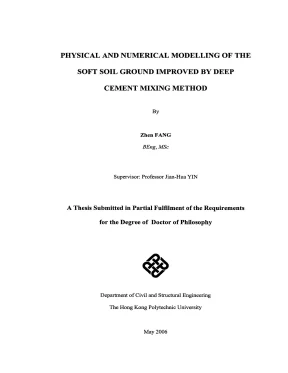
Tải xuống để đọc toàn bộPHYSICAL AND NUMERICAL MODELLING OF THE SOFT SOIL GROUND IMPROVED BY DEEP CEMENT MIXING METHOD By Zhen FANG BEng, MSc Supervisor: Professor Jian-Hua YIN A Thesis Submitted in Partial Fulfilment of the Requirements for the Degree of Doctor of Philosophy & Department of Civil and Structural Engineering The Hong Kong Polytechnic University May 2006 UMI Number: 3241057 INFORMATION TO USERS The quality of this reproduction is dependent upon the quality of the copy submitted. Broken or indistinct print, colored or poor quality illustrations and photographs, print bleed-through, substandard margins, and improper alignment can adversely affect reproduction. In the unlikely event that the author did not send a complete manuscript and there are missing pages, these will be noted. Also, if unauthorized copyright material had to be removed, a note will indicate the deletion.
® UMI UMI Microform 3241057 Copyright 2007 by ProQuest Information and Learning Company. All rights reserved. This microform edition is protected against unauthorized copying under Title 17, United States Code. ProQuest Information and Learning Company 300 North Zeeb Road P.
Box 1346 Ann Arbor, MI 48106-1346 & PHYSICAL AND NUMERICAL MODELLING OF THE SOFT SOIL GROUND IMPROVED BY DEEP CEMENT MIXING METHOD ZHEN FANG Ph. THE HONG KONG POLYTECHNIC UNIVERSITY 2006 CERTIFICATE OF ORIGINALITY I hereby declare that this thesis entitled “Physical and Numerical Modelling of the Soft Soil Ground Improved by Deep Cement Mixing Method” is my own work and that, to the best of my knowledge and belief, it reproduces no material previously published or written nor material which has been accepted for the award of any other degree or diploma, except where due acknowledgement has been made in the text. Signed: Zhe Pt Name: Zhen FANG TO MY FAMILY Abstract of thesis entitled PHYSICAL AND NUMERICAL MODELLING OF THE SOFT SOIL GROUND IMPROVED BY DEEP CEMENT MIXING METHOD submitted by Zhen Fang for the degree of Doctor of Philosophy at The Hong Kong Polytechnic University in May 2006 The research described in this thesis focuses on the consolidation behaviour and vertical bearing capacity of soft soil ground improved by Deep Cement Mixing (DCM) method. The soft soil ground modelled in this study may support relatively light structures, reclaimed fills or road embankments.
Firstly, an axisymmetric physical model (Model 1) test was carried out to investigate the consolidation behaviour of soft soil ground installed with a single DCM column. The surface settlement, excess pore water pressures at different locations in the soil, and pressures carried by the soil and the DCM column were all measured throughout testing. This model test revealed that the DCM column behaved as a vertical drain partially, which suggests that the DCM column might be regarded as a partial or full vertical drainage, somewhat similar to a Prefabricated Vertical Drain (PVD) or a sand drain in the DCM improved ground. Under the approximate rigid loading, the pressure on the surrounding soil was progressively transferred to the DCM column, which caused an increase in stress concentration ratio.
The stress concentration ratio was also found to be dependent on both the external pressure and the degree of consolidation of the surrounding soil. On the basis of the findings of Model 1 test, another axisymmetric model (Model 2) test on the soft soil installed with a PVD strip was performed. This model test was attempted to make a comparative study on the dissipation of excess pore water pressure mechanism between the soil ground installed with DCM column and the soil ground installed with PVD strip. Compared to Model 1 test, the excess pore water pressure in the soil of Model 2 test was observed to dissipate slowly under the same load increment.
This difference was mainly due to the different changing patterns of the surcharge carried by soft soil in the two model tests. The surcharge carried by soil was nearly constant for the soil with PVD strip in Model 2 test, but reducing gradually for the soil ground with DCM column in Model 1 test. After Model 1 test and Model 2 test, Model 3 test was carried out. Model 3 was a plane strain model consisting of a soft soil ground installed with nine mini DCM columns.
The DCM columns were covered by a thin sand layer and rigid plate, which was then subjected to a vertical load. Model 3 test was used to investigate the vertical bearing capacity, and the failure mode of the soil ground improved by a DCM column group. Establishment of the model ground and the arrangement of transducers are both presented in detail. Throughout the test, surface settlement, pore pressures and the stress carried by soil were all measured.
The recorded load versus displacement curve represents pronounced softening, which implies the progressive failure of the column group in the model ground. It was observed that responses of pore pressure were dependent on not only the drainage condition but also the local failure of DCM columns and the progressive failure of the column group. However, effective stress paths of soil elements in the ground could be useful tool to interpret the pore pressure responses reasonably. Moreover, post-test study verifies a wedge-shaped failure mode ii in the model test.
It is possible that this type of failure pattern is explored experimentally for the first time. Numerical modelling was carried out in an attempt to improve understanding of the consolidation process and the failure mechanism of the improved soil ground. In order to take account of the time-dependent behaviour of soft soil, an Elastic Visco-Plastic (EVP) model is needed. For this purpose, a three-dimensional (3-D) EVP constitutive model originally proposed by Yin and Graham (1999) has been incorporated into a Finite Element (FE) package, ABAQUS, by means of a User MATerial (UMAT) FORTRAN subroutine.
This model is formulated as incremental stress-strain relationship for use in FE analysis. For the purpose of verification, a number of single element numerical experiments were carried out to evaluate the overall performance and the efficiency of the UMAT subroutine. Finite element package associated with UMAT developed in this study was employed to conduct FE analysis on two model tests (Model 1 and Model 3). The softening behaviour of the DCM column has been incorporated by employing Mohr-Coulomb constitutive model with the progressive reduction of the cohesion with the deviatoric plastic strain.
In terms of Model 1 test, fairly good agreement between measurements and computations is obtained. In particular, the sudden changes of the excess pore pressure resulted from the DCM column failure has been well captured. Based on a series of parametric studies, the permeability of the DCM column and the viscosity of the surrounding soil were found to have an influence on the dissipation of excess pore pressure in the soil, but little influence on the stress concentration ratio. Finite element analysis was also performed on Model 3 test.
The results reveal that there is good 1H agreement between computed and measured load versus displacement curve. The vertical bearing capacity of the DCM treated soil ground has been well predicted. Besides, the degradation process of the vertical bearing capacity has been reproduced successfully with the introduction of the softening behaviour of the DCM columns. Two field cases involving DCM method have been simulated using FE models with the UMAT.
The permeability of DCM columns has been set to be much higher than that of surrounding soil. Computed results are in good agreement with field measurements. It is demonstrated that the permeability of the DCM column has a negligible influence on the deformation of the improved soil ground. This also indicates that a successful prediction of the performance of soil ground with DCM columns shall take account of the permeability of the DCM column.
In order to identify the influence of soil viscosity on the current problems, one more elastic plastic (EP) FE analysis has been made, in which the Modified Cam-Clay (MCC) model is used to model the soft soil. A comparison between them reveals that EVP modelling is capable of providing better results than EP modelling, particularly for the long-term deformation. At the end of this thesis, a summary of the major conclusions and some recommendations for further studies are presented. iv LIST OF PUBLICATIONS Journal Papers 1.
A model study on soft soil ground installed with cement-soil columns subjected to vertical loading. Submitted to Geotechnique. Experimental study on consolidation process of marine clay around a soil-cement column. International Journal of Geomechanics (In press).
Physical modelling of consolidation of Hong Kong marine clay with prefabricated vertical drains. Canadian Geotechnical Journal, 43(6), 638-652. Physical modelling of consolidation behavior of a composite foundation consisting of a cement mixed soil column and untreated soft marine clay. Experimental and numerical analysis of the progressive deformation and failure of marine clay improved with deep cement mixing column.
Rock and Soil Mechanics, 26, 205-208 (In Chinese). Physical modelling study on the composite foundation of a cement-soil-mixed column in soft Hong Kong marine clay. Annual Conference of Hong Kong Society of Theoretical and Applied Mechanics 2003-2004, Hong Kong. Physical modelling study on the consolidation behavior of a composite foundation improved by DCM.
Proceedings of the 11" International Conference of International Conference on Computer Methods and Advances in Geomechanics, Italy, June 2005. Elastic Viscoplastic modelling of two cases involving PVD improved Hong Kong marine clay. 4” International Conference on Soil Engineering '2006, Vancouver, Canada, October 2006 (Accepted). Physical modelling of the consolidation behavior of soft soil ground installed with vertical drains or deep cement mixed soil columns.
International Conference on Physical Modelling in Geotechnics, Hong Kong, August 2006. vi ACKNOWLEDGEMENTS I would like to express my sincere gratitude to my supervisor Professor J. His guidance and patience has been invaluable, and is greatly appreciated. Without his encouragement, understanding and continuous support, it would not have been possible to complete my work.
I would also like to thank members of my oral examination committee, Professors C. Li for reviewing the manuscript and offering valuable comments and suggestions. Many thanks are due to Mr. Lam for their great help when I carried out tests in the Soil Mechanics Laboratory of Department of Civil and Structural Engineering of The Hong Kong Polytechnic University.
Other people whom I would particularly like to thank are: Professor G. Zhu and Dr. Zhou for their help with proof reading of the thesis, FORTRAN programming and numerical simulations. Discussions with Mr.
Wang of City University of Hong Kong are also appreciated. Thanks are also extended to Professor X. Yu and Mrs. Yan of the Geotechnical Research Institute of Hohai University who introduced me to the world of the Soil Mechanics.
Financial supports from the RGC grant (No: PolyU 5055/02E) of The Hong Kong Government are deeply appreciated. Also, administrative and technical supports from the staff of the Department of Civil and Structural Engineering are appreciated. I am in the debt of my family and my girl friend who suffered from my long absence. I really appreciate the sacrifice of them.
Vii Table of Contents Certificate of originality Dedication Abstract List of publications Acknowledgements Table of contents List of figures List of tables Page CHAPTER 1 TNTRODUCTION «vvceccsscscsscccccccsscsccceccccccsccsececccoserennsccseserescssesesssoos 1 1.1 Background DD nna 1 1.2 Obj ectives and the scope of current study =ÔÔÔÔÔÔÔỒÔÔÒÔÔÔ 4 1.3 Layout of thesis ằằằ. 5 CHAPTER2 LITERATURE REVIEW -----.ƒỹ}Ÿỹ†}Ÿ{Ĩ‡ĨŸỹ}Ĩ}ỊỊỘỰ ỊH nỤ 9n 0Ó 0 0006 8 2.1 Introductions ---:----------->----=<><* sọ HH Hi HH Họ H4 1 K00 000006001004 040640 9-0l9 0440610 086/198 8 22 Deep Mixing (DM) nethod ‹-------------------------------< <<. ỊỌÍ HH HH ng 9K H4 9 60 060000008 8 2.1 Fundamental concepts ằẰ. 10 2 2 2 Characteristics ‹-----------<-‹-+-5‹=+2<s<ss se HH Y0 10 Ki ó9 0 0000004 000608 0 80 80 00 12 223 Applications M.
13 224 Engineering properties Of cemented SOI] -:--------------------- --‹ - --===-<-==<<=>° 15 vi 224.1 Influencing FACTOLS crccereseeececsncereascesescesescscseeseesessessesssssuseesonas 15 2.2 Unconfined compressive strength --‹---------------------©-55- sec 16 2.5 Drained and undrained strength --------------------------c-ccccccsneeeesre 19 2.6 Viscosity and creep -------------c-cccnennnhnhhhnnhhehhHhHH re 20 2.7 Permeability ------------------5-°scs hen 20 2.3 Bearing capacity of the DM ground -‹-------------‹-‹--‹---5-5cccccssnshhehehtrrreriree 21 2.
Nội dung được bảo vệ bản quyền — Tải xuống đầy đủ
Trích dẫn luận án này
Zhen Fang (2006). Mô hình hóa vật lý và số của đất mềm cải thiện bằng phương pháp trộn xi măng sâu [Luận án tiến sĩ, The Hong Kong Polytechnic University]. LuanAn.net. https://luanan.net/ky-thuat-xay-dung-kien-truc/ky-thuat-xay-dung-dan-dung-cong-nghiep/luan-an-tien-si-mo-hinh-hoa-dat-mem-cai-thien-deep-cement-mixing
Từ khóa và chủ đề nghiên cứu
Từ khóa liên quan
Chủ đề nghiên cứu
Câu hỏi thường gặp
Luận án "Mô hình hóa vật lý và số của đất mềm cải thiện bằng phương pháp trộn xi măng sâu" nghiên cứu về vấn đề gì?
Luận án tiến sĩ về mô hình hóa đất mềm cải thiện bằng phương pháp trộn xi măng sâu. Phân tích lún nền, khả năng chịu tải và thoát nước của cột DCM.
Luận án "Mô hình hóa vật lý và số của đất mềm cải thiện bằng phương pháp trộn xi măng sâu" được bảo vệ tại trường nào?
Luận án này được bảo vệ tại The Hong Kong Polytechnic University. Năm bảo vệ: 2006.
Luận án "Mô hình hóa vật lý và số của đất mềm cải thiện bằng phương pháp trộn xi măng sâu" thuộc chuyên ngành gì?
Luận án "Mô hình hóa vật lý và số của đất mềm cải thiện bằng phương pháp trộn xi măng sâu" thuộc chuyên ngành Civil and Structural Engineering. Danh mục: Kỹ Thuật Xây Dựng Dân Dụng & Công Nghiệp.
Luận án "Mô hình hóa vật lý và số của đất mềm cải thiện bằng phương pháp trộn xi măng sâu" có bao nhiêu trang?
Luận án "Mô hình hóa vật lý và số của đất mềm cải thiện bằng phương pháp trộn xi măng sâu" có 341 trang. Bạn có thể xem trước một phần tài liệu ngay trên trang web trước khi tải về.
Cách tải luận án "Mô hình hóa vật lý và số của đất mềm cải thiện bằng phương pháp trộn xi măng sâu" về máy như thế nào?
Để tải luận án về máy, bạn nhấn nút "Tải xuống ngay" trên trang này, sau đó hoàn tất thanh toán phí lưu trữ. File sẽ được tải xuống ngay sau khi thanh toán thành công. Hỗ trợ qua Zalo: 0559 297 239.