Self-Authentication in IoT Transportation Systems by Tran Van Hau, VNU-HCM
"Khám phá tự xác thực trong IoT, một giải pháp an ninh tiên tiến, đảm bảo bảo mật dữ liệu và thiết bị, mang lại trải nghiệm người dùng an toàn và đáng tin cậy."
Năm xuất bản
Số trang
99
Thời gian đọc
15 phút
Lượt xem
0
Lượt tải
0
Phí lưu trữ
40 Point
Tổng quan nhanh
- Chủ đề:
- Tối ưu Bảo mật IoT Giao thông Thông minh
- Số trang:
- 99 trang
- Trường:
- Trường Đại học Bách khoa, Đại học Quốc gia Thành phố Hồ Chí Minh
- Chuyên ngành:
- Computer Science
- Tác giả:
- Tran Van Hau
- Năm:
- 2023
Tóm tắt nội dung luận án
I.Tối ưu Bảo mật IoT Giao thông Thông minh
Hệ thống Giao thông Thông minh (ITS) dựa trên IoT đang đối mặt với nhiều thách thức bảo mật. Quyền riêng tư người dùng là mối lo ngại hàng đầu. Các hệ thống cần được bảo vệ khỏi các mối đe dọa. Công nghệ mới giúp tăng cường IoT security trong môi trường giao thông phức tạp. Mục tiêu là phát triển giải pháp tự xác thực hiệu quả.
1.1. Thách thức Quyền riêng tư trong ITS
Mạng Adhoc dành cho phương tiện giao thông (VANET) là thành phần cốt lõi của ITS. VANET phát sóng thông tin liên tục. Tuy nhiên, việc truyền tải danh tính người dùng bằng văn bản rõ ràng tạo ra rủi ro nghiêm trọng về quyền riêng tư. Điều này làm lộ thông tin cá nhân. Bảo vệ quyền riêng tư là vấn đề then chốt trong mọi hệ thống connected vehicle authentication. Các lỗ hổng bảo mật có thể bị khai thác. Cần có cơ chế mạnh mẽ để bảo vệ dữ liệu nhạy cảm.
1.2. Vấn đề Kết nối và Nút thắt cổ chai
Xác thực truyền thống trong ITS thường dựa vào Cơ quan Tin cậy (TA). Kết nối với TA có thể gây ra vấn đề. Khu vực nông thôn gặp khó khăn về kết nối. Khu vực đô thị phải đối mặt với tình trạng tắc nghẽn mạng. Những vấn đề này cản trở quá trình xác thực hiệu quả. Cần một giải pháp không phụ thuộc hoàn toàn vào TA. Giải pháp tự xác thực giúp giảm tải cho hệ thống. Nó đảm bảo tính liên tục và khả năng mở rộng. Điều này rất quan trọng đối với device identity management trong IoT.
II.Đảm bảo Xác thực Phương tiện Kết nối An toàn
Xác thực đóng vai trò tuyến đầu trong việc bảo vệ ITS khỏi vi phạm quyền riêng tư. Tuy nhiên, các hạn chế về kết nối và tắc nghẽn đòi hỏi phương pháp tự xác thực. Điều này giúp phương tiện tự xác thực độc lập với Cơ quan Tin cậy (TA). Giải pháp mới tăng cường connected vehicle authentication. Nó cải thiện vehicle cybersecurity đáng kể.
2.1. Nhu cầu Xác thực độc lập TA
Các hệ thống xác thực truyền thống phụ thuộc vào TA. Sự phụ thuộc này tạo ra điểm yếu. Đặc biệt ở các vùng xa hoặc khi mạng quá tải. Tự xác thực giải quyết vấn đề này. Nó cho phép các thiết bị và phương tiện tự xác thực. Điều này giảm gánh nặng cho TA. Đồng thời, nó tăng cường khả năng phục hồi của hệ thống. Đây là một bước tiến quan trọng trong access control systems transportation.
2.2. Khung xác thực dựa trên Biệt danh
Để bảo vệ quyền riêng tư, hệ thống sử dụng biệt danh. Xác thực dựa trên biệt danh giúp ẩn danh tính thực của người dùng. Một Cơ quan Tin cậy (TA) vẫn có vai trò ban đầu. TA giám sát việc cấp biệt danh. Tuy nhiên, quy trình xác thực sau đó diễn ra độc lập. Phương pháp này cân bằng giữa quyền riêng tư và trách nhiệm giải trình. Nó là cốt lõi cho trust management IoT trong môi trường động.
III.Giải pháp Blockchain cho Quản lý Danh tính IoT
Đề xuất một lược đồ tự xác thực mới. Lược đồ này tích hợp Blockchain. Blockchain hỗ trợ bảo vệ quyền riêng tư. Nó cải thiện tính hiệu quả của hệ thống. Công nghệ này cách mạng hóa blockchain IoT authentication. Nó cung cấp một nền tảng phi tập trung cho device identity management.
3.1. Vai trò của Blockchain trong ITS
Blockchain cung cấp một sổ cái phân tán, bất biến. Sổ cái này phù hợp cho việc ghi nhận các giao dịch xác thực. Nó đảm bảo tính toàn vẹn của dữ liệu. Blockchain loại bỏ nhu cầu về một bên thứ ba duy nhất. Điều này giảm thiểu rủi ro điểm lỗi duy nhất. Nó tăng cường trust management IoT. Toàn bộ quá trình từ đăng ký đến thu hồi được đồng bộ hóa hiệu quả.
3.2. Hợp đồng Thông minh và Giảm tải cho TA
Hợp đồng thông minh chạy trên Blockchain. Chúng tự động hóa các quy trình xác thực. Điều này giảm đáng kể gánh nặng cho Cơ quan Tin cậy (TA). TA chỉ cần kết nối một lần duy nhất. Việc này diễn ra trong giai đoạn đăng ký ban đầu. Sau đó, hợp đồng thông minh xử lý các tác vụ. Điều này giúp TA tập trung vào chức năng giám sát ITS. Nó nâng cao hiệu quả tổng thể của hệ thống.
IV.Nâng cao An ninh V2X và Quyền riêng tư Dữ liệu
Lược đồ tự xác thực được đề xuất nâng cao đáng kể V2X security. Nó cải thiện quyền riêng tư trong hệ thống giao thông thông minh. Việc này thực hiện thông qua việc sử dụng các công nghệ tiên tiến. Mục tiêu là tạo ra môi trường giao tiếp an toàn hơn. Đây là yếu tố then chốt cho sự phát triển của IoT security trong lĩnh vực giao thông.
4.1. Bảo vệ Danh tính Người dùng trong VANET
Hệ thống sử dụng cơ chế dựa trên biệt danh. Biệt danh thay thế danh tính thực của người dùng. Điều này ngăn chặn việc theo dõi và lạm dụng thông tin. Quyền riêng tư được bảo vệ mạnh mẽ. Các phương tiện giao tiếp an toàn hơn. Mối đe dọa về việc lộ danh tính được giảm thiểu. Điều này rất quan trọng đối với connected vehicle authentication. Nó đảm bảo tính ẩn danh trong giao tiếp V2X.
4.2. Ký BLS cho Đồng bộ hóa hiệu quả
Ký BLS (Boneh-Lynn-Shacham) được triển khai. BLS Signatures đảm bảo đồng bộ hóa hiệu quả. Các giai đoạn khác nhau của hệ thống hoạt động liền mạch. Từ đăng ký đến thu hồi danh tính, tất cả đều được tích hợp. Điều này nâng cao hiệu suất tổng thể. Nó cũng tăng cường độ tin cậy của lược đồ. BLS Signatures là một phần quan trọng của cryptographic protocols IoT.
V.Kiến trúc Giao thức Mật mã cho IoT Giao thông
Đề xuất một kiến trúc mạnh mẽ. Kiến trúc này sử dụng các cryptographic protocols IoT tiên tiến. Nó đảm bảo tính bảo mật và toàn vẹn dữ liệu. Hệ thống hỗ trợ tự xác thực trong ITS. Đây là nền tảng cho IoT security trong giao thông. Nó tạo ra một môi trường tin cậy cho mọi tương tác.
5.1. Quy trình đăng ký và thu hồi danh tính
Quy trình đăng ký ban đầu chỉ yêu cầu một kết nối duy nhất đến Cơ quan Tin cậy (TA). Sau đó, việc quản lý danh tính diễn ra tự động. Hệ thống hỗ trợ cơ chế thu hồi danh tính hiệu quả. Việc này rất quan trọng để quản lý các thiết bị bị xâm phạm. Nó duy trì sự tin cậy trong mạng. Đây là một phần thiết yếu của device identity management.
5.2. Hiệu quả của Ký số BLS
Ký số BLS (Boneh-Lynn-Shacham) tối ưu hóa hiệu suất. Chúng cho phép xác minh nhóm nhanh chóng. Điều này quan trọng trong các mạng quy mô lớn như VANET. Việc sử dụng BLS Signatures đảm bảo tốc độ và an toàn. Nó góp phần vào trust management IoT. Đồng thời, nó duy trì tính bảo mật cao trong giao tiếp.
Mục lục chi tiết luận án
Tải xuống file đầy đủ để xem toàn bộ nội dung
Tải đầy đủ (99 trang)Trích đoạn nội dung luận án
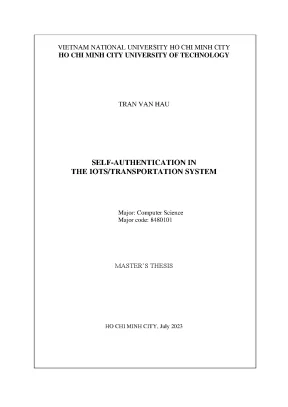
Tải xuống để đọc toàn bộVIETNAM NATIONAL UNIVERSITY HO CHI MINH CITY HO CHI MINH CITY UNIVERSITY OF TECHNOLOGY TRAN VAN HAU SELF-AUTHENTICATION IN THE IOTS/TRANSPORTATION SYSTEM Major: Computer Science Major code: 8480101 MASTER’S THESIS HO CHI MINH CITY, July 2023 THIS THESIS IS COMPLETED AT HO CHI MINH CITY UNIVERSITY OF TECHNOLOGY – VNU-HCM Supervisor: Dr. TRUONG TUAN ANH Examiner 1: Assoc. NGUYEN TUAN DANG Examiner 2: Dr. PHAN TRONG NHAN This master’s thesis is defended at HCM City University of Technology, VNU- HCM City on July 11th, 2023.
Master’s Thesis Committee: 1. TRAN MINH QUANG 2. NGUYEN THI AI THAO 3. NGUYEN TUAN DANG 4.
PHAN TRONG NHAN 5. DANG TRAN TRI Approval of the Chairman of Master’s Thesis Committee and Dean of Faculty of Computer Science and Engineering after the thesis being corrected (If any). CHAIRMAN OF THESIS COMMITTEE DEAN OF FACULTY OF COMPUTER SCIENCE AND ENGINEERING Assoc. TRAN MINH QUANG Page |i VIETNAM NATIONAL UNIVERSITY - HO CHI MINH CITY SOCIALIST REPUBLIC OF VIETNAM HO CHI MINH CITY UNIVERSITY OF TECHNOLOGY Independence – Freedom - Happiness THE TASK SHEET OF MASTER’S THESIS Full name: TRAN VAN HAU Student ID: 1970505 Date of birth: April 2nd, 1997 Place of birth: HCM City Major: Computer Science Major ID: 8480101 I.
THESIS TITLE: SELF-AUTHENTICATION IN THE IOTS/TRANSPORTATION SYSTEM BẢO VỆ TÍNH RIÊNG TƯ TRONG TỰ XÁC THỰC CỦA HỆ THỐNG GIAO THÔNG THÔNG MINH II. TASKS AND CONTENTS: 1. Research and evaluate authentication schemes in Intelligent Transportation System. Research on mathematics for self-authentication.
Research on applying Blockchain in Intelligent Transportation System. Propose a self-authentication scheme with Blockchain support. Implement and evaluate the proposed scheme with respect to security. THESIS START DAY: February 6th, 2023 IV.
THESIS COMPLETION DAY: June 10th, 2023 V. TRUONG TUAN ANH Ho Chi Minh City, June 9th, 2023 SUPERVISOR CHAIR OF PROGRAM COMMITTEE (Full name and signature) (Full name and signature) Dr. Truong Tuan Anh DEAN OF FACULTY OF COMPUTER SCIENCE AND ENGINEERING (Full name and signature) P a g e | ii ACKNOWLEDGEMENTS I would like to express my profound gratitude to my thesis instructor Dr.Truong Tuan Anh for his invaluable guidance and support throughout every stage of the thesis process. A special thanks goes to my family and friends at the BKU, who have faith in me and been a constant source of encouragement on this journey.
I would also like to acknowledge my colleagues at TMA Solutions, who have shared with me the tasks so that I can focus on this research. Last but not least, I want to thank all other individuals from the faculty and IMP who have in one way or the other contributed to this research effort. Without their support, this achievement would not have been possible. Self-Authentication In Ho Chi Minh City University of Technology The Iots/Transportation System International Master Program P a g e | iii ABSTRACT With the evolution of the world, technology has become an integral part of a new transportation model called Intelligent Transportation System (ITS).
Within ITS, Vehicular Adhoc Network (VANET) is a crucial infrastructure component that provides features such as traffic monitoring and road safety messages. However, the process of broadcasting is susceptible to privacy threats because the user's identity is transmitted in clear text. Therefore, alongside Connectivity and Bottleneck, Privacy can be seen as a significant challenge in ITS. Privacy and authentication are closely linked, as vulnerabilities can be exposed during anomalous actions followed by successful authentication.
Hence, to protect the privacy, authentication with a Pseudonym-based System is deployed, relying on a Trusted Authority (TA) as a pseudonym supervisor. However, the connection between TA and vehicles can lead to Connectivity or Bottleneck issues in rural and urban areas respectively. As a result, authentication is considered as a front line of defense against Privacy breaches, but Connectivity and Bottleneck concerns necessitate self-authentication, which authenticates independently of TA. The thesis examines Privacy by analyzing related studies and devises an improved self-authentication method to protect it based on Pseudonym-based System and Blockchain.
The proposed scheme employs BLS Signatures for efficient synchronization between different stages of the system, from registration to revocation; while requiring only a single connection to TA during the registration stage. Furthermore, the Smart Contract running on Blockchain lessens the burden on TA to give room for ITS monitoring functions. Self-Authentication In Ho Chi Minh City University of Technology The Iots/Transportation System International Master Program P a g e | iv TÓM TẮT LUẬN VĂN Với sự phát triển của thế giới, công nghệ đã trở thành một phần không thể thiếu trong mô hình giao thông mới được gọi là Hệ thống Giao thông Thông minh (ITS). Trong ITS, Mạng Adhoc dành cho phương tiện giao thông (VANET) là một thành phần cơ sở hạ tầng quan trọng cung cấp các tính năng như giám sát giao thông và thông báo an toàn đường bộ.
Tuy nhiên, quá trình phát sóng dễ bị đe dọa về quyền riêng tư vì danh tính của người dùng được truyền dưới dạng văn bản thường. Do đó, bên cạnh vấn đề về Kết nối, Quyền riêng tư có thể được coi là một thách thức đáng kể trong ITS. Quyền riêng tư và xác thực được liên kết chặt chẽ, vì các lỗ hổng có thể dễ dàng khai thác thông qua các hành vi bất thường sau khi xác thực thành công. Do đó, để bảo vệ Quyền riêng tư, xác thực bằng Hệ thống dựa trên bút danh được triển khai, dựa vào Cơ quan đáng tin cậy (TA) với tư cách là người giám sát bút danh.
Tuy nhiên, kết nối giữa TA và phương tiện vẫn tồn đọng những vấn đề về hiện thực ở cả nông thôn và thành thị. Nhìn chung, xác thực được coi là tiền tuyến bảo vệ chống lại các vi phạm Quyền riêng tư, nhưng các mối lo ngại về Kết nối đòi hỏi phải tự xác thực, một cách độc lập với TA. Luận án xem xét Quyền riêng tư bằng cách phân tích các nghiên cứu liên quan và đề xuất một Hệ thống tự xác thực cải tiến để bảo vệ Quyền riêng tư dựa trên Hệ thống dựa trên bút danh và Blockchain. Hệ thống đề xuất sử dụng Chữ ký BLS để đồng bộ hóa hiệu quả giữa các giai đoạn khác nhau của tự xác thực, từ đăng ký đến thu hồi; trong khi chỉ yêu cầu một kết nối duy nhất đến TA trong giai đoạn đăng ký.
Hơn nữa, Hợp đồng thông minh chạy trên Blockchain sẽ giảm bớt tác vụ cho TA để nhường chỗ cho các chức năng giám sát chính của ITS. Self-Authentication In Ho Chi Minh City University of Technology The Iots/Transportation System International Master Program Page |v COMMITMENT I understand that plagiarism is an unethical academic practice and is considered a serious offense. Therefore, I hereby commit to avoiding any instances of plagiarism in my thesis. All information sources and references utilized in this thesis will be appropriately cited, ensuring that the work is entirely original and free from any plagiarism.
I also plight to conduct an extensive review of any literature I have referenced or utilized, ensuring that any quotes and ideas are cited accordingly. Furthermore, I will adhere to proper academic standards and guidelines, including but not limited to proper citation format, citation style, and ethical consideration for the authorship of cited materials. Should any plagiarism be detected in this thesis, I fully acknowledge that it could result in severe consequences, including disqualification of the work. Therefore, I pledge to take full responsibility for ensuring that this thesis is entirely original, authentic, and free from any plagiarism.
Self-Authentication In Ho Chi Minh City University of Technology The Iots/Transportation System International Master Program P a g e | vi Table of Contents THE TASK SHEET OF MASTER’S THESIS. v Table of Contents .vi Table of Figures .ix Table of Tables. 6 2 Overview of authentication schemes in ITS .1 Public Key Infrastructure (PKI) .4 Pseudonym-based System. 15 3 Self-authentication scheme in ITS with Blockchain support .3 Elliptic Curve over Finite Field .4 Elliptic Curve Cryptography (ECC).
24 Self-Authentication In Ho Chi Minh City University of Technology The Iots/Transportation System International Master Program P a g e | vii 3.3 Pairing-Based Cryptography (PBC) .4 BGLS Signatures definition .5 BGLS Signatures construction .3 Proposed self-authentication scheme .1 Security on BLS Signatures .4 Unlinkability and forward unlinkability. 71 Self-Authentication In Ho Chi Minh City University of Technology The Iots/Transportation System International Master Program P a g e | viii 5 Conclusion and Future work. 74 Self-Authentication In Ho Chi Minh City University of Technology The Iots/Transportation System International Master Program P a g e | ix Table of Figures Figure 1.1 Enhanced VANET model with Trusted Authority supported [25].1 Illustration of GSIS protocol under Group Signature scheme [18] .2 Illustration of sample authentication protocol under Pseudonym-Identity scheme [23] .3 Illustration of key derivation with Smart Contract supported [38] .4 Illustration of Blockchain-enabled edge computing based on Cooperation scheme [44] .1 A catalog of elliptic curves with the region shown is x, y ∈ [−3,3] [50]18 Figure 3.2 Two types of a Singular Curve (Cusp and Node) [52] .3 Group Law on point addition of P+Q+R=0 [53] .4 Group Law on point addition with P=Q comes to a tangent to EC [53] 21 Figure 3.6 Relationship between order and subgroup order on cyclic curves [56] .7 Elliptic Curve Cryptography in comparison with Pairing-Based Cryptography [65] .8 BLS Signatures on Message Signing step [72] .9 BLS Signatures on Signature Verification step [72] .11 ITS system model with Blockchain supported feature .12 Proposed scheme on System initialization stage .13 Proposed scheme on Vehicle Registration stage .14 ITS system model on proposed scheme.15 Proposed scheme on Message exchange stage (Normal condition) .16 Proposed scheme on Message exchange stage (No-Internet condition) .17 Proposed scheme on Revocation List (RL) update stage .18 Performance test of proposed scheme on local environment .19 Performance test of proposed scheme on Blockchain network .55 Self-Authentication In Ho Chi Minh City University of Technology The Iots/Transportation System International Master Program Page |x Table of Tables Table 3.1 Performance of proposed scheme compared to others .2 Cost of deployment test for proposed scheme on Ethereum network .3 Cost of deployment for proposed scheme on different Blockchain networks .56 Self-Authentication In Ho Chi Minh City University of Technology The Iots/Transportation System International Master Program Page |1 1 Introduction 1.1 Context New technologies are constantly emerging, leading to a world that moves at a rapid pace. The movement of billions of related journeys each day makes transportation the most complex system on the planet.
Technology has brought about the development of Intelligent Transportation Systems (ITS), which involves equipping vehicles with electronic devices. The changes in transportation policy beginning in the 1980s were brought about due to safety and environmental concerns, and the realization that traditional transportation programs were not well-suited for future needs. The cost-effective nature of technology has supported the advancement of traffic management, with new technology developments such as microprocessors, computers, sensors, and communication technologies having direct implications for transportation [1, 2]. The global market size of ITS is currently estimated at USD 23 billion, and may likely reach USD 100 billion by 2030 [3-5].
The adoption of ITS is expected to expand in regions such as Asia Pacific and Europe, with North America holding a 40% market share of the worldwide market by 2021. Advanced Transportation Management Systems (ATMS) which is the most widely used ITS category because they effectively monitor traffic flow and detect incidents. Generally, ITS applications offer solutions to reduce environmental impact, promote overall mobility and improve road safety. ITS development involves improving infrastructure, and Vehicular Adhoc Network (VANET) is considered a core infrastructure component.
VANET has its origins in Mobile Adhoc Network (MANET), and security discussions about ITS and VANET often utilize the two terms interchangeably.
Nội dung được bảo vệ bản quyền — Tải xuống đầy đủ
Trích dẫn luận án này
Tran Van Hau (2023). Self-Authentication in IoT Transportation Systems [Luận án tiến sĩ, Ho Chi Minh City University of Technology]. LuanAn.net. https://luanan.net/ky-thuat-giao-thong-van-tai/ky-thuat-hang-khong/self-authentication-in-iots-transportation-system
Câu hỏi thường gặp
Luận án "Self-Authentication in IoT Transportation Systems" nghiên cứu về vấn đề gì?
"Khám phá tự xác thực trong IoT, một giải pháp an ninh tiên tiến, đảm bảo bảo mật dữ liệu và thiết bị, mang lại trải nghiệm người dùng an toàn và đáng tin cậy."
Luận án "Self-Authentication in IoT Transportation Systems" được bảo vệ tại trường nào?
Luận án này được bảo vệ tại Ho Chi Minh City University of Technology. Năm bảo vệ: 2023.
Luận án "Self-Authentication in IoT Transportation Systems" thuộc chuyên ngành gì?
Luận án "Self-Authentication in IoT Transportation Systems" thuộc chuyên ngành Computer Science. Danh mục: Kỹ Thuật Hàng Không.
Luận án "Self-Authentication in IoT Transportation Systems" có bao nhiêu trang?
Luận án "Self-Authentication in IoT Transportation Systems" có 99 trang. Bạn có thể xem trước một phần tài liệu ngay trên trang web trước khi tải về.
Cách tải luận án "Self-Authentication in IoT Transportation Systems" về máy như thế nào?
Để tải luận án về máy, bạn nhấn nút "Tải xuống ngay" trên trang này, sau đó hoàn tất thanh toán phí lưu trữ. File sẽ được tải xuống ngay sau khi thanh toán thành công. Hỗ trợ qua Zalo: 0559 297 239.