Investigating student learning of analog electronics
Khám phá cách sinh viên học điện tử tương tự. Phân tích phương pháp giảng dạy, thách thức & giải pháp hiệu quả. Nâng cao trải nghiệm học tập.
Năm xuất bản
Số trang
282
Thời gian đọc
43 phút
Lượt xem
0
Lượt tải
0
Phí lưu trữ
50 Point
Tổng quan nhanh
- Chủ đề:
- Nghiên cứu học tập điện tử analog: Khám phá cốt lõi
- Số trang:
- 282 trang
- Trường:
- University of Maine
- Chuyên ngành:
- Physics
- Tác giả:
- Kevin L. Van De Bogart
- Năm:
- 2017
Tóm tắt nội dung luận án
I.Nghiên cứu học tập điện tử analog Khám phá cốt lõi
Tài liệu này trình bày một cuộc điều tra toàn diện về việc học điện tử analog của sinh viên. Nghiên cứu này lấp đầy khoảng trống trong lĩnh vực nghiên cứu giáo dục điện tử. Trong khi các mạch điện giới thiệu đã được nghiên cứu kỹ lưỡng, việc học điện tử analog ở cấp độ cao hơn còn hạn chế. Công trình này tích hợp các khóa học vật lý và kỹ thuật. Mục tiêu là xây dựng nền tảng nghiên cứu mạnh mẽ cho việc học và giảng dạy mạch điện. Phương pháp tiếp cận liên ngành này mang lại cái nhìn sâu sắc độc đáo. Nó làm rõ cách sinh viên suy nghĩ và phân tích mạch điện tử. Nghiên cứu là một đóng góp quan trọng cho nghiên cứu giáo dục điện tử. Nó đặc biệt tập trung vào sư phạm điện tử analog.
1.1. Mục tiêu chính và phạm vi nghiên cứu
Nghiên cứu nhằm mục đích tăng cường cơ sở nghiên cứu về việc học và giảng dạy mạch điện. Nó mở rộng sang lĩnh vực điện tử analog. Phạm vi nghiên cứu bao gồm nhiều khóa học. Các khóa học này thuộc cả chuyên ngành vật lý và kỹ thuật. Điều này cho phép một cuộc điều tra gắn kết và toàn diện. Nghiên cứu giải quyết sự thiếu hụt trong các tài liệu hiện có. Nó cung cấp một cái nhìn sâu sắc về kết quả học tập của sinh viên. Nó đánh giá sự hiểu biết về khái niệm của mạch điện.
1.2. Hướng tiếp cận liên ngành độc đáo
Tài liệu này có ba thành phần riêng biệt. Mỗi thành phần làm sáng tỏ cách sinh viên tư duy về các mạch điện. Thành phần đầu tiên điều tra rộng rãi việc học các loại mạch analog cụ thể. Bao gồm bộ chia điện áp có tải, mạch diode và mạch khuếch đại thuật toán. Việc thu thập dữ liệu diễn ra ở cả các khóa học vật lý và kỹ thuật. Cách tiếp cận đa ngành này củng cố nghiên cứu. Nó tạo ra những cải tiến trong giáo dục kỹ thuật điện.
1.3. Nền tảng cho cải tiến giáo dục
Kết quả từ nghiên cứu này cung cấp cơ sở cho các cải tiến. Các cải tiến này nhắm vào việc giảng dạy điện tử. Việc nghiên cứu có tính hệ thống và liên ngành. Điều này đảm bảo tính áp dụng rộng rãi của nó. Nó có thể cải thiện việc giảng dạy trong cả khoa vật lý và kỹ thuật. Nghiên cứu tạo ra một khung để hiểu rõ hơn về khó khăn học tập trong điện tử. Nó cũng giúp giải quyết nhầm lẫn của sinh viên.
II.Đánh giá hiểu biết mạch điện Kết quả học tập sinh viên
Nghiên cứu này đi sâu vào việc đánh giá sự hiểu biết của sinh viên về các loại mạch analog cụ thể. Các mạch được kiểm tra bao gồm bộ chia điện áp có tải, mạch diode và mạch khuếch đại thuật toán. Các cuộc điều tra được thực hiện trên nhiều khóa học. Điều này bao gồm cả các chương trình vật lý và kỹ thuật. Phát hiện ban đầu cho thấy sinh viên gặp khó khăn. Họ không phát triển sự hiểu biết mạch lạc và chức năng. Điều này áp dụng cho nhiều mạch chính sau tất cả các hướng dẫn. Đây là một điểm quan trọng trong kết quả học tập của sinh viên. Nó cho thấy những thách thức trong hiểu biết về khái niệm của mạch điện.
2.1. Đánh giá hiểu biết các loại mạch chính
Thành phần đầu tiên của luận án tập trung vào việc hiểu biết mạch rộng rãi. Nó đánh giá mức độ sinh viên nắm bắt các nguyên tắc cơ bản. Các mạch cụ thể như bộ chia điện áp và mạch op-amp được phân tích. Dữ liệu thu thập từ các khóa học đa dạng. Điều này cung cấp một bức tranh toàn cảnh về hiệu suất của sinh viên. Nghiên cứu làm nổi bật sự cần thiết của các phương pháp giảng dạy mạch analog hiệu quả hơn.
2.2. Nhận diện các khái niệm còn mơ hồ
Sinh viên thường không xây dựng được sự hiểu biết thống nhất. Họ cũng không thể áp dụng các khái niệm nền tảng. Khó khăn này xảy ra trong các bối cảnh mới. Phát hiện này phù hợp với các nghiên cứu hiện có. Các nghiên cứu đó tập trung vào các chủ đề khác. Điều này nhấn mạnh sự tồn tại của nhầm lẫn của sinh viên. Nó cũng chỉ ra khó khăn học tập trong điện tử.
2.3. Khó khăn trong áp dụng kiến thức nền tảng
Một thách thức đáng kể là việc áp dụng khái niệm. Sinh viên thường vật lộn để chuyển kiến thức đã học. Họ gặp khó khăn khi áp dụng kiến thức đó vào các tình huống mới. Điều này cho thấy thiếu kỹ năng phân tích mạch. Nó cũng chỉ ra một lỗ hổng trong hiểu biết về khái niệm của mạch điện. Nghiên cứu đề xuất cần có các chiến lược giảng dạy. Các chiến lược này phải thúc đẩy sự hiểu biết sâu sắc hơn. Sự hiểu biết này phải vượt ra ngoài việc ghi nhớ đơn thuần.
III.Phân tích khó khăn học tập Nhận diện điểm yếu sinh viên
Luận án bao gồm một nghiên cứu chuyên sâu. Nghiên cứu này tập trung vào sự hiểu biết của sinh viên về transistor lưỡng cực (BJT) và các mạch transistor. Một bộ nhiệm vụ nghiên cứu được phát triển có hệ thống. Những nhiệm vụ này dựa trên nghiên cứu. Mục đích là để xác định chính xác. Chúng giúp xác định các khía cạnh cụ thể của hành vi mạch transistor. Đây là những khía cạnh mà sinh viên gặp khó khăn nhất. Khó khăn này tồn tại ngay cả sau khi đã được hướng dẫn. Nghiên cứu này làm sáng tỏ khó khăn học tập trong điện tử. Nó đặc biệt tập trung vào nhầm lẫn của sinh viên liên quan đến các thành phần phức tạp.
3.1. Nghiên cứu chuyên sâu về transistor
Thành phần thứ hai của luận án là một cuộc điều tra chi tiết. Nó tập trung vào transistor lưỡng cực. Các transistor là một thành phần cơ bản trong điện tử analog. Nghiên cứu này vượt xa các đánh giá mạch chung. Nó đi sâu vào các sắc thái về cách sinh viên hiểu và phân tích. Điều này củng cố sư phạm điện tử analog. Nó cung cấp dữ liệu quan trọng để cải thiện giảng dạy.
3.2. Xác định các vấn đề cụ thể sau giảng dạy
Các nhiệm vụ nghiên cứu được thiết kế cẩn thận. Chúng giúp xác định những điểm cụ thể mà sinh viên vướng mắc. Những điểm này bao gồm cả hành vi lý thuyết và ứng dụng thực tế. Việc xác định các vấn đề này là cần thiết. Nó giúp phát triển các phương pháp giảng dạy mạch analog nhắm mục tiêu. Mục tiêu là giải quyết hiểu biết về khái niệm của mạch điện.
3.3. Phát triển nhiệm vụ nghiên cứu có hệ thống
Quá trình phát triển nhiệm vụ rất có hệ thống. Nó dựa trên các nguyên tắc nghiên cứu giáo dục. Điều này đảm bảo tính hợp lệ và độ tin cậy của phát hiện. Các nhiệm vụ được xây dựng để làm nổi bật các kỹ năng phân tích mạch. Chúng cũng bộc lộ khó khăn học tập trong điện tử. Cách tiếp cận này giúp thu thập dữ liệu định lượng. Dữ liệu này thông báo về những cải tiến trong giáo dục.
IV.Kỹ năng thực hành mạch Phát triển năng lực giải quyết vấn đề
Thành phần thứ ba của luận án chuyển trọng tâm. Nó kiểm tra các khía cạnh thực nghiệm của việc giảng dạy điện tử. Nghiên cứu xem xét chi tiết kỹ năng phòng thí nghiệm thực tế. Kỹ năng này là xử lý sự cố. Kỹ năng xử lý sự cố là rất quan trọng trong thiết kế và bảo trì mạch. Nghiên cứu phân tích cách sinh viên tiếp cận. Nó cũng xem xét cách họ thực hiện các nhiệm vụ chẩn đoán và sửa chữa. Phần này làm nổi bật tầm quan trọng của giải quyết vấn đề trong điện tử. Nó cũng nhấn mạnh vai trò của kỹ năng phân tích mạch thực tế.
4.1. Khám phá kỹ năng xử lý sự cố thực tế
Luận án đi sâu vào khía cạnh thực tế của việc học điện tử. Nó phân tích các khả năng xử lý sự cố của sinh viên. Đây là một kỹ năng phòng thí nghiệm thiết yếu. Việc hiểu những khó khăn của sinh viên trong việc này rất quan trọng. Nó giúp xây dựng các chương trình giảng dạy thực tế hơn. Nó cũng giúp phát triển phương pháp giảng dạy mạch analog hiệu quả.
4.2. Tầm quan trọng của trải nghiệm phòng thí nghiệm
Phần này nhấn mạnh vai trò của phòng thí nghiệm. Phòng thí nghiệm là nơi cung cấp kinh nghiệm thực hành. Những kinh nghiệm này rất quan trọng cho việc phát triển các kỹ năng. Các kỹ năng đó bao gồm cả việc giải quyết vấn đề trong điện tử. Nó củng cố nhận định rằng trải nghiệm thực hành là không thể thiếu. Nó không thể thiếu cho việc thành thạo điện tử. Việc này giúp giảm thiểu nhầm lẫn của sinh viên.
4.3. Phát triển năng lực phân tích và sửa chữa
Nghiên cứu gợi ý các phương pháp để tăng cường kỹ năng. Các phương pháp này tập trung vào phân tích và sửa chữa. Các phương pháp đó rất quan trọng đối với các kỹ sư điện tử. Bằng cách hiểu rõ những thách thức, các nhà giáo dục có thể phát triển. Họ có thể phát triển các bài tập phòng thí nghiệm có mục tiêu. Các bài tập này sẽ trau dồi kỹ năng phân tích mạch. Chúng cũng sẽ củng cố sư phạm điện tử analog tổng thể.
V.Cải thiện giảng dạy điện tử Phương pháp tiếp cận mới
Công trình này củng cố cơ sở nghiên cứu hiện có. Nó đề cập đến việc học và giảng dạy điện tử. Bản chất có hệ thống và liên ngành của nghiên cứu này rất quan trọng. Nó góp phần cải thiện việc giảng dạy điện tử. Những cải tiến này áp dụng cho cả khoa vật lý và kỹ thuật. Nghiên cứu chỉ ra rằng sinh viên thường thiếu sự hiểu biết chức năng, mạch lạc. Tuy nhiên, sinh viên thường sử dụng các yếu tố suy luận hiệu quả. Điều này xảy ra khi họ suy nghĩ về các mạch điện. Nghiên cứu đưa ra các khuyến nghị cụ thể. Các khuyến nghị này dành cho nghiên cứu trong tương lai. Chúng cũng dành cho việc giảng dạy điện tử. Đây là một đóng góp quan trọng cho sư phạm điện tử analog. Nó cung cấp nền tảng cho phương pháp giảng dạy mạch analog mới.
5.1. Đề xuất cho nghiên cứu và giảng dạy
Luận án kết thúc bằng những khuyến nghị. Các khuyến nghị này dành cho cả nghiên cứu trong tương lai và việc giảng dạy thực hành. Các đề xuất nhằm mục đích giải quyết những thiếu sót đã được xác định. Chúng giúp tăng cường hiểu biết về khái niệm của mạch điện. Các nhà giáo dục có thể sử dụng những hiểu biết này. Họ có thể thiết kế các khóa học hiệu quả hơn. Các khóa học này có thể làm giảm khó khăn học tập trong điện tử.
5.2. Tăng cường hiểu biết chức năng mạch lạc
Một phát hiện quan trọng là thiếu sự hiểu biết mạch lạc. Sinh viên cần phát triển khả năng vận dụng khái niệm. Điều này bao gồm khả năng áp dụng các khái niệm nền tảng vào các bối cảnh mới. Các phương pháp giảng dạy cần tập trung. Chúng cần tập trung vào việc xây dựng một cấu trúc kiến thức mạnh mẽ. Cấu trúc này vượt ra ngoài việc học thuộc lòng. Nó giúp sinh viên phát triển kỹ năng phân tích mạch mạnh mẽ.
5.3. Định hướng cho chương trình học tương lai
Nghiên cứu cung cấp một lộ trình cho sự phát triển chương trình giảng dạy. Điều này áp dụng cho các khóa học điện tử. Các khóa học này nằm trong cả các chương trình vật lý và giáo dục kỹ thuật điện. Các đề xuất bao gồm việc tích hợp các bài tập thực hành. Các bài tập này nâng cao giải quyết vấn đề trong điện tử. Chúng cũng giải quyết nhầm lẫn của sinh viên. Mục tiêu cuối cùng là tạo ra những người học có năng lực hơn.
Mục lục chi tiết luận án
Tải xuống file đầy đủ để xem toàn bộ nội dung
Tải đầy đủ (282 trang)Trích đoạn nội dung luận án
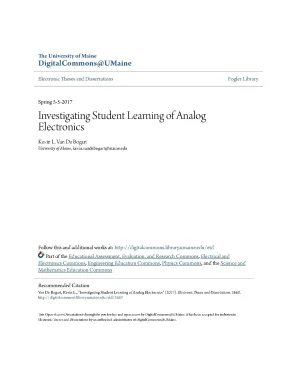
Tải xuống để đọc toàn bộThe University of Maine DigitalCommons@UMaine Electronic Theses and Dissertations Fogler Library Spring 5-5-2017 Investigating Student Learning of Analog Electronics Kevin L. Van De Bogart University of Maine, kevin.edu Follow this and additional works at: http://digitalcommons.edu/etd Part of the Educational Assessment, Evaluation, and Research Commons, Electrical and Electronics Commons, Engineering Education Commons, Physics Commons, and the Science and Mathematics Education Commons Recommended Citation Van De Bogart, Kevin L., "Investigating Student Learning of Analog Electronics" (2017). Electronic Theses and Dissertations.edu/etd/2660 This Open-Access Dissertation is brought to you for free and open access by DigitalCommons@UMaine. It has been accepted for inclusion in Electronic Theses and Dissertations by an authorized administrator of DigitalCommons@UMaine.
INVESTIGATING STUDENT LEARNING OF ANALOG ELECTRONICS By Kevin L. Van De Bogart B. University of Idaho, 2008 A DISSERTATION Submitted in in Partial Fulfillment of the Requirements for the Degree of Doctor of Philosophy (in Physics) The Graduate School University of Maine May 2017 Advisory Committee: MacKenzie R. Stetzer, Assistant Professor of Physics, Advisor John R.
Thompson, Professor of Physics Donald B. Mountcastle, Associate Professor of Physics Nuri W. Emanetoglu, Associate Professor of Electrical and Computer Engineering James P. McClymer, Associate Professor of Physics © 2017 Kevin L.
Van De Bogart All Rights Reserved ii INVESTIGATING STUDENT LEARNING OF ANALOG ELECTRONICS By Kevin L. Van De Bogart Dissertation Advisor: Dr. Stetzer An Abstract of the Dissertation Presented in Partial Fulfillment of the Requirements for the Degree of Doctor of Philosophy (in Physics) May, 2017 Instruction in analog electronics is an integral component of many physics and engineering programs, and is typically covered in courses beyond the first year. While extensive research has been conducted on student understanding of introductory electric circuits, to date there has been relatively little research on student learning of analog electronics in either physics or engineering courses.
Given the significant overlap in content of courses offered in both disciplines, this study seeks to strengthen the research base on the learning and teaching of electric circuits and analog electronics via a single, coherent investigation spanning both physics and engineering courses. This dissertation has three distinct components, each of which serves to clarify ways in which students think about and analyze electronic circuits. The first component is a broad investigation of student learning of specific classes of analog circuits (e., loaded voltage dividers, diode circuits, and operational amplifier circuits) across courses in both physics and engineering. The second component of this dissertation is an in-depth study of student understanding of bipolar junction transistors and transistor circuits, which employed the systematic, research-based development of a suite of research tasks to pinpoint the specific aspects of transistor circuit behavior that students struggle with the most after instruction.
The third component of this dissertation focuses more on the experimental components of electronics instruction by examining in detail the practical laboratory skill of troubleshooting. Due to the systematic, cross-disciplinary nature of the research documented in this dissertation, this work will strengthen the research base on the learning and teaching of electronics and will contribute to improvements in electronics instruction in both physics and engineering departments. In general, students did not appear to have developed a coherent, functional understanding of many key circuits after all instruction. Students also seemed to struggle with the application of foundational circuits concepts in new contexts, which is consistent with existing research on other topics.
However, students did frequently use individual elements of productive reasoning when thinking about electric circuits. Recommendations, both general and specific, for future research and for electronics instruction are discussed. DEDICATION To my wife, Sylvia iii ACKNOWLEDGEMENTS Throughout my last six years at the University of Maine, there are numerous people who have made a positive impact on my life, in both professional and personal capacities. I would like to thank those who have helped make this work possible, and to apologize in advance if I have left anyone out.
I would like to start by acknowledging my advisor, MacKenzie Stetzer. With his guidance, I have learned a great deal about research, teaching, and electronics. Before coming to the University of Maine, I had essentially no practical experience with circuits beyond what is taught in introductory physics; now I strive to better understand electronics myself and to spread such knowledge to students in ways that enrich their lives. Mac has also helped provide thoughtful input into the process of refining my rough ideas into targeted questions or well-structured arguments.
Together we have shared in the struggles of running and changing a course, and I feel prepared to step into the role of a professional instructor and researcher thanks to his guidance. I would also like to thank all of the members of Physics Education Research Laboratory whom I’ve had the pleasure of working with during my time at Maine. Their friendship and guidance have been invaluable in supporting my development as a scientist, and I hope that I can continue to collaborate with my peers from UMaine throughout my career. I would also like to thank Nuri Emanetoglu and Duane Hanselman in the Department of Electrical and Computer Engineering for their cooperation and help throughout this project, as well as my committee members John Thompson and James McClymer and my external reader Christian Kautz for their thoughtful feedback on this dissertation.
iv I should also thank Dimitri Dounas-Frazer, for both his continued support and unbridled enthusiasm when working together on the troubleshooting research project. It took us many hours-long conversations to disentangle the intricacies of modeling and socially mediated metacognition, and without his patience and willingness to delve into the minutiae of interpretations, the troubleshooting project would have been greatly diminished. Throughout the years in graduate school, I have had to devote the bulk of my time to my schooling or my research. However, I would like to thank those who have helped me stay connected to the other things in life I love.
Foremost, I must thank my wife Sylvia, without whom I would be incomplete. The quiet joy we share in simply being together has helped me through many trying times. I would like to thank my parents Lee and Mary, who have gone to ridiculous lengths to support me, even if it meant mailing gardening supplies first-class. I also have to thank my brother, Jeremy, as a sounding board for any number of eccentric schemes throughout the years.
And thank you to one particularly Cynical Brit. Finally, I would like to formally acknowledge the National Science Foundation, whose grant support made much of my work possible. In particular, the projects on which I have worked have been supported by: Grant Nos. DUE-0618185, DUE-0962805, DUE-1022449, DUE-1245313, DUE-1323101, DUE-1323426, and PHY-1125844.
v 1 TABLE OF CONTENTS DEDICATION. iv LIST OF TABLES .xv LIST OF FIGURES .1 Physics Education Research .2 Engineering Education Research .1 Research on Circuits .2 Research on Electronics .24 3 RESEARCH CONTEXTS AND METHODS .1 University of Maine .1 Introductory Physics II .2 Physical Electronics Laboratory .4 Fundamentals of Electric Circuits .1 Electric Circuits Laboratory I .2 Electronics for the Physical Sciences. 37 4 INVESTIGATING STUDENT UNDERSTANDING OF VOLTAGE DIVIDERS & LOADING IN PHYSICS AND ENGINEERING COURSES .2 Context for Research .3 Overview of Instruction on Voltage Division and Loading .5 Basic Loading Task .2 Overview of Student Performance on the Basic Loading Task .3 Basic Loading Task: Specific Difficulties Identified.4 Comparisons Between Courses.1 Comparison Between Electronics Courses and Introductory Courses .5 Changes in Student Responses.1 Changes in Student Responses: Physics Electronics .2 Changes in Student Responses: Engineering Electronics .58 5 INVESTIGATING STUDENT UNDERSTANDING OF DIODE CIRCUITS IN PHYSICS AND ENGINEERING COURSES.1 Context for Research and Overview of Diode Coverage .3 Reverse-Biased Diode Task .3 Overview of Student Performance on the Reverse-Biased Diode Task.1 Part 1: Current Direction at Point a .2 Part 2: Current Ranking .3 Part 3: Voltage Ranking .4 Comparisons Across Task Components and Discussion .5 Difficulties Identified from the Reverse-Biased Diode Task.4 Three-diode Network Task .3 Overview of Student Performance on the Three-Diode Network Task .1 Part 1: Voltage at Point X.2 Part 2: Voltage at Point Y.3 Part 3: Voltage at Point Z .4 Consistency of Student Responses Across Task Components .5 Three-Diode Network Task: Specific Difficulties Encountered .5 Discussion and Conclusions .93 6 INVESTIGATING STUDENT UNDERSTANDING OF OPERATIONAL AMPLIFIER CIRCUITS IN PHYSICS AND ENGINEERING COURSES .1 Overview of Op-amp Coverage .3 Op-amp Specific Research Questions .4 Three Amplifier Task .3 Overview of Student Performance on Three Amplifiers Task .4 Specific Difficulties Noted Across Disciplines .5 Inverting Amplifier Task .3 Overview of Student Performance on the Inverting Amplifier Task .4 Additional Difficulties Noted Across Disciplines .6 Discussion, Conclusions, and Ongoing Work .119 7 INVESTIGATING STUDENT UNDERSTANDING OF TRANSISTOR CIRCUITS .1 Context for Research and Overview of BJT Coverage .3 Three Amplifier Comparison Task.1 AC Biasing Network .2 Emitter Follower Circuit .3 Common-Emitter Amplifier Circuit .3 Overview of Student Performance on the Three Amplifier Comparison Task .4 Overview of Student Performance: Pairwise Comparisons .5 Specific Difficulties Identified .4 Follower Current Ranking Task .3 Overview of Student Performance on the Follower Current Ranking Task .4 Summary of Findings .5 Follower Graphing Task .3 Overview of Student Performance on the Follower Graphing Task.4 Summary of Findings .5 Specific Difficulties Identified .6 Transistor Supply Voltage Modification Task .3 Overview of Student Performance on the Supply Voltage Modification Task .4 Summary of Findings .5 Specific Difficulties Identified .7 Revised Amplifier Comparison Task .3 Overview of Student Performance on the Revised Amplifier Comparison Task .8 AC Biasing Network Tasks .1 Overview of ac Biasing Network Tasks .2 DC Analysis Task .1 Overview of dc Analysis Task .3 Overview of Student Performance on dc Analysis Task .3 AC Analysis Graphing Task .1 Overview of ac Analysis Graphing Task .3 Overview of Student Performance on ac Analysis Graphing Task .4 Summary of Findings .1 Specific Difficulties Spanning Tasks .10 Implications for Instruction .183 8 INVESTIGATING THE ROLE OF SOCIALLY MEDIATED METACOGNITION DURING COLLABORATIVE TROUBLESHOOTING OF ELECTRIC CIRCUITS .2 Relevant Background for Analysis Frameworks .3 Context and Methodology .1 Context for Investigation .2 Think-Aloud Interviews .2 Socially Mediated Metacognition Coding .3 Node and Cluster Coding .1 Analysis of Episodes by Category .3 Split-Half Strategy .5 Summary and Episode Discussion .2 Clusters in Socially Mediated Metacognition .1 Clusters About Clarification .2 Clusters About Suggested Approaches .3 Summary of Cluster Analysis.5 Summary and Limitations .1 Overview of Findings from Investigation of Student Understanding of Analog Electronics Across Physics and Engineering Courses .2 Overview of Findings on the Role of Socially Mediated Metacognition in Student Troubleshooting on Analog Electronics .3 Implications for Instruction .4 Recommendations for future work .249 APPENDIX A – THE OPERATIONAL AMPLIFIER CURRENTS TUTORIAL .259 APPENDIX B – INITIAL PROMPT FOR TROUBLESHOOTING INTERVIEWS.261 BIOGRAPHY OF THE AUTHOR .262 xiv LIST OF TABLES Table 3. Summary of courses studied.
Overview of the number of respondents for the basic loading task by year and course. Student responses to the basic loading task by course. Matched student post-test responses for the basic loading task. Matched pre-post responses in the physics electronics course.
Matched pre-post responses in the engineering electronics course. Overview of student performance on the reverse-biased diode task. Overview of overall responses to reverse-biased diode task. Student responses for the voltage at point X.
Student responses for the voltage at point Y. Student responses for the voltage at point Z. Consistency of student responses between points Y and Z. Summary of the overall responses given by students in the three-diode network task.
Overview of student performance on the three amplifiers task. Student responses to the non-inverting amplifier task. Overview of student performance on the transistor amplifier comparison task. Specific comparisons made by students in the transistor amplifier comparison task.
Student responses to follower current comparison task. Student responses to the follower graphing task. Student responses to transistor supply voltage modification task. Student responses to transistor ac and dc comparison.
Overview of student responses to dc analysis task part 1: capacitor voltage.
Nội dung được bảo vệ bản quyền — Tải xuống đầy đủ
Trích dẫn luận án này
Kevin L. Van De Bogart (2017). Investigating student learning of analog electronics [Luận án tiến sĩ, University of Maine]. LuanAn.net. https://luanan.net/ky-thuat-dien-dien-tu/investigating-student-learning-of-analog-electronics
Câu hỏi thường gặp
Luận án "Investigating student learning of analog electronics" nghiên cứu về vấn đề gì?
Khám phá cách sinh viên học điện tử tương tự. Phân tích phương pháp giảng dạy, thách thức & giải pháp hiệu quả. Nâng cao trải nghiệm học tập.
Luận án "Investigating student learning of analog electronics" được bảo vệ tại trường nào?
Luận án này được bảo vệ tại University of Maine. Năm bảo vệ: 2017.
Luận án "Investigating student learning of analog electronics" thuộc chuyên ngành gì?
Luận án "Investigating student learning of analog electronics" thuộc chuyên ngành Physics. Danh mục: Kỹ Thuật Điện - Điện Tử.
Luận án "Investigating student learning of analog electronics" có bao nhiêu trang?
Luận án "Investigating student learning of analog electronics" có 282 trang. Bạn có thể xem trước một phần tài liệu ngay trên trang web trước khi tải về.
Cách tải luận án "Investigating student learning of analog electronics" về máy như thế nào?
Để tải luận án về máy, bạn nhấn nút "Tải xuống ngay" trên trang này, sau đó hoàn tất thanh toán phí lưu trữ. File sẽ được tải xuống ngay sau khi thanh toán thành công. Hỗ trợ qua Zalo: 0559 297 239.