Luận án Analog Logic: Mạch Tín hiệu Liên tục cho Xử lý Tín hiệu Thống kê - Benjamin Vigoda
Khám phá mạch logic analog, tín hiệu liên tục và ứng dụng chúng trong xử lý tín hiệu thống kê. Nâng cao hiểu biết về nền tảng điện tử.
Massachusetts Institute of Technology
Media Arts and Sciences
Luan An
Doctor of Philosophy (Luận án tiến sĩ)
Năm xuất bản
Số trang
209
Thời gian đọc
32 phút
Lượt xem
0
Lượt tải
0
Phí lưu trữ
50 Point
Tổng quan nhanh
- Chủ đề:
- 1. Mạch Analog Logic: Nền Tảng Xử Lý Tín Hiệu Thống Kê
- Số trang:
- 209 trang
- Trường:
- Massachusetts Institute of Technology
- Chuyên ngành:
- Media Arts and Sciences
- Tác giả:
- Benjamin Vigoda
- Năm:
- 2003
Tóm tắt nội dung luận án
I. Mạch Analog Logic Nền Tảng Xử Lý Tín Hiệu Thống Kê
Luận án đề xuất mô hình thiết kế máy tính mới. Mô hình dùng mạch tín hiệu liên tục theo thời gian. Benjamin Vigoda thực hiện nghiên cứu tại MIT. Công trình hoàn thành tháng 9 năm 2003. Giáo sư Neil Gershenfeld là người hướng dẫn chính. Phương pháp xem mạch tương tự như hệ truyền xác suất. Cách tiếp cận này khôi phục bậc tự do liên tục. Kỹ thuật số đánh mất bậc tự do này từ lâu. Mạch analog logic mở ra hướng xử lý tín hiệu thống kê mới. Hệ thống đạt tốc độ cao và công suất thấp. Chi phí sản xuất hợp lý cho nhiều ứng dụng. Mô hình hứa hẹn thay đổi cách thiết kế máy tính.
1.1. Luận án và phương pháp nghiên cứu
Luận án tập trung vào mạch tín hiệu liên tục. Mạch analog logic truyền xác suất trong thuật toán message passing. Cách tiếp cận có nguyên lý rõ ràng. Mục tiêu là tạo hệ thống lập trình được. Hệ thống đạt tốc độ cao và tiêu thụ ít điện năng. Chi phí sản xuất thấp hơn kỹ thuật số. Nhiều bài toán cần giải quyết trước khi áp dụng thực tế. Kết quả nghiên cứu tạo nền tảng lý thuyết vững chắc.
1.2. Tầm quan trọng của tín hiệu tương tự liên tục
Tín hiệu tương tự liên tục mang nhiều thông tin hơn. Kỹ thuật số rời rạc hóa tín hiệu theo thời gian. Quá trình rời rạc hóa làm mất thông tin. Mạch tương tự giữ nguyên bản chất liên tục. Điều này giúp xử lý tín hiệu nhanh hơn. Hệ thống hoạt động ổn định với công suất thấp. Mạch analog logic tận dụng tối đa đặc tính này. Ứng dụng rộng trong viễn thông không dây.
II. Mạch Tín Hiệu Liên Tục và Giới Hạn Kỹ Thuật Số
Mạch số gặp giới hạn khi mở rộng quy mô. Mạch tương tự cũng có giới hạn riêng. Hai loại mạch cần kết hợp để tối ưu. Xử lý tín hiệu thống kê là lĩnh vực phù hợp. Máy thu không dây cần xử lý tín hiệu nhanh. Mạch analog logic giải quyết bài toán này. Luận án phân tích cả hai giới hạn mở rộng. Từ đó đưa ra hướng thiết kế cân bằng. Nghiên cứu làm rõ vì sao kỹ thuật số thiếu hiệu quả. Đồng thời chỉ ra điểm yếu của mạch tương tự. Giải pháp nằm ở sự kết hợp hài hòa. Xử lý tín hiệu thống kê trở nên khả thi hơn.
2.1. Giới hạn mở rộng của mạch số
Mạch số tiêu thụ nhiều năng lượng ở tần số cao. Chi phí sản xuất tăng theo tốc độ xung clock. Kỹ thuật số cần bộ chuyển đổi ADC và DAC. Các bộ chuyển đổi này gây trễ và nhiễu. Tần số vô tuyến vượt khả năng mạch số. Đây là điểm nghẽn của xử lý tín hiệu số. Mạch số khó đáp ứng tốc độ cần thiết.
2.2. Giới hạn mở rộng của mạch tương tự
Mạch tương tự nhạy cảm với nhiễu và nhiệt độ. Sai số linh kiện gây mất chính xác. Mạch analog thường chỉ điều chỉnh được. Mạch tương tự hiếm khi tái cấu hình được. Bộ nhớ analog phù hợp vẫn còn thiếu. Cổng mềm soft-gate đã có từ trước. Luận án bổ sung phần còn thiếu này.
2.3. Suy luận thống kê và xử lý tín hiệu
Suy luận thống kê giúp tách tín hiệu từ nhiễu. Mạch analog logic thực hiện suy luận trực tiếp. Tín hiệu thống kê được biểu diễn bằng dòng điện. Mỗi nút mạch là một phép toán xác suất. Hệ thống hội tụ về kết quả đúng. Ứng dụng cho máy thu không dây hiệu quả.
III. Xử Lý Tín Hiệu Thống Kê Bằng Mạch Analog Logic
Mạch analog logic hoạt động theo thời gian liên tục. Mỗi nút mạch xử lý xác suất tín hiệu. Thuật toán message passing lan truyền thông tin. Mạch nhân tương tự thực hiện phép nhân xác suất. Mạch so sánh tín hiệu đánh giá khả năng. Hệ thống hội tụ về trạng thái cân bằng. Luận án nghiên cứu sự hội tụ và đồng bộ. Phân tích toán học dành cho hệ thời gian liên tục. Kết quả là mạch xử lý tín hiệu thống kê mạnh mẽ. Hệ thống vừa lập trình được vừa tái cấu hình được. Đây là nền tảng cho thiết bị xử lý hiện đại.
3.1. Thuật toán message passing trong mạch liên tục
Mạch analog truyền xác suất qua dòng điện. Mỗi node cập nhật xác suất liên tục. Thuật toán hội tụ khi mạch đạt cân bằng. Thời gian hội tụ phụ thuộc tham số mạch. Cần phân tích toán học cho hệ liên tục. Luận án phát triển lý thuyết hội tụ này. Đồng bộ giữa các node là yếu tố then chốt.
3.2. Op amp và mạch nhân tương tự cho xác suất
Mạch khuếch đại thuật toán op-amp là linh kiện nền tảng. Op-amp tạo ra hàm toán học trên tín hiệu. Kết hợp op-amp tạo mạch nhân tương tự. Mạch nhân tương tự nhân hai xác suất. Mạch tích phân và vi phân xử lý tốc độ thay đổi. Các khối này ghép thành mạng xác suất.
IV. Linh Kiện Mạch Analog Op Amp Lọc Nhân So Sánh
Các linh kiện mạch analog logic được xây dựng từ khối cơ bản. Mạch khuếch đại thuật toán op-amp là trung tâm. Mạch lọc tương tự analog filter định hình tín hiệu. Mạch nhân tương tự thực hiện phép toán xác suất. Mạch so sánh tín hiệu đưa ra quyết định. Mạch tích phân và vi phân mô tả động học. Các khối này ghép thành hệ xử lý hoàn chỉnh. Mỗi linh kiện có vai trò riêng biệt. Tổ hợp linh kiện tạo nên mạch xử lý thống kê.
4.1. Mạch khuếch đại thuật toán op amp
Op-amp khuếch đại sai số giữa hai đầu vào. Mạch hồi tiếp tạo hàm truyền chính xác. Op-amp dùng cho mạch cộng, trừ, nhân, chia. Độ lợi lớn giúp mạch chính xác cao. Đây là nền tảng của mạch tương tự hiện đại.
4.2. Mạch lọc tương tự analog filter
Mạch lọc tương tự loại bỏ nhiễu không mong muốn. Bộ lọc thông thấp giữ tín hiệu chậm. Bộ lọc thông cao giữ tín hiệu nhanh. Bộ lọc thông dải chọn dải tần cần thiết. Analog filter kết hợp với op-amp và tụ điện. Vai trò của bộ lọc rất quan trọng.
4.3. Mạch nhân so sánh tích phân và vi phân
Mạch nhân tương tự nhân hai tín hiệu với nhau. Mạch so sánh tín hiệu xác định mức ngưỡng. Mạch tích phân tính tổng tích lũy theo thời gian. Mạch vi phân đo tốc độ thay đổi tín hiệu. Bốn loại mạch tạo nên bộ xử lý thống kê.
V. Bộ Nhớ Analog và Cổng Mềm Trong Mạch Tương Tự
Mạch analog logic cần bộ nhớ để lưu trạng thái. Cổng mềm soft-gate đã được đề xuất trước đây. Bộ nhớ analog vẫn còn thiếu và chưa hoàn thiện. Luận án nghiên cứu mạch nhớ tuyến tính và phi tuyến. Mạch tích phân và vi phân dùng làm bộ nhớ. Soft-multiplexer là khối xây dựng mảng cổng. Mảng cổng analog lập trình được là mục tiêu cuối. Nghiên cứu bổ sung thành phần còn thiếu của mạch tương tự.
5.1. Cổng mềm soft gate và bộ nhớ analog
Soft-gate là cổng logic làm việc với xác suất. Cổng mềm thay vì giá trị nhị phân 0 và 1. Cổng mềm xử lý tín hiệu mềm liên tục. Bộ nhớ analog lưu giá trị mềm theo thời gian. Cần nhiều loại mạch nhớ khác nhau. Mạch nhớ giữ trạng thái khi mất điện áp vào.
5.2. Mạch phi tuyến cho bộ nhớ analog
Mạch phi tuyến có nhiều trạng thái ổn định. Trạng thái ổn định lưu trữ thông tin lâu dài. Mạch tuyến tính dùng cho nhớ ngắn hạn. Kết hợp hai loại tạo hệ nhớ linh hoạt. Luận án khảo sát cả hai họ mạch này.
5.3. Soft multiplexer và mảng cổng lập trình
Soft-multiplexer chọn giữa nhiều tín hiệu mềm. Khối này hoạt động như bộ chuyển mạch xác suất. Soft-multiplexer xây dựng mảng cổng analog. Mảng cổng lập trình được giống FPGA. Người dùng cấu hình lại chức năng sau sản xuất. Đây là bước tiến lớn cho mạch tương tự.
VI. Ứng Dụng Thực Tế Noise Lock Loop và Tương Lai
Noise Lock Loop là ứng dụng minh họa chính. Vòng khóa nhiễu thực hiện trải phổ chuỗi trực tiếp. Hệ thống thu và bám tín hiệu lan truyền. Mạch analog logic vượt trội so với kỹ thuật số. Tốc độ nhanh hơn một bậc độ lớn. Công suất tiêu thụ thấp hơn đáng kể. Chi phí sản xuất cũng giảm rõ rệt. Công trình mở đường cho máy thu không dây mới.
6.1. Noise Lock Loop và trải phổ chuỗi trực tiếp
Noise Lock Loop dùng cho truyền thông trải phổ. Hệ thống bám tín hiệu trong nhiễu mạnh. Vòng khóa nhiễu thực hiện hai chức năng chính. Chức năng thứ nhất là thu tín hiệu. Chức năng thứ hai là theo dõi tín hiệu. Kết quả đạt được vượt trội kỹ thuật số.
6.2. Lợi ích về tốc độ công suất và chi phí
Mạch analog logic hoạt động ở tần số rất cao. Kỹ thuật số không đạt nổi tần số này. Công suất tiêu thụ của mạch rất thấp. Chi phí sản xuất thấp hơn nhiều lần. Lợi ích mở rộng cho nhiều hệ thống nhúng. Thiết bị di động hưởng lợi lớn nhất.
6.3. Tương lai của mạch analog logic
Nghiên cứu mở ra hướng thiết kế máy tính mới. Mạch analog logic cần phát triển thêm. Cần công cụ thiết kế và mô phỏng tốt hơn. Cần thư viện linh kiện chuẩn hóa. Hứa hẹn ứng dụng trong nhiều lĩnh vực. Tương lai của xử lý tín hiệu thống kê rất sáng.
Tải xuống file đầy đủ để xem toàn bộ nội dung
Tải đầy đủ (209 trang)Trích đoạn nội dung luận án
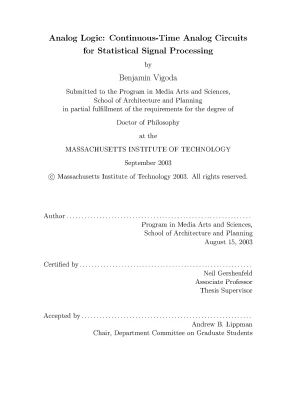
Tải xuống để đọc toàn bộAnalog Logic: Continuous-Time Analog Circuits for Statistical Signal Processing by Benjamin Vigoda Submitted to the Program in Media Arts and Sciences, School of Architecture and Planning in partial fulfillment of the requirements for the degree of Doctor of Philosophy at the MASSACHUSETTS INSTITUTE OF TECHNOLOGY September 2003 c Massachusetts Institute of Technology 2003. All rights reserved. Program in Media Arts and Sciences, School of Architecture and Planning August 15, 2003 Certified by. Neil Gershenfeld Associate Professor Thesis Supervisor Accepted by.
Lippman Chair, Department Committee on Graduate Students 2 Analog Logic: Continuous-Time Analog Circuits for Statistical Signal Processing by Benjamin Vigoda Submitted to the Program in Media Arts and Sciences, School of Architecture and Planning on August 15, 2003, in partial fulfillment of the requirements for the degree of Doctor of Philosophy Abstract This thesis proposes an alternate paradigm for designing computers using continuous- time analog circuits. Digital computation sacrifices continuous degrees of freedom. A principled approach to recovering them is to view analog circuits as propagat- ing probabilities in a message passing algorithm. Within this framework, analog continuous-time circuits can perform robust, programmable, high-speed, low-power, cost-effective, statistical signal processing.
This methodology will have broad appli- cation to systems which can benefit from low-power, high-speed signal processing and offers the possibility of adaptable/programmable high-speed circuitry at frequencies where digital circuitry would be cost and power prohibitive. Many problems must be solved before the new design methodology can be shown to be useful in practice: Continuous-time signal processing is not well understood. Analog computational circuits known as “soft-gates” have been previously proposed, but a complementary set of analog memory circuits is still lacking. Analog circuits are usually tunable, rarely reconfigurable, but never programmable.
The thesis develops an understanding of the convergence and synchronization of statistical signal processing algorithms in continuous time, and explores the use of linear and nonlinear circuits for analog memory. An exemplary embodiment called the Noise Lock Loop (NLL) using these design primitives is demonstrated to perform direct-sequence spread-spectrum acquisition and tracking functionality and promises order-of-magnitude wins over digital implementations. A building block for the con- struction of programmable analog gate arrays, the “soft-multiplexer” is also pro- posed. Thesis Supervisor: Neil Gershenfeld Title: Associate Professor 3 4 Hans-Andrea Loeliger Thesis Reader Professor of Signal Processing Signal Processing Laboratory of ETH Zurich, Switzerland 5 6 Anantha Chandrakasan Thesis Reader Professor Department of Electrical Engineering and Computer Science, MIT Jonathan Yedidia Thesis Reader Research Scientist Mitsubishi Electronics Research Laboratory Cambridge, MA 7 8 Acknowledgments Thank you to the Media Lab for having provided the most interesting context possible in which to conduct research.
Thank you to Neil Gershenfeld for providing me with the direction opportunity to study what computation means when it is analog and continuous-time; a problem which has intrigued me since I was 13 years old. Thank you to my committee, Anantha Chandrakasan, Hans-Andrea Loeliger, and Jonathan Yedidia for their invaluable support and guidance in finishing the dissertation. Thank you to professor Loeliger’s group at ETH in Zurich, Switzerland for many of the ideas which provide prior art for this thesis, for your support, and especially for your shared love for questions of time and synchronization. Thank you to the Physics and Media Group for teaching me how to make things and to our fearless administrators Susan Bottari and Mike Houlihan for their work which was crucial to the completion of the physical implementations described herein.
Thank you to Bernd Schoner for being a role model and to Matthias Frey, Justin Dauwels, and Yael Maguire for your collaboration and suggestions. Thank you to Saul Griffith, Jon Feldman, and Yael Maguire for your true friend- ship and camaraderie in the deep deep trenches of graduate school. Thank you to Bret Bjurstrom, Dan Paluska, Chuck Kemp, Nancy Loedy, Shawn Hershey, Dan Overholt, John Rice, Rob McCuen and the Flying Karamazov Brothers, Howard, Kristina, Mark, Paul and Rod for putting on the show. Thank you to my parents for all of the usual reasons and then some.
Much of the financial resources for this thesis were provided through the Center for Bits and Atoms NSF research grant number NSF CCR-0122419.1 A New Way to Build Computers .1 Digital Scaling Limits .2 Analog Scaling Limits .2 Statistical Inference and Signal Processing .3 Application: Wireless Transceivers .4 Road-map: Statistical Signal Processing by Simple Physical Systems .5 Analog Continuous-Time Distributed Computing .1 Analog VLSI Circuits for Statistical Inference .2 Analog, Un-clocked, Distributed Computing .1 Entrainment for Synchronization .2 Neuromorphic and Translinear Circuits. 43 2 Probabilistic Message Passing on Graphs 47 2.1 The Uses of Graphical Models .1 Graphical Models for Representing Probability Distributions .2 Graphical Models in Different Fields .3 Factor Graphs for Engineering Complex Computational Systems 50 2.4 Application to Signal Processing .2 Review of the Mathematics of Probability .2 Bayes’ Rule and Conditional Probability Distributions .4 Computing Marginal Probabilities .3 Factor Graph Tutorial .2 Factor Graphs Represent a Factorized Probability Distribution 57 2.4 General Soft-gates .5 Marginalization on a Tree: The Message Passing Metaphor .6 Marginalization on Tree: Variable Nodes Multiply Incoming Messages .8 Graphs with Cycles .4 Probabilistic Message Passing on Graphs .1 A Lower Complexity Way to Compute Marginal Probabilities 66 2.2 The Sum-Product Algorithm .5 Other Kinds of Probabilistic Graphical Models .2 Markov Random Fields .4 Forney Factor Graphs (FFG) .5 Circuit Schematic Diagrams .6 Equivalence of Probabilistic Graphical Models .6 Representations of Messages: Likelihood Ratio and Log-likelihood Ratio 79 2.1 Log-Likelihood Formulation of the Soft-Equals .2 Log-Likelihood Formulation of the Soft-xor .7 Derivation of Belief Propagation from Variational Methods. 81 12 3 Examples of Probabilistic Message Passing on Graphs 83 3.2 Soft Hamming Decoder .2 Decoding with Sum Product Algorithm .3 Optimization of Probabilistic Routing Tables in an Adhoc Peer-to-Peer Network. 93 4 Synchronization as Probabilistic Message Passing on a Graph 101 4.1 The Ring Oscillator .1 Trellis Decoding for Ring Oscillator Synchronization .2 Forward-only Message Passing on the Ring Oscillator Trellis .2 Synchronization to a Linear Feedback Shift Register (LFSR) .1 LFSRs Generate PN-Sequences .2 Applications of LFSR Synchronization .3 Maximum Likelihood LFSR Acquisition .1 Trellis for Maximum-Likelihood LFSR Synchronization .2 Converting a the Trellis to a Factor Graph .3 The Sum Product (Forward-Backward) Algorithm on the LFSR Trellis .4 The Max Product (Viterbi’s) Algorithm .4 Low-Complexity LFSR Acquisition .1 The LFSR Shift Graph .2 “Rolling Up the Shift Graph: The Noise Lock Loop .3 Performance of the Noise Lock Loop (NLL) .5 Joint Marginals Generalize Between the NLL and the trellis.
127 5 Analog VLSI Circuits for Probabilistic Message Passing 131 5.1 Introduction: The Need for Multipliers .2 Multipliers Require Active Elements .3 Active Elements Integrated in Silicon: Transistors .4 Single-Quadrant Multiplier Circuits .1 Multiply by Summing Logarithms .2 Multiply by Controlling Gain: The Differential Pair .5 General Theory of Multiplier Circuits .2 The Translinear Principle .3 Companding Current-Mirror Inputs .7 Figures of Merit .1 Resolution and Power Consumption of Soft-Gates at 1GHz. 151 6 The Sum Product Algorithm in Continuous-Time 155 6.1 Differential Message Passing .2 Von Neuman Stability Analysis of Finite Differences .3 Filtering Probabilities and Likelihoods is Equivalent to Damping160 6.4 Filtering Log-Likelihoods .2 Analog Memory Circuits for Continuous-Time Implementation .1 Active Low-Pass Filters .3 Continuous-Time Dynamical Systems .1 Simple Harmonic Oscillators .3 Continuous-Time LFSR Signal Generator .4 Continuous-Time Synchronization by Injection Locking as Statistical Estimation .1 Synchronization of Simple Harmonic Oscillator by Entrainment 174 6.2 Noise Lock Loop Tracking by Injection Locking .1 Extending Digital Primitives with Soft-Gates .2 Soft Flip-Flop .2 Application to Wireless Transceivers .1 Conventional Wireless Receiver .2 Application to Time-Domain (Pulse-based) Radios. Chandrakasan, MIT EECS, Cambridge, MA .2 Hans-Andrea Loeliger, ETH, Zurich, Switzerland .3 Jonathan Yedidia, Mitsubishi Electronics Research Lab, Cambridge, MA202 8.4 Neil Gershenfeld, MIT Media Lab, Cambridge, MA .5 Biography of Author. 204 15 16 List of Figures 1-1 Analog, distributed and un-clocked design decisions reinforce each other 35 1-2 A design space for computation.
The partial sphere at the bottom rep- resents digital computation and the partial sphere at the top represents our approach. 39 1-3 Chaotic communications system proposed by Mandal et al. 40 2-1 Gaussian distribution over two variables. 48 2-2 Factor graph for computer vision.
49 2-3 Factor graph model for statistical physics. 50 2-4 Factor graph for error correction decoding. 51 2-5 Visualization of joint distribution over random variables x1 , x2 , x3. 54 2-6 Visualization of marginalization over random variables x2 , x3 to find p(x1 = 1).
55 2-7 Visualization of marginalization over 2-dimensional gaussian distribution 56 2-8 Factor graph expressing that binary variables x and y are constrained to be opposite in value. 56 2-9 Factor graph expressing that binary variables x, y, and z are con- strained to sum to zero mod 2. 60 2-10 Factor graph containing a variable node more than one incident edge 61 2-11 Factor graph with more than one kind of constraint node. 62 2-12 Factor graph with incomplete marginalization leaving a “region” node: The basis of Generalized Belief Propagation.
63 2-13 Factor graph with a frustrated cycle. 65 17 2-14 Factor graph with a frustrated cycle and a local evidence node. 65 2-15 Simple acyclic graph. 67 2-16 Left to right: factor graph, MRF, Bayesian network.
70 2-17 The fictional “Asia” example of a Bayesian network, taken from Lau- ritzen and Spiegelhalter 1988. 71 2-18 Message passing with a single equals gate. 76 2-19 Converting a factor graph to a pairwise MRF. 77 2-20 Converting a a factor graph to a Bayesian network.
77 2-21 Converting a MRF to a factor graph. 78 2-22 Converting a Bayesian network to a factor graph. 78 3-1 System state update. 84 3-2 System state update combined with measurements.
84 3-3 Kalman filter update. 86 3-5 Graph representing the codeword constraints. 89 3-6 Graph representing the same codeword constraints. 90 3-8 Receiver graph implementing the codeword constraints.
91 3-9 Symbol for the soft-xor gate. 91 3-10 Random ad hoc peer-to-peer network. There are four interfaces {1, 2, 3, 4} on nodes 1 and 4, and three interfaces{1, 2, 3} on nodes 2 and 3. 93 3-11 Factor graph derived from ad hoc peer-to-peer network.
97 3-12 Factor graph derived from ad hoc peer-to-peer network. There are four interfaces {1, 2, 3, 4} on nodes 1 and 4, and three interfaces{1, 2, 3} on nodes 2 and 3. 98 4-1 Schematic diagram for a ring (relaxation) oscillator. 102 4-2 Factor graph for a ring (relaxation) oscillator.
102 4-3 Factor graph for trellis for synchronization of a ring oscillator. 103 4-4 Trellis section for a ring oscillator. 104 18 4-5 Factor graph for transmit and receive ring oscillators. 107 4-6 4-bin, 2-tap LFSR.
108 4-7 State cycle of a 4-bin, 2-tap LFSR. 111 4-9 DS/CDMA modulation with PN-sequence generated by an LFSR. 113 4-10 DS/CDMA demodulation with PN-sequence generated by an LFSR. 113 4-11 Trellis section for a 4-bin, 2-tap LFSR.
114 4-12 Factor graph for a trellis. 115 4-13 Shift graph for a linear feedback shift register. 118 4-14 Forward-only message passing on shift graph for a linear feedback shift register. 119 4-15 Section of the shift graph for a linear feedback shift register.
120 4-16 System to recursively implement section of the shift graph. 121 4-17 The Noise Lock Loop (NLL). 121 4-18 The Noise Lock Loop (NLL). 122 4-19 2 time-step joint message on the LFSR shift graph.
123 4-20 3 time-step joint message on the LFSR shift graph (recovers the trellis) 124 4-21 Block diagram for a binary counter. 128 4-22 Shift graph for a binary counter .
Nội dung được bảo vệ bản quyền — Tải xuống đầy đủ
Trích dẫn luận án này
Benjamin Vigoda (2003). Analog Logic: Mạch Tín hiệu Liên tục cho Xử lý Tín hiệu Thống kê [Luận án tiến sĩ, Massachusetts Institute of Technology]. LuanAn.net. https://luanan.net/ky-thuat-dien-dien-tu/analog-logic-mach-tin-hieu-lien-tuc-cho-xu-ly-tin-hieu-thong-ke
Câu hỏi thường gặp
Luận án "Analog Logic: Mạch Tín hiệu Liên tục cho Xử lý Tín hiệu Thống kê" nghiên cứu về vấn đề gì?
Khám phá mạch logic analog, tín hiệu liên tục và ứng dụng chúng trong xử lý tín hiệu thống kê. Nâng cao hiểu biết về nền tảng điện tử.
Luận án "Analog Logic: Mạch Tín hiệu Liên tục cho Xử lý Tín hiệu Thống kê" được bảo vệ tại trường nào?
Luận án này được bảo vệ tại Massachusetts Institute of Technology. Năm bảo vệ: 2003.
Luận án "Analog Logic: Mạch Tín hiệu Liên tục cho Xử lý Tín hiệu Thống kê" thuộc chuyên ngành gì?
Luận án "Analog Logic: Mạch Tín hiệu Liên tục cho Xử lý Tín hiệu Thống kê" thuộc chuyên ngành Media Arts and Sciences. Danh mục: Kỹ Thuật Điện - Điện Tử.
Luận án "Analog Logic: Mạch Tín hiệu Liên tục cho Xử lý Tín hiệu Thống kê" có bao nhiêu trang?
Luận án "Analog Logic: Mạch Tín hiệu Liên tục cho Xử lý Tín hiệu Thống kê" có 209 trang. Bạn có thể xem trước một phần tài liệu ngay trên trang web trước khi tải về.
Cách tải luận án "Analog Logic: Mạch Tín hiệu Liên tục cho Xử lý Tín hiệu Thống kê" về máy như thế nào?
Để tải luận án về máy, bạn nhấn nút "Tải xuống ngay" trên trang này, sau đó hoàn tất thanh toán phí lưu trữ. File sẽ được tải xuống ngay sau khi thanh toán thành công. Hỗ trợ qua Zalo: 0559 297 239.