Agent-Based Modelling of Articular Cartilage Feasibility - Quang Duong, QUT
Nghiên cứu tính khả thi mô hình tác nhân (ABM) sụn khớp. Luận án trình bày biểu diễn cấu trúc khái niệm của sụn khớp.
Queensland University of Technology
Biomedical Engineering
Luan An
Luận án
Số trang
338
Thời gian đọc
51 phút
Lượt xem
0
Lượt tải
0
Phí lưu trữ
60 Point
Mục lục chi tiết
Tóm tắt nội dung
I. Khả năng mô phỏng mô hình Agent Based của sụn khớp
Mô hình hóa sụn khớp bằng phương pháp agent-based modeling (ABM) cho phép hiểu rõ hơn về hành vi của chondrocytes và động lực học của extracellular matrix (ECM). Sụn khớp là một cấu trúc phức tạp, nơi các proteoglycans bị nén trong mạng lưới collagen 3D. Mô hình này giúp khám phá mối quan hệ giữa các thành phần vi mô và cơ chế cơ học vĩ mô trong quá trình chức năng sinh lý. Nghiên cứu này mang lại cái nhìn sâu sắc về sự suy thoái sụn và mô hình hóa thoái hóa khớp.
1.1. Tầm quan trọng của Agent Based Modeling ABM
ABM cho phép mô phỏng các tương tác phức tạp giữa các tế bào chondrocytes và môi trường xung quanh. Với ABM, có thể theo dõi sự thay đổi của các yếu tố như áp suất thẩm thấu và sự di chuyển của chất lỏng trong mô sụn.
1.2. Cấu trúc của sụn khớp trong mô hình
Mô hình được xây dựng trên cơ sở các đơn vị thẩm thấu vi mô, kết hợp các yếu tố như proteoglycans, collagen và nước. Cấu trúc này giúp tạo ra một mô hình 3D chính xác về sụn khớp.
II. Cơ chế vi mô trong mô hình hóa sụn khớp
Mô hình hóa vi mô giúp nghiên cứu động lực học của sụn dưới áp lực nén. Nghiên cứu sử dụng các quy tắc lân cận trong cellular automata để mô phỏng áp suất thẩm thấu và chuyển động của nước. Điều này cho phép hiểu rõ hơn về cách mà áp suất thẩm thấu ảnh hưởng đến biến dạng của mô sụn.
2.1. Quy tắc lân cận và di chuyển chất lỏng
Các quy tắc lân cận được phát triển dựa trên nguyên lý của cellular automata cho phép mô phỏng hành vi của chất lỏng trong môi trường sụn khớp. Sự thay đổi trong quy tắc này dẫn đến những biến dạng khác nhau trong mạng lưới collagen.
2.2. Ảnh hưởng của áp suất thẩm thấu
Áp suất thẩm thấu có vai trò quan trọng trong việc điều chỉnh sự phân phối và lưu lượng chất lỏng trong mô sụn. Sự tương tác giữa áp suất và biến dạng của mô cung cấp cái nhìn sâu sắc về quá trình thoái hóa khớp.
III. Ứng dụng mô hình trong nghiên cứu thoái hóa khớp
Mô hình ABM cung cấp công cụ mạnh mẽ để nghiên cứu thoái hóa khớp. Bằng cách mô phỏng các điều kiện khác nhau, nó cho phép phân tích sự tiến triển của bệnh và tương tác với thuốc điều trị. Điều này mở ra hướng đi mới trong nghiên cứu và điều trị các bệnh liên quan đến sụn.
3.1. Giám sát tổn thương vi mô
Mô hình giúp theo dõi các tổn thương vi mô trong cấu trúc sụn, từ đó đưa ra các chỉ số đánh giá sức khỏe của mô. Việc theo dõi này có thể dẫn đến việc phát triển các liệu pháp điều trị hiệu quả hơn.
3.2. Tương tác thuốc sụn
Hiểu biết về cơ chế vi mô cho phép nghiên cứu sự tương tác giữa thuốc và mô sụn, từ đó tối ưu hóa các phương pháp điều trị mới cho bệnh nhân bị thoái hóa khớp.
IV. Triển vọng tương lai của mô hình hóa sụn khớp
Tương lai của mô hình hóa sụn khớp hứa hẹn sẽ tiếp tục phát triển với sự cải tiến của công nghệ và phương pháp mô phỏng. Việc tích hợp các mô hình đa tác nhân và mô hình cá thể sẽ cho phép phân tích sâu hơn về cơ chế bệnh lý và phát triển các liệu pháp điều trị mới.
4.1. Công nghệ mô phỏng tiên tiến
Sự phát triển của công nghệ mô phỏng sẽ cung cấp các công cụ mạnh mẽ hơn để nghiên cứu sụn khớp. Các mô hình phức tạp hơn sẽ giúp hiểu rõ hơn về sự tương tác giữa các yếu tố cơ học và sinh học.
4.2. Tương lai của nghiên cứu bệnh lý
Nghiên cứu về sụn khớp sẽ tiếp tục mở rộng sang các lĩnh vực khác như kỹ thuật mô và sinh học tế bào. Điều này sẽ thúc đẩy sự phát triển của các phương pháp chữa trị mới và cải thiện chất lượng cuộc sống cho bệnh nhân.
Tải xuống file đầy đủ để xem toàn bộ nội dung
Tải đầy đủ (338 trang)Trích đoạn nội dung luận án
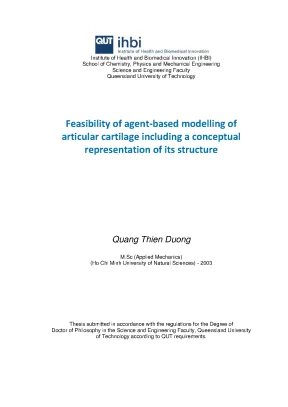
Tải xuống để đọc toàn bộInstitute of Health and Biomedical Innovation (IHBI) School of Chemistry, Physics and Mechanical Engineering Science and Engineering Faculty Queensland University of Technology Feasibility of agent-based modelling of articular cartilage including a conceptual representation of its structure Quang Thien Duong M.Sc (Applied Mechanics) (Ho Chi Minh University of Natural Sciences) - 2003 Thesis submitted in accordance with the regulations for the Degree of Doctor of Philosophy in the Science and Engineering Faculty, Queensland University of Technology according to QUT requirements. Keywords Articular Cartilage, Multiscale Modelling, Osmotic Pressure, Fluid diffusion, Deformation, Cellular Automata, Margolus Neighbourhood, Virtual Clay Model. i Abstract Articular cartilage is a complex structure with an architecture in which fluid-swollen proteoglycans constrained within a 3D network of collagen fibrils. Because of the complexity of the cartilage structure, the relationship between its mechanical behaviours at the macro- scale level and its components at the micro-scale level are not completely understood.
The research objective in this thesis is to create a new model of articular cartilage that can be used to simulate and obtain insight into the micro-macro-interaction and mechanisms underlying its mechanical responses during physiological function. The new model of articular cartilage has two characteristics, namely: i) not use fibre-reinforced composite material idealization ii) Provide a framework for that it does probing the micro mechanism of the fluid-solid interaction underlying the deformation of articular cartilage using simple rules of repartition instead of constitutive / physical laws and intuitive curve-fitting. Even though there are various microstructural and mechanical behaviours that can be studied, the scope of this thesis is limited to osmotic pressure formation and distribution and their influence on cartilage fluid diffusion and percolation, which in turn governs the deformation of the compression-loaded tissue. The study can be divided into two stages.
In the first stage, the distributions and concentrations of proteoglycans, collagen and water were investigated using histological protocols. Based on this, the structure of cartilage was conceptualised as microscopic osmotic units that consist of these constituents that were distributed according to histological results. These units were repeated three-dimensionally to form the structural model of articular cartilage. In the second stage, cellular automata were incorporated into the resulting matrix (lattice) to simulate the osmotic pressure of the fluid and the movement of water within and out of the matrix; following the osmotic pressure gradient in ii accordance with the chosen rule of repartition of the pressure.
The outcome of this study is the new model of articular cartilage that can be used to simulate and study the micromechanical behaviours of cartilage under different conditions of health and loading. These behaviours are illuminated at the microscale level using the so- called neighbourhood rules developed in the thesis in accordance with the typical requirements of cellular automata modelling. Using these rules and relevant Boundary Conditions to simulate pressure distribution and related fluid motion produced significant results that provided the following insight into the relationships between osmotic pressure gradient and associated fluid micromovement, and the deformation of the matrix. For example, it could be concluded that: 1.
It is possible to model articular cartilage with the agent-based model of cellular automata and the Margolus neighbourhood rule. The concept of 3D inter connected osmotic units is a viable structural model for the extracellular matrix of articular cartilage. Different rules of osmotic pressure advection lead to different patterns of deformation in the cartilage matrix, enabling an insight into how this micromechanism influences macromechanical deformation. When features such as transition coefficient were changed, permeability (representing change) is altered due to the change in concentrations of collagen, proteoglycans (i.
degenerative conditions), the deformation process is impacted. The boundary conditions also influence the relationship between osmotic pressure gradient and fluid movement at the micro-scale level. The outcomes are important to cartilage research since we can use these to study the microscale damage in the cartilage matrix. From this, we are able to monitor related iii diseases and their progression leading to potential insight into drug-cartilage interaction for treatment.
This innovative model is an incremental progress on attempts at creating further computational modelling approaches to cartilage research and other fluid-saturated tissues and material systems. iv Table of Contents Keywords i Abstract ii Table of Contents v List of Figures xiii List of Equations xxi List of Diagrams xxiii List of Tables xxiv List of Matlab Programs xxv List of Abbreviations xxv List of Papers and Posters xxvi Declaration xxvii Acknowledgements xxviii Chapter 1 Introduction 1.1 The focus of the thesis 1 1.2 Research gap in articular cartilage computational modelling associated research 1 1.1 Current experimental studies of articular cartilage 3 1.2 Some main factors governing the deformation of articular cartilage 6 1.2 Numerical modelling of cartilage and related simulations 12 1.3 The gap in research 17 1.3 Significance and benefits 19 1.1 Articular cartilage degeneration and diseases 19 v 1.2 Significance and contribution to knowledge of this research 22 1.1 The virtual cartilage concept 22 1.2 Contribution to knowledge 24 Summary 27 Chapter 2 Articular cartilage and Cellular Automata approach 2.2 Constituents of articular cartilage 33 2.3 Fluid in cartilage 47 2.2 Osmosis, osmotic pressure and osmotic unit 51 2.1 Osmosis and osmotic pressure 51 2.2 The osmotic pressure in articular cartilage 56 2.1 Osmotic pressure at macro-scale level 56 2.2 Osmotic pressure at micro-scale level 57 2.3 Osmotic units in cartilage 59 2.3 Cellular automata, the Margolous neighbourhood and partitioning rule 62 2.4 Mechanics of the Margolus partitioning rule 69 Chapter 3 The conceptual in-silico structural model of articular cartilage 3.1 New conceptual idealization of cartilage structure for computational analysis 73 3.2 Margolus neighbourhood application to cartilage modelling 78 3.1 Physical model of the cartilage structure 78 vi 3.2 The conceptual microscale load-bearing unit of articular cartilage 80 3.3 Osmotic units and the Margolus neighbourhood 84 3.3 Simulation of deformation with the in-silico model 84 3.4 Virtual clay simulation 85 Chapter 4 Determination of cartilage matrix components The three major Components of cartilage 87 Histology 89 Image processing 90 Volume rendering 92 4.1 Introduction of proteoglycan 93 4.2 Material and method 96 4.4 Calculation of quantities from images using ImageJ 101 4.7 Optical Density Imaging 104 4.8 Converting into unit of (g/cm3) 108 4.4 Summary of proteoglycans quantification results 116 4.2 Collagen quantification 117 vii 4.1 Introduction of collagen 117 4.2 Method and apparatus 119 4.1 An example for calculating collagen concentration from absorbance values 124 4.2 The results of all experiments 128 4.4 Summary of collagen quantification results 128 4.3 Quantification of water content 132 4.4 Determination of the thickness 138 4.5 Calculating osmotic pressure and collagen meshwork stress for articular cartilage 139 4.2 Stress on collagen component 144 Summary 147 Chapter 5 Deformable cellular automata of articular cartilage 5.1 Protocol for creating Voxel and implementing Cellular Automata 153 5.2 Setting up the voxels 155 5.1 Setting up the values of collagen, proteoglycans and water for each cell 155 5.2 Visualization of the change of the thicknesses during the deformation process 158 5.1 Collecting the real sample for 3D laser scanning 160 5.2 Create the base of the object 160 5.3 Creating the grid 161 5.4 Mapping the volume 163 viii Chapter 6 Implementation of forms of the Margolus neighbourhood rules with Matlab I The set of rules 166 6.1 Applying virtual clay model for articular cartilage matrix 166 6.2 The set of rules using in the model of articular cartilage 169 6.2 The rules for the threshold condition 171 6.3 The moving plate rules 173 6.4 The One-Zero altering Rules 175 6.5 The Active-Inactive cell rules 177 6.6 Boundary conditions 183 II Structure of Matlab program in the thesis 184 6.3 Creating blocks on odd grid 185 6.1 Two-Dimension blocks (2D blocks) 185 6.2 Three-Dimension blocks (3D blocks) 186 6.4 Creating blocks on even grid 188 6.1 Two-Dimension blocks (2D blocks) 188 6.2 Three-Dimension blocks 189 ix 6.5 The main algorithm for the main program 190 6.6 Description for Matlab codes 190 6.2 Preliminary calculation, volume of each voxel 192 6.3 Setting up Threshold 193 6.2 Modelling the special areas 194 6.1 Surface of cartilage 194 6.2 The bottom of the model 194 6.3 The area of loading 194 6.5 The cells next to the indenter 195 6.3 Modelling the boundary conditions 195 6.4 Setting up moving plate 196 6.5 Creating odd grid 200 6.1 Module subprogram “Odd_step_active” (Making 2D odd grid) 200 6.1 Numbering the blocks 200 6.2 Finding the active blocks in the odd grid 202 6.2 The module subprogram “CombineLayer” (Making 3D odd grid) 205 6. Calculating the quantities of active cells in active blocks 207 6.7 Calculating water movement based on the transition rule 208 6.8 Updating the results as input data for the next step 223 6.9 Working on the even steps 226 6.txt file 228 x Chapter 7 Results and validation 7.1 The graphs obtained from the models 234 7.3 Comments 275 Chapter 8 Discussion 279 References 291 Appendixes (all appendixes are stored in the CD) Appendix 1 New approach for articular cartilage and expected outcomes Appendix 2 Numerical techniques and applications to cartilage modelling Appendix 3 Introduction of some common neighbourhoods xi Appendix 4 The consolidation of articular cartilage Appendix 5.1 Main program for mode 1 Appendix 6.2 Main program for mode 2 Appendix 6.3 Sub program odd_step_active Appendix 6.4 Sub program even_step_active Appendix 6.5 Sub program CombineLayer Appendix 6.6 Sub program odd_step_computation Appendix 6.7 Sub program even_step_computation Appendix 6.8 Sub program GeneralRules Appendix 7 The graphs Appendix 8.1 Water_layer Appendix 8.2 Collagen_layer Appendix 8.1 Map_Rule_1_vs_3 Appendix 8.2 Pressure_Rule_1_vs_3 Appendix 8.1 Water_BC_1D_vs_3D Appendix 9 Scenario 1_Matlab program Appendix 10 Matlab program (changing λ at boundary/ies) Appendix 11 Scenario 2 xii List of Figures Page Chapter 2 Fig 2.1: The human knee showing the location of articular cartilage 29 Fig 2.2: The scheme of collagen meshwork entrap proteoglycans 30 Fig 2.3: The four zones of articular cartilage (James et al.4 a: TEM of normal general matrix structure as fixed –on-bone in its pre-equilibration control state. b: in its post-equilibration state.
Arrows indicate radial direction. Bars, 1 micron (Chen and Broom, [1999]) 34 Fig.5 a: TEM of normal general matrix structure as fixed –on-bone in its pre-equilibration control state; b: in its post-equilibration state. Arrows indicate radial direction. Bars, 1 micron (Chen and Broom, [1999]) 35 Fig 2.6: Structure of a collagen molecule (Shipman et al.
amino acid chain 39 Fig 2.8: Schematic illustration of the collagen meshwork within the matrix (Broom, [1982]) a) full thickness (from surface to calcified zone) b) one fibril of the middle zone c) interconnected meshwork in the middle zone 41 Fig 2.9: SEM of the softened general matrix (Chen and Broom, [1999]) Arrow indicates radial direction. a) Pre-swelling control state as fixed –on-bone. b and c): SEM of the softened swollen general matrix. They are different from the normal xiii picture because the radial architecture was transformed into either a diffuse or more open meshwork of discrete fibrils or fibril bundles.
These bundles were separated out over relatively short distances in the transverse direction (Chen and Broom, [1999]) 43 Fig.10: Structure of typical proteoglycans 45 Fig.11: Chondrocyte in articular cartilage (Wroble, 2000) 48 Fig.12: A: The 3-D view of human articualar cartilage; B,C,D: The 2D sections from Fig. A (Sah et al.13: Solution A and B with the membrane 52 Fig.14: Solution A, B and applied pressure 53 Fig 2.15: Solution A, B, solute C and applied pressure 55 Fig.16: Volume change in articular cartilage depends on water flow 57 Fig.17: An osmotic unit with collagen acts as membrane and proteoglycan macromolecules inside 60 Fig.18: a) initial stage; b) Ink and water diffuse into each other; c) finally, a uniform mixture 66 Fig.19: The 2x2 blocks of the Margolus neighbourhood: consecutive steps alternate between the even grid (solid lines) and the odd grid (dot lines) 67 Fig.20: The 2D Margolus neighbourhood showing odd and even blocks 70 Fig.21: The 3D Margolus neighbourhood illustrating odd and even blocks 71 Chapter 3 Fig.
Nội dung được bảo vệ bản quyền — Tải xuống đầy đủ
Câu hỏi thường gặp
Luận án "Feasibility of Agent-Based Modelling of Articular Cartilage" nghiên cứu về vấn đề gì?
Nghiên cứu tính khả thi mô hình tác nhân (ABM) sụn khớp. Luận án trình bày biểu diễn cấu trúc khái niệm của sụn khớp.
Luận án "Feasibility of Agent-Based Modelling of Articular Cartilage" được bảo vệ tại trường nào?
Luận án này được bảo vệ tại Queensland University of Technology.
Luận án "Feasibility of Agent-Based Modelling of Articular Cartilage" thuộc chuyên ngành gì?
Luận án "Feasibility of Agent-Based Modelling of Articular Cartilage" thuộc chuyên ngành Biomedical Engineering. Danh mục: Kỹ Thuật Y Học.
Luận án "Feasibility of Agent-Based Modelling of Articular Cartilage" có bao nhiêu trang?
Luận án "Feasibility of Agent-Based Modelling of Articular Cartilage" có 338 trang. Bạn có thể xem trước một phần tài liệu ngay trên trang web trước khi tải về.
Cách tải luận án "Feasibility of Agent-Based Modelling of Articular Cartilage" về máy như thế nào?
Để tải luận án về máy, bạn nhấn nút "Tải xuống ngay" trên trang này, sau đó hoàn tất thanh toán phí lưu trữ. File sẽ được tải xuống ngay sau khi thanh toán thành công. Hỗ trợ qua Zalo: 0559 297 239.