Dissertation bailu li final 04 24 19
Luận văn Li 04/24/19: Phân tích sâu sắc các khía cạnh quan trọng của đề tài, đưa ra kết luận và đề xuất giải pháp hiệu quả.
Ngôn ngữ và Văn hóa (School of Languages and Cultures)
Luan An
Luận án tiến sĩ
Năm xuất bản
Số trang
208
Thời gian đọc
32 phút
Lượt xem
0
Lượt tải
0
Phí lưu trữ
50 Point
Tổng quan nhanh
- Chủ đề:
- Bailu Li Dissertation: Service-Learning in Chinese Courses
- Số trang:
- 208 trang
- Trường:
- Purdue University
- Chuyên ngành:
- Ngôn ngữ và Văn hóa (School of Languages and Cultures)
- Tác giả:
- Bailu Li
- Năm:
- 2019
Tóm tắt nội dung luận án
I.Bailu Li Dissertation Service Learning in Chinese Courses
This academic research presents a comprehensive doctoral thesis by Bailu Li. The dissertation explores the implementation of service-learning in Chinese language courses. Authored at Purdue University in May 2019, this scholarly work fulfills the requirements for a Doctor of Philosophy degree. The study provides critical insights into pedagogical innovations for modern language education. It examines how practical community engagement can enhance linguistic proficiency and cultural understanding. This research paper contributes significantly to the field of second language acquisition. It offers a detailed analysis of an impactful educational approach. The work establishes a robust framework for understanding service-learning's role in advanced language pedagogy.
1.1. Overview of Bailu Li s PhD Thesis
Bailu Li’s PhD thesis focuses on integrating service-learning into the Chinese language curriculum. The scholarly work addresses a critical area in language pedagogy. It proposes a model for effective implementation. The dissertation details the study’s background, methodology, and findings. It represents a substantial contribution to academic writing. The research paper establishes a framework for future studies in this domain. This doctoral thesis underscores the importance of applied learning experiences. It demonstrates commitment to innovative educational practices.
1.2. Study Purpose Enhancing Chinese Language Skills
The primary purpose of this dissertation involves investigating the impact of service-learning on Chinese language acquisition. The research identifies specific benefits for students. It addresses challenges inherent in such programs. The study aims to bridge classroom learning with real-world application. It seeks to improve students' communication skills, cultural competency, and civic engagement. This academic research illuminates pathways for richer, more meaningful language learning experiences. It targets enhanced linguistic and intercultural skills through practical application.
II.Theoretical Basis Service Learning Language Acquisition
The theoretical foundations for this dissertation are robust. Service-learning is positioned within established pedagogical theories. Experiential education principles are central to its framework. Critical theory and transformative learning also inform this approach. These perspectives emphasize active engagement and personal growth. This scholarly work defines service-learning clearly. It distinguishes it from other forms of community involvement. Core elements like reflection and reciprocity are highlighted. Understanding these theoretical underpinnings is crucial for successful implementation. This academic research builds upon existing knowledge in language pedagogy. It provides a strong conceptual grounding.
2.1. Core Principles of Service Learning Framework
Service-learning relies on key theoretical principles. Experiential education forms its bedrock. Students learn by doing, applying classroom knowledge in practical settings. Critical theory encourages deeper analysis of societal issues. Transformative learning facilitates significant personal change through experience. Reflection activities are essential for processing experiences. Reciprocity ensures mutual benefit for students and communities. These elements define a robust service-learning experience. The dissertation meticulously explores these foundational concepts. It details their application in linguistic contexts.
2.2. Service Learning s Role in Language Teaching
Service-learning offers unique advantages for language acquisition. It provides authentic communicative contexts. Students practice target language skills naturally. Previous studies have shown success in Spanish, English (ESL/TOSEL), Russian, French, and German. This doctoral thesis specifically extends this application to Chinese language courses. It examines how real-world interactions foster linguistic proficiency and cultural understanding. The academic research highlights its potential to move beyond traditional classroom settings. This integration creates dynamic learning environments.
III.Methodology Chinese Language Service Learning Study
The methodology employed in this dissertation involved a comprehensive study design. Research investigated students enrolled in CHNS Level VII courses. This specific group represented advanced Chinese language learners. The study integrated a defined service-learning component into the curriculum. Data collection involved both quantitative and qualitative methods. This approach ensured a holistic understanding of the impact. The scholarly work outlines the research design meticulously. It provides a detailed account of participant selection. This section of the research paper validates the credibility of the findings. The rigorous approach strengthens conclusions drawn.
3.1. Research Design Participant Selection
The research design utilized a mixed-methods approach. It combined statistical analysis with qualitative inquiry. The study sample comprised students from CHNS Level VII. Participant selection focused on students with varying language backgrounds and community service histories. This ensured a diverse and representative group. The dissertation details the criteria for inclusion. It describes the academic context of the service-learning integration. Robust participant recruitment contributed to the study's validity. This careful planning supported reliable data.
3.2. Data Collection Assessment Tools
Data collection involved multiple instruments. Students completed surveys regarding language background and expectations. The Public Affairs Scale (PAS) assessed civic engagement and related outcomes. Qualitative evidence was gathered through reflections and interviews. The service-learning component itself generated observational data. This comprehensive data set allowed for thorough analysis. The academic writing describes each tool's application. Such rigorous methods enhance the credibility of this doctoral thesis. They ensure a multi-dimensional evaluation of impacts.
IV.Student Experiences Chinese Service Learning Outcomes
Student experiences formed a crucial part of this dissertation. The research captured diverse student perspectives. It examined their motivations for taking Chinese courses. Students' expectations regarding the service-learning experience were also documented. Their formal and informal Chinese language experiences were considered. The scholarly work presents descriptive statistics of the study sample. It also provides rich qualitative evidence. This section offers a nuanced view of the impact on individual learners. The academic research directly addresses student growth and engagement. It highlights the direct benefits of immersion.
4.1. Student Backgrounds Service Motivations
Student backgrounds varied significantly. Language exposure levels ranged from limited to extensive. Community service history was also diverse among participants. Motivations for enrolling in Chinese courses included career advancement, cultural interest, and personal growth. Expectations for the service-learning experience varied. Some students anticipated language practice. Others hoped for deeper cultural immersion. This dissertation explores how these factors shaped their overall experience. It connects individual attributes to learning outcomes.
4.2. Impact on Personal Growth Civic Engagement
The study revealed significant impact on students. Personal and interpersonal growth were frequently reported. Students developed greater self-confidence and empathy. Communication skills improved through authentic interactions. Meaningful civic engagement was another key outcome. Participants understood their role in the community more deeply. The service-learning component fostered a sense of responsibility. This research paper highlights these transformative aspects for learners. It demonstrates the holistic development fostered.
V.Key Findings Service Learning in Chinese Curriculum
Key findings of this Bailu Li dissertation provide compelling evidence. The study indicates substantial benefits of integrating service-learning into Chinese language courses. These benefits extend beyond linguistic improvement. They encompass personal, interpersonal, and civic development. The research addresses specific questions about the effectiveness of this pedagogical approach. It offers actionable insights for educators and curriculum designers. This scholarly work reinforces the value of applied learning. The doctoral thesis concludes with significant implications for future academic research in language education. It outlines a path for continued pedagogical innovation.
5.1. Benefits of Integrating Service Learning
The discussion directly relates to the first research question. Service-learning demonstrably enhances Chinese language proficiency. Students gained practical communication skills. Cultural understanding deepened through direct community interaction. The experience fostered greater motivation for language study. It also developed critical thinking skills. This research paper provides evidence of multifaceted benefits. The positive outcomes support wider adoption of this approach. It confirms service-learning as a valuable tool.
5.2. Future Directions for Academic Research
This doctoral thesis concludes with recommendations for future academic research. Further studies could explore long-term impacts on students. Investigation into different cultural contexts would be valuable. The transferability of findings to other less commonly taught languages is an important area. Replication studies could strengthen the generalizability of these results. This dissertation, a comprehensive scholarly work by Bailu Li, serves as a foundational text, inspiring continued exploration in service-learning and language acquisition. It guides future academic writing endeavors.
Mục lục chi tiết luận án
Tải xuống file đầy đủ để xem toàn bộ nội dung
Tải đầy đủ (208 trang)Trích đoạn nội dung luận án
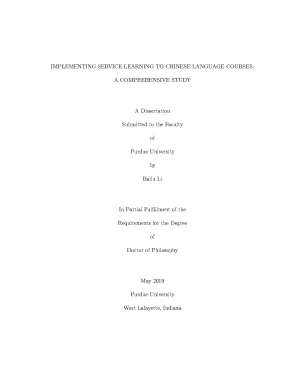
Tải xuống để đọc toàn bộIMPLEMENTING SERVICE-LEARNING TO CHINESE LANGUAGE COURSES: A COMPREHENSIVE STUDY A Dissertation Submitted to the Faculty of Purdue University by Bailu Li In Partial Fulfillment of the Requirements for the Degree of Doctor of Philosophy May 2019 Purdue University West Lafayette, Indiana ii THE PURDUE UNIVERSITY GRADUATE SCHOOL STATEMENT OF DISSERTATION APPROVAL Dr. Wei Hong, Chair School of Languages and Cultures Dr. Ann Abbott University of Illinois Urbana-Champaign, Department of Spanish and Por- tuguese Dr. Margie Berns Department of English Dr.
Atsushi Fukada School of Languages and Cultures Approved by: Dr. William Head of the School Graduate Program iii To my parents, husband, and children iv ACKNOWLEDGMENTS I am indebted to everyone who supported me academically, professionally, and personally through this doctoral process. Many have walked with me and encouraged me in this Ph. journey and I am grateful.
Their support made this degree and dissertation possible. My heartfelt gratitude to my committee: to chairperson, Dr. Wei Hong, for the encouragement, commitment, expertise, and laughs. I am honored to have worked alongside you.
Your positivity, concern for others, and belief in your students have influenced me in this long journey; to Dr. Ann Abbott, for sharing your expertise and insights in service-learning and for your inspiration of service-learning with im- migrants in my future research; to Dr. Margie Berns, my thesis and dissertation committee members, for your encouragement and patience, and for everything I have learned about sociolinguistics from you; to Dr. Atsushi Fukada, for your words of encouragement, your guide of technology-advanced teaching and learning, and for your careful reading and speedy feedback.
I would also like to thank Dr. Darcy Lear, from whose keynote speech in CIBER Business Language Conference (2012) that I first found this inspirational idea of service-learning that I set out upon this venture. This study could not have taken place without my students, community partners and college staff. Specially thanks to Ye Sun and Joni Hipsher.
Each of you con- tributed to the completion of this study, and I am grateful for the time you share and the support you offer. I also want to thank my dear friends – Ying, Ping, Luyang, Siyan, Nan, Yuanyuan, Mingming. You have encouraged my heart with your precious gifts of authentic friendship, unfailing support, joy and countless words of wisdom. Also, a sincere thank you to Elanie for her diligent proofreading of my paper.
v Last but not least, I wish to thank my family for their support. To my father and mother, Jianqiang Li and Xianxing Bai, whose love, patience, and support gave me the foundation to live full, healthy, and meaningful lives. My dad, especially, instilled in me the work ethic necessary to persist through this Ph. program; to my husband, Fengyuan Li, who has provided the steady support without which the journey would not have been possible.
He also helped me to stay grounded and to persist through the final stages; to my parents-in-law, to their unweaving support of the family, and finally, to my daughters, Katherine and Brianna, as the most beautiful gifts I have received, for the love, happiness, and support you bring to me. vi TABLE OF CONTENTS Page LIST OF TABLES. x LIST OF FIGURES .1 Overview of the Study .2 Statement of the Problem .3 Purpose of the Study .5 Significance of the Study .6 Organization of the Study. 5 2 THEORITICAL FOUNDATIONS AND RESEARCH PERSPECTIVES .1 Theoretical Foundations of Service-Learning .1 Experiential education and Service-Learning .2 Critical Theory, Transformative Learning, and Service-Learning 12 2.2 Service-Learning Roots in Higher Education .3 Definition and Distinctions .4 Two Essential Elements of Service-Learning: Reflection and Reciprocity 24 2.5 Best Practices of Service-Learning .6 Challenges of Service-Learning .7 Service-Learning and Language Acquisition .1 Service-Learning and Spanish .2 Service-Learning in the English as a Second Language (ESL) and Teaching English as a Second Language (TOSEL) Context .3 Service-Learning in Other Languages/Cultures: Russian, French and German .4 Conclusions and Limitations of Previous Study .5 Service-Learning and Chinese Language .8 Service-Learning Research Scale: The Public Affairs Scale (PAS) .1 Students Enrolled in CHNS Level VII .3 Service-Learning Component .4 Credibility of the Study .1 Students’ Service and Language Background .1 Language Background and Exposure .2 Expectations about the Service-Learning Experience .3 History of Students’ Community Service .4 Chinese Language Experiences both Formal and Informal .5 Motivations to Take Chinese Courses .6 The Impact of Chinese and the Future Role of Chinese .2 Descriptive Statistics of the Study Sample .3 Qualitative Evidence from the Study Sample .1 Personal and Interpersonal Growth .3 Meaningful Civic Engagement .1 Discussion in Relation to Research Question 1: Benefits of Service- Learning .2 Discussion in Relation to Research Question 2: Language and 5Cs .3 Discussion in Relation to Research Question 3: Variables of Students 113 5.
122 6 CONCLUSION AND FUTURE DIRECTIONS .1 International Service-Learning (ISL) .2 Service-Learning and LSP .4 Service-Learning and Heritage Speakers .6 Pre-service Teacher Programs. 187 ix C PUBLIC AFFAIRS SCALE. 190 x LIST OF TABLES Table Page 3.1 Research Questions and Sources of Data .3 Student Demographics II .4 Student Demographics III .5 Student Demographics IV .7 Service-learning Projects and Partners .1 Descriptive Statistics for the Three Subscales of the Public Affairs Scale at Pre- and Post-survey .2 Paired Samples Test Results for the Three Subscales .3 Chi-Square Tests for Community Engagement - Gender Pre-survey .4 Chi-Square Tests for Community Engagement - Gender Post-survey .5 Chi-Square Tests for Community Engagement - Race Pre-survey .6 Chi-Square Tests for Community Engagement - Race Post-survey .7 Chi-Square Tests for Cultural Competence - Gender Pre-survey .8 Chi-Square Tests for Cultural Competence - Gender Post-survey .9 Chi-Square Tests for Cultural Competence - Race Pre-survey .10 Chi-Square Tests for Cultural Competence - Race Post-survey .11 Chi-Square Tests for Ethnical Leadership - Gender Pre-survey .12 Chi-Square Tests for Ethnical Leadership - Gender Post-survey .13 Chi-Square Tests for Ethnical Leadership - Race Pre-survey .14 Chi-Square Tests for Ethnical Leadership - Race Post-survey .15 Themes and Sub-themes in Qualitative Data .1 Public Affairs Scale Rating. 190 xi LIST OF FIGURES Figure Page 2.1 Kolb Learning Cycle .2 Distinctions among Service Programs.
23 xii ABBREVIATIONS ACTFL American Council on the Teaching of Foreign Languages CSL Community Service-Learning CFL Chinese as a Foreign Language ELT Experiential Learning Theory ESL English as a Second Language GSL Global Service-Learning ISL International Service-Learning LSP Language for Special Purposes MLA Modern Language Association SSP Spanish for Special Purposes TESOL Teach English to Speakers of Other Languages HL Heritage Language HLL Heritage Language Learners PAS Public Affair Scale xiii ABSTRACT Li, Bailu Ph., Purdue University, May 2019. Implementing Service-Learning to Chinese Language Courses: A Comprehensive Study. Major Professor: Wei Hong. Service learning has been proposed as a widespread educational movement that merges academic work with real-life community service activities that encourages students to reflect and think critically about their experiences.
As a pedagogical tool for second language acquisition, the greatest benefit of utilizing service learning activities results in the fact that it creates connections to the target language commu- nity and provides authentic experiences for target language use (F. Although service-learning has been extensively implemented into language programs such as Spanish and English as a Second Language (ESL), it is still in its infancy with Chinese second language learners. This dissertation examines the effects and outcomes of service-learning involve- ment on the advanced Chinese learners towards language acquisition, cultural un- derstanding, and community engagement. The study was conducted in a Midwest university with 30 students from a variety of educational and cultural backgrounds.
The data was collected through pre-/post-survey, observation and reflective jour- nals. Findings indicated that the service-learning experiences enhanced and enriched students’ Chinese language learning. Additional benefits to the students included increasing their knowledge of Chinese culture and history, developing a higher mo- tivation for community engagement and transformative learning, and forming con- nections to people and community beyond the classroom. However, differences were also found in students’ service-learning experiences and outcomes based on gender, race, and cultural backgrounds.
Future directions of Chinese service-learning in the xiv emerging fields were discussed as promising avenues for future Chinese as a Foreign Language (CFL) research and practice.1 Overview of the Study Over the past several decades, civic engagement has become burgeoning and inte- gral goals in higher education (American Council on Education). Colleges are consid- ered catalysts for community change with college students being critical contributors of community engagement for their campuses (Plodinec et al. Creating civic- minded higher education institutions and communities call for dynamic and reciprocal relationship. Service-learning can be a powerful means used to promote civic responsi- bility on campus and throughout the community.
Service-learning is “a highly flexible and adaptable practice that works across an immense variety of institutions, faculty, disciplines and students. It can accommodate different goals and manifest divergent institutional strategies. In a particular community setting, the content taught and discussed in the classroom can be addressed and implemented so that academic work and community service are achieved together (Speck, 2001). The prevalence of service-learning in higher education has grown substantially since the 1990s (Bringle & Hatcher, 1996).
Service-learning, as a powerful strategy to learn and foster civic engagement, has been proven to provide evident benefits for the students who participated (e. Astin & Sax, 1998; Eyler et al. The service-learning principles of instruction, curriculum, and the building and developing of a community provide a lens through which one can understand the over- arching themes of service and educational experiences (Keith, 1997). Instruction of service-learning addresses the importance of alternative learning styles, engagement in real-world tasks, and collaborative work that enhance student engagement and motivation.
The curriculum enhances in-class and relevant knowledge while connect- ing learning and research opportunities through provoking, culturally relevant ideas. 2 Last but not least, the building and developing of a community can enhance mu- tual respect and mutually beneficial relationships for the university and community (Plante, 2015). Among the service-learning practices throughout the disciplines, language teach- ing has gradually gained popularity in connection with service-learning. For foreign language learners, there is not enough evidence to show that students acquire the new materials sufficiently for language improvement through learning with the textbook- alone approach (Wong & Van Patten, 2003).
The teaching profession is continually exploring new options for addressing the issue and the effectiveness of different peda- gogy in the classroom and beyond. Minor (2002) stressed the importance of real and meaningful context to learn a language well. Springer & Collins (2008) also asserted that many language learners are eager to participate in personal and professional ac- tivities after having achieved a certain comfort level in the newly acquired language. Service-learning has the potential to fulfill the students’ academic, civic and com- municative needs.
Students feel challenged both affectively and cognitively in their service-learning courses due to the fact that they apply the foreign language they learn in class to a real-life situation, which, in return, stimulates them to assess and reflect not only on the language acquisition, but also on their own personal assump- tions, values and beliefs (Bippus & Eslami, 2013). Service-learning has been shown to provide distinct benefits for students in a linguistic and cross-cultural setting. Advo- cates have noted linguistic gains not only in students’ acquisition of the language but also in their motivation of language learning, comprehension of the corresponding culture, and an attitude change toward native speakers of the language (e., Sax, 1999; Eyler & Giles, 1999; Vogelgesang & Astin, 2000). Students who take part in service-learning activities have higher motivation, earn higher academic achievement, and become more involved in their communities.
They are also more aware about their civic and ethical responsibilities, as well as the sociocultural contexts in which they live (Reinke, 2004; Simons & Cleary, 2006).2 Statement of the Problem Interest in learning Chinese has surged in the past decade as China’s economy is more and more engaged in global market.
Nội dung được bảo vệ bản quyền — Tải xuống đầy đủ
Trích dẫn luận án này
Bailu Li (2019). Dissertation bailu li final 04 24 19 [Luận án tiến sĩ, Purdue University]. LuanAn.net. https://luanan.net/khoa-hoc-giao-duc/dissertation-bailu-li-final-04-24-19
Câu hỏi thường gặp
Luận án "Dissertation bailu li final 04 24 19" nghiên cứu về vấn đề gì?
Luận văn Li 04/24/19: Phân tích sâu sắc các khía cạnh quan trọng của đề tài, đưa ra kết luận và đề xuất giải pháp hiệu quả.
Luận án "Dissertation bailu li final 04 24 19" được bảo vệ tại trường nào?
Luận án này được bảo vệ tại Purdue University. Năm bảo vệ: 2019.
Luận án "Dissertation bailu li final 04 24 19" thuộc chuyên ngành gì?
Luận án "Dissertation bailu li final 04 24 19" thuộc chuyên ngành Ngôn ngữ và Văn hóa (School of Languages and Cultures). Danh mục: Khoa Học Giáo Dục.
Luận án "Dissertation bailu li final 04 24 19" có bao nhiêu trang?
Luận án "Dissertation bailu li final 04 24 19" có 208 trang. Bạn có thể xem trước một phần tài liệu ngay trên trang web trước khi tải về.
Cách tải luận án "Dissertation bailu li final 04 24 19" về máy như thế nào?
Để tải luận án về máy, bạn nhấn nút "Tải xuống ngay" trên trang này, sau đó hoàn tất thanh toán phí lưu trữ. File sẽ được tải xuống ngay sau khi thanh toán thành công. Hỗ trợ qua Zalo: 0559 297 239.