The acquisition of cultural competence a phenomenological inquir
Nghiên cứu hiện tượng học về việc tiếp thu năng lực văn hóa. Khám phá ý nghĩa sâu sắc của trải nghiệm cá nhân trong quá trình này.
Educational Psychology
Luan An
Luận án tiến sĩ
Năm xuất bản
Số trang
123
Thời gian đọc
19 phút
Lượt xem
0
Lượt tải
0
Phí lưu trữ
40 Point
Tổng quan nhanh
- Chủ đề:
- Acquiring Cultural Competence: A Phenomenological Inquiry
- Số trang:
- 123 trang
- Trường:
- University of Nevada, Las Vegas
- Chuyên ngành:
- Educational Psychology
- Tác giả:
- Douglas L. Garner
- Năm:
- 2012
Tóm tắt nội dung luận án
I.Acquiring Cultural Competence A Phenomenological Inquiry
This research explores the acquisition of cultural competence among Master's-level Counselor Education students. A significant gap exists between theoretical understanding of culturally competent characteristics and the practical emergence and development of these traits. The study addresses this by investigating how students narrate their experiences. It highlights the processes, challenges, and triumphs associated with initial attempts at culturally competent practice. The inquiry illuminates student attitudes, beliefs, and dispositions. It defines processes linked to cognitive awareness and learning, along with skill development. The research describes individual progress toward embodying a culturally competent counselor. This phenomenological inquiry offers vital insights into how future counselors develop essential cross-cultural understanding and cultural sensitivity, paving the way for improved intercultural communication in practice.
1.1. Unpacking Competence Acquisition in Counseling
The study aims to understand the journey of competence acquisition. It focuses on how counselor education students internalize and apply cultural competence. Research previously identified key characteristics of a culturally competent counselor. However, little exploration occurred regarding how these characteristics are acquired. This study bridges that gap. It observes the emergence of cultural awareness and practical skills. The investigation seeks to inform pedagogy, strengthening future counselor training. Developing cultural competence is crucial for effective client care in diverse settings.
1.2. The Phenomenological Approach to Lived Experience
A phenomenological methodology underpins this inquiry. This approach focuses on the lived experience of individuals. It gathers narratives detailing encounters, challenges, triumphs, and epiphanies. Students recount their preliminary attempts at culturally competent practice. This qualitative research method allows for a deep understanding of subjective experiences. It unveils the personal meaning-making processes involved in developing cultural sensitivity. The framework helps define the complex journey of competence acquisition through the lens of those undergoing it. Data analysis reveals the core structure of this lived experience.
II.Exploring Lived Experience in Cultural Competence
This qualitative research utilized a phenomenological inquiry to explore the lived experiences of counselor education students. The study investigated their narratives concerning cultural competence development. It captured their attitudes, beliefs, and dispositions toward diverse populations. Data collection focused on personal encounters and their impact on students' understanding. The aim was to shed light on the subjective reality of becoming a culturally competent practitioner. Understanding these lived experiences is paramount for effective counselor training. It contributes to enhancing cross-cultural understanding and promoting cultural awareness. The methodology emphasized meaning-making from individual perspectives, providing rich, descriptive data.
2.1. Unveiling Counselor Student Narratives
Student narratives formed the core data for this study. These stories detailed personal experiences with cultural issues. They described moments of realization, difficulty, and success. The narratives provided insight into the internal processes of developing cultural sensitivity. Through these accounts, researchers identified common patterns in competence acquisition. The focus remained on how students perceived and interpreted their own journey. This approach revealed the intricacies of learning intercultural communication skills firsthand. It highlighted the emotional and intellectual labor involved.
2.2. Qualitative Research Insights into Development
The study employed qualitative research methods to capture nuanced understandings. Content analysis applied the Cultural Competency Domains Model. This framework guided the interpretation of student data. The approach moved beyond mere identification of characteristics. It explored the 'how' and 'why' of their acquisition. Findings illuminate the developmental trajectory of cultural awareness. This methodology is crucial for understanding complex human experiences like competence acquisition. It provides a foundation for developing targeted educational interventions. Hermeneutic phenomenology deepened the interpretation of meaning.
III.Processes Challenges in Cultural Competence Growth
The research revealed significant challenges and processes in cultural competence growth. Students faced discomfort, angst, and self-confrontation. These experiences arose during initial exposure to issues of race, ethnicity, culture, religion, age, gender, and sexual orientation. The analysis highlighted the internal struggles involved in developing cross-cultural abilities. It uncovered the arduous process of self-understanding related to cultural sensitivity. Navigating these difficulties is integral to the competence acquisition journey. The findings underscore the emotional labor required for genuine intercultural communication and cultural awareness development.
3.1. Confronting Cross Cultural Discomfort
Students frequently encountered personal discomfort. This arose from confronting their own biases and assumptions. Initial exposure to diverse cultural issues often triggered unease. These challenging moments were critical for growth in cultural competence. The process involved deep self-reflection and introspection. It forced students to re-evaluate existing worldviews. Overcoming this discomfort is a necessary step toward effective cross-cultural understanding. It signifies a move beyond surface-level cultural awareness. Embracing this challenge fosters genuine cultural sensitivity.
3.2. Navigating Intercultural Communication Difficulties
Difficulties in intercultural communication were a common theme. Students struggled with applying theoretical knowledge in real-world interactions. Misunderstandings and communication breakdowns occurred. These situations provided learning opportunities. They pushed students to refine their communication skills. The development of effective intercultural communication is central to cultural competence. It requires ongoing practice and reflection. This navigational process builds resilience and adaptability. It transforms theoretical understanding into practical capability.
IV.Core Themes of Cultural Competence Development
Six core themes emerged from the data analysis, providing a comprehensive view of cultural competence development. These themes outline the multifaceted nature of competence acquisition. They include: 1) Attitudes, beliefs, and dispositions; 2) Cognitive awareness and learning; 3) Skills and abilities; and 4) Opinions about school. These themes highlight the interplay between personal characteristics, intellectual growth, practical application, and educational environment. Understanding these core themes offers a holistic perspective on developing cultural sensitivity and fostering cross-cultural understanding. They illuminate the critical components necessary for effective intercultural communication and cultural awareness.
4.1. Attitudes Beliefs Dispositions Shaping Competence
Student attitudes, beliefs, and dispositions significantly influence cultural competence. These internal frameworks shape how individuals approach diversity. Openness, curiosity, and respect are foundational for growth. Biases and prejudices, conversely, pose significant barriers. The study found that confronting these deeply held views is essential. This self-confrontation leads to transformative learning. Shifting dispositions is a key part of the competence acquisition process. It underpins genuine cultural sensitivity and ethical practice. Cultivating positive attitudes is paramount for effective intercultural communication.
4.2. Cognitive Awareness and Skill Building Pathways
Cognitive awareness and skill building form another vital theme. Students reported increasing their knowledge of diverse cultures. This included understanding historical contexts and systemic inequalities. Simultaneously, they developed practical skills for working with diverse populations. Examples include active listening, empathy, and culturally appropriate interventions. The study highlighted the connection between theoretical learning and practical application. Both cognitive understanding and behavioral skills are crucial. This dual development pathway contributes significantly to overall cultural competence. It enhances the ability to engage in effective intercultural communication.
V.Boosting Cultural Sensitivity in Counselor Training
The findings of this phenomenological inquiry offer valuable recommendations for counselor education. The study directly informs pedagogy aimed at fostering cultural competence. Educators can design curricula that intentionally create opportunities for self-confrontation and reflection. Emphasizing the lived experience of students can normalize discomfort and angst. This approach validates their developmental journey. The research suggests that integrating diverse narratives into coursework can enhance cultural awareness. Tailored interventions addressing specific challenges identified can improve competence acquisition. The ultimate goal is to cultivate highly effective, culturally sensitive counselors capable of excellent intercultural communication and cross-cultural understanding.
5.1. Enhancing Pedagogy for Cultural Competence
Pedagogical practices can be enhanced using these findings. Counselor education programs should actively incorporate experiential learning. This fosters deeper cultural awareness. Designing assignments that encourage self-reflection on cultural biases is crucial. Educators can create safe spaces for discussing uncomfortable topics related to race, ethnicity, and other cultural dimensions. The curriculum should address the emotional aspects of competence acquisition. This supports students through their personal growth. Strengthening pedagogy directly contributes to developing robust cultural sensitivity.
5.2. Fostering Cross Cultural Understanding and Skills
Fostering cross-cultural understanding requires deliberate effort. Training programs should prioritize the development of practical intercultural communication skills. This includes role-playing, case studies, and supervised fieldwork with diverse client populations. Emphasis must be placed on understanding the lived experience of different cultural groups. Encouraging a hermeneutic phenomenological approach in student learning can deepen empathy. These efforts collectively build a stronger foundation for cultural competence. They prepare counselors to navigate complex multicultural environments effectively. It ensures graduates possess advanced cultural sensitivity and awareness.
Mục lục chi tiết luận án
Tải xuống file đầy đủ để xem toàn bộ nội dung
Tải đầy đủ (123 trang)Trích đoạn nội dung luận án
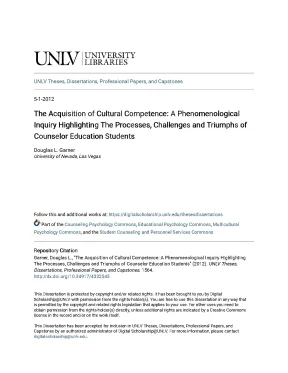
Tải xuống để đọc toàn bộUNLV Theses, Dissertations, Professional Papers, and Capstones 5-1-2012 The Acquisition of Cultural Competence: A Phenomenological Inquiry Highlighting The Processes, Challenges and Triumphs of Counselor Education Students Douglas L. Garner University of Nevada, Las Vegas Follow this and additional works at: https://digitalscholarship.edu/thesesdissertations Part of the Counseling Psychology Commons, Educational Psychology Commons, Multicultural Psychology Commons, and the Student Counseling and Personnel Services Commons Repository Citation Garner, Douglas L., "The Acquisition of Cultural Competence: A Phenomenological Inquiry Highlighting The Processes, Challenges and Triumphs of Counselor Education Students" (2012). UNLV Theses, Dissertations, Professional Papers, and Capstones.34917/4332545 This Dissertation is protected by copyright and/or related rights. It has been brought to you by Digital Scholarship@UNLV with permission from the rights-holder(s).
You are free to use this Dissertation in any way that is permitted by the copyright and related rights legislation that applies to your use. For other uses you need to obtain permission from the rights-holder(s) directly, unless additional rights are indicated by a Creative Commons license in the record and/or on the work itself. This Dissertation has been accepted for inclusion in UNLV Theses, Dissertations, Professional Papers, and Capstones by an authorized administrator of Digital Scholarship@UNLV. For more information, please contact digitalscholarship@unlv.
THE ACQUISITION OF CULTURAL COMPETENCE: A PHENOMENOLOGICAL INQUIRY HIGHLIGHTING THE PROCESSES, CHALLENGES AND TRIUMPHS OF COUNSELOR EDUCATION GRADUATE STUDENTS By Douglas L. Garner Master of Educational Psychology University of Nevada, Las Vegas 2004 A dissertation submitted in partial fulfillment of the requirements for the degree of Doctor of Philosophy in Educational Psychology Department of Educational Research, Cognition and Development College of Education Graduate College University of Nevada, Las Vegas May 2012 © Copyright by Douglas L. Garner 2012 All Rights Reserved THE GRADUATE COLLEGE We recommend the dissertation prepared under our supervision by Douglas L. Garner entitled The Acquisition of Cultural Competence: A Phenomenological Inquiry Highlighting the Processes, Challenges and Triumphs of Counselor Education Graduate Students be accepted in partial fulfillment of the requirements for the degree of Doctor of Philosophy in Educational Psychology School of Community Health Sciences W.
Paul Jones, Ph., Committee Chair William Cross, Ph., Committee Member Dale-Elizabeth Pehrsson, Ph., Committee Member Cecila Maldonado-Daniels, Ph., Graduate College Representative Ronald Smith, Ph., Vice President for Research and Graduate Studies and Dean of the Graduate College May 2012 ii ABSTRACT The Acquisition of Cultural Competence: A Phenomenological Inquiry Highlighting the Processes, Challenge s and Triumphs of Counselor Education Graduate Students by Douglas L., Examination Committee Co-Chair Professor of Counselor education Dr. Paul Jones, Examination Committee Co-Chair Professor of Educational Psychology Dr. Dale-Elizabeth Pehrsson, Examination Committee Co-Chair Professor of Counselor Education Department of Educational Research and Cognitive Development University of Nevada, Las Vegas Although research has effectively isolated and identified the key characteristics of a culturally competent counselor, there are few studies regarding the acquisition of these characteristics. To close the gap between theory and practice, studies are needed researching the emergence and, acquisition of these characteristics.
This study explores how Masters-level Counselor Education students narrate the encounters, challenges, triumphs and epiphanies associated with their preliminary attempts to practice in a culturally competent manner. This phenomenological inquiry seeks to shed light students attitudes, beliefs and dispositions; defines the processes related to the acquisition of cognitive awareness and learning, skills and abilities; and illuminates how students describe their individual progress toward the acquisition of the traits and characteristics of a culturally competent counselor. Data was subjected to content analysis. The Cultural Competency Domains Model set the framework for analysis.
The findings inform development of pedagogy. iii The analysis revealed the challenges, discomfort, angst and discoveries associated with self-understanding and self-confrontation regarding students cross cultural abilities and skills during their earliest exposure to issues of race, ethnicity, culture, religion, age, gender and sexual orientation. Six core themes emerged: (1) Attitudes, beliefs and dispositions. (2) Cognitive awareness and learning.
(3) Skills and abilities. (5) Opinions about school. Recommendations for educators are offered. iv TABLE OF CONTENTS ABSTRACT.
iii CHAPTER 1 INTRODUCTION. 1 Statement of Problem and Overview of Dissertation. 1 Significance of Research. 2 CHAPTER 2 REVIEW OF LITERATURE.
4 Generic and Cultural Foundations of Counselor Education. 4 Multiculturalism and Changes in the Counselor Education Curriculum. 6 Early Theory and Growth of Definitions Associated with Cultural Competence. 7 ACA and APA Position Papers on CC.
9 Empirical Research on the Characteristics of Culturally Competent Counselors. 10 Cultural Competency Domains Model. 13 Evolution of the Current Study. 21 Role of Researcher.
21 Researcher’s Personal Narrative and Assumptions. 22 Sampling and Participants. 27 CHAPTER 4 DISCUSSIION OF CODING SCHEMES AND DATA ANALYSIS 29 Coding Schemes. 36 Textural Structural Synthesis.
37 Validity and Reliability. 38 Triangulation of Data. 38 Check on Researcher Bias. 42 Jean’s Contextual Structural Description.
45 Jean’s Background/Experience. 45 Jean’s Attitudes, Beliefs and Dispositions. 46 Jean’s Cognitive Awareness and Learning. 46 Jean’s Skills and Abilities.
50 Jean’s Cultural Competence. 51 Jean’s Opinions about School. 51 v Jean’s Self-Assessment. 53 CCDM Textural Structural Synthesis of Jean.
54 Jean’s Attitudes, Beliefs and Dispositions. 54 Jean’s Cognitive Awareness and Learning. 55 Jean’s Skills and Abilities. 56 Jean’s Cultural Competence.
57 Jean’s Opinions about School. 57 Jean’s Self-Assessment. 58 Helen’s Contextual Structural Description. 61 Helen’s Background/Experience.
61 Helen’s Attitudes, Beliefs and Dispositions. 62 Helen’s Cognitive Awareness and Learning. 63 Helen’s Skills and Abilities. 65 Helen’s Cultural Competence.
67 Helen’s Opinions about School. 67 Helen’s Self-Assessment. 68 CCDM Textural Structural Synthesis of Helen. 70 Helen’s Attitudes, Beliefs and Dispositions.
70 Helen’s Cognitive Awareness and Learning. 71 Helen’s Skills and Abilities. 72 Helen’s Cultural Competence. 73 Helen’s Opinions about School.
73 Helen’s Self-Assessment. 74 Laura’s Contextual Structural Description. 76 Laura’s Background/Experience. 76 Laura’s Attitudes, Beliefs and Dispositions.
77 Laura’s Cognitive Awareness and Learning. 79 Laura’s Skill and Abilities. 82 Laura’s Cultural Competence. 84 Laura’s Opinions about School.
84 Laura’s Self-Assessment. 86 CCDM Contextual Structural Synthesis of Laura. 87 Laura’s Attitudes, Beliefs and Dispositions. 87 Laura’s Cognitive Awareness and Learning.
88 Laura’s Skills and Abilities. 89 Laura’s Cultural Competence. 89 Laura’s Opinions about School. 90 Laura’s Self-Assessment.
95 Limitations of Study. 97 Implications of Future Research. 98 APPENDIX A PARTICIPANT DEMOGRAPHICS FORM. 99 APPENDIX B PARTICIPANT DEMOGRAPHICS DATA.
100 vi APPENDIX C INFORMED CONSENT .113 vii ACKNOWLEDGMENTS There are many people to thank. Many names may not appear on this page. Nevertheless, please know that I thank you for touching my life. I reverently thank my ancestors and elders Charlie Robinson, Sarah Robinson, Geeogia Robinson, Lee Sanders, Miss Lucy Robinson, Anthony Strange, Carter A.
Strange, Jack Rice, Flossie Strange, James R. Bolds, William and Mariah Rogers, Mary Bolds, Fred and Dorothy Allen, Dianne Yarbrough, Jackie Taylor, for their nurture, love, hopes, dreams and possibilities. To my dearest siblings TuWanda Locke, Olabisi Carr, Jackie Lloyd, and Titilayo Bonner you have been there since the beginning. My greatest achievement is being your big brother.
Thank you for your constant guidance, teachings, support, love and patience. To my cherished parents, Ardoway and Shirley Garner. You allowed me to believe that I could do, and be anything in the universe. Thank you for your guidance, patience, trust and love.
You are forever my hero and sheroe. To my dearest children Christopher, Emon and new baby grandson Mikan Tiher I love you, thank you for your love, support, patience and understanding. I know it’s hard raising parents. My dear Emon, you will now know the blessings of parenthood.
To my nieces and nephews, Ndambi, Maisha, Amir, Hasani, Heaven, Shay, Kamau, Natice, Ifayemi, Knoelle, and Tyre. Each of you are capable of reaching the cosmos. To Charlotte and Calvin thank you for your ongoing guidance and friendship. Pearl and Lil, you are the best, I love and appreciate you.
Thank you Mrs. Trinidad (Angeles Mesa Elementary School) for making me feel capable. A shout out to my Crenshaw High School “shaw dogs” Willie West, Reggie, viii Mims, Robert Smith, Karen Celestine-Foucher, Stanley Carr, Walter Griffin, Arvitis Muhammed, Andrea Sutton, the Johnson brothers, Patrice Rushion, Ed Waters and Marcus Johnson. A shout to the folks at the Ron Karenga Cultural Center, and thank you to the original Black Panther Party for the awakening to social justice issues in my community.
What a great foundation and learning environment we were provided. To my East Bay kinfolk Majors and Lucella Harrison, Brian, Donald, Denise, Wendall, Ventrice, and the entire Harrison clan thank you for allowing me to be a part of your family. To Barbara Richardson, Joan, Jackie and the entire Richardson clan thank you for welcoming me. To Marion Nickson, Uncle James, Marie, Ray, Ranetta and the entire Nickson clan thank you for your support, guidance, understanding and patience.
My time at Cal-State University Hayward, now known as Cal-State East Bay allowed me to flower as an athlete and more importantly a human being. To Coach, Jim Santos, Don Chu, Marcel Hetu, and Malachi Andrews thank you for discovering my talent, for challenging me, for teaching me how to challenge myself in a tranquil manner, but perform and respond dynamically. To my teammates Edward Ray Clark, Dave Haber, Marvin Wamble, Greg Flenory, John Haynes and others, thank you for going to battle with me. We were a force to be dealt with.
To my national, international teammates and competitors, Willie Banks, Larry Myricks, Evelyn Ashford, Al Joyner, and others thank you for showing me the ropes. My move to Las Vegas transitioned me to adulthood Cal-State alums, Kenny and Kermit Bayless. Thurbin Warrick, Sam Germany, and Coach Al Mc Daniels thank you for welcoming to the community. My thanks to Theron and Naomi Goynes, Angelo Collis, Linda Young, Yolanda ix Arrington for taking me under your wing during my time at Clark High School.
To my Jeffrey Behavior Center crew, thank you for your continued support, I appreciate you very much. You are the best. Special thanks to brother Dave Ross, Shelley K. Smith, Joni Wakley, Christina Paa, Connie Dabney, Rita Knox, and Fatima Parker thank you for your inspiration, friendship, love and support.
To my friends and colleagues, Marie Wakefield and Tiffany Tyler thank you very much for your ongoing friendship and support. What a journey we have endured together. To Steven Henderson, thank you for your interest, patience, hard work and dedication to this research project. To my venerated committee, thank you for your patience and guidance throughout this most rewarding process.
x CHAPTER 1 INTRODUCTION Statement of Problem and Overview of Dissertation In order to educate and prepare counselor educators to service an increasingly diverse client base, the curriculum for (CACREP) Accredited Masters Level Counselor Education Programs has undergone radical change, with the cultural competence of new graduates a key success factor of that change. The curriculum first exposes new graduate students to theory and practice that is foundational or “generic” to the counselor education profession. Issues of cultural diversity are often integrated into the fabric of foundational courses, but more typically, advanced courses are offered on multiculturalism and cultural competence. Definitions, models, and theories of cultural competence have significantly expanded over the last twenty years.
Research, however, on the challenges and problems faced by graduate students in the early development and practice of cultural competence has lagged behind the production of theory. This dissertation project seeks to close the gap between theory and practice through a year-long qualitative study that captures the way Counselor Education graduate students narrate the emergence and acquisition of cultural competence. From their narratives information was gleaned regarding the attitudes, skill sets, instruction, and counseling practices that predict successful acquisition of cultural competence. The study engaged three first-year graduate students.
Nội dung được bảo vệ bản quyền — Tải xuống đầy đủ
Trích dẫn luận án này
Douglas L. Garner (2012). The acquisition of cultural competence a phenomenological in [Luận án tiến sĩ, University of Nevada, Las Vegas]. LuanAn.net. https://luanan.net/giao-duc-hoc/tam-ly-hoc-giao-duc/the-acquisition-of-cultural-competence-a-phenomenological-inquir
Câu hỏi thường gặp
Luận án "The acquisition of cultural competence a phenomenological in" nghiên cứu về vấn đề gì?
Nghiên cứu hiện tượng học về việc tiếp thu năng lực văn hóa. Khám phá ý nghĩa sâu sắc của trải nghiệm cá nhân trong quá trình này.
Luận án "The acquisition of cultural competence a phenomenological in" được bảo vệ tại trường nào?
Luận án này được bảo vệ tại University of Nevada, Las Vegas. Năm bảo vệ: 2012.
Luận án "The acquisition of cultural competence a phenomenological in" thuộc chuyên ngành gì?
Luận án "The acquisition of cultural competence a phenomenological in" thuộc chuyên ngành Educational Psychology. Danh mục: Tâm Lý Học Giáo Dục.
Luận án "The acquisition of cultural competence a phenomenological in" có bao nhiêu trang?
Luận án "The acquisition of cultural competence a phenomenological in" có 123 trang. Bạn có thể xem trước một phần tài liệu ngay trên trang web trước khi tải về.
Cách tải luận án "The acquisition of cultural competence a phenomenological in" về máy như thế nào?
Để tải luận án về máy, bạn nhấn nút "Tải xuống ngay" trên trang này, sau đó hoàn tất thanh toán phí lưu trữ. File sẽ được tải xuống ngay sau khi thanh toán thành công. Hỗ trợ qua Zalo: 0559 297 239.