Thiết kế, Mô hình hóa và Tối ưu Robot Mềm Sinh Học Tạo Lực Đẩy & Bơm Chất Lỏng
Khám phá Robot Mềm Sinh Học: Thiết kế, mô hình hóa, tối ưu hóa. Tìm hiểu công nghệ đột phá, ứng dụng thực tế và tương lai phát triển.
Luan An
Luận văn thạc sĩ
Năm xuất bản
Số trang
120
Thời gian đọc
18 phút
Lượt xem
0
Lượt tải
0
Phí lưu trữ
40 Point
Tổng quan nhanh
- Chủ đề:
- Thiết kế Robot Mềm Sinh Học: Cảm hứng & Mục tiêu
- Số trang:
- 120 trang
- Trường:
- University of Nevada, Las Vegas
- Chuyên ngành:
- Mechanical Engineering
- Tác giả:
- Zakai Jedidiah Olsen
- Năm:
- 2018
Tóm tắt nội dung luận án
I.Thiết kế Robot Mềm Sinh Học Cảm hứng Mục tiêu
Kỹ thuật robot mềm tiếp tục lấy cảm hứng mạnh mẽ từ tự nhiên. Thiên nhiên cung cấp những giải pháp đơn giản, hiệu quả cho nhiều vấn đề phức tạp. Nghiên cứu này tập trung vào thiết kế robot mềm sinh học mới. Nó bắt chước cơ chế di chuyển và vận động của sứa. Robot mềm sinh học sử dụng vật liệu mềm linh hoạt. Thiết kế robot này giải quyết các thách thức kỹ thuật. Đây là lĩnh vực nghiên cứu năng động, hứa hẹn nhiều tiềm năng. Robot mềm sinh học cho thấy sự phù hợp đặc biệt trong việc phát triển các thiết bị bắt chước sinh học.
1.1. Cảm hứng bắt chước sinh học Lấy ý tưởng từ sứa
Thiết kế robot mềm được truyền cảm hứng từ sinh học. Đặc biệt, chuyển động và động học của sứa cung cấp nền tảng. Các cơ chế vận động tự nhiên được nghiên cứu kỹ lưỡng. Mục tiêu là chuyển đổi chúng thành các nguyên tắc kỹ thuật. Robot mềm sinh học cố gắng tái tạo hiệu quả di chuyển của sứa. Điều này bao gồm khả năng biến dạng và tạo dòng chảy. Việc bắt chước sinh học giúp tạo ra thiết bị hiệu quả cao.
1.2. Mục tiêu thiết kế robot Bơm chất lỏng và tạo lực đẩy
Mục tiêu chính của thiết kế robot này là tạo ra một hệ thống hiệu quả. Robot phải có khả năng bơm chất lỏng. Ngoài ra, robot cần tạo ra lực đẩy. Điều này mở ra các ứng dụng tiềm năng trong nhiều lĩnh vực. Robot mềm có thể được sử dụng trong môi trường chất lỏng. Ứng dụng bao gồm khám phá đại dương hoặc hệ thống y tế. Thiết kế robot biomimetic tận dụng tối đa các đặc tính của vật liệu mềm. Robot cần hoạt động hiệu quả trong các môi trường khác nhau. Việc tối ưu hóa robot đóng vai trò quan trọng để đạt được hiệu suất cao nhất.
II.Mô hình hóa Robot Mềm Từ Hình học đến Vật lý phức tạp
Quá trình mô hình hóa robot mềm trải qua nhiều giai đoạn. Ban đầu, một mô hình hình học đơn giản đã được phát triển. Mô hình này dựa trên chuyển động của sứa. Các phương trình điều khiển chuyển động của sứa được sửa đổi. Sự khác biệt về hình học giữa sinh học và thiết kế robot được tính đến. Mô hình có khả năng tính toán khối lượng và hình dạng của thiết kế robot. Nó chứng minh tính khả thi của ý tưởng robot mềm sinh học. Mô hình hóa robot ban đầu này là bước quan trọng.
2.1. Phát triển mô hình hình học đơn giản
Mô hình hình học đơn giản được phát triển đầu tiên. Nó mô tả chuyển động và động học của robot mềm. Các sửa đổi được thực hiện cho phương trình di chuyển của sứa. Những sửa đổi này tính đến sự khác biệt hình học. Mô hình hóa robot này cho phép xem xét khối lượng và hình học. Nó xác nhận tính khả thi của thiết kế robot mềm ban đầu. Mô hình đơn giản này là nền tảng cho các nghiên cứu tiếp theo.
2.2. Xây dựng mô hình vật lý dựa trên lý thuyết dầm
Sau đó, một mô hình vật lý mạnh mẽ hơn được phát triển. Mô hình này tích hợp lý thuyết dầm tuyến tính. Lý thuyết dầm kết hợp với mô hình mạch tương đương. Mục đích là điều khiển bộ truyền động của robot. Bộ truyền động sử dụng vật liệu polymer kim loại điện phân (IPMC). Mô hình vật lý cung cấp cái nhìn sâu sắc hơn về hoạt động của robot. Nó cho phép phân tích chính xác hơn. Việc mô hình hóa robot trở nên chi tiết hơn.
2.3. Xác minh mô hình với phân tích phần tử hữu hạn
Mô hình mạch được xác minh. Quá trình này sử dụng mô hình phần tử hữu hạn đa vật lý mạnh mẽ. Mô hình này đặc biệt cho bộ truyền động IPMC. Mô hình vật lý mới của robot mềm được so sánh. So sánh diễn ra với mô hình hình học. Nó cũng được so sánh với cách bơi của sứa sinh học. Điều này làm nổi bật hiệu quả được cải thiện của mô hình vật lý. Việc mô hình hóa robot liên tục được nâng cấp để chính xác hơn.
III.Tối ưu hóa Robot Mềm Nâng cao hiệu suất vận hành
Thiết kế robot sau đó được tối ưu hóa. Một thuật toán lập trình bậc hai tuần tự được sử dụng. Đây là thuật toán cho tối ưu hóa đa biến phi tuyến. Quá trình tối ưu hóa robot này nhằm nâng cao hiệu suất. Độ lệch chuẩn của các giá trị tối ưu được sử dụng. Chúng dùng để xác minh độ chính xác. Hiệu suất đẩy của mô hình chưa tối ưu và đã tối ưu được so sánh. Điều này xác minh sự cải thiện về hiệu suất tổng thể. Việc tối ưu hóa robot mềm là cần thiết.
3.1. Phương pháp tối ưu hóa đa biến phi tuyến
Thuật toán lập trình bậc hai tuần tự được áp dụng. Phương pháp này phù hợp cho tối ưu hóa đa biến phi tuyến. Nó giúp tìm ra cấu hình thiết kế tốt nhất. Mục tiêu là tối đa hóa hiệu suất của robot mềm. Quá trình tối ưu hóa robot này là một bước quan trọng. Nó đảm bảo thiết kế đạt được hiệu suất cao nhất có thể.
3.2. Đánh giá cải thiện hiệu suất vận động
Hiệu suất vận động của robot được cải thiện đáng kể. Thiết kế tối ưu cho thấy sự vượt trội rõ ràng. Nó tốt hơn so với phiên bản chưa tối ưu. Phương pháp mô hình hóa có tính mô-đun. Điều này cho phép dễ dàng thêm các mô hình phức tạp hơn. Các mô hình này có thể bao gồm các yếu tố phi tuyến tính. Quá trình tối ưu hóa robot đảm bảo hiệu suất tối đa.
3.3. Phân tích ảnh hưởng quy mô đến thiết kế tối ưu
Ảnh hưởng của quy mô đến thiết kế tối ưu cũng được kiểm tra. Đây là một dạng phân tích thứ nguyên ban đầu. Các kết quả này cung cấp thông tin giá trị. Chúng giúp hiểu cách thức các yếu tố vật lý thay đổi. Việc này ảnh hưởng đến thiết kế robot khi thay đổi kích thước. Kỹ thuật robot mềm được hưởng lợi từ những phân tích này.
IV.Công nghệ Bộ Truyền Động trong Robot Mềm Sinh Học
Robot mềm sinh học sử dụng bộ truyền động tiên tiến. Polymer điện hoạt (EAP) là vật liệu thông minh. Chúng đặc biệt phù hợp để phát triển các thiết bị bắt chước sinh học. Các bộ truyền động mềm này có khả năng biến dạng đáng kể. Chúng phản ứng với kích thích điện. Điều này làm cho EAP trở thành lựa chọn lý tưởng cho kỹ thuật robot mềm. Nghiên cứu này tập trung vào việc sử dụng EAP.
4.1. Sử dụng polymer điện hoạt EAP
Polymer điện hoạt (EAP) được sử dụng làm vật liệu bộ truyền động. Chúng là vật liệu thông minh có thể biến dạng dưới điện trường. EAP rất phù hợp cho robot mềm do tính linh hoạt cao. Khả năng biến dạng lớn của chúng cho phép mô phỏng chuyển động sinh học. Đây là một công nghệ then chốt cho robot sinh học.
4.2. Tích hợp bộ truyền động IPMC với mô hình mạch
Cụ thể, bộ truyền động polymer kim loại điện phân ion (IPMC) được sử dụng. Các bộ truyền động IPMC tích hợp vào thiết kế robot. Mô hình mạch tương đương được sử dụng để điều khiển chúng. Điều này đảm bảo phản ứng chính xác và hiệu quả. Mô hình mạch được xác minh cẩn thận. Quá trình này sử dụng mô hình phần tử hữu hạn đa vật lý. Sự tích hợp này là chìa khóa. Nó cho phép robot mềm hoạt động theo cách mong muốn. Bộ truyền động mềm là trái tim của robot.
4.3. Ưu điểm của vật liệu mềm trong robot
Ưu điểm của vật liệu mềm rất rõ ràng. Chúng mang lại sự linh hoạt và khả năng biến dạng cao. Điều này không thể đạt được với vật liệu cứng truyền thống. Vật liệu mềm cho phép robot tương tác an toàn hơn với môi trường. Chúng cũng giảm nguy cơ hư hỏng. Robot mềm với các bộ truyền động này có tiềm năng lớn. Chúng là một phần không thể thiếu của kỹ thuật robot tiên tiến.
V.Ứng dụng Tiềm năng Robot Mềm Bơm chất lỏng Lực đẩy
Robot mềm sinh học thể hiện tiềm năng ứng dụng rộng lớn. Một ứng dụng chính là bơm chất lỏng hiệu quả. Thiết kế robot lấy cảm hứng từ sứa. Nó có khả năng tạo ra dòng chảy. Điều này rất hữu ích trong các hệ thống bơm vi lỏng hoặc các thiết bị y tế. Kỹ thuật robot này mở ra các hướng đi mới.
5.1. Khả năng bơm chất lỏng hiệu quả
Robot mềm sinh học có khả năng bơm chất lỏng hiệu quả. Thiết kế bắt chước sinh học cho phép tạo ra các chuyển động tuần hoàn. Những chuyển động này có thể tạo ra dòng chảy. Ứng dụng tiềm năng bao gồm các thiết bị y tế. Chúng cũng có thể được dùng trong hệ thống quản lý chất lỏng nhỏ. Đây là một ứng dụng quan trọng của kỹ thuật robot mềm.
5.2. Tạo lực đẩy cho di chuyển dưới nước
Ngoài ra, robot có khả năng tạo lực đẩy. Lực đẩy này cần thiết cho di chuyển trong môi trường chất lỏng. Robot mềm sinh học có thể được sử dụng trong các phương tiện dưới nước. Chúng phục vụ mục đích thăm dò hoặc giám sát. Hiệu suất vận động được tối ưu hóa. Điều này đảm bảo robot có thể di chuyển một cách hiệu quả và tiết kiệm năng lượng. Robot mềm đang thay đổi cảnh quan của kỹ thuật robot.
5.3. Tiềm năng trong các hệ thống robot mới
Tiềm năng của các hệ thống robot mới này là rất lớn. Chúng có thể được tùy chỉnh cho nhiều nhiệm vụ khác nhau. Từ các ứng dụng trong y sinh đến khám phá môi trường khắc nghiệt. Việc sử dụng vật liệu mềm và thiết kế bắt chước sinh học. Điều này mang lại sự an toàn, linh hoạt và hiệu quả cao. Robot mềm sinh học tiếp tục là một lĩnh vực nghiên cứu đầy hứa hẹn. Kỹ thuật robot tiếp tục phát triển với các vật liệu mềm.
Tải xuống file đầy đủ để xem toàn bộ nội dung
Tải đầy đủ (120 trang)Trích đoạn nội dung luận án
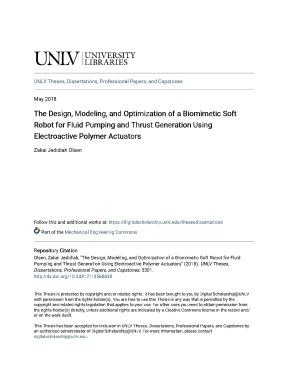
Tải xuống để đọc toàn bộUNLV Theses, Dissertations, Professional Papers, and Capstones May 2018 The Design, Modeling, and Optimization of a Biomimetic Soft Robot for Fluid Pumping and Thrust Generation Using Electroactive Polymer Actuators Zakai Jedidiah Olsen Follow this and additional works at: https://digitalscholarship.edu/thesesdissertations Part of the Mechanical Engineering Commons Repository Citation Olsen, Zakai Jedidiah, "The Design, Modeling, and Optimization of a Biomimetic Soft Robot for Fluid Pumping and Thrust Generation Using Electroactive Polymer Actuators" (2018). UNLV Theses, Dissertations, Professional Papers, and Capstones.34917/13568638 This Thesis is protected by copyright and/or related rights. It has been brought to you by Digital Scholarship@UNLV with permission from the rights-holder(s). You are free to use this Thesis in any way that is permitted by the copyright and related rights legislation that applies to your use.
For other uses you need to obtain permission from the rights-holder(s) directly, unless additional rights are indicated by a Creative Commons license in the record and/ or on the work itself. This Thesis has been accepted for inclusion in UNLV Theses, Dissertations, Professional Papers, and Capstones by an authorized administrator of Digital Scholarship@UNLV. For more information, please contact digitalscholarship@unlv. THE DESIGN, MODELING, AND OPTIMIZATION OF A BIOMIMETIC SOFT ROBOT FOR FLUID PUMPING AND THRUST GENERATION USING ELECTROACTIVE POLYMER ACTUATORS By Zakai J.
Olsen Bachelor of Science in Engineering – Mechanical Engineering University of Nevada, Las Vegas 2016 A thesis submitted in partial fulfillment of the requirements for the Master of Science in Engineering – Mechanical Engineering Department of Mechanical Engineering Howard R. Hughes College of Engineering The Graduate College University of Nevada, Las Vegas May 2018 Thesis Approval The Graduate College The University of Nevada, Las Vegas April 13, 2018 This thesis prepared by Zakai J. Olsen entitled The Design, Modeling, and Optimization of a Biomimetic Soft Robot for Fluid Pumping and Thrust Generation Using Electroactive Polymer Actuators is approved in partial fulfillment of the requirements for the degree of Master of Science in Engineering – Mechanical Engineering Department of Mechanical Engineering Kwang Kim, Ph. Kathryn Hausbeck Korgan, Ph.
Examination Committee Chair Graduate College Interim Dean Mohamed Trabia, Ph. Examination Committee Member Woosoon Yim, Ph. Examination Committee Member Rebecca Martin, Ph. Graduate College Faculty Representative ii Abstract Nature is a constant source of inspiration for engineers and scientists through its simple, effective, and elegant solutions to many complex problems.
Smart materials and soft robotics have been seen to be particularly well suited for developing biomimetic devices and are active fields of research. In this study, the design, modeling, and optimization of a new biomimetic soft robot is described. Preliminary work was made in the modeling of a biomimetic robot based on the locomotion and kinematics of jellyfish. Modifications were made to the governing equations for jellyfish locomotion that accounted for geometric differences between biology and the robotic design.
Particularly, the capability of the model to account for the mass and geometry of the robot design. A simple geometrically defined model is developed and used to show the feasibility of a proposed biomimetic robot. With the concept verified, a more robust physics- based model is developed. In this model, linear beam theory is coupled to an equivalent circuit model to actuate the robot with ionic polymer-metal composite (IPMC) actuators.
The circuit model is verified using a robust, Multiphysics finite element model of the IPMC actuator. The newly created physics-based model of the soft robot is compared to that of the geometric model as well as biological jellyfish swimming to highlight its improved efficiency. The design is then optimized using a sequential quadratic programming algorithm for nonlinear multivariable optimization. Standard deviations of the optimized values are used to verify their accuracy, and the propulsion efficiency of the unoptimized and optimized model are compared to verify the improvement in efficiency and overall performance.
Scale effects on the optimal design are also examined as an initial form of dimensional analysis. The optimized design shows clear improvement over the unoptimized counterpart, and the modularity of the modeling approach allows for more complex models that include nonlinearities to be easily added. iii Acknowledgements I would like to thank my advisor, Dr. Kwang Kim, for his immense support and advice throughout my undergraduate and graduate studies.
His mentorship, teaching, financial support, research guidance, and amazing travel opportunities given to me have greatly shaped my career as an engineer and researcher. I am profoundly grateful for Dr. Kim’s generosity and interest invested in these many areas of my life, all of which have helped lead me to graduating at this time. I would also like to thank committee members, Dr.
Mohamed Trabia, Dr. Woosoon Yim, and Dr. Rebecca Martin for their teaching and advice during my career at UNLV. I truly appreciate their time and interest spent on my studies and development as a researcher.
All of the faculty and staff who have had such a positive impact on me throughout my time at UNLV are very much appreciated and my sincere thanks go to each of them. The incredible professors I have studied under have given me the education necessary to pursue a graduate career, and beyond. I would like to specifically thank Joan Conway for all her incredible assistance, encouragement, and support. All my colleagues in the AMSL lab who helped me throughout my graduate studies are well-deserving of my thanks.
Their advice and support are greatly appreciated, equally as much as their friendship. I also thank the National Science Foundation PIRE program and the Nevada NASA Space Grant Consortium for the funding and support for my graduate research. Finally, an acknowledgement of warmhearted gratitude for my friends and family. Their continual support of my academic and professional endeavors has helped me stay focused and level-headed.
I particularly give special thanks to my younger brother, Luke Olsen, for always being there to give his advice and perspective whenever I needed it. iv Table of Contents Abstract. iv List of Tables. vii List of Figures.
Kinematics of Swimming Jellyfish. Derivation of Governing Equations. Modeling of Jellyfish Locomotion. Design Principle of a Biomimetic Jellyfish.
Electromechanical Modeling of Ionic Polymer-Metal Composite Actuators. Physics-Based Modeling. Governing Partial Differential Equations. Multi-Physics Modeling in COMSOL.
Equivalent Circuit Modeling. RCW Circuit Model. Comparison and Utility of Modeling Approaches. Modeling of a Biomimetic Soft Robot.
Governing Equation and Model Inputs. Geometry Based Modeling. Description of Robot Body as Geometric Surface. Derivation of Model Parameters.
Comparison to Biological Jellyfish. Physics-Based Modeling. Beam Theory Approach. Derivation of Model Parameters.
Addition of IPMC Electromechanical Effects. Evaluation and Comparison to Previous Model. Sequential Quadratic Programming Optimization. Selection of Design Variables.
Optimization of Design Variables. Comparison of Unoptimized and Optimized Design. Scale Effects on Optimal Parameter Values. Fabrication of Prototype.
Structure of Future Experimental Study. Additions to Physics-Based Model. 88 Appendix A: Additional Figures of COMSOL Domains and Mesh. 89 Appendix B: Coefficients for Volume and Cross-Sectional Area in Physics-Based Model.
105 vi List of Tables Table 3.1 Model parameters for 2D vs 1D PNP Comparison.2 Metrics for 1D vs 2D PNP Comparison .3 Metrics for 1D vs Refined 1D PNP Comparison.4 Parameters and Dimensions of IPMC Used for Experimental Comparison .5 Parameter Values for Equivalent Circuit Model.1 Direction Cosine Angles for Inlet and Outlet During Different Swimming Modes .2 Beam Geometry and Loading for COMSOL Comparison .3 Physics-Based Model Comparison Parameters .1 Simulation Parameters for IPMC Length Optimization .2 Simulation Parameters for Pairwise Optimization.3 Parameter Values for Unoptimized and Expected Optimal Designs .4 Parameters for SQP Optimization of Design Variables.5 Results of SQP Optimization .6 Propulsion Efficiency for Unoptimized and Optimized Models .7 Results of Optimization with Scaled Shell Radius. 77 vii List of Figures Figure 2.1 Illustration of Jet Propulsion Mechanism Found in Biological Jellyfish .2 Illustration of Jellyfish Body Structure .3 Free Body Diagram of Swimming Jellyfish .4 Position, Velocity, and Acceleration of Biological Jellyfish .5 Illustrative Cross-Section of Proposed Soft Robot Design .1 Cantilever IPMC Diagram for COMSOL Multiphysics Modeling .2 COMSOL Domain for 1D PNP FEM .3 Domain for 2D Solid Mechanics in COMSOL.4 Comparison of 1D and 2D PNP Models .5 Differences in 1D Domain Structures Used in COMSOL .6 Comparison of 1D and Refined 1D PNP Models .7 Unconstrained IPMC Deformation Under External Stress Loading.8 Comparison Between Refined 1D COMSOL Model and Experimental Data .9 Circuit Diagram Used for Equivalent Circuit IPMC Model .10 Comparison Between RCW Circuit Model and Experimental Data .11 Comparison of FEM, Equivalent Circuit, and Experimental IPMC Deflection .1 Illustration of Direction Cosine for Inlet and Outlet Valves.2 Representative Waveforms Generated with Fourier Series Square Wave.3 Geometric Description of Robot Body as an Ellipsoid.4 Drag Coefficient as a Function of Reynold’s Number .5 Input Half-Axis Dimension for Geometric Model, 1000th Partial Sum Input .6 Simulation of Geometric Model with Various Inputs and Swimming Modes .7 Thrust Profile for Geometric Model in Both Swimming Modes .8 Diagram of Physics-Based Description of Robot Body .9 Illustrative Cross-Section of Proposed Physics-Based Model .10 Comparison of Beam Theory to FEM Implementation .11 Error of Straight Beam Assumption .12 RCW Model Charge Response for Fourier Series Input .13 Comparison of Physics-Based Model to Geometric and Jellyfish Models.14 Thrust Profile for Physics-Based Model .15 Mass Flux for Physics-Based Model .16 Velocity Profiles for Fluid Pump Operation .1 Distance vs IPMC Length .2 Surface Plot of Distance vs Length and Contraction Time.3 Surface Plot of Distance vs Length and Time Ratio .4 Surface Plot of Distance vs Time Ratio and Contraction Time .5 Probability Density Function: IPMC Length .6 Probability Density Function: Time Ratio .7 Probability Density Function: Contraction Time.8 Comparison of Unoptimized and Optimized Models: Distance Traveled .9 Velocity Profiles for Efficiency Calculation.10 Optimized IPMC Length Versus Radius of Shell .11 Optimized Time Ratio Versus Radius of Shell .12 Optimized Contraction Time Versus Radius of Shell.1 Engineering Sketch of Prototype Mold Design .2 Second Mold Design CAD Image .3 First 3D Printed Mold .4 Second 3D Printed Mold.5 Current Status of Elastomer Prototype Body .1 Finite Element Mesh for 2D PNP Domain .2 Enhanced View of Figure A.3 Finite Element Mesh of 2D Solid Mechanics Domain .4 Enhanced View of Figure A.5 Finite Element Mesh of 1D PNP Domain.6 Enhanced View of Figure A.5, Electrode-Polymer Interface .7 Enhanced View of Figure A.5, Membrane-Membrane Interface .8 Finite Element Mesh of 2D Solid Mechanics Domain for 1D PNP Modeling.9 Enhanced View of Figure A. 91 x Nomenclature 𝐴𝐴𝑣𝑣 Velar / valve aperture area (m2) 𝐺𝐺 Acceleration reaction (N) 𝛼𝛼ℎ Hydrofilicity coefficient ℎ Bell height (m) (N-m/mol) ℎ𝑡𝑡 Integrator time step (s) 𝛼𝛼𝐴𝐴𝐴𝐴 Added mass coefficient 𝐼𝐼 Moment of inertia (m4) 𝛼𝛼𝑅𝑅𝑅𝑅𝑅𝑅 Hydrofilicity coefficient for 𝐽𝐽 Cation flux (mol/m3-s) circuit model (N/m-C) 𝜅𝜅 Bending strain (1/m) 𝛼𝛼𝑐𝑐 Hydrofilicity coefficient in 𝐿𝐿𝑐𝑐 Characteristic length (m) COMSOL (N/C) 𝑚𝑚 Mass of jellyfish / robot (kg) 𝛼𝛼 Starting polar angle 𝜇𝜇 Cation mobility (s-mol/kg) 𝛽𝛽ℎ Hydrofilicity coefficient 𝑁𝑁𝑤𝑤 Number of shape functions (N-m4/mol2) 𝑵𝑵𝒔𝒔 Vector of shape functions 𝛽𝛽 Ending polar angle 𝑵𝑵𝜻𝜻 Vector of nondimensional shape 𝐶𝐶𝑑𝑑 Drag coefficient functions 𝑐𝑐0 Anion concentraction (mol/m3) 𝜈𝜈 Kinematic viscosity of water 𝐶𝐶 Stiffness tensor (Pa) (m2/s) 𝑐𝑐 Cation concentration (mol/m3) 𝑂𝑂𝐺𝐺 Order of gauss quadrature 𝐷𝐷𝑒𝑒 Electric displacement (C/m2) 𝑃𝑃𝑤𝑤 Transverse loading (N/m) 𝐷𝐷𝑓𝑓𝑓𝑓𝑓𝑓𝑓𝑓𝑓𝑓 Drag force of jellyfish / robot 𝜙𝜙 Electric potential (V) (N) 𝑄𝑄 Charge in IPMC (C) 𝛿𝛿𝑖𝑖 Perturbation of ith SQP variable 𝜌𝜌𝑤𝑤 Density of water (kg/m2) 𝛿𝛿𝑡𝑡 Time ratio 𝜌𝜌𝑐𝑐 Charge density (C/m3) 𝐷𝐷 Cation diffusivity (m2/s) 𝜌𝜌𝑚𝑚 Material density (kg/m3) 𝑑𝑑𝑑𝑑 Volume change for jellyfish 𝑅𝑅𝑅𝑅 Reynold’s number swimming model (m3) 𝑟𝑟 Instantaneous bell radius (m) 𝐸𝐸�⃗ Electric field strength (N/C) 𝜌𝜌 Radius of curvature (m) 𝜀𝜀0 Dielectric constant in vacuum 𝑆𝑆0 Initial cross-sectional area (m2) (F/m) 𝑆𝑆𝐴𝐴 Cross-sectional area w.
Nội dung được bảo vệ bản quyền — Tải xuống đầy đủ
Trích dẫn luận án này
Zakai Jedidiah Olsen (2018). Robot Mềm Sinh Học: Thiết kế, Mô hình hóa và Tối ưu [Luận án tiến sĩ, University of Nevada, Las Vegas]. LuanAn.net. https://luanan.net/cong-nghe-thong-tin/tri-tue-nhan-tao/thiet-ke-mo-hinh-hoa-toi-uu-robot-mem-sinh-hoc-tao-luc-day-bom-chat-long
Câu hỏi thường gặp
Luận án "Robot Mềm Sinh Học: Thiết kế, Mô hình hóa và Tối ưu" nghiên cứu về vấn đề gì?
Khám phá Robot Mềm Sinh Học: Thiết kế, mô hình hóa, tối ưu hóa. Tìm hiểu công nghệ đột phá, ứng dụng thực tế và tương lai phát triển.
Luận án "Robot Mềm Sinh Học: Thiết kế, Mô hình hóa và Tối ưu" được bảo vệ tại trường nào?
Luận án này được bảo vệ tại University of Nevada, Las Vegas. Năm bảo vệ: 2018.
Luận án "Robot Mềm Sinh Học: Thiết kế, Mô hình hóa và Tối ưu" thuộc chuyên ngành gì?
Luận án "Robot Mềm Sinh Học: Thiết kế, Mô hình hóa và Tối ưu" thuộc chuyên ngành Mechanical Engineering. Danh mục: Trí Tuệ Nhân Tạo.
Luận án "Robot Mềm Sinh Học: Thiết kế, Mô hình hóa và Tối ưu" có bao nhiêu trang?
Luận án "Robot Mềm Sinh Học: Thiết kế, Mô hình hóa và Tối ưu" có 120 trang. Bạn có thể xem trước một phần tài liệu ngay trên trang web trước khi tải về.
Cách tải luận án "Robot Mềm Sinh Học: Thiết kế, Mô hình hóa và Tối ưu" về máy như thế nào?
Để tải luận án về máy, bạn nhấn nút "Tải xuống ngay" trên trang này, sau đó hoàn tất thanh toán phí lưu trữ. File sẽ được tải xuống ngay sau khi thanh toán thành công. Hỗ trợ qua Zalo: 0559 297 239.