Mackenzie dissertation 2 binding
Dịch vụ đóng bìa luận văn Mackenzie chất lượng cao. Giấy tốt, bền chắc, đảm bảo tính chuyên nghiệp và thẩm mỹ cho luận văn của bạn.
Năm xuất bản
Số trang
326
Thời gian đọc
49 phút
Lượt xem
0
Lượt tải
0
Phí lưu trữ
60 Point
Tổng quan nhanh
- Chủ đề:
- West Virginia: A Border State Dissertation Analysis
- Số trang:
- 326 trang
- Trường:
- Auburn University
- Chuyên ngành:
- History
- Tác giả:
- Scott Alexander MacKenzie
- Năm:
- 2014
Tóm tắt nội dung luận án
I.West Virginia A Border State Dissertation Analysis
This meticulously researched dissertation redefines West Virginia's Civil War identity. It challenges previous historical interpretations that label the state an 'oddity.' Instead, this academic document positions West Virginia as a crucial 'fifth border state.' It shares significant characteristics with Delaware, Maryland, Kentucky, and Missouri, altering perceptions of the conflict's complexities. This PhD thesis binding represents a rigorous re-evaluation, providing essential context for understanding Civil War dynamics and state formation. The analysis integrates West Virginia into a broader national narrative, moving beyond isolated regional studies.
1.1. Challenging Established Views
Civil War historians often misinterpret West Virginia. It is frequently seen as an 'oddity,' a dissident part of Virginia. Its resistance to secession is attributed to economic neglect. Some analyses compare the region more to Pennsylvania and Ohio. These interpretations frequently center on the limited presence of slavery in 1860. This custom dissertation binding challenges such long-held beliefs. It presents a more nuanced understanding of the region's historical alignment and motivations.
1.2. Reclassifying West Virginia s Role
This academic document binding argues West Virginia operated as a border state. Similar to Delaware, Maryland, Kentucky, and Missouri, it shared complex loyalties. These four states, while slaveholding, remained with the Union. Their defense of slavery, despite smaller numbers, was consistent. Both Union and Confederate leaders highly valued their allegiances. Lincoln exhibited great adaptability in securing their loyalty. This dissertation integrates West Virginia into this critical group. Federal treatment of northwestern Virginia before and after statehood supports this classification. The arguments presented adhere to strict dissertation submission guidelines.
II.Revisiting West Virginia s Civil War Slavery Role
The dissertation scrutinizes the socio-political landscape of northwestern Virginia before the Civil War. It reveals a population largely aligned with southern ancestry and pro-slavery sentiments, contradicting notions of a purely abolitionist or economically driven split. The document examines the internal divisions that emerged with secession, highlighting the complex interplay of class, geography, and loyalty. This thesis provides a deep dive into the region's nuanced stance on slavery and its impact on the eventual formation of the state.
2.1. Pre War Social and Political Landscape
The pre-war population of northwestern Virginia was predominantly southern in ancestry. Pro-slavery attitudes were widespread. The northern panhandle represented a small, distinct exception. A landholding class and an urban middle class governed a stratified society. This society included laborers, farmers, and enslaved people. During the 1850s, the region consistently supported the South. It sided with its mother state against northern anti-slavery agitation. People generally favored the status quo. They also desired economic progress. This dissertation provides detailed historical context, fulfilling all university dissertation requirements for thorough research.
2.2. Internal Divisions Amidst Secession
Secession brought deep divisions to the region. The split occurred along geographic and economic lines. Unionists from the middle class gained power. They took control from landowners who sided with Virginia's secession. These loyalists aimed to form a new state. This move demonstrated slavery's safety within the Constitution. They believed treason led only to slavery's destruction. This academic document examines these critical shifts in power and allegiance, offering a unique perspective on the motivations behind state formation.
III.Formation of West Virginia Statehood Slavery Debate
The process of West Virginia's statehood was fraught with intense debates over slavery. This section explores how conservative and radical factions clashed over the issue, ultimately leading to a precarious compromise. President Lincoln's pragmatic approach to border states played a pivotal role, allowing West Virginia to enter the Union as a slave state. The hardcover dissertation meticulously details these political maneuvers and their long-term implications for the new state and the Union.
3.1. Contentious Statehood Process
West Virginia's statehood project faced significant hurdles. Bitter disputes over slavery nearly derailed its formation. Conservatives demanded no federal intervention on the issue. More radical leaders advocated for gradual emancipation. They saw this as a necessary war measure. A compromise plan eventually resolved this deadlock. This allowed West Virginia to join the Union. It entered as a slave state in 1863. Adherence to dissertation submission guidelines ensures proper presentation of this complex historical narrative.
3.2. Lincoln s Flexible Border State Approach
President Lincoln's flexible policy towards border states proved crucial. This approach permitted West Virginia's entry. Lincoln tolerated the region's strong attachment to slavery. He exempted West Virginia, along with the other four border states, from the Emancipation Proclamation. This decision underscores West Virginia's unique position. This archival dissertation binding ensures the longevity and accessibility of this vital research. It illuminates the complexities of Lincoln's wartime strategy and its impact on state formation.
IV.Wartime Experiences Legacy of a Fifth Border State
Even after achieving statehood, West Virginia endured years of costly conflict, characterized by continuous battles and pervasive guerrilla warfare. The dissertation highlights how these experiences mirrored those of other border states, particularly regarding the contentious reception of the Thirteenth Amendment. This bound dissertation concludes by asserting West Virginia's rightful place as a border state, whose unique blend of northern and southern influences and internal divisions makes it a critical area of study for Civil War historians.
4.1. Prolonged Conflict and Internal Strife
West Virginia's war continued for two more costly years after statehood. Armies constantly clashed across its territory. Seemingly endless battles defined the landscape. Guerrilla warfare plagued most regions. This internal conflict mirrored experiences in other border states. The Thirteenth Amendment, abolishing slavery, caused significant dissent within the state. This academic document details these turbulent years. It highlights the profound societal impact of prolonged warfare and legal changes.
4.2. Acknowledging a Unique Border State Legacy
West Virginia was not merely an 'oddity.' It was not a dissident appendage of another state. It functioned as a true Border State. Its blend of northern and southern influences created unique dynamics. Class structures, intense debates over slavery, and divided wartime loyalties defined it. These characteristics closely resembled its four border state neighbors. They differed from eastern Virginia. Civil War historians must include West Virginia as a fifth border state. Its formation arose from multiple factors, not singular special circumstances. High-quality thesis printing and binding is essential for preserving such vital historical re-interpretations.
V.Critical Insights from this PhD Thesis on West Virginia
This PhD thesis offers profound insights into Civil War historiography, challenging traditional views and advocating for a more integrated understanding of border state dynamics. It underscores the importance of examining complex regional identities and their influence on national events. The document serves as a foundational text for future research, encouraging scholars to re-evaluate the nuanced positions of states caught between Union and Confederacy. Professional dissertation binding services ensure this groundbreaking work is preserved and widely accessible.
5.1. Redefining Civil War Historiography
This PhD thesis significantly contributes to Civil War historiography. It challenges long-standing interpretations of West Virginia. The document argues forcefully for its inclusion among the border states. Its analysis reveals West Virginia's complex identity. It was shaped by both northern and southern influences. Its class structures and intense slavery debates paralleled those in other border regions. Historians are urged to adopt this broader framework. This re-evaluation offers a more accurate understanding of the conflict. The rigorous research adheres to all university dissertation requirements.
5.2. Significance for Future Research
The findings presented in this academic document binding open new avenues. Future scholarship can explore the nuanced interactions of border states. West Virginia's experience offers a lens for understanding regional loyalties. It shows how internal divisions influenced national events. This comprehensive study, presented with custom dissertation binding, ensures its longevity. It sets a standard for examining overlooked narratives. Professional dissertation binding services are essential for such important scholarly works, guaranteeing their preservation and impact.
Tải xuống file đầy đủ để xem toàn bộ nội dung
Tải đầy đủ (326 trang)Trích đoạn nội dung luận án
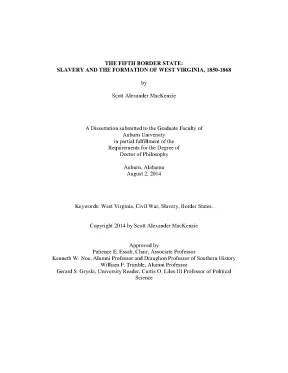
Tải xuống để đọc toàn bộTHE FIFTH BORDER STATE: SLAVERY AND THE FORMATION OF WEST VIRGINIA, 1850-1868 by Scott Alexander MacKenzie A Dissertation submitted to the Graduate Faculty of Auburn University in partial fulfillment of the Requirements for the Degree of Doctor of Philosophy Auburn, Alabama August 2, 2014 Keywords: West Virginia, Civil War, Slavery, Border States. Copyright 2014 by Scott Alexander MacKenzie Approved by Patience E. Essah, Chair, Associate Professor Kenneth W. Noe, Alumni Professor and Draughon Professor of Southern History William F.
Trimble, Alumni Professor Gerard S. Gryski, University Reader, Curtis O. Liles III Professor of Political Science Abstract Civil War historians unfairly treat West Virginia as an oddity. They tend to see it as the dissident part of Virginia that resisted its secession in 1861 to protest decades of economic neglect.
Some explain this process from the area more closely resembling Pennsylvania and Ohio than to its parent. Each centers his or her interpretations on the paucity of slavery in the region in 1860. I suggest another possibility: West Virginia was a border state. Four slave states, Delaware, Maryland, Kentucky, and Missouri, remained loyal to the Union.
Each had fewer slaves than in the Upper and Lower South states, but each defended the practice for as long as possible. Their allegiances concerned both sides in the Civil War. President Abraham Lincoln worked tirelessly to preserve their loyalties to the Union, demonstrating great flexibility when dealing with them, especially on slavery. On the other hand, Confederate leader Jefferson Davis sought to keep all slaveholding states under his domain.
Men from each state joined both armies as well as numerous guerrilla bands. Recent scholarship has renewed interest in finding the nexus of social and political divisions within each state, yet historians may have neglected another place that endured similar ordeals. My dissertation will integrate West Virginia into the border states. Although it did not exist as an independent polity at the war’s beginning like the ii other states, the federal government treated northwestern Virginia as if it were one before and after statehood.
My work starts by challenging long-held beliefs about the region’s politics and society. The population was in fact mostly southern in ancestry and proslavery in attitude. Only the small yet vital northern panhandle differed. The landholding class and an urban middle class shared rule over a stratified population of laborers, farmers, and slaves.
During the 1850s, the region consistently supported the South and its mother state against northern agitation over slavery. Northwestern Virginians were, I believe, content with the status quo if desirous of economic progress. When secession came, however, the region split along geographic and economic lines. Middle-class Unionists seized power from landowners who seceded with Virginia.
These loyalists sought to form a new state to show that slavery was safe under the Constitution while treason led only to its destruction. Even so, bitter disputes over slavery almost thwarted the project. Conservatives demanded no federal interference on the issue. More radical leaders sought a gradual emancipation plan as a war measure.
A compromise plan resolved the deadlock and allowed West Virginia to enter the Union as a slave state in 1863. Lincoln’s flexible approach to the border states permitted this to happen. As with the other border states, he tolerated the northwest’s stubborn attachment to slavery, and exempted it and the four others from the Emancipation Proclamation. West Virginia’s war would drag on for two more costly years.
Armies fought over it in seemingly endless battle against each other. Guerrilla warfare plagued most of its territory. As in other border states, iii the Thirteenth Amendment, which ended slavery, caused great dissention in the state. In short, West Virginia was not an oddity or a mere dissident appendage of another state.
It is fairer to call it a Border State. Its mix of northern and southern influences, class structures, intense debate over slavery, and divided wartime allegiances more closely resembled its four neighbors than it did eastern Virginia. Civil War historians need to include West Virginia as a fifth border state arising from a combination of factors rather than see it as a singular entity born from special circumstances. iv Acknowledgments One accumulates many debts while working on a project as large as a dissertation.
The first ones go to those in whose memory I pursued graduate school. To my father Roderick I. (1944-2007), my brother Roderick A. (1976-2002), and my mentor Stanley P.
(1928-2003), please let this work justify that your faith in me was well placed. I thank you for your sending your encouragement and support from heaven to earth. My family made this all possible. My mother Maryel Andison has been a constant source of inspiration to me, and selflessly gave her time to me when I had health problems in 2011 and 2013.
To my brother John, sister-in-law Brandi, nephew Noah and niece Sara in Calgary: thank you, Uncle Scott loves you. To my sister Karen, brother-in-law Erik, and my nephews Samuel, David and Malcolm in Stockholm: tack, Morbor Scott älskar dig. Space prevents me from thanking my numerous other relatives here so I will thank them all individually. I had the honor of making some incredible friends in my lifetime.
Dick Denny and Sharon Hamilton shared many TV nights and several Auburn football games with me. Karen Hartt, Ashley Hartt, Bill King, Cindy Kressler, Colin Shannon, Noah Skelton, Beth White, Ian Wilson, and Jennifer Zimmer each helped me in their own ways. Elizabeth Butcher kindly rented a room to me during my research trip to Morgantown. I will thank many others individually.
v To all the students whom I served as a teaching assistant and studied alongside in our joint classes, I thank you for a great experience at Auburn. War Eagle! I also thank my colleagues at the History Department for accepting me into your lives. They include, in alphabetical order, Meredith Bocian, Tommy Brown, Dave Burke, Carol Ann Dennis, Brett Derbes, Rebecca Eckstein, Michael Johnson, John Klein, Corey Markum, David McCrae, Hector and Hesper Montford, Susan Moore, Rolundus Rice, Angelia Rivera, Abby Sayers, Sean Seyer, Tom Szendry, Matt Vogeler, Charles Wexler and Andy Wood. My professors with whom I took classes and/or for whom I worked as a teaching assistant also deserve gratitude: Morris Bian, Donna Bohanan, Kathryn Braund, Jennifer Brooks, David Carter, Ruth Crocker, Boris Gorshkov, Reagan Grimsley, Charles Israel, Joseph Kicklighter, Kelly Kennington, Ralph Kingston, Angela Lakwete, Matt Malczycki, Mark Sheftall, Tiffany Sippial, Rod Stewart and Abigail Swingen.
I also thank people from other institutions for their insights and support. From the University of Calgary, I thank Frank Towers, Jewel Spangler and Patrick Brennan. From the University of Florida, Allison Fredette. From Marshall University, Kevin Barksdale.
From West Virginia University, Kenneth Fones-Wolf and Adam Zucconi. From East Tennessee State University, Andrew L. From the University of Central Florida, Barbara Gannon. From the University of Georgia, John C.
Inscoe, Angela Elder, and Keri Leigh Merritt. From the University of Virginia, Jeff Zvengrowski. From Shepherd University, John E. From the George Tyler Moore Center for the Study of the vi Civil War, Mark Snell, Denise Messinger, Tom White and Al Pejack.
From the Papers of Abraham Lincoln, Christian McWhirter. From the University of Louisville, A. From Queens College of the City of New York, Frank A. Warren, Francine Kapchan and Marilyn Harris.
I also thank the following institutions for aiding my research: In Morgantown, the West Virginia and Regional History Collection in the Wise Library. In Richmond, the Library of Virginia. In Philadelphia, the Mid-Atlantic Branch of the National Archives. In Charleston, the West Virginia State Archives.
At Auburn, the Interlibrary Loan section of the Ralph Draughon Library. Without these fine people, this project would never have become a reality. I thank my committee for their hard work turning some vague ideas into a dissertation. Patience Essah generously gave me her time and attention.
Her door was always open to me on any issue I wished to raise. When it came to the work, however, she was most impatient with bad writing and thinking. I learned a great deal from her. It was an honor to be her student.
Ken Noe deserves similar credit. His attention to the smallest details of primary and secondary research kept this project on track towards something important. Bill Trimble’s rigor as an editor made his participation on the committee essential and most welcome. Gerry Gryski, the university reader, kept us all on track.
I owe each of them a great debt. I take full responsibility for any errors in analysis and evidence in my work. vii Table of Contents Abstract……………………….……………………………………v List of Tables…………………………………………………………………….ix List of Maps.1 Chapter One: Part of the South: The Social and Economic Structure of Antebellum Northwestern Virginia………………………………………………………………………….22 Chapter Two: Increasing Strife and Discord: The Politics of Slavery in Northwestern Virginia 1851-1859….…………………………………55 Chapter Three: Making a Border State: Northwestern Virginia in the Secession Crisis, January to October 1861……………………………………………….104 Chapter Four: Behind Friendly Lines: Forming a Constitution in Wartime, May 1861 - April 1862………………………….157 Chapter Five: Very Severe Trials: Statehood, Emancipation, and the Rise of Unconditional Unionism, 1862-1863.199 Chapter Six: To the Bitter End: Statehood and the Troubled Emancipation Process in West Virginia, 1863-1868.295 Bibliography……………………………………………………………………303 viii List of Tables Table 1: Border State Slavery……………………………………………………18 Table 2: Nativity by Percentage of Adult Heads of Household, 1850-1860…….34 Table 3: Slaveholders’ Share of Property by County, 1850-1860……………….40 Table 4: Effects of Slave Ownership in Ohio, Harrison and Kanawha, 1850- 1860………………………………………………………………………………49 Table 5: Increase in Suffrage by 1851 Virginia Constitution by County……….64 Table 6: Wheeling, West Virginia, Election Returns by Ward, 1864 Presidential Election…………………………………………………………………………273 Table 7: County Returns for 1864 Presidential Election……………………….275 ix List of Maps Map 1: The Virginia Regions, 1860………………………………………………3 Map 2: The Border States……………………………………………………….14 x Introduction Historians have taken for granted that the formation of West Virginia was a unique experience of the American Civil War. They have accepted the century- old narrative of the mountaineers resisting the secession of Virginia as the truth behind the state’s formation.
It goes like this: the west struggled with the east over taxation, suffrage, and legislative representation from the Revolution to the Civil War. The planter class in the eastern part of the state did not believe that the west shared their support for slavery, so they retained power for themselves. The west saw this as an impediment to their rights and openly questioned the institution of slavery. Constitutional and economic changes in 1829-1830 and 1850-1851 redressed some of these concerns, including the construction of the Baltimore and Ohio Railroad which linked the region to the Atlantic seaports.
The east, however, still held much of the political power. When Virginia considered seceding from the Union after a decade of tensions over the future of slavery, the western counties prevented the measure. South Carolina’s attack Fort Sumter in April 1861 and President Abraham Lincoln summoning of troops from the loyal states to put down the rebellion prompted many western Virginians to support secession. Other delegates, mainly from the northwestern part of the state, refused to obey and returned to the city of Wheeling to form a government of their own.
Two bloody years later, West Virginia joined the Union as a free state after discarding slavery as a congressional condition for statehood. From this, historians have inferred numerous views of the new state. Some argued that the northwestern part of Virginia was more like the North than 1 the South. Many pointed to the limited presence of slavery in the region as the basis for its allegiances, even to the point of being abolitionist.
All identified the long-standing differences with eastern Virginia as the reason for West Virginia’s formation. From this, they concluded that its creation was a unique experience. To be fair, it was the only geographic change made in the United States during the Civil War. These ideas are flawed.
Limited interest in the subject has allowed them to persist. Natives of the state contributed virtually all of the literature.
Nội dung được bảo vệ bản quyền — Tải xuống đầy đủ
Trích dẫn luận án này
Scott Alexander MacKenzie (2014). Mackenzie dissertation 2 binding [Luận án tiến sĩ, Auburn University]. LuanAn.net. https://luanan.net/giao-duc-hoc/mackenzie-dissertation-2-binding
Câu hỏi thường gặp
Luận án "Mackenzie dissertation 2 binding" nghiên cứu về vấn đề gì?
Dịch vụ đóng bìa luận văn Mackenzie chất lượng cao. Giấy tốt, bền chắc, đảm bảo tính chuyên nghiệp và thẩm mỹ cho luận văn của bạn.
Luận án "Mackenzie dissertation 2 binding" được bảo vệ tại trường nào?
Luận án này được bảo vệ tại Auburn University. Năm bảo vệ: 2014.
Luận án "Mackenzie dissertation 2 binding" thuộc chuyên ngành gì?
Luận án "Mackenzie dissertation 2 binding" thuộc chuyên ngành History. Danh mục: Giáo Dục Học.
Luận án "Mackenzie dissertation 2 binding" có bao nhiêu trang?
Luận án "Mackenzie dissertation 2 binding" có 326 trang. Bạn có thể xem trước một phần tài liệu ngay trên trang web trước khi tải về.
Cách tải luận án "Mackenzie dissertation 2 binding" về máy như thế nào?
Để tải luận án về máy, bạn nhấn nút "Tải xuống ngay" trên trang này, sau đó hoàn tất thanh toán phí lưu trữ. File sẽ được tải xuống ngay sau khi thanh toán thành công. Hỗ trợ qua Zalo: 0559 297 239.