Bbynum dissertation draft3 final rev
Bản nháp luận văn cuối cùng Bbynum: bản sửa đổi cuối cùng, hoàn thiện. Đề xuất nghiên cứu và phân tích sâu sắc.
Special Education, Rehabilitation, and Counseling
Luan An
luận án
Năm xuất bản
Số trang
133
Thời gian đọc
20 phút
Lượt xem
0
Lượt tải
0
Phí lưu trữ
40 Point
Tổng quan nhanh
- Chủ đề:
- 1. Nghiên cứu học thuật về yếu tố nơi làm việc và kiệt sức
- Số trang:
- 133 trang
- Trường:
- Auburn University
- Chuyên ngành:
- Special Education, Rehabilitation, and Counseling
- Tác giả:
- Baxlee A. Bynum
- Năm:
- 2019
Tóm tắt nội dung luận án
I. Nghiên cứu học thuật về yếu tố nơi làm việc và kiệt sức
Nghiên cứu này là một luận án tiến sĩ, tập trung vào mối quan hệ giữa các yếu tố trong môi trường làm việc, kiệt sức cảm xúc và ý định nghỉ việc. Trọng tâm đặc biệt là các cố vấn chuyên nghiệp trong môi trường tư vấn sức khỏe tâm thần. Mục đích chính là hiểu rõ hơn cách các yếu tố cụ thể trong môi trường làm việc ảnh hưởng đến trải nghiệm của cố vấn. Nghiên cứu đã khám phá cách nhận thức về công bằng tổ chức tác động đến kiệt sức cảm xúc và ý định nghỉ việc. Đây là một đóng góp quan trọng vào nghiên cứu học thuật về sức khỏe tâm thần nghề nghiệp.
1.1. Mục tiêu luận án tiến sĩ về kiệt sức cảm xúc
Luận án tiến sĩ này nhằm mục đích sâu sắc là làm rõ các mối liên hệ. Nó xem xét các mối quan hệ giữa các yếu tố tại nơi làm việc, kiệt sức cảm xúc và ý định nghỉ việc. Bối cảnh nghiên cứu cụ thể là các cơ sở tư vấn sức khỏe tâm thần. Nghiên cứu đã tìm cách khám phá cách nhận thức về công bằng tổ chức ảnh hưởng đến các vấn đề này. Điều này giúp cung cấp cái nhìn tổng quan về các thách thức mà cố vấn phải đối mặt. Tầm quan trọng của nghiên cứu học thuật này được nhấn mạnh.
1.2. Tầm quan trọng của nghiên cứu học thuật này
Với những hiểu biết thu được, các cố vấn chuyên nghiệp và các cơ quan tư vấn có thể phát triển chiến lược. Các chiến lược này nhằm hỗ trợ phúc lợi của cố vấn và giảm các triệu chứng kiệt sức cảm xúc. Việc hiểu các khía cạnh công việc liên quan đến kiệt sức cảm xúc là rất quan trọng. Điều này giúp giải quyết vấn đề lớn hơn về tỷ lệ nghỉ việc của cố vấn. Nghiên cứu học thuật này cung cấp cơ sở để cải thiện môi trường làm việc. Nó góp phần nâng cao sự bền vững nghề nghiệp trong lĩnh vực tư vấn.
II. Luận án tiến sĩ Kiệt sức cảm xúc và ý định nghỉ việc
Tài liệu này là một luận án tiến sĩ hoàn chỉnh, trình bày kết quả nghiên cứu quan trọng. Nghiên cứu tập trung vào mối tương quan giữa các yếu tố nơi làm việc, kiệt sức cảm xúc và ý định nghỉ việc. Thông qua đánh giá tài liệu chi tiết, các khái niệm chính đã được xác định. Công bằng tổ chức đóng vai trò trung tâm trong nghiên cứu này. Phân tích cho thấy cách nhận thức về công bằng ảnh hưởng đến tình trạng kiệt sức và ý định rời bỏ công việc của cố vấn. Nghiên cứu cung cấp dữ liệu định lượng giá trị về các vấn đề này.
2.1. Khảo sát yếu tố nơi làm việc và kiệt sức
Luận án tiến sĩ này sử dụng thiết kế nghiên cứu định lượng. Nó báo cáo kết quả về cách các yếu tố trong môi trường làm việc tương quan với kiệt sức cảm xúc. Các yếu tố này được kiểm tra thông qua việc đánh giá nhận thức về công bằng tổ chức. Nghiên cứu đã đánh giá tài liệu và dữ liệu để xác định các mối liên hệ. Nó làm rõ các yếu tố môi trường có thể gây ra kiệt sức cho cố vấn.
2.2. Phân tích tác động lên ý định nghỉ việc của cố vấn
Nghiên cứu cũng khám phá tác động của các yếu tố nơi làm việc lên ý định nghỉ việc. Kết quả cho thấy mối tương quan chặt chẽ giữa công bằng tổ chức, kiệt sức cảm xúc và ý định nghỉ việc. Việc phân tích dữ liệu luận án này cung cấp bằng chứng rõ ràng. Nó giúp các tổ chức hiểu rõ hơn các yếu tố ảnh hưởng đến sự duy trì nhân sự. Các kết quả này có ý nghĩa quan trọng đối với quản lý nguồn nhân lực.
III. Phương pháp nghiên cứu định lượng trong luận án này
Thiết kế nghiên cứu cho luận án này là định lượng. Phương pháp nghiên cứu này cho phép khám phá mối quan hệ và tương quan giữa các biến số. Nó cung cấp một cách tiếp cận có hệ thống để thu thập và phân tích dữ liệu. Việc lựa chọn phương pháp nghiên cứu định lượng đảm bảo tính khách quan của các phát hiện. Nó cũng cho phép sử dụng các kỹ thuật phân tích dữ liệu luận án phức tạp. Sự chính xác trong phương pháp luận là nền tảng của nghiên cứu học thuật này.
3.1. Thiết kế nghiên cứu định lượng cho luận án tiến sĩ
Nghiên cứu này đã áp dụng một thiết kế định lượng để kiểm tra các mối quan hệ. Thiết kế này là lý tưởng để đo lường và phân tích thống kê. Nó giúp xác định các mối tương quan giữa các biến số chính. Các phương pháp nghiên cứu được lựa chọn kỹ lưỡng. Điều này đảm bảo tính hợp lệ và độ tin cậy của các phát hiện. Đây là một thành phần cốt lõi của việc hoàn thành luận án tiến sĩ.
3.2. Phân tích dữ liệu luận án về công bằng tổ chức
Dữ liệu được thu thập đã được phân tích để đánh giá nhận thức về công bằng tổ chức. Sau đó, nó được liên hệ với kiệt sức cảm xúc và ý định nghỉ việc. Quá trình phân tích dữ liệu luận án này sử dụng các kỹ thuật thống kê tiên tiến. Điều này giúp xác định mức độ tương quan và ý nghĩa thống kê của các phát hiện. Sự kỹ lưỡng trong phân tích đảm bảo kết quả đáng tin cậy. Nó cung cấp bằng chứng vững chắc cho các kết luận của nghiên cứu.
IV. Kết quả và hàm ý từ phân tích dữ liệu luận án chuyên sâu
Các phát hiện từ việc phân tích dữ liệu luận án này rất quan trọng. Chúng cho thấy mối tương quan chặt chẽ giữa công bằng tổ chức, kiệt sức cảm xúc và ý định nghỉ việc. Kết quả này có ý nghĩa sâu rộng đối với giáo dục cố vấn và thực tiễn lâm sàng. Nghiên cứu cung cấp kiến thức cần thiết để phát triển các chiến lược can thiệp hiệu quả. Điều này nhằm cải thiện phúc lợi của cố vấn và giảm tỷ lệ nghỉ việc. Các cuộc thảo luận chi tiết về kết quả nghiên cứu cũng được trình bày.
4.1. Mối tương quan giữa công bằng tổ chức và kiệt sức
Các kết quả nghiên cứu làm nổi bật mối tương quan đáng kể. Nhận thức về công bằng tổ chức có liên hệ chặt chẽ với kiệt sức cảm xúc. Đồng thời, nó cũng có mối liên hệ với ý định nghỉ việc ở các cố vấn chuyên nghiệp. Những phát hiện này làm rõ các yếu tố môi trường làm việc ảnh hưởng đến trải nghiệm của cố vấn. Sự hiểu biết này là cơ sở để tạo ra các môi trường hỗ trợ hơn.
4.2. Hàm ý giáo dục cố vấn và thực tiễn lâm sàng
Nghiên cứu này có những hàm ý quan trọng cho cả giáo dục cố vấn và các cơ quan tư vấn. Việc hiểu các mối tương quan giúp phát triển các chương trình đào tạo tốt hơn. Nó cũng giúp tạo ra môi trường làm việc hỗ trợ hơn. Các cuộc thảo luận sâu về kết quả nghiên cứu được cung cấp. Chúng giúp đưa ra các khuyến nghị thực tiễn nhằm cải thiện phúc lợi của cố vấn và giảm tỷ lệ nghỉ việc. Việc bảo vệ luận án đã trình bày những phát hiện này, mang lại giá trị thực tiễn.
V. Hướng dẫn viết học thuật và quá trình sửa đổi luận án
Quá trình hoàn thành luận án tiến sĩ này đòi hỏi sự cống hiến to lớn cho việc viết học thuật. Từ việc xây dựng cấu trúc ban đầu đến hiệu đính bản thảo cuối cùng, mỗi bước đều quan trọng. Việc phát triển các công cụ nghiên cứu, như khảo sát, là một phần thiết yếu của quá trình này. Sự hỗ trợ từ các cố vấn và giáo sư đóng vai trò then chốt trong việc hướng dẫn. Nó đảm bảo chất lượng và sự hoàn thiện của tài liệu cuối cùng. Quá trình sửa đổi luận án đã được thực hiện tỉ mỉ.
5.1. Quy trình phát triển bản thảo luận án tiến sĩ
Quá trình viết học thuật này bao gồm nhiều giai đoạn phức tạp. Từ việc hình thành ý tưởng ban đầu đến phát triển công cụ khảo sát cho luận án tiến sĩ, mọi bước đều được thực hiện cẩn thận. Việc phát triển một bản khảo sát hiệu quả là một phần quan trọng của nghiên cứu. Nó minh chứng cho sự cống hiến cho phương pháp luận khoa học. Giai đoạn này đặt nền móng cho toàn bộ dự án nghiên cứu.
5.2. Hỗ trợ học thuật và hiệu đính bản thảo luận án
Thành công của luận án này phụ thuộc vào sự hỗ trợ học thuật mạnh mẽ. Các cố vấn và giáo sư đã cung cấp hướng dẫn quý báu trong suốt quá trình. Họ giúp định hướng các mốc thời gian, kỹ thuật và quá trình hoàn thiện. Sự hỗ trợ này rất quan trọng trong việc hoàn thiện và hiệu đính bản thảo luận án. Quá trình sửa đổi luận án đã được thực hiện cẩn thận. Điều này đảm bảo tính chính xác và rõ ràng của tài liệu khoa học cuối cùng.
Mục lục chi tiết luận án
Tải xuống file đầy đủ để xem toàn bộ nội dung
Tải đầy đủ (133 trang)Trích đoạn nội dung luận án
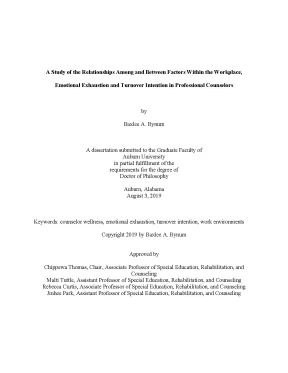
Tải xuống để đọc toàn bộA Study of the Relationships Among and Between Factors Within the Workplace, Emotional Exhaustion and Turnover Intention in Professional Counselors by Baxlee A. Bynum A dissertation submitted to the Graduate Faculty of Auburn University in partial fulfillment of the requirements for the degree of Doctor of Philosophy Auburn, Alabama August 3, 2019 Keywords: counselor wellness, emotional exhaustion, turnover intention, work environments Copyright 2019 by Baxlee A. Bynum Approved by Chippewa Thomas, Chair, Associate Professor of Special Education, Rehabilitation, and Counseling Malti Tuttle, Assistant Professor of Special Education, Rehabilitation, and Counseling Rebecca Curtis, Associate Professor of Special Education, Rehabilitation, and Counseling Jinhee Park, Assistant Professor of Special Education, Rehabilitation, and Counseling Abstract The purpose of the current study was to gain an understanding of the relationships among and between factors within the workplace, emotional exhaustion, and turnover intention; specifically in mental health counseling settings. This study sought to discover if and how certain factors within workplace settings, studied through the evaluation of organizational justice perception, impact emotional exhaustion and turnover intention in professional counselors.
This study employed a quantitative design and reported results that identify how factors within the workplace (perception of organizational justice) correlate with emotional exhaustion and turnover intention in professional counselors. With this knowledge, professional counselors and counseling agencies will begin to identify strategies to be employed within mental health workplaces that support counselor wellness and decrease burnout symptoms, such as emotional exhaustion. Further, understanding the aspects of work and organizational culture that are associated with emotional exhaustion is critical if the larger issue of counselor turnover is to be addressed. Additionally, further discussions of the study findings are also presented.
Results have significance for understanding the close correlations among organizational justice, emotional exhaustion and turnover intention in professional counselors. Implications of the study for counselor education are also discussed. ii Acknowledgements “If a man does not keep pace with his companions, perhaps it is because he hears the sound of a different drummer. Let him step to the music he hears, however measured or far away.” I begin my acknowledgements with this quote by Henry David Thoreau to thank anyone in my life that has encouraged or inspired me to step out of my comfort zone to pursue my dreams, regardless of what the path looked like.
Thank you to those people who have encouraged or inspired me to be true to myself, to love myself, and to step to the beat of my own drum, regardless of any contrary messages I received along the way. I have grown to be confident, brave and strong through the love and support of so many individuals. First on the list of names, my family. To my mother, Cheryl and my father, Jerry: Thank you for your love, support and prayers throughout my life.
I cannot imagine what my life would be like without your strong, moral example. You two are truly servant leaders and have shaped me into the strong and resilient helping professional that I am today. To my sister, Brannon: Thank you for showing me what unconditional love looks like and feels like. You are truly one of a kind with a heart of gold.
To my grandparents: Ninie and Coachie. Although Coachie is no longer with us, his wisdom still guides me to this day. Thank you for being a positive example of leadership, citizenship and partnership. I will be forever grateful for the many generous gifts you both leave with me.
To the mentors and professors that I have looked up to and learned so much from. Evans, thank you for believing in me. Thank you for teaching me through example how to be a iii life changing educator and supervisor. I owe my professional and academic success to your mentorship, encouragement, and now friendship.
Thomas, thank you for the phone calls and meetings that helped me navigate through graduate school deadlines and technicalities, PowerPoint presentation development and the finalization of this dissertation. Your cheerful attitude and positive spirit have been so appreciated. Marshall, first, thank you for your survey methods course, which is where I developed the survey for this dissertation. I now model your collaborative teaching style and look up to you in many ways.
Thank you for teaching me to regard you as a colleague and for inviting me to be a part of your life-changing research. I would like to thank my dissertation committee for your willingness to be a part of this study. Thank you for your feedback and guidance that helped me complete this academic accomplishment. I want to thank my friends who have become more like family.
Without this secondary support, I would not be here. Lindsey, you are and will always be my sister from a different mister. Words cannot explain how much your friendship means to me! I love you, I am proud of you, and I cannot wait to continue sharing successes with you! Justin, you have taught me so much in our past three years of our friendship. I am forever grateful for the bond that we have developed and will continue to strengthen! Maegan (PhD momma) and Claudia, thank you for being there to provide comedic relief from the PhD program when needed, an ear to listen to grievances (free counseling), and most importantly, life-long friendship.
I love you both and cannot wait to see where we go next! Jaclyn, thank you for your positive attitude and fun-loving spirit. You and Samford knew just how to cheer me up in years one-two! Andrea, we have grown together since the beginning of our master’s program, being baptized by fire as interns at the Opelika Addictions Center and now as colleagues and friends. Thank you for holding me iv tight in your prayers as we have both lived through unimaginable changes these past two years. You are a daily inspiration to me and I can only hope to develop a heart as pure and as golden as yours.
Jessica, my newest friend that I met in my internship adventure in Cleveland. When an unexpected tragedy ripped through my life, you opened your heart and your arms to me, virtually a complete stranger. You will never know how much your kindness and friendship helped me make it through that time, staying productive and functioning while so far away from family and home. I want to share my own version of an age-old quote here for these special friends: “Make new friends, but keep the old, one is gold and the other is gold.” No silver here! Thank you to those who kept me in your prayers when I needed it the most: Dadeville First United Methodist Church family (you know who you are).
You have been my village of secondary parents; you have supported so many of my goals throughout my life. You have helped my parents raise me from my first christening, to loving me through my identity crisis in my late teens, supporting my educational research trips and school endeavors, and finally being servant leaders that teach me by example how to live in the light. Your love, support and prayers have gotten not only me, but most importantly, my family through the most difficult time of our lives this year. Finally, I want to thank all of the professional mental health counselors who participated in my study.
Together, we are agents for change! v Table of Contents Abstract. iii List of Tables. xi CHAPTER I: INTRODUCTION AND REVIEW OF THE LITERATURE .6 Risk for Burnout and Impairment .7 Impact of Burnout on Counseling Agencies .11 Dimensions of Organizational Justice .12 Organizational Justice as a Stressor .13 Summary of the Literature Review .14 Significance of the Study .15 Statement of Purpose .18 vi CHAPTER II.21 Research Questions and Hypotheses .44 Limitations of the Study.46 Future Research Recommendations .50 Introduction and Background of the Problem .54 Risk for Burnout and Impairment .56 Impact of Burnout on Counseling Agencies .60 Dimensions of Organizational Justice .61 Organizational Justice as a Stressor .62 Significance of the Study .63 Statement of Purpose .65 viii Data Analysis .82 Limitations of the Study.84 Future Research Recommendations .87 ix Appendix A: Survey .97 Appendix B: Open Ended Questions and Responses .109 Appendix C: Email Invitation .118 Appendix D: IRB Approval .119 Appendix E: Information Letter.121 x List of Tables Table 1 Measures and Their Associated Variables .21 Table 2 Demographic Profile of the Sample: Percentages for Categorical Data and Means and Standard Deviation for Continuous Variables .25, 68 Table 3 Mean, Standard Deviation and Range for Variables of Interest .33, 72 Table 4 Independent Samples t-test Results: Private practice vs.35, 73 Table 5 Independent Samples t-test Results: Organizational Justice and Turnover Intention .36, 75 Table 6 Independent Samples t-test Results: Organizational Justice and Emotional Exhaustion.37, 75 Table 7 Correlations between Variables of Interest. INTRODUCTION AND REVIEW OF THE LITERATURE Introduction Although counselor wellness and burnout are widely discussed and researched in the field of mental health, diminished wellness, emotional exhaustion, counselor burnout and high turnover rates remain steadily prevalent in counseling agencies (Green, Miller, & Aarons, 2013; Lawson & Venart, 2005; Skovholt, 2001).
Because the consequences of diminished wellness, emotional exhaustion and counselor burnout are harmful for counselors, mental health agencies, and clients, it is important to examine the consequences and factors that contribute to this dangerous phenomenon. Professional mental health counselors are at a particularly high risk for burnout due to the intense and psychologically close work counselors do with clients, which is an occupational hazard that cannot be controlled for or changed as it is in the nature of the work (Skovholt, 2001). With this understanding, identifying work related factors that can be modified and controlled to support counselor wellness is imperative to address counselor burnout and further, support employee retention. Ohrt and Cunningham (2012) shared that counselors’ work environments may influence their levels of wellness and burnout, yet much of the literature notes that environment is a component of wellness that is sometimes overlooked.
Although burnout occurs in the counselor, it is rooted in the environment (Lawson, 2007). If the work environment does not value employee wellness or allow for revitalization, employees (professional mental health counselors) may become distressed and impaired (Maslach, Leiter, & Schaufeli, 2008). Roscoe (2009) stated 1 that an individual’s interaction with physical space, nature, neighborhood, community, and workplace can have enormous impact upon individual wellness, just as an individual can have a positive or negative impact on the environment. Working environments have been identified as a contributing factor in the development of diminished wellness and counselor burnout with symptoms presenting as: poor work performance, irritability, inadequacy, feelings of failure, sleeplessness, and exhaustion among others (Jordan, 2010).
Available literature identifies several work environment factors linked to the contribution of diminished wellness and counselor burnout such as: caseload (heavy and unmanageable), (lack of) available resources, (lack of) autonomy, and unjust role expectations (Broome et al., 2009; Ducharme, Knudsen & Roman, 2008; McNulty et al. Similarly, Maslach (2003) identified environmental factors within the workplace that closely parallel with aforementioned factors that lead to diminished wellness and counselor burnout including: work overload, lack of control in the workplace, unsupportive and unhealthy work peers, and ineffective/punitive supervisors. These environmental factors can all lead to increased risk of or a hastening development of counselor burnout. It is imperative to continue researching the phenomenon of burnout and all factors that may contribute to it, and to develop more effective prevention strategies and interventions to support counselor wellness in order to protect continuity of care for clients, client wellbeing, quality of service, higher productivity of counselors, and to promote accessible mental health care to the public.
Although evidence suggests that the independently employed practices of self-care, optimism and providing colleague to colleague support are crucial for counselor wellness and job satisfaction (Warren et al., 2010), they are not easily maintained with little additional support from counseling agencies and workplaces.
Nội dung được bảo vệ bản quyền — Tải xuống đầy đủ
Trích dẫn luận án này
Baxlee A. Bynum (2019). Bbynum dissertation draft3 final rev [Luận án tiến sĩ, Auburn University]. LuanAn.net. https://luanan.net/giao-duc-hoc/bbynum-dissertation-draft3-final-rev
Câu hỏi thường gặp
Luận án "Bbynum dissertation draft3 final rev" nghiên cứu về vấn đề gì?
Bản nháp luận văn cuối cùng Bbynum: bản sửa đổi cuối cùng, hoàn thiện. Đề xuất nghiên cứu và phân tích sâu sắc.
Luận án "Bbynum dissertation draft3 final rev" được bảo vệ tại trường nào?
Luận án này được bảo vệ tại Auburn University. Năm bảo vệ: 2019.
Luận án "Bbynum dissertation draft3 final rev" thuộc chuyên ngành gì?
Luận án "Bbynum dissertation draft3 final rev" thuộc chuyên ngành Special Education, Rehabilitation, and Counseling. Danh mục: Giáo Dục Học.
Luận án "Bbynum dissertation draft3 final rev" có bao nhiêu trang?
Luận án "Bbynum dissertation draft3 final rev" có 133 trang. Bạn có thể xem trước một phần tài liệu ngay trên trang web trước khi tải về.
Cách tải luận án "Bbynum dissertation draft3 final rev" về máy như thế nào?
Để tải luận án về máy, bạn nhấn nút "Tải xuống ngay" trên trang này, sau đó hoàn tất thanh toán phí lưu trữ. File sẽ được tải xuống ngay sau khi thanh toán thành công. Hỗ trợ qua Zalo: 0559 297 239.