The silent majority an examination of nonresponse in college stu
Nghiên cứu phân tích nhóm người không trả lời trong môi trường đại học. Khám phá nguyên nhân và tác động của sự không tham gia trong học thuật.
Educational Policy and Leadership
Luan An
Luận án tiến sĩ
Năm xuất bản
Số trang
290
Thời gian đọc
44 phút
Lượt xem
1
Lượt tải
0
Phí lưu trữ
50 Point
Tổng quan nhanh
- Chủ đề:
- Unpacking Student Nonresponse in College Surveys
- Số trang:
- 290 trang
- Trường:
- University of Massachusetts Amherst
- Chuyên ngành:
- Educational Policy and Leadership
- Tác giả:
- Ethan A. Kolek
- Năm:
- 2012
Tóm tắt nội dung luận án
I.Unpacking Student Nonresponse in College Surveys
College student surveys aim to gather vital feedback. However, a significant portion of the student population often remains unheard. This phenomenon, known as student nonresponse, presents a persistent challenge in higher education research. Understanding the scope and nature of this nonresponse is fundamental. It allows institutions to improve data collection methods. The silent majority of non-responders can skew results. Accurate representation of student opinions becomes compromised without careful consideration of these missing voices. This examination delves into the core issues surrounding participation rates in college surveys.
1.1. Defining Student Nonresponse in Higher Education
Student nonresponse specifically refers to instances where sampled college students do not complete or return surveys. This creates gaps in collected data. It introduces potential biases into findings. Nonresponse is not simply a lack of data; it signifies missing perspectives. Recognizing this definition is the first step in addressing the problem within higher education research.
1.2. Identifying Factors Contributing to Low Response Rates
Various factors contribute to the prevalent issue of low response rates. Students face increasing demands on their time. They may experience survey fatigue from frequent requests. A lack of perceived value or impact from survey participation also plays a significant role. Identifying these specific contributing factors helps in developing more effective engagement strategies for future college surveys.
1.3. The Pervasive Challenge of College Surveys
Achieving comprehensive and representative data through college surveys remains a pervasive challenge. The difficulty lies in capturing the full spectrum of student experiences. High levels of student nonresponse undermine the integrity of survey results. This ongoing struggle impacts the reliability of insights derived from these crucial data collection efforts. Addressing this challenge is paramount for valid institutional assessment.
II.Exploring the Silent Majority College Student Voices
The concept of a 'silent majority' within college student populations is central to this examination. These are the students who do not actively participate in surveys or feedback mechanisms. Their absence creates a void in institutional understanding. Institutions risk making decisions based on incomplete information. Gaining insight into this group is essential. It ensures a more inclusive representation of the overall student body. The silent majority's reasons for nonresponse are complex. Uncovering these reasons contributes to a fuller picture of student engagement.
2.1. Unveiling the Silent Majority Among Students
The 'silent majority' represents a substantial group of students. These individuals typically opt out of survey participation. Their experiences and opinions remain largely unrecorded. Understanding the demographics and characteristics of this group is critical. It helps to contextualize survey findings and identify potential blind spots in student voice data. Their silence carries significant implications.
2.2. Understanding Characteristics of Disengaged Students
Disengaged students often form a core part of the silent majority. Characterizing these students involves examining their academic involvement, extracurricular participation, and overall connection to the institution. Factors such as academic load, work commitments, or perceived alienation can contribute to their disengagement from survey requests. Profiling them aids targeted outreach efforts.
2.3. The Significance of Unheard Student Perspectives
The perspectives of the silent majority hold immense significance. Unheard student voices can represent dissatisfaction, unique needs, or untapped potential. Their absence from survey data can lead to skewed policy development. Institutions must recognize the value these missing insights could provide. Efforts to capture these views are crucial for comprehensive academic decision-making.
III.Implications of Low Response Rates for Higher Ed Research
Low response rates in college surveys carry serious implications for higher education research. The reliability and generalizability of findings suffer. Institutions may draw inaccurate conclusions about student experiences and needs. This can lead to misallocation of resources. It also creates flawed policy development. Understanding these implications is vital for researchers and administrators alike. The integrity of data-driven decision-making depends on addressing these challenges. Nonresponse affects everything from program evaluation to student success initiatives.
3.1. Impact on Data Validity and Representativeness
Low response rates directly compromise data validity. The sample of responders may not accurately represent the entire student body. This leads to issues of representativeness. Survey results become less reliable. Generalizing findings to the broader student population becomes problematic. Institutions risk misunderstanding their own constituents, which impacts strategic planning and resource allocation.
3.2. Challenges for Accurate Higher Education Research
Researchers in higher education face substantial challenges due to student nonresponse. The ability to conduct accurate, unbiased studies is hindered. Comparisons across different student groups or over time become less robust. Robust research relies on comprehensive data. The absence of this completeness impedes the advancement of knowledge about student populations and institutional effectiveness.
3.3. Misinterpretation of Student Feedback and Trends
Without insights from the silent majority, institutions risk misinterpreting student feedback. Perceived trends based solely on responses from engaged students may not reflect reality. This can lead to misguided interventions or celebratory conclusions that lack broad support. A distorted understanding of student sentiment can undermine efforts to foster a supportive and responsive campus environment.
IV.Mitigating Survey Bias and Boosting Student Engagement
Addressing survey bias and boosting student engagement are critical goals for improving college surveys. Bias arises when non-responders differ significantly from responders. Strategies must focus on both reducing this bias and actively encouraging broader participation. Effective mitigation ensures that data collected offers a more balanced and accurate reflection of the student body. Boosting student engagement transforms passive observation into active contribution. Institutions can employ various techniques to enhance participation rates and gather more comprehensive insights from student voice.
4.1. Strategies to Counteract Survey Bias
Counteracting survey bias requires deliberate efforts. This includes using weighting techniques to adjust for known demographic discrepancies. Post-stratification methods can also help. Understanding the characteristics of non-responders through follow-up studies or external data helps inform these adjustments. The goal is to minimize the distortion caused by student nonresponse and achieve more accurate insights.
4.2. Fostering Greater Student Engagement in Surveys
Fostering greater student engagement is essential for higher response rates. Institutions can improve survey design for clarity and brevity. Offering incentives can increase participation. Communicating the direct impact of student feedback encourages involvement. Building a culture where student voice is valued promotes a willingness to respond to college surveys. This proactive approach benefits all stakeholders.
4.3. Designing Effective College Surveys
Effective college surveys are thoughtfully designed. They prioritize clear, concise questions and avoid jargon. Mobile-friendly formats improve accessibility. Pilot testing helps identify issues before broad distribution. Ensuring anonymity and confidentiality builds trust. These design principles contribute significantly to reducing student nonresponse. Well-crafted surveys maximize the likelihood of valuable input.
V.Enhancing Student Voice in Academic Decision Making
Enhancing student voice is paramount for informed academic decision-making. Student perspectives offer unique insights into learning environments, support services, and institutional culture. When nonresponse creates a silent majority, these crucial perspectives are lost. This impacts the quality and relevance of decisions made by administrators and faculty. Efforts to capture a broader range of student experiences strengthen governance. It promotes a more responsive and student-centered educational experience. Ensuring all students feel heard is a continuous institutional endeavor.
5.1. The Critical Role of Student Voice
Student voice plays a critical role in shaping higher education. It provides firsthand accounts of campus life, academic programs, and student support. This feedback is invaluable for continuous improvement. Ignoring or misinterpreting student input can lead to decisions that do not align with student needs. A strong student voice fosters a sense of ownership and belonging.
5.2. Barriers to Incorporating Diverse Student Perspectives
Several barriers hinder the incorporation of diverse student perspectives. These include language differences, cultural backgrounds, and varied levels of digital access. The silent majority often includes students from underrepresented groups. Their experiences are vital. Overcoming these barriers requires inclusive survey practices and alternative feedback channels. This ensures a truly representative student voice.
5.3. Informing Academic Decision Making Effectively
Informing academic decision-making effectively relies on comprehensive data. This includes robust student feedback. Decisions regarding curriculum changes, resource allocation, and student welfare benefit from diverse input. When institutions act upon well-represented student insights, outcomes are more likely to be successful. This directly improves the overall quality of the educational experience for all.
VI.Future Directions for Engaging Disengaged Students
Future directions in higher education research must prioritize engaging disengaged students. Innovative strategies are necessary to reach the silent majority effectively. This involves moving beyond traditional survey methods. Exploring new technologies and personalized outreach could yield better results. The goal is to ensure all students have avenues to share their experiences. Continuous improvement in understanding student nonresponse will strengthen institutional effectiveness. Research must focus on the underlying causes of disengagement to create more inclusive feedback systems.
6.1. Innovative Approaches to Improve Participation
Innovative approaches are needed to improve student survey participation. This might include gamification elements or integrating surveys into existing student portals. Utilizing social media platforms for targeted outreach could also prove effective. Personalized invitations and clear messaging about the survey's purpose can increase engagement. These new methods aim to make participation more appealing and accessible, thereby reducing low response rates.
6.2. Addressing Underlying Reasons for Nonresponse
Addressing the underlying reasons for nonresponse is key. This goes beyond superficial incentives. Institutions need to understand if students feel their opinions truly matter. Concerns about privacy, time commitment, or previous negative experiences must be explored. Deep dives into these root causes can inform more sustainable strategies for fostering genuine student engagement and participation.
6.3. Advancing Higher Education Research Methodologies
Advancing higher education research methodologies is essential. This involves developing new techniques to account for nonresponse bias. Mixed-methods approaches combining quantitative and qualitative data can offer richer insights. Longitudinal studies could track student engagement over time. Continual methodological innovation strengthens the validity and impact of studies on student populations. This pushes the boundaries of understanding student nonresponse.
Mục lục chi tiết luận án
Tải xuống file đầy đủ để xem toàn bộ nội dung
Tải đầy đủ (290 trang)Trích đoạn nội dung luận án
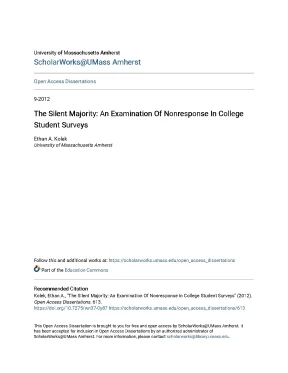
Tải xuống để đọc toàn bộUniversity of Massachusetts Amherst ScholarWorks@UMass Amherst Open Access Dissertations 9-2012 The Silent Majority: An Examination Of Nonresponse In College Student Surveys Ethan A. Kolek University of Massachusetts Amherst Follow this and additional works at: https://scholarworks.edu/open_access_dissertations Part of the Education Commons Recommended Citation Kolek, Ethan A., "The Silent Majority: An Examination Of Nonresponse In College Student Surveys" (2012). Open Access Dissertations.7275/wn37-0y87 https://scholarworks.edu/open_access_dissertations/613 This Open Access Dissertation is brought to you for free and open access by ScholarWorks@UMass Amherst. It has been accepted for inclusion in Open Access Dissertations by an authorized administrator of ScholarWorks@UMass Amherst.
For more information, please contact scholarworks@library. THE SILENT MAJORITY: AN EXAMINATION OF NONRESPONSE IN COLLEGE STUDENT SURVEYS A Dissertation Presented by ETHAN A. KOLEK Submitted to the Graduate School of the University of Massachusetts Amherst in partial fulfillment of the requirements for the degree of DOCTOR OF EDUCATION September 2012 School of Education Educational Policy and Leadership © Copyright by Ethan A. Kolek, 2012 All Rights Reserved THE SILENT MAJORITY: AN EXAMINATION OF NONRESPONSE IN COLLEGE STUDENT SURVEYS A Dissertation Presented by ETHAN A.
KOLEK Approved as to style and content by: _______________________________________ Elizabeth Williams, Chair _______________________________________ Gary Malaney, Member _______________________________________ Gloria DiFulvio, Member ____________________________________ Christine B. McCormick, Dean School of Education ACKNOWLEDGMENTS I have many people to thank for their help, support, encouragement, interest, and love that have made it possible for me to write this dissertation. I have been fortunate to have had many teachers (both inside and outside of the classroom), family members, and friends who have shaped who I am and how I think. Miss Pretat, Mrs.
Pawelczyk, David Brownell, Toby Gillis, Liz Rapoza, David Boyce, Priscilla Bates, and Jim Bean took an interest in me as an adolescent and encouraged my curiosity and creativity. I have thought of them, as well as many of my Star Island friends, as I have reflected on my dissertation journey. My parents, Carol and Drew, and their respective partners, Carlton and Sandy, have always supported me and have encouraged me throughout this process. My friendships with my brother, Adam, and good friends, Aric Russom and Dan Saunders, helped sustain me while I was in the midst of writing.
I would like to thank my Center for Community Engagement colleagues for their encouragement and understanding, particularly my supervisor, Molly Mead, who created my part-time position which enabled me to complete this dissertation. My partner, Tamatha Gaumnitz, has been incredibly supportive throughout my time in graduate school and during the time I spent writing this dissertation. Tamatha was instrumental in the success of my focus group study, helping to recruit many participants and finding a place to hold the focus groups at the university. Tamatha, thank you for being so understanding when I curtailed nearly all social commitments, abandoned my domestic responsibilities, and locked myself in my office to finish this project.
I have been very lucky to have your love and encouragement. iv I am grateful for the small, but vibrant, intellectual community in the higher education program, especially the members of our informal “Doc Reading Group,” which included Aaron Kuntz, Dan Saunders, Tom Fleenor, Raldy Laguilles, April Stroud, Shelly Perdomo, and Karen Howard. The members of my committee, Liz Williams, Gary Malaney, and Gloria Difulvio, have asked great questions and shared important perspectives. Ryan Wells graciously helped me learn logistic regression, which I employed in this project.
A special thanks goes to Dan Saunders, who read and commented on several chapters and prodded me to finish my dissertation. Gary Malaney’s sarcasm and cynicism were reassuring when I first arrived at the University. I have valued his encouragement, advice and friendship. During the nearly six years that I spent in the Student Assessment, Research and Evaluation Office, I worked closely with my mentor, Liz Williams.
I am grateful to her for that incredibly rich experience, through which I learned more than I could have imagined about research and higher education. At work, in the classroom, or while working on independent projects, Liz always challenged me to be a better writer, thinker, and researcher. For over a decade, Liz has been a wonderful supervisor, teacher, advisor, collaborator and friend. v ABSTRACT THE SILENT MAJORITY: AN EXAMINATION OF NONRESPONSE IN COLLEGE STUDENT SURVEYS SEPTEMBER 2012 ETHAN A., UNIVERSITY OF MASSACHUSETTS AMHERST Ed.D, UNIVERSITY OF MASSACHUSETTS AMHERST Directed by: Adjunct Assistant Professor Elizabeth Williams Nonresponse is a growing problem in surveys of college students and the general population.
At present, we have a limited understanding of survey nonresponse in college student populations and therefore the extent to which survey results may be biased. The purpose of this dissertation is to explore three facets of nonresponse in surveys of college students in order to strengthen our empirical and conceptual understanding of this phenomenon. This dissertation seeks to contribute to our understanding of who participates in surveys and who does not, how students experience the process of being asked to complete surveys, and whether or not students’ perspectives about surveys suggest that college student surveys should be conceptualized as organizational surveys. To begin to answer these questions, I conducted three studies – a secondary data analysis that examines student characteristics associated with the odds of completing a survey, a “survey on surveys” study that asks students about their experiences with surveys, and a series of focus groups to understand how students made vi sense of surveys at their institutions.
Taken together, these findings provide a basis for a more developed and nuanced understanding of nonresponse in student surveys. vii TABLE OF CONTENTS Page ACKNOWLEDGMENTS. vi LIST OF TABLES .xv CHAPTER 1: INTRODUCTION .1 Introduction: Survey Research and the Study of College Students .3 Response Rates in Decline .4 Purpose of the Study .9 Significance of the Study .13 People: Populations, Samples, Respondents, and Response Rates .22 Section 1: Declining Response Rates .23 Documenting Declines in Survey Response Rates in the General Population .23 Potential Reasons for Declining Response Rates .26 Declining Response Rates Summary .27 Section 2: Nonresponse Bias .28 viii Causal Nonresponse Models .29 Separate Cause Model.29 Common Cause Model .30 Direct Survey Variable Cause Model .30 Causal Model Summary.31 Approaches to Studying Nonresponse Bias .31 Comparing Response Rates .32 Comparisons to Existing Data .32 Use of Auxiliary Variables .33 Early and Late Respondents Comparisons .33 Follow-Up Surveys .35 Archival or Record-Linking Approach .36 Surveys on Surveys .37 Summary of Approaches to Studying Nonresponse Bias .38 Empirical Studies of Nonresponse Bias .38 Higher Response Rates Do Not Lessen Nonresponse Bias .40 Studies Suggesting Increased Response Rates Lessen Nonresponse Bias.42 Nonresponse Bias Meta-Analyses .43 Nonresponse Bias Summary .44 Section 3: Response Theories .46 Web Survey Response Steps .50 Social Exchange Theory .50 Leverage Salience Theory.51 Active and Passive Nonresponse .54 Other Theories of Survey Response from the Public Opinion Literature .55 Response Theories Summary.56 Section 4: Factors Relating to Survey Response .60 Societal Level Factors Summary .61 Survey Design Characteristics .66 Survey Design Characteristics Summary.68 Characteristics of Individuals .71 General Survey Attitudes and Previous Survey Experience .71 Factors Relating to Survey Response Summary .73 Section 5: Survey Methodology in Surveys of College Students .73 Response Rate Decline in College Student Surveys .74 Potential Reasons for Declining Response Rates in College Student Surveys .76 College Student Survey Response Rate Summary .77 Factors Relating to College Student Nonresponse.77 Salutations, Personalization, and Sponsorship in Web Surveys of Students .80 College and University Characteristics .83 Person-level Factors in College Student Surveys .89 Section 6: Organizational Research .91 How Organizational Surveys Differ from General Population Surveys .95 Critique of Organizational Research Studies on Survey Nonresponse .102 Summary of Organizational Nonresponse Findings .104 College Students as Organizational Members .105 x “National” Studies as Composites of Individual Organizational Studies .107 Summary of Literature Review .111 Design and Research Questions .114 Participants and Data Sources .119 Past Survey Behavior .123 Inter-Item Correlations.124 Logistic Regression Results .126 Logistic Regression Statistics .128 Interpreting Exponentiated Logged Odds .133 4: SURVEYS ON SURVEYS .140 Self-Reported Response Rate .141 xi Data Analysis .146 Self-Reported Response Rates .146 Self-Reported Response Rates and Number of Requests .149 Self-Reported Response Rates and Demographics .149 Reasons for Participating in the Current Survey.150 Differences by Semester .151 Correlations Between Motivations .152 Class Year and Motivation.153 Gender and Motivation .156 5: FOCUS GROUP STUDY .159 Focus Groups: Methods .160 Focus Groups: Sites and Participants .160 Focus Group Sites .160 Focus Group Recruitment .160 Focus Group Participant Information .161 Focus Groups: Administration and Protocol.162 Focus Groups: Analysis .163 Coding and Trustworthiness .164 Focus Groups: Limitations .166 Focus Groups: Results .167 Understanding the Nature of Surveys .168 Surveys as Referenda .168 Sampling and Measurement .171 Students’ Perceptions of Nature of Surveys: Summary .173 xii Survey Experiences .175 Respondent-(Un)friendly Questionnaires .179 Number of Survey Requests .181 Two Important Considerations in the Response Decision Process .184 Surveys Should Have Meaning.186 Students Want Surveys to Have an Effect .187 Black Hole and Trust .189 Students Want to See Survey Results .199 Who Responds and Who Does Not Respond to Student Surveys .199 How Students Experience the Survey Process.202 Should We Treat College Student Surveys as Organizational Surveys? .205 Implications for Higher Education Research .211 Conduct Surveys Sparingly.212 Implications for Future Research .216 APPENDICES A: RESEARCH QUESTIONS AND METHODS MAP .219 B: LOGISTIC REGRESSION STATISTICS FOR EACH REGRESSION MODEL .220 xiii C: SURVEY ITEMS .222 D: SAMPLE FOCUS GROUP FLIER .223 E: FOCUS GROUP INFORMED CONSENT LETTER .224 F: FOCUS GROUP INFORMATION FORM .225 G: FOCUS GROUP PROTOCOL .255 xiv LIST OF TABLES Table Page 2.1: Overall NSSE Response Rates and Number of Institutions .2: College Alcohol Study Historical Response Rates .1: Select University and College Characteristics .2 Disposition of Sample for Replication Study .3 Logistic Regression Independent Variables .4: Database Variables Included in Logistic Regression Models .5: CIRP Variables Included in Logistic Regression Models .7: Holland Personality Types .8: Inter-Item Correlations for Model 1 and Model 2 .9: Inter-Item Correlations for Model 3 and Model 4 .11: Logistic Regression Classification of Cases .12: Logistic Regression Results .13: Example of Gender to Interpret Odds and Odds Ratios .1: Comparison of Respondent Demographics to Population Demographics.2: Excluding Current Survey, Number of Institutional Surveys Respondents Reported Being Asked to Complete during Current Semester .3: Students’ Self-Reported Response Rates .4: Number of Surveys Students Reported Completing by Number of Surveys Students Reported Being Asked to Complete .5: Reasons for Participation in Current Survey .6: Gender Differences in Self-Reported Motivation .7: Spring Inter-Item Correlations: Motivations to Complete Survey .8: Fall Inter-Item Correlations: Motivations to Complete Survey .1: Focus Group Participant Characteristics .2: Majors of Focus Group Participants .254 xvi CHAPTER 1 INTRODUCTION Introduction: Survey Research and the Study of College Students Higher education research attempts to answer numerous questions about the college student experience. What causes some students to persist, and others to drop out? Does attending an institution with a racially diverse student body contribute to students’ success in an increasingly heterogeneous world? How widespread a problem is Internet addiction among students? As befitting an applied field with a wide breadth of research questions, higher education researchers rely on the theoretical underpinnings and methodologies of several social science disciplines (Smart, 2005), in particular sociology, psychology and economics, as well as the methods of other applied fields of study (e.
public health and management). Moreover, the field of higher education does not align itself solely within a particular tradition of inquiry or epistemology. For example, studies conducted from constructivist (e. Jones & Hill, 2003), feminist (e.
Twombly, 1993), and post-positivist perspectives (e. Pike 2008) are all published in higher education journals. Higher education researchers rely on a range of data collection methods to answer their research questions, including interviews, observations, administrative data, tests, content analyses, and experiments (Hutchinson & Lovell, 2004). Although the research orientations and data sources of higher education studies are quite diverse, the single most common method of collecting data on college students is through surveys (Hutchinson & Lovell, 2004, Porter, 2011).
Nội dung được bảo vệ bản quyền — Tải xuống đầy đủ
Trích dẫn luận án này
Ethan A. Kolek (2012). The silent majority an examination of nonresponse in college [Luận án tiến sĩ, University of Massachusetts Amherst]. LuanAn.net. https://luanan.net/giao-duc-hoc/danh-gia-giao-duc/the-silent-majority-an-examination-of-nonresponse-in-college-stu
Câu hỏi thường gặp
Luận án "The silent majority an examination of nonresponse in college" nghiên cứu về vấn đề gì?
Nghiên cứu phân tích nhóm người không trả lời trong môi trường đại học. Khám phá nguyên nhân và tác động của sự không tham gia trong học thuật.
Luận án "The silent majority an examination of nonresponse in college" được bảo vệ tại trường nào?
Luận án này được bảo vệ tại University of Massachusetts Amherst. Năm bảo vệ: 2012.
Luận án "The silent majority an examination of nonresponse in college" thuộc chuyên ngành gì?
Luận án "The silent majority an examination of nonresponse in college" thuộc chuyên ngành Educational Policy and Leadership. Danh mục: Đánh Giá Giáo Dục.
Luận án "The silent majority an examination of nonresponse in college" có bao nhiêu trang?
Luận án "The silent majority an examination of nonresponse in college" có 290 trang. Bạn có thể xem trước một phần tài liệu ngay trên trang web trước khi tải về.
Cách tải luận án "The silent majority an examination of nonresponse in college" về máy như thế nào?
Để tải luận án về máy, bạn nhấn nút "Tải xuống ngay" trên trang này, sau đó hoàn tất thanh toán phí lưu trữ. File sẽ được tải xuống ngay sau khi thanh toán thành công. Hỗ trợ qua Zalo: 0559 297 239.