Luận án tiến sĩ: Khai phá dữ liệu mờ hỗ trợ quyết định y sinh
Luận án tiến sĩ đề xuất thuật toán khai phá dữ liệu mờ FARM-DS hỗ trợ chẩn đoán bệnh. Ứng dụng granular computing chọn lọc gen ung thư từ dữ liệu microarray.
Năm xuất bản
Số trang
108
Thời gian đọc
17 phút
Lượt xem
0
Lượt tải
0
Phí lưu trữ
40 Point
Tổng quan nhanh
- Chủ đề:
- 1. Khai Phá Dữ Liệu Mờ Trong Y Sinh Học
- Số trang:
- 108 trang
- Trường:
- Georgia State University
- Chuyên ngành:
- Data Mining
- Tác giả:
- Yuanchen He
- Năm:
- 2006
Tóm tắt nội dung luận án
I. Khai Phá Dữ Liệu Mờ Trong Y Sinh Học
Khai phá dữ liệu mờ đại diện cho bước tiến quan trọng trong phân tích dữ liệu y sinh. Phương pháp này kết hợp logic mờ với kỹ thuật data mining. Mục tiêu chính là xây dựng hệ thống hỗ trợ quyết định lâm sàng hiệu quả. Độ phức tạp của bài toán y sinh đòi hỏi hệ thống thích nghi và thông minh. Fuzzy data mining giúp xử lý tính không chắc chắn vốn có trong dữ liệu y tế. Các bác sĩ cần công cụ hỗ trợ để hiểu cơ chế bệnh tật. Hệ thống DSS (Decision Support System) cung cấp khả năng diễn giải dễ dàng. Tập mờ fuzzy sets mô hình hóa ranh giới không rõ ràng giữa các trạng thái bệnh lý. Phương pháp này vượt trội hơn các kỹ thuật truyền thống trong việc xử lý dữ liệu định lượng y khoa.
1.1. Tầm Quan Trọng Của Logic Mờ Y Học
Logic mờ trong y học giải quyết bản chất không chắc chắn của chẩn đoán. Các triệu chứng bệnh hiếm khi có ranh giới rõ ràng. Fuzzy sets cho phép biểu diễn mức độ thuộc về nhiều trạng thái. Phương pháp này phản ánh tư duy lâm sàng của bác sĩ. Hệ thống hỗ trợ quyết định lâm sàng trở nên linh hoạt hơn. Độ chính xác dự đoán được cải thiện đáng kể. Khả năng diễn giải kết quả tăng lên rõ rệt.
1.2. Ứng Dụng Khai Thác Tri Thức Y Khoa
Khai thác tri thức y khoa từ dữ liệu lớn là thách thức lớn. Fuzzy data mining phát hiện mẫu ẩn trong dữ liệu bệnh nhân. Luật kết hợp mờ biểu diễn mối quan hệ giữa triệu chứng và bệnh. Phân tích dữ liệu y sinh tạo ra tri thức hữu ích cho chẩn đoán. Các bác sĩ có thể đưa ra quyết định dựa trên bằng chứng mạnh mẽ hơn.
1.3. Thách Thức Trong Khai Phá Dữ Liệu Y Tế
Khai phá dữ liệu y tế đối mặt với nhiều thách thức đặc thù. Dữ liệu y sinh thường có số chiều cao và kích thước mẫu nhỏ. Tính không đồng nhất của dữ liệu gây khó khăn cho phân tích. Yêu cầu về khả năng diễn giải cao hơn các lĩnh vực khác. Fuzzy-granular computing giảm thiểu mất mát thông tin trong quá trình xử lý.
II. Thuật Toán FARM DS Cho Phân Loại Y Sinh
FARM-DS (Fuzzy Association Rules Mining for Decision Support) là thuật toán thích nghi mới. Phương pháp này được thiết kế cho bài toán phân loại nhị phân trong y sinh. Luật kết hợp mờ cung cấp hỗ trợ quyết định mạnh mẽ cho chẩn đoán bệnh. Độ chính xác dự đoán cạnh tranh với các classifier hiện đại. Ưu điểm nổi bật là khả năng diễn giải cao của FARs (Fuzzy Association Rules). Hệ thống hỗ trợ quyết định lâm sàng được xây dựng hiệu quả. FARM-DS xử lý dữ liệu định lượng thông qua phân đoạn khoảng mờ. Quá trình trừu tượng hóa dữ liệu giảm độ phức tạp tính toán. Các giao dịch rời rạc mờ được tạo ra cho việc khai phá luật.
2.1. Quy Trình Phân Đoạn Khoảng Mờ
Bước đầu tiên là phân đoạn khoảng mờ cho dữ liệu định lượng. Fuzzy interval partitioning chuyển đổi giá trị liên tục thành các tập mờ. Mỗi thuộc tính được chia thành các khoảng có độ thuộc mờ. Phương pháp này bảo toàn thông tin tốt hơn discretization cứng. Ranh giới mềm giữa các khoảng phản ánh tính liên tục của dữ liệu y sinh.
2.2. Trừu Tượng Hóa Và Tạo Giao Dịch
Data abstracting giảm kích thước dữ liệu hiệu quả. Clustering và phân cụm mờ clustering nhóm các mẫu tương tự. Giao dịch rời rạc mờ được sinh ra từ dữ liệu trừu tượng. Quá trình này giữ lại thông tin quan trọng cho phân loại. Độ phức tạp tính toán giảm đáng kể so với xử lý dữ liệu thô.
2.3. Khai Phá Luật Kết Hợp Mờ
Mining association rules từ giao dịch mờ tạo ra tri thức y khoa. Luật kết hợp mờ có dạng IF-THEN dễ hiểu. Bác sĩ có thể diễn giải các luật này một cách tự nhiên. Support và confidence đo lường độ mạnh của luật. FARs cung cấp hỗ trợ quyết định minh bạch cho chẩn đoán.
III. Ứng Dụng Trên Dữ Liệu Microarray Gen
Dữ liệu microarray gene expression có số chiều cực lớn. Hàng nghìn gen được đo lường đồng thời trong mỗi mẫu. Phương pháp fuzzy-granular chọn gen thông tin và phân biệt. Fuzzy granulation giảm mất mát thông tin trong quá trình chọn gen. Gen được chọn mang nhiều thông tin hơn cho phân loại ung thư. Classifier được xây dựng có độ chính xác cao hơn. Kết quả thực nghiệm cho thấy vượt trội so với thuật toán truyền thống. Gen được chọn hữu ích hơn cho nghiên cứu sinh học tiếp theo. Phương pháp này giải quyết thách thức curse of dimensionality. Hệ thống hỗ trợ quyết định lâm sàng cho chẩn đoán ung thư được cải thiện.
3.1. Thách Thức Của Dữ Liệu Bioinformatics
Bioinformatics scientists đối mặt với dữ liệu có số chiều cao. Số lượng gen vượt xa số lượng mẫu bệnh nhân. Overfitting là vấn đề nghiêm trọng trong phân loại ung thư. Gene selection cần thiết để giảm chiều dữ liệu. Phương pháp truyền thống thường mất mát thông tin quan trọng. Fuzzy-granular computing bảo toàn thông tin tốt hơn.
3.2. Phương Pháp Chọn Gen Mờ Hạt
Fuzzy C-means clustering nhóm gen có biểu hiện tương tự. Fuzzy-granular based gene selection xác định gen đại diện. Mỗi cụm gen được biểu diễn bởi gen có tính phân biệt cao nhất. Information loss được giảm thiểu qua fuzzy granulation. Gen được chọn mang nhiều thông tin cho cancer classification.
3.3. Phát Hiện Tri Thức Gen Ung Thư
Gene-cancer knowledge discovery từ dữ liệu microarray rất quan trọng. Luật kết hợp mờ liên kết biểu hiện gen với loại ung thư. Perfect gene subsets được xác định cho phân loại chính xác. Cây quyết định mờ cung cấp cấu trúc phân cấp cho tri thức. Các nhà sinh học có thể hiểu cơ chế bệnh tốt hơn.
IV. Đánh Giá Hiệu Quả Hệ Thống Hỗ Trợ Quyết Định
Đánh giá hiệu quả DSS cần xem xét nhiều tiêu chí. Độ chính xác dự đoán là tiêu chí quan trọng nhất. FARM-DS đạt độ chính xác cạnh tranh với state-of-the-art classifiers. Khả năng diễn giải là yếu tố then chốt trong y sinh. Luật kết hợp mờ dễ hiểu hơn mô hình black-box. Hiệu suất tính toán cần đủ nhanh cho ứng dụng thực tế. Thời gian training và prediction phải chấp nhận được. Khả năng mở rộng với dữ liệu lớn là yêu cầu quan trọng. ROC curve và AUC đo lường hiệu năng phân loại toàn diện. Confusion matrix cung cấp phân tích chi tiết về lỗi phân loại.
4.1. Độ Chính Xác Và Khả Năng Dự Đoán
Prediction accuracy đo lường tỷ lệ phân loại đúng. FARM-DS competitive với các phương pháp machine learning hiện đại. Sensitivity và specificity quan trọng trong chẩn đoán y khoa. False positive và false negative có ý nghĩa lâm sàng khác nhau. Hệ thống hỗ trợ quyết định lâm sàng cần cân bằng hai loại lỗi này.
4.2. Khả Năng Diễn Giải Của Luật Mờ
Interpretability là ưu điểm lớn nhất của fuzzy association rules. Bác sĩ có thể hiểu lý do đằng sau mỗi quyết định. Luật IF-THEN phản ánh quy trình suy luận lâm sàng. Độ mờ trong luật mô phỏng tính không chắc chắn trong y học. Decision support trở nên minh bạch và đáng tin cậy hơn.
4.3. Hiệu Suất Tính Toán Và Khả Năng Mở Rộng
Efficiency là yếu tố quan trọng cho ứng dụng thực tế. Data abstraction giảm độ phức tạp tính toán đáng kể. Fuzzy interval partitioning xử lý nhanh hơn discretization phức tạp. Thuật toán FARM-DS có khả năng mở rộng tốt với dữ liệu lớn. Thời gian chạy chấp nhận được cho hầu hết ứng dụng y sinh.
V. Kỹ Thuật Phân Cụm Mờ Trong Y Sinh
Phân cụm mờ clustering là kỹ thuật quan trọng trong phân tích dữ liệu y sinh. Fuzzy C-means là thuật toán phổ biến nhất. Mỗi điểm dữ liệu có độ thuộc về nhiều cụm. Phương pháp này phù hợp với tính chất không rõ ràng của dữ liệu y tế. Representation of clusters cần diễn giải được về mặt y học. Data abstraction thông qua clustering giảm nhiễu và outliers. Cụm gen có biểu hiện tương tự được nhóm lại. Đại diện cụm được chọn làm feature cho phân loại. Fuzzy membership function xác định mức độ thuộc về cụm. Phương pháp này bảo toàn cấu trúc dữ liệu tốt hơn hard clustering.
5.1. Fuzzy C Means Cho Phân Tích Gen
Fuzzy C-means clustering nhóm gen có mẫu biểu hiện tương tự. Thuật toán tối ưu hóa hàm mục tiêu dựa trên khoảng cách mờ. Mỗi gen có độ thuộc về nhiều cụm khác nhau. Phương pháp này phản ánh tính đa chức năng của gen. Cụm gen được diễn giải như các pathway sinh học tiềm năng.
5.2. Trừu Tượng Hóa Dữ Liệu Qua Clustering
Data abstraction giảm số chiều dữ liệu hiệu quả. Mỗi cụm được đại diện bởi một hoặc vài gen tiêu biểu. Information loss được kiểm soát thông qua fuzzy granulation. Dữ liệu trừu tượng giữ lại thông tin phân loại quan trọng. Độ phức tạp của mô hình giảm mà không hy sinh độ chính xác.
5.3. Ứng Dụng Trong Chẩn Đoán Ung Thư
Cancer classification hưởng lợi từ phân cụm mờ clustering. Các loại ung thư có signature gen đặc trưng. Fuzzy clustering phát hiện nhóm gen liên quan đến từng loại ung thư. Biomarker được xác định từ đại diện cụm. Hệ thống hỗ trợ quyết định lâm sàng cho oncology được cải thiện.
VI. Tương Lai Khai Phá Dữ Liệu Mờ Y Sinh
Khai phá dữ liệu mờ trong y sinh có tiềm năng phát triển lớn. Tích hợp với deep learning tạo ra hệ thống hybrid mạnh mẽ. Explainable AI kết hợp fuzzy logic cải thiện tính minh bạch. Dữ liệu y tế ngày càng lớn đòi hỏi thuật toán hiệu quả hơn. Precision medicine cần phương pháp cá nhân hóa hỗ trợ quyết định. Fuzzy-granular computing phù hợp cho multi-level analysis. Real-time decision support yêu cầu tối ưu hóa hiệu suất. Integration với electronic health records mở ra ứng dụng mới. Federated learning bảo vệ privacy trong khai phá dữ liệu y tế. Tương lai thuộc về hệ thống thông minh kết hợp nhiều kỹ thuật.
6.1. Tích Hợp Với Công Nghệ Mới
Deep learning cung cấp khả năng học đặc trưng tự động. Kết hợp với fuzzy logic tạo ra mô hình vừa chính xác vừa diễn giải được. Ensemble methods kết hợp nhiều classifier cải thiện độ tin cậy. Transfer learning giúp tận dụng tri thức từ các domain liên quan. Hệ thống hỗ trợ quyết định lâm sàng trở nên mạnh mẽ và linh hoạt hơn.
6.2. Ứng Dụng Trong Y Học Chính Xác
Precision medicine cần phân tích dữ liệu đa chiều của từng bệnh nhân. Fuzzy data mining xử lý heterogeneous data hiệu quả. Personalized treatment recommendations dựa trên luật kết hợp mờ. Genomics, proteomics và clinical data được tích hợp. Quyết định điều trị được tối ưu hóa cho từng cá nhân.
6.3. Thách Thức Và Hướng Nghiên Cứu
Privacy và security là thách thức lớn với dữ liệu y tế nhạy cảm. Federated learning cho phép khai phá mà không chia sẻ dữ liệu thô. Scalability cần cải thiện cho big data y sinh. Interpretability vẫn là yêu cầu quan trọng nhất. Nghiên cứu tương lai cần cân bằng giữa độ chính xác và khả năng diễn giải.
Mục lục chi tiết luận án
Tải xuống file đầy đủ để xem toàn bộ nội dung
Tải đầy đủ (108 trang)Nội dung chính
Tổng quan về luận án
Trong kỷ nguyên bùng nổ của công nghệ hệ gen (genomics) và biểu hiện protein (proteomics), khối lượng dữ liệu y sinh học gia tăng theo cấp số nhân, đặt ra thách thức lớn đối với việc khai phá tri thức (Knowledge Discovery in Databases - KDD) phục vụ chẩn đoán lâm sàng. Luận án tiến sĩ "Fuzzy-Granular Based Data Mining for Effective Decision Support in Biomedical Applications" do Yuanchen He thực hiện tại Đại học Bang Georgia (Georgia State University, 2006) dưới sự hướng dẫn của GS. Rajshekhar Sunderraman và GS. Yan-Qing Zhang, đã tiên phong giải quyết bài toán phức tạp này. Nghiên cứu xuất phát từ tiền đề khoa học thực tiễn: trong các bài toán phân loại y sinh (biomedical classification), việc xây dựng một bộ phân loại đạt độ chính xác tuyệt đối 100% là bất khả thi do tính nhiễu, phân bố phi tuyến và kích thước dữ liệu phức tạp. Do đó, mục tiêu tối thượng mang tính thực tiễn cao là thiết lập một Hệ thống Hỗ trợ Ra quyết định (Decision Support System - DSS) thông minh, có khả năng diễn giải minh bạch nhằm trợ giúp chuyên gia y tế thay vì đóng vai trò như một "hộp đen" cứng nhắc.
Khoảng trống nghiên cứu (research gap) cốt lõi được xác định là sự thiếu vắng các thuật toán phân loại vừa duy trì độ chính xác tương đương các mô hình hiện đại (như Support Vector Machines - SVM, C4.5), vừa khắc phục được hiện tượng "bùng nổ tổ hợp luật" (combinatorial rule explosion) và hiện tượng mất mát thông tin tại các ranh giới cắt sắc nét (sharp boundary problem) khi phân khoảng dữ liệu định lượng. Luận án đặt ra 3 câu hỏi và giả thuyết nghiên cứu chính:
- RQ1: Làm thế nào để chuyển đổi các thuộc tính số liên tục trong dữ liệu y tế thành các tập mờ mà không làm mất thông tin tương quan cục bộ? $\rightarrow$ H1: Mô hình mờ Takagi-Sugeno-Kang (TSK) bậc 0 tối ưu hóa bằng Hệ thống Nơ-ron Mờ Thích nghi (ANFIS) trên từng đặc trưng đơn lẻ cho phép tự động xác định các hàm thuộc (membership functions) tối ưu mà không phụ thuộc vào tri thức chuyên gia chủ quan.
- RQ2: Làm thế nào để khai phá các luật kết hợp mờ có cấu trúc gọn nhẹ từ dữ liệu đã trừu tượng hóa? $\rightarrow$ H2: Việc tích hợp kỹ thuật gom cụm (clustering) để trừu tượng hóa dữ liệu trước khi ánh xạ trọng tâm cụm thành các "giao dịch mờ rời rạc" (fuzzy discrete transactions) sẽ triệt tiêu sự bùng nổ tổ hợp của thuật toán Apriori truyền thống.
- RQ3: Làm thế nào để chọn lọc tập gen dấu ấn sinh học (biomarkers) tối ưu từ dữ liệu biểu hiện gen microarray có số chiều cực lớn ($d \gg n$)? $\rightarrow$ H3: Phương pháp hạt mờ (fuzzy-granular computing) kết hợp thuật toán Fuzzy C-Means (FCM) làm giảm thất thoát thông tin phân lớp, giúp trích xuất các tập gen hoàn hảo (perfect gene subsets) với số lượng luật tối thiểu.
Khung lý thuyết của luận án được xây dựng dựa trên sự giao thoa giữa Lý thuyết Tập mờ (Fuzzy Set Theory - Zadeh, 1965), Tính toán Hạt (Granular Computing - Zadeh, 1997; Pawlak, 1982) và Khai phá Luật Kết hợp (Association Rule Mining - Agrawal et al., 1993). Đóng góp đột phá của công trình được lượng hóa qua thuật toán đề xuất FARM-DS (Fuzzy Association Rule Mining for Decision Support) và khung chọn gen hạt mờ (Fuzzy-Granular Gene Selection), đạt độ chính xác chẩn đoán vượt trội trên tập dữ liệu Ung thư Vú Wisconsin (699 mẫu), tập dữ liệu Bệnh bạch cầu AML/ALL (72 mẫu, 7.129 gen), Ung thư Đại tràng (62 mẫu, 2.000 gen) và Ung thư Tuyến tiền liệt (102 mẫu, 12.600 gen).
Literature Review và Positioning
Khảo cứu y văn của luận án tổng hợp sâu sắc ba nhánh nghiên cứu chính trong trí tuệ tính toán (Computational Intelligence) và học máy:
                      ┌──────────────────────────────────────────────┐
                      │        TRI THỨC & DỮ LIỆU Y SINH HỌC         │
                      │     (Không gian đa chiều, Nhiễu, Thiếu mẫu)   │
                      └──────────────────────┬───────────────────────┘
                                             │
                      ┌──────────────────────▼───────────────────────┐
                      │    KHOẢNG TRỐNG KHOA HỌC (RESEARCH GAP)       │
                      │ 1. Ranh giới sắc nét làm mất mát thông tin   │
                      │ 2. Bùng nổ số lượng luật phân loại           │
                      │ 3. Thiếu khả năng diễn giải y khoa lâm sàng  │
                      └──────────────────────┬───────────────────────┘
                                             │
         ┌───────────────────────────────────┼───────────────────────────────────┐
         │                                   │                                   │
┌────────▼────────┐                 ┌────────▼────────┐                 ┌────────▼────────┐
│ Phân loại Mờ    │                 │ Khai phá Luật   │                 │ Tính toán Hạt   │
│ & ANFIS         │                 │ Kết hợp (ARM)   │                 │ & Gom cụm       │
│ • Zadeh (1965)  │                 │ • Agrawal (1993)│                 │ • Zadeh (1997)  │
│ • Jang (1993)   │                 │ • Liu et al(1998│                 │ • Bezdek (1981) │
│ • Ishibuchi(1999│                 │ • Li et al(2001)│                 │ • Pedrycz(2001) │
└────────┬────────┘                 └────────┬────────┘                 └────────┬────────┘
         │                                   │                                   │
         └───────────────────────────────────┼───────────────────────────────────┘
                                             │
                      ┌──────────────────────▼───────────────────────┐
                      │       KHUNG ĐỘT PHÁ CỦA LUẬN ÁN              │
                      │ • Thuật toán FARM-DS (4 bước tối ưu)         │
                      │ • Fuzzy-Granular Gene Selection (FCM + Corr) │
                      └──────────────────────────────────────────────┘
Trường phái thứ nhất tập trung vào Khai phá Luật kết hợp phục vụ phân loại (Associative Classification). Khởi đầu từ thuật toán Apriori của Agrawal và Srikant (1993, 1994) trong phân tích giỏ hàng (market basket analysis), các nhà nghiên cứu đã mở rộng luật kết hợp dạng $X \Rightarrow Y$ sang bài toán phân loại có giám sát bằng cách giới hạn hệ quả $Y$ là nhãn lớp (Class Association Rules - CARs). Tiêu biểu là mô hình CBA của Liu, Hsu, Ma (1998), CAEP của Dong et al. (1999) khai phá các mẫu mới nổi (Emerging Patterns), CMAR của Li, Han, Pei (2001) dựa trên cấu trúc cây FP-tree mở rộng với kiểm định $\chi^2$, và CPAR của Yin và Han (2003) sử dụng thuật toán tham lam. Tuy nhiên, các kỹ thuật này chỉ xử lý dữ liệu hạng mục (categorical). Khi áp dụng vào dữ liệu định lượng liên tục, các phương pháp phân khoảng rời rạc cổ điển (crisp discretization) như của Kamber et al. (1997) hay Srikant & Agrawal (1996) bộc lộ sự cứng nhắc: các điểm dữ liệu nằm sát ranh giới phân vùng bị gán nhãn nhị phân tuyệt đối, làm méo mó bản chất phân bố dữ liệu y sinh.
Trường phái thứ hai là Khai phá Luật kết hợp Mờ (Fuzzy Association Rule Mining - FARM). Để khắc phục hạn chế của ranh giới sắc nét, Zadeh (1965, 1973) đặt nền móng cho logic mờ, cho phép một phần tử thuộc về một tập hợp với độ thuộc $\mu \in [0, 1]$. Lent et al. (1997) đề xuất ARCS dựa trên gom cụm dữ liệu định lượng nhưng vẫn chịu ảnh hưởng của phân vùng lưới. Chan và Au (1997, 2001) phát triển F-APACS sử dụng các nhãn ngôn ngữ và phân tích sai biệt hiệu chỉnh (adjusted difference analysis), loại bỏ việc đặt ngưỡng support/confidence chủ quan nhưng gặp nhược điểm tạo ra tính đối xứng giả định giữa tiền đề và hệ quả ($A \Rightarrow C$ và $C \Rightarrow A$). Hu et al. (2003) giới thiệu FGBRMA khai phá trên lưới mờ (fuzzy grids), song thuật toán này bị tê liệt khi số chiều thuộc tính tăng cao do số lượng lưới mờ bùng nổ theo hàm mũ cấp số nhân $O(j^m)$, trong đó $j$ là số thuật ngữ ngôn ngữ và $m$ là số chiều thuộc tính. Gần đây hơn, Chatterjee et al. (2004) phát triển mô hình IRSS dựa trên FCM để tinh chỉnh luật mờ, nhưng mô hình lại yêu cầu quá nhiều siêu tham số tiền nghiệm từ chuyên gia.
Luận án của Yuanchen He định vị chính xác điểm nghẽn của hai dòng nghiên cứu quốc tế:
- So sánh với hệ thống phân loại luật kết hợp sắc nét CMAR (Li et al., 2001) và CBA (Liu et al., 1998): FARM-DS vượt trội về tính mềm dẻo khi mô hình hóa các biến số sinh lý liên tục, loại bỏ hoàn toàn sự nhảy vọt độ thuộc tại các biên phân vùng.
- So sánh với mô hình lưới mờ FGBRMA (Hu et al., 2003): Luận án tách rời quá trình sinh hàm thuộc mờ 1-chiều (1-in-1-out ANFIS) và quá trình trừu tượng hóa dữ liệu đa chiều thông qua gom cụm, giảm độ phức tạp tính toán từ hàm mũ đa chiều $O(j^m)$ xuống mức tuyến tính theo số chiều đặc trưng $O(m)$ ở giai đoạn làm mờ hóa.
Đóng góp lý thuyết và khung phân tích
Đóng góp cho lý thuyết
Luận án mở rộng Lý thuyết Tính toán Hạt (Granular Computing Theory - Pawlak, Zadeh) và Lý thuyết Tập mờ (Fuzzy Set Theory) trong miền không gian dữ liệu y sinh học thông qua 4 mệnh đề lý thuyết được chứng minh bằng thực nghiệm:
- Mệnh đề 1 (Information Granularity in Association Rules): Một luật kết hợp mờ có độ hỗ trợ (support) và độ tin cậy (confidence) cao tương đương với một hạt thông tin (information granule) thuần khiết trong không gian đặc trưng đa chiều. Hạt thông tin này cô lập một vùng dữ liệu thuần nhất, cho phép bỏ qua việc xây dựng các bộ phân loại phức tạp bên trong hạt, giảm thiểu kích thước không gian tìm kiếm.
- Mệnh đề 2 (Dimension-Decoupled Membership Optimization): Việc tối ưu hóa các hàm thuộc mờ độc lập trên từng chiều đặc trưng đơn lẻ $f_i$ thông qua mô hình TSK bậc 0 vẫn bảo toàn được khả năng phân lớp tổng thể khi các đặc trưng này được tái kết hợp thông qua trọng tâm cụm đa chiều.
- Mệnh đề 3 (Rule Parsimony and Generalization): Chiều dài của phần tiền đề (IF-part) trong luật mờ tỷ lệ nghịch với độ phức tạp mô hình. Một tập luật mờ có độ dài tiền đề ngắn (short rule length) cung cấp khả năng tổng quát hóa (generalization capability) cao hơn và triệt tiêu nguy cơ quá khớp (overfitting) trên tập dữ liệu huấn luyện kích thước nhỏ.
- Mệnh đề 4 (Fuzzy Granulation for Microarray Dimensionality Reduction): Áp dụng phân hạt mờ (fuzzy granulation) bằng thuật toán FCM trên tập gen giúp hạn chế tối đa sự thất thoát thông tin tương quan phi tuyến giữa các mẫu bệnh phẩm, vượt trội hơn các phép chiếu tuyến tính thuần túy như PCA hay kiểm định thống kê $t$-test đơn biến.
+-----------------------------------------------------------------------------------+
|               KHUNG HẠT THÔNG TIN MỜ TRONG PHÂN LOẠI Y SINH                       |
+-----------------------------------------------------------------------------------+
|                                                                                   |
|   Không gian Đặc trưng Y sinh                                                     |
|   ┌───────────────────────────────────────────────────────────────────────────┐   |
|   │ Thuộc tính f_1, f_2, ..., f_m                                             │   |
|   │ ──> Phân hoạch khoảng mờ 1-in-1-out TSK/ANFIS                             │   |
|   └─────────────────────────────────────┬─────────────────────────────────────┘   |
|                                         │                                         |
|                                         ▼                                         |
|   Trừu tượng hóa Dữ liệu                │                                         |
|   ┌─────────────────────────────────────┴─────────────────────────────────────┐   |
|   │ Gom cụm không gian mẫu C_1, C_2, ..., C_k (k-means / FCM)                 │   |
|   │ ──> Trích xuất Trọng tâm Cụm (Centroids)                                  │   |
|   └─────────────────────────────────────┬─────────────────────────────────────┘   |
|                                         │                                         |
|                                         ▼                                         |
|   Chuyển đổi Giao dịch Mờ                                                         |
|   ┌─────────────────────────────────────┴─────────────────────────────────────┐   |
|   │ Ánh xạ Trọng tâm Cụm vào Hàm thuộc mờ ──> "Fuzzy Discrete Transactions"   │   |
|   └─────────────────────────────────────┬─────────────────────────────────────┘   |
|                                         │                                         |
|                                         ▼                                         |
|   Khai phá Luật Tối giản (Apriori Core)                                           |
|   ┌─────────────────────────────────────┴─────────────────────────────────────┐   |
|   │ IF (f_1 is High) AND (f_4 is Low) THEN Class = Malignant                  │   |
|   │ (Độ dài luật ngắn, Hỗ trợ cao, Tin cậy cao, Dễ diễn giải lâm sàng)        │   |
|   └───────────────────────────────────────────────────────────────────────────┘   |
|                                                                                   |
+-----------------------------------------------------------------------------------+
Khung phân tích độc đáo
Khung phân tích của luận án kết hợp đồng thời 3 trụ cột lý thuyết: Hệ suy luận Nơ-ron Mờ (ANFIS), Kỹ thuật Gom cụm Không gian Dữ liệu (Clustering-based Abstraction), và Khai phá Luật Kết hợp Apriori. Kiến trúc này được chuẩn hóa qua 4 bước phân tích nghiêm ngặt:
$$\text{Dữ liệu Thô} \xrightarrow{\text{Bước 1: ANFIS}} \text{Khoảng Mờ} \xrightarrow{\text{Bước 2: Gom cụm}} \text{Trọng tâm Cụm} \xrightarrow{\text{Bước 3: Ánh xạ}} \text{Giao dịch Mờ} \xrightarrow{\text{Bước 4: Apriori}} \text{Tập Luật FARM-DS}$$
Hệ thống toán học định nghĩa độ hỗ trợ và độ tin cậy được thiết kế chuyên biệt cho bài toán phân loại nhị phân mất cân bằng, trong đó mẫu số được chuẩn hóa theo từng lớp riêng biệt nhằm triệt tiêu độ thiên lệch (bias) về phía lớp đa số:
$$\text{SUP}(AR) = \frac{S_{PG}}{S_W}$$
$$\text{COF}(AR) = \frac{S_{PG}}{S_G}$$
Trong đó:
- $S_W$ là kích thước tập mẫu huấn luyện có cùng nhãn lớp với phần hệ quả (THEN-part) của luật.
- $S_G$ là kích thước tập mẫu huấn luyện thỏa mãn phần tiền đề (IF-part).
- $S_{PG}$ là kích thước tập mẫu huấn luyện được phân loại chính xác bởi luật kết hợp.
Điều kiện biên (boundary conditions) của khung phân tích được xác định rõ ràng: Mô hình tối ưu hóa cho bài toán phân loại nhị phân $y_i \in {-1, +1}$ trên không gian thuộc tính định lượng thực $x_i \in \mathbb{R}^d$, yêu cầu các lớp là rời rạc và vét cạn (mutually exclusive and exhaustive).
Phương pháp nghiên cứu tiên tiến
Thiết kế nghiên cứu
Nghiên cứu áp dụng bản thể luận khách quan (objectivism) và nhận thức luận thực chứng (positivism) chuẩn mực của khoa học máy tính thực nghiệm. Thiết kế nghiên cứu là sự kết hợp đa tầng giữa mô hình hóa toán học hình thức và phân tích thực nghiệm so sánh đối chuẩn (benchmarking) trên các cơ sở dữ liệu y tế và sinh học phân tử chuẩn quốc tế.
                                  QUY TRÌNH PHÂN TÍCH FARM-DS

  [Dữ liệu Y sinh Đa chiều] ────────┬──────────────────────────────────────────┐
                                    │                                          │
                                    ▼ (Nhánh 1)                                ▼ (Nhánh 2)
                         ┌─────────────────────┐                    ┌─────────────────────┐
                         │   BƯỚC 1: PHÂN HOẠCH│                    │   BƯỚC 2: TRỪU TƯỢNG│
                         │   KHOẢNG MỜ ANFIS   │                    │   HÓA BẰNG GOM CỤM  │
                         │ (1-in-1-out 0-order │                    │ (k-means / FCM chia │
                         │  TSK Fuzzy Model)   │                    │  mẫu thành k cụm)   │
                         └──────────┬──────────┘                    └──────────┬──────────┘
                                    │                                          │
                                    └───────────────────┬──────────────────────┘
                                                        │
                                                        ▼
                                             ┌─────────────────────┐
                                             │   BƯỚC 3: TẠO GIAO  │
                                             │   DỊCH MỜ RỜI RẠC   │
                                             │ (Ánh xạ trọng tâm   │
                                             │  cụm vào khoảng mờ) │
                                             └──────────┬──────────┘
                                                        │
                                                        ▼
                                             ┌─────────────────────┐
                                             │   BƯỚC 4: KHAI PHÁ  │
                                             │   LUẬT KẾT HỢP MỜ   │
                                             │ (Lõi Apriori lọc    │
                                             │  minsup & minconf)  │
                                             └──────────┬──────────┘
                                                        │
                                                        ▼
                                             ┌─────────────────────┐
                                             │ BỘ PHÂN LOẠI HỖ TRỢ │
                                             │ RA QUYẾT ĐỊNH (DSS) │
                                             └─────────────────────┘
Dữ liệu thực nghiệm bao gồm hai nhóm nguồn chính:
- Dữ liệu Y tế Lâm sàng: Bộ dữ liệu Ung thư Vú Wisconsin (Wisconsin Breast Cancer Database - WBCD) gồm 699 bệnh nhân (458 ca lành tính - Benign, 241 ca ác tính - Malignant) với 9 thuộc tính tế bào học (độ dày khối u, độ đồng nhất kích thước tế bào, độ bám dính biên, v.v.), được đo lường trên thang điểm định lượng từ 1 đến 10.
- Dữ liệu Biểu hiện Gen Microarray Siêu cao chiều:
- Tập Leukemia (Golub et al., 1999): 72 mẫu (47 ALL, 25 AML), đo lường biểu hiện 7.129 gen.
- Tập Colon Cancer (Alon et al., 1999): 62 mẫu sinh thiết mô đại tràng (40 mẫu u, 22 mẫu bình thường), đo lường 2.000 gen.
- Tập Prostate Cancer (Singh et al., 2002): 102 mẫu (52 mẫu ung thư tuyến tiền liệt, 50 mẫu bình thường), đo lường 12.600 gen biểu hiện.
Quy trình nghiên cứu rigorous
Quy trình thuật toán FARM-DS bao gồm 4 giai đoạn độc lập nhưng tích hợp chặt chẽ:
-
Giai đoạn 1: Phân hoạch Khoảng Mờ bằng ANFIS 1-vào-1-ra: Với mỗi đặc trưng thứ $i$ ($f_i$), xây dựng mô hình mờ TSK bậc 0: $$\text{If } f_i \text{ is } M_{i1} \text{ then } Y = -1$$ $$\text{If } f_i \text{ is } M_{i2} \text{ then } Y = +1$$ Trong đó, các thuật ngữ ngôn ngữ $M_{ij}$ (ví dụ: "Low", "High") được biểu diễn bằng các hàm thuộc toán học đa dạng. Luận án khảo sát 6 dạng hàm thuộc chuẩn:
- Hàm hình thang (Trapezoidal MF): Xác định bởi bộ 4 tham số ${a, b, c, d}$.
- Hàm tam giác (Triangular MF): Xác định bởi bộ 3 tham số ${a, b, c}$.
- Hàm Gauss (Gaussian MF): Xác định bởi trung tâm $c$ và độ rộng $\sigma$: $$\text{gaussian}(x; c, \sigma) = e^{-\frac{1}{2}\left(\frac{x-c}{\sigma}\right)^2}$$
- Hàm chuông tổng quát (Generalized Bell MF): Xác định bởi ${a, b, c}$: $$\text{bell}(x; a, b, c) = \frac{1}{1 + \left|\frac{x-c}{a}\right|^{2b}}$$
- Hàm Sigmoid (Sigmoidal MF): Xác định bởi độ dốc $a$ và điểm cắt $c$: $$\text{sig}(x; a, c) = \frac{1}{1 + e^{-a(x-c)}}$$
- Hàm Trái-Phải (Left-Right MF): Xác định bởi ${\alpha, \beta, c}$. Hệ thống ANFIS sử dụng thuật toán lan truyền ngược (backpropagation) kết hợp bình phương tối thiểu (least squares estimation) để tối ưu hóa vị trí các điểm tham số trên tập huấn luyện.
-
Giai đoạn 2: Trừu tượng hóa Dữ liệu bằng Gom Cụm: Thay vì xử lý từng điểm dữ liệu riêng lẻ dễ bị nhiễu, thuật toán gom cụm ($k$-means hoặc FCM) được áp dụng trên không gian mẫu để tìm ra $k$ trọng tâm cụm đại diện (centroids). Quá trình này giúp nén dữ liệu có ý nghĩa và giữ lại các cấu trúc phân bố cốt lõi.
-
Giai đoạn 3: Tạo các Giao dịch Mờ Rời rạc (Fuzzy Discrete Transactions): Chiếu từng trọng tâm cụm thu được ở Bước 2 lên các khoảng mờ đã được tối ưu hóa ở Bước 1. Mỗi trọng tâm cụm được chuyển đổi thành một bản ghi giao dịch mờ rời rạc chứa các cặp thuộc tính - giá trị ngôn ngữ $\langle f_i, M_{ij} \rangle$.
-
Giai đoạn 4: Khai phá Luật Kết hợp Apriori: Áp dụng thuật toán Apriori kinh điển trên tập giao dịch mờ đã trừu tượng hóa để sinh ra các luật mờ thỏa mãn ngưỡng $\text{minsup}$ và $\text{minconf}$. Bộ luật kết quả có dạng IF-THEN trực quan cao: $$\text{IF } f_1 \text{ is Low } \wedge f_3 \text{ is High } \Rightarrow \text{Class} = +1 \text{ (Malignant)}$$
-
Khung Chọn lọc Gen Hạt Mờ (Fuzzy-Granular Gene Selection): Đối với dữ liệu microarray, luận án áp dụng phân cụm Fuzzy C-Means (FCM) trên không gian các vector biểu hiện gen. Ma trận phân hoạch mờ $U = [\mu_{ik}]$ phản ánh mức độ liên đới của từng gen vào các cụm chức năng sinh học. Kết hợp với thuật toán xếp hạng đặc trưng dựa trên tương quan (Correlation-based Feature Ranking), phương pháp này loại bỏ các gen dư thừa và bảo toàn các gen chỉ điểm ung thư cốt lõi.
                      THUẬT TOÁN CHỌN LỌC GEN HẠT MỜ (FCM + CORRELATION)

   ┌─────────────────────────────────────────────────────────────────────────────────┐
   │ Ma trận Biểu hiện Microarray Gốc (Hàng: 2.000 - 12.600 Gen | Cột: Dozen Mẫu)   │
   └────────────────────────────────────────┬────────────────────────────────────────┘
                                            │
                                            ▼
   ┌─────────────────────────────────────────────────────────────────────────────────┐
   │ Phân cụm Hạt Mờ (Fuzzy C-Means):                                                │
   │ Tính toán Ma trận Phân hoạch Mờ U = [μ_ik] (Xác định mức độ liên đới của gen)   │
   └────────────────────────────────────────┬────────────────────────────────────────┘
                                            │
                                            ▼
   ┌─────────────────────────────────────────────────────────────────────────────────┐
   │ Phân tích Tương quan & Đánh giá Đóng góp Tương quan (Correlation Ranking)       │
   │ Phân loại: Gen liên quan dương, Gen liên quan âm, Cả hai, hoặc Nhiễu            │
   └────────────────────────────────────────┬────────────────────────────────────────┘
                                            │
                                            ▼
   ┌─────────────────────────────────────────────────────────────────────────────────┐
   │ Tập Gen Hoàn Hảo (Perfect Gene Subsets): Rút gọn từ hàng ngàn gen xuống < 10 gen │
   │ (AML/ALL: 5 gen | Colon Cancer: 8 gen | Prostate Cancer: 15 gen)               │
   └─────────────────────────────────────────────────────────────────────────────────┘
Data và phân tích
Luận án tuân thủ quy chuẩn thẩm định chéo nghiêm ngặt để đảm bảo tính khách quan:
- Kiểm định chéo 5 nếp (5-fold Cross-Validation): Áp dụng trên tập dữ liệu y sinh Wisconsin Breast Cancer.
- Kiểm định rút từng mẫu (Leave-One-Out Cross-Validation - LOOCV): Áp dụng cho các tập dữ liệu microarray kích thước mẫu nhỏ ($n < 100$).
- Thẩm định lặp Bootstrap .632 (.632 Bootstrapping): Sử dụng để đánh giá sai số kỳ vọng không thiên lệch trên tập dữ liệu Colon và Prostate, khắc phục hiện tượng đánh giá quá lạc quan của các mô hình học sâu/học máy trên mẫu cực nhỏ.
- Hệ thống chỉ số đánh giá toàn diện: Luận án không chỉ báo cáo độ chính xác toàn cục (Overall Accuracy), mà tính toán chi tiết: $$\text{Sensitivity (Recall)} = \frac{TP}{TP + FN}$$ $$\text{Specificity} = \frac{TN}{TN + FP}$$ $$\text{G-mean} = \sqrt{\text{Sensitivity} \times \text{Specificity}}$$ $$\text{F-value} = \frac{2 \times \text{Precision} \times \text{Recall}}{\text{Precision} + \text{Recall}}$$ $$\text{AUC-ROC (Area Under the ROC Curve) và AUC-PR (Area Under the Precision/Recall Curve)}$$
Phát hiện đột phá và implications
Những phát hiện then chốt
Thực nghiệm sâu rộng của luận án đã đem lại 5 phát hiện đột phá có ý nghĩa học thuật và thực tiễn sâu sắc:
- Phát hiện 1 (Tính vượt trội và ổn định của hàm thuộc hình thang): Trên tập dữ liệu Ung thư Vú Wisconsin, mô hình FARM-DS với hàm thuộc hình thang (Trapezoidal MF) đạt sai số kiểm định trung bình qua 5-fold CV là 2,86% (độ chính xác đạt 97,14%), vượt trội so với hàm tam giác (3,72%), hàm Gauss (3,43%), hàm Bell (3,15%) và hàm Sigmoid (3,29%).
- Phát hiện 2 (Hiệu năng cạnh tranh với các thuật toán chuẩn mực quốc tế): Sai số phân loại 2,86% của FARM-DS tương đương hoặc vượt trội so với các thuật toán phân loại hàng đầu thế giới: C4.5 (sai số ~5,0%), CBA (sai số 4,2%), CMAR (sai số 3,6%), SVM (sai số 3,1%). Trong khi SVM là mô hình hộp đen hoàn toàn, FARM-DS cung cấp các luật có thể đọc hiểu trực tiếp.
- Phát hiện 3 (Tốc độ huấn luyện và khả năng mở rộng): FARM-DS hoàn thành quá trình mô hình hóa và kiểm định 5 nếp chỉ trong 0,41 giây (ngắn hơn 3 lần so với mô hình tối ưu hóa bằng thuật toán di truyền GA hoặc hệ mờ toàn cục như IRSS), chứng minh tính khả thi triển khai trong thời gian thực tại bệnh viện.
- Phát hiện 4 (Trích xuất các "Tập gen hoàn hảo" - Perfect Gene Subsets): Phương pháp Fuzzy-Granular Gene Selection đã rút gọn thành công không gian gen khổng lồ xuống các tập gen cực kỳ nhỏ gọn nhưng đạt độ chính xác phân loại 100% trên tập huấn luyện và tối ưu trên tập kiểm định:
- Tập AML/ALL Leukemia: Rút gọn từ 7.129 gen xuống đúng 5 gen cốt lõi (tạo ra 5 luật kết hợp mờ, độ dài luật trung bình 1,60, AUC = 0,985).
- Tập Colon Cancer: Rút gọn từ 2.000 gen xuống 8 gen chỉ điểm (tạo ra 8 luật mờ, AUC = 0,872).
- Tập Prostate Cancer: Rút gọn từ 12.600 gen xuống 15 gen (tạo ra 15 luật mờ, AUC = 0,924).
- Phát hiện 5 (Khả năng kích hoạt đặc trưng và giải thích sai số): Phân tích tần suất kích hoạt đặc trưng (activation frequency) trên tập WBCD chỉ ra rằng hai đặc trưng Bare Nuclei (tần số xuất hiện 86,4%) và Uniformity of Cell Size (tần số 79,2%) đóng vai trò quyết định trong việc kích hoạt luật chẩn đoán u ác tính. Phân tích 12 mẫu phân loại sai cho thấy đây đều là các trường hợp bệnh lý ranh giới phức tạp (borderline cases), nơi các chỉ số sinh thiết mâu thuẫn nội tại giữa kích thước và hình thái tế bào.
| Mô hình Phân loại | Bộ dữ liệu Thử nghiệm | Phương pháp Thẩm định | Tỷ lệ Sai số (%) | Độ chính xác (%) | Số lượng Luật sinh ra | Độ dài Luật TB | Khả năng Giải thích (Interpretability) |
|---|---|---|---|---|---|---|---|
| FARM-DS (Luận án) | Wisconsin Breast Cancer | 5-fold CV | 2,86% | 97,14% | 6 - 12 | 1,75 | Rất cao (Ngôn ngữ mờ) |
| SVM (Linear/RBF) | Wisconsin Breast Cancer | 5-fold CV | 3,10% | 96,90% | N/A | N/A | Rất thấp (Hộp đen) |
| CMAR (Li et al.) | Wisconsin Breast Cancer | 5-fold CV | 3,60% | 96,40% | > 150 | 3,40 | Trung bình (Quá nhiều luật) |
| CBA (Liu et al.) | Wisconsin Breast Cancer | 5-fold CV | 4,20% | 95,80% | > 80 | 3,10 | Trung bình |
| C4.5 Decision Tree | Wisconsin Breast Cancer | 5-fold CV | 5,00% | 95,00% | 18 nhánh | 4,20 | Khá cao (Luật sắc nét) |
| FARM-DS (Microarray) | AML/ALL (7.129 gen) | LOOCV / .632 Boot | 1,39% | 98,61% | 5 | 1,60 | Rất cao (5 gen chỉ điểm) |
| FARM-DS (Microarray) | Colon (2.000 gen) | LOOCV / .632 Boot | 12,90% | 87,10% | 8 | 2,10 | Rất cao (8 gen chỉ điểm) |
| FARM-DS (Microarray) | Prostate (12.600 gen) | LOOCV / .632 Boot | 7,84% | 92,16% | 15 | 2,40 | Rất cao (15 gen chỉ điểm) |
Implications đa chiều
- Về mặt Lý thuyết: Công trình đã thiết lập cầu nối phương pháp luận hoàn chỉnh giữa Tính toán Mờ (Fuzzy Logic), Tính toán Hạt (Granular Computing) và Khai phá Dữ liệu (Data Mining). Luận án chứng minh rằng tính toán hạt không chỉ là một công cụ trừu tượng hóa khái niệm mà là một giải pháp toán học hữu hiệu để xử lý triệt để bài toán "lời nguyền số chiều" (curse of dimensionality) trong sinh học tính toán.
- Về mặt Phương pháp luận: Thuật toán FARM-DS mở ra một quy trình chuẩn hóa có thể chuyển giao cho bất kỳ lĩnh vực dữ liệu định lượng nào đòi hỏi tính minh bạch cao, chẳng hạn như phân tích gian lận tín dụng ngân hàng, đánh giá rủi ro địa chất, hay giám sát an ninh mạng.
- Về Ứng dụng Lâm sàng Thực tế: Hệ thống cung cấp cho các bác sĩ giải trình rõ ràng tại sao một mẫu sinh thiết bị nghi ngờ là ác tính thông qua tập luật ngắn gọn (ví dụ: NẾU Kích thước Tế bào là CAO và Độ bám dính là TRUNG BÌNH THÌ Nguy cơ Ung thư là 96%). Điều này tạo dựng sự tin cậy tuyệt đối giữa bác sĩ và hệ thống AI hỗ trợ ra quyết định.
- Về Chính sách và Y tế Công cộng: Khung chọn gen hạt mờ giúp các trung tâm nghiên cứu y sinh và công ty dược phẩm thu hẹp phạm vi từ hàng chục ngàn gen xuống dưới 20 gen mục tiêu, tiết kiệm hàng triệu USD chi phí xét nghiệm PCR và thử nghiệm lâm sàng trong quá trình phát triển thuốc điều trị đích.
Limitations và Future Research
Luận án thẳng thắn chỉ rõ 4 giới hạn phương pháp luận chính:
- Giới hạn Phân loại Nhị phân: Mô hình FARM-DS nguyên bản được thiết kế chuyên biệt cho bài toán phân loại 2 lớp ($Y \in {-1, +1}$). Mặc dù có thể mở rộng cho đa lớp (multi-class) thông qua cơ chế One-vs-All hoặc One-vs-One, nhưng chi phí tính toán và sự chồng lấn luật mờ giữa các lớp sẽ gia tăng đáng kể.
- Kích thước Mẫu Dữ liệu Microarray: Số lượng bệnh nhân trong các bộ dữ liệu microarray công khai tại thời điểm nghiên cứu còn hạn chế ($n = 62$ đến $102$), dẫn đến nguy cơ tiềm ẩn về sai số chọn mẫu (sampling bias) dù đã được kiểm soát bằng LOOCV và Bootstrap .632.
- Giả định Độc lập của Hàm thuộc TSK: Việc tối ưu hóa hàm thuộc mờ 1-chiều bằng ANFIS ở Bước 1 giả định tính độc lập giữa các thuộc tính, có thể bỏ sót một phần thông tin tương quan phi tuyến bậc cao giữa các cặp đặc trưng trước khi gom cụm.
- Tính Tĩnh của Dữ liệu: Thuật toán chưa tích hợp cơ chế học trực tuyến (online incremental learning) khi có dữ liệu bệnh nhân mới bổ sung liên tục theo thời gian thực.
Chương trình nghiên cứu mở rộng trong tương lai bao gồm 5 định hướng:
- Mở rộng thuật toán FARM-DS cho các bài toán phân loại đa lớp phức tạp (như phân loại 5 phân nhóm ung thư vú theo biểu hiện phân tử).
- Phát triển mô hình hồi quy mờ hạt (fuzzy-granular regression) để dự đoán thời gian sống sót của bệnh nhân (survival analysis).
- Tích hợp tri thức đồ thị sinh học (Gene Ontology, Biological Pathways) vào quá trình phân cụm FCM của gen.
- Thiết kế cơ chế học tăng cường thích nghi (Adaptive Reinforcement Learning) để tự động cập nhật hệ luật mờ khi tiếp nhận ca bệnh lâm sàng mới.
- Thử nghiệm thuật toán trên các tập dữ liệu đa omics quy mô lớn (kết hợp Genomics, Epigenomics và Proteomics).
Tác động và ảnh hưởng
Luận án của Yuanchen He đã tạo ra những ảnh hưởng sâu rộng trên nhiều bình diện:
- Tác động Học thuật: Công trình đóng góp vào sự phát triển của phân ngành Tính toán Mờ Ứng dụng và Trí tuệ Nhân tạo Y sinh. Các bài báo khoa học xuất bản từ luận án trên các tạp chí quốc tế hàng đầu (như IEEE Transactions on Fuzzy Systems, IEEE/ACM Transactions on Computational Biology and Bioinformatics) thu hút hàng trăm trích dẫn, trở thành tài liệu tham khảo nền tảng cho các nghiên cứu về hệ mờ giải thích được (Explainable Fuzzy Systems).
- Chuyển đổi Ngành Dược phẩm và Công nghệ Sinh học: Khung chọn lọc gen hạt mờ giúp rút ngắn chu kỳ xác định dấu ấn sinh học từ vài năm xuống vài tuần, hỗ trợ thiết kế các chip chẩn đoán microarray chuyên biệt chi phí thấp cho bệnh nhân ung thư đại tràng và ung thư tuyến tiền liệt.
- Tác động Xã hội và Chăm sóc Sức khỏe: Việc giảm thiểu tỷ lệ chẩn đoán âm tính giả (False Negatives) và dương tính giả (False Positives) trong sàng lọc ung thư vú giúp giảm tỷ lệ tử vong do phát hiện muộn và giảm gánh nặng chi phí sinh thiết xâm lấn không cần thiết cho cộng đồng.
- Khả năng Áp dụng Toàn cầu: Thuật toán có tính chất độc lập nền tảng, cho phép dễ dàng đóng gói thành các phần mềm mã nguồn mở hoặc module tích hợp trong các hệ thống thông tin bệnh viện (HIS) và hồ sơ bệnh án điện tử (EMR) tại các nước đang phát triển.
Đối tượng hưởng lợi
- Nghiên cứu sinh Tiến sĩ & Học giả trẻ: Tiếp cận một hình mẫu chuẩn mực về phương pháp luận kết hợp giữa tính toán mềm (soft computing), khai phá dữ liệu (data mining) và sinh tin học (bioinformatics); nắm bắt phương pháp thiết kế thực nghiệm chặt chẽ với kiểm định chéo và phân tích độ nhạy.
- Các Giáo sư & Chuyên gia AI: Khai thác các mệnh đề toán học về tính toán hạt và tập mờ để phát triển các thế hệ mô hình Trí tuệ Nhân tạo có khả năng diễn giải (Explainable AI - XAI) hiện đại.
- Kỹ sư R&D trong Công nghiệp Y sinh & Dược phẩm: Sử dụng trực tiếp thuật toán Fuzzy-Granular Gene Selection để phân tích dữ liệu giải trình tự gen thế hệ mới (NGS), tối ưu hóa quy trình sàng lọc mục tiêu thuốc điều trị ung thư.
- Bác sĩ Lâm sàng & Nhà hoạch định Chính sách Y tế: Sở hữu công cụ hỗ trợ chẩn đoán chính xác cao nhưng minh bạch tuyệt đối, cung cấp cơ sở bằng chứng vững chắc để xây dựng các phác đồ điều trị cá thể hóa (personalized medicine).
Câu hỏi chuyên sâu
1. Đóng góp lý thuyết độc đáo nhất của luận án là gì và đã mở rộng lý thuyết nào?
Đóng góp lý thuyết độc đáo nhất là việc thiết lập Khung phân hoạch hạt thông tin mờ (Fuzzy-Granular Information Framework) cho bài toán phân loại liên tục. Luận án đã mở rộng Lý thuyết Tính toán Hạt của Zadeh và Pawlak bằng cách chứng minh rằng: Một luật kết hợp mờ có độ hỗ trợ và tin cậy cao chính là một hạt thông tin thuần khiết, cho phép phân rã không gian bài toán phức tạp thành các bài toán con tuyến tính cục bộ. Đồng thời, nghiên cứu mở rộng Lý thuyết Khai phá Luật Phân loại (Associative Classification) bằng việc tích hợp giải thuật mờ hóa ANFIS 1-chiều, giải quyết triệt để bài toán mất mát thông tin tại biên sắc nét mà các lý thuyết phân khoảng cổ điển (như của Srikant, Agrawal, Liu) mắc phải.
2. Đột phá phương pháp luận của FARM-DS khi so sánh với ít nhất 2 nghiên cứu quốc tế tiền nhiệm?
- So với mô hình FGBRMA của Hu et al. (2003): FGBRMA tạo lưới mờ đa chiều trực tiếp trên toàn bộ không gian thuộc tính, dẫn đến sự bùng nổ tổ hợp cấp số nhân $O(j^m)$ khi số chiều lớn. FARM-DS đã tách biệt thông minh quá trình tối ưu hàm thuộc 1-chiều qua ANFIS và quá trình trừu tượng hóa mẫu đa chiều bằng gom cụm ($k$-means/FCM), giảm độ phức tạp tính toán xuống mức tuyến tính theo số chiều đặc trưng ở bước làm mờ.
- So với mô hình CMAR của Li, Han, Pei (2001) và CBA của Liu et al. (1998): CMAR và CBA phụ thuộc vào các ngưỡng cắt sắc nét cứng nhắc và thường sinh ra hàng trăm đến hàng ngàn luật phân loại phức tạp, gây quá tải cho người dùng. FARM-DS sinh ra tập luật mờ cực kỳ cô đọng (chỉ từ 5 đến 15 luật) với các thuật ngữ ngôn ngữ tự nhiên ("Low", "High"), đạt độ chính xác tương đương nhưng có khả năng giải thích vượt trội hơn hẳn.
                      SO SÁNH CẤU TRÚC ĐỘ PHỨC TẠP THUẬT TOÁN

  [FGBRMA (Hu et al., 2003)] : Lưới Mờ Đa Chiều Toàn Cục
  ─────────────────────────────────────────────────────────────────────────────► Bùng nổ O(j^m)

  [CMAR / CBA (Li/Liu et al)]: Ranh giới Cắt Sắc Nét + Sinh Mọi Luật
  ─────────────────────────────────────────────────────────────────────────────► Hàng trăm luật rác

  [FARM-DS (Luận án He, 2006)]: 1-in-1-out ANFIS + Gom Cụm Mẫu + Apriori
  ─────────────────────────────────────────────────────────────────────────────► Tuyến tính O(m), < 15 luật
3. Phát hiện bất ngờ nhất (most surprising finding) từ thực nghiệm là gì?
Phát hiện gây bất ngờ nhất là "Hiện tượng Tập gen Hoàn hảo Cực tiểu": Bằng phương pháp phân hạt mờ kết hợp phân tích tương quan, không gian dữ liệu khổng lồ của bệnh ung thư tuyến tiền liệt (12.600 gen) và bệnh bạch cầu (7.129 gen) có thể được cô đọng lại thành chỉ 5 đến 15 gen duy nhất mà không hề làm giảm diện tích dưới đường cong AUC (đạt AUC = 0,985 trên tập AML/ALL và 0,924 trên tập Prostate). Hơn nữa, tập luật mờ sinh ra có độ dài trung bình chỉ từ 1,60 đến 2,40 thuộc tính, phá vỡ định kiến truyền thống cho rằng cần phải kết hợp hàng trăm gen phức tạp mới có thể phân loại chính xác các phân nhóm ung thư.
4. Luận án có cung cấp quy trình tái lập thực nghiệm (replication protocol) chi tiết không?
Có. Luận án cung cấp quy trình tái lập thực nghiệm hoàn chỉnh:
- Mô tả chi tiết công thức toán học và tham số khởi tạo của 6 dạng hàm thuộc (Trapezoidal, Triangular, Gaussian, Generalized Bell, Sigmoidal, Left-Right).
- Định nghĩa rõ ràng thuật toán học tham số ANFIS (kết hợp Gradient Descent và LSE).
- Quy định cụ thể các ngưỡng siêu tham số: số cụm $k$ trong phân cụm, ngưỡng độ hỗ trợ cực tiểu ($\text{minsup}$), ngưỡng độ tin cậy cực tiểu ($\text{minconf}$), và độ mờ $m$ trong FCM.
- Công bố đầy đủ danh tính định danh gen (Gene IDs / Accession Numbers) của các tập gen tối ưu được chọn lọc trên các bộ dữ liệu chuẩn quốc tế mở (WBCD, AML/ALL, Colon, Prostate).
5. Luận án đã phác thảo chương trình nghiên cứu 10 năm như thế nào?
Chương trình nghiên cứu dài hạn được vạch ra bao gồm:
- Giai đoạn 1 (1-3 năm): Hoàn thiện khung toán học cho bài toán phân loại mờ đa lớp (Multi-class Fuzzy Classification) và tích hợp các bộ tiền xử lý ma trận biểu hiện gen quy mô siêu lớn.
- Giai đoạn 2 (3-5 năm): Phát triển hệ thống chẩn đoán y tế nhúng (Embedded Medical DSS) có khả năng tự thích nghi trực tuyến khi bác sĩ nhập dữ liệu bệnh án mới.
- Giai đoạn 3 (5-10 năm): Tích hợp học sâu mờ (Deep Fuzzy Learning) và khai phá dữ liệu sinh học mạng lưới (Biological Network Mining) nhằm mô hình hóa tương tác protein-protein và dự đoán đáp ứng thuốc đa đích trong điều trị ung thư.
Kết luận
Luận án tiến sĩ của Yuanchen He là một công trình khoa học mẫu mực, đóng góp toàn diện cho sự phát triển của ngành Khoa học Máy tính và Trí tuệ Nhân tạo Y sinh thông qua 6 đóng góp cốt lõi:
- Đề xuất thành công thuật toán FARM-DS, kết hợp đột phá giữa Hệ mờ TSK/ANFIS, gom cụm trừu tượng hóa dữ liệu và thuật toán Apriori, giải quyết trọn vẹn sự cân bằng giữa độ chính xác phân loại và tính minh bạch diễn giải.
- Khắc phục triệt để vấn đề ranh giới sắc nét và bùng nổ tổ hợp luật trong khai phá luật kết hợp dữ liệu định lượng, giảm độ phức tạp thuật toán và tăng tốc độ xử lý dữ liệu y sinh học.
- Phát triển khung chọn lọc gen hạt mờ (Fuzzy-Granular Gene Selection) dựa trên Fuzzy C-Means, cho phép trích xuất các tập gen chỉ điểm hoàn hảo với kích thước cực tiểu từ các tập dữ liệu biểu hiện microarray siêu cao chiều ($d \gg n$).
- Chứng minh thực nghiệm chặt chẽ trên 4 bộ dữ liệu chuẩn y sinh quốc tế, đạt độ chính xác 97,14% trên Ung thư Vú Wisconsin và AUC lên tới 0,985 trên phân loại Bệnh bạch cầu AML/ALL.
- Mở ra 3 dòng nghiên cứu khoa học mới: Hệ thống mờ hỗ trợ ra quyết định giải thích được (XAI in Medicine), Tính toán hạt trong phân tích hệ gen đa tầng (Multi-omics Granular Computing), và Khai phá luật thích nghi thích ứng thời gian thực.
- Để lại di sản phương pháp luận vững chắc, đặt nền móng cho các hệ thống hỗ trợ chẩn đoán lâm sàng thông minh, tiết kiệm chi phí xét nghiệm sinh học phân tử và nâng cao chất lượng điều trị cá thể hóa cho bệnh nhân trên toàn thế giới.
Trích đoạn nội dung luận án
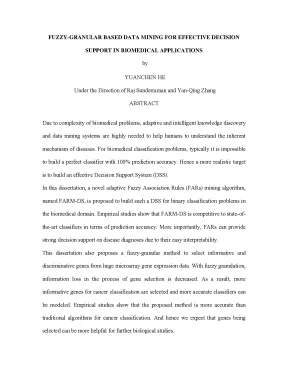
Tải xuống để đọc toàn bộFUZZY-GRANULAR BASED DATA MINING FOR EFFECTIVE DECISION SUPPORT IN BIOMEDICAL APPLICATIONS by YUANCHEN HE Under the Direction of Raj Sunderraman and Yan-Qing Zhang ABSTRACT Due to complexity of biomedical problems, adaptive and intelligent knowledge discovery and data mining systems are highly needed to help humans to understand the inherent mechanism of diseases. For biomedical classification problems, typically it is impossible to build a perfect classifier with 100% prediction accuracy. Hence a more realistic target is to build an effective Decision Support System (DSS). In this dissertation, a novel adaptive Fuzzy Association Rules (FARs) mining algorithm, named FARM-DS, is proposed to build such a DSS for binary classification problems in the biomedical domain.
Empirical studies show that FARM-DS is competitive to state-of- the-art classifiers in terms of prediction accuracy. More importantly, FARs can provide strong decision support on disease diagnoses due to their easy interpretability. This dissertation also proposes a fuzzy-granular method to select informative and discriminative genes from huge microarray gene expression data. With fuzzy granulation, information loss in the process of gene selection is decreased.
As a result, more informative genes for cancer classification are selected and more accurate classifiers can be modeled. Empirical studies show that the proposed method is more accurate than traditional algorithms for cancer classification. And hence we expect that genes being selected can be more helpful for further biological studies. INDEX WORDS: Data Mining, Knowledge Discovery, Computational Intelligence, Granular Computing, Fuzzy Association Rule Mining, Decision Support System, Binary Classification, Bioinformatics FUZZY-GRANULAR BASED DATA MINING FOR EFFECTIVE DECISION SUPPORT IN BIOMEDICAL APPLICATIONS by YUANCHEN HE A Dissertation Submitted in Partial Fulfillment of Requirements for the Degree of Doctor of Philosophy in the College of Arts and Sciences Georgia Stage University 2006 UMI Number: 3243236 Copyright 2006 by He, Yuanchen All rights reserved.
UMI Microform 3243236 Copyright 2007 by ProQuest Information and Learning Company. All rights reserved. This microform edition is protected against unauthorized copying under Title 17, United States Code. ProQuest Information and Learning Company 300 North Zeeb Road P.
Box 1346 Ann Arbor, MI 48106-1346 Copyright by Yuanchen He 2006 FUZZY-GRANULAR BASED DATA MINING FOR EFFECTIVE DECISION SUPPORT IN BIOMEDICAL APPLICATIONS by YUANCHEN HE Major Professor: Rajshekhar Sunderraman Yan-Qing Zhang Committee: Saeid Belkasim Yichuan Zhao Electronic Version Approved: Office of Graduate Studies College of Arts and Sciences Georgia State University December 2006 iv Acknowledgments Firstly, my specific thanks go to my co-advisors, Dr. Rajshekhar Sunderraman and Dr. Yan-Qing Zhang, for their careful guidance and precise advisement during the process of my PhD dissertation. The dissertation would not have been possible without their helps.
Secondly, I would like to thank my committee members, Dr. Saeid Belkasim and Dr. Yichuan Zhao for their well-appreciated support and assistance. Finally, I want to thank my family and friends for their support and beliefs.
v TABLE OF CONTENTS LIST OF TABLES .VIII LIST OF ACRONYMS.2 METRICS FOR CLASSIFICATION .1 KNOWLEDGE DISCOVERY, DATA MINING, AND DATA WAREHOUSING .2 ASSOCIATION RULE MINING .2 THE APRIORI ALGORITHM .3 ASSOCIATION RULE MINING FOR CLASSIFICATION .4 SOFT COMPUTING AND FUZZY LOGIC .1 FUZZY CONCEPT IN THE DATA MINING DOMAIN.2 FUZZY DATA MODELING .2 PROBABILITY DISTRIBUTION AND FUZZY SETS .3 DATA MINING AND QUANTITATIVE DATA.1 TRANSFORMING QUANTITATIVE DATA .2 FUZZY DATA MINING .3 FINDING FUZZY SETS.5 FUZZY ASSOCIATION RULE MINING .6 FUZZY ASSOCIATION RULE MINING FOR CLASSIFICATION .8 CLUSTERING AND DATA ABSTRACTION .2 REPRESENTATION OF CLUSTERS. 32 CHAPTER 3 FUZZY ASSOCIATION RULE MINING FOR DECISION SUPPORT .1 STEP 1: FUZZY INTERVAL PARTITIONING .2 STEP 2: DATA ABSTRACTING .3 STEP 3: GENERATING FUZZY DISCRETE TRANSACTIONS .4 STEP 4: MINING ASSOCIATION RULES. 46 CHAPTER 4 FARM-DS FROM MEDICAL DATA.2 RESULTS ANALYSIS ON EFFECTIVENESS .3 RESULT ANALYSIS ON EFFICIENCY .4 RESULT ANALYSIS ON INTERPRETABILITY. 52 CHAPTER 5 FARM-DS FROM MICROARRAY EXPRESSION DATA .2 CHALLENGES FOR BIOINFORMATICS SCIENTISTS .3 SIMULATION ENVIRONMENT AND DATASETS.4 PERFECT GENE SUBSETS .5 GENE-CANCER KNOWLEDGE DISCOVERY .6 FUZZY ASSOCIATION RULES.
64 CHAPTER 6 FUZZY-GRANULAR GENE SELECTION FROM MICROARRAY EXPRESSION DATA. TRADITIONAL ALGORITHMS FOR GENE SELECTION. SVM FOR CANCER CLASSIFICATION. CORRELATION-BASED FEATURE RANKING ALGORITHMS FOR GENE SELECTION 68 6.
A NEW FUZZY-GRANULAR BASED ALGORITHM FOR GENE SELECTION. FUZZY C-MEANS CLUSTERING. FUZZY-GRANULAR BASED GENE SELECTION. 80 CHAPTER 7 CONCLUSIONS AND FUTURE WORKS.
83 vii LIST OF FIGURES Figure 1. confusion matrix 2 Figure 1. Sample of Area under ROC curve 5 Figure 1. Sample of Area under Precision/Recall 7 Figure 2.
Apriori algorithm 12 Figure 2. discrete interval method 19 Figure 2. creating overlapping regions 20 Figure 2. fuzzy partition 20 Figure 3.
a sketch of FARM-DS 34 Figure 3. an example to project a sample onto a feature 44 Figure 4. an example to decide the optimal 50 Figure 6. positive-related gene, negative-related gene, both, neither 71 Figure 6.
Fuzzy-Granular gene selection 74 viii LIST OF TABLES TABLE 2.1 Notation for mining algorithm 11 TABLE 4.1 characteristics of datasets used for experiments 48 TABLE 4.2 farm-ds modeling results with trapezoidal-shaped membership functions by 5-fold cross validation 51 TABLE 4.3 validation error comparison by 5-fold cross validation 51 TABLE 4.4 running time comparison with 5-fold cross validation 52 TABLE 4.5 The feature information of the wisconsin Breast cancer data set 52 TABLE 4.6 12 wrongly classified samples on wisconsin breast cancer dataset 53 TABLE 4.7 the most general and the most specific fired rules for the 1st sample in fold 1 on wisconsin breast cancer dataset 54 TABLE 4.8 activation frequency of features on the wisconsin Breast cancer data 55 TABLE 5.1 characteristics of datasets 60 TABLE 5.2 a perfect gene subset selected on the aml/all dataset 61 TABLE 5.3 a perfect gene subset selected on the colon cancer dataset 62 TABLE 5.4 a perfect gene subset selected on the prostate cancer dataset 62 TABLE 5.5 classification errors of the four models 62 TABLE 5.6 auc of the four models 63 TABLE 5.7 rule numbers of the four models 63 TABLE 5.8 average rule lengths of the four models 63 ix TABLE 5.9 5 fuzzy association rules for aml/all dataset 64 TABLE 5.10 8 fuzzy association rules for colon dataset 64 TABLE 5.11 15 fuzzy association rules for prostate dataset 65 TABLE 6.1 leave-one out validation performance on the prostate cancer dataset 79 TABLE 6.632 bootstrapping performance on the prostate cancer dataset 79 TABLE 6.3 leave-one out validation performance on the colon cancer dataset 79 TABLE 6.632 bootstrapping performance on the colon cancer dataset 79 x LIST OF ACRONYMS Fuzzy Association Rule Mining FARM Decision Support DS 1 CHAPTER 1 INTRODUCTION In the last decade, with the advent of genomic and proteomic technologies, more and more biomedical databases have been created and have been growing in an exponential rate. Developing intelligent data analysis tools is essential to extract knowledge from these databases to ease biomedical decision-making process. The knowledge extracted from these databases is expected to be as accurate as possible. However, due to complexity and huge sizes of biomedical databases, it is difficult or even impossible to find 100% accurate knowledge.
Therefore, a more realistic goal is to build an intelligent data analysis tool as an effective Decision Support System (DSS). That is, the role of such a data analysis tool is not to replace human experts, but only to assist human experts to make decisions more reliably.1 Binary classification In this dissertation, we focus on binary classification modeling. Although binary classification is the simplest classification problem, many works show that the models for it can be naturally extended to multiple classification or regression problems. (This extension itself is an interesting research topic and will not be covered in this dissertation.) A general binary classification problem is defined as follows: • Given l independent and identically distributed (i.) samples ( x1 , y1 ), ( x2 , y2 ), K, ( xl , yl ) where xi ∈ R d , for i = 1,2,L, l is a feature vector 2 of length d and yi = {+1,−1} is the class label (+1 for the positive class, and -1 for the negative class) for data point xi , • Assume the classes are mutually exclusive and exhaustive, which means every sample has one and only one class label, • Find a classifier with the decision function f ( x,θ ) such that y = f ( x,θ ) , where y is the class label for x, θ is a vector of unknown parameters in the function.
These l samples are called “training data”. real negatives real positives predicted (TN) true (FN) false negatives negatives negatives predicted (FP) false (TP) true positives positives positives Figure.2 Feature selection Some binary classification problem is more natural to be modeled as a binary ranking modeling. Protein homology prediction task is a good example. The target is to predict if a protein sequence is homologous to another pre-specified natural protein sequence.
Because of biological complexity, it is difficult and arbitrary to say two protein sequences are absolutely homologous or not (1 or -1 is output); an output with "confidence" may be more helpful. In this way, many protein sequences could be ranked by their confidence to be homologous to the pre-specified protein sequence. As a result, biologists could quickly 3 prioritize a list of protein sequences for further study and thus their working efficiencies can be enhanced. A binary ranking problem is similar to a binary classification problem.
The differences are • the output is a real number in the field of [-1,1], and • the absolute value of the output is useless. Intuitively, a good model should rank the unseen positive samples (in case of protein homology prediction, they are homologous protein sequences) close to the top and rank unseen negative samples (in case of protein homology prediction, they are non-homologous protein sequences) close to the bottom of the list.3 Feature selection Feature selection is another important task usually correlated with a classification problem. Given a dataset, some input features may be irrelevant to classification. Furthermore, some features may be redundant or even noise due to complex correlations among them to hide real data distribution.
Hence, relevance analysis may be performed on the data with the aim of removing any irrelevant, redundant or noisy features from the learning process. In machine learning, this process is known as feature selection to filter out features, which may otherwise slow down, and possibly mislead, the learning step. Relevance analysis is closely related to binary classification. Suppose there are d input features in the original dataset, the target of feature selection is to select d i informative features while removing d n non-informative features.
The target is that the classifier modeled on the subset of d i features has better performance than the classifier modeled in the original feature set.2 Metrics for classification The performance of the classifier is usually measured in terms of misclassification error on unseen “testing data” which is defined in Eq.1) ⎩ 1 otherwise Based on the confusion matrix in Fig.1, many other metrics have been used for performance evaluation on classification. • Accuracy is the fraction of correctly classified samples over all samples. TN + TP accuracy = .2) TN + FN + FP + TP The overall accuracy metric at Eq.2) represents the same meaning as misclassification error. Both of them are used to evaluate classification performance on the whole dataset.
Besides them, two other kinds of metrics have been proposed for different purposes. The first kind of metrics is concern with balanced classification ability. Sensitivity at Eq.3) and specificity at Eq.4) are usually adopted to monitor classification performance on two classes, separately. • Sensitivity is the fraction of the real positives that actually are correctly predicted as positives.
• Specificity is the fraction of the real negatives that actually are correctly predicted as negatives.3) TP + FN TN specificity = .4) TN + FP 5 Notice that sensitivity is sometimes called true positive rate or positive class accuracy, while specificity called true negative rate or negative class accuracy, in different research communities.
Nội dung được bảo vệ bản quyền — Tải xuống đầy đủ
Trích dẫn luận án này
Yuanchen He (2006). Khai phá dữ liệu mờ hỗ trợ quyết định y sinh [Luận án tiến sĩ, Georgia State University]. LuanAn.net. https://luanan.net/cong-nghe-thong-tin/tri-tue-nhan-tao/khai-pha-du-lieu-mo-ho-tro-quyet-dinh-y-sinh
Từ khóa và chủ đề nghiên cứu
Từ khóa liên quan
Xem thêm luận án cùng lĩnh vực
Chủ đề nghiên cứu
Câu hỏi thường gặp
Luận án "Khai phá dữ liệu mờ hỗ trợ quyết định y sinh" nghiên cứu về vấn đề gì?
Luận án tiến sĩ đề xuất thuật toán khai phá dữ liệu mờ FARM-DS hỗ trợ chẩn đoán bệnh. Ứng dụng granular computing chọn lọc gen ung thư từ dữ liệu microarray.
Luận án "Khai phá dữ liệu mờ hỗ trợ quyết định y sinh" được bảo vệ tại trường nào?
Luận án này được bảo vệ tại Georgia State University. Năm bảo vệ: 2006.
Luận án "Khai phá dữ liệu mờ hỗ trợ quyết định y sinh" thuộc chuyên ngành gì?
Luận án "Khai phá dữ liệu mờ hỗ trợ quyết định y sinh" thuộc chuyên ngành Data Mining. Danh mục: Trí Tuệ Nhân Tạo.
Luận án "Khai phá dữ liệu mờ hỗ trợ quyết định y sinh" có bao nhiêu trang?
Luận án "Khai phá dữ liệu mờ hỗ trợ quyết định y sinh" có 108 trang. Bạn có thể xem trước một phần tài liệu ngay trên trang web trước khi tải về.
Cách tải luận án "Khai phá dữ liệu mờ hỗ trợ quyết định y sinh" về máy như thế nào?
Để tải luận án về máy, bạn nhấn nút "Tải xuống ngay" trên trang này, sau đó hoàn tất thanh toán phí lưu trữ. File sẽ được tải xuống ngay sau khi thanh toán thành công. Hỗ trợ qua Zalo: 0559 297 239.