Lựa chọn phương tiện đi lại và định giá tắc nghẽn thời gian thực - Luận án Tiến sĩ Kinh tế UCI
Qt9fz0z9kq nosplash 50e09e618850911e0ef6de780017a75c - Khám phá thông tin chi tiết, mã nguồn và ứng dụng liên quan đến các định danh độc đáo này.
University of California, Irvine
Luan An
Luận án tiến sĩ
Năm xuất bản
Số trang
158
Thời gian đọc
24 phút
Lượt xem
0
Lượt tải
0
Phí lưu trữ
50 Point
Tổng quan nhanh
- Chủ đề:
- 1. Optimizing Qt Application Startup with Nosplash Options
- Số trang:
- 158 trang
- Trường:
- University of California, Irvine
- Chuyên ngành:
- Economics
- Tác giả:
- Arindam Ghosh
- Năm:
- 2001
Tóm tắt nội dung luận án
I. Optimizing Qt Application Startup with Nosplash Options
Efficient application startup is crucial for user experience and system performance. Qt applications often include a splash screen, providing visual feedback during initialization. However, scenarios exist where disabling this feature becomes beneficial. The nosplash command line argument offers a direct method to bypass the splash screen, streamlining the launch process. This optimization is particularly valuable in automated environments, server-side operations, or when minimizing visual interruptions is a priority. Understanding how to integrate and manage such startup options enhances the overall flexibility and responsiveness of Qt software deployments. This section explores the mechanics of the nosplash argument, the benefits of its implementation, and broader considerations for configuring Qt application startup behavior. Faster loading times contribute to a more professional and efficient user interaction, especially in complex or frequently accessed applications. Developers gain greater control over the initial presentation and resource allocation of their Qt solutions.
1.1. Understanding the nosplash Command Line Argument
1.2. Disabling Splash Screens for Faster Loading
1.3. Integrating Startup Options for Qt Software
II. Ensuring Qt File Integrity with MD5 Hash Checksums
Maintaining the integrity of Qt application files is paramount for security, reliability, and proper functionality. Corrupted or tampered files can lead to unexpected behavior, crashes, or even security vulnerabilities. Utilizing cryptographic hash functions, such as MD5, provides a robust method for verifying file integrity. An MD5 hash generates a unique identifier, a fixed-size string, for any given input file. Comparing this calculated hash with a known, trusted checksum allows for immediate detection of any changes. This process is vital throughout the software lifecycle, from development and distribution to deployment and runtime. Implementing checksum verification ensures that the Qt application running on a user's system matches the intended version, protecting against accidental corruption or malicious modification. This section outlines the process of generating and verifying MD5 hashes, emphasizing their role in safeguarding Qt application files.
2.1. Generating MD5 Hashes for Qt Executables
2.2. Verifying File Checksums for Application Security
2.3. Best Practices for Software Integrity Checks
III. Customizing Qt Splash Screen Experiences Effectively
Splash screens offer the first visual impression of a Qt application, providing an opportunity for branding and user engagement during the loading period. Effective customization of splash screens enhances the user experience, transforming a simple waiting screen into an informative or aesthetically pleasing element. The Qt framework provides extensive capabilities for tailoring splash screens, ranging from basic image display to dynamic content presentation. Developers can control the visual elements, timing, and interactivity of the splash screen. This allows for a polished and professional application launch sequence. Proper customization can manage user expectations, display useful information like version numbers or loading progress, and reinforce brand identity. Beyond the nosplash argument for disabling, understanding the full scope of splash screen customization enables developers to craft a compelling initial interaction for their Qt applications.
3.1. Dynamic Splash Screen Management in Qt
3.2. Advanced Splash Screen Configuration Options
3.3. Enhancing User Experience with Branded Splash Screens
IV. Command Line Argument Usage in Qt Applications
Command line arguments provide a powerful and flexible mechanism for interacting with Qt applications at runtime. They enable users and developers to customize behavior, apply specific settings, or trigger particular functions without needing to modify source code or graphical interfaces. This dynamic configurability is essential for automation, testing, and supporting diverse operational environments. Qt provides robust tools for parsing and interpreting these arguments, allowing developers to define custom options that extend beyond standard system flags. Mastering command line argument usage is key to creating versatile and adaptable Qt software. It empowers users with greater control over application startup options and runtime execution. This section details the implementation of argument parsing, the creation of custom options, and the broader role of arguments in software configuration, offering insights into building more flexible Qt solutions.
4.1. Implementing Robust Command Line Argument Parsing
4.2. Defining Custom Application Startup Options
4.3. Runtime Software Configuration via Arguments
V. Managing Unique Identifiers Software Configuration
Effective software configuration and the use of unique identifiers are cornerstones of robust Qt application development. Unique identifiers provide a distinct reference for instances, files, or specific configurations, crucial for logging, debugging, and multi-instance management. Alongside these identifiers, a systematic approach to software configuration ensures that applications behave predictably across different environments and user settings. This involves establishing clear methods for storing, retrieving, and prioritizing configuration parameters. Integration with command line argument options provides an additional layer of flexibility, allowing runtime adjustments that can override or supplement persistent settings. A well-managed configuration system, supported by unique identifiers, enhances an application's maintainability, deployability, and overall reliability. This section explores strategies for incorporating unique identifiers and managing software configuration effectively within Qt projects, ensuring a consistent and controlled operational environment.
5.1. Utilizing Unique Identifiers for Qt Applications
5.2. Persistent Software Configuration Storage
5.3. Linking Configuration to Application Startup Options
Tải xuống file đầy đủ để xem toàn bộ nội dung
Tải đầy đủ (158 trang)Trích đoạn nội dung luận án
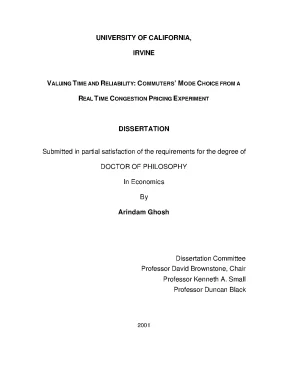
Tải xuống để đọc toàn bộUNIVERSITY OF CALIFORNIA, IRVINE VALUING T IME AND RELIABILITY: C OMMUTERS’ M ODE CHOICE FROM A REAL T IME CONGESTION PRICING EXPERIMENT DISSERTATION Submitted in partial satisfaction of the requirements for the degree of DOCTOR OF PHILOSOPHY In Economics By Arindam Ghosh Dissertation Committee Professor David Brownstone, Chair Professor Kenneth A. Small Professor Duncan Black 2001 © 2001 Arindam Ghosh The dissertation of Arindam Ghosh is approved and is acceptable in quality and form for publication on microfilm: ----------------------------------- ----------------------------------- ----------------------------------- Committee Chair University of California, Irvine 2001 DEDICATION To My Parents For their support and unwavering faith and for their sacrifices which made this dissertation a reality My Wife For everything TABLE OF CONTENTS PAGE LIST OF FIGURES vii LIST OF TABLES viii LIST OF SYMBOLS ix ACKNOWLEDGEMENT x CURRICULUM VITAE xi ABSTRACT OF THE DISSERTATION xiv INTRODUCTION 1 CHAPTER 1 LITERATURE REVIEW AND DESCRIPTION OF THE I-15 9 CONGESTION PRICING PROJECT SECTION 1.1 LITERATURE REVIEW 9 SECTION 1.2 THE I-15 C ONGESTION PRICING PROJECT 30 CHAPTER 2 DATA DESCRIPTION 35 SECTION 2.1 THE PANEL SURVEY 35 SECTION 2.2 NETWORK DATA 40 CHAPTER 3 PASS AND MODE CHOICE MODELS FROM REVEALED 50 PREFERENCE DATA SECTION 3.1 MODE CHOICE MODELS FOR MORNING COMMUTE : 52 USING RP D ATA FROM WAVE 5 SECTION 3.2 MORNING AND AFTERNOON MODE CHOICE MODEL 82 FROM WAVE 3 RP D ATA CHAPTER 4 VALUE-OF-TIME FROM STATED PREFERENCE AND 102 REVEALED PREFERENCE ROUTE-CHOICE AND MODE CHOICE MODELS SECTION 4.1 STATED PREFERENCE AND REVEALED PREFERENCE 102 R -C M ROUTE-CHOICE MODELS SECTION 4.2 JOINT ESTIMATION OF RP AND SP D ATA 113 SECTION 4.3 SP MODEL WITH UNOBSERVED HETEROGENEITY 118 CHAPTER 5 EXPLAINING THE DIFFERENCE 121 SECTION 5.1 SP MODEL CONDITIONAL ON ACTUAL CHOICE 122 SECTION 5.2 THE RP MODEL WITH PERCEIVED TIME SAVINGS 125 SECTION 5.3 A RANDOM EFFECTS DYNAMIC MODEL OF ROUTE 129 CHOICE SECTION 5.4 SP MODEL WITH IMPUTED VARIABILITY 133 SECTION 5.5 RP MODEL WITH 'CHANGED DEPARTURE TIME' 136 CONCLUSIONS 139 LIST OF FIGURES PAGE FIGURE 1 LOCATION OF THE I-15 HOT (OR EXPRESS) LANES 31 FIGURE 2 MEDIAN TIME SAVINGS FOR WAVE 3 AND 5 38 FIGURE 3 VARIABILITY FOR WAVES 3 AND 5 41 FIGURE 4 AVERAGE TED WILLIAMS WAIT FOR WAVE 3 AND 5 45 FIGURE 5 MEAN TOLL ACROSS WAVES 46 FIGURE 6 MEDIAN TIME SAVINGS, VARIABILITY AND TOLL FOR 47 AFTERNOON FIGURE 7 TREE STRUCTURE FOR THE NESTED LOGIT MODEL 48 FIGURE 8 NUMBER OF RESPONDENTS BY IMPLIED VOT FROM SP 48 LIST OF TABLES PAGE TABLE 1 DEMOGRAPHIC CHARACTERISTICS TABLE 2 THE DEPENDENT VARIABLE 18 TABLE 3 PURE CHOICE -BASED WEIGHTS 40 TABLE 4 ESTIMATION RESULT FROM THE MODE & P ASS CHOICE 42-43 MODEL TABLE 5 ESTIMATION RESULT FROM H. AND MIXED LOGIT 45 MODEL TABLE 6 VALUE -OF-TIME ($ PER HOUR) 64 TABLE 7 VALUE -OF-VARIABILITY 71 TABLE 8 EXPLANATION OF THE MODE CHOICE VARIABLE TABLE 9 PURE CHOICE -BASED WEIGHTS 122 TABLE 10 ESTIMATION RESULT 123 TABLE 11 VALUE -OF-TIME ESTIMATES ($/HR) FOR MORNING 143 AND AFTERNOON C OMMUTE TABLE 12 SUMMARY OF HOURLY WAGE 146 TABLE 13 VALUE OF VARIABILITY FOR MORNING 148 COMMUTE AFTER 7:30 AM & A FTERNOON COMMUTE TABLE 14 HYPOTHETICAL TOLL AND TIME SAVINGS FOR THE I-15 153 SAMPLE TABLE 15 ESTIMATION RESULT FOR THE ROUTE CHOICE MODELS 155 FOR THE REVEALED PREFERENCE & S TATED PREFERENCE EXPERIMENTS TABLE 16 VALUE -OF-TIME ESTIMATES FROM THE ROUTE CHOICE 156 MODELS TABLE 17 REPORTED WAGE RATE FOR THE THREE DIFFERENT SAMPLES TABLE 18 JOINT ESTIMATION OF SP-RP (WAVE 5) TABLE 19 THE LIKELIHOOD RATIO TEST FOR DATA ENRICHMENT TABLE 20 VALUE -OF-TIME AND VALUE –OF VARIABILITY FROM THE JOINT MODEL TABLE 20A SP MODEL WITH UNOBSERVED HETEROGENEITY TABLE 20B VALUE OF TIME ESTIMATES TABLE 21 SP MODEL CONDITIONAL ON ACTUAL CHOICE TABLE 22 VALUE -OF-TIME TABLE 23 SUMMARY OF PERCEPTION ERROR BY MODE CHOICE TABLE 24 RP MODE CHOICE MODEL WITH ‘EXCESS SAVINGS’ TABLE 25 VALUE OF TIME TABLE 26 THE RP MODEL BUT EXCLUDING THE CARPOOLERS TABLE 27 VALUE -OF-TIME & V ALUE -OF-VARIABILITY TABLE 28 A RANDOM EFFECTS PANEL MODEL OF RP ROUTE CHOICE TABLE 28A VALUE -OF-TIME TABLE 29 SP MODEL WITH IMPUTED VARIABILITY TABLE 30 VALUE OF TIME TABLE 31 A RP ROUTE CHOICE MODEL FOR FASTRAK USERS ONLY WITH 'CHANGED DEPARTURE TIME DUE TO FASTRAK TABLE 32 VALUE OF TIME LIST OF SYMBOLS Greek Symbol α Alpha β Beta γ Gamma δ Delta ε Epsilon φ Phi η Eta ϕ Psi λ Lambda π Pi θ Theta ρ Rho σ Sigma Φ Theta (Capital) ACKNOWLEDGEMENTS I would like to express my deepest appreciation to my committee chair, Professor David Brownstone, from whom I learned the art of disaggregate modeling. It was from him that I learned how to work with data and create meaningful models and I am also thankful for all those “cute little tricks” with data that made discrete choice modeling fun.
Without his guidance, persistent help, constant encouragement and advice this dissertation would not have been possible. I would also like to thank Professor Kenneth Small for teaching me transportation economics. More importantly he taught me the value of dedication and the determination not to be satisfied with anything less than perfect. Professor Pete Fielding helped me in integrating my research to a broader context and helped me improve my writing style.
Professor Tom Golob showed me how to be a good researcher and showed me how to look between the data. Thanks also go to the members of the San Diego I-15 Congestion Pricing Project evaluation team: Janusz Supernak and Christine Kaschade of San Diego State University, Jackie Golob of Jacqueline Golob Associates, Dirk van Amelsfort of Bureau Goudappel Coffeng, the Netherlands (formerly of Delft University) and Kim Kawada of San Diego Association of Governments (SANDAG). Kathy Happersett of the Social Science Research Laboratory of San Diego State University led the team that collected the panel survey data. This research was partly financially supported by the University of California Transportation Center (UCTC) through their dissertation fellowship.
I would also like to thank the University of California, Irvine for providing the Regents Dissertation Fellowship and Professor David Brownstone and Professor Tom Golob for supporting a large part of the research from their grant from the project "Consumer Response to Congestion Pricing on High-Occupancy/ Toll Lanes" sponsored by the University of California Transportation Center In the course of my graduate studies, I have been very fortunate in having wonderful classmates who over the years have become very good friends. But for them, the journey would have been much more arduous. My heartfelt appreciation also goes to all the staff in the Economics department and the Social Science graduate office, for easing a lot of the official red tape. I would specially like to thank Kathy Alberti, Ivonne Maldonado, Alicia Sanchez and Iris Adams for making me feel at home in the US and for providing constant support and encouragement.
CURRICULUM VITAE Arindam Ghosh Citizenship Indian Visa F-1 Fields Of Specialization Applied Microeconomics, Applied Econometrics, Transportation, Industrial Organization Education q University of California, Irvine (1997 to 2001) Ph. in Economics Dissertation Title: Value of Time and Mode Choice Under Road Congestion Pricing q Delhi School Of Economics, Delhi, India (1994 to 1996) M. in Economics q Jadavpur University , Calcutta, India (1991 to 1994) B. (Hons) in Economics Awards A.
Kimball Romney Award for Outstanding Graduate Paper (2001) , School of Social Sciences, University of California, Irvine. Regents' Dissertation Fellowship (Fall 2000) University of California, Irvine. Dissertation Fellowship (2000-2001) University of California Transportation Center , University of California, Berkeley Regents' Fellowship (1997-1998) University Of California, Irvine. Summer Fellowship (1998) Institute of Mathematical and Behavioral Sciences, University of California, Irvine.
Working Papers Heterogeneity in Value-of-Time: Revealed and Stated Preference Estimates from the I-15 Congestion Pricing Project (2000) To Pay Or Not To Pay: Commuters' Mode Choice Decisions Under Real Time Congestion Pricing Presented At the 1st IGERT Graduate Student Research Conference, April (2000) Presented at the 80th Annual TRB Meeting, January (2001) The Size Distribution of International Box Office Revenues and the Stable Paretian Hypothesis (2000) Willingness-to-Pay to Reduce Commute Time and Its Variance: Evidence from the San Diego I-15 Congestion Pricing Project. Joint with Camilla Kazimi, David Brownstone, Thomas. Golob and Dirk van Amelsfort Presented to the 79th Annual Meeting, Transportation Research Board. On Preprint CD-ROM.: Transportation Research Board (Jan.
2000) Teaching and Research Experience Research assistant for the project "Consumer Response to Congestion Pricing on High-Occupancy/ Toll Lanes" conducted by Dr. David Brownstone & Thomas Golob from 1998 to 2000. Project sponsored by the University of California Transportation Center. Was responsible for organizing the survey data, estimating econometric models and developing a code in GAUSS to estimate an efficient Method of Moments Estimator for discrete choice models under choice based sampling.
Served as a teaching assistant for several intermediate and advanced undergraduate Economics courses. Led discussion sections and lab sessions. Conducted review sessions. Research Associate at Center for Development Economics, Delhi School of Economics, India from August 96 to June 97.
Was responsible for monitoring and analyzing different development indicators for India. Helped create and manage a database of leading indicators of the Indian stock market Current Research My current research analyzes the mode and scheduling choice for commuters on I-15 of San Diego, California. In particular, I study the value-of-time for this corridor from revealed and stated preference estimates and examine its policy implications. Work-in-Progress Transit Maintenance: A Survey Principal-Agent Relationship with an Informed Principal: The Managerial Contract Model Corruption: A review of Issues Language Proficiency English, Hindi, Bengali (Read, Write and Speak fluently).
Computer Skills Stata, Gauss, EVIEWS, LIMDEP, Shazam, Matlab, Excel and other software packages. Professional Affiliation American Economic Association References Prof. David (949) 824 – 6231 Brownstone dbrownst@uci.edu Professor of Economics 3151 Social Science Plaza Prof. Kenneth Small (949)824-5658, University of California, Professor Of 7642 Irvine Economics, ksmall@uci.edu CA 92697-5100 Fax: (949)824-2182 Prof.
(Pete) (949) 824-5448 Fielding gjfieldi@uci.edu Professor Emeritus ABSTRACT OF THE DISSERTATION Valuing Time and Reliability: Commuters’ Mode Choice from a Real Time Congestion Pricing Experiment By Arindam Ghosh Doctor of Philosophy in Economics University of California, Irvine, 2001 Prof. Davis Brownstone, Chair The valuation of travel time savings has been an important theme in transportation research because it is the single largest contributor to the benefits of many transportation projects. It also plays a central role in deciding about the size and scope of public investment and has important welfare implications. It can shed important light as to whether any congestion pricing scheme will have increase social welfare or not.
And help us understand how commuters make their travel decisions. The San Diego I-15 Congestion Pricing Project (SDCPP) is a demonstration project where an existing High Occupancy Vehicle lane was converted to HOT (High Occupancy/Toll) lane. Beginning in 1996 these lanes were made available to solo drivers who pay a toll. The toll adjusts every six minutes to maintain free flowing traffic on the HOT lane.
Carpoolers get to use the lane for free as before. This presents us with a unique opportunity to study commuters’ choice between a tolled and a free alternative based on not only what the commuters say they would do (SP), but also on what they actually did (RP). The general result is that this tolled facility is used by high income, middle aged, homeowners, female commuters. An interesting result that comes out of this analysis is the dual effects of toll.
If the actual toll rises above the mean toll then the commuter is more likely to take the FasTrak lane. Another interesting implication that the effect of toll is conditional on the level of uncertainty of travel time and conversely uncertainty in travel time encourages use of FasTrak lane only if toll rises above a threshold value. Commuters are more sensitive to variations in travel time in the morning, specially during the peak, than in the afternoon.
Nội dung được bảo vệ bản quyền — Tải xuống đầy đủ
Trích dẫn luận án này
Arindam Ghosh (2001). Lựa chọn phương tiện đi lại: Nghiên cứu từ thí nghiệm định giá tắc nghẽn thời gian thực [Luận án tiến sĩ, University of California, Irvine]. LuanAn.net. https://luanan.net/cong-nghe-thong-tin/qt9fz0z9kq-nosplash-50e09e618850911e0ef6de780017a75c
Câu hỏi thường gặp
Luận án "Lựa chọn phương tiện đi lại: Nghiên cứu từ thí nghiệm định giá tắc nghẽn thời gian thực" nghiên cứu về vấn đề gì?
Qt9fz0z9kq nosplash 50e09e618850911e0ef6de780017a75c - Khám phá thông tin chi tiết, mã nguồn và ứng dụng liên quan đến các định danh độc đáo này.
Luận án "Lựa chọn phương tiện đi lại: Nghiên cứu từ thí nghiệm định giá tắc nghẽn thời gian thực" được bảo vệ tại trường nào?
Luận án này được bảo vệ tại University of California, Irvine. Năm bảo vệ: 2001.
Luận án "Lựa chọn phương tiện đi lại: Nghiên cứu từ thí nghiệm định giá tắc nghẽn thời gian thực" thuộc chuyên ngành gì?
Luận án "Lựa chọn phương tiện đi lại: Nghiên cứu từ thí nghiệm định giá tắc nghẽn thời gian thực" thuộc chuyên ngành Economics. Danh mục: Công Nghệ Thông Tin.
Luận án "Lựa chọn phương tiện đi lại: Nghiên cứu từ thí nghiệm định giá tắc nghẽn thời gian thực" có bao nhiêu trang?
Luận án "Lựa chọn phương tiện đi lại: Nghiên cứu từ thí nghiệm định giá tắc nghẽn thời gian thực" có 158 trang. Bạn có thể xem trước một phần tài liệu ngay trên trang web trước khi tải về.
Cách tải luận án "Lựa chọn phương tiện đi lại: Nghiên cứu từ thí nghiệm định giá tắc nghẽn thời gian thực" về máy như thế nào?
Để tải luận án về máy, bạn nhấn nút "Tải xuống ngay" trên trang này, sau đó hoàn tất thanh toán phí lưu trữ. File sẽ được tải xuống ngay sau khi thanh toán thành công. Hỗ trợ qua Zalo: 0559 297 239.