Pattern search ranking and selection algorithms for mixed variabl
Thuật toán xếp hạng và chọn mẫu cho tìm kiếm hỗn hợp VA. Tối ưu hóa hiệu quả, tăng cường kết quả tìm kiếm.
Air Force Institute of Technology
Operations Research
Luan An
Luận án tiến sĩ
Năm xuất bản
Số trang
252
Thời gian đọc
38 phút
Lượt xem
0
Lượt tải
0
Phí lưu trữ
50 Point
Tổng quan nhanh
- Chủ đề:
- Tối ưu hóa biến hỗn hợp: Giải pháp hệ thống ngẫu nhiên
- Số trang:
- 252 trang
- Trường:
- Air Force Institute of Technology
- Chuyên ngành:
- Operations Research
- Tác giả:
- Todd A. Sriver
- Năm:
- 2004
Tóm tắt nội dung luận án
I.Tối ưu hóa biến hỗn hợp Giải pháp hệ thống ngẫu nhiên
Tài liệu giới thiệu một lớp thuật toán mới. Nó giải quyết các bài toán tối ưu hóa. Các bài toán này có ràng buộc biên và tuyến tính. Hàm mục tiêu là ngẫu nhiên. Biến thiết kế có loại hỗn hợp. Đây là một vấn đề quan trọng trong tối ưu hóa biến hỗn hợp. Nhiều hệ thống thực tế có tính chất ngẫu nhiên. Chúng cũng chứa các biến liên tục, rời rạc. Điều này dẫn đến các thách thức đáng kể. Phương pháp này cung cấp một giải pháp hiệu quả. Nó nhằm giải quyết sự phức tạp của các hệ thống như vậy. Khả năng xử lý dữ liệu ngẫu nhiên là rất quan trọng.
1.1. Giới thiệu vấn đề tối ưu hóa phức tạp
Vấn đề nằm ở việc tối ưu hóa các hệ thống ngẫu nhiên. Các biến thiết kế bao gồm nhiều loại. Chúng có thể là liên tục, số rời rạc hoặc phân loại rời rạc. Hàm mục tiêu thường không có đạo hàm rõ ràng. Các ràng buộc biên và tuyến tính cũng được xem xét. Đây là một hình thức của tối ưu hóa phi tuyến số nguyên hỗn hợp (MINLP). Nó đòi hỏi các phương pháp đặc biệt. Thuật toán này cung cấp một khung làm việc mới.
1.2. Các loại biến trong miền tối ưu hóa
Các thuật toán này áp dụng cho miền biến hỗn hợp. Miền này bao gồm các biến liên tục, số rời rạc và phân loại rời rạc. Chúng có thể có ràng buộc biên và tuyến tính trên các biến liên tục. Khả năng xử lý các loại biến khác nhau là một điểm mạnh. Điều này rất quan trọng đối với các bài toán tối ưu hóa số nguyên hỗn hợp (MIO). Các thuật toán đạo hàm tự do là cần thiết. Hàm mục tiêu thường là 'hộp đen'. Điều này tăng tính linh hoạt của phương pháp.
II.Thuật toán tìm kiếm mẫu Tiếp cận không đạo hàm mới
Cách tiếp cận mở rộng lớp thuật toán tìm kiếm mẫu tổng quát (GPS). Nó áp dụng cho thiết lập bài toán mới. Trong đó, việc đánh giá hàm mục tiêu đòi hỏi lấy mẫu. Lấy mẫu từ một mô hình hệ thống ngẫu nhiên. Các thuật toán tìm kiếm trực tiếp này không cần đạo hàm. Chúng chỉ yêu cầu phản hồi mô phỏng 'hộp đen'. Điều này hữu ích khi đạo hàm khó tính toán. Hoặc khi hàm mục tiêu không trơn. Đây là một phương pháp tối ưu hóa đạo hàm tự do hiệu quả. Nó mở rộng phạm vi ứng dụng của GPS. Cách tiếp cận này giúp giải quyết các bài toán phức tạp mà các phương pháp truyền thống gặp khó khăn. Nó cung cấp một công cụ mạnh mẽ cho các nhà nghiên cứu và thực hành.
2.1. Mở rộng thuật toán tìm kiếm mẫu tổng quát GPS
GPS được mở rộng để phù hợp với hàm mục tiêu ngẫu nhiên. Quá trình đánh giá yêu cầu lấy mẫu từ hệ thống. Điều này làm cho thuật toán trở thành phương pháp tối ưu hóa đạo hàm tự do. Nó không cần thông tin đạo hàm. GPS đặc biệt hiệu quả trong tối ưu hóa biến hỗn hợp. Nó có thể hoạt động với dữ liệu không liên tục. Đây là một tiến bộ đáng kể trong lĩnh vực này.
2.2. Ưu điểm của tiếp cận không đạo hàm
Ưu điểm chính là không yêu cầu thông tin đạo hàm. Nhiều bài toán tối ưu hóa thực tế có hàm mục tiêu phức tạp. Đạo hàm của chúng không tồn tại hoặc rất khó tính toán. Thuật toán này sử dụng các phản hồi mô phỏng trực tiếp. Nó giúp giải quyết các bài toán đó. Khả năng làm việc với các hệ thống ngẫu nhiên là quan trọng. Nó giúp tối ưu hóa biến hỗn hợp. Phương pháp này có thể tìm kiếm các điểm dừng. Nó không bị kẹt ở các điểm không trơn tru.
III.Xếp hạng và lựa chọn giải pháp Cải thiện hiệu quả
Cách tiếp cận kết hợp GPS với các quy trình thống kê xếp hạng và lựa chọn (R&S). Mục tiêu là chọn các điểm lặp mới. Các quy trình R&S giúp quản lý sự không chắc chắn. Đặc biệt khi đánh giá hàm mục tiêu là ngẫu nhiên. Chúng cung cấp một khuôn khổ đáng tin cậy. Điều này để so sánh và lựa chọn các giải pháp tiềm năng. Quá trình này rất quan trọng để đưa ra quyết định tối ưu. Nó giúp trong môi trường có nhiễu. Sự kết hợp này mang lại sức mạnh. Nó giúp thuật toán tìm kiếm hiệu quả hơn trong việc xác định các giải pháp tối ưu. Khả năng xếp hạng giải pháp là trọng tâm của phương pháp này. Nó đảm bảo các bước tiến có căn cứ.
3.1. Quy trình thống kê xếp hạng và lựa chọn R S
R&S là một công cụ thống kê. Nó giúp so sánh các phương án. Đặc biệt hữu ích khi kết quả mang tính ngẫu nhiên. Trong bối cảnh này, R&S chọn điểm lặp tiếp theo của thuật toán. Nó đảm bảo rằng các quyết định được đưa ra có cơ sở thống kê. Điều này làm tăng độ tin cậy của thuật toán. Nó giúp tránh các lỗi do nhiễu dữ liệu. Đây là một thành phần quan trọng trong việc tối ưu hóa cục bộ và toàn cục.
3.2. Lựa chọn điểm lặp mới thông minh
Việc sử dụng R&S đảm bảo lựa chọn điểm lặp mới hiệu quả. Nó cân bằng giữa thăm dò và khai thác. Điều này cần thiết trong tối ưu hóa đạo hàm tự do. Mục tiêu là tìm kiếm các giải pháp tốt hơn một cách tin cậy. Xếp hạng giải pháp giúp đánh giá độ tin cậy. Nó so sánh các ứng viên giải pháp. Sau đó chọn ra những ứng viên hứa hẹn nhất. Điều này cải thiện khả năng tìm kiếm. Nó hướng đến tối ưu hóa toàn cục hoặc tối ưu hóa cục bộ hiệu quả.
IV.Cải tiến thuật toán Tối ưu hóa với hàm xấp xỉ
Các lựa chọn triển khai bao gồm sử dụng các hàm thay thế. Các hàm này tăng cường tìm kiếm. Chúng xấp xỉ hàm mục tiêu chưa biết. Chúng sử dụng các bề mặt đáp ứng phi tham số. Điều này giúp giảm số lần đánh giá hàm mục tiêu thực tế. Đặc biệt khi đánh giá tốn kém. Hàm thay thế có thể dẫn đến hiệu suất cao hơn. Chúng giúp định hướng tìm kiếm hiệu quả hơn. Đây là một chiến lược thường thấy trong các thuật toán metaheuristic. Nó giúp tìm kiếm tối ưu hóa toàn cục. Các cải tiến này rất quan trọng. Chúng làm cho thuật toán trở nên thực tế và hiệu quả hơn trong các ứng dụng thực tế. Nó là một phương pháp lựa chọn mô hình hiệu quả.
4.1. Sử dụng hàm thay thế surrogate functions
Hàm thay thế, hay mô hình xấp xỉ, được dùng để tăng tốc tìm kiếm. Chúng ước tính giá trị của hàm mục tiêu tốn kém. Điều này giảm số lượng các lần mô phỏng cần thiết. Hàm thay thế giúp thuật toán định hướng tìm kiếm tốt hơn. Chúng cải thiện hiệu quả tổng thể. Đây là một kỹ thuật mạnh mẽ trong tối ưu hóa biến hỗn hợp. Nó hỗ trợ các chiến lược tối ưu hóa toàn cục.
4.2. Chiến lược lấy mẫu hiệu quả từ R S hiện đại
Các thuật toán cũng có thể sử dụng các quy trình R&S hiện đại. Chúng được thiết kế để cung cấp các chiến lược lấy mẫu hiệu quả. Lấy mẫu hiệu quả làm giảm chi phí tính toán. Nó cải thiện độ chính xác trong việc xếp hạng giải pháp. Việc lựa chọn mô hình và tối ưu hóa biến hỗn hợp được hưởng lợi. Các chiến lược này tối ưu hóa việc phân bổ tài nguyên mô phỏng. Nó hướng tới việc tìm ra giải pháp tốt nhất. Điều này giúp đẩy nhanh quá trình tối ưu hóa.
V.Phân tích hội tụ Đảm bảo tính vững chắc thuật toán
Phân tích hội tụ được thiết lập cho lớp thuật toán chung. Nó xác định hội tụ gần chắc chắn của một chuỗi con lặp. Chuỗi này hướng đến các điểm dừng. Các điểm dừng được định nghĩa phù hợp trong miền biến hỗn hợp. Điều này đảm bảo tính vững chắc về mặt lý thuyết. Nó khẳng định rằng thuật toán tìm thấy các giải pháp hợp lệ. Điều này rất quan trọng cho các phương pháp tối ưu hóa đạo hàm tự do. Đặc biệt khi giải quyết tối ưu hóa phi tuyến số nguyên hỗn hợp (MINLP). Phân tích này là nền tảng. Nó chứng minh rằng các kết quả thuật toán đáng tin cậy. Nó cung cấp sự tự tin vào khả năng của phương pháp. Nó hướng tới việc tìm kiếm tối ưu hóa toàn cục.
5.1. Hội tụ gần chắc chắn đến các điểm dừng
Phân tích hội tụ chứng minh rằng thuật toán hội tụ. Hội tụ gần chắc chắn đến các điểm dừng. Những điểm này được định nghĩa phù hợp với miền biến hỗn hợp. Điều này cung cấp sự đảm bảo về mặt lý thuyết. Nó khẳng định tính đúng đắn của phương pháp. Đối với tối ưu hóa đạo hàm tự do, đây là một bước tiến quan trọng. Nó đảm bảo thuật toán đạt được mục tiêu tìm kiếm. Nó có khả năng tìm kiếm tối ưu hóa cục bộ.
5.2. Áp dụng cho bài toán MINLP và MIO
Tính chất 'biến hỗn hợp' và 'phi tuyến' ám chỉ khả năng áp dụng. Nó có thể giải quyết các bài toán tối ưu hóa phi tuyến số nguyên hỗn hợp (MINLP). Các kết quả hội tụ là rất quan trọng. Chúng cung cấp cơ sở lý thuyết vững chắc. Cơ sở này để sử dụng các thuật toán này. Áp dụng cho các bài toán tối ưu hóa số nguyên hỗn hợp (MIO) phức tạp. Điều này bao gồm tìm kiếm tối ưu hóa toàn cục và tối ưu hóa cục bộ.
VI.Thử nghiệm và kết quả Xác thực hiệu suất giải pháp
Đánh giá tính toán đã được thực hiện. Sáu biến thể cụ thể của thuật toán được thử nghiệm. Cùng với đó là bốn phương pháp cạnh tranh. Thử nghiệm trên 26 bài toán kiểm tra tiêu chuẩn hóa. Điều này cho phép so sánh toàn diện. Nó giúp đánh giá hiệu suất của phương pháp mới. Các biến thể này thể hiện các cải tiến khác nhau. Điều này bao gồm việc sử dụng các chiến lược xếp hạng giải pháp nâng cao. Kết quả số học xác nhận việc sử dụng các triển khai nâng cao. Nó như một phương tiện để cải thiện hiệu suất thuật toán. Điều này bao gồm các kỹ thuật tối ưu hóa đạo hàm tự do và tối ưu hóa biến hỗn hợp. Các cải tiến như hàm thay thế và R&S hiện đại đã chứng minh giá trị. Chúng giúp thuật toán tìm kiếm hiệu quả hơn.
6.1. Đánh giá sáu biến thể thuật toán cụ thể
Sáu biến thể khác nhau của thuật toán đã được triển khai. Chúng được thử nghiệm để đánh giá hiệu suất. Mỗi biến thể có các cải tiến riêng. Điều này cho phép phân tích chi tiết. Nó giúp xác định những yếu tố nào cải thiện hiệu quả. Việc so sánh với bốn phương pháp cạnh tranh khác rất quan trọng. Nó khẳng định ưu việt của cách tiếp cận mới. Đặc biệt trong bối cảnh tối ưu hóa biến hỗn hợp.
6.2. Kết quả số học xác nhận cải tiến hiệu suất
Kết quả số học cung cấp bằng chứng thực nghiệm. Chúng cho thấy các triển khai nâng cao thực sự cải thiện hiệu suất. Điều này đặc biệt đúng với các kỹ thuật tối ưu hóa đạo hàm tự do. Việc sử dụng các hàm thay thế và quy trình R&S hiện đại là hiệu quả. Chúng giúp thuật toán vượt trội. So sánh với các thuật toán metaheuristic khác. Kết quả này củng cố giá trị của phương pháp. Nó hỗ trợ khả năng lựa chọn mô hình và xếp hạng giải pháp.
Mục lục chi tiết luận án
Tải xuống file đầy đủ để xem toàn bộ nội dung
Tải đầy đủ (252 trang)Trích đoạn nội dung luận án
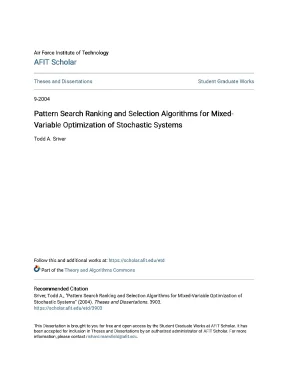
Tải xuống để đọc toàn bộAir Force Institute of Technology AFIT Scholar Theses and Dissertations Student Graduate Works 9-2004 Pattern Search Ranking and Selection Algorithms for Mixed- Variable Optimization of Stochastic Systems Todd A. Sriver Follow this and additional works at: https://scholar.edu/etd Part of the Theory and Algorithms Commons Recommended Citation Sriver, Todd A., "Pattern Search Ranking and Selection Algorithms for Mixed-Variable Optimization of Stochastic Systems" (2004). Theses and Dissertations.edu/etd/3903 This Dissertation is brought to you for free and open access by the Student Graduate Works at AFIT Scholar. It has been accepted for inclusion in Theses and Dissertations by an authorized administrator of AFIT Scholar.
For more information, please contact richard. Pattern Search Ranking and Selection Algorithms for Mixed-Variable Optimization of Stochastic Systems DISSERTATION Todd A. Major, USAF AFIT/DS/ENS/04-02 DEPARTMENT OF THE AIR FORCE AIR UNIVERSITY AIR FORCE INSTITUTE OF TECHNOLOGY Wright-Patterson Air Force Base, Ohio Approved for public release; distribution unlimited The views expressed in this dissertation are those of the author and do not reflect the official policy or position of the United States Air Force, the Department of Defense, or the United States Government. AFIT/DS/ENS/04-02 Pattern Search Ranking and Selection Algorithms for Mixed-Variable Optimization of Stochastic Systems DISSERTATION Presented to the Faculty of the Graduate School of Engineering and Management Air Force Institute of Technology Air University In Partial Fulfillment for the Degree of Doctor of Philosophy Specialization in: Operations Research Todd A.
Major, USAF September, 2004 Sponsored by the Air Force Office of Scientific Research Approved for public release; distribution unlimited AFIT/DS/ENS/04-02 Abstract A new class of algorithms is introduced and analyzed for bound and linearly con- strained optimization problems with stochastic objective functions and a mixture of design variable types. The generalized pattern search (GPS) class of algorithms is extended to a new problem setting in which objective function evaluations require sampling from a model of a stochastic system. The approach combines GPS with ranking and selection (R&S) statistical procedures to select new iterates. The derivative-free algorithms require only black-box simulation responses and are applicable over domains with mixed variables (con- tinuous, discrete numeric, and discrete categorical) to include bound and linear constraints on the continuous variables.
A convergence analysis for the general class of algorithms establishes almost sure convergence of an iteration subsequence to stationary points appro- priately defined in the mixed-variable domain. Additionally, specific algorithm instances are implemented that provide computational enhancements to the basic algorithm. Im- plementation alternatives include the use of modern R&S procedures designed to provide efficient sampling strategies and the use of surrogate functions that augment the search by approximating the unknown objective function with nonparametric response surfaces. In a computational evaluation, six variants of the algorithm are tested along with four com- peting methods on 26 standardized test problems.
The numerical results validate the use of advanced implementations as a means to improve algorithm performance. iv Acknowledgments I express my heartfelt gratitude to many individuals who directly or indirectly sup- ported me in the challenging, but rewarding, endeavor of completing a Ph. I begin with the most important person — my wife — whose strength and encouragement were essential to my success. I am also grateful for our three children (who make me very proud) for the ability to make me smile during those times when the road ahead seemed difficult.
I owe a deep thanks my research advisor, Professor Jim Chrissis. His expertise, guid- ance, and friendship kept me on the right track while enabling me to enjoy the ride. I am also grateful to the remainder of my research committee, Lt Col Mark Abramson, Professor Dick Deckro, and Professor J. Miller for all of the positive support they provided me.
In particular, Lt Col Abramson’s help on some of the more theoretical issues was crucial to the development of the material presented in Chapter 3. I also thank the Air Force Office of Scientific Research for sponsoring my work. I would be negligent if I did not acknowledge my friends and colleagues in the B. The synergy amongst the Ph.
students in that small building led to some novel ideas incorporated in my research (Major Trevor Laine gets credit for introducing me to kernel regression); but, perhaps more importantly, the moments of levity kept things in the proper perspective. Finally, I offer a special thanks to both my mother and father. Their love and guidance throughout my life has inspired me to seek achievement. Sriver v Table of Contents Page Abstract.
v List of Figures. x List of Tables .2 Purpose of the Research .1 Methods for Stochastic Optimization .3 Ranking and Selection .5 Response Surface Methods .7 Summary of Methods .2 Generalized Pattern Search .1 Pattern Search for Continuous Variables .2 Pattern Search for Mixed Variables .3 Pattern Search for Random Response Functions. ALGORITHMIC FRAMEWORK AND CONVERGENCE THEORY .2 Positive Spanning Sets and Mesh Construction .3 Bound and Linear Constraint Handling .4 The MGPS Algorithm for Deterministic Optimization .5 Iterate Selection for Noisy Response Functions .6 The MGPS-RS Algorithm for Stochastic Optimization .1 Controlling Incorrect Selections .2 Mesh Size Behavior .1 Specific Ranking and Selection (R&S) Procedures .2 Use of Surrogate Models .1 Building the Surrogate During Initialization .2 Algorithm Search Steps and Termination .1 Continuous-Variable Problems .2 Mixed-Variable Problems .1 Performance Measures and Statistical Model .2 Selection of Parameter Settings .5 Results and Analysis .1 Analysis of MGPS-RS Variant Implementations .2 Comparative Analysis of All Algorithm Implementations .3 Termination Criteria Analysis .4 Summary of the Analysis. 140 viii Page Chapter 6.
CONCLUSIONS AND RECOMMENDATIONS .1 Modifications to Existing Search Framework .2 Extensions to Broader Problem Classes. TEST PROBLEM DETAILS. TEST RESULT DATA .1 Iteration History Charts .2 Statistical Analysis Data Summary. 235 ix List of Figures Figure Page 1.1 Model for Stochastic Optimization via Simulation .1 Robbins-Monro Algorithm for Stochastic Optimization (adapted from [10]) .2 General Random Search Algorithm (adapted from [11]) .3 Nelder-Mead Search (adapted from [141]) .1 Directions that conform to the boundary of Θc (from [81]) .2 MGPS Algorithm for Deterministic Optimization (adapted from [1]) .4 MGPS-RS Algorithm for Stochastic Optimization .5 Example Test Function.6 Asymptotic behavior of MGPS-RS, shown after 2 million response samples.1 Rinott Selection Procedure (adapted from [27]) .2 Combined Screening and Selection (SAS) Procedure (adapted from [99]) .3 Sequential Selection with Memory (adapted from [109]) .4 Smoothing effect of various bandwidth settings for fitting a surface to eight design sites in one dimension.5 Examples of Latin Hypercube Samples of Strengths 1 and 2 for p = 5.6 Demonstration of the surrogate building process during MGPS-RS algorithm execution.7 Growth of response samples required per Rinott R&S procedure for a fixed response variance of S 2 = 1.8 Growth in response samples for Rinott’s R&S procedure as α decreases for fixed ratio Sδ = 1.9 Algorithm flow chart for MGPS-RS using surrogates.10 MGPS-RS Algorithm using Surrogates for Stochastic Optimization .11 Algorithm for Generating Conforming Directions (adapted from [1] and [81]).1 Illustration of Corrective Move Method for Infeasible Iterates Used in SA Algorithms.2 Random Search Algorithm Used in Computational Evaluation .3 Mixed-variable Test Problem Illustration for nc = 2.
117 xi List of Tables Table Page 3.1 MGPS-RS Average Performance for Noise Case 1 over 20 Replications.2 MGPS-RS Average Performance for Noise Case 2 over 20 Replications.1 Summary of MGPS-RS parameters.1 Continuous-Variable Test Problem Properties.2 Mixed-variable Test Problems.3 Parameter Settings for All Algorithms — Continuous-variable Problems.4 Summary of “Tunable” Parameter Settings for all Algorithms — Continuous-variable Problems.5 Parameter Settings for MGPS-RS and RNDS Algorithms — Mixed-variable Problems.6 Significance Tests of Main Effects for Performance Measures Q and P — Continuous-variable Test Problems .7 Significance Tests of Main Effects for Performance Measures Q and P — Mixed-variable Test Problems.8 Terminal Value for Performance Measure Q Averaged over 60 Replications (30 for each noise case) — MGPS-RS Algorithms.9 Terminal Value for Performance Measure P Averaged over 60 Replications (30 for each noise case) — MGPS-RS Algorithms.10 Number of Switches SW at Termination Averaged over 60 Replications (30 for each noise case) — MGPS-RS Algorithms. 132 xii Table Page 5.11 Terminal Value for Performance Measure Q Averaged over 60 Replications (30 for each noise case) — FDSA, SPSA, RNDS, NM, and Best MGPS-RS Algorithms.12 Terminal Value for Performance Measure P Averaged over 60 Replications (30 for each noise case) — FDSA, SPSA, RNDS, NM, and Best MGPS-RS Algorithms.13 Termination Criteria Analysis for S-MGPS-RIN — Noise Case 1.14 Termination Criteria Analysis for S-MGPS-RIN — Noise Case 2.1 Transformation functions and Shapiro-Wilk Nonnormality Test Results.2 P-values for Nonparametric Tests — Performance Measure Q.3 P-values for Nonparametric Tests — Performance Measure P. 195 xiii Pattern Search Ranking and Selection Algorithms for Mixed-Variable Optimization of Stochastic Systems Chapter 1 - Introduction 1.1 Problem Setting Consider the optimization of a stochastic system in which the objective is to find a set of controllable system parameters that minimize some performance measure of the system. This situation is representative of many real-world optimization problems in which random noise is present in the evaluation of the objective function.
In many cases, the system is of sufficient complexity so that the objective function, representing the performance measure of interest, cannot be formulated analytically and must be evaluated via a representative model of the system. In particular, the use of simulation is emphasized as a means of characterizing and analyzing system performance. The term simulation is used in a generic sense to indicate a numerical procedure that takes as input a set of controllable system parameters (design variables) and generates as output a response for the measure of interest. It is assumed that the variance of this measure can be reduced at the expense of additional computational effort, e., repeated sampling from the simulation.
Applications involve the optimization of system designs where the systems under analy- sis are represented as simulation models, such as those used to model manufacturing sys- tems, production-inventory situations, communication or other infrastructure networks, lo- gistics support systems, or airline operations. In these situations, a search methodology is used to drive the search for the combination of values of the design variables that optimize a system measure of performance. A model of such a stochastic optimization methodology via simulation is depicted in Figure 1. Vector of design variable values Initial guess, Parameter Optimization ⎡ X1 ⎤ settings Routine X = ⎢⎢ M ⎥⎥ ⎢⎣ X n ⎥⎦ Stochastic Prescribes improved Simulation vector via search technique {Fi ( X)}is=1 “Black-box” system response samples Figure 1.
Model for Stochastic Optimization via Simulation The random performance measure may be modeled as an unknown response function F (x, ω) which depends upon an n-dimensional vector of controllable design variables x ∈ Rn , and the vector ω, which represents random effects inherent to the system. The objective function f of the optimization problem is the expected performance of the system, given by f(x) = EP [F (x, ω)] = F (x, ω)P (dω), (1.1) Ω where ω ∈ Ω can be considered an element of an underlying probability space (Ω, F, P ) with sample space Ω, sigma-field F, and probability measure P. It is assumed that the probability distribution that defines the response F (x, ω) is unknown but can be sampled. Even for noise-free system responses obtained via simulation, finding optimal solutions using traditional optimization approaches can be difficult since the structure of f is un- known, analytical derivatives are unavailable, and numerical evaluation of f may involve 2 expensive simulation runs.
The presence of random variation further complicates matters because f cannot be evaluated exactly and derivative approximating techniques, such as finite differencing, become problematic. Estimating f requires the aggregation of repeated samples of the response F , making it difficult to determine conclusively if one design is better than another and further hindering search methods that explicitly rely on directions of improvement.
Nội dung được bảo vệ bản quyền — Tải xuống đầy đủ
Trích dẫn luận án này
Todd A. Sriver (2004). Pattern search ranking and selection algorithms for mixed va [Luận án tiến sĩ, Air Force Institute of Technology]. LuanAn.net. https://luanan.net/cong-nghe-thong-tin/pattern-search-ranking-and-selection-algorithms-for-mixed-variabl
Câu hỏi thường gặp
Luận án "Pattern search ranking and selection algorithms for mixed va" nghiên cứu về vấn đề gì?
Thuật toán xếp hạng và chọn mẫu cho tìm kiếm hỗn hợp VA. Tối ưu hóa hiệu quả, tăng cường kết quả tìm kiếm.
Luận án "Pattern search ranking and selection algorithms for mixed va" được bảo vệ tại trường nào?
Luận án này được bảo vệ tại Air Force Institute of Technology. Năm bảo vệ: 2004.
Luận án "Pattern search ranking and selection algorithms for mixed va" thuộc chuyên ngành gì?
Luận án "Pattern search ranking and selection algorithms for mixed va" thuộc chuyên ngành Operations Research. Danh mục: Công Nghệ Thông Tin.
Luận án "Pattern search ranking and selection algorithms for mixed va" có bao nhiêu trang?
Luận án "Pattern search ranking and selection algorithms for mixed va" có 252 trang. Bạn có thể xem trước một phần tài liệu ngay trên trang web trước khi tải về.
Cách tải luận án "Pattern search ranking and selection algorithms for mixed va" về máy như thế nào?
Để tải luận án về máy, bạn nhấn nút "Tải xuống ngay" trên trang này, sau đó hoàn tất thanh toán phí lưu trữ. File sẽ được tải xuống ngay sau khi thanh toán thành công. Hỗ trợ qua Zalo: 0559 297 239.