Luận án TS: Yếu tố Thành công Cải tiến Liên tục trong Khu vực Dịch vụ Công Saudi - Abdullah Alhaqbani
Khám phá yếu tố then chốt dẫn đến thành công trong cải tiến liên tục tại Dịch vụ Công Saudi. Nâng cao hiệu quả và trải nghiệm người dùng.
University of Portsmouth
Operations and Systems Management
Luan An
Luận án tiến sĩ
Năm xuất bản
Số trang
481
Thời gian đọc
1 giờ 13 phút
Lượt xem
0
Lượt tải
0
Phí lưu trữ
60 Point
Tổng quan nhanh
- Chủ đề:
- 1. Tầm quan trọng cải tiến liên tục dịch vụ công Saudi
- Số trang:
- 481 trang
- Trường:
- University of Portsmouth
- Chuyên ngành:
- Operations and Systems Management
- Tác giả:
- Abdullah Mohammad Alhaqbani
- Năm:
- 2017
Tóm tắt nội dung luận án
I. Tầm quan trọng cải tiến liên tục dịch vụ công Saudi
Cải tiến liên tục (CI) là nỗ lực không ngừng cải thiện các hoạt động tổ chức. Nó đòi hỏi cam kết từ quản lý và nhân viên. CI là một chiến lược cạnh tranh hiệu quả cho doanh nghiệp, giúp cải thiện hiệu suất. CI cung cấp dịch vụ tốt hơn và sản phẩm chất lượng. Tuy nhiên, CI thường chỉ là một lựa chọn trong nhiều tổ chức khu vực công. Việc triển khai CI thành công trong khu vực dịch vụ công ít được chú ý. Nghiên cứu về vấn đề này còn thiếu. Các doanh nghiệp và chính phủ Ả Rập cũng chưa nhận được sự quan tâm đầy đủ liên quan đến triển khai CI. Đặc biệt, các yếu tố thành công cho triển khai CI không được xác định rõ ràng trong bối cảnh dịch vụ công ở các nước đang phát triển. Nghiên cứu này được thực hiện để tìm hiểu nhận thức của các nhà quản lý và nhân viên tại các tổ chức dịch vụ công Ả Rập Saudi. Mục tiêu là xác định các yếu tố thành công quan trọng (CSF) của việc triển khai CI. Các yếu tố này giúp tổ chức dịch vụ công xem xét và đo lường hiệu suất. Chúng cũng giúp cung cấp các cải tiến quy trình dịch vụ công tốt hơn. Quá trình khám phá này phản ánh hoạt động chiến lược cấp cao, không phải kinh nghiệm thực tế. Nó góp phần xây dựng văn hóa đổi mới khu vực công Saudi và quản lý chất lượng tổng thể Saudi.
1.1. Nhu cầu cấp thiết cải tiến dịch vụ công
Khu vực công Saudi cần cải tiến liên tục để nâng cao hiệu quả. Nhu cầu này phát sinh từ yêu cầu ngày càng cao về chất lượng dịch vụ. Các tổ chức công phải đáp ứng kỳ vọng của công dân. Điều này đòi hỏi quy trình làm việc tối ưu và chất lượng đầu ra cao. Việc triển khai CI giúp dịch vụ công đạt được mục tiêu này. Nó tạo ra lợi thế cạnh tranh và giá trị bền vững.
1.2. Khoảng trống nghiên cứu về đổi mới khu vực công
Có một khoảng trống đáng kể trong nghiên cứu về CI tại khu vực công. Đặc biệt là ở các nước đang phát triển và bối cảnh Ả Rập Saudi. Hầu hết các nghiên cứu tập trung vào khu vực tư nhân hoặc sản xuất. Điều này khiến việc hiểu các yếu tố thành công của CI trong dịch vụ công bị hạn chế. Nghiên cứu này lấp đầy khoảng trống đó. Nó cung cấp cái nhìn sâu sắc cụ thể cho bối cảnh Saudi.
II. Phương pháp nghiên cứu yếu tố thành công cải tiến liên tục
Nghiên cứu này thiết kế sử dụng quy trình tuần tự. Nó bao gồm thiết kế và phân tích nghiên cứu. Một nghiên cứu thực nghiệm được tiến hành về CI tại tám tổ chức trong khu vực dịch vụ công Ả Rập Saudi. Mục tiêu là xác định các thực hành CI thành công. Nó cũng nhằm tạo điều kiện cho quá trình triển khai. Thiết kế phương pháp hỗn hợp được sử dụng để thu thập dữ liệu định tính và định lượng. Dữ liệu nghiên cứu được thu thập bằng nhiều kỹ thuật. Bao gồm phân tích tài liệu, phỏng vấn, khảo sát (câu hỏi đóng và mở) và nhóm tập trung. Nghiên cứu đã xem xét 103 bài báo tập trung vào khái niệm CI và các yếu tố thành công quan trọng (CSFs). Các bài báo này bao gồm các nghiên cứu trong các lĩnh vực công, tư nhân và sản xuất, đến từ các nước phát triển và đang phát triển. Phỏng vấn bán cấu trúc được thực hiện với 15 nhà quản lý của các tổ chức dịch vụ công Ả Rập Saudi. Những người này làm việc ở các vị trí cụ thể liên quan đến CI. Cuộc khảo sát 1.198 nhân viên từ tám tổ chức đạt tỷ lệ phản hồi 54,09%. Nó đại diện cho tổng dân số. Ngoài ra, có 32 người tham gia bốn nhóm tập trung và 11 cuộc phỏng vấn. Họ thảo luận về các phát hiện của bảng câu hỏi. Nghiên cứu này cung cấp cơ sở vững chắc cho việc xác định các yếu tố ảnh hưởng đến tối ưu hóa hoạt động khu vực công. Đây là một phần quan trọng của chiến lược cải tiến chính phủ Saudi và quản lý thay đổi trong chính phủ.
2.1. Tiếp cận đa phương pháp thu thập dữ liệu
Việc sử dụng phương pháp hỗn hợp (định tính và định lượng) đảm bảo tính toàn diện. Kỹ thuật này bao gồm phân tích tài liệu để xây dựng nền tảng lý thuyết. Phỏng vấn sâu với các nhà quản lý cung cấp góc nhìn chuyên sâu. Khảo sát diện rộng thu thập dữ liệu định lượng từ số lượng lớn nhân viên. Nhóm tập trung thảo luận chi tiết các phát hiện. Phương pháp này giúp đo lường hiệu suất dịch vụ công một cách đa chiều.
2.2. Quy mô mẫu và đối tượng nghiên cứu
Nghiên cứu bao gồm tám tổ chức dịch vụ công Ả Rập Saudi. 15 nhà quản lý và 1.198 nhân viên đã tham gia khảo sát. Tỷ lệ phản hồi cao (54,09%) đảm bảo tính đại diện của dữ liệu. Quy mô mẫu lớn này tăng cường độ tin cậy của các phát hiện. Nó cung cấp cái nhìn sâu sắc từ các cấp quản lý và nhân viên. Đây là nền tảng vững chắc cho phân tích.
III. Xác định các yếu tố thành công cốt lõi cải tiến dịch vụ
Các phát hiện của nghiên cứu này chỉ ra sự khác biệt giữa các tổ chức trong cùng một lĩnh vực (dịch vụ công). Sự khác biệt này tồn tại trong việc xác định các yếu tố thành công quan trọng (CSFs) của CI. Hơn nữa, có sự khác biệt giữa các cấp quản lý liên quan đến các yếu tố cần thiết cho CI. Tuy nhiên, phân tích cho thấy 12 yếu tố chung. Các yếu tố này mang lại thành công cho CI giữa các tổ chức tham gia. Các yếu tố này có thể được đặt làm CSFs cốt lõi của CI. Chúng áp dụng trong lĩnh vực dịch vụ công Ả Rập Saudi. Nghiên cứu cũng điều tra các trở ngại chính. Các trở ngại này hạn chế CI trong môi trường dịch vụ công Ả Rập Saudi. Công trình này được coi là nghiên cứu thực nghiệm đầu tiên. Nó điều tra sự khác biệt giữa các tổ chức của một lĩnh vực (dịch vụ công) trong việc xác định CSFs của CI. Công trình này cũng điều tra sự khác biệt giữa các cấp quản lý của cấu trúc dịch vụ công. Điều này liên quan đến việc xác định CSFs của CI. Nghiên cứu xác định CSFs của CI trong môi trường dịch vụ công Saudi. Nó giải quyết sự thiếu hụt các nghiên cứu tập trung vào CI trong lĩnh vực dịch vụ công, cụ thể trong bối cảnh Saudi và các quốc gia đang phát triển. Những yếu tố này góp phần vào phát triển nguồn nhân lực công Saudi và thúc đẩy văn hóa đổi mới khu vực công Saudi thông qua cải tiến quy trình dịch vụ công.
3.1. Các yếu tố thành công chung trong dịch vụ công
Bất chấp sự khác biệt, nghiên cứu đã xác định được 12 yếu tố chung. Các yếu tố này là nền tảng cho sự thành công của CI. Chúng bao gồm cam kết lãnh đạo, sự tham gia của nhân viên, đào tạo và phát triển năng lực. Việc có các quy trình rõ ràng và hệ thống hỗ trợ cũng rất quan trọng. Những yếu tố này tạo nên một lộ trình hiệu quả cho các tổ chức công.
3.2. Sự khác biệt yếu tố thành công theo cấp quản lý
Nghiên cứu chỉ ra rằng các yêu cầu về yếu tố hỗ trợ CI khác nhau giữa các cấp quản lý. Quản lý cấp cao cần tập trung vào chiến lược và nguồn lực. Quản lý cấp trung cần sự hỗ trợ trong việc triển khai và điều phối. Nhân viên cấp cơ sở cần đào tạo thực tế và môi trường khuyến khích đổi mới. Sự hiểu biết này giúp tùy chỉnh các sáng kiến CI.
IV. Thách thức cản trở đổi mới và cải thiện khu vực công
Nghiên cứu này không chỉ xác định các yếu tố thành công. Nó còn đi sâu vào các rào cản cụ thể. Những rào cản này hạn chế khả năng triển khai CI hiệu quả. Trong môi trường dịch vụ công Ả Rập Saudi, nhiều yếu tố có thể cản trở chuyển đổi số dịch vụ công Saudi và tối ưu hóa hoạt động khu vực công. Thiếu cam kết từ các cấp quản lý cao có thể là một rào cản lớn. Sự thiếu hiểu biết về lợi ích của CI cũng hạn chế việc áp dụng. Ngoài ra, việc phân bổ nguồn lực không đầy đủ cũng gây khó khăn. Nguồn lực bao gồm tài chính, con người và công nghệ. Văn hóa tổ chức đôi khi chống lại sự thay đổi. Điều này tạo ra một môi trường không thuận lợi cho quản lý thay đổi trong chính phủ. Các quy trình hành chính phức tạp và quan liêu có thể làm chậm trễ các sáng kiến. Hơn nữa, sự thiếu vắng các cơ chế đo lường hiệu suất dịch vụ công rõ ràng cũng gây trở ngại. Nó làm cho việc đánh giá tiến độ và thành công của CI trở nên khó khăn. Việc nhận diện và giải quyết các thách thức này là bước đầu tiên hướng tới việc xây dựng một chiến lược cải tiến chính phủ Saudi toàn diện. Nghiên cứu đã cung cấp cái nhìn sâu sắc giúp các tổ chức dịch vụ công vượt qua những rào cản này.
4.1. Rào cản quản lý và văn hóa tổ chức
Văn hóa tổ chức truyền thống thường chống lại sự thay đổi. Điều này là một rào cản lớn đối với CI. Thiếu sự lãnh đạo mạnh mẽ và cam kết từ cấp cao làm giảm động lực. Nhân viên có thể ngại rủi ro hoặc thiếu quyền tự chủ. Việc tạo ra một môi trường khuyến khích thử nghiệm và học hỏi là cần thiết.
4.2. Hạn chế về nguồn lực và quy trình
Nguồn lực hạn chế, bao gồm tài chính và nhân lực, cản trở việc đầu tư vào CI. Các quy trình hành chính phức tạp làm chậm việc thực hiện. Thiếu công cụ và công nghệ phù hợp cũng là một trở ngại. Việc tối ưu hóa phân bổ nguồn lực và đơn giản hóa quy trình là các bước quan trọng. Điều này cần để thúc đẩy CI.
V. Khung cải tiến khuyến nghị chiến lược phát triển bền vững
Nghiên cứu đã phát triển "Room for Improvement Framework". Khung này giúp các nhà quản lý và đội ngũ cải tiến trong nỗ lực của họ. Nó tạo điều kiện thuận lợi cho triển khai CI. Khung này cung cấp một cấu trúc rõ ràng để phân tích và hành động. Cuối cùng, công trình này đã phát triển các khuyến nghị. Những khuyến nghị này dành cho các tổ chức dịch vụ công Ả Rập Saudi. Chúng giúp triển khai CI. Nó cũng đưa ra các gợi ý cho công việc nghiên cứu tiếp theo. Các khuyến nghị tập trung vào việc củng cố văn hóa đổi mới khu vực công Saudi. Đồng thời tăng cường phát triển nguồn nhân lực công Saudi. Điều này bao gồm việc đào tạo liên tục và xây dựng năng lực. Mục tiêu là thúc đẩy cải tiến quy trình dịch vụ công. Các chính sách cần khuyến khích sự tham gia của nhân viên. Sự cam kết của lãnh đạo cấp cao là yếu tố then chốt. Việc áp dụng công nghệ số cũng rất quan trọng. Điều này để hỗ trợ chuyển đổi số dịch vụ công Saudi. Một hệ thống đo lường hiệu suất dịch vụ công mạnh mẽ cần được thiết lập. Điều này đảm bảo theo dõi tiến độ và đánh giá tác động. Mục tiêu cuối cùng là tăng sự hài lòng của công dân Saudi. Điều này thông qua việc tối ưu hóa hoạt động khu vực công. Các khuyến nghị này đặt nền tảng cho chiến lược cải tiến chính phủ Saudi toàn diện.
5.1. Khung Room for Improvement cho quản lý
Khung "Room for Improvement" cung cấp một công cụ thực tiễn. Công cụ này giúp các nhà quản lý xác định, phân tích và giải quyết các lĩnh vực cần cải tiến. Nó khuyến khích tư duy hệ thống và hành động có mục tiêu. Khung này là một lộ trình chi tiết. Nó hướng dẫn việc triển khai CI hiệu quả trong khu vực dịch vụ công. Nó giúp biến các lý thuyết thành hành động cụ thể.
5.2. Khuyến nghị chiến lược cho dịch vụ công Saudi
Nghiên cứu đưa ra các khuyến nghị chiến lược. Các khuyến nghị này bao gồm việc đầu tư vào đào tạo và phát triển nhân lực. Chúng cũng bao gồm việc xây dựng một văn hóa khuyến khích đổi mới. Việc thiết lập hệ thống khen thưởng và công nhận là cần thiết. Khuyến nghị cũng nhấn mạnh sự cần thiết của cam kết lãnh đạo. Việc áp dụng công nghệ mới và liên tục đo lường hiệu suất dịch vụ công là quan trọng. Các khuyến nghị này nhằm mục đích nâng cao hiệu quả và sự hài lòng của công dân Saudi.
Mục lục chi tiết luận án
Tải xuống file đầy đủ để xem toàn bộ nội dung
Tải đầy đủ (481 trang)Trích đoạn nội dung luận án
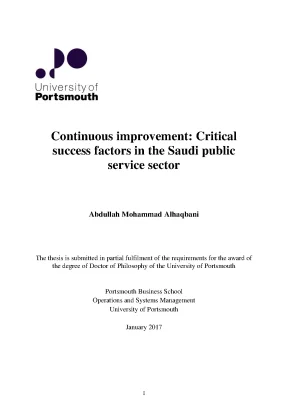
Tải xuống để đọc toàn bộContinuous improvement: Critical success factors in the Saudi public service sector Abdullah Mohammad Alhaqbani The thesis is submitted in partial fulfilment of the requirements for the award of the degree of Doctor of Philosophy of the University of Portsmouth Portsmouth Business School Operations and Systems Management University of Portsmouth January 2017 I Abstract Continuous improvement (CI) is a never-ending effort to improve an organisation’s activities that requires management and employee commitment. Although CI is considered a competitive strategy for business firms to improve their performance and deliver better services and quality products, unfortunately, it is still a choice for many public sector organisations. However, successful implementation of CI in the public service sector has received little attention and there is a lack of research. Arab businesses and governments have apparently also not received attention in relation to CI implementation.
Furthermore, successful factors for implementing CI are undefined in the context of public services in developing countries. Therefore, this research was conducted to explore the perceptions of managers and employees at Saudi Arabian public service organisations in order to determine the critical successful factors (CSFs) of CI implementation that can help public service organisations to review and measure their performance, and deliver better services. This exploration process clearly reflects a high level strategic activity and is not exploring practical experience. The research examined the differences of CSFs of CI between organisations of one sector (public service), the differences of improvement factors across management levels and determined the obstacles that face improvement activities.
This work was designed using a sequence process of research design and analysis. An empirical research studying CI in eight organisations within the Saudi Arabian public service sector was conducted in order to determine successful practices of CI and facilitate the implementation process. A mixed-method design was employed to collect qualitative and quantitative data. The research data was collected using several techniques including literature analysis, interviews, survey (closed and open questions) and focus groups.
This research reviewed 103 papers that focus on the CI concept and CSFs. These papers included studies in the public, private and manufacturing sectors in developed and developing countries. Semi-structured interviews were conducted with 15 managers of Saudi Arabian public services organisations who work in particular positions in relation to CI. The survey of 1,198 employees from the eight organisations achieved a 54.09 % response rate representing the total population.
Moreover, there are 32 participants involved in four focus groups and 11 interviews to discuss the findings of the questionnaire. The findings of this research indicated that there are differences between organisations of one sector (public service) in determining the CSFs of CI. Moreover, there are differences across management levels regarding required enablers for CI. However, the analysis showed that 12 I common factors for successful CI found across participating organisations.
These factors can be set as core CSFs of CI in Saudi Arabian public service sector. Moreover, the study investigated the key obstacles that restricted CI in Saudi Arabian public services environment. This work is considered the first empirical research to investigate the differences between organisations of one sector (public service) in determining CSFs of CI. Moreover, this work investigated the differences between management levels of the public service structure in determining CSFs of CI.
The study determined CSFs of CI in the Saudi public service environment and addressed the lack of studies that focus on CI in the public service sector, Saudi context and developing nations. The research developed “Room for Improvement Framework” to help management and improvement teams in their efforts to facilitate CI implementation. Finally, this work has developed recommendations for Saudi public service organisations to implement CI and offers suggestions for further work. II Publications Journal Article Alhaqbani, A.
The impact of middle management commitment on improvement initiatives in public organisations. Business Process Management Journal, 22 (5), 924 - 938.1108/BPMJ-01-2016-0018 Conference Papers Alhaqbani, A. Practical Procedures for Improving Quality Management Systems at Public Service Organisations. Paper presented at the 22nd APQO Conference 2016, Rotorua, New Zealand, 20-23 November 2016.
The impact of middle management commitment on improvement initiatives in public organisations. Paper presented at the 7th Canadian Quality Congress, Canada, Edmonton 28-29 September 2015. Required enablers for successful CI initiatives across management levels. Paper presented at the 60th EOQ Quality Conference.
Helsinki -Finland / 1-2 June 2016. The core obstacles of Continuous Improvement Implementation in the Public Sector: Some key findings from health and education sectors. Paper presented at the 18th International Conference on Quality in Higher Education, Zurich, Switzerland, 12-13 January 2016. The Impact of the Relationship between Public Organisations and their Commitment toward Service Improvement.
Paper presented at the 18th Conference of the International Academy of Management and Business, TRE University, Rome, Italy, 17-19 September 2014. An Overview of the Continuous Improvement Culture in the Saudi Public Sector. Paper presented at the 7th Saudi Students Conference in the UK - University of Edinburgh, 1-2 February 2014 Alhaqbani. Examining the readiness of organisations’ leaders towards the implementation of improvement programmes: Some key findings.
Paper presented at the 8th Saudi Students Conference. London, Imperial College, Queen Elizabeth II Conference Center, 31st January- 1st February 2015. III Acknowledgements First and foremost, my deepest thanks and gratitude go to Allah for providing me the ability to complete this research. Without His will and generosity, none of this or any other accomplishment would have been possible.
I hereby express my sincere appreciation to my first supervisor Dr. Debbie Reed and the members of the supervision team - Dr. Barbara Savage and Dr. Jana Ries for their support, patience, valued comments, advice, and motivation.
Without their encouragement and valuable support, this thesis would not have been possible. I want to express my thanks and appreciation to the academic staff and administrative employees in the University of Portsmouth. I would like to extend my thanks and appreciation to all managers and employees at Saudi Arabian public service organisations who volunteered to participate in this research. My deepest thanks go to my parents, who were always supporting and encouraging me with their pray and best wishes.
Special thanks go to my wife, my son Mohammad and my daughters Wareef and Diem. I am deeply grateful to my brothers and sisters for their encouragement and constant emotional support along the way. IV Continuous improvement: Critical success factors in the Saudi public service sector Doctor of Philosophy of the University of Portsmouth Declaration Whilst registered as a candidate for the above degree, I have not been registered for any other research award. The results and conclusions embodied in this thesis are the work of the named candidate and have not been submitted for any other academic award.
Word count: 85,865 Abdullah Mohammad Alhaqbani V Table of Contents Abstract. V Table of Contents. VI List of Appendices. XII List of Tables.
XIII List of Figures .XIV List of Abbreviations. XV Chapter 1: Introduction .1 Brief introduction of Saudi Arabia .2 Society and Culture .3 The structure of the Saudi public sector .5 The research key themes .6 The main purpose .7 The research objectives and questions .8 The importance and contribution of the research .9 The research implications. 17 Chapter 2: Literature review Part (I) .0: An introduction to the Literature Review .1 Public Sector Reform .2 The development of Public Sector management .3 The reform of the public sector in developing countries .4 The development of the Saudi Public Sector .5 The development of the Saudi Public Services.2 The origin of continuous improvement.3 Definition of continuous improvement .4 The strategy of continuous improvement .5 Continuous improvement implementation .6 Continuous improvement and self-assessment .7 Continuous improvement methodologies .1 Total Quality Management .4 Business process re-engineering (BPR) .6 Theory of constraints .7 Summary of Continuous Improvement methodologies .8 Continuous improvement in the public sector .9 Continuous improvement and innovation .10 The benefits of continuous improvement .11 The obstacles to improvement in the public sector .3 Critical Success Factors (CSFs) .1 Overview of CSFs .2 The Structure of CSFs .3 CSFs and Continuous Improvement. 66 Chapter 2: Literature review Part (II).4 Systematic Literature Review and Analysis .2 Systematic Literature Review structure .3 Systematic Literature Review Analysis and Result .1 CSFs of CI in developing and developed countries .2 CSFs of CI in the context of public service sector.3 CSFs of CI in public and private services sectors.4 CSFs of CI across different sectors .4 Common CSFs of CI in the public sector .1 Top Management and Leadership Commitment.4 Team problem-solving .5 Training and Learning.8 Focus on Strategic Objectives and Goals / Integration of CI into Strategic Objectives .10 Ongoing Measurement and Improvement.
93 Chapter 3: Research Methodology .2 The research purpose .4 Methodological design process .6 Research design methods .7 Data collection methods .8 Data collecting techniques .9 The Pilot Studies .12 Data analysis techniques .1 Systematic Literature Review analysis .3 Factor analysis and the analysis of variance .13 Cross-Case Analysis .15 Reliability and Validity. 124 VIII Chapter 4: Analysis and Discussion .0 Introduction to Analysis and Discussion .1 Exploring the key enablers for continuous improvement .2 Characteristics of participants in the interviews .3 Analysis and discussion of the interview themes .1 The managerial job responsibilities in relation to CI .2 Performance key drivers .4 Continuous improvement obstacles .5 Key Enablers for Continuous Improvement .4 Interview Analysis Summary .2 Assessment of improvement efforts at Saudi Arabian public service organisations .3 Questionnaire Response Rate .4 Characteristics of Participant Groups .5 Analysis of Improvement efforts at Saudi Arabian public service organisations .1 Development and Learning Support (F1) .3 Strategic Performance Management (F3) .5 Process and Management Support (F5) .7 Team Problem-Solving (F7) .6 Summary of Improvement Factors Analysis .7 The Analysis of Variance.1 The Analysis of Variance across Management Levels .2 The Analysis of Variance across Research Cases.3 The Analysis of Variance of Research Cases Across Management Levels .8 Further Improvement Factors .2 Availability of Resources .3 Decentralisation at workplace .9 Improvement obstacles across Research Cases .10 The Questionnaire Findings Summary .3 Focus groups and follow-up interviews analysis .2 Suggested procedures to facilitate CI at Saudi Arabian public servic organisations .3 The level of communication between management levels .4 Required Changes to Implement CI .5 Key enablers for improving internal organisational structure .6 Focus groups and interviews Summary. 189 Chapter 5:Determining CSFs of CI in the Saudi Arabian public service sector and the “Room for Improvement” Framework .2 Key Enablers of CI across research cases .3 Key Enablers for CI across management levels .4 Core CSFs of CI in the Saudi Arabian public service sector .5 Suggested Improvement tools .6 Leader Standard Work .8 Overall Professional Effectiveness .9 Soft Systems Methodology .11 Training Within Industry. 209 Chapter 6: Conclusions and Recommendations .2 Research process summary .3 Conclusions of Research findings.
Common Factors that senior managers believe keep organisations pursuing continuous improvement. Common success factors in CI studies list of CSFs across sectors. The differences of CI practices between public service organisations in the views of their employees.4 The issues that hinder or restrict Saudi Arabian public organisations from on-going improvement .5 Core factors that will lead to successful implementation of continuous improvement in the Saudi Arabian public service sector. Ranking CSFs of CI .1 Decentralisation at workplace .2 Reviewing organisational structure.3 Selecting an appropriate improvement approach .4 Improving training and development .5 Implementing a system for motivation .6 Sharing experience between public and private sectors .7 Deploying CSFs across management levels .8 Room for improvement .9 House of Improvement .5 Limitations of the Study.
Nội dung được bảo vệ bản quyền — Tải xuống đầy đủ
Trích dẫn luận án này
Abdullah Mohammad Alhaqbani (2017). Yếu tố Thành công Cải tiến Liên tục tại Dịch vụ Công Saudi [Luận án tiến sĩ, University of Portsmouth]. LuanAn.net. https://luanan.net/chinh-tri-hoc/cai-tien-lien-tuc-yeu-to-thanh-cong-dich-vu-cong-saudi
Câu hỏi thường gặp
Luận án "Yếu tố Thành công Cải tiến Liên tục tại Dịch vụ Công Saudi" nghiên cứu về vấn đề gì?
Khám phá yếu tố then chốt dẫn đến thành công trong cải tiến liên tục tại Dịch vụ Công Saudi. Nâng cao hiệu quả và trải nghiệm người dùng.
Luận án "Yếu tố Thành công Cải tiến Liên tục tại Dịch vụ Công Saudi" được bảo vệ tại trường nào?
Luận án này được bảo vệ tại University of Portsmouth. Năm bảo vệ: 2017.
Luận án "Yếu tố Thành công Cải tiến Liên tục tại Dịch vụ Công Saudi" thuộc chuyên ngành gì?
Luận án "Yếu tố Thành công Cải tiến Liên tục tại Dịch vụ Công Saudi" thuộc chuyên ngành Operations and Systems Management. Danh mục: Chính Trị Học.
Luận án "Yếu tố Thành công Cải tiến Liên tục tại Dịch vụ Công Saudi" có bao nhiêu trang?
Luận án "Yếu tố Thành công Cải tiến Liên tục tại Dịch vụ Công Saudi" có 481 trang. Bạn có thể xem trước một phần tài liệu ngay trên trang web trước khi tải về.
Cách tải luận án "Yếu tố Thành công Cải tiến Liên tục tại Dịch vụ Công Saudi" về máy như thế nào?
Để tải luận án về máy, bạn nhấn nút "Tải xuống ngay" trên trang này, sau đó hoàn tất thanh toán phí lưu trữ. File sẽ được tải xuống ngay sau khi thanh toán thành công. Hỗ trợ qua Zalo: 0559 297 239.