Influence of the vitamin d3 analog eb 1089 on senescence and cell
Ảnh hưởng của analog vitamin D3 EB 1089 đến lão hóa: Phân tích cơ chế, vai trò tiềm năng trong y học và nghiên cứu.
Medical Pharmacology / Pharmacology and Toxicology
Luan An
Luận án
Năm xuất bản
Số trang
209
Thời gian đọc
32 phút
Lượt xem
0
Lượt tải
0
Phí lưu trữ
50 Point
Tổng quan nhanh
- Chủ đề:
- Vitamin D3 Analog EB 1089 & Breast Tumor Cell Senescence
- Số trang:
- 209 trang
- Trường:
- Virginia Commonwealth University
- Chuyên ngành:
- Medical Pharmacology / Pharmacology and Toxicology
- Tác giả:
- Gerald Alan DeMasters
- Năm:
- 2006
Tóm tắt nội dung luận án
I.Vitamin D3 Analog EB 1089 Breast Tumor Cell Senescence
EB 1089 is a synthetic Vitamin D3 analog under significant investigation. This compound demonstrates potent biological activity. Research specifically explores its impact on senescence pathways in breast tumor cells. Understanding its influence is crucial for developing novel cancer therapies. This analog represents a promising area for therapeutic development, targeting cellular mechanisms vital for cancer progression and resistance to treatment. Its unique properties distinguish it from other vitamin D derivatives.
1.1. Introduction to EB 1089 as a Vitamin D3 Analog
EB 1089 serves as a potent analog of Vitamin D3. It is designed to modulate cellular processes. This analog interacts with the Vitamin D receptor (VDR). Such interaction triggers specific cellular responses. Its chemical structure confers distinct pharmacological advantages. These include improved stability or enhanced receptor affinity. Its role in various diseases, especially cancer, is a key focus.
1.2. Radiation Induced Senescence in MCF 7 Cells
Breast tumor cells, specifically MCF-7 cells, exhibit a characteristic response to ionizing radiation. Fractionated radiation (5 x 2 Gy) typically induces a senescence-like growth arrest. This arrest is often a temporary state. Cancer cells frequently recover their proliferative capacity rapidly after radiation exposure. This recovery mechanism challenges the long-term efficacy of radiation monotherapy, allowing for potential tumor relapse or continued growth through cellular aging.
1.3. EB 1089 s Role in Inhibiting Senescence
Pre-exposure to EB 1089 profoundly alters this cellular response. A 100 nM concentration of EB 1089 effectively prevents radiation-induced senescence. This inhibition is a critical action. It stops tumor cells from entering a reversible growth arrest. Instead of temporary cellular aging, cells proceed toward irreversible death. This action shifts the cellular outcome, enhancing therapeutic success by eliminating senescent cells.
II.Mechanism of Action EB 1089 on Cellular Aging Cell Death
EB 1089 fundamentally reconfigures the cellular response to radiation. Instead of a reversible growth arrest, cells undergo irreversible death. This shift occurs due to EB 1089's direct influence on cellular aging processes. The compound prevents the establishment of a stable senescent state. It pushes cells beyond the point of recovery. This targeted action enhances therapeutic efficacy by ensuring permanent elimination of cancer cells rather than just temporary suppression. Understanding this detailed mechanism reveals EB 1089's powerful potential in cancer treatment.
2.1. Shifting Cellular Fate from Arrest to Death
EB 1089's primary mechanism involves a critical redirection of cellular fate. It converts a temporary growth arrest into permanent cell death. This profound change is crucial for effective cancer treatment. The compound interferes with cellular signaling pathways. These pathways usually promote survival post-radiation. This intervention ensures a more destructive outcome for tumor cells, circumventing cellular aging.
2.2. Promotion of Apoptotic Pathways
A significant part of EB 1089's mechanism involves apoptosis. Apoptotic cell death is a programmed process. It systematically eliminates damaged or unwanted cells. EB 1089 promotes this pathway in irradiated breast tumor cells. This increased apoptosis contributes substantially to the overall cell death observed. It bypasses cellular mechanisms that allow survival, effectively sensitizing cells to radiation-induced damage. This enhances cytotoxicity.
2.3. Inducing Autophagic Cell Death
Beyond apoptosis, EB 1089 also induces autophagic cell death. Autophagy represents another form of programmed cell demise. It involves the cell digesting its own components. This pathway provides an additional mechanism for tumor cell elimination. The dual induction of both apoptosis and autophagy highlights EB 1089's potent cytotoxic properties. This multi-pronged attack overcomes cellular resistance mechanisms, ensuring comprehensive cell removal.
III.EB 1089 Sensitization Breast Cancer Response to Radiation
EB 1089 acts as a potent sensitizer to ionizing radiation in breast cancer treatment. It significantly enhances the effectiveness of conventional radiation therapy. This effect is clearly observed in MCF-7 breast tumor cells, which typically respond to radiation with a temporary growth arrest. Combining EB 1089 with radiation leads to widespread and irreversible cell death, moving beyond transient cellular aging. This synergistic action represents a critical advancement, promising improved outcomes compared to radiation monotherapy and potentially overcoming common treatment resistances.
3.1. Enhancing Radiation Efficacy in Breast Tumor Cells
EB 1089 substantially enhances the cytotoxic effects of radiation. It transforms a recovery phase into a lethal outcome for breast tumor cells. This synergy is critical for improving treatment success rates. The compound primes the cells for death. It ensures a more thorough eradication of cancerous cells. This enhances the overall efficacy of the therapeutic intervention against cellular aging.
3.2. Overcoming Senescence Associated Recovery
Radiation-induced senescence often allows tumor cells to recover. This recovery limits the long-term efficacy of cancer treatment. EB 1089 directly counters this phenomenon. It inhibits the development of a stable senescent state. By doing so, it prevents cells from regaining proliferative capacity. This crucial intervention ensures a more complete and irreversible therapeutic effect. Senescent cells are effectively eliminated.
3.3. Implications for Cancer Therapy
The findings carry substantial implications for future cancer therapy protocols. EB 1089 offers a strategy to significantly improve current radiation regimens. It could reduce tumor recurrence rates. Recurrence is often linked to the survival of senescent cells. This approach could lead to more durable patient responses. Developing combination therapies with EB 1089 may prove highly beneficial, representing a new avenue in anti-aging cancer treatments targeting the Senescence-associated secretory phenotype (SASP).
IV.Targeting Senescent Cells Therapeutic Potential of EB 1089
EB 1089 exhibits properties akin to senolytic or senomorphic agents. Senolytics selectively kill senescent cells, while senomorphics modulate their phenotype. EB 1089 not only prevents the establishment of senescence but also promotes death in cells that would otherwise become senescent. This dual action is powerful, suggesting EB 1089 could manage cellular aging processes effectively. Its unique ability to influence the fate of irradiated breast tumor cells highlights its broad therapeutic promise, extending beyond immediate cancer treatment to potentially address age-related cellular dysfunctions.
4.1. EB 1089 as a Senolytic Senomorphic Agent
EB 1089 demonstrates actions consistent with senolytic or senomorphic agents. It actively prevents cells from reaching a senescent state. Crucially, it promotes the death of cells that would otherwise become senescent. This dual functionality is highly valuable. It positions EB 1089 as a significant compound in cellular aging research. Its ability to directly influence senescent cell populations is profound.
4.2. Broader Applications in Cellular Aging
The influence of EB 1089 extends beyond just cancer therapeutics. Its ability to manage cellular aging has wider implications. Senescence contributes significantly to many age-related diseases. Targeting senescent cells could offer considerable anti-aging benefits. EB 1089's mechanism suggests potential for other conditions. These include fibrosis, neurodegenerative disorders, and metabolic syndromes. Further exploration is certainly warranted for these broader applications.
4.3. Future Research Directions for Vitamin D3 Analogs
Research into Vitamin D3 analogs like EB 1089 continues to expand rapidly. Future studies should investigate its full spectrum of action. Understanding its detailed interaction with the Vitamin D receptor (VDR) is vital. Investigating its effects on the Senescence-associated secretory phenotype (SASP) could reveal further insights. These insights could unlock entirely new therapeutic avenues. EB 1089 and similar Calcipotriol derivatives hold significant promise in both oncology and anti-aging medicine.
Tải xuống file đầy đủ để xem toàn bộ nội dung
Tải đầy đủ (209 trang)Trích đoạn nội dung luận án
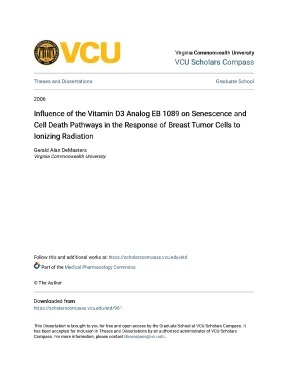
Tải xuống để đọc toàn bộVirginia Commonwealth University VCU Scholars Compass Theses and Dissertations Graduate School 2006 Influence of the Vitamin D3 Analog EB 1089 on Senescence and Cell Death Pathways in the Response of Breast Tumor Cells to Ionizing Radiation Gerald Alan DeMasters Virginia Commonwealth University Follow this and additional works at: https://scholarscompass.edu/etd Part of the Medical Pharmacology Commons © The Author Downloaded from https://scholarscompass.edu/etd/961 This Dissertation is brought to you for free and open access by the Graduate School at VCU Scholars Compass. It has been accepted for inclusion in Theses and Dissertations by an authorized administrator of VCU Scholars Compass. For more information, please contact libcompass@vcu. ix List of Figures Figure Page 1.1 Simplified overview of cell cycle progression.2 DNA damage-induced growth arrest pathways .3 Telomerase and telomere maintenance .4 Extrinsic apoptotic pathway .5 Intrinsic apoptotic pathway.6 Crosstalk between intrinsic and extrinsic apoptotic pathways .7 Chemical structures of 1,25(OH)2 Vit.
Dj, EB 1089, and ILX 23-7553 .1 Growth inhibitory effects of EB 1089.2 Sensitization to radiation by EB 1089 .3 The influence of fractionated radiation and EB 1089 followed by fractionated radiation on viability of MCF-7 breast tumor cells.4 Assessment of apoptotic cell death in MCF-7 cells exposed to EB 1089, 5 X 2 Gy IR, and EB 1089 + 5 X 2 Gy IR .5 Cell cycle analysis for MCF-7 cells exposed to EB 1089, 5 X 2 Gy IR, and EB 1089 + 5 X 2 Gy IR .6 Cell cycle distribution for MCF-7 cells exposed to EB 1089, 5 X 2 Gy IR, and EB 1089+5 X 2 Gy IR .7 Senescence assessment by P-galactosidase staining for MCF-7 cells X exposed to EB 1089, 5 X 2 Gy IR, and EB 1089 + 5 X 2 Gy IR .8 The influence of 5 X 2 Gy IR and EB 1089 followed by 5 X 2 Gy IR on MCF-7ICasp 3 cell growth and viability .9 Assessment of apoptotic cell death in MCF-7 cells exposed to EB 1089, 5 X 2 Gy IR, and EB 1089 + 5 X 2 Gy IR .10 Assessment of senescence by p-galactosidase staining for MCF-71Casp3 cells exposed to EB 1089, 5 X 2 Gy IR, and EB 1089 + 5 X 2 Gy IR .1 1 Lack of influence of EB 1089 on clonogenic survival in MCF-71Casp 3 cells. exposed to irradiation.12 Effects of caspase inhibition on cell viability after EB 1089 + 5 X 2 Gy IR .13 Effects of caspase inhibition on apoptosis after EB 1089 + 5 X 2 Gy IR .14 Detection of micronuclei in MCF-7 cells treated with 5 X 2 Gy IR or EB 1089 plus 5 X 2 Gy IR .15 Influence of EB 1089 on formation of bi-nucleated cells and generation of micronuclei after irradiation .16 Detection of AVO by vital staining with acridine orange in MCF-7 breast tumor cells .17 Influence of 10 Gy ionizing radiation on the levels of p53 and p2 1 in breast tumor cells .18 The Influence of EB 1089 on the temporal response to fractionated radiation in MCF-7lE6 cells .19 Cell cycle disribution and apoptosis of MCF-7/E6 cells exposed to EB 1089. andEB 1089 + 5 X 2 Gy IR .1 Assessment of DNA damage and repair by alkaline unwinding .2 Assessment of DNA damage and repair by 53BP1 foci formation .3 ROS generation in MCF-7 cells .4 Effects of NAC on the response to radiation and EB 1089 plus radiation.5 Effects of GSH on the response to EB 1089 plus 10 Gy IR .6 Effects of NAC and GSH on cell viability following exposure to H202.7 Effects of EB 1089 and 10 Gy on the expression of myc in MCF-7 cells .8 Effects of EB 1089 and 10 Gy on the expression of myc in MCF-7135im cells .9 Effects of EB 1089 on the response to radiation in MCF-7135im cells .10 Senescent response in MCF-7/35im cells treated with 10 Gy IR .1 1 Effects of fumonisin B1 on the response to EB 1089 plus 5 X 2 Gy IR .l Bcl-2 overexpression in MCF-7 cells .2 The influence of 5 X 2 Gy IR and EB 1089 followed by 5 X 2 Gy IR on MCF-7/Bcl-2 cells .3 Assessment of senescence by P-galactosidase staining for MCF-71Bcl-2 cells exposed to EB 1089. and EB 1089 + 5 X 2 Gy IR .4 Bcl-2 expression in MCF-7 and MCF-71Bcl-2 cells treated with IR .6 Bcl-2 expression in MCF-7lwt cells and MCF-71Bcl-2 clones.
184 Abstract INFLUENCE OF THE VITAMIN D3 ANALOG EB 1089 ON SENESCENCE AND CELL DEATH PATHWAYS IN THE RESPONSE OF BREAST TUMOR CELLS TO IONIZING RADIATION By Gerald Alan DeMasters, Ph.D A dissertation submitted in partial fulfillment of the requirements for the degree of Doctor of Philosophy at Virginia Commonwealth University. Virginia Commonwealth University, 2006 Major Dissertation Director: David A.D Professor, Department of Pharmacology and Toxicology A senescence-like growth arrest succeeded by rapid recovery of proliferative capacity is observed in MCF-7 breast tumor cells exposed to fractionated radiation (5 x 2Gy) alone. Exposure to the vitamin D3 analog EB 1089 (100nM) prior to irradiation converts the initial growth arrest response to cell death in part through the inhibition of radiation-induced senescence and promotion of both apoptotic and autophagic cell death. More importantly, EB 1089 was shown to profoundly reduce the rate of recovery following fractionated irradiation.
The effect of EB 1089 on the temporal response to radiation is also observed in MCF-7 cells expressing caspase 3, but not in cells where p53 function is abrogated. EB 1089 does not increase radiation-induced DNA damage or
Nội dung được bảo vệ bản quyền — Tải xuống đầy đủ
Trích dẫn luận án này
Gerald Alan DeMasters (2006). Influence of the vitamin d3 analog eb 1089 on senescence and [Luận án tiến sĩ, Virginia Commonwealth University]. LuanAn.net. https://luanan.net/y-hoc/influence-of-the-vitamin-d3-analog-eb-1089-on-senescence-and-cell
Câu hỏi thường gặp
Luận án "Influence of the vitamin d3 analog eb 1089 on senescence and" nghiên cứu về vấn đề gì?
Ảnh hưởng của analog vitamin D3 EB 1089 đến lão hóa: Phân tích cơ chế, vai trò tiềm năng trong y học và nghiên cứu.
Luận án "Influence of the vitamin d3 analog eb 1089 on senescence and" được bảo vệ tại trường nào?
Luận án này được bảo vệ tại Virginia Commonwealth University. Năm bảo vệ: 2006.
Luận án "Influence of the vitamin d3 analog eb 1089 on senescence and" thuộc chuyên ngành gì?
Luận án "Influence of the vitamin d3 analog eb 1089 on senescence and" thuộc chuyên ngành Medical Pharmacology / Pharmacology and Toxicology. Danh mục: Y Học.
Luận án "Influence of the vitamin d3 analog eb 1089 on senescence and" có bao nhiêu trang?
Luận án "Influence of the vitamin d3 analog eb 1089 on senescence and" có 209 trang. Bạn có thể xem trước một phần tài liệu ngay trên trang web trước khi tải về.
Cách tải luận án "Influence of the vitamin d3 analog eb 1089 on senescence and" về máy như thế nào?
Để tải luận án về máy, bạn nhấn nút "Tải xuống ngay" trên trang này, sau đó hoàn tất thanh toán phí lưu trữ. File sẽ được tải xuống ngay sau khi thanh toán thành công. Hỗ trợ qua Zalo: 0559 297 239.