Luận án Tiến sĩ: Trải nghiệm tìm việc của người di cư tay nghề tại Úc - Phân tích kết quả di động nghề nghiệp
Khám phá trải nghiệm tìm việc của lao động lành nghề nhập cư tại Úc, tập trung vào kết quả di chuyển nghề nghiệp.
Năm xuất bản
Số trang
215
Thời gian đọc
33 phút
Lượt xem
0
Lượt tải
0
Phí lưu trữ
50 Point
Tổng quan nhanh
- Chủ đề:
- Thị trường lao động Úc: Cơ hội & Thách thức di cư
- Số trang:
- 215 trang
- Trường:
- RMIT University
- Chuyên ngành:
- Management
- Tác giả:
- Don Asanka Sanjeewa Livera Tennakoon
- Năm:
- 2018
Tóm tắt nội dung luận án
I.Thị trường lao động Úc Cơ hội Thách thức di cư
Tài liệu này khám phá bối cảnh phức tạp của thị trường lao động Úc dành cho người di cư tay nghề. Nó tập trung vào các cơ hội và thách thức mà nhóm này phải đối mặt. Nghiên cứu phân tích các thay đổi trong chính sách di cư. Việc tìm kiếm việc làm phù hợp với trình độ chuyên môn là một vấn đề lớn. Tài liệu tìm cách cung cấp cái nhìn sâu sắc về trải nghiệm của người di cư tay nghề. Mục tiêu là hiểu rõ hơn về khả năng di chuyển nghề nghiệp của họ tại Úc.
1.1. Bức tranh tổng quan thị trường lao động Úc
Thị trường lao động Úc là điểm đến hấp dẫn cho người di cư tay nghề. Chính phủ Úc đã điều chỉnh nhiều chính sách để thu hút nhân tài. Điều này nhằm đáp ứng nhu cầu nhân lực trong các ngành nghề quan trọng. Tuy nhiên, việc thích nghi với Thị trường lao động Úc không hề dễ dàng. Người di cư thường gặp phải những khó khăn riêng. Các rào cản này ảnh hưởng đến khả năng tìm được việc làm mơ ước.
1.2. Xu hướng di cư tay nghề chính sách Visa
Chính sách Visa tay nghề Úc liên tục thay đổi. Những điều chỉnh này có tác động lớn đến người nộp đơn. Sự thay đổi trong các yêu cầu về Visa có thể tạo ra bất ổn. Người di cư cần cập nhật thông tin thường xuyên. Việc hiểu rõ các quy định mới là rất quan trọng. Điều này giúp họ có sự chuẩn bị tốt nhất cho quá trình định cư Úc và tìm việc.
II.Rào cản tìm việc người di cư tay nghề tại Úc
Người di cư tay nghề thường đối mặt với nhiều Rào cản tìm việc tại Úc. Những yếu tố này ngăn cản họ phát huy tối đa năng lực. Các rào cản bao gồm việc thiếu công nhận bằng cấp nước ngoài. Kinh nghiệm làm việc quốc tế thường không được đánh giá cao. Mạng lưới nghề nghiệp Úc hạn chế cũng là một trở ngại. Các tổ chức chuyên nghiệp và nhà tuyển dụng đóng vai trò là 'người gác cổng'. Họ có thể tạo ra những thách thức vô hình cho người tìm việc.
2.1. Công nhận bằng cấp nước ngoài và kinh nghiệm
Công nhận bằng cấp nước ngoài là một trong những thách thức lớn. Các quy trình đánh giá có thể phức tạp và tốn thời gian. Kinh nghiệm làm việc ở nước ngoài đôi khi không được công nhận hoàn toàn. Điều này khiến người di cư gặp khó khăn khi ứng tuyển. Họ phải nỗ lực hơn để chứng minh năng lực. Việc này thường đòi hỏi các khóa học bổ sung hoặc thi chứng chỉ.
2.2. Mạng lưới nghề nghiệp Úc Khó khăn tiếp cận
Thiếu Mạng lưới nghề nghiệp Úc gây bất lợi đáng kể. Người di cư khó tiếp cận các vị trí việc làm không được quảng cáo công khai. Các mối quan hệ cá nhân đóng vai trò quan trọng tại Úc. Việc xây dựng mạng lưới đòi hỏi sự chủ động và thời gian. Điều này có thể khiến họ bị cô lập trong quá trình tìm việc.
2.3. Thiếu kinh nghiệm làm việc Úc Vòng luẩn quẩn
Nhiều nhà tuyển dụng ưu tiên ứng viên có Kinh nghiệm làm việc Úc. Thiếu kinh nghiệm địa phương trở thành một rào cản lớn. Người di cư khó có được kinh nghiệm ban đầu nếu không ai thuê họ. Điều này tạo ra một vòng luẩn quẩn khó phá vỡ. Việc tìm kiếm các vị trí tình nguyện hoặc thực tập có thể là giải pháp.
III.Kinh nghiệm làm việc Úc Chiến lược thành công
Để vượt qua các rào cản, người di cư tay nghề cần có chiến lược hiệu quả. Tài liệu này khám phá các phương pháp giúp họ thành công. Các chiến lược bao gồm phát triển kỹ năng mềm phù hợp. Nâng cao Kỹ năng phỏng vấn Úc cũng rất quan trọng. Việc chủ động tìm kiếm và thích nghi với văn hóa địa phương là cần thiết. Những người di cư thành công thường có sự chuẩn bị kỹ lưỡng và tinh thần kiên trì.
3.1. Kỹ năng phỏng vấn Úc hiệu quả
Kỹ năng phỏng vấn Úc có những đặc điểm riêng. Người di cư cần tìm hiểu văn hóa phỏng vấn tại đây. Chuẩn bị các câu trả lời sắc bén, thể hiện sự tự tin. Thể hiện sự phù hợp với văn hóa công ty Úc. Điều này giúp tạo ấn tượng tốt với nhà tuyển dụng.
3.2. Xây dựng mạng lưới tìm kiếm việc làm
Xây dựng Mạng lưới nghề nghiệp Úc là yếu tố then chốt. Tham gia các sự kiện, hội thảo chuyên ngành là một cách hiệu quả. Kết nối với các chuyên gia trong lĩnh vực là cần thiết. Sử dụng các nền tảng trực tuyến như LinkedIn cũng rất quan trọng. Việc tìm kiếm việc làm không chỉ dừng lại ở các quảng cáo công khai.
3.3. Thích nghi văn hóa làm việc và môi trường
Thích nghi với Hòa nhập văn hóa làm việc Úc là điều cần thiết. Hiểu các quy tắc ứng xử và giao tiếp chuyên nghiệp. Nắm bắt phong cách làm việc của đồng nghiệp và quản lý. Điều này giúp hòa nhập nhanh chóng hơn vào môi trường mới. Nó cũng góp phần vào thành công lâu dài trong sự nghiệp.
IV.Hòa nhập văn hóa làm việc Úc Hỗ trợ định cư
Quá trình hòa nhập không chỉ gói gọn trong việc tìm kiếm việc làm. Nó còn bao gồm việc thích nghi với văn hóa và xã hội rộng lớn hơn. Hỗ trợ người nhập cư đóng vai trò vô cùng quan trọng. Các dịch vụ tư vấn và hỗ trợ giúp người di cư vượt qua khó khăn. Việc hiểu và chấp nhận các giá trị địa phương là chìa khóa. Điều này giúp giảm bớt Thách thức định cư Úc ban đầu.
4.1. Vai trò của hỗ trợ người nhập cư
Các tổ chức Hỗ trợ người nhập cư cung cấp nhiều dịch vụ thiết yếu. Họ tư vấn về việc làm, pháp lý, và cuộc sống hàng ngày. Các chương trình hỗ trợ giúp người di cư vượt qua khó khăn ban đầu. Điều này bao gồm cả việc xây dựng kỹ năng mềm và kỹ năng sống. Sự hỗ trợ này rất quan trọng cho quá trình Hòa nhập văn hóa làm việc.
4.2. Thách thức định cư Úc ban đầu
Thách thức định cư Úc rất đa dạng và phức tạp. Nó bao gồm các vấn đề về nhà ở, tài chính, và rào cản ngôn ngữ. Việc thích nghi với hệ thống xã hội và y tế mới cũng là một thử thách. Người di cư cần có sự kiên nhẫn và quyết tâm cao. Sự chuẩn bị kỹ lưỡng có thể giúp giảm thiểu những khó khăn này.
V.Phân tích tìm việc người di cư tay nghề tại Úc
Nghiên cứu này sử dụng phương pháp hỗn hợp để cung cấp cái nhìn toàn diện. Mục tiêu là làm rõ các yếu tố phức tạp ảnh hưởng đến việc làm. Phân tích cả dữ liệu định lượng và định tính. Điều này giúp hiểu sâu sắc hơn về trải nghiệm của người di cư tay nghề. Kết quả nghiên cứu đưa ra những khuyến nghị quan trọng. Các khuyến nghị này nhằm cải thiện quá trình tìm việc và hòa nhập cho người di cư.
5.1. Phương pháp nghiên cứu định lượng và định tính
Nghiên cứu này kết hợp dữ liệu định lượng và phỏng vấn định tính. Cách tiếp cận này cho phép khám phá các trải nghiệm cá nhân. Nó cũng giúp phân tích các yếu tố bối cảnh rộng hơn. Việc kết hợp hai phương pháp giúp có được cái nhìn toàn diện. Điều này giúp giải mã các Rào cản tìm việc một cách hiệu quả.
5.2. Các yếu tố ảnh hưởng đến kết quả việc làm
Nhiều yếu tố ảnh hưởng đến kết quả việc làm của người di cư. Bao gồm kỹ năng chuyên môn, kỹ năng giao tiếp và khả năng thích ứng. Thái độ tích cực và sự kiên trì cũng đóng vai trò quan trọng. Sự hỗ trợ từ cộng đồng và các tổ chức cũng là một yếu tố then chốt. Những yếu tố này quyết định khả năng thành công trên Thị trường lao động Úc.
Mục lục chi tiết luận án
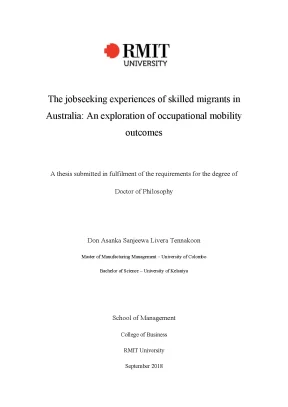
Tải xuống file đầy đủ để xem toàn bộ nội dung
Tải đầy đủ (215 trang)Trích đoạn nội dung luận án
Tải xuống để đọc toàn bộThe jobseeking experiences of skilled migrants in Australia: An exploration of occupational mobility outcomes A thesis submitted in fulfilment of the requirements for the degree of Doctor of Philosophy Don Asanka Sanjeewa Livera Tennakoon Master of Manufacturing Management – University of Colombo Bachelor of Science – University of Kelaniya School of Management College of Business RMIT University September 2018 Declaration I certify that except where due acknowledgement has been made, the work is that of the author alone; the work has not been submitted previously, in whole or in part, to qualify for any other academic award; the content of the thesis is the result of work which has been carried out since the official commencement date of the approved research program; any editorial work, paid or unpaid, carried out by a third party is acknowledged; and, ethics procedures and guidelines have been followed. Further, I acknowledge the support I have received for my research through the provision of an Australian Government Research Training Program Scholarship. Don Asanka Sanjeewa Livera Tennakoon 17 September 2018 i Acknowledgements First of all, I am eternally grateful to the participants of this research for their generosity in sharing the lived experience of being skilled migrants to Australia. The way they have navigated through the obstacles of life was truly inspiring.
I hope that this thesis has delivered the value and the recognition that their experience has well deserved. I would like to express my sincere gratitude to my senior supervisor Associate Professor Darryn Snell and associate supervisor Dr Margaret Heffernan OAM. Without their mentoring, invaluable comments, constructive criticism and collegiality my journey of doing this thesis would have been a lot more difficult. Much appreciation should also be given to Dr Keith Toh for the invaluable insights on critical realism led research and generous support in formatting the thesis.
Further, my thankfulness should also be extended to all of my colleagues at RMIT for the joyful and pleasant moments throughout this journey. Special thanks should also be extended to Lucy Gatto and her team in the Melbourne based career counselling service from which the qualitative phase participants of the research were sourced. Her generous support in hosting focus group discussions, research interviews and sharing a wealth of information and insights has enriched the qualitative phase of the research. Similarly, many thanks should also be given to Terry O’Reilly for letting me benefit from his extensive experience in the career counselling industry and sharing his webinar series with skilled migrant jobseekers.
Finally, I would like to extend my heartfelt indebtedness to my parents for their selflessness in raising me to who I am today and instilling the value of education. Similarly, I owe my wife Vishani, and children Akein and Kiara, for their love and unwavering support throughout many endeavours in life including this thesis. ii Table of Contents DECLARATION. II TABLE OF CONTENTS.
III LIST OF TABLES. VIII LIST OF FIGURES .IX LIST OF ABBREVIATIONS .XI CHAPTER 1 INTRODUCTION .1 The context of the study .1 The change of policy orientation .2 Divisions in the migration literature .2 The importance of the occupational mobility perspective .5 The researcher’s position in the research: An attempt to understand reflexivity. 13 CHAPTER 2 LITERATURE REVIEW .2 The terminological complexity of international mobility.1 Terminology to demarcate skilled migrants .3 Key themes highlighted in the migration literature .4 Downward occupational mobility as a global issue: Evidence from countries around the world .5 Skilled migrants’ employment outcomes in Australia: Some quantitative findings .1 Official findings and mobility explanations from the DIBP .2 Alternative perspectives on skilled migrants’ employment outcomes .6 Occupational mobility barriers for skilled migrants in Australia .1 The challenges in qualification recognition .2 The role of professional bodies, recruiters and other forms of labour market ‘gatekeepers’ .3 Australian policies and regulations for equal employment opportunity (EEO) 32 iii 2.7 Structure–agency interplay in migrant employment. 35 CHAPTER 3 RESEARCH METHODOLOGY .2 Rejecting methodological individualism: Ontological, analytical and methodological dualism .3 Structure–agency interplay: Ontological assumptions and epistemological orientation .4 The critical realists’ pathway: Ontological realism, epistemological relativism and judgemental rationality .5 Methodological options for critical realist research .6 Adoption of mixed research methodology .7 Defining research participants .1 Phase 1: Quantitative phase .2 Phase 2: Qualitative phase .9 Reliability and validity .10 Ethics consideration of the research.
56 CHAPTER 4 QUANTITATIVE FINDINGS .2 Background to the CSAM dataset .1 CSAM sample selection .2 Outliers, weighting and data coding .3 The sample used in this research: Skill stream primary applicants .3 Characteristics of migrants skills and educational qualifications .1 The extent of home country educational qualifications and skills.2 Skilled migrants’ attainments of Australian qualifications .3 Skilled migrants’ visa reporting categories.4 Skilled migrants’ employment outcomes: A deeper examination .5 The extent of employment among skilled migrants .6 The quantity of work secured by the skilled migrants .7 Mapping skilled migrants’ occupational mobility .1 Occupational mobility in terms of language background .2 Occupational mobility in terms of visa sponsorship status .3 Occupational mobility in terms of gender .8 Benefits of using CSAM data .9 Limitations of using CSAM data. 84 CHAPTER 5 QUALITATIVE FINDINGS .2 Focus group findings: Occupation specific mobility barriers .1 Common occupational mobility barriers for accountancy and finance sector workers .2 Common occupational mobility barriers for administrative and office assistance workers .3 Common occupational mobility barriers for education and scientific industry workers .4 Common occupational mobility barriers for engineers and other technical sector workers .3 Pre-arrival experience and occupational mobility .1 Selected 10 individuals: More detailed personal accounts of the skilled migrant experience .2 Preparation strategies and participants perceptions on Australian labour market in the pre-arrival stage .3 Skill assessment process: Participants’ understanding of the complicated sourcing process .4 Post-arrival jobseeking experience and occupational mobility barriers .1 The similarities and differences between skilled migrants’ previous jobs and comparable Australian jobs.2 The need for Australian context-specific knowledge as a mobility barrier .3 The lack of local work experience as an occupational mobility barrier .4 Recognition of foreign qualifications and work experience .5 Availability of jobs: Participants’ experiences in low job growth industries .6 Participants’ experiences with recruitment services and labour market intermediaries .7 English language proficiency and cultural distance as an occupational mobility barrier .8 Skill atrophy and outdated skills as an occupational mobility barrier .9 Knowledge of local job searching techniques, local referees, social networks and supportive career counselling programs.10 Job searching strategies.5 Post-employment career progression and work experience .1 Use of previously developed skills in new jobs .2 Australian workplace culture, prospects of assimilation and direct or systemic discrimination in the workplace .2 Agents’ motivation and desire to contribute to Australia .3 Intersectionality and experience of dual/multiple disadvantage .4 Skilled migrants’ experiences through the morphogenetic perspective .5 The difference between the agential perception of social structures and real, causally efficacious emergent properties of social structures .6 Skill assessment process: The complicated skilled migration sourcing process .7 Skill transferability through structure–agency perspective .8 Skilled migrant employment through a skill transferability perspective .9 The problems associated with foreign work experience and educational qualification recognition: The subtlety of structural manifestations .10 The role of labour market intermediaries as occupational mobility barriers and facilitators .11 Theoretical framework to understand the interplay between structural and agential concerns of skilled migrants’ occupational mobility .5 Directions for future research. 178 APPENDIX A: AN EXAMPLE OF QUALITATIVE CODE ARRANGEMENT (4 OF THE 30 SECOND-ORDER CODES). 193 APPENDIX B: PARTICIPANT INFORMATION AND CONSENT FORM.
194 APPENDIX C: INTERVIEW PROTOCOL FOR THE QUALITATIVE DATA COLLECTION PHASE. 198 APPENDIX D: ETHICS APPROVAL LETTER. 200 APPENDIX E: THE GAP BETWEEN OCCUPATIONAL CEILINGS AND ACTUAL VISA INVITATIONS. 201 APPENDIX F: INDUSTRY PLACEMENT INTRODUCTION LETTER USED BY THE CAREER COUNSELLING PROGRAM.
203 vii List of Tables Table 1: Key diversity descriptors. 19 Table 2: Employment outcomes; after 6 months of arrival or has been granted visa (cohorts 1 to 5 pooled); DIAC (2011). 25 Table 3: Summary of literature review (compiled by author). 36 Table 4: The properties of realists’ stratified ontology.
42 Table 5: Cross-tabulated data variables: developed by the author based on CSAM codebook (DIBP, 2015c). 50 Table 6: Sample descriptive statistics. 61 Table 7: Top 5 pre-immigration educational qualifications. 64 Table 8: Migrants’ visa reporting categories.
65 Table 9: Labour force status of primary visa applicants, based on demographic characteristics. 67 Table 10: Labour force status of primary visa applicants, based on visa grant location. 68 Table 11: Labour force status of offshore primary visa applicants, based on demographic identities. 69 Table 12: Labour force status of offshore primary visa applicants, based on gender identities.
70 Table 13: Number of hours migrants have worked during the reference week in all jobs. 72 Table 14: Skill stream primary applicants’ occupational mobility in terms of language background. 75 Table 15: Skill stream primary applicants’ occupational mobility in terms of visa sponsorship. 77 Table 16: Skill stream primary applicants’ occupational mobility in terms of gender.
80 Table 17: Participant details of the qualitative phase. 86 Table 18: Push and pull factors influencing Neha’s migration decision. 94 Table 19: Push and pull factors influencing Farah’s migration decision. 98 Table 20: Individual in-depth interview phase participants’ employment status.
109 Table 21: Occupational mobility barriers/facilitators identified through the post- arrival jobseeking experience. 116 Table 22: Participants’ reasons to anglicise their names. 134 Table 23: The evolution of participants’ perceptions of Australian society with prolonged stay in Australia. 137 Table 24: Comparison of employability skills.
156 viii List of Figures Figure 1: Major migrant sourcing regions from 2007–08 to 2016–17; adapted from (DIBP, 2017a). 2 Figure 2: Employment outcomes of degree-qualified migrants who arrived in Canada in 1996–2001, by country/region; Hawthorne (2008). 24 Figure 3: The critical realists’ stratified ontology; Bhaskar (2013). 41 Figure 4: An illustration of sequential mixed-method approach; adapted from (Teddlie & Tashakkori, 2009, p.
47 Figure 5: The research design. 48 Figure 6: CSAM data collection waves; adapted from DIBP (2015b). 58 Figure 7: The DIBP’s statistical treatment of the population file. 59 Figure 8: ANZSCO skill levels of migrants’ nominated occupations.
63 Figure 9: Neha’s jobseeking process. 94 Figure 10: Garry’s jobseeking process. 96 Figure 11: Farah’s jobseeking process. 97 Figure 12: Tashmiha’s jobseeking process.
98 Figure 13: Felix’s jobseeking process. 100 Figure 14: Tino’s jobseeking process. 102 Figure 15: Gayan’s jobseeking process. 104 Figure 16: Ahmed’s jobseeking process.
106 Figure 17: Kevin’s jobseeking process. 107 Figure 18: Cynthia’s jobseeking process. 109 Figure 19: The morphogenetic sequence; adapted from (Archer, 1995). 146 Figure 20: Major skill categories; adapted from Balcar et al.
159 Figure 21: A comparison of skills necessary for two town planning jobs in India and Australia. 160 Figure 22: The theoretical framework to better understand skilled migrants’ occupational mobility .
Nội dung được bảo vệ bản quyền — Tải xuống đầy đủ
Trích dẫn luận án này
Don Asanka Sanjeewa Livera Tennakoon (2018). Trải nghiệm tìm việc của người di cư tay nghề tại Úc [Luận án tiến sĩ, RMIT University]. LuanAn.net. https://luanan.net/triet-hoc/trai-nghiem-tim-viec-nguoi-di-cu-tay-nghe-uc
Câu hỏi thường gặp
Luận án "Trải nghiệm tìm việc của người di cư tay nghề tại Úc" nghiên cứu về vấn đề gì?
Khám phá trải nghiệm tìm việc của lao động lành nghề nhập cư tại Úc, tập trung vào kết quả di chuyển nghề nghiệp.
Luận án "Trải nghiệm tìm việc của người di cư tay nghề tại Úc" được bảo vệ tại trường nào?
Luận án này được bảo vệ tại RMIT University. Năm bảo vệ: 2018.
Luận án "Trải nghiệm tìm việc của người di cư tay nghề tại Úc" thuộc chuyên ngành gì?
Luận án "Trải nghiệm tìm việc của người di cư tay nghề tại Úc" thuộc chuyên ngành Management. Danh mục: Triết Học.
Luận án "Trải nghiệm tìm việc của người di cư tay nghề tại Úc" có bao nhiêu trang?
Luận án "Trải nghiệm tìm việc của người di cư tay nghề tại Úc" có 215 trang. Bạn có thể xem trước một phần tài liệu ngay trên trang web trước khi tải về.
Cách tải luận án "Trải nghiệm tìm việc của người di cư tay nghề tại Úc" về máy như thế nào?
Để tải luận án về máy, bạn nhấn nút "Tải xuống ngay" trên trang này, sau đó hoàn tất thanh toán phí lưu trữ. File sẽ được tải xuống ngay sau khi thanh toán thành công. Hỗ trợ qua Zalo: 0559 297 239.