Luận án: "Left of Center" - Nhiếp ảnh, bản sắc và sự dịch chuyển ở New York & Los Angeles (1970-1988)
Khám phá nghệ thuật nhiếp ảnh tại NY & LA 1970-1988. Phân tích tác động của nhiếp ảnh đến bản sắc văn hóa và cá nhân qua từng khung hình.
History of Art, Architecture, and Archaeology
Luan An
Dissertation
Năm xuất bản
Số trang
227
Thời gian đọc
35 phút
Lượt xem
0
Lượt tải
0
Phí lưu trữ
50 Point
Tổng quan nhanh
- Chủ đề:
- Nghệ thuật nhiếp ảnh đương đại: NY & LA 1970-1988
- Số trang:
- 227 trang
- Trường:
- university of pennsylvania
- Chuyên ngành:
- History of Art, Architecture, and Archaeology
- Tác giả:
- Jeanne M. Dreskin
- Năm:
- 2018
Tóm tắt nội dung luận án
I.Nghệ thuật nhiếp ảnh đương đại NY LA 1970 1988
Thập niên 1970 và 1980 chứng kiến sự trỗi dậy của "hình ảnh hậu hiện đại" trong giới nghệ thuật Mỹ. Nhiếp ảnh đóng vai trò trung tâm trong cuộc thảo luận này. Các nhà sử học nghệ thuật và nhà phê bình đã dựa trên lý thuyết hậu cấu trúc. Họ coi nhiếp ảnh vốn là một "bản sao". Khái niệm về tính độc đáo của tác giả bị đặt dấu hỏi. Nó được coi là gượng ép và không tự nhiên. Dự án này xem xét cách các lịch sử nhiếp ảnh hậu hiện đại đã bỏ qua. Họ không bao gồm các nghệ sĩ quan tâm đến các vấn đề xã hội-chính trị. Những vấn đề này liên quan đến chính trị bản sắc văn hóa thời dân quyền. Điều này tạo ra một cái nhìn thiếu sót về phong trào nghệ thuật nhiếp ảnh trong giai đoạn này. Sự phát triển nhiếp ảnh đương đại ở New York và Los Angeles cần được đánh giá lại.
1.1. Khái niệm hình ảnh hậu hiện đại
Hình ảnh hậu hiện đại định hình nền nghệ thuật Mỹ thập niên 1970-1980. Nhiếp ảnh là phương tiện chính. Nó thách thức các nguyên tắc hiện đại.
1.2. Nhiếp ảnh Bản sao hay tác phẩm gốc
Nhiếp ảnh được nhìn nhận là một bản sao. Tính nguyên bản của tác giả bị nghi ngờ. Đây là một điểm trọng tâm trong lý thuyết hậu cấu trúc.
1.3. Bối cảnh lịch sử nhiếp ảnh Mỹ
Lịch sử nhiếp ảnh hiện hành thường bỏ qua. Nó không xem xét các nghệ sĩ tập trung vào chính trị xã hội. Điều này làm cho bức tranh về nhiếp ảnh đương đại chưa đầy đủ.
II.Bản sắc cá nhân xã hội qua nhiếp ảnh Mỹ
Nhiều nghệ sĩ nhiếp ảnh Mỹ trong giai đoạn này tập trung vào các vấn đề xã hội-chính trị. Họ khám phá chính trị bản sắc văn hóa. Các vấn đề này nảy sinh từ thời kỳ dân quyền. Công trình của họ liên quan mật thiết đến các phong trào huy động chính trị và biểu tình những năm 1960. Nhiếp ảnh trở thành công cụ mạnh mẽ. Nó phê phán hệ thống phân cấp xã hội. Điều này bao gồm chủng tộc, quyền công dân và giai cấp. Sự giao thoa của các bản sắc này là trọng tâm. Các nghệ sĩ sử dụng nhiếp ảnh để chất vấn. Họ đặt câu hỏi về các cấu trúc quyền lực hiện có. Tác phẩm của họ phản ánh các dịch chuyển xã hội. Họ mang lại góc nhìn đa chiều về bản sắc. Nó thách thức những định nghĩa truyền thống. Đây là một phần quan trọng của lịch sử nhiếp ảnh Mỹ.
2.1. Phê bình phân cấp xã hội qua nghệ thuật
Nhiếp ảnh được sử dụng để phê phán. Nó chỉ ra hệ thống phân cấp chủng tộc, giai cấp và quyền công dân. Tác phẩm nghệ thuật trở thành tiếng nói.
2.2. Ảnh hưởng từ phong trào dân quyền
Các vấn đề bản sắc và xã hội trong nhiếp ảnh bắt nguồn. Chúng liên quan đến phong trào dân quyền những năm 1960. Sự huy động chính trị là động lực.
III.Văn hóa đô thị New York Los Angeles Biểu tượng
Các nghệ sĩ nhiếp ảnh Mỹ làm việc trong bối cảnh đô thị New York và Los Angeles. Họ sử dụng máy ảnh để điều hướng các địa lý kinh tế-xã hội đa dạng. Các thành phố này không chỉ là bối cảnh. Chúng là những biểu tượng phản ánh mối quan hệ của nghệ sĩ. Mối quan hệ này liên quan đến các hệ thống phân cấp văn hóa xã hội có giá trị. Những hệ thống này cấu trúc các trung tâm nghệ thuật lớn của Mỹ. Các nhà phê bình, giám tuyển và học giả thường ủng hộ. Họ hỗ trợ các cộng đồng nghệ sĩ phù hợp với lịch sử nghệ thuật chủ đạo. Điều này tạo ra một sự dịch chuyển. Các nghệ sĩ ngoại vi bị bỏ qua. Công trình của họ mang đến góc nhìn độc đáo về văn hóa đô thị. Nó cho thấy cách các không gian này định hình bản sắc. Đồng thời, nó phơi bày những căng thẳng xã hội.
3.1. Địa lý đô thị định hình bản sắc
New York và Los Angeles mang đến nhiều địa lý kinh tế-xã hội. Chúng ảnh hưởng sâu sắc đến bản sắc nghệ sĩ. Không gian đô thị là nguồn cảm hứng.
3.2. Phân cấp xã hội trong trung tâm nghệ thuật
Các trung tâm nghệ thuật lớn có hệ thống phân cấp. Nhà phê bình và giám tuyển ưu tiên một số nhóm nghệ sĩ. Điều này ảnh hưởng đến sự công nhận.
IV.Nghệ sĩ nhiếp ảnh Mỹ tiêu biểu Góc nhìn mới
Ba nghiên cứu điển hình chính khám phá sự phát triển. Chúng nằm trong các tác phẩm nhiếp ảnh thập niên 1970-1980 của Patrick Nagatani, Lorraine O’Grady và tập thể Asco. Công việc của họ đặt trong các chiến lược nhiếp ảnh hậu hiện đại. Họ giao thoa các phê phán định hướng bản sắc. Nó nhắm vào các hệ thống phân cấp chủng tộc, quyền công dân và giai cấp. Những hệ thống này đã được thúc đẩy giữa các phong trào chính trị và biểu tình những năm 1960. Mỗi nghệ sĩ sử dụng máy ảnh tĩnh. Họ điều hướng địa lý kinh tế-xã hội đa dạng. Đó là môi trường đô thị New York và Los Angeles. Qua đó, họ xem xét cách không gian được miêu tả. Nó phản ánh mối quan hệ của chính họ với các hệ thống phân cấp xã hội. Điều này làm phong phú lịch sử nhiếp ảnh Mỹ.
4.1. Patrick Nagatani Thấu hiểu dịch chuyển
Nagatani khám phá các dịch chuyển. Tác phẩm của ông phản ánh sự giao thoa bản sắc. Ông sử dụng nhiếp ảnh để thể hiện quan điểm.
4.2. Lorraine O Grady Khám phá bản sắc
O’Grady tập trung vào chính trị bản sắc văn hóa. Công trình của bà là tiếng nói mạnh mẽ. Bà thách thức các chuẩn mực xã hội.
4.3. Asco Tập thể và tiếng nói phản kháng
Tập thể Asco sử dụng nhiếp ảnh như một hình thức phản kháng. Họ phê phán các hệ thống phân cấp. Tiếng nói tập thể của họ rất quan trọng.
Tải xuống file đầy đủ để xem toàn bộ nội dung
Tải đầy đủ (227 trang)Trích đoạn nội dung luận án
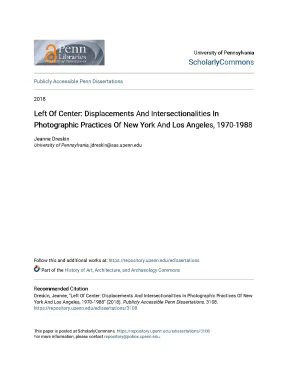
Tải xuống để đọc toàn bộUniversity of Pennsylvania ScholarlyCommons Publicly Accessible Penn Dissertations 2018 Left Of Center: Displacements And Intersectionalities In Photographic Practices Of New York And Los Angeles, 1970-1988 Jeanne Dreskin University of Pennsylvania, jdreskin@sas.edu Follow this and additional works at: https://repository.edu/edissertations Part of the History of Art, Architecture, and Archaeology Commons Recommended Citation Dreskin, Jeanne, "Left Of Center: Displacements And Intersectionalities In Photographic Practices Of New York And Los Angeles, 1970-1988" (2018). Publicly Accessible Penn Dissertations.edu/edissertations/3108 This paper is posted at ScholarlyCommons.edu/edissertations/3108 For more information, please contact repository@pobox. Left Of Center: Displacements And Intersectionalities In Photographic Practices Of New York And Los Angeles, 1970-1988 Abstract Throughout the 1970s and 1980s, notions of a “postmodern image,” often revolving around the use of photography, emerged within American art world discourses. Building in significant part upon themes of postructuralist theory, art historians and critics gestured to the photograph’s inherent status as “copy,” implicating notions of authorial originality as contrived and unnatural.
My project grapples with questions as to how the scholarly contours of preeminent histories of photographic postmodernism, in their efforts to articulate photographic shifts away from late-modernist tenets, foreclosed the inclusion of artists whose work remained invested in sociopolitical concerns and imbricated politics of cultural identity introduced during the civil rights era. Three major case studies trace evolutions within the 1970s/80s photographic oeuvres of Patrick Nagatani, Lorraine O’Grady, and the collective Asco. Their work located within strategies of photographic postmodernism intersecting identity-oriented critiques of systemic race, citizenship, and class hierarchies, many of which were fomented amidst political mobilization and protest movements of the 1960s. Each artist’s use of the still camera entails a navigation of the diverse socioeconomic geographies of their urban surroundings of New York and Los Angeles.
In turn, they consider how the spaces they depict reflect their own relationships to the valuative sociocultural hierarchies structuring these major American art world centers, in which critics, curators, and scholars propped up artist communities more embedded in predominant histories. Degree Type Dissertation Degree Name Doctor of Philosophy (PhD) Graduate Group History of Art First Advisor Karen Redrobe Subject Categories History of Art, Architecture, and Archaeology This dissertation is available at ScholarlyCommons: https://repository.edu/edissertations/3108 LEFT OF CENTER: DISPLACEMENTS AND INTERSECTIONALITIES IN PHOTOGRAPHIC PRACTICES OF NEW YORK AND LOS ANGELES, 1970-1988 Jeanne M. Dreskin A DISSERTATION in History of Art Presented to the Faculties of the University of Pennsylvania in Partial Fulfillment of the Requirements for the Degree of Doctor of Philosophy 2018 Supervisor of Dissertation Signature; _____________________ Karen Redrobe, Elliot and Roslyn Jaffe Endowed Professor in Film Studies Graduate Group Chairperson Signature: ______________________ Holly Pittman, Bok Family Professor in the Humanities Dissertation Committee Gwendolyn DuBois Shaw, Associate Professor of History of Art Michael Leja, James and Nan Wagner Farquhar Professor of the History of Art ACKNOWLEDGMENTS Thanks first of all to my parents and to Paul Salveson for tirelessly standing by me every step of the way throughout the development and completion of this project. Deepest, sincerest gratitude to Karen Redrobe, my dissertation advisor, as well as Gwendolyn DuBois Shaw and Michael Leja, without whose generous and discerning feedback, continual support, and keen critical eyes this project simply would not have been possible.
I’m indebted also to the wisdom and graciousness of many friends and colleagues, including Kaja Silverman, David Young Kim, Alex Klein, Philipp Kaiser, Iggy Cortez, Mashinka Firunts Hakopian, Patricia Eunji Kim, Miriam Stanton, Juliana Barton, and Rachel Wise, among others, who have all indelibly influenced my scholarship. ii ABSTRACT LEFT OF CENTER: DISPLACEMENTS AND INTERSECTIONALITIES IN PHOTOGRAPHIC PRACTICES OF NEW YORK AND LOS ANGELES, 1970-1988 Jeanne Dreskin Karen Redrobe Throughout the 1970s and 1980s, notions of a “postmodern image,” often revolving around the use of photography, emerged within American art world discourses. Building in significant part upon themes of postructuralist theory, art historians and critics gestured to the photograph’s inherent status as “copy,” implicating notions of authorial originality as contrived and unnatural. My project grapples with questions as to how the scholarly contours of preeminent histories of photographic postmodernism, in their efforts to articulate photographic shifts away from late- modernist tenets, foreclosed the inclusion of artists whose work remained invested in sociopolitical concerns and imbricated politics of cultural identity introduced during the civil rights era.
Three major case studies trace evolutions within the 1970s/80s photographic oeuvres of Patrick Nagatani, Lorraine O’Grady, and the collective Asco. Their work located within strategies of photographic postmodernism intersecting identity-oriented critiques of systemic race, citizenship, and class hierarchies, many of which were fomented amidst political mobilization and protest movements of the 1960s. Each artist’s use of the still camera entails a navigation of the diverse socioeconomic geographies of their urban surroundings of New York and Los Angeles. In turn, they consider how the spaces they depict reflect their own relationships to the valuative sociocultural hierarchies structuring these major American art world centers, in which critics, curators, and scholars propped up artist communities more embedded in predominant histories.
iii TABLE OF CONTENTS ACKNOWLEDGMENTS…………………………………………………………….iii LIST OF ILLUSTRATIONS……………………………………………………….197 iv LIST OF ILLUSTRATIONS (Images removed for copyright purposes) Introduction Fig. 1 Excerpt from Robert Indiana, “Back in the Frame,” T New York Times Style Magazine, February 2017 Fig. 2 Pablo Picasso, Guitare, journal, verre et bouteille, 1913, printed papers and ink on paper, 18. 3 Hannah Höch, Cut with the Kitchen Knife Dada Through the Beer-Belly of the Weimar Republic, 1919, collage of pasted papers, 44 9/10 × 35 2/5 inches (114 × 90 cm) Fig.
4 Gustav Klutsis, Let’s Fulfill the Plan of the Great Works, 1930, lithograph, 46 5/8 x 33 inches (118. 5 Barbara Kruger, (The future belongs to those who can see it), 1997, silkscreen on vinyl, 85 × 60 inches (215. 6a, 6b Covers of Robert Indiana, Scar Tissue & Other Stories; Robert Indiana, Schwarzenegger Syndrome: Politics and Celebrity in the Age of Contempt Fig. 7 T Magazine Online, Robert Indiana, “These 80s Artists are More Important Than Ever,” February 13, 2017 Fig.
8 Cindy Sherman, Untitled Film Still #15, 1978, Gelatin silver print, 9 7/16 x 7 7/16 inches (24 x 18. 9 Laurie Simmons, Woman Opening Refrigerator, 1979, Silver dye bleach print, 3 × 5 inches (7. 10 Robert Longo, Men in the Cities - Men Trapped in Ice, 1980, charcoal and graphite on paper, 60 x 40 inches (152.6 cm), each panel, Collection Mera and Donald Rebell, New York. 11 Selections from Cindy Sherman’s Bus Riders, 1976, gelatin silver prints on paper 7 ½ x 5 inches (18.
12 Martha Rosler, Detail, The Bowery in Two Inadequate Descriptive Systems, 1974-75, gelatin silver prints of text and image mounted on backing board, dimensions variable Fig. 13 Allan Sekula, detail, School is a Factory, 1978-80, gelatin silver print on paper, dimensions variable, Museo Nacional Centro de Arte Reina Sofia, Madrid, Spain v Fig. 14 Fred Lonidier Detail, The Health and Safety Game, 1976/79 (Version 3), photo/text panels, dimensions variable Fig. 15 Lewis Baltz, New Industrial Parks #45, 1974, gelatin silver print, 6 in x 9 inches (15.9 cm), Museum of Contemporary Photography, San Diego Fig.
16 John Schott, Untitled (Route 66 Motels), 1973, gelatin silver print, 10 in x 8 inches (25. 17 Ansel Adams, Half Dome with Blowing Snow, ca. 1955, gelatin silver print, 14 7/8 × 18 11/16 inches, 37. 18 Ed Ruscha, Every Building on the Sunset Strip, 1966, self-published book, offset lithograph, 7 1/8 x 5 3/4 x 3/8 inches (18 x 14.95 cm), Getty Research Institute Fig.
19 Installation view, “Pictures,” 1977, Artists Space, New York Fig. 20 Cindy Sherman, Untitled Film Still #21, 1978, gelatin silver print, 7 1/2 x 9 1/2 inches (19.1 cm), Museum of Modern Art Chapter 1 Fig. 1 Asco, Decoy Gang War Victim, 1974, photograph Ó 1974, Harry Gamboa, Jr. 2 Cindy Sherman, Untitled Film Still #16, 1978, gelatin silver print, 9 7/16 x 7 9/16 inches (24 x 19.2 cm), Museum of Modern Art, New York Fig.
3 Asco, A la Mode, 1976, photograph Ó 1974, Harry Gamboa, Jr. 4 “Kick Photo,” reproduced in Stuart Hall, “The Determinations of News Photographs,” in The Manufacture of News: Social Problems, Deviance, and the Mass Media, ed. Stanley Cohen and Jock Young (London: Constable, 1981) Fig. 5 Signature by Robert Legorreta (also known as Cyclona) in Garfield High School yearbook, 1969, Harry Gamboa, Jr., Papers 1968-1995, Special Collections M0753, Stanford University Libraries, Box 12 Fig.
6 Clipping from Los Angeles Herald Examiner, March 12, 1968, Harry Gamboa, Jr., Papers 1968-1995, Special Collections M0753, Stanford University Libraries, Box 11 (Gamboa’s face circled) Fig. 7 Page 8, Chicano Student Vol. 3, May 18, 1968, Chicano Newspaper Collection, University of California, Los Angeles, Chicano Studies Research Center Fig. 8 Page 8, Chicano Student News, March 15, 1968, Harry Gamboa, Jr., Papers 1968-1995, Special Collections M0753, Stanford University Libraries, Box 11 Fig.
9 Pages 4-5, Chicano Student News, March 15, 1968, Harry Gamboa, Jr., Papers 1968-1995, Special Collections M0753, Stanford University Libraries, Box 11 vi Fig. 10 Front page, Los Angeles Herald Examiner, August 31, 1970, Los Angeles Public Library Fig. 11 Detail, Page 2, Los Angeles Herald Examiner, August 31, 1970, Los Angeles Public Library Fig. 12 Detail, Page B1, Los Angeles Times, August 30, 1970, Los Angeles Public Library Fig.
13 Detail, front page, Los Angeles Times, September 1, 1970, Los Angeles Public Library Fig. 14 Cover, La Raza Vol. 2, 1970, University of Arizona Libraries Digital Collections Fig. 15 Pages 4-5, La Raza Vol.
2, 1970, University of Arizona Libraries Digital Collections Fig. 16 Page 2, La Raza Vol. 2, 1970, University of Arizona Libraries Digital Collections Fig. 17 Detail, Page 6, La Raza Vol.
2, 1970, University of Arizona Libraries Digital Collections Fig. 18 Asco, Spraypaint LACMA, 1972, photograph Ó 1972, Harry Gamboa, Jr. 19 Eugène Atget, Rue Laplace and Rue Valette, Paris, 1926, gelatin silver print from glass negative, 8 11/16 x 6 15/16 inches (22 x 17.), The Elisha Whittelsey Collection, The Elisha Whittelsey Fund, by exchange, 1970, Metropolitan Museum of Art, New York Figs. 20a-b Asco stamp, 1974, Gronk Papers 1969-2007, CSRC.0095, University of California, Los Angeles, Chicano Studies Research Center, Box 51, Folder 2 Figs.
21a-b Mail art network mailing list, Gronk Papers 1969-2007, CSRC.0095, University of California, Los Angeles, Chicano Studies Research Center, Box 1, Folder 2 Fig. 22 Asco, The Gores, 1974, photograph Ó 1974, Harry Gamboa, Jr. 23 Asco, The Gores, 1974, photograph Ó 1974, Harry Gamboa, Jr. 24 Asco, The Gores, 1974, photograph Ó 1974, Harry Gamboa, Jr.
25 Film still, Phantom of the Paradise, 1974 Fig. 26 Film still, Phantom of the Paradise, 1974 Fig. 27 Les Petites Bonbons, 1971, photographer unknown Fig. 28 David Bowie as “The Man who Fell to Earth,” 1976, Studiocanal Films Ltd.
29 Film still, Twins of Evil, 1971 Fig. 30 Ana Mendieta, Untitled (Rape Scene), 1973, c-print, 10 × 8 inches (25.) © The Estate of Ana Mendieta Collection, LLC. 31 Front page, Los Angeles Herald Examiner, February 1, 1971, Los Angeles Public Library Fig. 32 Pages 40-41, La Raza Vol.
5, 1971, Chicano Newspaper Collection, University of California, Los Angeles, Chicano Studies Research Center Fig. 33 Detail, Page 7, La Raza Vol. 2, 1970, University of Arizona Libraries Digital Collections Fig. 34 Detail, Front page, Los Angeles Times, May 9, 1972, Los Angeles Public Library Fig.
35 Asco, Waiting for Tickets, 1975, photograph Ó 1975, Harry Gamboa, Jr. 36 Asco, Slasher No. 9, 1975, photograph Ó 1975, Harry Gamboa, Jr. 37 Front page, Los Angeles Times, February 1, 1975, Los Angeles Public Library Figs.
38a-b Details, Sarah Charlesworth, April 20, 1978, 1978, black and white print, approx.6 cm) each Fig. 39 Adrian Piper, The Mythic Being, Village Voice Ad, 1974, newspaper, 17 x 14 inches (43.), Museum of Modern Art, New York Fig. 40 Asco, Asco Goes to the Universe, 1975, photograph Ó 1975, Harry Gamboa, Jr. 1 Patrick Nagatani and Andrée Tracey, Red Piece, 1983, two Polaroid Polacolor diffusion transfer prints, 20 x 48 inches (51 x 122 cm.
Nội dung được bảo vệ bản quyền — Tải xuống đầy đủ
Trích dẫn luận án này
Jeanne M. Dreskin (2018). Nghệ thuật nhiếp ảnh & bản sắc: NY & LA 1970-1988 [Luận án tiến sĩ, University of Pennsylvania]. LuanAn.net. https://luanan.net/thiet-ke-kien-truc-nghe-thuat/nhiep-anh-quay-phim/left-of-center-displacements-and-intersectionalities-in-photogra
Câu hỏi thường gặp
Luận án "Nghệ thuật nhiếp ảnh & bản sắc: NY & LA 1970-1988" nghiên cứu về vấn đề gì?
Khám phá nghệ thuật nhiếp ảnh tại NY & LA 1970-1988. Phân tích tác động của nhiếp ảnh đến bản sắc văn hóa và cá nhân qua từng khung hình.
Luận án "Nghệ thuật nhiếp ảnh & bản sắc: NY & LA 1970-1988" được bảo vệ tại trường nào?
Luận án này được bảo vệ tại University of Pennsylvania. Năm bảo vệ: 2018.
Luận án "Nghệ thuật nhiếp ảnh & bản sắc: NY & LA 1970-1988" thuộc chuyên ngành gì?
Luận án "Nghệ thuật nhiếp ảnh & bản sắc: NY & LA 1970-1988" thuộc chuyên ngành History of Art, Architecture, and Archaeology. Danh mục: Nhiếp Ảnh & Quay Phim.
Luận án "Nghệ thuật nhiếp ảnh & bản sắc: NY & LA 1970-1988" có bao nhiêu trang?
Luận án "Nghệ thuật nhiếp ảnh & bản sắc: NY & LA 1970-1988" có 227 trang. Bạn có thể xem trước một phần tài liệu ngay trên trang web trước khi tải về.
Cách tải luận án "Nghệ thuật nhiếp ảnh & bản sắc: NY & LA 1970-1988" về máy như thế nào?
Để tải luận án về máy, bạn nhấn nút "Tải xuống ngay" trên trang này, sau đó hoàn tất thanh toán phí lưu trữ. File sẽ được tải xuống ngay sau khi thanh toán thành công. Hỗ trợ qua Zalo: 0559 297 239.