Làm việc ngoài luồng: Nghiên cứu Lao động Adjunct trong Giáo dục Đại học
Nghiên cứu chuyên sâu về lao động giảng dạy bán thời gian (adjunct) trong giáo dục đại học, phân tích thực trạng, thách thức và đề xuất giải pháp.
Năm xuất bản
Số trang
86
Thời gian đọc
13 phút
Lượt xem
0
Lượt tải
0
Phí lưu trữ
40 Point
Tổng quan nhanh
- Chủ đề:
- Sự gia tăng lao động Adjunct trong Giáo dục Đại học
- Số trang:
- 86 trang
- Trường:
- university of pennsylvania
- Chuyên ngành:
- Sociology
- Tác giả:
- Chad Gregory Evans
- Năm:
- 2018
Tóm tắt nội dung luận án
I.Sự gia tăng lao động Adjunct trong Giáo dục Đại học
Lực lượng lao động adjunct đang phát triển mạnh mẽ trong giáo dục đại học. Tỷ lệ giảng viên ngoài biên chế tăng đều đặn trong thập kỷ qua. Hiện tại, giảng viên thỉnh giảng chiếm đến hai phần ba tổng số giảng viên. Sự thay đổi này tạo ra một "đa số giảng viên mới". Xu hướng này định hình lại toàn bộ cơ cấu nhân sự học thuật. Mặc dù có sự gia tăng đáng kể, việc hiểu biết về nhóm giảng viên này vẫn còn hạn chế. Các phương pháp truyền thống thường bỏ qua sự đa dạng phức tạp của họ. Điều này gây khó khăn trong việc xây dựng các chính sách hỗ trợ phù hợp. Giáo dục đại học cần nhận diện rõ hơn vai trò của giảng viên bán thời gian. Việc này ảnh hưởng đến chất lượng giảng dạy đại học và trải nghiệm của sinh viên. Nghiên cứu này hướng đến việc thu hẹp khoảng trống kiến thức đó. Nó cung cấp cái nhìn sâu sắc về một phân khúc lao động học thuật quan trọng.
1.1. Thực trạng Giảng viên bán thời gian
Giảng viên ngoài biên chế đã trở thành lực lượng chủ chốt. Họ chiếm đa số trong nhiều khoa và ngành. Sự phụ thuộc vào giảng viên bán thời gian giúp các trường đại học linh hoạt hơn. Tuy nhiên, nó cũng đặt ra nhiều vấn đề về an ninh việc làm và quyền lợi. Tình trạng này đòi hỏi một cách tiếp cận mới trong quản lý nhân sự học thuật.
1.2. Thách thức nhận thức về lao động Adjunct
Việc phân loại giảng viên thỉnh giảng thường không chính xác. Các mô hình hiện có không nắm bắt được sự đa dạng của họ. Thiếu thông tin giá trị làm hạn chế khả năng phân loại. Điều này dẫn đến sự hiểu lầm về động lực và nhu cầu của các giảng viên. Hậu quả là các chính sách hỗ trợ có thể không hiệu quả. Nghiên cứu nhấn mạnh sự cần thiết của một phân loại tự nhiên. Nó giúp nhận diện đúng các nhóm giảng viên phụ tá khác nhau.
II.Phân loại Giảng viên thỉnh giảng Thách thức và Giải pháp
Việc hiểu rõ sự đa dạng của giảng viên thỉnh giảng là một thách thức lớn. Các phân loại hiện có thường không phù hợp. Chúng thiếu thông tin giá trị để phân loại chính xác. Điều này dẫn đến một bức tranh không đầy đủ về nhóm lao động học thuật này. Nghiên cứu này giải quyết vấn đề đó. Phương pháp phân tích nhóm đa biến (cluster analysis) được sử dụng. Phân tích này tiết lộ một "phân loại tự nhiên" cho giảng viên adjunct. Nó cho thấy những sắc thái quan trọng trong việc nhận diện sự đa dạng này. Việc hiểu rõ các nhóm giảng viên phụ tá giúp xây dựng chính sách tốt hơn. Điều này bao gồm các chính sách liên quan đến điều kiện làm việc giảng viên và phúc lợi giảng viên. Việc thiếu phân loại rõ ràng có thể dẫn đến bất bình đẳng trong giáo dục.
2.1. Hạn chế trong phân loại giảng viên
Các mô hình hiện có thường không nắm bắt được sự phức tạp. Chúng gộp chung nhiều loại giảng viên bán thời gian vào một nhóm. Việc này bỏ qua những khác biệt về động cơ, kinh nghiệm và mục tiêu nghề nghiệp. Hạn chế này gây khó khăn cho các trường đại học. Họ không thể đưa ra các hỗ trợ phù hợp.
2.2. Phương pháp phân tích nhóm dữ liệu
Nghiên cứu áp dụng phân tích nhóm. Phương pháp này giúp nhận diện các mẫu tiềm ẩn trong dữ liệu. Nó tạo ra một phân loại dựa trên các đặc điểm thực tế của giảng viên. Kết quả là một bức tranh chi tiết hơn về sự đa dạng của giảng viên thỉnh giảng. Việc này có ý nghĩa lớn đối với chi phí lao động học thuật và cách quản lý nguồn nhân lực.
III.Rủi ro và an ninh việc làm của Giảng viên bán thời gian
Giảng viên ngoài biên chế thường đối mặt với rủi ro nghề nghiệp cao hơn. Giả định chung là việc bắt đầu sự nghiệp ngoài biên chế dẫn đến khả năng rời bỏ sớm. Điều này xuất phát từ thu nhập thấp hơn và an ninh việc làm kém. Tuy nhiên, bằng chứng thực nghiệm cho giả định này còn yếu. Nghiên cứu này đã củng cố những bằng chứng đó. Phân tích sống sót (survival analysis) được sử dụng. Một thước đo hành vi về hao mòn sự nghiệp được áp dụng. Kết quả xác nhận rủi ro khởi đầu ngoài biên chế. Việc này có ý nghĩa quan trọng đối với điều kiện làm việc giảng viên. An ninh việc làm là một yếu tố then chốt ảnh hưởng đến quyết định gắn bó. Bất bình đẳng trong giáo dục được thể hiện rõ qua sự khác biệt này.
3.1. Rủi ro khởi đầu ngoài biên chế
Giảng viên bắt đầu sự nghiệp ngoài lộ trình biên chế đối mặt với thách thức. Họ có xu hướng rời bỏ công việc sớm hơn. Điều này liên quan đến các hợp đồng lao động giáo dục ngắn hạn. Mức lương thấp và thiếu phúc lợi giảng viên làm tăng áp lực.
3.2. Bằng chứng về tỷ lệ nghỉ việc sớm
Nghiên cứu sử dụng phân tích sống sót. Phương pháp này định lượng nguy cơ rời bỏ công việc. Dữ liệu hành vi củng cố quan điểm về rủi ro này. Kết quả cung cấp bằng chứng mạnh mẽ hơn cho sự bất ổn nghề nghiệp. Nó làm rõ thêm chi phí lao động học thuật không ổn định.
IV.Sự hài lòng phúc lợi và nghỉ việc của giảng viên
Nghiên cứu này đi sâu vào sự hài lòng và ý định nghỉ việc. Nó tập trung vào các nhóm phụ khác nhau của giảng viên thỉnh giảng. Một mô hình phương trình cấu trúc được sử dụng để khám phá các sắc thái. Sự hài lòng với phúc lợi và sự hài lòng tài chính có sự khác biệt rõ rệt. Điều này được nhận thấy giữa "học giả đầy tham vọng" và "giảng viên sắp kết thúc sự nghiệp". Các nhóm này có nhu cầu và ưu tiên riêng biệt. Hiểu rõ những khác biệt này rất quan trọng. Nó có ý nghĩa lớn đối với chính sách giữ chân giảng viên. Việc cải thiện phúc lợi giảng viên có thể giảm tỷ lệ nghỉ việc. Điều kiện làm việc giảng viên tốt hơn cũng góp phần tăng sự hài lòng. Đây là yếu tố then chốt để duy trì chất lượng giảng dạy đại học.
4.1. Phân tích sự hài lòng theo nhóm
Các giảng viên thỉnh giảng không phải là một khối đồng nhất. Mức độ hài lòng của họ khác nhau đáng kể. Những giảng viên có tham vọng học thuật có kỳ vọng khác. Những người coi đây là chặng cuối sự nghiệp lại có ưu tiên riêng.
4.2. Sự khác biệt về phúc lợi tài chính
Hài lòng với phúc lợi và tài chính là hai khía cạnh riêng biệt. Chúng tác động khác nhau đến các nhóm giảng viên. Đối với học giả trẻ, phúc lợi có thể quan trọng hơn. Với những người đã có kinh nghiệm, sự ổn định tài chính là ưu tiên hàng đầu.
V.Tác động của lao động Adjunct đến chính sách giữ chân
Phát hiện của nghiên cứu mang lại ý nghĩa quan trọng. Chúng giúp các trường đại học phát triển chính sách giữ chân giảng viên hiệu quả hơn. Việc nhận diện được "phân loại tự nhiên" của giảng viên thỉnh giảng là bước đầu. Hiểu rõ các nhóm phụ với nhu cầu và động lực khác nhau. Điều này cho phép tạo ra các chương trình hỗ trợ phù hợp. Ví dụ, cải thiện an ninh việc làm cho giảng viên bán thời gian. Nâng cao phúc lợi giảng viên có thể làm giảm tỷ lệ nghỉ việc. Đặc biệt, việc hiểu sự khác biệt về hài lòng tài chính là rất quan trọng. Các chính sách cần phân biệt giữa "học giả đầy tham vọng" và "giảng viên sắp kết thúc sự nghiệp". Điều này giúp tối ưu hóa chi phí lao động học thuật. Nó cũng góp phần vào việc duy trì chất lượng giảng dạy đại học. Giảm bất bình đẳng trong giáo dục bắt đầu từ việc hiểu rõ lực lượng lao động này.
5.1. Nhận diện các nhóm giảng viên
Việc phân loại rõ ràng giúp trường đại học hiểu rõ hơn. Các nhóm giảng viên phụ tá có nhu cầu và mong muốn riêng. Chính sách không thể áp dụng chung cho tất cả. Cần có sự linh hoạt và cá nhân hóa.
5.2. Hướng phát triển chính sách hiệu quả
Chính sách giữ chân cần được điều chỉnh. Chúng phải phù hợp với từng phân khúc giảng viên. Điều này bao gồm cải thiện điều kiện làm việc giảng viên. Cung cấp các gói phúc lợi cạnh tranh và an ninh việc làm. Việc này không chỉ giữ chân nhân tài mà còn nâng cao uy tín trường.
Mục lục chi tiết luận án
Tải xuống file đầy đủ để xem toàn bộ nội dung
Tải đầy đủ (86 trang)Trích đoạn nội dung luận án
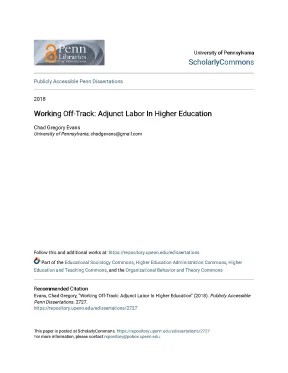
Tải xuống để đọc toàn bộUniversity of Pennsylvania ScholarlyCommons Publicly Accessible Penn Dissertations 2018 Working Off-Track: Adjunct Labor In Higher Education Chad Gregory Evans University of Pennsylvania, chadgevans@gmail.com Follow this and additional works at: https://repository.edu/edissertations Part of the Educational Sociology Commons, Higher Education Administration Commons, Higher Education and Teaching Commons, and the Organizational Behavior and Theory Commons Recommended Citation Evans, Chad Gregory, "Working Off-Track: Adjunct Labor In Higher Education" (2018). Publicly Accessible Penn Dissertations.edu/edissertations/2727 This paper is posted at ScholarlyCommons.edu/edissertations/2727 For more information, please contact repository@pobox. Working Off-Track: Adjunct Labor In Higher Education Abstract The proportion of non-tenure track faculty has grown over the last decade and adjuncts now constitute two-thirds of the academic workforce. Despite this growth, there remain important limitations to our understanding of this new faculty majority.
For one, typologies for conceptualizing adjunct diversity are often poorly aligned and make limited use of information valuable for classification. This study addresses these issues by employing the multivariate typological method of cluster analysis. The analysis implied a “natural typology” for adjunct faculty and suggested important nuances for fully recognizing adjunct diversity in higher education. This dissertation also addresses limitations with regard to adjunct job satisfaction and turnover.
With lower earnings and less job security, it has typically been assumed that beginning off the tenure line carries with it a greater risk of early career departure. However, the empirical evidence of this has been weak. Using survival analysis and a behavioral measure of career attrition, this study confirmed the risks of beginning off the tenure track. Furthermore, using a structural equation model, this study examined nuances in the satisfaction and turnover intentions of different subclasses of contingent faculty members.
Satisfaction with benefits and financial satisfaction are distinct among aspiring academics and career-ending adjuncts and this has important implications with regard to faculty retention policies. Degree Type Dissertation Degree Name Doctor of Philosophy (PhD) Graduate Group Sociology First Advisor Paul D. Allison Keywords adjunct, contingent, new faculty majority, non-tenure, tenure, track Subject Categories Educational Sociology | Higher Education Administration | Higher Education and Teaching | Organizational Behavior and Theory This dissertation is available at ScholarlyCommons: https://repository.edu/edissertations/2727 WORKING OFF-TRACK: ADJUNCT LABOR IN HIGHER EDUCATION Chad Evans A DISSERTATION in Sociology Presented to the Faculties of the University of Pennsylvania in Partial Fulfillment of the Requirements for the Degree of Doctor of Philosophy 2018 Supervisor of Dissertation _____________________ Paul Allison Professor of Sociology Graduate Group Chairperson ________________________ David Grazian, Associate Professor of Sociology Dissertation Committee Frank Furstenberg, Zellerbach Family Professor of Sociology, Emeritus Jerry Jacobs, Professor of Sociology ABSTRACT WORKING OFF-TRACK: ADJUNCT LABOR IN HIGHER EDUCATION Chad Evans Paul Allison The proportion of non-tenure track faculty has grown over the last decade and adjuncts now constitute two-thirds of the academic workforce. Despite this growth, there remain important limitations to our understanding of this new faculty majority.
For one, typologies for conceptualizing adjunct diversity are often poorly aligned and make limited use of information valuable for classification. This study addresses these issues by employing the multivariate typological method of cluster analysis. The analysis implied a “natural typology” for adjunct faculty and suggested important nuances for fully recognizing adjunct diversity in higher education. This dissertation also addresses limitations with regard to adjunct job satisfaction and turnover.
With lower earnings and less job security, it has typically been assumed that beginning off the tenure line carries with it a greater risk of early career departure. However, the empirical evidence of this has been weak. Using survival analysis and a behavioral measure of career attrition, this study confirmed the risks of beginning off the tenure track. Furthermore, using a structural equation model, this study examined nuances in the satisfaction and turnover intentions of different subclasses of contingent faculty members.
Satisfaction with benefits and financial satisfaction are distinct among aspiring academics and career- ending adjuncts and this has important implications with regard to faculty retention policies. ii TABLE OF CONTENTS ABSTRACT. II LIST OF TABLES. VI LIST OF ILLUSTRATIONS.
VII CHAPTER 1: INTRODUCTION. 4 CHAPTER 2: CLASSIFYING NON-TENURE TRACK FACULTY. 11 Classification of Full-time Adjunct Faculty. 12 Classification of Part-time Adjunct Faculty.
21 iii CHAPTER 3: NON-TENURE TRACK JOB SATISFACTION AND TURNOVER INTENTIONS. 26 Satisfaction of Adjunct Types. 28 Limitations of Earlier Work. 30 Adjunct Job Satisfaction Hypotheses.
48 CHAPTER 4: ATTRITION: NON-TENURE TRACK FACULTY LEAVING ACADEMIA. 52 Theory on Turnover. 53 Prior Research on Faculty Career Attrition. 55 Limitations of Earlier Research.
77 v LIST OF TABLES Table 1: Crosstabulation of Full-time Adjunct Clusters.12 Table 2: Crosstabulation of Part-time Adjunct Clusters .14 Table 3: Descriptive Statistics of Quantitative Variables in the Analysis.22 Table 4: Variables Used in Cluster Analysis .23 Table 5: Adjunct Satisfaction .38 Table 6: Bayesian Structural Equation Models Predicting Turnover Intentions .40 Table 7: Descriptive Statistics (n=8418) .48 Table 8: Standardized Factor Loadings .49 Table 9: Latent Factors with Satisfaction Items.50 Table 10: Cox Proportional Hazards Models.64 Table 11: Life Table .74 Table 12: Study Entrants by Year .74 vi LIST OF ILLUSTRATIONS Figure 1: Bayesian Structural Equation Model (Full Model with All Covariates) .36 Figure 2: Survival Curves .63 Figure 3: Changes in Tenure Systems (1993-2015) .74 vii CHAPTER 1: INTRODUCTION Decades ago, the work of higher education was conducted mostly by long-term faculty with tenured contracts. Visiting, clinical and in-residence faculty had a role, but that role was limited to short-term course assignments or ancillary support that tenured faculty were not able to provide. In recent years, however, there has been an eruption of criticism regarding the use of adjunct faculty, as it has become clear that adjunct faculty are now permanent fixtures on college campuses. Scholars have documented the uptick in non-tenure track faculty, tracing back to the late 1960s.
At that point, a mere 22% of faculty members were tenure-ineligible (Schuster and Finkelstein 2006). However, by the Fall of 2009, nearly two-thirds of all faculty were non-tenure track. This dramatic change has revolutionized the academic workforce: fixed-term faculty are now the new faculty majority. This fundamental shift in the academic workforce has attracted substantial research for decades.
Considerable efforts have been made to understand the historical and economic reasons for this extensive growth (Schuster and Finkelstein 2006). Others have examined how uncoordinated and decentralized hiring practices relate to fixed-term faculty (Cross and Goldenberg 2003). Some have focused on the job conditions and work responsibilities of these faculty members (Baldwin and Chronister 2001, Schell and Stock 2001). Others have examined student persistence and undergraduate academics under the instruction of adjuncts (Jaeger and Eagan 2009, Eagan and Jaeger 2008).
These are only a few of the many themes undertaken due to this revolutionary change in the contracts of postsecondary faculty. The scope of this dissertation is focused on two key aspects of non-tenure track faculty and their work. First, faculty adjuncts are far too often treated as a homogenous block with uniform experiences working in academia. They are portrayed as struggling with poverty wages, disrespected by their tenure-line peers, and universally exploited.
No one would dispute the importance of these topics and possibilities. No doubt, some members of the adjunct population do work under such regrettable conditions. However, before implementing policies to ameliorate these conditions, it is of great importance to consider just how widespread these conditions and experiences are. It is possible that not all adjuncts experience them—maybe not even a majority.
After all, we know that some adjuncts teach outside of a professional career because they enjoy sharing their expertise. Others work part-time to stay productive during their early retirement years. In short, there is surely diversity among postsecondary adjuncts, and an understanding of this diversity is sorely needed. The second component of this dissertation relates to the job satisfaction, turnover, and permanence of non-tenure track faculty in higher education.
It is a fact that non-tenure track faculty earn less and are less likely to receive health and retirement benefits. By definition, they also do not have tenure—a desirable contractual guarantee encouraging faculty commitment. Adjuncts also have less autonomy, control over their work and professional support. It is intuitive that employees working in such circumstances would be less satisfied and more likely to abandon their jobs and 1 potentially their careers.
However, demonstrating this empirically is a formidable challenge. Theoretical Framework Extensive research on employee withdrawal and turnover exists. Researchers in this line of work typically approach the topic from one of four theoretical angles. Some focus specifically on the psychological commitment that bonds employee with employer (Porter, Crampon, and Smith 1976, Porter et al.
1976, Meyer and Allen 1991). Workers commit due to the implied costs of leaving as well as normative pressures. Another group of researchers has approached turnover from the theoretical lens of embeddedness (Mitchell and Lee 2001). This line of research draws on social networks, employee “fit,” and cost-avoidance to understand worker decisions (Lee, Burch, and Mitchell 2014).
The unfolding model—a third perspective—highlights the importance of unexpected shocks causing employees to leave (Hom et al. 2017, Holtom et al. 2008, Weller et al. Vroom’s (1964) work on expectancy theory may be the most influential of all.
Expectancy theory views motivation as a cognitive process and focuses on how structural, attitudinal and environmental factors influence this process. In the context of work, this perspective implies that employees maintain the work arrangements that fulfill their job expectations. When unfulfilled, workers pursue other options like exerting less effort, detaching from their work, or leaving a job altogether (March and Simon 1958). Job satisfaction is central to expectancy theory because it is viewed as an expression of “fit.” Satisfied workers feel more aligned and connected to their employer and colleagues.
Dissatisfied workers feel alienated and detached from their work. Researchers integrate job satisfaction into turnover models in several ways. Herzberg, Mausner, and Snyderman's (1959) argued that there were two principal dimensions to job satisfaction. Some work conditions mapped explicitly onto a factor measuring satisfaction while other work features mapped onto a factor measuring dissatisfaction.
These factors were viewed as entirely independent in their framework. A second important job satisfaction model is Hackman and Oldham’s (1980) “Job Characteristics” model. This framework was very important for elaborating on the intrinsic aspects of job satisfaction like task variety, meaningfulness and task feedback. In the domain of higher education research, however, the work of Kalleberg (1977) truly stands out.
Like Hackman and Oldham (1980), Kalleberg also recognized the intrinsic components of job satisfaction. However, his model was valuable for its incorporation of external factors of job satisfaction as well. Specifically, he found six dimensions to the job satisfaction construct: intrinsic value, convenience, financial, relationships with co- workers, career and resource adequacy. Problem statement While research often treats non-tenure track faculty as a homogenous block, there is an important line of typological scholarship recognizing adjunct heterogeneity.
Notably, Gappa and Leslie (1993) identified career-enders, adjunct experts, freelancers and aspiring academics. Baldwin and Chronister (2001) classified full-time adjuncts according to principal work responsibilties. While these studies (and others) have done a great service, they have important limitations that this dissertation aims to address. For one, this line of research has led to a proliferation of labels for adjuncts without 2 clearly demonstrating that actual differences exist in new classes.
As a result, there has been redundancy in some cases and conceptual vagueness in others. To truly carve out distinct classes of adjunct faculty members, this line of research would benefit from a method inferring how many clusters are justified in the adjunct population. The second limitation this study aims to address relates to the failure to utilize information that is potentially valuable for creating an adjunct typology. Commonly, researchers build typologies around two or sometimes three characteristics they believe to be self-evident.
The problem is that this approach potentially excludes variables important for classification. Ethnographers get around this to some extent by pouring over fieldnotes. However, even there, it is not certain that the right information is employed for the purposes of creating a robust typology.
Nội dung được bảo vệ bản quyền — Tải xuống đầy đủ
Trích dẫn luận án này
Chad Gregory Evans (2018). Lao động Adjunct trong Giáo dục Đại học: Nghiên cứu [Luận án tiến sĩ, University of Pennsylvania]. LuanAn.net. https://luanan.net/quan-ly-giao-duc/quan-ly-giao-duc-dai-hoc/lam-viec-ngoai-luong-lao-dong-adjunct-giao-duc-dai-hoc
Câu hỏi thường gặp
Luận án "Lao động Adjunct trong Giáo dục Đại học: Nghiên cứu" nghiên cứu về vấn đề gì?
Nghiên cứu chuyên sâu về lao động giảng dạy bán thời gian (adjunct) trong giáo dục đại học, phân tích thực trạng, thách thức và đề xuất giải pháp.
Luận án "Lao động Adjunct trong Giáo dục Đại học: Nghiên cứu" được bảo vệ tại trường nào?
Luận án này được bảo vệ tại University of Pennsylvania. Năm bảo vệ: 2018.
Luận án "Lao động Adjunct trong Giáo dục Đại học: Nghiên cứu" thuộc chuyên ngành gì?
Luận án "Lao động Adjunct trong Giáo dục Đại học: Nghiên cứu" thuộc chuyên ngành Sociology. Danh mục: Quản Lý Giáo Dục Đại Học.
Luận án "Lao động Adjunct trong Giáo dục Đại học: Nghiên cứu" có bao nhiêu trang?
Luận án "Lao động Adjunct trong Giáo dục Đại học: Nghiên cứu" có 86 trang. Bạn có thể xem trước một phần tài liệu ngay trên trang web trước khi tải về.
Cách tải luận án "Lao động Adjunct trong Giáo dục Đại học: Nghiên cứu" về máy như thế nào?
Để tải luận án về máy, bạn nhấn nút "Tải xuống ngay" trên trang này, sau đó hoàn tất thanh toán phí lưu trữ. File sẽ được tải xuống ngay sau khi thanh toán thành công. Hỗ trợ qua Zalo: 0559 297 239.