Luận án nghiên cứu phương pháp phát hiện và xác định vị trí nguồn can nhiễu lên tín hiệu định vị sử dụng vệ tinh - Nguyễn Văn Hiên
Luận án: Luận án nghiên cứu phương pháp phát hiện và xác định vị trí nguồn can nhiễu lên tín hiệu định vị sử dụng vệ tinh. Xem tóm tắt và tải về tại LuanAn.net
Luan An
Dissertation
Năm xuất bản
Số trang
177
Thời gian đọc
27 phút
Lượt xem
1
Lượt tải
0
Phí lưu trữ
50 Point
Tổng quan nhanh
- Chủ đề:
- Vulnerabilities và Phát hiện Nhiễu GNSS hiệu quả
- Số trang:
- 177 trang
- Trường:
- Đại học Bách khoa Hà Nội
- Chuyên ngành:
- Computer Engineering
- Tác giả:
- Nguyen Van Hien
- Năm:
- 2022
Tóm tắt nội dung luận án
I.Vulnerabilities và Phát hiện Nhiễu GNSS hiệu quả
Tín hiệu định vị vệ tinh toàn cầu (GNSS) rất quan trọng. Chúng cung cấp thông tin vị trí, điều hướng và thời gian chính xác. Tuy nhiên, tín hiệu GNSS yếu khi đến Trái Đất. Điều này khiến chúng dễ bị ảnh hưởng bởi nhiễu. Các nguồn nhiễu có thể là vô tình hoặc cố ý. Nhiễu vô tình thường do thiết bị điện tử tạo ra. Nhiễu cố ý thường xuất phát từ thiết bị gây nhiễu GPS (GPS jammer) hoặc tấn công giả mạo tín hiệu định vị (Spoofing). Việc phát hiện nhiễu GNSS là rất cần thiết. Nó giúp duy trì độ chính xác và độ tin cậy của hệ thống. Nghiên cứu này tập trung vào các phương pháp tiên tiến để phát hiện và định vị nguồn gây nhiễu GPS. Nó góp phần quan trọng vào việc chống phá sóng vệ tinh và đảm bảo hoạt động an toàn của các ứng dụng phụ thuộc vào GNSS.
1.1. Tổng quan về nhiễu tín hiệu định vị
Tín hiệu GNSS yếu khi đến Trái Đất. Chúng dễ bị ảnh hưởng bởi nhiễu. Có nhiều nguồn nhiễu khác nhau. Nhiễu có thể là vô tình hoặc cố ý. Các thiết bị điện tử có thể gây nhiễu vô tình. Thiết bị gây nhiễu GPS (GPS jammer) tạo ra nhiễu cố ý. Tấn công giả mạo tín hiệu định vị (Spoofing) là một dạng nhiễu nguy hiểm. Nó làm sai lệch thông tin định vị. Việc phát hiện nhiễu GNSS là cần thiết. Nó giúp duy trì độ chính xác và tin cậy của hệ thống.
1.2. Các loại tấn công phá sóng GNSS
Nhiễu tần số vô tuyến (RFI) là mối đe dọa chính. RFI có thể làm tắc nghẽn tín hiệu. Điều này gây mất khả năng định vị. Tấn công giả mạo (Spoofing) phức tạp hơn. Kẻ tấn công tạo ra tín hiệu giả. Tín hiệu này trông giống tín hiệu thật. Thiết bị nhận tín hiệu có thể bị lừa. Nó báo cáo vị trí và thời gian sai. Các cuộc tấn công này gây rủi ro lớn. Chúng ảnh hưởng đến nhiều ứng dụng quan trọng. Các ứng dụng như giao thông, quốc phòng đều chịu tác động. Việc chống phá sóng vệ tinh là ưu tiên hàng đầu.
1.3. Kỹ thuật phát hiện nhiễu phổ biến
Nhiều kỹ thuật được phát triển để phát hiện nhiễu. Phân tích phổ tần vô tuyến là một phương pháp cơ bản. Nó giúp giám sát phổ tần. Bất thường trong phổ có thể chỉ ra nhiễu. Đo cường độ trường tín hiệu cũng hữu ích. Tín hiệu mạnh bất thường có thể là dấu hiệu tấn công. Các thuật toán chuyên biệt phát hiện Spoofing. Các thuật toán này so sánh các đặc tính tín hiệu. Sự khác biệt chỉ ra sự giả mạo. Việc kết hợp nhiều kỹ thuật tăng cường khả năng phát hiện.
II.Phát hiện Nguồn Gây Nhiễu GPS và Spoofing
Việc xác định nguồn gây nhiễu GPS là một thách thức lớn. Đặc biệt là khi đối mặt với các cuộc Tấn công giả mạo tín hiệu định vị (Spoofing) ngày càng tinh vi. Tấn công giả mạo nhằm mục đích lừa dối bộ thu GNSS. Chúng làm bộ thu tin rằng nó đang ở một vị trí khác. Nghiên cứu này đi sâu vào phân loại các mối đe dọa Spoofing. Nó cũng trình bày các phương pháp hiệu quả để phát hiện chúng. Mục tiêu là phát triển các công cụ robust để bảo vệ hệ thống GNSS. Các phương pháp này bao gồm việc phân tích sự khác biệt giữa tín hiệu thật và giả. Nó sử dụng các đặc tính riêng biệt của tín hiệu để xác định sự giả mạo. Điều này rất quan trọng để chống phá sóng vệ tinh hiệu quả.
2.1. Phân loại mối đe dọa tấn công giả mạo
Tấn công giả mạo tín hiệu định vị (Spoofing) có nhiều loại. Tấn công đơn giản tạo tín hiệu giả không nhất quán. Tín hiệu này dễ bị phát hiện. Tấn công tinh vi hơn tạo ra tín hiệu giả thuyết phục. Chúng có thể đồng bộ với tín hiệu thật. Điều này khiến thiết bị nhận khó phân biệt. Các cuộc tấn công có thể nhắm mục tiêu cụ thể. Chúng thay đổi vị trí giả lập theo ý muốn. Khả năng định vị nguồn gây nhiễu GPS trở nên cực kỳ quan trọng. Việc hiểu rõ các loại tấn công giúp phát triển biện pháp phòng vệ hiệu quả.
2.2. Các phương pháp phát hiện tấn công giả mạo
Nhiều phương pháp đã được đề xuất. Một phương pháp là theo dõi pha sóng mang. Sự sai lệch bất thường trong pha có thể là dấu hiệu Spoofing. Các thuật toán sử dụng sự phân tán của hiệu số đôi (D3). D3 phân tích sự khác biệt giữa các tín hiệu vệ tinh. Một tín hiệu giả mạo có thể gây ra sự phân tán lớn. Phương pháp này giúp phát hiện Spoofing nguồn đơn. Các kỹ thuật tiên tiến hơn sử dụng góc tới (Angle of Arrival - AOA). Hệ thống định hướng (Direction Finding - DF) giúp xác định hướng nguồn nhiễu. Đây là bước quan trọng để định vị nguồn gây nhiễu GPS.
III.Thuật toán Phát hiện Tấn công Giả mạo Tín hiệu D3
Thuật toán D3 (Dispersion of Double Differences) đóng vai trò trung tâm trong phát hiện Spoofing. D3 phân tích các đặc tính pha của tín hiệu vệ tinh. Nó dựa trên nguyên tắc rằng tín hiệu thật có mối quan hệ pha ổn định. Tín hiệu giả mạo làm phá vỡ sự ổn định này. Nghiên cứu này trình bày chi tiết cơ chế hoạt động của D3. Nó cũng đề xuất các cải tiến để tăng cường hiệu suất. Mục tiêu là làm cho thuật toán D3 trở nên mạnh mẽ hơn. Nó cần có khả năng phát hiện Tấn công giả mạo tín hiệu định vị (Spoofing) ngay cả trong điều kiện khó khăn. Điều này góp phần quan trọng vào nỗ lực chống phá sóng vệ tinh.
3.1. Cơ chế phát hiện D3 cho tín hiệu giả mạo
Thuật toán D3 (Dispersion of Double Differences) là một công cụ mạnh mẽ. Nó phát hiện Tấn công giả mạo tín hiệu định vị (Spoofing). D3 hoạt động dựa trên hiệu số đôi của pha sóng mang. Các tín hiệu GNSS thật duy trì mối quan hệ pha ổn định. Khi có tín hiệu giả mạo, mối quan hệ này bị phá vỡ. Sự phân tán của các hiệu số đôi tăng lên đáng kể. Điều này tạo ra một chỉ số để phát hiện Spoofing. Ngưỡng quyết định được thiết lập. Vượt ngưỡng này, cảnh báo giả mạo được kích hoạt. Việc này giúp chống phá sóng vệ tinh hiệu quả.
3.2. Cải thiện hiệu suất thuật toán D3
Hiệu suất D3 có thể được nâng cao. Một cải tiến là mô hình hồi quy tuyến tính pha. Mô hình này giúp làm mịn dữ liệu pha. Nó giảm thiểu nhiễu ngẫu nhiên. Điều này tăng cường khả năng phát hiện Spoofing. Nó cũng giảm tỷ lệ báo động sai. Việc giám sát trượt chu kỳ (cycle slip) cũng quan trọng. Trượt chu kỳ có thể gây ra lỗi. Sử dụng bộ giám sát dịch Doppler (Doppler shift monitor) giúp phát hiện. Việc trung bình hóa theo thời gian giảm xác suất quyết định sai. Các cải tiến này tăng cường độ tin cậy của D3. Chúng giúp hệ thống chống phá sóng vệ tinh tốt hơn.
IV.Nâng cao Khả năng Chống Phá Sóng Vệ Tinh
Để đối phó với các cuộc tấn công ngày càng phức tạp, cần có các phương pháp phát hiện tiên tiến. Nghiên cứu này khám phá các kỹ thuật tinh vi hơn. Chúng bao gồm việc sử dụng Góc tới (AOA) và Mô hình hỗn hợp Gaussian (GMM). AOA giúp xác định hướng nguồn gây nhiễu. GMM phân loại tín hiệu thật và giả. Việc kết hợp các phương pháp này tăng cường đáng kể khả năng chống phá sóng vệ tinh. Nó cho phép hệ thống nhận diện và giảm thiểu rủi ro từ Tấn công giả mạo tín hiệu định vị (Spoofing) tinh vi. Các giải pháp này là chìa khóa để bảo vệ tính toàn vẹn của định vị GNSS.
4.1. Phát hiện Spoofing phức tạp bằng AOA
Các cuộc Tấn công giả mạo tín hiệu định vị (Spoofing) ngày càng tinh vi. Chúng yêu cầu các phương pháp phát hiện tiên tiến hơn. Hệ thống định hướng (Direction Finding - DF) sử dụng góc tới (Angle of Arrival - AOA) là một giải pháp. AOA phân tích hướng đến của tín hiệu. Tín hiệu thật từ nhiều vệ tinh đến từ các hướng khác nhau. Tín hiệu giả mạo từ một nguồn duy nhất sẽ có cùng hướng. Sự khác biệt này được khai thác để phát hiện Spoofing. Kỹ thuật này đặc biệt hiệu quả với các cuộc tấn công tinh vi. Nó giúp phân biệt tín hiệu thật và giả. Việc này là thiết yếu để chống phá sóng vệ tinh hiệu quả.
4.2. Ứng dụng mô hình hỗn hợp Gaussian GMM
Mô hình hỗn hợp Gaussian (GMM) cung cấp một cách tiếp cận mạnh mẽ. GMM phân loại tín hiệu GNSS thành thật và giả. Nó sử dụng hiệu số đôi của pha sóng mang. GMM mô hình hóa phân bố của dữ liệu. Nó tìm ra các cụm dữ liệu tương ứng với tín hiệu thật hoặc giả. Thuật toán Expectation-Maximization (EM) được sử dụng để tối ưu GMM. Phương pháp này có thể xử lý các kịch bản Spoofing phức tạp. Nó phân tách các tín hiệu khó phân biệt. GMM nâng cao đáng kể khả năng phát hiện. Nó là một công cụ quan trọng trong việc chống phá sóng vệ tinh.
V.Mô phỏng và Phân tích Phổ Tần Vô Tuyến GNSS
Để kiểm tra và xác nhận hiệu quả của các thuật toán phát hiện nhiễu, cần có các phương pháp mô phỏng và đánh giá thực tế. Nghiên cứu này tận dụng công nghệ Radio Xác định bằng Phần mềm (SDR). SDR được sử dụng để tạo ra tín hiệu GNSS đa hướng. Điều này cho phép tạo ra các kịch bản nhiễu phức tạp. Nó bao gồm cả Tấn công giả mạo tín hiệu định vị (Spoofing) và thiết bị gây nhiễu GPS (GPS jammer). Việc đánh giá hiệu suất hệ thống được thực hiện trong môi trường phòng thí nghiệm. Phân tích phổ tần vô tuyến và Đo cường độ trường tín hiệu là các bước quan trọng. Chúng đảm bảo rằng các giải pháp phát hiện nhiễu hoạt động tin cậy trong các tình huống thực tế.
5.1. Phương pháp tạo tín hiệu GNSS đa hướng
Việc thử nghiệm các hệ thống chống nhiễu đòi hỏi môi trường kiểm soát. Mô phỏng tín hiệu GNSS là cần thiết. Phương pháp sử dụng công nghệ Radio Xác định bằng Phần mềm (SDR) rất hiệu quả. SDR có thể tạo ra tín hiệu GNSS đa hướng. Nó mô phỏng các vệ tinh từ nhiều vị trí khác nhau. Điều này cho phép tạo ra các kịch bản nhiễu phức tạp. Bao gồm cả Tấn công giả mạo tín hiệu định vị (Spoofing) từ một hướng cụ thể. Hoặc mô phỏng thiết bị gây nhiễu GPS (GPS jammer) trong môi trường thực. Khả năng mô phỏng linh hoạt này rất quan trọng. Nó giúp đánh giá chính xác hiệu suất của các thuật toán.
5.2. Đánh giá hiệu suất hệ thống trong phòng thí nghiệm
Đánh giá thực tế là bước cuối cùng. Các thuật toán phát hiện nhiễu được kiểm tra. Sử dụng dữ liệu tín hiệu GNSS được tạo ra. Các thử nghiệm được thực hiện trong môi trường phòng thí nghiệm. Dữ liệu mô phỏng Spoofing và nhiễu RFI được áp dụng. Phân tích phổ tần vô tuyến được tiến hành. Đo cường độ trường tín hiệu giúp xác định tác động. Kết quả phân tích đánh giá khả năng của hệ thống. Nó kiểm tra khả năng định vị nguồn gây nhiễu GPS. Đồng thời xác định hiệu quả của việc chống phá sóng vệ tinh. Điều này đảm bảo hệ thống hoạt động tin cậy trong thực tế.
Tải xuống file đầy đủ để xem toàn bộ nội dung
Tải đầy đủ (177 trang)Trích đoạn nội dung luận án
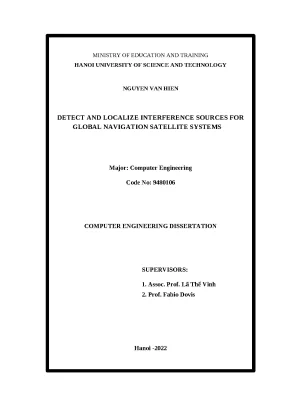
Tải xuống để đọc toàn bộMINISTRY OF EDUCATION AND TRAINING HANOI UNIVERSITY OF SCIENCE AND TECHNOLOGY NGUYEN VAN HIEN DETECT AND LOCALIZE INTERFERENCE SOURCES FOR GLOBAL NAVIGATION SATELLITE SYSTEMS Major: Computer Engineering Code No: 9480106 COMPUTER ENGINEERING DISSERTATION SUPERVISORS: 1. Fabio Dovis Hanoi -2022 STATEMENT OF ORIGINALITY AND AUTHENTICITY I hereby declare that all the content and organization of the thesis is the product of my own research and does not compromise in any way the rights of third parties, and all citations are explicitly specified from credible sources. I further confirm that all the data and results in the thesis are performed on actual devices completely true and have never been published by anyone else. Hanoi, April 2022 SUPERVISORS AUTHOR Assoc.
Lã Thế Vinh Nguyễn Văn Hiên Prof. Fabio Dovis i ACKNOWLEDGEMENTS First of all, I would like to sincerely thanks my supervisor Assoc. La The Vinh, for his guiding, supporting and motivating me throughout the whole my PhD student time. I would also like to express my gratitude to the members of the Navigation, Signal Analysis and Simulation (NavSAS) and Navis Centre.
In many ways, they have contributed to all the research activities presented in the thesis. In particular, I want to express my gratitude to Dr. Gianluca Falco and Dr. Nguyen Dinh Thuan, their endless support and their huge knowledge have greatly contributed to my work.
And I'd like to express my gratitude to Dr. Emanuela Falletti, who offered scientific guidance and suggestions to help me develope and finish my research during my period at NavSAS. Thanks to Prof. Fabio Dovis, who gave me important ideas and guided me to do my research especially during my period at Politecnico Di Torino.
I sincere thanks to VINIF. With the great financial support of the VINIF, my research conditions have greatly improved, and I am fully committed to the works with all of my creative energy. This work was funded by Vingroup Joint Stock Company and supported by the Domestic Master/ PhD Scholarship Programme of Vingroup Innovation Foundation (VINIF), Vingroup Big Data Institute (VINBIGDATA), code VINIF. I'd also like to thank the members of the dissertation committee for their insightful suggestions, which have helped me develop and finish this dissertation.
Last but not least, I am grateful to my parents and my wife for their unconditional love, encouragement, support and motivation, as well as for inspiring me to overcome all challenges and difficulties in order to finish this thesis. ii TABLE OF CONTENTS STATEMENT OF ORIGINALITY AND AUTHENTICITY.ii TABLE OF CONTENTS. iii LIST OF ACRONYMS. vi LIST OF TABLES.viii LIST OF FIGURES.1 Civil GNSS vulnerabilities to intentional interference.2 Radio Frequency Interference.3 GNSS Interference detection techniques.4 Spoofing detection techniques.1 Classification of spoofing threat.2 Spoofing detection algorithms.
INTERMEDIATED GNSS SPOOFING DETECTOR BASED ON ANGLE OF ARRIVAL.1 Fundamental background of GNSS and Spoofing.1 GNSS positioning theory.3 GNSS receiver architecture.2 Detection of a subset of counterfeit GNSS signals based on the Dispersion of the Double Differences (D3).1 Differential Carrier-Phase Model and SoS Detector.2 Sum of Squares Detector Based on Double Differences.3 Some Limitations of the SoS Detector.4 Detection Of A Subset Of Counterfeit Signals Based On The Dispersion Of The Double Differences (D3).5 Determination of the Decision Threshold.6 Cycle slip monitoring: the Doppler shift monitor.7 Reducing the probability of incorrect decision by time averaging.3 Performance Analysis of the Dispersion of Double Differences Algorithm to Detect Single-Source GNSS Spoofing.1 Theoretical analysis of performance and decision threshold.2 Performance evaluation of robust D3 implementations.3 Considerations on practical performance.4 A Linear Regression Model of the Phase Double Differences to Improve the D3 Spoofing Detection Algorithm.1 Limitations of D3 algorithm.2 The piecewise linear model.3 The proposed LR-D3 detector.4 Performance assessment with in-lab GNSS signals. SOPHISTICATED GNSS SPOOFING DETECTOR BASED ON ANGLE OF ARRIVAL.1 Gaussian Mixture Models and Expectation-Maximization for GMM (source [76]).3 Maximum likelihood for the Gaussian.4 The expectation maximization algorithm for GMM.2 A Gaussian Mixture Model Based GNSS Spoofing Detector using Double Difference of Carrier Phase in simple spoofing scenario.3 A novel approach to classify authentic and fake GNSS signals in sophisticated spoofing scenario using Gaussian Mixture Models.1 Grouping of Double Carrier Phase Difference.4 Multi-Directional GNSS Simulation Data Generation Method Use of Software Defined Radio Technology.1 Multidirectional GNSS signal simulation.2 Signal and system model.1 Multidirectional GNSS signals simulation.2 Sophisticated GNSS spoofing detector. CONCLUSIONS AND FUTURE WORKS. 127 v LIST OF ACRONYMS Acronym Meaning ADC Analog to Digital Converters AGC Automatic Gain Control AoA Angle of Arrival C/A Coarse/Acquisition C/N0 Carrier-to-Noise density CDMA Code Division Multiple Access D3 Dispersion of the Double Differences DVBT Digital Video Broadcasting – Terrestrial FDMA Frequency Division Multiple Access FNR False Negative Rate FPR False Positive Rate GLRT General Likelihood Ratio Test GMM Gaussian Mixture Model GNSS Global Navigation Satellite Systems GoF Goodness of Fit GPS Global Positioning System GSM Global System for Mobile Communications vi IMU Inertial Measurement Units OEM Original Equipment Manufacturer PVT Position, Velocity and Time RFI Radio Frequency Interference RX Receiver SDR Software-Defined Radio SIS Signal in Space SoS Sum of Squares TNR True Negative Rate TOA Time of Arrival TPR True Positive Rate TX Transmitter UTMS Universal Mobile Telecommunications System VHF Very High Frequency VSD Vestigial Signal Defense vii LIST OF TABLES Table 2.1 Techniques of GNSS spoofing detector based on signal features.1 Percentage of correct decisions for SoS and D3, in the three scenarios under test .2 Statistical performance of the D3 algorithm with two baselines.3 Static tests: estimation of the probability of missed detection on the counterfeit signals (%).
the ‘overall’ case is the probability of missed detection of three counterfeit signals.4 Static tests: Estimation of the probability of false alarms on the authentic signals (%).5 Dynamic tests: aircraft trajectories description.6 Dynamic test TRJ1: Estimation of the probability of missed detection on the counterfeit signals (%). The ‘overall’ case is the probability of missed detection of three counterfeit signals.7 Dynamic test TRJ1: Estimation of the probability of false alarm on the authentic signals (%).8 Dynamic test TRJ2: Estimation of the probability of missed detection on the counterfeit signals (%).9 Dynamic test TRJ2: Estimation of the probability of false alarm on the authentic signals (%).10 Static test with Real Measurements: Detection Results for Test #1.11 Dynamic tests with Real Measurements: Tests trajectories description.12 Dynamic tests with Real Measurements: Detection Results for Test #4 78 Table 3.13 Comparison of detection performance for 2 hours of signal simulation: LR-D3 and standard D3 algorithms.14 Detection performance as a function of C/N0.1 The result of cross validation testing.2 The result of Fractional DDs in case of Intermediate spoofing attack, where the DDs of authentic satellites cross the ones related to the spoofed satellites.3 Normalized confusion matrix of Fractional DDs in case of Intermediate spoofing attack. 123 viii LIST OF FIGURES Figure 1.1 Applications of GNSS (source: [64]).1 The enviroment for transmitting signals from satellites to receivers (source: [65]).2 The low SIS signal power of GNSS (source: [75]).3 GNSS frequency bands (source:[69]).4 Radio frequency interference.5 Intermediated Spoofing Scenario.6 Cheap jammers are widely sold online (source: [96]).7 Techniques for Detecting GNSS Interference.8 Three continuum of spoofing threat: simplistic, intermediate, and sophisticated attacks (source:[19]).9 A summary of the various spoofing detection methods available in the literature (source: [17]).10 Angle of arrival of GNSS satellite.11 Angle of arrival defense Spoofing.1 Spherical positioning system of GNSS.2 A fundamental GNSS receiver architecture (source: [72]).3 Principles of GPS simulator.4 Blocks scheme of GPS simulator.7 Reference geometry for the dual-antenna system.8 Fractional DDs and SoS detector results under simulated spoofing attack (H0) .9 Fractional DDs and SoS detector results in normal conditions (H1).10 Fractional DD measurements and SoS detection metric in mixed tracking conditions under spoofing attack. Only three signals out of nine are counterfeit.
The reference signal is authentic.11 Example of cycle slips effect on the SoS metric in the presence of single source. The detector is not able to reveal a spoofing attack when cycle slips occur 43 Figure 3.12 Zero baseline fractional DD measurements for various values of input C/N0 ratio. In this setup the ratio was equal for all the simulated signals.13 Empirical mapping of the relationship between threshold ξk and input C/N0 ratio.14 Fractional DD measurements and SoS metric in the presence of single source after removing cycle slips.15 Authentic signals scenario.16 Simplistic spoofing attack scenario.17 Intermediate spoofing attack scenario.18 Fractional DD measurements and SoS metric in the Authentic signals scenario. When cycle slips occur, the DDs are not computed.19 D3 detector results in the Authentic signals scenario.20 Fractional DDs in case of Intermediate spoofing attack, where the DDs of authentic satellites (PRN 23) cross the ones related to the spoofed satellites.21 Fractional DD measurements in mixed tracking conditions under spoofing attack.
Five signals of eight are counterfeit. The reference signal is counterfeit, so that Mcnt = 0.22 Normalized distribution under the h1 condition: comparison between theoretical and sample distribution.23 Normalized distribution under the h0 condition: comparison between theoretical and sample distribution.24 Relationship between ξ2 and pairwise Pmd, under the h0 condition (logarithmic scale on the Y axis). 58 detection rate Rmd for various values of detection threshold ξ2.25 Comparison between the theoretical Pmd and the computed missed- Figure 3.26 Theoretical values of Pfa (3.24) as a function of ξ2 and for several non- centrality parameters λ.27 Evaluation of the feasible range of values for the non-centrality parameter λ, as a function of the difference |m j-mk | and of the standard deviation of the measurement noise σ.28 Measured values of Rfa as a function of ξ2 for a two-hours simulation in which |mj-mk | varies along time and so does the non-centrality parameter λ|(h1).29 Pairwise operating curves (i., pairwise Pfa (λ) as a function of the pairwise Pmd ) for the D3 detection rule, for several non-centrality parameters λ.30 Estimated PMD for the D3 algorithm under the H0 condition.31 ROC curves for the D3 spoofing detection algorithm, for several non- centrality parameters λ.32 Estimated PMD for the D3 algorithm with averaged fractional DDs, under the H0 condition and for different averaging window lengths η.33 Comparison of ROC curves for the D3 spoofing detection algorithm with 1 and 2 baselines, for several non-centrality parameters λ.34 Static test: Double carrier phase differences with respect to a counterfeit reference satellite.35 Double carrier phase differences of the 1st baseline (top) and 2nd baseline (bottom) in TRJ 1.36 Block diagram of LR-D3 Detector.37 Fractional DD measurements in mixed tracking conditions under spoofing attack. Five signals of eight are counterfeit.38 Sequences of decisions, with false alarms, in the standard D 3 spoofing detector algorithm for PRNs 25 and 16.39 Example of fractional DD approximated by piecewise straight lines.40 Example of estimated value of line slope and intercept.41 Measured pairwise missed-detection rate for the detection events Aij and Bij evaluated on three data collections at different SNR.42 Overall probability of missed-detection (PMD) estimated for the LR-D3 and the standard D3 algorithms.43 Measured pairwise false-alarm rate for the detection events Aij and Bij evaluated on three data collections at different SNR.44 Overall probability of false-alarm (PFA) estimated for the LR- D3 and the standard D3 algorithms.45 Time series of the fractional DD measurements computed from a GNSS dataset, including both authentic and spoofed signals.46 Decisions produced by the standard D3 algorithm.47 Decisions produced by the LR-D3 algorithm.90 associated pairwise false alarm rates for events A7-25(b) and B7-25(d).
Here PRN 7∈ S Figure 3.48 Examples of slope estimates (a) and intercept estimates (c), and and PRN 25∈ A.49 Measured missed-detection rate and false alarm rate, evaluated on three data collections at different C/N0 (dataset 1: 39 dBHz; dataset 2: 42 dBHz, dataset 3: 45 dBHz) as a function of the detection threshold λ.50 Measured pairwise missed-detection rate for the detection events Aij and Bij evaluated on three data collections at different distance of two antennas.1 Block diagram of sophisticated gnss spoofing detector using GMM.2 The single variable Gaussian are plotted with 𝜇 = 0 and 𝜎 = 1.3 Example of a Gaussian mixture distribution in one dimension, green, blue, and yellow are shown as components, and their sum is shown in black.
Nội dung được bảo vệ bản quyền — Tải xuống đầy đủ
Trích dẫn luận án này
Nguyen Van Hien (2022). Phát hiện và xác định vị trí nguồn can nhiễu tín hiệu định vị vệ tinh [Luận án tiến sĩ, Hanoi University of Science and Technology]. LuanAn.net. https://luanan.net/tai-lieu-khac/phat-hien-va-xac-dinh-vi-tri-nguon-can-nhieu-tin-hieu-dinh-vi-viet-tinh
Câu hỏi thường gặp
Luận án "Phát hiện và xác định vị trí nguồn can nhiễu tín hiệu định vị vệ tinh" nghiên cứu về vấn đề gì?
Luận án: Luận án nghiên cứu phương pháp phát hiện và xác định vị trí nguồn can nhiễu lên tín hiệu định vị sử dụng vệ tinh. Xem tóm tắt và tải về tại LuanAn.net
Luận án "Phát hiện và xác định vị trí nguồn can nhiễu tín hiệu định vị vệ tinh" được bảo vệ tại trường nào?
Luận án này được bảo vệ tại Hanoi University of Science and Technology. Năm bảo vệ: 2022.
Luận án "Phát hiện và xác định vị trí nguồn can nhiễu tín hiệu định vị vệ tinh" thuộc chuyên ngành gì?
Luận án "Phát hiện và xác định vị trí nguồn can nhiễu tín hiệu định vị vệ tinh" thuộc chuyên ngành Computer Engineering. Danh mục: Tài liệu khác.
Luận án "Phát hiện và xác định vị trí nguồn can nhiễu tín hiệu định vị vệ tinh" có bao nhiêu trang?
Luận án "Phát hiện và xác định vị trí nguồn can nhiễu tín hiệu định vị vệ tinh" có 177 trang. Bạn có thể xem trước một phần tài liệu ngay trên trang web trước khi tải về.
Cách tải luận án "Phát hiện và xác định vị trí nguồn can nhiễu tín hiệu định vị vệ tinh" về máy như thế nào?
Để tải luận án về máy, bạn nhấn nút "Tải xuống ngay" trên trang này, sau đó hoàn tất thanh toán phí lưu trữ. File sẽ được tải xuống ngay sau khi thanh toán thành công. Hỗ trợ qua Zalo: 0559 297 239.