Bất đẳng thức lojasiewicz tương đương topo và đa diện newton la tiến sĩ
Luận án: Bất đẳng thức lojasiewicz tương đương topo và đa diện newton la tiến sĩ. Xem tóm tắt và tải về tại LuanAn.net
Giải tích toán học
Luan An
Luận án tiến sĩ
Năm xuất bản
Số trang
73
Thời gian đọc
11 phút
Lượt xem
0
Lượt tải
0
Phí lưu trữ
40 Point
Tổng quan nhanh
- Chủ đề:
- Nghiên cứu Bất đẳng thức Lojasiewicz và Tương đương tô pô
- Số trang:
- 73 trang
- Trường:
- Trường Đại học Đà Lạt
- Chuyên ngành:
- Giải tích toán học
- Tác giả:
- Bùi Nguyễn Thảo Nguyên
- Năm:
- 2017
Tóm tắt nội dung luận án
I.Nghiên cứu Bất đẳng thức Lojasiewicz và Tương đương tô pô
Nghiên cứu tập trung vào bất đẳng thức Lojasiewicz và các dạng tương đương tô pô. Các nghiên cứu bao gồm tương đương cục bộ và tương đương tại vô cực. Đối tượng là một lớp các hàm thỏa mãn điều kiện không suy biến. Lý thuyết điểm kỳ dị và Hình học đại số thực là các công cụ chính. Công trình này đóng góp vào sự hiểu biết về tính chất của các hàm giải tích. Đồng thời, nó cung cấp phương pháp mới để phân tích hành vi của chúng gần các điểm kỳ dị và tại vô cực. Sự kết hợp giữa các lĩnh vực này mở ra nhiều hướng nghiên cứu quan trọng.
1.1. Giới thiệu tổng quan mục tiêu nghiên cứu
Luận án khảo sát bất đẳng thức Lojasiewicz cho mầm hàm giải tích. Nó cũng phân tích các dạng tương đương tô pô. Mục tiêu là hiểu rõ hơn về hành vi của hàm quanh điểm 0 và tại vô cực. Các điều kiện không suy biến của hàm đóng vai trò trung tâm. Điều này giúp đơn giản hóa việc phân tích và đưa ra các kết quả cụ thể.
1.2. Vai trò của Lý thuyết điểm kỳ dị và Hình học đại số thực
Lý thuyết điểm kỳ dị cung cấp khung lý thuyết mạnh mẽ. Nó dùng để nghiên cứu các cấu trúc địa phương của hàm. Hình học đại số thực hỗ trợ phân tích các tập con giải tích. Hai lĩnh vực này là nền tảng cho việc chứng minh các định lý chính. Chúng cho phép xây dựng các công cụ cần thiết để giải quyết các vấn đề phức tạp. Các kết quả có được dựa trên sự tương tác chặt chẽ giữa hai lý thuyết này.
II.Tính toán Số mũ Lojasiewicz bằng Đa diện Newton
Bất đẳng thức Lojasiewicz cổ điển khẳng định sự tồn tại của các hằng số. Nó liên quan đến giá trị tuyệt đối của hàm và khoảng cách đến tập không của hàm. Số mũ Lojasiewicz là cận dưới đúng của các số mũ thỏa mãn bất đẳng thức này. Đây là một số hữu tỉ dương và luôn đạt được. Việc tính toán và ước lượng số mũ này là một vấn đề quan trọng. Nó có nhiều ứng dụng trong Lý thuyết điểm kỳ dị.
2.1. Định nghĩa và ý nghĩa của Số mũ Lojasiewicz
Số mũ Lojasiewicz (L0(f)) đo lường mức độ "phẳng" của hàm f tại gốc tọa độ. Một giá trị nhỏ của L0(f) chỉ ra hàm "phẳng" hơn. Giá trị này cung cấp thông tin quan trọng về cấu trúc địa phương của tập không. Nó đóng vai trò then chốt trong phân loại điểm kỳ dị. Sự hiểu biết về số mũ này giúp dự đoán hành vi của hàm.
2.2. Phương pháp tính toán Số mũ Lojasiewicz mới
Luận án trình bày một công thức mới. Công thức này tính toán số mũ Lojasiewicz cho mầm hàm giải tích f. Nó dựa trên đa diện Newton của f. Điều kiện áp dụng là f không âm và không suy biến. Kết quả này đơn giản hóa đáng kể quá trình tính toán. Nó cung cấp một liên kết trực tiếp giữa cấu trúc đại số và tính chất tô pô. Phương pháp này có thể áp dụng cho các điểm kỳ dị cô lập.
III.Khám phá Tương đương tô pô của mầm hàm giải tích
Nghiên cứu mở rộng sang tương đương tô pô cho các mầm hàm giải tích. Đặc biệt, nó khảo sát tương đương G-tô pô bi-Lipschitz. Tương đương này diễn ra trong không gian con giải tích. Các nhóm G cổ điển của Mather được sử dụng. Phân loại các điểm kỳ dị là một mục tiêu chính. Sự tương đương này giúp nhóm các hàm có cấu trúc địa phương tương tự. Nó cung cấp một cách hệ thống để so sánh các hàm.
3.1. Các dạng Tương đương tô pô cho mầm hàm
Tương đương tô pô có thể là cục bộ hoặc tại vô cực. Tương đương cục bộ xem xét hành vi của hàm gần điểm kỳ dị. Tương đương tại vô cực phân tích hàm khi biến tiến ra vô cực. Các nhóm Mather (chẳng hạn như A-equivalence, K-equivalence) định nghĩa các dạng tương đương khác nhau. Nghiên cứu tập trung vào tương đương tô pô trong ngữ cảnh sub-analytically bi-Lipschitz. Điều này liên quan đến các phép biến đổi bảo toàn cấu trúc.
3.2. Tiêu chí cho sự Tương đương tô pô cục bộ
Luận án điều tra điều kiện đủ cho tương đương tô pô G-bi-Lipschitz. Nó xem xét các mầm hàm từ (Rn, 0) đến (R, 0). Một đồng phôi địa phương bảo toàn cấu trúc sub-analytically bi-Lipschitz là cần thiết. Tiêu chí này giúp phân loại điểm kỳ dị một cách hiệu quả. Nó cung cấp một công cụ mạnh mẽ để nhận diện các lớp hàm. Điều này có ý nghĩa quan trọng trong Lý thuyết điểm kỳ dị.
IV.Đa diện Newton và điều kiện không suy biến
Đa diện Newton là một công cụ hình học quan trọng. Nó đại diện cho thông tin về các bậc của hàm. Điều kiện không suy biến liên quan đến tính chất của đa diện này. Nó đảm bảo các tính toán và phân tích được thực hiện dễ dàng hơn. Điều kiện này thường được sử dụng trong Lý thuyết điểm kỳ dị. Nó giúp đơn giản hóa các vấn đề phức tạp. Đa diện Newton cung cấp cái nhìn sâu sắc về cấu trúc của hàm.
4.1. Định nghĩa và ứng dụng của Đa diện Newton
Đa diện Newton của một hàm f là bao lồi của các điểm trong Rn. Các điểm này tương ứng với các số mũ của các đơn thức trong chuỗi Taylor của f. Nó cung cấp một biểu diễn hình học của hàm. Đa diện Newton được sử dụng để xác định các đặc trưng của hàm. Đặc biệt, nó giúp trong việc tính toán số mũ Lojasiewicz. Nó cũng hỗ trợ trong việc phân tích các điểm kỳ dị.
4.2. Khảo sát các biến dạng của hàm đa thức
Luận án đưa ra một điều kiện đủ cho biến dạng. Biến dạng của một hàm đa thức f là "analytically trivial" tại vô cực. Điều kiện này được diễn giải thông qua đa diện Newton của f tại vô cực. Kết quả này có ý nghĩa trong việc nghiên cứu hành vi của hàm. Nó liên quan đến tương đương tô pô tại vô cực. Việc hiểu các biến dạng này giúp trong phân loại hàm.
V.Ứng dụng Bất đẳng thức Lojasiewicz và Phân loại kỳ dị
Bất đẳng thức Lojasiewicz có vai trò trung tâm trong nhiều lĩnh vực toán học. Nó được ứng dụng rộng rãi trong Lý thuyết điểm kỳ dị. Ví dụ, nó liên quan đến tính đủ C0 của các jet. Bất đẳng thức này cũng quan trọng trong việc biểu diễn đa thức dương. Cụ thể, nó xuất hiện trong Positivstellensätze của Schmüdgen và Putinar. Sự hiểu biết sâu sắc về bất đẳng thức này mở ra nhiều ứng dụng thực tiễn. Nó kết nối hình học đại số với lý thuyết hàm.
5.1. Vai trò của bất đẳng thức trong Lý thuyết điểm kỳ dị
Trong Lý thuyết điểm kỳ dị, bất đẳng thức Lojasiewicz là công cụ cơ bản. Nó giúp phân tích cấu trúc địa phương của các tập con giải tích. Nó cung cấp các ràng buộc định lượng về hành vi của hàm gần điểm kỳ dị. Các kết quả liên quan đến số mũ Lojasiewicz trực tiếp ảnh hưởng đến phân loại điểm kỳ dị. Điều này đặc biệt quan trọng cho các điểm kỳ dị cô lập. Nó góp phần vào việc đồng phôi địa phương.
5.2. Đóng góp vào Phân loại điểm kỳ dị giải tích
Nghiên cứu này đóng góp đáng kể vào phân loại điểm kỳ dị. Nó cung cấp các công cụ và điều kiện mới. Đặc biệt là thông qua việc sử dụng đa diện Newton. Các công thức tính số mũ Lojasiewicz giúp xác định các đặc trưng của kỳ dị. Việc tìm kiếm các điều kiện tương đương tô pô cũng hỗ trợ phân loại. Đây là bước tiến quan trọng trong việc hiểu sâu hơn về cấu trúc của các hàm.
Tải xuống file đầy đủ để xem toàn bộ nội dung
Tải đầy đủ (73 trang)Trích đoạn nội dung luận án
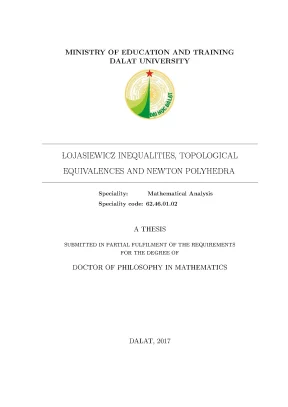
Tải xuống để đọc toàn bộMINISTRY OF EDUCATION AND TRAINING DALAT UNIVERSITY LOJASIEWICZ INEQUALITIES, TOPOLOGICAL EQUIVALENCES AND NEWTON POLYHEDRA Speciality: Mathematical Analysis Speciality code: 62.02 A THESIS SUBMITTED IN PARTIAL FULFILMENT OF THE REQUIREMENTS FOR THE DEGREE OF DOCTOR OF PHILOSOPHY IN MATHEMATICS DALAT, 2017 MINISTRY OF EDUCATION AND TRAINING DALAT UNIVERSITY BUI NGUYEN THAO NGUYEN LOJASIEWICZ INEQUALITIES, TOPOLOGICAL EQUIVALENCES AND NEWTON POLYHEDRA Speciality: Mathematical Analysis Speciality code: 62.02 A THESIS SUBMITTED IN PARTIAL FULFILMENT OF THE REQUIREMENTS FOR THE DEGREE OF DOCTOR OF PHILOSOPHY IN MATHEMATICS Supervisors: 1. Pham Tien Son 2. Dinh Si Tiep DALAT, 2017 Declaration of Authorship I, Bùi Nguyê˜n Thȧ’o Nguyên, declare that this thesis titled, “LOJASIEWICZ IN- EQUALITIES, TOPOLOGICAL EQUIVALENCES AND NEWTON POLYHEDRA” and the work presented in it are my own. I confirm that: • This work was done wholly or mainly while in candidature for a research degree at this University.
• Where any part of this thesis has previously been submitted for a degree or any other qualification at this University or any other institution, this has been clearly stated. • Where I have consulted the published work of others, this is always clearly at- tributed. • Where I have quoted from the work of others, the source is always given. With the exception of such quotations, this thesis is entirely my own work.
• I have acknowledged all main sources of help. • Where the thesis is based on work done by myself jointly with others, I have made clear exactly what was done by others and what I have contributed myself. Signed: Date: i Abstract LOJASIEWICZ INEQUALITIES, TOPOLOGICAL EQUIVALENCES AND NEWTON POLYHEDRA by Bùi Nguyê˜n Thȧ’o Nguyên The goals of this thesis are to study Lojasiewicz inequalities and topological equiva- lences (local and at infinity) for a class of functions satisfying non-degenerate conditions. Singularity Theory and Semi-algebraic Geometry are main tools for our study.
Our main results include: - Establishing a formula for computing the Lojasiewicz exponent of a non-constant analytic function germ f in terms of the Newton polyhedron of f in the case where f is non-negative and non-degenerate. - Investigating into the sub-analytically bi-Lipschitz topological G-equivalence for function germs from (Rn , 0) to (R, 0), where G is one of the classical Mather’s groups. - Giving a sufficient condition for a deformation of a polynomial function f in terms of its Newton polyhedron at infinity to be analytically (smooth in the complex case) trivial at infinity. Keywords and phrases: Lojasiewicz inequalities, topological equivalences, non-degenerate conditions, Newton polyhedra, sub-analytically, bi-Lipschitz, analytically trivial at infinity.
ii Acknowledgements First and foremost, I would like to express my sincere gratitude for my supervisors, Assoc. D - inh Sĩ Tiê.p, who always support and encourage me. Thank you for your helpful suggestions, your ideas and the interesting discussions that we have had on the material of this work. Thank you so much.
I am also grateful to my teachers in the Department of Mathematics and Informatics at Da Lat University. Thank for your attractive lectures which encourage me to pursue scientific research. Finally, I take this opportunity to express the profound gratitude from my heart to my family. iii Introduction The main purposes of this thesis are to study Lojasiewicz inequalities and topological equivalences (local and at infinity) for a class of functions satisfying non-degenerate conditions in terms of Newton polyhedra with some tools of Singularity Theory and Semi-Algebraic Geometry.
In details, let f : (Rn , 0) → (R, 0) be an analytic function defined in a neighborhood of the origin 0 ∈ Rn. The Classical Lojasiewicz inequality [2, 34] asserts that there exist some constants δ > 0, c > 0, and l > 0 such that |f (x)| ≥ cd(x, f −1 (0))l for all kxk ≤ δ, where d(x, f −1 (0)) := inf{kx − yk | y ∈ f −1 (0)}, and k · k denotes the usual Euclidean norm in Rn. The Lojasiewicz exponent of f at the origin 0 ∈ Rn , denoted by L0 (f ), is the infimum of the exponents l satisfying the above Lojasiewicz inequality. Bochnak and Risler [8] proved that L0 (f ) is a positive rational number.
Moreover, the Lojasiewicz exponent L0 (f ) is attained, i., there are some positive constants c and δ such that |f (x)| ≥ cd(x, f −1 (0))L0 (f ) for kxk ≤ δ. The Lojasiewicz inequality plays an important role in many problems of mathemat- ics, such as Singularity Theory (C 0 -sufficiency of jets, [7, 29, 32]); the complexity of the representations of positive polynomials (Schmüdgen’s and Putinar’s Positivstellensätze [41, 52]). Hence, the computation and estimation of the Lojasiewicz exponent are interesting problems. In the case where f is an analytic function in two variables, a formula for computing the Lojasiewicz exponent L0 (f ) was given by Kuo in the paper [31] (see also the paper [21] for the Lojasiewicz exponent at infinity).
If f is a polynomial of degree d iv in n variables with an isolated zero at the origin, Gwozdziewicz [25] (see also [27]) prove that: L0 (f ) ≤ (d − 1)n + 1. In the general case, when f may have a non-isolated singularity at the origin, Pha. In general, as far as we know, there is no method to determine L0 (f ). In the thesis, we will establish a formula for the Lojasiewicz exponent of non-negative and non-degenerate analytic functions.
Another problem which attracts our studies is the classification of functions by equivalence relations which is a fundamental problem in Singularity Theory. Many authors have focused their attention on this problem, and many characteristics and invariants of G-equivalence are established, where G is one of the classical Mather’s groups [35, 36], i. The classification problem with respect to C 0 -G-equivalence relations has been well- studied. For C ∞ -stable map germs, Mather in [36] proved that C 0 -K-equivalence implies C 0 -A-equivalence.
For analytic function germs with isolated singularities in two or three variables, it is was proved by King in [26] (see also [1, 46]) that C 0 -V-equivalence implies C 0 -A-equivalence. On the other hand, in [43], it is pointed out by Nishimura that C 0 - V-equivalence of smooth functions with isolated singularities implies C 0 -K-equivalence. Recently, new works have also treated such theme [1, 3, 4, 5, 13, 14, 15, 50, 56]. In this work, we are interested in the sub-analytically, bi-Lipschitz C 0 -G-equivalence of contin- uous sub-analytic function germs from (Rn , 0) to (R, 0) and bi-Lipschitz K-equivalence invariances of the Lojasiewicz exponent and the multiplicity.
We also give a condition for analytic function germs in terms of their Newton polyhedra to be sub-analytically bi-Lipschitz C-equivalent to their Newton principal parts. In the thesis, we also focus on the C 0 -sufficiency of jets. Recall that the k-jet of a C r -function in the neighborhood of 0 ∈ Rn is identified with its k-th Taylor polynomial at 0, then the function is called a realization of the jet. The k-jet is said to be C p - sufficient in the C r class (p ≤ r), if for any two of its C r -realizations f and g there exists a C p diffeomorphism ϕ of neighborhood of 0, such that f ◦ ϕ = g in some neighborhood of 0.
Then, two following conditions are equivalent: (i) There are positive constants C and r such that k∇f (x)k ≥ Ckxkk−1 for kxk ≤ r. (ii) The k-jet of f is sufficient in the C k class. Analogous results in the case of complex analytic functions were proved by Chang and Lu [11], Teissier [55], and by Bochnak and Kucharz [6]. Similar considerations are also carried out for polynomial mappings in two variables in a neighborhood of infinity by Cassou-Noguès and Hà [10]: Let f be a polynomial in C[z1 , z2 ].
Then, two following conditions are equiv- alent: (i) There are positive constants C and R such that k∇f (x)k ≥ Ckxkk−1 for kxk ≥ R. Let us recall that the links at infinity of the fiber of f ∈ C[z1 , z2 ] is the set f −1 (λ) ∩ {(x, y) ∈ C2 | |x|2 + |y|2 = R2 } for R sufficiently large. The result of Cassou-Noguès and Hà is recently generalised by Skalski [54], Rodak and Spodzieja [49]. In this thesis, we will give a version at infinity of the above result for a class of polynomial maps, which are Newton non-degenerate at infinity.
The results attended in this thesis assert that the topological, analytic and geometric properties of analytic function germs and polynomials can be described by their Newton polyhedra, see also [16, 17, 18, 20, 21, 24, 28, 37, 44, 45, 58, 59]. vi In details, this thesis is divided into four chapters and a list of references. Chapter 1 recalls some notions and results of Semi-algebraic Geometry, Sub-analytic Geometry, Newton polyhedra and non-degeneracy conditions as well as of Differential equations that are useful for subsequent studies. Chapter 2 establishes a formula for computing the Lojasiewicz exponent of a non- constant analytic function germ f in terms of its Newton polyhedron in the case where f is non-negative and non-degenerate (see Theorem 2.
Chapter 3 investigates the sub-analytically bi-Lipschitz topological G-equivalence for function germs from (Rn , 0) to (R, 0), where G is one of the classical Mather’s groups. The mains results of this chapter are Theorem 3. Chapter 4 gives a sufficient condition for a deformation of a polynomial function f in terms of its the Newton boundary at infinity to be analytically (smooth in the complex case) trivial at infinity (see Theorem 4. The results presented in this thesis are written on three papers done by myself jointly with my supervisor, Assoc.
They were published in the journals including International Journal of Mathematics [BP-1], Houston Journal of Mathematics [BP-2] and Annales Polonici Mathematici [BP-3]. vii Contents Declaration of Authorship i Abstract ii Acknowledgements iii Introduction iv 1 Preliminaries 1 1.1 Semi-algebraic Geometry .1 Semi-algebraic sets and maps .2 The Tarski–Seidenberg theorem .4 Other results of Semi-algebraic Geometry .2 Sub-analytic Geometry .1 Semi-analytic sets and maps .2 Sub-analytic sets and maps .3 Newton polyhedra and non-degeneracy conditions .1 Newton polyhedra and non-degeneracy conditions at the origin .2 Newton polyhedra and the Kouchnirenko non-degeneracy condi- tion at infinity. 12 viii 2 Computation of the Lojasiewicz exponent of non-negative and non- degenerate analytic functions 15 2.2 Computation of the Lojasiewicz exponent of non-negative and non-degenerate analytic functions. 27 3 The sub-analytically topological types of function germs 29 3.2 Sub-analytically topological types .3 Bi-Lipschitz K-equivalence invariances of the Lojasiewicz exponent and the multiplicity .4 Sub-analytically bi-Lipschitz C-equivalence and non-degeneracy conditions 38 4 Analytically principal part of polynomials at infinity 45 4.
46 Conclusions 54 List of Author’s Related Papers 55 Bibliography 56 Table of Notations 61 Index 62 ix Chapter 1 Preliminaries This chapter recalls some notions and results of Semi-algebraic Geometry, Sub- analytic Geometry, Newton polyhedra and non-degeneracy conditions, and Differential equations. A detailed expositon, and proofs, can be found in [9, 23, 24, 28, 34, 37, 57].1 Semi-algebraic Geometry This section begins with basic definitions of semi-algebraic sets and maps. Some notions and results of Semi-algebraic Geometry such as Tarski–Seidenberg theorem, Cell Decomposition, Curve Selection Lemma and Lojasiewicz inequalities. are also presented.
A more detailed discussion and proofs can be found in [9, 34, 38, 40, 53, 57].1 Semi-algebraic sets and maps Definition 1.4]) A subset of Rn is called semi-algebraic if it is a finite union of sets of the form {x ∈ Rn | f1 (x) = 0; fi (x) > 0, i = 2,. , k}, where all fi are polynomials in R[x]. (i) The semi-algebraic subsets of R are the unions of finitely many points and open intervals. (ii) Any algebraic subsets of Rn (defined by polynomial equations) are semi-algebraic.
Nội dung được bảo vệ bản quyền — Tải xuống đầy đủ
Trích dẫn luận án này
Bùi Nguyễn Thảo Nguyên (2017). Bất đẳng thức lojasiewicz tương đương topo và đa diện newton [Luận án tiến sĩ, Đại học Đà Lạt]. LuanAn.net. https://luanan.net/tai-lieu-khac/bat-dang-thuc-lojasiewicz-tuong-duong-topo-va-da-dien-newton-la-tien-si
Câu hỏi thường gặp
Luận án "Bất đẳng thức lojasiewicz tương đương topo và đa diện newton" nghiên cứu về vấn đề gì?
Luận án: Bất đẳng thức lojasiewicz tương đương topo và đa diện newton la tiến sĩ. Xem tóm tắt và tải về tại LuanAn.net
Luận án "Bất đẳng thức lojasiewicz tương đương topo và đa diện newton" được bảo vệ tại trường nào?
Luận án này được bảo vệ tại Đại học Đà Lạt. Năm bảo vệ: 2017.
Luận án "Bất đẳng thức lojasiewicz tương đương topo và đa diện newton" thuộc chuyên ngành gì?
Luận án "Bất đẳng thức lojasiewicz tương đương topo và đa diện newton" thuộc chuyên ngành Giải tích toán học. Danh mục: Tài liệu khác.
Luận án "Bất đẳng thức lojasiewicz tương đương topo và đa diện newton" có bao nhiêu trang?
Luận án "Bất đẳng thức lojasiewicz tương đương topo và đa diện newton" có 73 trang. Bạn có thể xem trước một phần tài liệu ngay trên trang web trước khi tải về.
Cách tải luận án "Bất đẳng thức lojasiewicz tương đương topo và đa diện newton" về máy như thế nào?
Để tải luận án về máy, bạn nhấn nút "Tải xuống ngay" trên trang này, sau đó hoàn tất thanh toán phí lưu trữ. File sẽ được tải xuống ngay sau khi thanh toán thành công. Hỗ trợ qua Zalo: 0559 297 239.