The formation and promulgation of institutional ethos by new univ
Phân tích và đề xuất phương pháp hình thành và phổ biến tinh thần tổ chức mới.
Georgia Southern University
Luan An
Luận án tiến sĩ
Năm xuất bản
Số trang
193
Thời gian đọc
29 phút
Lượt xem
0
Lượt tải
0
Phí lưu trữ
50 Point
Tổng quan nhanh
- Chủ đề:
- 1. Khám phá Ethos Tổ chức: Thách thức Lãnh đạo mới
- Số trang:
- 193 trang
- Trường:
- Georgia Southern University
- Chuyên ngành:
- Higher Education
- Tác giả:
- Charles F. Ziglar
- Năm:
- 2018
Tóm tắt nội dung luận án
I. Khám phá Ethos Tổ chức Thách thức Lãnh đạo mới
Chủ tịch đại học mới đối mặt với nhiều thách thức. Việc chuẩn bị cho các vấn đề bối cảnh là nỗ lực chuyên môn đáng gờm (Alexander, 2014; Siegel, 2011). Các sự kiện gần đây liên quan đến căng thẳng tổng thống tại các trường đại học minh họa vấn đề khó khăn. Chủ tịch mới đối mặt với những vấn đề này khi nhậm chức. Birnbaum (1992) khẳng định chủ tịch mới hiệu quả nhất khi họ diễn giải đời sống tổ chức. Họ sử dụng ngôn ngữ, biểu tượng và nghi lễ. Nghiên cứu của Trachtenberg, Kauvar, và Bogue (2013) cùng Vyas (2013) nhấn mạnh việc hiểu ethos của một tổ chức là cần thiết. Điều này hỗ trợ lãnh đạo hiệu quả của chủ tịch. Nghiên cứu này khám phá cách các chủ tịch đại học mới làm rõ ý nghĩa của ethos tổ chức. Họ đã phục vụ ít nhất một năm và không quá ba năm trong nhiệm kỳ đầu tiên. Họ áp dụng những gì học được để định hình tổ chức, nhằm mục đích lãnh đạo hiệu quả. Cách tiếp cận hiện tượng luận giải thích của Van Manen được sử dụng làm khung lý thuyết.
1.1. Bối cảnh Lãnh đạo Đại học Mới
Chủ tịch đại học mới đối mặt với những thách thức phức tạp. Việc hiểu bối cảnh là rất quan trọng. Các vấn đề này đòi hỏi sự chuẩn bị kỹ lưỡng.
1.2. Tầm quan trọng của Ethos Tổ chức
Ethos là nền tảng cho sự lãnh đạo thành công. Nó định hình văn hóa tổ chức và giá trị cốt lõi. Hiểu ethos giúp chủ tịch đưa ra quyết định sáng suốt.
1.3. Nghiên cứu Định nghĩa Ethos Đại học
Nghiên cứu tập trung vào cách chủ tịch mới diễn giải ethos. Họ sử dụng kiến thức này để định hình bản sắc tổ chức. Mục tiêu cuối cùng là lãnh đạo hiệu quả, phát triển văn hóa mạnh mẽ.
II. Vai trò Chủ tịch Đại học trong Xây dựng Văn hóa
Nghiên cứu sử dụng cách tiếp cận hiện tượng luận giải thích của Van Manen. Đây là khung lý thuyết cho công trình này. Các cuộc phỏng vấn với bốn chủ tịch đại học mới đóng vai trò là nguồn dữ liệu. Các chủ tịch này, khi hoạt động trong bối cảnh độc đáo của tổ chức, đã quan tâm đến các khái niệm về bản sắc tổ chức, văn hóa tổ chức, và hình ảnh tổ chức. Việc này diễn ra khi họ tìm cách xây dựng và truyền bá ethos của một tổ chức. Phát hiện này nhấn mạnh vai trò trung tâm của lãnh đạo trong việc định hình giá trị và văn hóa. Chủ tịch mới cần tích cực tham gia vào quá trình kiến tạo giá trị. Họ cần đảm bảo sự phổ biến văn hóa trong toàn bộ cộng đồng trường. Vai trò lãnh đạo của họ trực tiếp ảnh hưởng đến việc xây dựng ethos. Điều này củng cố bản sắc doanh nghiệp và định hướng các nỗ lực quản lý thay đổi.
2.1. Cách tiếp cận Nghiên cứu Độc đáo
Nghiên cứu áp dụng phương pháp hiện tượng luận giải thích của Van Manen. Phương pháp này khám phá kinh nghiệm sống của chủ tịch. Bốn chủ tịch đại học mới được phỏng vấn để thu thập dữ liệu.
2.2. Định hình Bản sắc và Giá trị Tổ chức
Chủ tịch chú ý đến bản sắc, văn hóa và hình ảnh tổ chức. Các yếu tố này là then chốt để xây dựng ethos. Nghiên cứu này làm nổi bật tầm quan trọng của việc kiến tạo giá trị.
2.3. Truyền bá Văn hóa và Giá trị Cốt lõi
Chủ tịch đóng vai trò quan trọng trong việc truyền bá văn hóa. Họ đảm bảo các giá trị cốt lõi được truyền đạt rộng rãi. Đây là một khía cạnh quan trọng của sự phát triển văn hóa.
III. Định hình Bản sắc Tổ chức và Giá trị Cốt lõi
Phát hiện của nghiên cứu chỉ ra rằng các chủ tịch, mặc dù hoạt động trong bối cảnh độc đáo của mỗi tổ chức, đã quan tâm đến ba khái niệm chính. Đó là bản sắc tổ chức, văn hóa tổ chức và hình ảnh tổ chức. Những khái niệm này là nền tảng khi họ tìm cách hình thành và truyền bá ethos của một tổ chức. Bản sắc tổ chức định nghĩa "chúng ta là ai". Văn hóa tổ chức là "chúng ta làm việc như thế nào". Hình ảnh tổ chức là "cách chúng ta được nhìn nhận". Chủ tịch phải tích hợp ba yếu tố này để tạo ra một ethos mạch lạc. Việc tạo ra giá trị mới không chỉ là phát biểu sứ mệnh. Nó liên quan đến việc xây dựng một văn hóa thể chế phù hợp với các giá trị cốt lõi. Sự phát triển văn hóa này đòi hỏi sự lãnh đạo chiến lược và khả năng thúc đẩy sự tích hợp văn hóa.
3.1. Các Thành phần Chính của Ethos
Ethos bao gồm bản sắc, văn hóa và hình ảnh tổ chức. Chủ tịch phải cân bằng ba yếu tố này. Chúng định hình nhận thức bên trong và bên ngoài về tổ chức.
3.2. Xây dựng Bản sắc Doanh nghiệp Vững chắc
Bản sắc doanh nghiệp mạnh mẽ là thiết yếu. Nó tạo ra sự thống nhất và mục đích. Việc này giúp định vị tổ chức trong một môi trường cạnh tranh.
3.3. Thúc đẩy Văn hóa và Giá trị Nội bộ
Văn hóa nội bộ được củng cố thông qua các giá trị được chia sẻ. Chủ tịch khuyến khích các hành vi phù hợp với ethos. Quá trình này là một phần của phát triển văn hóa toàn diện.
IV. Phát triển Văn hóa Tổ chức qua Lãnh đạo Chiến lược
Dựa trên các phát hiện của nghiên cứu, các hàm ý được trình bày cho các ủy ban tìm kiếm, các chủ tịch đại học mới, các công ty tìm kiếm, và cộng đồng trường. Mỗi nhóm này đều có khả năng bị ảnh hưởng bởi quá trình hình thành và truyền bá ethos tổ chức. Lãnh đạo chiến lược là xương sống của sự phát triển văn hóa. Chủ tịch cần xác định rõ ràng các giá trị tổ chức. Họ cần truyền đạt chúng một cách nhất quán. Việc này đòi hỏi một cam kết mạnh mẽ để xây dựng ethos. Nó cũng đòi hỏi việc quản lý thay đổi hiệu quả. Sự tích hợp văn hóa thành công đảm bảo mọi thành viên hiểu và sống với các giá trị. Chủ tịch tạo ra một môi trường nơi các giá trị này phát triển mạnh mẽ.
4.1. Tầm quan trọng của Vai trò Lãnh đạo
Lãnh đạo đóng vai trò trung tâm trong phát triển văn hóa. Chủ tịch là kiến trúc sư của ethos tổ chức. Họ cần định hướng tầm nhìn chiến lược.
4.2. Tích hợp Văn hóa và Quản lý Thay đổi
Nghiên cứu nhấn mạnh sự cần thiết của tích hợp văn hóa. Quản lý thay đổi là một phần không thể thiếu. Các tổ chức cần điều chỉnh để duy trì tính phù hợp.
4.3. Vai trò Cộng đồng trong Phát triển Ethos
Cộng đồng trường đóng góp vào việc hình thành ethos. Sự tham gia của họ củng cố các giá trị được chia sẻ. Đây là một nỗ lực chung để xây dựng văn hóa mạnh mẽ.
V. Tác động của Ethos lên Lãnh đạo Hiệu quả Đại học
Nghiên cứu này cung cấp các khuyến nghị cho nghiên cứu thêm. Các cá nhân quan tâm đến việc khám phá sâu hơn các vấn đề liên quan đến ethos tổ chức và chủ tịch đại học mới có thể tham khảo. Ethos tổ chức mạnh mẽ là một yếu tố quyết định cho lãnh đạo hiệu quả của chủ tịch. Nó cung cấp một la bàn đạo đức. Nó định hướng các quyết định chiến lược. Chủ tịch sử dụng ethos để xây dựng sự tin tưởng và gắn kết. Một văn hóa thể chế được định hình rõ ràng giúp thu hút và giữ chân nhân tài. Nó cũng thúc đẩy sự đổi mới. Việc này là một hình thức tạo ra giá trị bền vững cho tổ chức. Chủ tịch mới cần nhận thức được sức mạnh của ethos trong việc định hình tương lai của trường đại học.
5.1. Hàm ý cho Chủ tịch Đại học Mới
Nghiên cứu hướng dẫn chủ tịch mới. Họ cần ưu tiên hiểu và định hình ethos. Điều này giúp họ lãnh đạo một cách chiến lược.
5.2. Hỗ trợ cho Các Ủy ban Tìm kiếm
Ủy ban tìm kiếm có thể sử dụng các phát hiện này. Họ sẽ lựa chọn những ứng viên hiểu rõ tầm quan trọng của ethos. Điều này đảm bảo sự phù hợp văn hóa.
5.3. Định hướng cho Nghiên cứu Tiếp theo
Nghiên cứu mở ra các con đường cho khám phá sâu hơn. Các chủ đề như truyền bá văn hóa và quản lý thay đổi có thể được nghiên cứu thêm. Việc này giúp nâng cao hiểu biết về ethos building.
Mục lục chi tiết luận án
Tải xuống file đầy đủ để xem toàn bộ nội dung
Tải đầy đủ (193 trang)Trích đoạn nội dung luận án
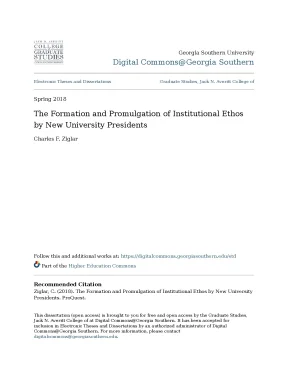
Tải xuống để đọc toàn bộGeorgia Southern University Digital Commons@Georgia Southern Electronic Theses and Dissertations Graduate Studies, Jack N. Averitt College of Spring 2018 The Formation and Promulgation of Institutional Ethos by New University Presidents Charles F. Ziglar Follow this and additional works at: https://digitalcommons.edu/etd Part of the Higher Education Commons Recommended Citation Ziglar, C. The Formation and Promulgation of Institutional Ethos by New University Presidents.
This dissertation (open access) is brought to you for free and open access by the Graduate Studies, Jack N. Averitt College of at Digital Commons@Georgia Southern. It has been accepted for inclusion in Electronic Theses and Dissertations by an authorized administrator of Digital Commons@Georgia Southern. For more information, please contact digitalcommons@georgiasouthern.
THE FORMATION AND PROMULGATION OF INSTITUTIONAL ETHOS BY NEW UNIVERSITY PRESIDENTS by CHARLES F. ZIGLAR (Under the Direction of Dr. Daniel Calhoun) ABSTRACT New university presidents face many challenges when leading an institution, and it seems a daunting professional effort to prepare for the contextual problems they will face (Alexander, 2014; Siegel, 2011). Recent episodes dealing with presidential tensions at universities illustrate the difficult issues new presidents face when entering an institution.
Birnbaum (1992) stated that new university presidents are most effective when they seek to offer an interpretation of institutional life using language, symbolism, and ritual. Research by Trachtenberg, Kauvar, and Bogue (2013) and Vyas (2013) noted that understanding the ethos of an institution is essential for effective presidential leadership. This research explores how new university presidents who have served at least one year and no more than three years in their first presidencies make meaning of institutional ethos and apply what they learn to frame the institution for the purpose of effective leadership. Van Manen’s hermeneutical phenomenological approach to quantitative research was utilized as the theoretical framework for this study.
Interviews with 4 new university presidents served as the data source for this study. This study found that the presidents, while operating within the unique context of the institution which they preside, attended to the concepts of organizational identity, organizational culture, and organization image when seeking to formulate and promulgate an institution’s ethos. Based on the findings of the study, implications for search committees, new university presidents, search firms, and campus communities are presented since each of these groups is potentially impacted. Finally, recommendations for further research are provided for individuals who are interested in further exploring matters related to institutional ethos and new university presidents.
INDEX WORDS: Higher education, University president, New university president, Institutional ethos, Organizational identity, Organizational culture, Organizational image, and Presidential leadership. THE FORMATION AND PROMULGATION OF INSTITUTIONAL ETHOS BY NEW UNIVERSITY PRESIDENTS by CHARLES F., Southern Baptist Theological Seminary, 1988 Ph., Southern Baptist Theological Seminary, 1994 A Dissertation Submitted to the Graduate Faculty of Georgia Southern University in Partial Fulfillment of the Requirements for the Degree DOCTOR OF EDUCATION STATESBORO, GEORGIA © 2018 CHARLES F. ZIGLAR All Rights Reserved 1 THE FORMATION AND PROMULGATION OF INSTITUTIONAL ETHOS BY NEW UNIVERSITY PRESIDENTS by CHARLES F. ZIGLAR Major Professor: Daniel Calhoun Committee: Pamela Wells Thomas Koballa Electronic Version Approved: May 2018 2 ACKNOWLEDGMENTS I wish to thank those who contributed to this study.
Daniel Calhoun served as my dissertation chair and made significant contributions to this work. I am appreciative of his guidance and his timeliness throughout this process. Thomas Koballa took time away from his busy schedule as Dean of the College of Education to serve as a committee member. His careful reading of my prospectus and comments made during the defense helped to clarify the research question and focus the methodology.
Pamela Wells served as the methodologist for this study and provided valuable insights and encouragement for this novice researcher. Her support provided the confidence I needed to complete this task. Devon Jensen and Dr. Amelia Davis served as initial members of my committee.
I appreciate their help during the pre- prospectus phase of this study. I entered this program not knowing anyone in my doctoral cohort. I leave this program having made seven life-long friends and professional colleagues. Their unique lived experiences have given me a deeper appreciation of life and a profound respect for women in higher education.
Their encouragement during the dissertation phase of this program helped to push me across the finish line, long after they completed the journey. I look forward to the years ahead as we seek to apply what we have learned as leaders in higher education institutions. Finally, I am thankful for my wife, Carrie, who offered unwavering support for me during this journey. We faced many life challenges during this process.
She somehow managed the stress associated with having a husband pursue a second doctoral degree. This work is as much hers as it is mine. 3 TABLE OF CONTENTS ACKNOWLEDGMENTS .2 LIST OF TABLES .9 LIST OF FIGURES .10 CHAPTER 1: INTRODUCTION TO THE STUDY.11 Background of the Study .16 Purpose of the Study .18 Significance of the Study .19 Definition of Terms.20 New University President .21 Chapter Summary and Outline of the Study .22 CHAPTER 2: REVIEW OF THE LITERATURE .24 The Essentialist Paradigm of Social Actors .30 The Social Constructionist Paradigm.31 4 Identity as Enduring .31 Identity as Dynamic .32 The Linguistic Discursive Paradigm .34 Identity and Image .35 Organizational Identity and Higher Education Institutions .43 Organizational Culture and Organizational Identity .44 Levels of Organizational Culture .45 Organizational Culture and Higher Education .49 Definition of Ethos .49 Definition of Institutional Ethos .51 Institutional Ethos and Higher Education Institutions .52 Case Studies on Institutional Ethos and University Presidents .55 Case Study #1: Scott Scarborough .56 Case Study #2: Eileen Ely.58 Case Study #3: Simon Newman .63 New Presidential Leadership .65 Transition Issues and New Presidential Leadership .66 5 New University Presidents and Institutional Change .76 Purpose Statement and Research Question .76 Positionality of the Researcher .79 Orientation to Research.85 Participant Recruitment and Sampling .90 Reporting the Data .95 Scope, Limitations, and Delimitations .98 CHAPTER 4: RESEARCH FINDINGS .101 Formation of an Understanding of Institutional Ethos .102 Formulation of an Institutional Ethos .103 Promulgation of the Institutional Ethos .112 Formation of an Understanding of Institutional Ethos .112 Formulation of an Institutional Ethos .114 Promulgation of the Institutional Ethos .124 Formation of an Understanding of Institutional Ethos .124 Formulation of an Institutional Ethos .125 Promulgation of the Institutional Ethos .133 Formation of an Understanding of Institutional Ethos .133 Formulation of an Institutional Ethos .135 Promulgation of Institutional Ethos .144 CHAPTER FIVE: DISCUSSION, IMPLICATIONS, AND RECOMMENDATIONS .146 Discussion of Research Findings .146 Primary Research Question.151 Sub-Question One .151 Sub-Question Two .153 Sub-Question Three .155 Implications of this Study .157 New University Presidents .160 Recommendations for Further Study .161 Reflections on this Study. Email to Presidents.
Informed Consent Form .188 9 LIST OF TABLES Table 4.1 General Characteristics of Presidents .101 10 LIST OF FIGURES Figure 2. Relationship of Identity, Image and Culture to Ethos .64 11 CHAPTER 1 INTRODUCTION TO THE STUDY Presidential transitions have a major impact on colleges and universities (Sanaghan, 2007). Eckel and Kezar (2011) noted that a university president is expected to be a leader who can navigate the complex higher education reality of academics, politics, mediation, and finances. In particular, new university presidents face many challenges with leading an institution, and it seems a daunting professional effort to prepare for the contextual problems they will face (Alexander, 2014; Siegel, 2011).
This complex reality is heightened even more for this population as presidents are under pressure to bring about immediate positive change while seeking to understand the institutions they have been chosen to lead. This challenge, according to Smerek (2011), involves trying to be the president while at the same time learning how to be the president. Birnbaum (1992) stated that new university presidents are most effective when they seek to offer an interpretation of institutional life using language, symbolism, and ritual. Trachtenberg, Kauvar, and Bogue (2013) noted that when new university presidents arrive on their campuses they are welcomed by a multitude of constituencies, each with a legitimate claim to be heard on issues such as institutional purpose, policy, and performance.
A university president shares information with constituent groups both inside and outside the organization, frames the information that is shared, and interprets the mission of the institution (Garza Mitchell, 2012). In other words, a new university president is responsible for conveying the institutional ethos. Recent episodes dealing with presidential tensions at universities illustrate the difficult issues new presidents face when entering an institution. The University of Iowa’s search for a new president made news when it was discovered that members of the Iowa Board of Regents 12 who were not on the presidential search committee were involved in the recruitment of a former IBM executive (Kelderman, 2015a).
Faculty members complained that the candidate, J. Bruce Harreld, did not have the higher education leadership experience needed to direct a top research university (McIntire, 2015). A standout moment of the search process occurred on the first day of Harreld’s presidency when a local clothing shop carried t-shirts with a logo resembling the Starbuck’s logo that read “Univ Iowa Inc. A corporate take on a liberal arts college” (Kelderman, 2015b).
In a different case, the resignation of R. Bowen Loftin as chancellor of the University of Missouri at Columbia appeared to come about as a result of student protests. Behind the scenes, however, was a coup led by nine deans who were working to force the resignation of Loftin as a result of his inability to create an environment where shared leadership was valued and where threats to fire employees, specifically deans, were common (Stripling, 2015b). In a third case, a Kent State faculty member attended an emergency meeting where the Committee on Administrative Officers was interviewing a candidate for the presidency, Beverly J.
During the interview, activity was heard outside the meeting room. The adjacent room was being prepared for the announcement of the next university president—Beverly J. Committee members were never given the names of the finalists nor asked for input (Stripling, 2015a). These three incidents are just a sample of the national presence surrounding the hiring and leadership of new university presidents.
New university presidents can arrive on campus and find themselves in situations that are less than ideal. How they handle these situations will affect their ability to provide leadership both in the short term and the long term. Understanding the institutional ethos is vital to a new university president’s success. Institutional ethos relates directly to leadership because it represents the symbols, rituals, and character of the institution.
As new university presidents arrive on the campuses they will 13 lead, it is important for them to grasp a sense of the institutional ethos quickly in order to understand how the decisions they make align with the rituals, traditions, and symbols that are important to the institution (Siegel, 2011). In terms of educational academic inquiry, it is important to understand how a new university president assesses institutional ethos and uses that information to promulgate an institutional ethos that will frame the institution. This understanding is important because it informs the decision-making process of new university presidents as they establish agendas for change. If university presidents are to be successful in leading their institutions, they must pay particular attention to the institutional ethos.
Background of the Study Institutional ethos can be difficult to discern, and the lack of clarity related to a definition of the concept makes difficult to identify in the literature related to higher education (Harris, 2013). For instance, Bolman and Deal (1997) identified four frames that successful leaders can use in the decision-making process. The structural frame focuses on rules and structures within the organization. The human resource frame takes into account people and their needs within the organization.
The political frame examines the process within an organization by which resources, power, and influence are distributed. The symbolic frame examines the culture, myths, and rituals of the organization.
Nội dung được bảo vệ bản quyền — Tải xuống đầy đủ
Trích dẫn luận án này
Charles F. Ziglar (2018). The formation and promulgation of institutional ethos by new [Luận án tiến sĩ, Georgia Southern University]. LuanAn.net. https://luanan.net/quan-ly-giao-duc/quan-ly-giao-duc-dai-hoc/the-formation-and-promulgation-of-institutional-ethos-by-new-univ
Câu hỏi thường gặp
Luận án "The formation and promulgation of institutional ethos by new" nghiên cứu về vấn đề gì?
Phân tích và đề xuất phương pháp hình thành và phổ biến tinh thần tổ chức mới.
Luận án "The formation and promulgation of institutional ethos by new" được bảo vệ tại trường nào?
Luận án này được bảo vệ tại Georgia Southern University. Năm bảo vệ: 2018.
Luận án "The formation and promulgation of institutional ethos by new" thuộc chuyên ngành gì?
Luận án "The formation and promulgation of institutional ethos by new" thuộc chuyên ngành Higher Education. Danh mục: Quản Lý Giáo Dục Đại Học.
Luận án "The formation and promulgation of institutional ethos by new" có bao nhiêu trang?
Luận án "The formation and promulgation of institutional ethos by new" có 193 trang. Bạn có thể xem trước một phần tài liệu ngay trên trang web trước khi tải về.
Cách tải luận án "The formation and promulgation of institutional ethos by new" về máy như thế nào?
Để tải luận án về máy, bạn nhấn nút "Tải xuống ngay" trên trang này, sau đó hoàn tất thanh toán phí lưu trữ. File sẽ được tải xuống ngay sau khi thanh toán thành công. Hỗ trợ qua Zalo: 0559 297 239.