Oneil rochester 0188e 11906
Oneil Rochester 0188E 11906: Thông tin chi tiết, đánh giá, so sánh giá và địa điểm mua sắm sản phẩm. Tìm hiểu ngay!
Năm xuất bản
Số trang
341
Thời gian đọc
52 phút
Lượt xem
1
Lượt tải
0
Phí lưu trữ
60 Point
Tổng quan nhanh
- Chủ đề:
- Tìm hiểu Oneil Rochester 0188E 11906: Linh kiện mới
- Số trang:
- 341 trang
- Trường:
- University of Rochester
- Chuyên ngành:
- English
- Tác giả:
- Scott M. O’Neil
- Năm:
- 2019
Tóm tắt nội dung luận án
I.Tìm hiểu Oneil Rochester 0188E 11906 Linh kiện mới
Oneil Rochester 0188E 11906 đại diện cho một linh kiện điện tử quan trọng. Mã sản phẩm 0188e giúp phân biệt nó. Model number 11906 xác định biến thể cụ thể. Linh kiện này phục vụ đa dạng ứng dụng công nghiệp và thương mại. Độ tin cậy là tính năng cốt lõi. Các kỹ sư tìm kiếm những thành phần mạnh mẽ. 0188e 11906 thường xuất hiện trong các hệ thống thiết yếu. Thiết kế của nó đảm bảo hiệu suất ổn định. Rochester Electronics phân phối các linh kiện này. Công ty duy trì tiêu chuẩn chất lượng cao. Sự sẵn có của linh kiện rất quan trọng cho dây chuyền sản xuất. Việc tìm đúng part number giúp giảm chậm trễ thiết kế. Dòng Oneil thường chỉ ra các chức năng chuyên biệt. Linh kiện này tích hợp vào các thiết kế mạch phức tạp. Hiểu chức năng cơ bản là bước đầu tiên. Thông tin chi tiết hơn có trong bảng dữ liệu (datasheet) chính thức.
1.1. Mã sản phẩm Oneil 0188e 11906 là gì
Mã sản phẩm Oneil 0188e 11906 định danh một loại linh kiện điện tử cụ thể. "0188e" là phần số hiệu chính. "11906" có thể là biến thể hoặc phiên bản. Mã này giúp phân biệt sản phẩm. Các nhà thiết kế cần mã chính xác. Mua sắm linh kiện cũng dựa vào mã này. Tìm kiếm linh kiện hiệu quả bắt đầu bằng mã. Rochester Electronics sử dụng mã này để theo dõi kho hàng. Mỗi mã sản phẩm có một bộ thông số kỹ thuật riêng. Không có mã trùng lặp. Đảm bảo đúng mã tránh sai sót trong thiết kế. Xác định đúng mã là bước quan trọng.
1.2. Vai trò của Oneil Rochester 0188e trong mạch điện tử
Oneil Rochester 0188e đảm nhiệm vai trò cụ thể trong mạch. Vai trò này có thể là điều khiển, xử lý tín hiệu, hoặc cung cấp nguồn. Chi tiết chức năng được mô tả trong thông số kỹ thuật. Nhiều hệ thống cần linh kiện ổn định. 0188e 11906 cung cấp sự ổn định đó. Nó tích hợp vào các thiết bị công nghiệp. Cũng xuất hiện trong các sản phẩm tiêu dùng. Khả năng hoạt động dưới các điều kiện nhất định là quan trọng. Các kỹ sư đánh giá cao hiệu suất của nó. Linh kiện này giúp hoàn thiện chức năng của bo mạch. Nó là một phần không thể thiếu trong nhiều thiết kế.
II.Thông số kỹ thuật Oneil Rochester 0188E 11906 chi tiết
Chi tiết thông số kỹ thuật cho Oneil Rochester 0188E 11906 rất quan trọng. Bảng dữ liệu (datasheet) cung cấp mọi thông tin cần thiết. Điện áp hoạt động, dòng điện tối đa, nhiệt độ môi trường được liệt kê. Tần số hoạt động và các giới hạn khác cũng có mặt. Các thông số này quyết định khả năng ứng dụng. Kỹ sư phải kiểm tra kỹ lưỡng. Đảm bảo linh kiện phù hợp với yêu cầu thiết kế. Sai sót có thể dẫn đến hỏng hóc hệ thống. Rochester Electronics đảm bảo tính chính xác của dữ liệu. Người dùng cần tải xuống bảng dữ liệu mới nhất. Thông số vật lý như kích thước, loại đóng gói cũng quan trọng. Chúng ảnh hưởng đến việc lắp ráp. Tìm kiếm linh kiện dựa trên các thông số này. Đây là bước then chốt trong quá trình thiết kế sản phẩm.
2.1. Phân tích bảng dữ liệu datasheet của 0188e 11906
Bảng dữ liệu của 0188e 11906 là tài liệu tham khảo chính. Nó chứa mọi thông tin kỹ thuật. Từ biểu đồ hiệu suất đến sơ đồ chân. Các giá trị điện áp tối đa được chỉ rõ. Dòng điện tiêu thụ cũng được nêu. Thông số môi trường như nhiệt độ hoạt động và lưu trữ rất quan trọng. Việc đọc hiểu datasheet là kỹ năng cơ bản. Kỹ sư sử dụng nó để xác minh tính tương thích. Tải datasheet từ trang web Rochester Electronics. Đây là nguồn thông tin đáng tin cậy.
2.2. Các thông số điện quan trọng của linh kiện 0188e
Linh kiện 0188e có nhiều thông số điện quan trọng. Điện áp cấp, điện áp đầu vào/đầu ra là cơ bản. Dòng điện hoạt động, dòng chờ cũng cần chú ý. Công suất tiêu thụ ảnh hưởng đến quản lý nhiệt. Trở kháng đầu vào/đầu ra xác định giao diện. Tốc độ chuyển mạch hoặc thời gian phản hồi là thiết yếu. Các thông số này ảnh hưởng trực tiếp đến hiệu suất. Đảm bảo chúng nằm trong giới hạn cho phép. Thông số này thường được kiểm tra nghiêm ngặt.
2.3. Kích thước và kiểu đóng gói package của model 11906
Kích thước vật lý của model 11906 ảnh hưởng đến bố cục PCB. Kiểu đóng gói xác định cách lắp đặt. Các dạng phổ biến như SOIC, QFN, BGA có thể áp dụng. Mỗi kiểu có ưu và nhược điểm riêng. Kích thước nhỏ gọn giúp tiết kiệm không gian. Khả năng tản nhiệt cũng liên quan đến kiểu đóng gói. Lựa chọn đúng package là quan trọng. Nó ảnh hưởng đến quy trình sản xuất. Thông tin chi tiết có trong bảng dữ liệu.
III.Ứng dụng phổ biến Oneil Rochester 0188E 11906
Oneil Rochester 0188E 11906 có nhiều ứng dụng đa dạng. Nó thường được tìm thấy trong các thiết bị công nghiệp. Hệ thống điều khiển tự động là một ví dụ. Các thiết bị viễn thông cũng sử dụng linh kiện này. Trong ngành ô tô, độ bền là yếu tố then chốt. 0188e 11906 đáp ứng các tiêu chuẩn khắt khe. Nó có mặt trong các thiết bị y tế. Độ chính xác và độ tin cậy được yêu cầu cao. Các nhà sản xuất tin tưởng vào chất lượng của Rochester Electronics. Khả năng hoạt động ổn định trong môi trường khắc nghiệt là lợi thế. Linh kiện điện tử này hỗ trợ nhiều công nghệ tiên tiến. Nó là một phần của các giải pháp phức tạp. Tìm kiếm linh kiện phù hợp với từng ứng dụng là công việc của kỹ sư.
3.1. Oneil Rochester 0188e trong hệ thống công nghiệp
Trong môi trường công nghiệp, 0188e 11906 đảm bảo hoạt động liên tục. Nó điều khiển động cơ, cảm biến, hoặc các thiết bị chấp hành. Các nhà máy tự động hóa dựa vào linh kiện này. Hệ thống PLC thường tích hợp nó. Độ bền và khả năng chống nhiễu là cần thiết. Linh kiện duy trì hiệu suất trong thời gian dài. Nền tảng này rất quan trọng cho dây chuyền sản xuất.
3.2. Vai trò của model 11906 trong thiết bị y tế
Model 11906 có thể được sử dụng trong thiết bị y tế. Nó đóng vai trò trong thiết bị chẩn đoán hoặc giám sát. Độ tin cậy là tối quan trọng ở đây. Sai sót có thể gây hậu quả nghiêm trọng. Linh kiện này cần đáp ứng các tiêu chuẩn y tế nghiêm ngặt. Các thông số kỹ thuật phải được kiểm tra kỹ. Rochester Electronics cung cấp linh kiện đạt chuẩn.
3.3. Oneil Rochester 0188e trong ngành ô tô và hàng không
Ngành ô tô và hàng không yêu cầu linh kiện có độ bền cao. Oneil Rochester 0188e đáp ứng các tiêu chuẩn này. Nó chịu được rung động, nhiệt độ khắc nghiệt. Hệ thống điện tử trên xe cộ sử dụng nó. Trong hàng không, an toàn là ưu tiên hàng đầu. Linh kiện này góp phần vào độ tin cậy của hệ thống. Nó giúp xe và máy bay hoạt động an toàn.
IV.Mua Oneil Rochester 0188E 11906 từ Rochester Electronics
Mua Oneil Rochester 0188E 11906 từ nguồn đáng tin cậy là cần thiết. Rochester Electronics là nhà cung cấp chính thức. Họ chuyên về linh kiện điện tử chất lượng cao. Đảm bảo nguồn gốc rõ ràng. Tránh hàng giả, hàng kém chất lượng. Rochester Electronics cung cấp linh kiện thay thế chính hãng. Họ cũng hỗ trợ linh kiện lỗi thời (obsolete parts). Dịch vụ này giúp kéo dài tuổi thọ sản phẩm. Tìm kiếm linh kiện cụ thể trên trang web của họ. Đặt hàng trực tuyến hoặc qua đại lý. Quá trình mua hàng được thực hiện an toàn. Chất lượng sản phẩm được kiểm định nghiêm ngặt. Đảm bảo nhận được đúng part number 0188e. Hỗ trợ khách hàng luôn sẵn sàng.
4.1. Tại sao chọn Rochester Electronics cho 0188e 11906
Rochester Electronics cung cấp linh kiện Oneil Rochester 0188e 11906. Họ là nhà cung cấp được ủy quyền. Chất lượng và độ tin cậy được đảm bảo. Họ có khả năng sản xuất lại các linh kiện lỗi thời. Điều này rất quan trọng cho chu kỳ sản phẩm dài. Hỗ trợ kỹ thuật chuyên nghiệp được cung cấp. Các sản phẩm đều trải qua kiểm tra chất lượng. Đây là lựa chọn an toàn cho mọi nhu cầu.
4.2. Quy trình đặt hàng Oneil Rochester 0188e 11906
Quy trình đặt hàng linh kiện 0188e 11906 đơn giản. Truy cập trang web Rochester Electronics. Sử dụng chức năng tìm kiếm linh kiện. Nhập part number 0188e hoặc model number 11906. Thêm sản phẩm vào giỏ hàng. Điền thông tin giao hàng. Thực hiện thanh toán an toàn. Xác nhận đơn hàng sẽ được gửi qua email. Quá trình này nhanh chóng và thuận tiện.
V.Giải pháp thay thế Oneil Rochester 0188E 11906
Tìm kiếm linh kiện thay thế cho Oneil Rochester 0188E 11906 có thể cần thiết. Đặc biệt khi linh kiện lỗi thời (obsolete parts). Rochester Electronics cung cấp các giải pháp thay thế. Họ sản xuất lại các linh kiện gốc. Hoặc đề xuất các linh kiện tương thích. Đảm bảo tính năng và hiệu suất tương đương. Bảng dữ liệu của linh kiện thay thế cần được so sánh. Các thông số kỹ thuật phải phù hợp. Việc tìm kiếm linh kiện thay thế đòi hỏi sự cẩn trọng. Tránh sử dụng linh kiện không tương thích. Điều này có thể gây hỏng hóc hoặc mất an toàn. Tham khảo ý kiến chuyên gia khi cần. Nguồn cung cấp đáng tin cậy là ưu tiên hàng đầu.
5.1. Khi nào cần tìm linh kiện thay thế cho 0188e 11906
Nhu cầu tìm linh kiện thay thế cho 0188e 11906 phát sinh khi linh kiện gốc không còn. Hoặc khi nó trở thành linh kiện lỗi thời. Các nhà sản xuất ngừng sản xuất một số mã. Hoặc khi linh kiện gốc bị hỏng và cần sửa chữa. Nâng cấp hệ thống cũng có thể yêu cầu linh kiện thay thế. Tìm kiếm linh kiện tương thích đảm bảo hoạt động liên tục.
5.2. Các lựa chọn linh kiện thay thế do Rochester Electronics cung cấp
Rochester Electronics cung cấp nhiều lựa chọn thay thế. Họ có thể còn hàng tồn kho linh kiện gốc. Hoặc họ có giấy phép sản xuất lại linh kiện lỗi thời. Đây là điểm mạnh của họ. Các linh kiện này được kiểm tra nghiêm ngặt. Đảm bảo đạt tiêu chuẩn ban đầu. Tra cứu trên trang web của họ để biết các lựa chọn thay thế.
5.3. Tiêu chí lựa chọn linh kiện thay thế tương thích cho Oneil Rochester 0188e
Lựa chọn linh kiện thay thế cần dựa trên các tiêu chí rõ ràng. Các thông số kỹ thuật phải phù hợp hoàn toàn. Kích thước và kiểu đóng gói phải tương thích. Hiệu suất điện và nhiệt phải tương đương. Khả năng tương thích phần mềm cũng cần xem xét. Tìm kiếm linh kiện từ các nhà cung cấp uy tín. Tham khảo bảng dữ liệu của cả hai linh kiện.
Tải xuống file đầy đủ để xem toàn bộ nội dung
Tải đầy đủ (341 trang)Trích đoạn nội dung luận án
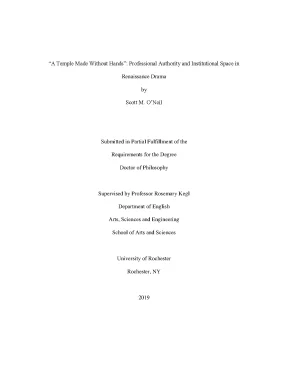
Tải xuống để đọc toàn bộ“A Temple Made Without Hands”: Professional Authority and Institutional Space in Renaissance Drama by Scott M. O’Neil Submitted in Partial Fulfillment of the Requirements for the Degree Doctor of Philosophy Supervised by Professor Rosemary Kegl Department of English Arts, Sciences and Engineering School of Arts and Sciences University of Rochester Rochester, NY 2019 ii Dedication Many years ago, as a small child, I was torn between two impossible choices: a collection of O. Henry stories and a book of stories about Greek mythology. Our family did not have an excess of money.
I don’t remember much else about that day beyond those two books and what happened next. I told my mother that I couldn’t decide, and she told me to get both, because “there’s always money for books.” That response transformed books for me—from things that I wanted into items of inherent value. That day was the beginning of a lifetime of reading and a passion for the written word. This dissertation is dedicated to my mother for starting me on that journey.
iii Table of Contents Biographical Sketch iv Acknowledgements v Abstract viii Contributors and Funding Sources x Chapter 1: “A Temple Made Without Hands”: The Professions and their Place in Tudor/Stuart England 1 Chapter 2: Courting the Fool: The Creation of Authoritative Space in King Lear 46 Chapter 3: The Kings of Subjects: Licensed Confinement and the Inversion of Authority in Love’s Labour’s Lost 110 Chapter 4: Habitual Friars: Monastic Equivocation in Much Ado About Nothing and Romeo and Juliet 164 Coda: Hiring Tudors: Disguised Rulers and the Breaking of Boundaries 216 Bibliography 234 End Notes 258 iv Biographical Sketch The author was born in Rochester, NY and grew up in Tunkhannock, PA. He attended Towson University in Towson, MD and graduated cum laude with a Bachelor of Science degree in English and Secondary Education. He spent four years as a high school teacher at North Harford High School. He earned a Master of Arts degree in English at St.
Bonaventure University in Olean, NY in 2011. He began doctoral study in English at the University of Rochester in 2011. He was awarded the Rossell Hope Robbins Library Digital Humanities Fellowship in 2014, Dudley Doust Teaching Fellowships in 2015 and 2016, and a Dean’s Dissertation Fellowship in 2017. He received a Master of Arts degree in English from the University of Rochester in 2015.
He pursued his research in Renaissance literature under the direction of Rosemary Kegl. The following publications were a result of work conducted during doctoral study: “Lorenzo Valla’s ‘intellectual violence’: Personal Feuds and Appropriated Sarcasm.” Words that Tear the Flesh: Sarcasm in Medieval and Early Modern Literature and Cultures, edited by Alan Baragona and Elizabeth L. De Gruyter, 2018, pp. “Medieval Drama: An Annotated Bibliography for Teachers.” The Once and Future Classroom: Resources for Teaching the Middle Ages, vol.” The Camelot Project, edited by Alan Lupack.
v Acknowledgements I have been fortunate to receive guidance from a long line of mentors, colleagues, and friends, all of whom helped to shape me into the scholar I am today. I would like to first thank my committee for their support throughout my graduate career. Jon Baldo, with his warmth and collegiality, has encouraged me at every step to push myself out of my comfort zone, particularly regarding sending articles out for submission and introducing myself to academic-famous people at conferences. Russell Peck has not only provided keen insights on my dissertation, but his ebullient passion for theater has been a constant reminder of everything I love about studying Shakespeare.
Russell even came to see all of the productions in which I played a bit part over the years, including the production of Merry Wives where I was upstaged by creepy, life-sized puppets. My advisor, Rosemary Kegl, is the reason that I came to the University of Rochester. In writing my thesis at Bonaventure, I came across her work on Merry Wives and instantly knew I wanted to learn from her. After successive seminars during coursework, I knew that I had made the correct decision.
Her feedback—particularly on my Lear chapter— has been incisive and generative, even when I seemingly forgot how to write a cogent topic sentence. I also would like to thank those who have mentored me outside of Rochester, including Deb VanderBilt at St. John Fisher College and Theodora Jankowski. Finally, I must also acknowledge mentors from my time before Rochester, particularly John Mulryan and Daniel Ellis for helping me learn how to write like a scholar, and vi Barbara Kraszewski for telling me I was an English major way back when I was under the mistaken notion that I was a political science major.
I also need to acknowledge the constant support and love from friends and colleagues, including my fellow grad students who have become close friends— particularly Lisa Vandenbossche, Erin Berg, Sam Dressel, Daniel Singleton, Cindy Rogers, Marjorie Harrington, Rose Zaloom, and Emily Kohlhase at Rochester, Leslie Nickerson at UB, and those I’ve met via the Folger and conferencing, including Amina Tajbhai, Dainy Bernstein, Sydnee Wagner, and so many others whose names I will surely remember about five minutes after writing this dissertation. I would also like to acknowledge those in my personal life who have made finishing this degree possible, including my undergraduate nerd herd (Marissa Spears and Rebecca Hranj), my friends in the Rochester theater community (especially Jillian Christensen, Abby DeVuyst, Diana Carter, and Virginia Monte), the dog who came into this program with me (Domino) and the dog who can’t wait to infuse my doctoral robes with fur (Windsor). I am further indebted to the tireless work of the English department staff: Lucy Peck, Sherri Gunter, and Carrie Morriss (my future Flea Market Flip partner). I would also be remiss if I did not acknowledge my beloved coffee houses, in which most of this dissertation was written, so kind thanks to Starry Nites, Equal Grounds, Finger Lakes Coffee Roasters, and yes, even Starbucks.
I am fortunate to have had the support of two families during my time in graduate school. I would like to thank my mother, my brother Kevin and sister-in-law Kristina (and the three most adorable nieces who have ever nieced—Kaley, Kaity, and Kacey), my uncle Rusty, and my cousin Katie O’Toole. Most of my relatives are not humanities vii folks at all, yet they were still supportive and stuck it out when I would start talking about my dissertation. I also need to thank my Rossell Hope Robbins family.
Words can’t express how much that community has meant to me over the years, and I know that grad school will truly feel “over” the moment I hand in my key. Without that community, I never would have been able to get to where I am right now, and I offer my heartfelt thanks to Alan and Barbara Lupack, Rose Paprocki, Anna Siebach-Larsen, Katie Papas, Marie Turner, and the Robbins crowd past and present: Kara, Kristi, Val, Kate, Pam, Steffi, Ashley, Kyle, Masani, Emily, Oishani, Katherine, Santiago, and so many more. Finally, I need to acknowledge and thank Kara McShane and her wife, Karen. They know what they did.
viii Abstract A Temple Made Without Hands argues that a new understanding of the role of professional space on professional authority in the 16th and 17th centuries will open up new interpretations of the role of theatrical—specifically Shakespearean—representations of such professional figures. While scholarly interest in Shakespeare’s professional figures has remained relatively high, scholarly consensus on the role played by those figures has been fleeting at best. Indeed, these figures seem to be at the heart of several of the most enduring Shakespearean debates in literary scholarship. In my dissertation, I suggest that a post-Reformation shift occurs in the way that the licenses of several professions were situated, as they changed from an embodied claim to authority, derived from skill and acquired intellect, to a spatial claim to authority, derived from having license from a ruler to occupy the space of the profession.
I track this development from late-medieval representations of these figures through to the Renaissance, with an emphasis on the spatially oriented licenses of three particular professions and the defining/confining spaces of their licenses: the fool in court, the schoolmaster in his schoolhouse, and the friar in (or more aptly out of) his friary/cell. My dissertation applies this new understanding of spatially situated professional authority to offer readings of dramatic texts featuring such professional figures. My dissertation makes three contributions to Shakespearean scholarship. First, it applies more recent understandings of the chronological place of the professions to ix readings of Shakespearean texts.
For most of the history of the study of the professions, there was an ahistorical, borderline obsession with connecting the notion of professional figures to the rise of Modernity. More recent studies of the professions have shown that the concept of a socially elevated occupation goes significantly further back historically than previously thought, and accordingly, my dissertation analyzes these characters as true professionals. Second, I argue in favor of a spatial reading of professional authority, and particularly track the shift away from a skill-based meritocracy and towards a more hierarchical, space-based claim to authority in certain professions—particularly those professions with a history of subversive behavior. Third, and most importantly, I bring these new understandings of professional identity and authority to readings of Shakespeare’s professional figures, particularly those who seem to be at the center of an interpretive paradox or have a history of interpretive dispute.
x Contributors and Funding Sources This work was supervised by a dissertation committee consisting of Professors Rosemary Kegl (advisor) and Russell Peck of the Department of English and Professor Jon Baldo of the Eastman School of Music. All work for the dissertation was completed independently by the student. 1 Chapter One “A Temple Made Without Hands”: The Professions and their Place in Tudor/Stuart England Professions and Place In discussing the role of proper occupational placement and behavior in an ordered society, William Perkins, in his Treatise on the Vocations and Callings of Men (c. 1600),1 states that “The church of God is a temple made without hands, the foundation is Christ and every member of Christ, with all that appertain to God's election are living stones.
The builders of this temple principally are pastors and teachers, and not only they but all Christian persons generally” (Perkins 452). Perkins’ treatise is remarkable both for its clear establishment of the concept of professional identity in the 16th century—the notion of “professional” identity was, until the latter part of the 20 th century, presumed to have its origins in the Industrial Revolution—and for its overwhelming emphasis on the function of professional space as both a source and boundary of professional authority. He uses this imagined space of a “temple built without hands” as a metaphor for an ordered society, with each professional figure situating himself in one profession along an authoritarian hierarchy, ultimately defining professional space as a form of hierarchical space. 2 Perkins does this, in part, through an insistent repetition of a paraphrased biblical passage from Paul.
Using an Aristotelian breakdown of vocations and callings, the treatise lists several rules “to be learned of all, which belong to every calling” (449). The first such rule listed is that: whatsoever any man enterpriseth or doth, either in word or deed, he must do it by virtue of his calling, and he must keep himself within the compass, limits or precincts thereof. This rule is laid down in the words of the apostle, Let every man abide in that calling wherein he was called, the drift whereof is to bind men to their calling and to teach them to perform all their actions by warrant of it.
Nội dung được bảo vệ bản quyền — Tải xuống đầy đủ
Trích dẫn luận án này
Scott M. O’Neil (2019). Oneil rochester 0188e 11906 [Luận án tiến sĩ, University of Rochester]. LuanAn.net. https://luanan.net/quan-ly-giao-duc/quan-ly-giao-duc-dai-hoc/oneil-rochester-0188e-11906
Câu hỏi thường gặp
Luận án "Oneil rochester 0188e 11906" nghiên cứu về vấn đề gì?
Oneil Rochester 0188E 11906: Thông tin chi tiết, đánh giá, so sánh giá và địa điểm mua sắm sản phẩm. Tìm hiểu ngay!
Luận án "Oneil rochester 0188e 11906" được bảo vệ tại trường nào?
Luận án này được bảo vệ tại University of Rochester. Năm bảo vệ: 2019.
Luận án "Oneil rochester 0188e 11906" thuộc chuyên ngành gì?
Luận án "Oneil rochester 0188e 11906" thuộc chuyên ngành English. Danh mục: Quản Lý Giáo Dục Đại Học.
Luận án "Oneil rochester 0188e 11906" có bao nhiêu trang?
Luận án "Oneil rochester 0188e 11906" có 341 trang. Bạn có thể xem trước một phần tài liệu ngay trên trang web trước khi tải về.
Cách tải luận án "Oneil rochester 0188e 11906" về máy như thế nào?
Để tải luận án về máy, bạn nhấn nút "Tải xuống ngay" trên trang này, sau đó hoàn tất thanh toán phí lưu trữ. File sẽ được tải xuống ngay sau khi thanh toán thành công. Hỗ trợ qua Zalo: 0559 297 239.