Chấp nhận công nghệ: Tiếng nói của giảng viên, nhà thiết kế giáo dục và sinh viên - Đề tài Tiến sĩ 2005
Nghiên cứu 2005 về việc chấp nhận công nghệ trong giáo dục đại học. Khám phá xu hướng và thách thức.
Năm xuất bản
Số trang
336
Thời gian đọc
51 phút
Lượt xem
0
Lượt tải
0
Phí lưu trữ
60 Point
Tổng quan nhanh
- Chủ đề:
- Chấp nhận công nghệ giáo dục đại học: Tổng quan nghiên cứu
- Số trang:
- 336 trang
- Trường:
- Deakin University
- Chuyên ngành:
- Education
- Tác giả:
- Ramya Gayani Samarawickrema
- Năm:
- 2005
Tóm tắt nội dung luận án
I.Chấp nhận công nghệ giáo dục đại học Tổng quan nghiên cứu
Nghiên cứu khám phá sự chấp nhận công nghệ trong giáo dục đại học, đặc biệt là ứng dụng công nghệ thông tin trong giáo dục. Tài liệu phân tích các yếu tố ảnh hưởng đến việc giảng viên, sinh viên và nhà thiết kế giáo dục tiếp nhận công nghệ mới. Mục tiêu chính là hiểu rõ các rào cản và động lực thúc đẩy việc tích hợp công nghệ vào quá trình dạy và học. Nghiên cứu cũng đi sâu vào các mối quan tâm ban đầu khi công nghệ được giới thiệu vào các trường đại học. Bối cảnh của nghiên cứu là sự phát triển nhanh chóng của e-learning và học trực tuyến, tạo ra nhu cầu cấp thiết phải phân tích quá trình chấp nhận này. Phạm vi nghiên cứu bao gồm nhiều khía cạnh từ lý thuyết đến thực tiễn, cung cấp cái nhìn toàn diện về thách thức và cơ hội. Các phương pháp luận được sử dụng để đảm bảo độ tin cậy và khả năng áp dụng của kết quả. Điều này giúp các tổ chức giáo dục xây dựng chiến lược hiệu quả hơn để tăng cường việc sử dụng công nghệ.
1.1. Bối cảnh lý do nghiên cứu chấp nhận công nghệ
Sự ra đời của công nghệ web đã tạo ra những thay đổi đáng kể trong giáo dục đại học. Các trường đại học đối mặt với yêu cầu phải thích nghi và tích hợp các công cụ e-learning. Nghiên cứu này xuất phát từ những lo ngại về tỷ lệ chấp nhận công nghệ chậm chạp. Cần hiểu rõ tại sao giảng viên và sinh viên lại chấp nhận hoặc từ chối các hệ thống quản lý học tập (LMS) mới. Bối cảnh nghiên cứu tập trung vào các trường đại học Úc. Lý do chính là để cung cấp bằng chứng thực nghiệm về các yếu tố thúc đẩy hoặc cản trở quá trình chấp nhận. Việc này giúp cải thiện các chính sách và chiến lược triển khai công nghệ.
1.2. Mục tiêu phạm vi và phương pháp luận chính
Mục tiêu nghiên cứu là khám phá tiếng nói của giảng viên, nhà thiết kế giáo dục và sinh viên về việc chấp nhận công nghệ. Nghiên cứu đề xuất một sự hiểu biết sâu sắc hơn về các yếu tố ảnh hưởng. Phạm vi nghiên cứu bao gồm việc áp dụng học tập và giảng dạy dựa trên web. Phương pháp luận chính dựa trên nghiên cứu tình huống, sử dụng lý thuyết khuếch tán đổi mới và lý thuyết mạng lưới yếu tố (Actor-Network Theory - ANT). Dữ liệu được thu thập thông qua phỏng vấn chuyên sâu. Điều này cho phép phân tích chi tiết về trải nghiệm cá nhân và ảnh hưởng tổ chức. Tính đáng tin cậy của dữ liệu được đảm bảo thông qua các biện pháp nghiêm ngặt.
II.Mô hình chấp nhận công nghệ Lý thuyết khuếch tán đổi mới
Việc chấp nhận công nghệ trong giáo dục đại học được phân tích thông qua các mô hình chấp nhận công nghệ đã được thiết lập. Lý thuyết khuếch tán đổi mới của Rogers cung cấp một khuôn khổ quan trọng. Lý thuyết này giúp giải thích cách các ý tưởng và công nghệ mới lan truyền. Việc áp dụng e-learning và các hệ thống quản lý học tập (LMS) phụ thuộc vào nhiều yếu tố. Các yếu tố này bao gồm nhận thức về lợi ích tương đối, tính tương thích, độ phức tạp, khả năng thử nghiệm và khả năng quan sát. Lý thuyết này được điều chỉnh để phù hợp với bối cảnh ứng dụng công nghệ thông tin trong giáo dục. Đặc biệt, nó xem xét các trải nghiệm cụ thể với học trực tuyến. Sự kết hợp giữa lý thuyết khuếch tán và các lý thuyết khác giúp tạo ra một bức tranh toàn diện hơn về quá trình chấp nhận.
2.1. Lý thuyết khuếch tán đổi mới và ứng dụng
Lý thuyết khuếch tán đổi mới (Diffusion of Innovation) là nền tảng để hiểu sự chấp nhận công nghệ. Lý thuyết này mô tả các giai đoạn từ nhận thức đến chấp nhận hoặc từ chối. Trong giáo dục đại học, việc áp dụng công nghệ web-based learning được xem xét qua lăng kính này. Các đặc điểm của đổi mới ảnh hưởng đến tốc độ chấp nhận. Bối cảnh tổ chức và xã hội cũng đóng vai trò quan trọng. Lý thuyết này cung cấp một cái nhìn sâu sắc về cách giảng viên và sinh viên quyết định sử dụng các công cụ mới. Nó cũng giúp xác định những người tiên phong và những người theo sau trong quá trình chấp nhận.
2.2. Mạng lưới yếu tố ảnh hưởng đến ứng dụng công nghệ
Lý thuyết mạng lưới yếu tố (Actor-Network Theory - ANT) bổ sung cho lý thuyết khuếch tán. ANT xem xét các tương tác phức tạp giữa con người và công nghệ. Trong giáo dục đại học, việc ứng dụng công nghệ không chỉ là một quyết định cá nhân. Nó là kết quả của một mạng lưới các yếu tố bao gồm chính sách, hạ tầng, phần mềm, đồng nghiệp và sinh viên. Các 'tác nhân' này cùng nhau định hình quá trình chấp nhận công nghệ. ANT giúp khám phá quyền lực và chính trị liên quan đến việc triển khai công nghệ. Nó làm rõ cách các yếu tố phi con người cũng ảnh hưởng đến hành vi chấp nhận.
III.Tác động e learning lên giảng viên phát triển kỹ năng mới
E-learning và học trực tuyến đã thay đổi đáng kể vai trò của giảng viên trong giáo dục đại học. Việc chấp nhận công nghệ đòi hỏi giảng viên phải phát triển các kỹ năng mới. Các tác động bao gồm sự thay đổi trong phương pháp giảng dạy và đánh giá. Giảng viên cần học cách sử dụng hiệu quả các hệ thống quản lý học tập (LMS) và các công cụ số khác. Sự hỗ trợ từ tổ chức là yếu tố then chốt. Quá trình này không chỉ là về kỹ năng kỹ thuật mà còn về sư phạm số. Nghiên cứu làm nổi bật những thách thức và cơ hội mà giảng viên gặp phải. Sự chuyển đổi này ảnh hưởng đến cả công việc giảng dạy và nghiên cứu của họ. Phần thưởng cũng được ghi nhận khi giảng viên thành công trong việc tích hợp công nghệ.
3.1. Phát triển vai trò kỹ năng mới của giảng viên
Việc giới thiệu công nghệ vào các trường đại học buộc giảng viên phải đảm nhận những vai trò mới. Họ trở thành người tạo nội dung số, người điều phối diễn đàn trực tuyến và người đánh giá kỹ thuật số. Điều này đòi hỏi sự phát triển các kỹ năng mới, từ kỹ năng kỹ thuật đến kỹ năng sư phạm. Các chương trình phát triển nhân sự trở nên thiết yếu. Giảng viên cần được đào tạo về thiết kế khóa học trực tuyến và quản lý môi trường học tập ảo. Sự thích ứng với những thay đổi này quyết định mức độ chấp nhận công nghệ của họ.
3.2. Áp lực công việc thời gian và yêu cầu hỗ trợ
Giảng viên thường xuyên đối mặt với áp lực công việc gia tăng khi tích hợp công nghệ. Thời gian dành cho việc học hỏi các công cụ mới và điều chỉnh tài liệu giảng dạy là rất lớn. Việc này ảnh hưởng đến khối lượng công việc tổng thể. Các yêu cầu hỗ trợ kỹ thuật và sư phạm cũng tăng lên. Giảng viên cần sự hỗ trợ từ các chuyên gia công nghệ và nhà thiết kế giáo dục. Thiếu hỗ trợ có thể dẫn đến sự thất vọng và giảm tỷ lệ chấp nhận công nghệ. Công việc nghiên cứu cũng có thể bị ảnh hưởng do phải dành nhiều thời gian cho việc giảng dạy trực tuyến.
3.3. Lý do và phần thưởng khi giảng viên chấp nhận công nghệ
Các lý do cá nhân để giảng viên chấp nhận công nghệ bao gồm mong muốn cải thiện chất lượng giảng dạy và sự tiện lợi. Một số giảng viên chấp nhận vì áp lực từ đồng nghiệp hoặc chính sách của trường. Phần thưởng có thể là sự công nhận, cảm giác thành tựu và khả năng tiếp cận một lượng lớn sinh viên hơn. Việc thấy được hiệu quả tích cực của e-learning đối với sinh viên cũng là một động lực. Mạng lưới tiếp xúc với các đồng nghiệp sử dụng công nghệ cũng ảnh hưởng đến quyết định chấp nhận.
IV.Sinh viên thiết kế giáo dục Quan điểm ứng dụng công nghệ
Nghiên cứu mở rộng sang quan điểm của sinh viên và các nhà thiết kế giáo dục về ứng dụng công nghệ. Sinh viên, với tư cách là người dùng cuối, đóng vai trò quan trọng trong việc chấp nhận và sử dụng công nghệ trong giáo dục đại học. Kinh nghiệm của họ với e-learning và học trực tuyến cung cấp thông tin quý giá. Các nhà thiết kế giáo dục lại là những người tạo ra cầu nối giữa công nghệ và sư phạm. Vai trò của họ đã phát triển đáng kể để hỗ trợ giảng viên và tạo ra các môi trường học tập số hiệu quả. Cả hai nhóm này đều đối mặt với những thách thức riêng. Việc hiểu rõ quan điểm của họ giúp thiết kế các hệ thống quản lý học tập (LMS) phù hợp hơn. Sự thành công của ứng dụng công nghệ thông tin trong giáo dục phụ thuộc vào sự chấp nhận từ mọi bên liên quan.
4.1. Vai trò của nhà thiết kế giáo dục trong e learning
Vai trò của nhà thiết kế giáo dục đã phát triển cùng với sự gia tăng của e-learning. Họ không chỉ là chuyên gia kỹ thuật mà còn là cố vấn sư phạm. Nhà thiết kế giáo dục hỗ trợ giảng viên trong việc tích hợp công nghệ vào thiết kế khóa học. Họ cung cấp các chương trình phát triển nhân sự và giải quyết các vấn đề kỹ thuật. Làm việc theo nhóm là một phần quan trọng trong công việc của họ. Họ cũng tham gia vào quá trình tạo tài nguyên học tập số. Vai trò này là trung tâm trong việc đảm bảo chất lượng và hiệu quả của học trực tuyến.
4.2. Quan điểm của sinh viên về ứng dụng công nghệ
Sinh viên có những quan điểm đa dạng về việc ứng dụng công nghệ trong học tập. Trải nghiệm của họ phụ thuộc vào các yếu tố như khả năng tiếp cận, kỹ năng kỹ thuật và kỳ vọng cá nhân. Một số sinh viên đánh giá cao sự linh hoạt và tài nguyên phong phú mà e-learning mang lại. Những người khác lại gặp khó khăn với các vấn đề kỹ thuật hoặc thiếu tương tác trực tiếp. Phản hồi của sinh viên là cần thiết để cải thiện các hệ thống quản lý học tập (LMS). Việc hiểu được sự 'đa dạng của khách hàng' này giúp điều chỉnh việc triển khai công nghệ cho phù hợp hơn.
V.Tăng cường chấp nhận công nghệ Thách thức giải pháp e learning
Nghiên cứu tổng hợp các thách thức chính và đề xuất các giải pháp để tăng cường chấp nhận công nghệ trong giáo dục đại học. Hạ tầng công nghệ, chính sách tổ chức và sự hỗ trợ dành cho giảng viên là những yếu tố then chốt. Việc hiểu rõ quyền lực và chính trị trong các tổ chức cũng rất quan trọng. Các thực hành làm việc mới cần được phát triển để thích ứng với môi trường học tập số. Tính thích ứng của cả cá nhân và tổ chức là cần thiết. Các kết luận cung cấp những hiểu biết sâu sắc cho các nhà hoạch định chính sách. Nghiên cứu đưa ra các khuyến nghị cụ thể để thúc đẩy e-learning và ứng dụng công nghệ thông tin trong giáo dục một cách bền vững. Điều này bao gồm việc liên tục đánh giá và cải thiện các mô hình chấp nhận công nghệ.
5.1. Hạ tầng chính sách tổ chức và hỗ trợ giảng viên
Việc chấp nhận công nghệ đòi hỏi một hạ tầng công nghệ mạnh mẽ và các chính sách tổ chức rõ ràng. Các trường đại học cần đầu tư vào hệ thống quản lý học tập (LMS) đáng tin cậy. Chính sách cần khuyến khích và công nhận việc sử dụng e-learning. Hỗ trợ liên tục cho giảng viên là điều bắt buộc. Điều này bao gồm đào tạo, hỗ trợ kỹ thuật và các nguồn lực phát triển chuyên môn. Sự thiếu hụt các yếu tố này có thể làm giảm đáng kể tỷ lệ chấp nhận công nghệ.
5.2. Các thực hành làm việc mới và tính thích ứng
Việc tích hợp công nghệ đòi hỏi các thực hành làm việc mới từ giảng viên và nhân viên hỗ trợ. Các phương pháp giảng dạy cần được cập nhật để tận dụng ưu điểm của học trực tuyến. Khả năng thích ứng là một kỹ năng quan trọng trong bối cảnh thay đổi nhanh chóng này. Các tổ chức cần tạo ra một môi trường khuyến khích sự đổi mới và thử nghiệm. Việc này giúp giảm bớt sự kháng cự đối với sự thay đổi và thúc đẩy chấp nhận công nghệ một cách tự nhiên hơn.
5.3. Ý nghĩa nghiên cứu và khuyến nghị phát triển
Nghiên cứu cung cấp những hiểu biết quan trọng về quá trình chấp nhận công nghệ trong giáo dục đại học. Các kết quả có ý nghĩa đối với việc phát triển chính sách và chiến lược triển khai e-learning. Cần có các khuyến nghị cho các nghiên cứu trong tương lai, bao gồm việc khám phá các mô hình chấp nhận công nghệ như TAM hoặc UTAUT chi tiết hơn. Việc tiếp tục nghiên cứu về ảnh hưởng của công nghệ đến giảng viên và sinh viên là cần thiết. Mục tiêu cuối cùng là tối ưu hóa việc ứng dụng công nghệ thông tin trong giáo dục để nâng cao chất lượng dạy và học.
Mục lục chi tiết luận án
Tải xuống file đầy đủ để xem toàn bộ nội dung
Tải đầy đủ (336 trang)Trích đoạn nội dung luận án
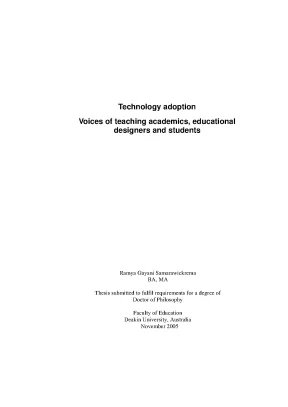
Tải xuống để đọc toàn bộTechnology adoption Voices of teaching academics, educational designers and students Ramya Gayani Samarawickrema BA, MA Thesis submitted to fulfil requirements for a degree of Doctor of Philosophy Faculty of Education Deakin University, Australia November 2005 DEAKIN UNIVERSITY CANDIDATE DECLARATION I certify that the thesis entitled Technology adoption: Voices of teaching academics, educational designers and students Submitted for the degree of Doctor of Philosophy is the result of my own work and that where reference is made to the work of others, due acknowledgement is given. I also certify that any material in the thesis which has been accepted for a degree or diploma by any other university or institution is identified in the text.……………………………………………………… DEAKIN UNIVERSITY ACCESS TO THESIS I am the author of the thesis entitled Technology adoption: Voices of teaching academics, educational designers and students submitted for the degree of Doctor of Philosophy. This thesis may be made available for consultation, loan and limited copying in accordance with the Copyright Act 1968. Table of contents List of figures and tables vi Abstract vii Acknowledgements ix Dedication x Chapter One Overview of the folio 1 Introduction 1 Rationale 1 Context of this folio 2 The three studies in the folio 2 Theoretical basis 4 Limitations of the research 10 The researcher’s role 10 Folio structure 11 Summary 12 Dissertation - Adoption of web-based learning and teaching: Voices of the teaching academics 13 Chapter Two Overview of the dissertation and origins of the research 14 Introduction 14 Concerns that led to the study 14 Purpose of the study 15 The research proposition 15 Terms used in this study 16 Theoretical perspective of the study 18 Limitations of the study 18 Structure of the dissertation 19 Summary 20 Chapter Three Technology and higher education institutions 22 Overview 22 Introduction of technology into universities 23 i The lure of technology in higher education 25 The impact of online learning and teaching on higher education institutions 28 Australian universities 28 Institutional strategies for adopting web-based learning and teaching 31 The impact of online learning and teaching on university teachers 36 Developing new roles and skills 37 Staff development 39 Workloads and time pressures 42 Impact on research 45 Rewards 46 Emerging research themes 48 Summary 52 Chapter Four Technology adoption 53 Overview 53 Adopting web-based learning and teaching 53 Approaches to adoption 54 Adoption experiences with web-based learning and learning management systems 55 The theory of diffusion of innovation 57 Diffusion theory and learning technology 59 Diffusion theory and context 63 Actor-network theory (ANT) 66 Diffusion of innovation and actor-network theory 70 Summary 71 Chapter Five Research Procedure 72 Overview 72 How diffusion theory and actor-network theory are used in this study 72 Rationale for the case study 77 Research context 78 The research design and method 79 Sample 82 Data collection procedures 83 Data management 85 Measures taken to enhance credibility and trustworthiness 86 Data analysis 88 The researcher’s position 94 Summary 95 ii Chapter Six Context of the study 96 Overview 96 The University 96 The University policy on technology for learning and teaching 97 The respondents 100 Summary 102 Chapter Seven Findings 1: Individuals’ reasons for adoption 103 Overview 103 Describing the findings through the Integrated Theory of Diffusion of Innovation 104 Demographic data 106 Participants 110 Network exposure 150 Teaching approach 151 Reasons for adoption 154 Rewards 157 Summary 157 Chapter Eight Findings 2: Influencing and Contributing Actors 159 Overview 159 Describing the findings through actor-network theory 160 The actors in this study 163 Summary 193 Chapter Nine Discussion 194 Introduction 194 Power, politics and the individual 195 Supporting organisational infrastructure and policy framework 197 New work practices 203 Staff development 206 Being adaptive 208 Summary 210 Chapter Ten Conclusions 211 Introduction 211 Summary of the study 211 What was learned from this research and its implications 212 Significance of the results 218 iii Recommendations for further study 220 Elective 1 - Online learning and the evolving role of the educational designer: Voices of the educational designers 222 Chapter Eleven Elective 1: Online learning and the evolving role of the educational designer – Voices of the educational designers 223 Background and justification 223 Concerns that led to the study 223 Terms used in this study 224 Defining and redefining the role 225 Research focus and scope 228 Method 229 Data collection 232 Findings and discussion 233 Introducing technology into design 234 Meeting staff development needs 237 Working in teams 241 Resource-creating processes 242 General technical help 244 Other roles 245 Issues arising 249 Conclusion 251 Elective 2 - Client diversity: Voices of the students 252 Chapter Twelve Elective 2: Client diversity – Voices of the students 253 Overview 253 Chapter Thirteen Voices of teaching academics, educational designers and students 273 Overview 273 Voices of teaching academics 273 Voices of educational designers 275 Voices of students 276 Implications of the collective voices of teaching academics, educational designers and students 277 Conclusion: Changing times 280 iv Appendix 1 Deakin University Ethics Application 281 Appendix 2 Monash University Ethics Application 283 Appendix 3 Open-ended interview questions for teaching academics 285 Appendix 4 Example of field notes 286 Portraits/sketches 01 – Carman 24 June 2004 286 Portraits/sketches 02 – Marg 03 May 2004 290 Appendix 5 NVivo subject categories/tree 291 Appendix 6 Elective 1: Ethics papers 293 Appendix 7 Elective 1: Interview questions 295 Appendix 8 Elective 2: Ethics papers 297 Appendix 9 Elective 2: Interview questions 299 References 300 v List of figures and tables Figure 4.1 Rogers’ theory used as the central foundation 61 Table 4.1 Extending the theory of diffusion of innovation to learning 62 technology Table 4.2 Categories of information technology related diffusion research 64 Table 5.1 Descriptors derived through the Integrated Theory of Diffusion of 75 Innovation Table 5.2 Distribution of the participants across the ten faculties 83 Table 5.3 Interview question themes and codes 92 Table 5.4 Organisation of codes derived from the Integrated Theory of 94 Diffusion of Innovation and actor-network theory Table 7.1 Focus of Chapter Seven in relation to the theoretical framework 105 of the study Table 7.2 Demographics of participants 107 Table 7.3 Participants’ technology adoption continuum 153 Table 7.4 Technology related reasons for adoption 154 Table 7.5 A summary of reasons for adoption 155 Table 8.1 Focus of Chapter Eight – Actors in the study 165 Table 11.1 Demographics of participants 232 vi Abstract This folio presents three studies (a dissertation and two electives) which use qualitative case study methodologies to investigate technology adoption from three perspectives.
Central to all three studies is the study context of Monash University. The Dissertation explores adoption of web-based learning and teaching approaches from the perspective of teaching academics as they incorporate these to facilitate their students’ learning. The study investigates teaching academics’ reasons for adopting these new technologies, the factors that influenced their adoption decisions, and the challenges they were confronted with, including the contributing factors that impacted on their adoption decisions. The study shows that while contextual factors such as power and politics of the school, department, faculty and the institution impact on adoption, supportive organisational infrastructures and policy frameworks are necessary to encourage adoption, including wider adoption.
In turn, on going staff development, adoption of new work practices and being adaptive to changing work environments are key demands made on teaching academics as a result of adopting web-based teaching approaches. Elective 1, a smaller study, leads on from the dissertation and examines the impact of technology adoption on the evolving role of educational designers. The study identifies the educational designers’ role change in assisting teaching academics to move from more conventional forms of teaching to more technology based learner-centred collaborative models. An important aspect of the study is the managers’ perspectives of this role in a university that has adopted a strong flexible learning and technology policy.
The findings show that educational designers now work as project managers in larger teams consisting of a wider range of professionals, their expanded role in introducing technology into learning designs, providing staff development in the area, and giving technical help including advice on copyright and intellectual property issues. Elective 2 explores student readiness to adopt these technologies for learning. The study is designed to achieve an understanding of three broad categories of learners from a first year design unit: (1) South East Asian and East Asian students, (2) all other international vii students, and (3) local Australian students are studied to examine their readiness for modes of learning that are flexible; their approaches to study in a creative discipline area; and their openness to using technology. Findings of the study are discussed under the key themes – dependence on the teacher and classroom environment, flexible learning and working alone, structure, communication and work patterns.
The study concludes by discussing the possible cultural attributes that have an impact on the learning. The three studies found that the institution, its people, structures and processes must all adapt, evolve and grow in order to provide effective, engaging, student-centred web- based learning environments. Students in turn must be enabled to manage their study, make use of the technologies and maximise their learning experience. The findings revealed the stage of technology use reached at Monash University at the time of the study through the voices of the teaching academics, educational designers and students.
viii Acknowledgements This work would not have been possible without contributions from several groups of people at Monash University, Australia who were generous with their time and shared their views through interviews. I am thankful to the teaching academics, educational designers, managers and students who participated in my investigations, and I acknowledge this debt with gratitude. Of the many who gave freely of their time and expertise, I am thankful to Professor Chris Bigum whose questions and incisive comments helped clarify the use of actor- network theory adopted in this work, and to Dr Robyn Benson who played the role of a critical friend and so willingly reviewed the draft thesis. I thank Dr Peter J Smith, my associate supervisor, for his direction and advice, particularly with regard to Elective 2, and his feedback on the draft thesis.
I am very grateful to Associate Professor Elizabeth A Stacey for navigating me through ‘the doctoral experience’. I thank her for her inspiration, patient guidance, constant encouragement and for challenging me to strive for excellence. Thank you, all. Gayani Samarawickrema Melbourne, November 2005 ix Dedication This work is dedicated with love to my family, for their faith and support of my efforts.
x Chapter One- Overview of the folio Chapter One Overview of the folio Introduction Web-based education using sophisticated electronic technologies has changed and is continuing to change the way learning and teaching are carried out in most universities in the developed world. The three studies in this folio are placed against this background of change within the context of a large Australian higher education institution. The aim of this chapter is to provide a general overview of this folio which consists of one large study referred to as the Dissertation and two smaller studies referred to as Electives 1 and 2. This chapter also describes the underlying methodological paradigm which is common to all three studies.
Rationale The Doctor of Philosophy degree by folio requires the completion of several projects that demonstrate research skills and feed back into the researcher’s professional work. Consequently, the three studies described in this folio are situated in the researcher’s own work environment and are directly related to the researcher’s practice. The three studies arose as a result of the researcher’s work as an educational designer at Monash University, Australia. The Dissertation explores factors that impact on the adoption of web-based learning and teaching approaches by teaching academics.
As a result of technology adoption in higher education, new roles have been identified for both teaching academics as well as educational designers (Collis & Moonen, 2001).
Nội dung được bảo vệ bản quyền — Tải xuống đầy đủ
Trích dẫn luận án này
Ramya Gayani Samarawickrema (2005). Chấp nhận công nghệ trong giáo dục đại học: Nghiên cứu 2005 [Luận án tiến sĩ, Deakin University]. LuanAn.net. https://luanan.net/quan-ly-giao-duc/quan-ly-giao-duc-dai-hoc/chap-nhan-cong-nghe-trong-giao-duc-dai-hoc-samarawickrema-2005
Câu hỏi thường gặp
Luận án "Chấp nhận công nghệ trong giáo dục đại học: Nghiên cứu 2005" nghiên cứu về vấn đề gì?
Nghiên cứu 2005 về việc chấp nhận công nghệ trong giáo dục đại học. Khám phá xu hướng và thách thức.
Luận án "Chấp nhận công nghệ trong giáo dục đại học: Nghiên cứu 2005" được bảo vệ tại trường nào?
Luận án này được bảo vệ tại Deakin University. Năm bảo vệ: 2005.
Luận án "Chấp nhận công nghệ trong giáo dục đại học: Nghiên cứu 2005" thuộc chuyên ngành gì?
Luận án "Chấp nhận công nghệ trong giáo dục đại học: Nghiên cứu 2005" thuộc chuyên ngành Education. Danh mục: Quản Lý Giáo Dục Đại Học.
Luận án "Chấp nhận công nghệ trong giáo dục đại học: Nghiên cứu 2005" có bao nhiêu trang?
Luận án "Chấp nhận công nghệ trong giáo dục đại học: Nghiên cứu 2005" có 336 trang. Bạn có thể xem trước một phần tài liệu ngay trên trang web trước khi tải về.
Cách tải luận án "Chấp nhận công nghệ trong giáo dục đại học: Nghiên cứu 2005" về máy như thế nào?
Để tải luận án về máy, bạn nhấn nút "Tải xuống ngay" trên trang này, sau đó hoàn tất thanh toán phí lưu trữ. File sẽ được tải xuống ngay sau khi thanh toán thành công. Hỗ trợ qua Zalo: 0559 297 239.