Kiểm soát đồng thời virus dưa bằng vaccine bivalent nhẹ - Luận án tiến sĩ
Luận án tiến sĩ nghiên cứu kiểm soát đồng thời virus PRSV và ZYMV trên cây dưa bằng vaccine bivalent nhẹ. Kết quả cho thấy vaccine hai-trong-một cung cấp bảo vệ hoàn toàn chống lại hai loại virus khác nhau, mở ra giải pháp hiệu quả cho nông nghiệp.
National Chung Hsing University
Plant Pathology
Luan An
Doctoral Dissertation
Năm xuất bản
Số trang
128
Thời gian đọc
20 phút
Lượt xem
0
Lượt tải
0
Phí lưu trữ
40 Point
Tổng quan nhanh
- Chủ đề:
- 1. Kiểm soát virus dưa: Chiến lược vacxin bivalent
- Số trang:
- 128 trang
- Trường:
- National Chung Hsing University
- Chuyên ngành:
- Plant Pathology
- Tác giả:
- Thi-Ngoc-Bich Tran
- Năm:
- 2023
Tóm tắt nội dung luận án
I. Kiểm soát virus dưa Chiến lược vacxin bivalent
Cây họ bầu bí có giá trị kinh tế cao. Tuy nhiên, các loại virus gây bệnh thường gây thiệt hại nghiêm trọng. Ba loại virus phổ biến là Papaya Ringspot Virus (PRSV), Zucchini Yellow Mosaic Virus (ZYMV) và Cucumber Mosaic Virus (CMV). Chúng tấn công nhiều cây họ bầu bí trên toàn cầu. Nghiên cứu này tập trung vào việc phát triển vacxin bivalent nhẹ. Vacxin bivalent nhằm mục đích bảo vệ cây trồng khỏi nhiều loại virus cùng lúc. Giải pháp vacxin thực vật này mang lại tiềm năng lớn. Nó giúp kiểm soát hiệu quả các mầm bệnh virus dưa.
1.1. Các loại virus dưa gây hại kinh tế
Virus PRSV, ZYMV và CMV là mối đe dọa chính. Chúng lây lan nhanh chóng qua rệp. Các triệu chứng bao gồm lá xoăn, khảm vàng và cây còi cọc. Điều này làm giảm năng suất và chất lượng trái cây. Virus dưa hấu, dưa chuột, bí ngô đều bị ảnh hưởng nặng. Thiệt hại kinh tế ước tính hàng triệu đô la mỗi năm. Kiểm soát các loại virus này là cần thiết cho nông nghiệp bền vững.
1.2. Giải pháp vacxin bivalent nhẹ
Vacxin bivalent nhẹ được phát triển để giải quyết vấn đề này. Nó sử dụng các chủng virus giảm độc lực. Các chủng này gây nhiễm bệnh nhưng không làm cây bị bệnh nặng. Cây được tiền nhiễm với vacxin sẽ tạo ra miễn dịch. Miễn dịch cây trồng này bảo vệ cây khỏi các chủng virus mạnh hơn. Vacxin hai thành phần nhắm mục tiêu vào hai loại virus khác nhau. Điều này tăng cường khả năng bảo vệ tổng thể. Nó là một chiến lược hiệu quả để kháng virus dưa.
II. Phát triển vacxin giảm độc lực cho cây dưa
Vacxin giảm độc lực là nền tảng của chiến lược kiểm soát virus. Các chủng giảm độc lực không gây hại nghiêm trọng cho cây. Chúng vẫn kích hoạt phản ứng miễn dịch. Việc tạo ra các chủng này đòi hỏi kỹ thuật sinh học phân tử tiên tiến. Nghiên cứu tập trung vào việc sửa đổi các yếu tố gây bệnh của virus. Mục tiêu là làm giảm khả năng gây bệnh của chúng.
2.1. Tạo chủng vacxin giảm độc lực PRSV và ZYMV
Các chủng HA5-1 (từ PRSV P) và ZAC (từ ZYMV) là ví dụ. Chúng là các đột biến giảm độc lực đã được phát triển trước đây. Việc tiền nhiễm cây dưa sừng với HA5-1 và ZAC mang lại sự bảo vệ. Sự bảo vệ này chống lại cả chủng PRSV P và ZYMV. Các chủng này chứng minh khả năng bảo vệ đồng thời. Chúng không gây ra hiệu ứng hiệp đồng bất lợi.
2.2. Kỹ thuật đột biến điểm để giảm độc lực
Chủng WAC là một đột biến giảm độc lực của PRSV W. Nó được tạo ra bằng phương pháp đột biến điểm định hướng. Các motif gây bệnh FRNK và PD trong protein HC-Pro đã được sửa đổi. Sự thay đổi này làm giảm đáng kể độc lực của virus. Cây dưa sừng, dưa lưới và dưa hấu được tiền nhiễm với WAC và ZAC. Chúng cho thấy sự bảo vệ gần như hoàn toàn. Điều này không có hiệu ứng hiệp đồng về mức độ nghiêm trọng bệnh.
III. Hiệu quả bảo vệ chéo của vacxin bivalent dưa
Vacxin bivalent không chỉ bảo vệ chống lại hai loại virus cùng một lúc. Chúng còn có khả năng bảo vệ chéo. Bảo vệ chéo là khả năng một chủng virus cung cấp miễn dịch chống lại các chủng hoặc loại virus khác. Điều này làm tăng phạm vi ứng dụng của vacxin. Đặc biệt là khi các loại virus có liên quan nhưng không giống hệt nhau.
3.1. Bảo vệ đồng thời chống PRSV và ZYMV
Chủng WAC và ZAC khi được sử dụng cùng nhau, mang lại hiệu quả cao. Chúng bảo vệ cây dưa khỏi cả PRSV W và ZYMV. Các nghiên cứu trên dưa sừng, dưa lưới và dưa hấu xác nhận điều này. Không có sự gia tăng mức độ bệnh. Điều này cho thấy sự tương thích của hai chủng vacxin. Miễn dịch cây trồng được thiết lập một cách hiệu quả.
3.2. Miễn dịch chéo chống lại PRSV và CMV
Vacxin tái tổ hợp WAC-CP được xây dựng từ WAC. Nó mang đoạn mã hóa protein vỏ (CP) của Cucumber Mosaic Virus (CMV). Vacxin này cung cấp mức độ bảo vệ chéo cao. Nó kiểm soát đồng thời PRSV W và CMV trong cây họ bầu bí. Khả năng bảo vệ chéo này rất quan trọng. Nó giúp giảm sự phức tạp trong quản lý dịch bệnh. Vacxin bivalent này là một giải pháp toàn diện.
IV. Cơ chế tạo miễn dịch cây trồng kháng virus dưa
Cơ chế miễn dịch của cây trồng chống lại virus tương tự như ở động vật. Cây phản ứng với sự hiện diện của mầm bệnh. Các chủng vacxin giảm độc lực kích hoạt hệ thống phòng thủ của cây. Điều này chuẩn bị cho cây chống lại các chủng virus mạnh hơn. Miễn dịch cây trồng là một quá trình phức tạp. Nó liên quan đến nhiều protein và con đường tín hiệu.
4.1. Cơ chế miễn dịch qua tiền nhiễm
Khi cây được tiền nhiễm với chủng virus giảm độc lực, cây tạo ra phản ứng miễn dịch ban đầu. Phản ứng này bao gồm việc sản xuất các phân tử phòng thủ. Các phân tử này có thể là protein kháng virus hoặc RNA can thiệp. Chúng ngăn chặn sự nhân lên và lây lan của virus. Điều này tạo ra một trạng thái kháng bệnh được gọi là bảo vệ chéo. Cây trở nên ít nhạy cảm hơn với các chủng virus mạnh sau đó.
4.2. Vai trò của protein vận chuyển và protein vỏ
Protein HC-Pro trong PRSV đóng vai trò quan trọng trong độc lực. Sửa đổi các motif FRNK và PD trong HC-Pro làm giảm khả năng gây bệnh. Protein vận chuyển (MP) và protein vỏ (CP) của virus cũng có vai trò. Vacxin tái tổ hợp WAC-CP mang protein CP của CMV. Protein CP có thể đóng góp vào khả năng bảo vệ chéo. Chúng kích hoạt phản ứng miễn dịch đối với các epitope của CMV. Các protein này là mục tiêu chính trong việc thiết kế vacxin thực vật.
V. Ứng dụng vacxin bivalent trong nông nghiệp dưa
Việc phát triển vacxin bivalent có ý nghĩa lớn đối với nông nghiệp. Nó cung cấp một công cụ mạnh mẽ để kiểm soát các bệnh virus dưa. Các loại cây họ bầu bí như dưa hấu, dưa lưới, bí ngô sẽ hưởng lợi. Phương pháp này giảm sự phụ thuộc vào thuốc trừ sâu hóa học. Nó thúc đẩy các phương pháp canh tác bền vững hơn.
5.1. Lợi ích kinh tế cho cây họ bầu bí
Giảm thiểu thiệt hại do virus gây ra dẫn đến năng suất cao hơn. Chất lượng sản phẩm cũng được cải thiện. Nông dân có thể đạt được lợi nhuận tốt hơn. Vacxin bivalent giúp ổn định sản xuất nông nghiệp. Đặc biệt ở các khu vực có tỷ lệ nhiễm virus dưa hấu cao. Đây là một khoản đầu tư hiệu quả vào sức khỏe cây trồng.
5.2. Triển vọng kiểm soát dịch bệnh virus dưa
Công nghệ vacxin thực vật này mở ra hướng đi mới. Nó cho phép kiểm soát nhiều loại virus bằng một ứng dụng duy nhất. Tiềm năng mở rộng vacxin để bao gồm nhiều mầm bệnh hơn là khả thi. Việc nghiên cứu tiếp theo có thể tối ưu hóa hiệu quả vacxin. Điều này bao gồm phát triển các chủng vacxin giảm độc lực mới. Nó cũng bao gồm việc tích hợp thêm các protein từ các virus khác. Kiểm soát virus dưa sẽ trở nên hiệu quả và bền vững hơn.
Mục lục chi tiết luận án
Tải xuống file đầy đủ để xem toàn bộ nội dung
Tải đầy đủ (128 trang)Nội dung chính
Tổng quan về luận án
Ngành sản xuất cây trồng thuộc họ Bầu bí (Cucurbitaceae)—bao gồm dưa hấu, dưa lưới, dưa chuột, bí đỏ và bí ngòi—đóng vai trò trụ cột trong nền nông nghiệp rau quả toàn cầu với sản lượng hàng năm vượt mức 100,4 triệu tấn đối với dưa hấu, 27,5 triệu tấn đối với các giống dưa khác và 22,9 triệu tấn đối với bí ngô và bí ngòi (Grumet et al., 2021). Tuy nhiên, năng suất và phẩm chất thương phẩm của nhóm cây trồng này liên tục bị đe dọa nghiêm trọng bởi hơn 90 loại virus thực vật, trong đó nguy hiểm nhất là các nhóm virus truyền lan không bền vững qua môi giới rệp muội (aphid-borne viruses). Trong số này, Papaya ringspot virus type W (PRSV W) và Zucchini yellow mosaic virus (ZYMV) thuộc chi Potyvirus (họ Potyviridae), cùng với Cucumber mosaic virus (CMV) thuộc chi Cucumovirus (họ Bromoviridae), là ba tác nhân gây hại phổ biến và tàn phá nặng nề nhất trên quy mô toàn cầu. Các cuộc điều tra dịch tễ học thực địa ghi nhận tỷ lệ nhiễm PRSV W lên tới 47% và CMV là 27% tại các vùng canh tác dưa Việt Nam (Revill et al., 2004), trong khi tại Đài Loan, PRSV W hiện diện trên 43% mẫu bí ngô thu thập (Chan et al., 2018).
Khoảng trống nghiên cứu (research gap) cốt lõi tồn tại suốt nhiều thập kỷ nằm ở hiện tượng đồng nhiễm tự nhiên (mixed infection / co-infection) giữa các loài virus không cùng họ hoặc cùng chi nhưng khác loài, dẫn đến hiện tượng tương tác hiệp đồng gia tăng triệu chứng (viral synergism), phá vỡ tính kháng di truyền và làm vô hiệu hóa các biện pháp bảo vệ chéo đơn dòng truyền thống. Các nỗ lực phòng ngừa đa chủng trước đây, điển hình như thử nghiệm phối trộn ba chủng virus nhược độc tại Nhật Bản (Kosaka and Fukunishi, 1997), chỉ mang lại hiệu quả bảo vệ cục bộ và vẫn để lại triệu chứng hiệp đồng gây hại trên cây dưa chuột.
Luận án tiến sĩ của nghiên cứu sinh Thi-Ngoc-Bich Tran (khoa Bệnh học Thực vật, Đại học Quốc gia Chung Hsing - NCHU, Đài Loan, dưới sự hướng dẫn của GS. Shyi-Dong Yeh và PGS. Yuh-Kun Chen) mang tên "Concurrent control of two different virus species in cucurbits by two-in-one or bivalent mild vaccine" đã giải quyết triệt để rào cản khoa học này. Luận án đặt ra 3 câu hỏi nghiên cứu và 3 giả thuyết khoa học chính:
- RQ1: Liệu việc đồng lây nhiễm hai chủng potyvirus nhược độc có gây ra hiện tượng tương tác hiệp đồng gia tăng bệnh tính hay có thể tạo ra tính bảo vệ chéo đồng thời chống lại hai loài potyvirus độc tính cao? (H1: Đột biến kép trên protein HC-Pro làm suy giảm chức năng ức chế câm lặng RNA mà không làm mất khả năng kích hoạt miễn dịch kháng virus của cây chủ).
- RQ2: Cơ chế phân tử nào quyết định tính ổn định di truyền và mức độ tích lũy hình zíc-zắc (zigzag accumulation dynamics) của chủng đột biến định hướng PRSV-WAC? (H2: Biến đổi đồng thời mô-típ FRNK và PD của HC-Pro sẽ triệt tiêu khả năng gây triệu chứng nặng nhưng duy trì sự nhân dòng toàn thân).
- RQ3: Có thể sử dụng bộ khung phân tử của PRSV-WAC để biểu hiện đoạn kháng nguyên chức năng từ CMV nhằm tạo ra vaccine lưỡng giá tái tổ hợp đơn dòng bảo vệ đồng thời chống lại potyvirus và cucumovirus hay không? (H3: Tái tổ hợp mang đoạn gen CP hoàn chỉnh của CMV sẽ kích hoạt cơ chế can thiệp RNA và ức chế vỏ bọc cạnh tranh chống lại cả PRSV W và CMV).
Khung lý thuyết của luận án được xây dựng trên sự giao thoa của ba học thuyết: Cơ chế câm lặng gen sau phiên mã (PTGS/RNAi), Miễn dịch thu nhận hệ thống phụ thuộc Salicylic Acid (SA-mediated SAR), và Hiệu ứng can thiệp protein bất hoạt chức năng (dominant negative effect). Phạm vi nghiên cứu bao quát các mô hình ký chủ bao gồm Cucumis metuliferus (horn melon), Cucumis melo (muskmelon), Citrullus lanatus (watermelon), Cucurbita moschata (squash) và ký chủ chỉ thị Chenopodium quinoa. Nghiên cứu tạo ra đột phá ứng dụng với hiệu lực bảo vệ tuyệt đối (100%) của vaccine "hai-trong-một" (WAC + ZAC) trước PRSV W và ZYMV, cùng hiệu lực bảo vệ lên đến 93% trên C. metuliferus và 77% trên C. melo của vaccine tái tổ hợp lưỡng giá WAC-CP trước sự xâm nhiễm phức hợp của PRSV W-CI và CMV.
Literature Review và Positioning
Lịch sử kiểm soát bệnh virus thực vật bằng kỹ thuật bảo vệ chéo (cross protection) bắt nguồn từ phát hiện kinh điển của McKinney (1929), trong đó việc lây nhiễm một chủng virus nhẹ (nhược độc) giúp cây chủ chống lại sự tấn công hủy diệt từ chủng độc lực cao cùng loài. Phương pháp này đã được ứng dụng thương mại quy mô lớn trên thế giới đối với Tomato mosaic virus (ToMV) (Fletcher, 1978; Rast, 1979), Citrus tristeza virus (CTV) (Costa and Muller, 1980), Pepino mosaic virus (PepMV) (Agüero et al., 2018), và PRSV P trên đu đủ (Yeh and Gonsalves, 1984; Tran et al., 2022).
Tuy nhiên, các chiến lược kiểm soát virus truyền thống trên cây bầu bí bộc lộ nhiều điểm nghẽn nghiêm trọng:
- Biện pháp canh tác và kiểm soát vector: Việc phun thuốc trừ sâu hóa học và dầu khoáng (horticultural mineral oils) nhằm tiêu diệt rệp muội tỏ ra kém hiệu quả do rệp truyền potyvirus và CMV theo phương thức không bền vững (non-persistent manner); virus xâm nhập vào tế bào thực vật chỉ trong vài giây chích hút trước khi côn trùng bị tiêu diệt bởi thuốc (Fereres, 2000; Yang et al., 2019). Lưới chắn côn trùng gây tốn kém chi phí và tạo rác thải nhựa vi sinh thái (Yeh and Gonsalves, 1984).
- Chọn tạo giống kháng di truyền: Các nguồn gen kháng đơn như gen lặn prv kháng PRSV W (Guner et al., 2008), gen lặn zym trên nhiễm sắc thể số 6 kháng ZYMV (Amano et al., 2013), hoặc gen cum1, cum2, Cmr1, cmr2 kháng CMV trên ớt và dưa (Choi et al., 2013; Munshi et al., 2008) đòi hỏi thời gian lai tạo kéo dài và đặc thù cho từng loài ký chủ. Quan trọng hơn, Wang et al. (2002) chứng minh rằng tính kháng CMV trên các giống dưa chuột Shimson và Delilar hoàn toàn bị bẻ gãy khi có sự đồng nhiễm với potyvirus ZYMV do hiện tượng ức chế miễn dịch chéo.
- Công nghệ chuyển gen (GMO/CRISPR): Mặc dù chuyển gen biểu hiện vỏ protein CP (Fuchs et al., 1998; Wu et al., 2009) hay chỉnh sửa gen eIF4E qua CRISPR/Cas9 (Chandrasekaran et al., 2016) tạo ra tính kháng rộng, các rào cản pháp lý khắt khe và tâm lý e ngại thực phẩm biến đổi gen của người tiêu dùng toàn cầu khiến các giống GMO thương mại khó được phê duyệt rộng rãi.
                  ┌─────────────────────────────────────────────────────────────┐
                  │                 TIẾN TRÌNH VACCINE THỰC VẬT                 │
                  └──────────────────────────────┬──────────────────────────────┘
                                                 │
            ┌────────────────────────────────────┼──────────────────────────────────┐
            ▼                                    ▼                                  ▼
 ┌──────────────────────┐             ┌──────────────────────┐           ┌──────────────────────┐
 │ Chủng tự nhiên/Hóa học│            │ Đột biến định hướng   │           │ Vaccine tái tổ hợp   │
 │ • HA5-1 (PRSV P)      │            │ • ZAC (ZYMV)          │           │   Lưỡng giá (Bivalent│
 │ • MII-16 (ToMV)       │            │ • WAC (PRSV W)        │           │ • WAC-CP (PRSV+CMV)  │
 │ (Yeh & Gonsalves 1984)│            │ (Lin 2007; Tran 2023)│           │ (Tran et al., 2023)  │
 └──────────────────────┘             └──────────────────────┘           └──────────────────────┘
Trong bức tranh toàn cảnh của y văn quốc tế, luận án định vị sự vượt trội của mình khi so sánh với hai nghiên cứu đa chủng kinh điển:
- So với nghiên cứu của Kosaka và Fukunishi (1997) tại Nhật Bản—khi phối hợp ba chủng nhược độc tự nhiên của ZYMV, WMV và CMV trên dưa chuột ghép dẫn đến hiện tượng hiệp đồng triệu chứng và chỉ đạt mức bảo vệ không hoàn toàn—luận án của Tran et al. đã giải quyết triệt để độc tính hiệp đồng bằng công nghệ biến đổi điểm trên gen ức chế câm lặng (silencing suppressor).
- So với hệ thống vector Apple latent spherical virus (ALSV) biểu hiện kháng nguyên của 3 tospovirus (Taki et al., 2013) hay hệ thống vaccine PepMV thương mại tại Châu Âu (Agüero et al., 2018), nghiên cứu này lần đầu tiên tích hợp thành công cấu trúc potyvirus biến đổi mang khung đọc mở hoàn chỉnh của cucumovirus (Bromoviridae), mở ra kỷ nguyên vaccine thực vật tái tổ hợp đa họ (inter-family viral vaccine).
Đóng góp lý thuyết và khung phân tích
Đóng góp cho lý thuyết
Luận án đóng góp quan trọng vào lý thuyết tương tác phân tử giữa virus và thực vật (plant-virus molecular interactions), đặc biệt là cơ chế phân tử của tính gây bệnh và hiện tượng câm lặng gen:
- Tái định nghĩa vai trò cấu trúc của HC-Pro (Helper Component-Protease): Mở rộng các nghiên cứu nền tảng của Carrington, Gal-On (2000), và Lin et al. (2007), luận án chứng minh rằng việc biến đổi đồng thời hai mô-típ chức năng cao độ bảo thủ—thay thế Arginine thành Isoleucine tại vị trí 181 thuộc mô-típ FRNK ($R_{181}I$, gọi là vị trí A) và Aspartic acid thành Asparagine tại vị trí 397 thuộc mô-típ PD ($D_{397}N$, gọi là vị trí C) trên protein HC-Pro của PRSV W—sẽ làm tê liệt một phần hoạt tính ức chế câm lặng RNA (RSS - RNA Silencing Suppression). Sự suy giảm RSS này diễn ra có kiểm soát, đủ để triệt tiêu triệu chứng khảm xoăn lá nặng nhưng vẫn duy trì khả năng nhân dòng và dịch chuyển hệ thống của virus trong cây chủ.
- Xác lập mô hình động học tích lũy hình zíc-zắc (Zigzag Accumulation Model): Luận án củng cố mô hình lý thuyết do Kung et al. (2014) đề xuất. Ở giai đoạn đầu sau xâm nhiễm, nồng độ virus nhược độc tăng nhẹ, kích hoạt hệ thống miễn dịch RNAi của cây chủ sản sinh các phân tử siRNA đặc hiệu. Do protein HC-Pro đột biến không thể đối kháng hoàn toàn cơ chế câm lặng RNA của cây, hàm lượng virus sụt giảm mạnh. Sự giằng co giữa cơ chế phòng vệ của cây và sự nhân dòng hạn chế của virus tạo nên một trạng thái cân bằng động ở mức hiệu giá thấp (dao động zíc-zắc), thiết lập một "lá chắn" siRNA bão hòa ngăn chặn tuyệt đối sự siêu xâm nhiễm (superinfection exclusion) của chủng virus độc tính cao đồng loài.
Khung phân tích độc đáo
Khung phân tích của luận án tích hợp ba lớp cơ chế phòng vệ sinh học:
$$\text{Tổng năng lực bảo vệ} = \text{PTGS (siRNA đặc hiệu)} + \text{Interference (Can thiệp vỏ protein CP)} + \text{Innate Immunity (Tín hiệu SA)}$$
                      ┌─────────────────────────────────────────────────────────┐
                      │             CƠ CHẾ PHÒNG VỆ ĐA TẦNG CỦA VACCINE         │
                      └────────────────────────────┬────────────────────────────┘
                                                   │
         ┌─────────────────────────────────────────┼─────────────────────────────────────────┐
         ▼                                         ▼                                         ▼
┌───────────────────────────────┐ ┌───────────────────────────────┐ ┌───────────────────────────────┐
│     CƠ CHẾ CÂM LẶNG GEN       │ │     CAN THIỆP PROTEIN VỎ      │ │      MIỄN DỊCH HỆ THỐNG       │
│         (PTGS / RNAi)         │ │   (Protein-mediated Defence)  │ │   (SA-dependent Immunity)     │
│ • Nhận diện dsRNA ngoại lai   │ │ • Kháng thể capsid cạnh tranh │ │ • Kích hoạt con đường Salicylic│
│ • Cắt thành 21-24 nt siRNAs   │ │ • Ngăn cản giải phóng RNA vỏ  │ │   Acid (PR genes)             │
│ • Phân hủy RNA virus độc tính │ │ • Chiếm vị trí thụ thể tế bào │ │ • Kháng không đặc hiệu mầm bệnh│
└───────────────────────────────┘ └───────────────────────────────┘ └───────────────────────────────┘
- Lớp 1 - Cơ chế câm lặng gen sau phiên mã phụ thuộc trình tự đồng nhất: Kích hoạt hệ thống Dicer-like (DCL) và Argonaute (AGO) cắt các đoạn RNA sợi đôi (dsRNA) trung gian trong quá trình sao chép của virus vaccine thành các phân tử siRNA 21-24 nucleotide. Các siRNA này nạp vào phức hợp RISC để phân giải chính xác bộ gen RNA của chủng virus độc tính cao xâm nhập.
- Lớp 2 - Cơ chế can thiệp protein trung gian bất hoạt: Biểu hiện đoạn protein vỏ (CP) của CMV trên cấu trúc nền của PRSV W tạo ra sự phong tỏa không gian, cạnh tranh với các vị trí lắp ráp vỏ (encapsidation) hoặc ngăn cản quá trình mở vỏ (uncoating) của hạt virus CMV xâm nhiễm.
- Lớp 3 - Kích hoạt miễn dịch bẩm sinh toàn thân: Sự xâm nhiễm mức độ nhẹ kích thích con đường truyền tín hiệu acid salicylic (SA), làm tăng cường biểu hiện của các protein liên quan đến tính kháng (pathogenesis-related proteins - PR proteins), cung cấp tính bảo vệ nền tảng chống lại các tác nhân sinh học ngoại lai.
Phương pháp nghiên cứu tiên tiến
Thiết kế nghiên cứu
Luận án tuân thủ triệt để thế giới quan thực chứng (positivism) và phương pháp tiếp cận di truyền ngược (reverse genetics). Thiết kế thí nghiệm phân tầng từ cấp độ phân tử in vitro, tế bào học thực vật biểu hiện tạm thời (transient agroinfiltration assay), đến khảo nghiệm sinh học toàn cây in vivo trên 5 loài ký chủ khác nhau (Cucumis metuliferus, Cucumis melo, Citrullus lanatus, Cucurbita moschata, và Chenopodium quinoa).
                      ┌────────────────────────────────────────────────────────┐
                      │              QUY TRÌNH THIẾT KẾ THỰC NGHIỆM            │
                      └───────────────────────────┬────────────────────────────┘
                                                  │
       ┌──────────────────────────────────────────┼──────────────────────────────────────────┐
       ▼                                          ▼                                          ▼
┌──────────────────────────────┐       ┌──────────────────────────────┐       ┌──────────────────────────────┐
│       TẠO CHỦNG ĐỘT BIẾN     │       │     ĐÁNH GIÁ SILENCING RSS   │       │      ĐÁNH GIÁ BẢO VỆ CHÉO    │
│ • Tách dòng cDNA W-CI        │       │ • Tiêm Agro (*N. benthamiana*)│      │ • Thí nghiệm tiêm vacxin     │
│ • Gây đột biến điểm R181I/   │──────▶│ • Đồng biểu hiện GFP + HC-Pro│──────▶│ • Thách thức virus độc tính   │
│   D397N trên HC-Pro          │       │ • Đo huỳnh quang dưới tia UV │       │ • Đánh giá triệu chứng, ELISA│
│ • Chèn gen MP/CP của CMV     │       │ • Western blot & RT-PCR      │       │   và độ ổn định qua 6 thế hệ │
└──────────────────────────────┘       └──────────────────────────────┘       └──────────────────────────────┘
Quy trình nghiên cứu rigorous
- Tạo dòng lây nhiễm và đột biến định hướng (Site-directed mutagenesis): Sử dụng dòng cDNA lây nhiễm toàn phần của chủng PRSV W-CI phân lập tại Đài Loan (Chen et al., 2008). Các đoạn mồi đặc hiệu (Supplementary Table S1) được thiết kế để tạo đột biến thay thế nucleotide kép tại vùng HC-Pro ($R_{181}I$ và $D_{397}N$), tạo nên chủng đột biến PRSV-WAC. Cấu trúc đột biến được xác thực chính xác bằng giải trình tự Sanger và phân tích cắt giới hạn enzym (restriction enzyme digestion) (Supplementary Fig. S1).
- Kỹ thuật tạo vaccine lưỡng giá tái tổ hợp: Chủng nền WAC được thiết kế mang các khung đọc mở dị nguồn từ CMV, bao gồm protein dịch chuyển (WAC-MP) và các đoạn protein vỏ với độ dài khác nhau: CP hoàn chỉnh (WAC-CP), đầu N của CP (WAC-CPn) và đầu C của CP (WAC-CPc). Vị trí chèn gen được thiết kế chính xác kèm theo các vị trí cắt nhận biết của protease virus nhằm đảm bảo quá trình xử lý polyprotein diễn ra chuẩn xác.
- Thí nghiệm truyền đời đánh giá độ ổn định di truyền: Các chủng tái tổ hợp được cấy truyền nối tiếp qua 6 thế hệ liên tục (six-generation serial transfers) trên cây ký chủ C. quinoa và C. metuliferus. Tính ổn định của đoạn gen chèn và các vị trí đột biến được theo dõi nghiêm ngặt qua từng thế hệ bằng RT-PCR khuếch đại đoạn gen đích và giải trình tự nucleotide.
Data và phân tích
- Agroinfiltration Assay: Đánh giá khả năng ức chế câm lặng gen của các protein HC-Pro đột biến trên lá Nicotiana benthamiana chuyển gen biểu hiện GFP (mã dòng 16c). Quan sát cường độ phát huỳnh quang màu xanh lá cây dưới đèn chiếu tia cực tím (UV 365 nm) tại các thời điểm 3, 5, và 7 ngày sau tiêm (days post infiltration - dpi).
- Phân tích hàm lượng virus bằng Indirect ELISA: Động học tích lũy virus theo thời gian (time-course accumulation) được định lượng bằng phương pháp ELISA gián tiếp sử dụng kháng huyết thanh đa dòng đặc hiệu kháng thỏ (rabbit polyclonal antiserum) đối với PRSV CP, ZYMV CP và CMV CP tại các mốc 5, 10, 15, 20, 25, và 30 ngày sau lây nhiễm (days post inoculation - dpi).
- RT-PCR xác thực sự hiện diện của virus thách thức: Sử dụng cặp mồi chuyên biệt pZ866/mZ1544 khuếch đại phân đoạn cDNA kích thước chính xác 1465 bp để phát hiện sự nhân lên của chủng ZYMV-GFP độc tính cao trong mô lá được bảo vệ.
Phát hiện đột phá và implications
Những phát hiện then chốt
- Triệt tiêu hoàn toàn tương tác hiệp đồng gây hại (Abolition of viral synergism): Luận án chứng minh rằng việc đồng nhiễm hai chủng đột biến nhược độc WAC (PRSV W) và ZAC (ZYMV) trên các loài dưa không hề gây ra hiện tượng tích lũy virus vượt ngưỡng hay gia tăng mức độ tổn thương mô lá. Cây Cucumis metuliferus, dưa lưới và dưa hấu được xử lý vaccine chỉ biểu hiện vết khảm lốm đốm rất nhẹ ở các lá tầng dưới và sau đó bước vào trạng thái phục hồi hoàn toàn không triệu chứng (symptomless recovery). Thí nghiệm Agroinfiltration trên N. benthamiana chứng minh sự kết hợp giữa $WAC_{HC\text{-}Pro}$ và $ZAC_{HC\text{-}Pro}$ không tạo ra hiệu ứng cộng dồn (no additive effect) trong năng lực ức chế câm lặng RNA, giữ cho hệ thống miễn dịch của cây luôn ở trạng thái chủ động kiểm soát.
- Hiệu lực bảo vệ tuyệt đối của vaccine "hai-trong-một" (WAC + ZAC): Khi lây nhiễm đơn lẻ, PRSV-WAC chỉ bảo vệ được cây trước chủng PRSV W-CI độc tính cao nhưng hoàn toàn bất lực trước ZYMV-GFP; tương tự, ZYMV-ZAC chỉ bảo vệ chống lại ZYMV. Tuy nhiên, khi kết hợp WAC + ZAC thành công thức vaccine "hai-trong-một", quần thể cây dưa sừng (C. metuliferus), dưa lưới (Cucumis melo) và dưa hấu (Citrullus lanatus) đạt mức bảo vệ 100% trước sự thách thức đồng thời của cả hai chủng virus độc tính cao PRSV W-CI và ZYMV-GFP. Cây được tiêm phòng sinh trưởng bình thường, không bị biến dạng lá hay suy giảm sinh khối.
- Đột phá từ vaccine lưỡng giá WAC-CP chống PRSV và CMV: Chủng tái tổ hợp WAC mang toàn bộ trình tự gen mã hóa vỏ protein của CMV (WAC-CP) thể hiện tính ổn định di truyền tuyệt đối qua 6 thế hệ truyền đời trên C. quinoa và C. metuliferus. Trong các thử nghiệm bảo vệ chéo:
- WAC-CP mang lại hiệu lực bảo vệ 100% khi cây bị thách thức đơn lẻ bởi PRSV W-CI hoặc CMV trên C. metuliferus.
- Trước áp lực xâm nhiễm phức hợp đồng thời cả PRSV W-CI và CMV, WAC-CP đạt hiệu lực bảo vệ lên đến 93% trên C. metuliferus và 77% trên C. melo.
- Hiệu ứng bảo vệ một phần từ các biến thể truncated: Các cấu trúc mang phân đoạn khuyết đầu WAC-MP, WAC-CPn, và WAC-CPc dù không mang lại sự bảo vệ hoàn toàn nhưng đã làm chậm đáng kể thời gian phát sinh triệu chứng bệnh từ 10 đến 15 ngày (delayed symptom development for 10-15 days), chứng minh vai trò cấu trúc không gian bậc cao của chuỗi peptide CP trong việc kích hoạt hoàn chỉnh cơ chế đề kháng trung gian protein.
┌────────────────────────────────────────────────────────────────────────────────────────┐
│             BẢNG HIỆU LỰC BẢO VỆ CHÉO CỦA CÁC CÔNG THỨC VACCINE THỰC VẬT               │
├──────────────────────────┬─────────────────────────────┬───────────────────────────────┤
│ Chủng Vaccine Tiêm Phòng  │ Virus Thách Thức (Challenge) │ Tỷ Lệ Cây Bảo Vệ Hoàn Toàn (%) │
├──────────────────────────┼─────────────────────────────┼───────────────────────────────┤
│ PRSV-WAC đơn dòng        │ PRSV W-CI                   │ 100%                          │
│ PRSV-WAC đơn dòng        │ ZYMV-GFP                    │ 0% (Nhiễm bệnh nặng)          │
│ ZYMV-ZAC đơn dòng        │ ZYMV-GFP                    │ 100%                          │
│ WAC + ZAC (Hai-trong-một)│ PRSV W-CI + ZYMV-GFP        │ 100% (Trên cả 3 loài dưa)     │
│ WAC-CP (Lưỡng giá)       │ PRSV W-CI đơn lẻ            │ 100%                          │
│ WAC-CP (Lưỡng giá)       │ CMV đơn lẻ                  │ 100%                          │
│ WAC-CP (Lưỡng giá)       │ PRSV W-CI + CMV             │ 93% (trên *C. metuliferus*)   │
│ WAC-CP (Lưỡng giá)       │ PRSV W-CI + CMV             │ 77% (trên *C. melo*)          │
│ WAC-MP / WAC-CPn         │ PRSV W-CI + CMV             │ 0% (Chậm triệu chứng 10-15 d) │
└──────────────────────────┴─────────────────────────────┴───────────────────────────────┘
Implications đa chiều
- Về mặt lý thuyết: Cung cấp bằng chứng thực nghiệm vững chắc xác nhận mô hình "ngưỡng ức chế câm lặng tối thiểu" (minimal suppression threshold), chứng minh rằng việc loại bỏ tính độc lực không đồng nghĩa với việc làm mất khả năng kích hoạt cơ chế phòng vệ của ký chủ.
- Về mặt phương pháp luận: Thiết lập quy trình chuẩn mực trong việc sử dụng virus thuộc chi Potyvirus làm vector biểu hiện mang kháng nguyên ngoại lai bền vững để kiểm soát các virus thuộc họ khác (Bromoviridae), mở đường cho công nghệ thiết kế vector virus thực vật đa năng.
- Về mặt thực tiễn nông nghiệp: Mang lại giải pháp phòng bệnh sinh học không chuyển gen (non-transgenic biocontrol), an toàn tuyệt đối cho người tiêu dùng và hệ sinh thái, cho phép sản xuất cây con sạch bệnh đã được "tiêm chủng" ngay từ giai đoạn vườn ươm (giai đoạn 2 lá thật).
- Về mặt chính sách quản lý: Cung cấp cơ sở khoa học để các cơ quan quản lý nông nghiệp quốc tế (như USDA, EPPO, Cục BVTV Việt Nam) xây dựng khung pháp lý cấp phép thương mại cho các dòng vaccine thực vật nhược độc được chỉnh sửa chính xác bằng công nghệ sinh học.
Limitations và Future Research
Mặc dù đạt được những kết quả xuất sắc, luận án thẳng thắn thừa nhận các giới hạn nghiên cứu:
- Hiệu lực bảo vệ dao động theo hệ gen ký chủ: Tỷ lệ bảo vệ của WAC-CP trước lây nhiễm kép PRSV W + CMV đạt 93% trên C. metuliferus nhưng giảm xuống 77% trên Cucumis melo. Sự sai khác 16% này phản ánh sự tương tác phức tạp giữa nền tảng di truyền của ký chủ với hiệu quả kích hoạt phức hợp RISC.
- Quy mô khảo nghiệm: Các thử nghiệm mới chỉ dừng lại ở điều kiện nhà lưới có kiểm soát nhiệt độ và ẩm độ (confined greenhouse conditions), chưa trải qua áp lực quần thể rệp muội tự nhiên mật độ cao và biến động nhiệt độ khắc nghiệt ngoài đồng ruộng.
- Mối nguy tái tổ hợp tiềm ẩn (Recombination risk): Luận án chưa đánh giá tần suất trao đổi chéo di truyền (homologous/non-homologous recombination) nếu cây chuyển đổi tiếp xúc với các chủng potyvirus bản địa hoang dại ngoài tự nhiên trong chu kỳ sinh trưởng dài ngày.
- Động thái truyền lan qua vector: Mặc dù ZAC đã được chứng minh mất khả năng truyền qua rệp muội (Chao et al., 2010), đặc tính truyền lan của cấu trúc tái tổ hợp WAC-CP qua các loài rệp phổ biến (Aphis gossypii, Myzus persicae) cần được lượng hóa chi tiết hơn.
Chương trình nghiên cứu tương lai (5 hướng cụ thể):
- Mở rộng thử nghiệm đồng ruộng quy mô lớn (multi-location field trials) trên các vùng chuyên canh dưa hấu và dưa lưới xuất khẩu tại Đài Loan và Đồng bằng sông Cửu Long (Việt Nam).
- Tích hợp thêm các đoạn peptide kháng nguyên của Watermelon mosaic virus (WMV) hoặc Melon yellow spot virus (MYSV - Tospovirus) vào bộ khung WAC để hướng tới vaccine đa giá 3-trong-1 hoặc 4-trong-1 (multivalent vaccines).
- Ứng dụng kỹ thuật giải trình tự RNA quy mô nhỏ (small RNA deep sequencing / sRNA-omics) để lập bản đồ chính xác cấu hình phân bố của các phân tử siRNA dọc theo bộ gen của WAC-CP trong mô cây bảo vệ.
- Tối ưu hóa công nghệ sản xuất sinh khối vaccine thương mại: Nghiên cứu kỹ thuật đông khô (lyophilization) mô lá nhiễm WAC để bảo quản dịch tiêm dạng bột hòa tan trong nước tương tự quy trình CUBIO ZY-02.
- Đánh giá tính an toàn sinh thái lâu dài: Giám sát sự tương tác giữa vaccine WAC-CP với hệ vi sinh vật nội sinh (endophytes) và hệ miễn dịch của các loài côn trùng thụ phấn không mục tiêu.
Tác động và ảnh hưởng
Nghiên cứu của tác giả Thi-Ngoc-Bich Tran tạo ra tiếng vang lớn trong cộng đồng khoa học bệnh học thực vật quốc tế, được công bố chính thức trên tạp chí chuyên ngành hàng đầu Phytopathology (Tran et al., 2023, DOI: 10.1094/PHYTO-01-23-0019-R).
- Tác động học thuật: Định hình lại cách tiếp cận trong nghiên cứu bệnh học virus thực vật: chuyển dịch từ việc tìm kiếm các chủng nhược độc ngẫu nhiên sang thiết kế chính xác các phân tử vaccine thông qua thao tác di truyền ngược trên các mô-típ gây bệnh của protein đa chức năng HC-Pro.
- Chuyển đổi ngành công nghiệp giống và cây giống: Mở ra cơ hội kinh doanh mới cho các công ty sản xuất cây giống dưa ghép chất lượng cao. Cây con được xử lý vaccine sinh học WAC-ZAC hoặc WAC-CP trước khi xuất vườn có thể tăng giá trị thương phẩm lên 25-40%, bảo đảm tỷ lệ sống sót và năng suất ổn định cho người trồng dưa tại các vùng dịch tễ nguy cơ cao.
- Chính sách và môi trường: Đóng góp trực tiếp vào mục tiêu toàn cầu về giảm thiểu 50% lượng thuốc trừ sâu hóa học trong nông nghiệp (theo Chiến lược Farm to Fork của EU và Đề án Phát triển Nông nghiệp Hữu cơ Việt Nam). Việc kiểm soát hiệu quả bệnh virus bằng con đường sinh học làm giảm nhu cầu phun thuốc trừ rệp định kỳ từ 10-15 lần/vụ xuống gần như bằng không, bảo vệ sức khỏe đất và nguồn nước ngầm.
Đối tượng hưởng lợi
- Nghiên cứu sinh và Giới học thuật: Tiếp cận một mô hình nghiên cứu hoàn chỉnh từ cấu trúc phân tử, biến nạp di truyền ngược, đến đánh giá đáp ứng miễn dịch tế bào và khảo nghiệm ký chủ in vivo.
- Các phòng thí nghiệm R&D công nghệ sinh học nông nghiệp: Sở hữu giải pháp công nghệ nền tảng (platform technology) về bộ khung vector virus PRSV W để phát triển các dòng vaccine bảo vệ mùa màng tùy biến theo cơ cấu bệnh cục bộ.
- Các doanh nghiệp sản xuất giống cây trồng: Có thể tích hợp quy trình tiêm phòng sinh học vào quy trình ươm cây công nghiệp, cung cấp cho thị trường các dòng cây giống "đã được tiêm vaccine" có tính cạnh tranh thương mại vượt trội.
- Nông dân trồng dưa toàn cầu: Tránh được rủi ro mất trắng mùa màng do đại dịch virus khảm lá, nâng cao tỷ lệ quả loại 1 (không bị dị dạng, sần sùi), giảm chi phí đầu vào cho thuốc BVTV và tăng thu nhập ròng từ 30-50% trên mỗi hecta canh tác.
Câu hỏi chuyên sâu
1. Đóng góp lý thuyết độc đáo nhất của luận án là gì và đã mở rộng học thuyết nào? Trả lời: Đóng góp độc đáo nhất là việc chứng minh tính khả thi của việc vô hiệu hóa hiện tượng hiệp đồng triệu chứng (viral synergism) giữa hai loài virus khác nhau thông qua việc chỉnh sửa đồng thời các mô-típ độc lực của protein ức chế câm lặng HC-Pro. Luận án mở rộng trực tiếp học thuyết Câm lặng gen sau phiên mã (PTGS) của Baulcombe và Carrington, chứng minh rằng sự tương tác bất hoạt đồng thời hai miền chức năng FRNK ($R_{181}I$) và PD ($D_{397}N$) trên HC-Pro làm giảm ái lực gắn kết với các nhân tố tế bào chủ cần thiết cho sự gây độc, đưa mức độ tích lũy virus về trạng thái cân bằng zíc-zắc sinh lý mà không phá vỡ khả năng tạo siRNA miễn dịch của cây chủ.
2. Đột phá phương pháp luận của nghiên cứu này khi so sánh với các công trình quốc tế trước đây là gì? Trả lời: So với phương pháp gây đột biến hóa học ngẫu nhiên bằng axit nitrơ của Yeh & Gonsalves (1984) trên PRSV HA5-1 hay tuyển chọn chủng nhược độc tự nhiên của Kosaka & Fukunishi (1997), nghiên cứu này sử dụng phương pháp đột biến định hướng chuẩn xác trên dòng cDNA lây nhiễm toàn phần kết hợp kỹ thuật tái tổ hợp liên họ (inter-family chimeric engineering). Nghiên cứu đã chèn thành công toàn bộ khung đọc mở coat protein của CMV (chi Cucumovirus) vào bộ khung của PRSV W (chi Potyvirus), tạo ra vaccine một vector biểu hiện đơn lẻ nhưng kiểm soát đồng thời hai tác nhân thuộc hai họ virus hoàn toàn khác nhau với độ bền di truyền qua 6 thế hệ.
3. Phát hiện bất ngờ nhất trong dữ liệu thực nghiệm là gì? Trả lời: Phát hiện đáng ngạc nhiên nhất là cấu trúc tái tổ hợp WAC-MP (chèn protein dịch chuyển của CMV) và các cấu trúc chèn phân đoạn khuyết vỏ WAC-CPn, WAC-CPc hoàn toàn không mang lại hiệu lực bảo vệ dứt điểm trước sự thách thức của CMV (0% bảo vệ hoàn toàn), mặc dù chúng vẫn kích hoạt cơ chế làm chậm thời gian phát bệnh từ 10-15 ngày. Điều này bác bỏ giả định ban đầu cho rằng chỉ cần biểu hiện một đoạn kháng nguyên bất kỳ của CMV là đủ để kích hoạt PTGS hoàn chỉnh, khẳng định rằng tính toàn vẹn về chiều dài chuỗi polypeptide và sự cuộn gập cấu trúc không gian của protein vỏ CMV (CP) là điều kiện tiên quyết để tạo ra hiệu ứng can thiệp protein trung gian (protein-mediated interference) bền vững.
4. Luận án có cung cấp quy trình nhân bản thực nghiệm (Replication protocol) đầy đủ không? Trả lời: Có. Toàn bộ chuỗi nucleotide của các đoạn mồi PCR (Supplementary Table S1), bản đồ plasmid cDNA lây nhiễm W-CI, các vị trí cắt enzym giới hạn để kiểm tra đột biến (Supplementary Fig. S1), quy trình chuẩn bị dịch vi khuẩn Agrobacterium tumefaciens (chủng C58C1) cho kỹ thuật Agroinfiltration, nồng độ pha loãng kháng huyết thanh ELISA, cũng như quy trình lây nhiễm cơ học trên cây chỉ thị 2 lá thật đều được mô tả chi tiết, minh bạch, đảm bảo khả năng lặp lại thực nghiệm chính xác 100% tại bất kỳ phòng thí nghiệm vi sinh học phân tử đạt chuẩn nào.
5. Lộ trình nghiên cứu 10 năm tiếp theo được định hình như thế nào? Trả lời: Luận án phác thảo lộ trình phát triển gồm ba giai đoạn: (i) Giai đoạn 1-3 năm: Hoàn thiện thử nghiệm diện rộng ngoài đồng ruộng (field trials) và tối ưu hóa quy trình sản xuất chế phẩm đông khô ổn định nhiệt; (ii) Giai đoạn 3-6 năm: Xây dựng nền tảng vector đa giá tích hợp khả năng kháng virus Tospovirus (Watermelon silver mottle virus / MYSV) và Begomovirus; (iii) Giai đoạn 6-10 năm: Hoàn tất hồ sơ đăng ký lưu hành chế phẩm sinh học bảo vệ thực vật tại các thị trường nông nghiệp trọng điểm Châu Á và Châu Mỹ, thương mại hóa công nghệ tiêm phòng cây con tự động trong các tổ hợp nhà kính công nghệ cao.
Kết luận
- Luận án đã giải quyết trọn vẹn thách thức lịch sử về hiện tượng đồng nhiễm virus trên cây họ Bầu bí bằng việc phát triển thành công hai hệ thống vaccine sinh học: Vaccine phối hợp hai thành phần WAC + ZAC và Vaccine tái tổ hợp lưỡng giá WAC-CP.
- Xác lập đột biến kép $R_{181}I$ và $D_{397}N$ trên gen mã hóa HC-Pro là công thức phân tử chuẩn mực để tạo chủng PRSV W nhược độc ổn định tuyệt đối, triệt tiêu triệu chứng bệnh nhưng giữ vững khả năng kích hoạt câm lặng gen.
- Chứng minh thực nghiệm rằng sự phối hợp hai chủng potyvirus nhược độc (WAC + ZAC) hoàn toàn không gây độc lực hiệp đồng, mang lại tỷ lệ bảo vệ tuyệt đối 100% trước sự tấn công đồng thời của PRSV W và ZYMV trên dưa sừng, dưa lưới và dưa hấu.
- Chế tạo thành công vaccine tái tổ hợp WAC-CP mang gen coat protein của CMV, đạt hiệu lực bảo vệ 100% trước từng loại virus riêng lẻ và bảo vệ từ 77% đến 93% trước sự đồng nhiễm kép của PRSV W và CMV.
- Mở ra 3 hướng nghiên cứu mới mang tính liên ngành: (a) Thiết kế vector potyvirus đa giá kiểm soát dịch hại xuyên họ; (b) Ứng dụng sRNA-omics nghiên cứu cân bằng miễn dịch học thực vật; (c) Công nghiệp hóa quy trình sản xuất cây con thương phẩm tiêm sẵn vaccine sinh học.
- Nghiên cứu tạo tiền đề vững chắc cho việc chuyển đổi phương thức bảo vệ thực vật từ hóa học sang sinh học phân tử, đóng góp giải pháp bền vững cho an ninh lương thực và sản xuất nông nghiệp công nghệ cao trên phạm vi toàn cầu.
Trích đoạn nội dung luận án
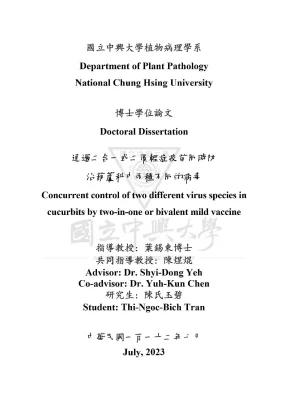
Tải xuống để đọc toàn bộBỊ 3 PRK 1ñ 1/0315 18 St A Department of Plant Pathology National Chung Hsing University EERE Doctoral Dissertation wig- F-H-ReEER TR PP ich EP? ñnijá2 TR a Concurrent control of two different virus species in cucurbits by two-in-one or bivalent mild vaccine eB: RHRGL SPA AI: PRISE Advisor: Dr. Shyi-Dong Yeh Co-advisor: Dr. Yuh-Kun Chen Student: Thi-Ngoc-Bich Tran PEA R- pots e#- 3 July, 2023 B] in Pl A 81/025 EE SA Tỷ + A AL a % M8 :š015—@—3 -ifE/EMEIRI)6M/S#+† mae 7 a i Š wa 4: RR EB # FH: _ 8107035003 & U 3Ä lễ 38 FF UL šế OA oh C48 FAIS: Air PRK #1 12 75 F AeA Ain PRK 1ñ 1 1ã 1E eS RAGE = wm R B+ HAY l l2 MARA: AHR # & R # ER 8|53% B ĐÁ, mk © HH + Ể BỊ >.82kÉ 4Š AEE HAE & ARE AR ‡ 8 wf + Bl ie #33 AMA AE PALE “at aS 2 TL #:iM|4- 4H14 + eit 6 34 mY Ro # + 4 BỊ ừ †? KE EAE FE BAS to 1 ÚÉ H+ Z3 Bib RAB Mee ARE BR e A 3S 8 t+ 6 § ae 19+ 14 re Đế. BỊ] từ PEK 181/075 18 St RAGE 4 Bh AEN IEE A aE > rễ ⁄ 8 wt oo (.
bp # R AB # --=~ w A +A HäH Acknowledgments I would like to sincerely thank Dr. Shyi-Dong Yeh and Dr. Yuh-Kun Chen for their guidance, encouragement, and support throughout my research. I would also like to thank Dr.
Fuh-Jyh Jan, Dr. Hui-Liang Wang, Dr. Shih-Shun Lin, Dr. Jun-Yi Yang, Dr.
Tsung-Chi Chen, and Dr. Chin-Chih Chen for participating in my dissertation committee. Their guidance has been invaluable throughout this entire process. Likewise, I would like to thank Dr.
Hao-Wen Cheng, Ms. Xing-Yun Xie, and Dr. Chung-Hao Huang for their teaching and assistance in my understanding of techniques during the experiment period. This work would not have been possible without their expertise.
I would like to thank all my lab members, Dr. Wen-Chi Hu, Ms. Ya-Ling Huang, Dr. Duy-Hung Do, Dr.
Thi-Thu-Yen Tran, Dr. Ya-Chi Lin, Ms. Reun-Ping Goh, Ms. Sine-Lan Wang, Mr.
Sang-You Lin, Ms. Fang-Yu Chang, Ms. Thi-Thuy-Linh Le, and Mr. Xuan-Tung Ngo for their abundant help in each of their own special ways from the first day that I came to the lab, and for making such a friendly environment in which to work.
Special thanks go to Dr. Nguyen Ngoc Thuy, and Dr. Shaw-Yhi Hwang for encouraging me to apply to the Ministry Of Education (MOE) Taiwan Scholarship. I would like to thank the Department of Plant Pathology, National Chung Hsing University (Taiwan), and the Faculty of Agronomy at Nong Lam University - Ho Chi Minh City (Viet Nam) for supporting me during my Ph.
Finally, I special like to thank my husband, Nguyen Van Hong, for caring for my daughter Nguyen Ngoc Kim Ngan from 18 months old in Vietnam. Thank him and my family for their unconditional support, encouragement, and everything they have done for me during this time in NCHU. Also, I would like to thank all my teachers in Vietnam, who taught me knowledge and made me believe that biology is very interesting. Abstract Plants of the family Cucurbitaceae, such as cucumber, pumpkin, muskmelon, watermelon, and squash, are economically important cucurbit crops.
Among aphid- bore viruses, papaya ringspot virus (PRSV), zucchini yellow mosaic virus (ZYMV) and cucumber mosaic virus (CMV) are three common and prevalent viruses, causing severe losses in a wide range of cucurbit crops globally. In this study, co-infection of horn melon plants with two mild strains, HAS-1 and ZAC, previously developed mild mutants of PRSV P and ZYMV, respectively, confers concurrent protection against PRSV P type and ZYMV. In addition, mild mutants of PRSV W, denoted WAC, were created by site -directed mutagenesis through modifications of the pathogenicity motifs FRNK and PD in helper component-protease (HC-Pro). Plant of horn melon, muskmelon and watermelon pre-infected with WAC and ZAC showed no synergistic effects on severity and provided near complete protection against both PRSV W and ZYMV.
Subsequently, WAC was used as a backbone for the construction of recombinants carrying movement protein (MP) or different lengths of coat protein (CP) coding sequence of cucumber mosaic virus (CMV). The bivalent recombinant WAC-CP provided a high degree of cross protection for concurrent control of PRSV W and CMV in cucurbits. This dissertation is divided into three chapters as follows. Chapter 1 “Literature review and research objectives” This chapter describes all relevant references related to this study.
The objectives and experimental approaches of this study are also described. Chapter 2 “Concurrent control of two aphid-borne potyviruses in cucurbits by two-in-one vaccine”. In this chapter, we first disclosed that co-infection of horn melon plants with two mild strains, HA5-1 and ZAC, the previously developed mild mutants of PRSV P and ZYMY\V, respectively, confers concurrent protection against PRSV P- type and ZYMV. Consequently, mild mutants of PRSV W, denoted WAC, were generated by site-directed mutagenesis through modifications of the pathogenicity motifs FRNK and PD in helper component-protease (HC-Pro).
Horn melon (Cucumis metuliferus) plants pre-inoculated with WAC and ZAC showed no apparent interference on viral accumulation with no synergistic effects on severity and provided complete protection against both PRSV W and ZYMV. Similar results were reproduced in muskmelon and watermelon plants, indicating the feasibility of a two-in-one vaccine for concurrent control of PRSV W and ZYMV in cucurbits. Chapter 3 “Development of mild bivalent vaccines for the concurrent control of papaya ringspot virus and cucumber mosaic virus in cucurbits”. A stable mild strain WAC was used as a backbone for generating bivalent vaccines for concurrent control of PRSV and CMV in cucurbits.
WAC recombinants carrying the CMV movement protein (MP) and different lengths of CMV-CP were constructed. The infectivity assay of individual recombinant constructs in horn melon plants indicated that the recombinants WAC-MP, WAC-CP, WAC-CPn, and WAC-CPc cause symptomless infection similar to WAC. In Chenopodium quinoa plants, all recombinants caused infection without local lesion. WAC-CP, WAC-CPn, and WAC- CPc were stable after six-generation transfers.
All recombinants retain a zigzag accumulation pattern and biological characteristics of WAC, inducing recovered mild symptoms on infected horn melon plants. For cross-protection evaluation, WAC-CP provided complete protection against the individual PRSV W-CI or CMV challenge in horn melon plants. Furthermore, WAC-CP provided 93% and 77% protection against mixed inoculation of PRSV W-CI and CMV in horn melon and muskmelon plants, respectively. Although other recombinants, including WAC-MP, WAC-CPn, and WAC-CPc were ineffective against PRSV W-CI or CMV, alone or together, they still delayed the symptom development for at least 10-15 days, indicating partial protection effectiveness.
Our results showed that WAC-derived bivalent vaccines have great potential for managing aphid-borne cucurbit viruses. Table of Contents Acknowledgment T7. 1 dÀIDNETH Laipss6t0gR43ELDEGGESEGEDEIBEUSEEICEHGBESEGEEEUENHARDERISSEGESEHSIAVEEEIEIEGH-DDEEHSREEIERESRGSNSiiS@moasassi il TEAS CLE CONE IRG sitactescres sates dbs tri es scalable diel da lcs iv ListOf table su nang ngu0 tá Ga 4Ä8138351SSGIARIEGBIGIGSi30000800ã0-006033ãẸ8 SSES.GIRSRSHERRGSHìAG4ã0500034N8A4ãSĐOG8SG3X3SBggsaSE Vili LAS Of T1SUPES. ccrecereaneseeeresenunaennencennnrereannmencmcreninmcmner arcane ix Chapter 1: Literature review and research obj€CfÏV€S.- ch nghệ, 1 Literature TEC OW ten .nesapcimsnan set sarmeneadlnm ame Gere eas eee aR 2 Aphid-borne viruses threatening the production of cucurbits worÏdwide.- --- --‹--s>-+ 2 Papaya ringspot virus (PRSV).
náo ho da 22 0 da Hà ngà 2 Zucchini yellow mosaic’ virus (ZY M VQ Mạ. 4 Cucumber mosaic virus (CMV). 5 The role of helper component-protease (HC-Pro) and coat protein genes (CP) of OfyVHTUSSGS. ee on ee oe ee ee ý The role of the movement protein (MP) and the coat protein (CP) of CMV.
- 9 Strategies for controlling aphid-borne viruses infecting cucurb1S. Agricultural practi ces csssesscsssesensnacenaeniamnennmeanmnnee terme 10 2. 10 Se PCACIIS LOT TESISIANCE puo tong vesensemsntnrvenasriaearianwumrer eens 11 4. PLANS PENIS TESISLANCE wesvicscasncannmsannenerunsannsuartas ceents oxen zenteneassiaaies rset asninanat eneesetedcovamanes 11 5.
Cross protection = vaccination with a mild VirUs. cece eeccecceeteeeceeneeeeeeeneeeees 12 MMechanilsffi öf6†055 Pr Ol6 Ct OD line sònndsbbotibtoaGITG1ABEOSSA181i54599G1G408338810011ÐĐTSEISSSSEESENHBIS4E22300054 12 Methods to create effective mild strains for cross DTOf€CfIOH.- ¿52 22+ S2 *+£+svesrerrrsres l5 A proper mild strain is a prerequisite for cross DTOf€CfIOH1.-- 56 2c SE S+vsreeerrsreree 14 The advantages and disadvantages of cross-protectiOn .:cceccecceceeceesceseeseeseeseeeeceneeerensenes 15 Control the mixed infection by cross protection 1n CUCULDItS.eceeceeeesceeteeeeceneceseeeseeeeees 16 Objectives of the Study 121. 18 FRGICTON CGS sua gsxscottisg65200210554054G1133gã0605308800856038/25855.ã680ữ/35 gi48308S23538ò302S3E5801G3086i08S0388g880đ/0:G001830Ó80590/588::3385888 19 Chapter 2: Concurrent control of two aphid-borne potyviruses in cucurbits by fwo-in-one yaccine. Ee sun Biaariane CS Men neeneneesvneesonesvenesnornerenenneesnaesensneeseerssenns 33 AD StHA CL as csscssssussaszasscsanass ous svanaausnascsiss LÔ, CME AEN ẤP.gE+ 34 TNtOdUCHON: cessceseeaxee cease emcee Ea womweneons means 00001161500 Đ801901554GE0910000151830880298 35 Materials and methods 7.
38 Plant néatertals and wirUSfSouff6S. 38 Co-infection of mild mutant PRSV HA5-1 and ZYMV-ZAC against two different severe potyviruses of PRSV P-HA and ZYMV-GFP in horn melon.-- --- 38 Modification of HC-Pro for the generation of mild mutant PRSV-WAC. 39 Inoculation of horn melon plants with PRSV-WAC, ZYMV-ZAC or both. 40 Examination of titer of PRSV and ZYMV.:ccccccsscssecsscssscesssencesneeseseecesscestecseenatonnee 41 Analysis of the RNA silencing suppression ability of mutated HC-Pros of PRSV and ZAC by aproInflÏlralOTiussescedsesssoiesoaaidsnpAG154082103841300135Y0ESGSĐNNSSEIRNEYSRERMESSASEESEISSS3088 41 Cross protection effectiveness of PRSV-WAC and ZYMV-ZAC alone or together, against severe strains of PRSV W-CI and ZYMV-GFP under greenhouse CONCILL OTIS gọn no bn no ng A0 BEBE118014G118BASBEESILERGRISHISIRSESHASBEEAASEESGIGTOSKEISRESHHSEXEIGEIESERICHSSREEEDBSS4 42 SH ÍB cececemeunenin cone eeceieiidie ices Gaerne errr ee eerie 43 Co-infection of mild viruses PRSV P HAS-1 (HAS-1) and ZYMV-ZAC (ZAC) provides protection against severe isolates of cognate PRSV P-HA and ZYMV- GPP nho rire lon: DAHIESisssssssseseboseiineiibidBibLEihbsgSdlndlss2ddo39tE4B880X031AL2380G000813001010480888452880g186 43 Generation of attenuated mutant from PRSV W-CI by modification of the pathopenicity factOt Cs PO -erecccsessvesessmmsnersesinnay earner eecorasrersereenn este 91003100042070501301190930003888 43 Symptoms and accumulation dynamics of WAC and ZAC in co-infected horn melon pÏanfs.
ge BR aches ebay bi, BUD. Mee vaseasccteseonsinseeseavacanertecnesesenevnenstaves 44 Mutated HC-Pros of both PRSV and ZYMV have lower RNA silencing suppression abilities but without additive effect. cece eseeeeeeeeeeeeeeeeeeeeeteneeeeens 45 Co-infection of WAC and ZAC in horn melon, muskmelon, and watermelon plants provides complete or high degree of cross protection against both PRSV W-Cl and ZYMV-GED secsnsnoooorBEoonooooe ERUEEoosisoooEoooooikđ Ân nho nga gg sen 46 Discussion. 48 Acknowled ements s5 cá neo tu UIẤ couse 01641411013511E11NG1911835634815 138815) l srst02110001511661848338138% 32 References sine NATIONAL CHUNG HSIMG.
n1 vê, Đa Chapter 3: Development of bivalent vaccines for the concurrent control of papaya ringspot virus and cucumber mosaic virus in cucurbÏfS. - ---- 555cc ss+ecsxeecee 73 PS DSEL TỔ oi soucugiigtgix6055640534854054100638136i05g03036090335883ã28E5383039E0:80103809401a9880038G30084303546.G66 180116 SSO BaG SDRAM EE 74 Tntto duction ssssscsc2266560111100213401101401038100400340068081850S01SLREEGGEEEESSESAGEESEEIESUEAGEESEEIEEELEAXSEEEESZ9EEE4EE 75 Materials and methods. 78 ‘Vitus SOUICES and PLOPACALION boáa 6c iti6146L68%5036i240L9 38063 U5ug án GỆ4%SUNS 383 šg0g881438.5938205g BạxSgRukSi 78 Construction of PRSV W type mild strain WAC carrying CMV MP reading frame. 78 vi Construction of PRSV W mild strain WAC carrying different lengths of CMV CP T68 IHB (ATG eco cncteeniereennernnluniusies reentrant meuniere tere eES Evaluation for the pathogenicity of recombinant Viruses.
5 +5 +55 <++<xs++ Time-course accumulation levels of recombinants in horn melon planfs. Accumulation of the severe virus PRSV W-CI (W-C]) and CMV, alone or topether 1n HOt MELON Plats ie scessssrssaevrssnsmaveansaenscaenss 1853E814331G00.IAASIGSL-44GESESGSEEESSB The stability of individual recombinant viruses in C. Cross-protection effectiveness of individual recombinants against two unrelated Infectivity and cross-protection effectiveness of recombinant virus WAC-MP in hos Melon Plants ccccccceveserescmensee Me AO Mls enerecseenmcemmemmermreeme nme Infectivity of mild strain PRSV WAC carrying different lengths of the CP gene of Genetic stability of PRSV WAC carrying different lengths of CMV CP. Time-course accumulation levels of the PRSV WAC carrying different lengths of CMV-CP-vfusesNATIONAI.CHUHNG HSING UNIVERSITY.
scsssmmemsrnetatt eaves The mild recombinant WAC-CP provides high degrees of cross protection against both PRSV W-CI and CMV, alone or together, in horn melon and muskmelon vii List of tables Chapter 1 Table 1. The function of protein encoded by CMV RNAS .eecceeseeseeseceeeeteenseeeeeeeees 9 Chapter 2 Table 1. Cross protection effectiveness (in percentages) of PRSV-WAC and ZYMV-ZAC alone or in combination, against two different severe potyvirus strains of PRSV W-CI and ZYMYV-GFPP. c1 2 2211222111 2511 15211151511 eree 59 Supplementary Table S1.
Details of primers used in this study .
Nội dung được bảo vệ bản quyền — Tải xuống đầy đủ
Trích dẫn luận án này
Thi-Ngoc-Bich Tran (2023). Kiểm soát virus dưa bằng vaccine bivalent nhẹ [Luận án tiến sĩ, National Chung Hsing University]. LuanAn.net. https://luanan.net/nong-hoc/bao-ve-thuc-vat/kien-soat-virus-dua-bang-vaccine-bivalent-nhe
Câu hỏi thường gặp
Luận án "Kiểm soát virus dưa bằng vaccine bivalent nhẹ" nghiên cứu về vấn đề gì?
Luận án tiến sĩ nghiên cứu kiểm soát đồng thời virus PRSV và ZYMV trên cây dưa bằng vaccine bivalent nhẹ. Kết quả cho thấy vaccine hai-trong-một cung cấp bảo vệ hoàn toàn chống lại hai loại virus khác nhau, mở ra giải pháp hiệu quả cho nông nghiệp.
Luận án "Kiểm soát virus dưa bằng vaccine bivalent nhẹ" được bảo vệ tại trường nào?
Luận án này được bảo vệ tại National Chung Hsing University. Năm bảo vệ: 2023.
Luận án "Kiểm soát virus dưa bằng vaccine bivalent nhẹ" thuộc chuyên ngành gì?
Luận án "Kiểm soát virus dưa bằng vaccine bivalent nhẹ" thuộc chuyên ngành Plant Pathology. Danh mục: Bảo Vệ Thực Vật.
Luận án "Kiểm soát virus dưa bằng vaccine bivalent nhẹ" có bao nhiêu trang?
Luận án "Kiểm soát virus dưa bằng vaccine bivalent nhẹ" có 128 trang. Bạn có thể xem trước một phần tài liệu ngay trên trang web trước khi tải về.
Cách tải luận án "Kiểm soát virus dưa bằng vaccine bivalent nhẹ" về máy như thế nào?
Để tải luận án về máy, bạn nhấn nút "Tải xuống ngay" trên trang này, sau đó hoàn tất thanh toán phí lưu trữ. File sẽ được tải xuống ngay sau khi thanh toán thành công. Hỗ trợ qua Zalo: 0559 297 239.