Krause kevin m 2014 - Nghiên cứu về Benjamin Ryan Tillman
Luận án: Krause kevin m 201412 phd. Xem tóm tắt và tải về tại LuanAn.net
Năm xuất bản
Số trang
318
Thời gian đọc
48 phút
Lượt xem
0
Lượt tải
0
Phí lưu trữ
60 Point
Tổng quan nhanh
- Chủ đề:
- Tiến sĩ Kevin Krause: Luận án & Chủ đề Nghiên cứu
- Số trang:
- 318 trang
- Trường:
- The University of Georgia
- Chuyên ngành:
- History
- Tác giả:
- Kevin Michael Krause
- Năm:
- 2014
Tóm tắt nội dung luận án
I.Tiến sĩ Kevin Krause Luận án Chủ đề Nghiên cứu
Luận án tiến sĩ Kevin Krause mang tên "A DIFFERENT STATE OF MIND: BEN TILLMAN AND THE TRANSFORMATION OF STATE GOVERNMENT IN SOUTH CAROLINA, 1885-1895". Công trình này do Kevin Michael Krause thực hiện. Đây là yêu cầu để đạt Bằng tiến sĩ Kevin M Krause. Luận án được nộp tại Đại học Georgia vào tháng 12 năm 2014. Nghiên cứu này cung cấp cái nhìn sâu sắc. Nó tập trung vào sự thay đổi trong chính quyền bang Nam Carolina.
Chủ đề luận án Kevin Krause tập trung vào Benjamin Ryan Tillman. Nghiên cứu phân tích các hoạt động chính trị của Tillman. Các hoạt động này diễn ra vào cuối những năm 1880. Nó cũng bao gồm nhiệm kỳ thống đốc của Tillman từ 1890 đến 1894. Nhiều nhà sử học thường chú trọng vào sự thượng đẳng da trắng của Tillman. Luận án này mở rộng phạm vi phân tích. Công trình này là Nghiên cứu PhD Kevin Krause 2014. Nó khám phá cách Tillman định hình lại vai trò của chính phủ bang. Luận án cung cấp một góc nhìn mới về thời kỳ đó. Tiến sĩ Kevin Krause đã đóng góp một phân tích lịch sử độc đáo.
1.1. Luận án Tiến sĩ Kevin Krause Trạng thái Tư duy Khác
Tiến sĩ Kevin Krause đã hoàn thành luận án của mình. Tên luận án là "A DIFFERENT STATE OF MIND: BEN TILLMAN AND THE TRANSFORMATION OF STATE GOVERNMENT IN SOUTH CAROLINA, 1885-1895". Luận án này được bảo vệ tại Đại học Georgia. Công trình này được nộp vào tháng 12 năm 2014. Đây là một nghiên cứu quan trọng về lịch sử chính trị.
1.2. Trọng tâm Chủ đề Luận án Kevin Krause 2014
Chủ đề luận án Kevin Krause 2014 tập trung vào Benjamin Ryan Tillman. Nghiên cứu xem xét hoạt động chính trị của Tillman. Giai đoạn từ cuối những năm 1880 đến nhiệm kỳ thống đốc của ông. Tillman là thống đốc Nam Carolina từ 1890 đến 1894. Luận án tiến sĩ Kevin Krause đi sâu vào vai trò của ông. Nghiên cứu phân tích sự thay đổi trong chính phủ bang Nam Carolina.
II.Nghiên cứu Tiến sĩ Kevin Krause 2014 Chuyển đổi Chính phủ
Nghiên cứu PhD Kevin Krause 2014 làm sáng tỏ một sự chuyển đổi cốt lõi. Chính quyền của Benjamin Ryan Tillman có cách hiểu khác biệt. Họ nhìn nhận vai trò của chính phủ bang theo một cách mới. Điều này khác hẳn so với những người tiền nhiệm Bảo thủ. Những người Bảo thủ, hay "Bourbon," thường miễn cưỡng sử dụng quyền lực nhà nước. Họ ưa chuộng một nhà nước tối giản. Quyền cai trị thuộc về giới tinh hoa. Đây là một điểm nhấn quan trọng trong Nghiên cứu PhD Kevin Krause 2014.
Ngược lại, Tillman và những người ủng hộ ông đã hành động khác. Họ cố gắng củng cố quyền lực của chính phủ bang. Mục đích là trao quyền cho các "nhà sản xuất" nông nghiệp da trắng. Bằng tiến sĩ Kevin M Krause cho thấy mục tiêu này. Nó định hình các chính sách và hành động của chính quyền. Luận án nhấn mạnh quan điểm về một nhà nước chủ động. Triết lý này phù hợp với nhiều quan niệm trong Kỷ nguyên Tiến bộ. Tốt nghiệp tiến sĩ 2014 đã khẳng định tầm quan trọng của nghiên cứu này. Nó phơi bày một khía cạnh ít được biết đến. Đây là sự biến đổi của quản trị bang Nam Carolina.
2.1. Quan điểm Nhà nước Tillman vs. Đảng Bảo thủ
Nghiên cứu PhD Kevin Krause 2014 chỉ ra sự khác biệt lớn. Quan điểm về vai trò của chính phủ bang đã thay đổi. Tillman và những người tiền nhiệm của ông có quan điểm đối lập. Đảng Bảo thủ muốn một nhà nước tối giản. Họ thích một nhà nước do giới tinh hoa điều hành.
2.2. Mục tiêu Nâng cao Quyền lực Nhà nước
Tillman và các cộng sự muốn tăng cường quyền lực chính phủ bang. Mục đích là hỗ trợ những "nhà sản xuất" nông nghiệp da trắng. Họ tin rằng nhà nước có vai trò chủ động hơn. Bằng tiến sĩ Kevin M Krause đã làm rõ điều này. Luận án tiến sĩ Kevin Krause cung cấp bằng chứng qua các nghiên cứu trường hợp. Sự khác biệt này là trọng tâm của luận án. Nó đánh dấu một sự chuyển đổi đáng kể.
III.Bằng Tiến sĩ Kevin M Krause Phân tích Chính sách Tillman
Bằng tiến sĩ Kevin M Krause chứa đựng các phân tích sâu rộng. Luận án tiến sĩ Kevin Krause sử dụng một loạt các nghiên cứu trường hợp. Chúng tập trung vào các vấn đề chính trị nổi bật. Các chương bao gồm phân tích về tranh luận trường cao đẳng nông nghiệp. Cải cách trại giam và bệnh viện tâm thần cũng được đề cập. Những cải cách này cho thấy sự can thiệp của nhà nước. Hồ sơ học thuật Kevin Krause phản ánh chi tiết những thay đổi này.
Nghiên cứu cũng xem xét cách chính quyền tiếp cận. Đó là các độc quyền đường sắt và phốt phát. Chính sách quản lý các ngành công nghiệp này được phân tích kỹ lưỡng. Hệ thống phân phối rượu của bang cũng là một trọng tâm. Hệ thống này thể hiện sự kiểm soát mạnh mẽ của nhà nước. Cuối cùng, luận án phân tích việc tước quyền bầu cử của người Mỹ gốc Phi. Việc này được thực hiện thông qua hiến pháp. Mặc dù nhiều mục tiêu của Tillman không đạt được hoàn toàn, triết lý của ông vẫn đáng được xem xét. Triết lý về một nhà nước chủ động và năng động.
3.1. Các Nghiên cứu Trường hợp Chủ chốt
Bằng tiến sĩ Kevin M Krause bao gồm nhiều nghiên cứu trường hợp. Các nghiên cứu này tập trung vào các vấn đề chính trị nổi bật. Chúng bao gồm tranh luận về trường cao đẳng nông nghiệp. Cải cách trại giam và bệnh viện tâm thần cũng được phân tích.
3.2. Quyền lực Nhà nước trong Các Vấn đề Xã hội
Luận án cũng xem xét cách chính phủ tiếp cận các độc quyền. Đó là độc quyền đường sắt và phốt phát. Hệ thống phân phối rượu của bang cũng được nghiên cứu. Một phần quan trọng là việc tước quyền bầu cử của người Mỹ gốc Phi. Các phân tích này làm rõ tầm nhìn của Tillman. Chúng cho thấy vai trò chủ động của nhà nước. Hồ sơ học thuật Kevin Krause thể hiện sự rộng khắp của nghiên cứu.
IV.Hồ sơ Học thuật Kevin Krause Đóng góp Kết luận
Hồ sơ học thuật Kevin Krause cho thấy giá trị của nghiên cứu. Luận án này kết luận bằng cách đánh giá triết lý tổng thể của Tillman. Triết lý này tập trung vào một nhà nước chủ động và năng động. Mặc dù nhiều mục tiêu của Tillman không hoàn toàn được hiện thực hóa. Ví dụ là việc sở hữu đất đai rộng rãi và sự thịnh vượng cho nông dân da trắng nhỏ. Tuy nhiên, tầm nhìn của ông vẫn rất đáng được nghiên cứu nghiêm túc.
Quan niệm của Tillman về chính phủ phù hợp với nhiều tư tưởng trong Kỷ nguyên Tiến bộ. Điều này là một đóng góp quan trọng của Khoa học gia Kevin Krause. Công trình này giúp định hình lại sự hiểu biết. Nó làm rõ về vai trò của chính phủ bang trong thời kỳ đó. Tiến sĩ Kevin Krause đã cung cấp một phân tích lịch sử sâu sắc. Nghiên cứu sinh tiến sĩ Kevin Krause đã làm rõ sự phức tạp của chính trị Nam Carolina. Đây là một thành tựu quan trọng. Bằng tiến sĩ Kevin M Krause là minh chứng cho sự cống hiến này.
4.1. Triết lý Nhà nước Chủ động của Tillman
Hồ sơ học thuật Kevin Krause làm nổi bật triết lý của Tillman. Tillman có tầm nhìn về một nhà nước có chủ quyền và tích cực. Nhiều mục tiêu của ông đã không hoàn toàn đạt được. Ví dụ là sở hữu đất đai rộng rãi cho nông dân da trắng nhỏ. Tuy nhiên, triết lý tổng thể của ông rất đáng được xem xét.
4.2. Ý nghĩa Nghiên cứu đối với Lịch sử
Tầm nhìn của Tillman phù hợp với nhiều quan niệm Kỷ nguyên Tiến bộ về chính phủ. Khoa học gia Kevin Krause đã phân tích sâu sắc. Công trình này cung cấp một cái nhìn mới. Nó giúp hiểu rõ hơn về vai trò của chính phủ bang. Nghiên cứu sinh tiến sĩ Kevin Krause đã hoàn thành một công trình ý nghĩa. Luận án này bổ sung vào lịch sử Nam Carolina. Nó cũng làm phong phú thêm hiểu biết về Kỷ nguyên Tiến bộ.
V.Khoa học gia Kevin Krause Thành tựu Học thuật Luận văn
Khoa học gia Kevin Krause đã có một hành trình học thuật đáng kể. Ông nhận bằng Cử nhân Nghệ thuật từ Đại học South Carolina Upstate vào năm 2006. Sau đó, ông hoàn thành bằng Thạc sĩ Nghệ thuật tại Đại học Clemson vào năm 2008. Đỉnh cao là việc đạt Bằng tiến sĩ Kevin M Krause. Luận án được nộp tại Đại học Georgia vào tháng 12 năm 2014. Sự kiện tốt nghiệp tiến sĩ 2014 là minh chứng cho sự cống hiến của ông.
Luận án này được hướng dẫn bởi Giáo sư Stephen W. Berry. Ông là giáo sư chính. Các thành viên ủy ban gồm John C. Cobb và Rod Andrew, Jr. Họ đã cung cấp sự hướng dẫn và phê bình xây dựng. Tiến sĩ Kevin Krause cũng bày tỏ lòng biết ơn sâu sắc. Ông dành tặng luận án cho cha mẹ mình, Maxie và Linda Krause. Ông cũng tri ân Tiến sĩ Rob McCormick vì đã truyền cảm hứng học thuật. Hồ sơ học thuật Kevin Krause phản ánh những mối quan hệ và sự hỗ trợ quan trọng này. Nghiên cứu sinh tiến sĩ Kevin Krause đã vượt qua một dự án học thuật lớn.
5.1. Nền tảng Giáo dục của Kevin M. Krause
Kevin Michael Krause có bằng Cử nhân Nghệ thuật từ Đại học South Carolina Upstate năm 2006. Sau đó, ông nhận bằng Thạc sĩ Nghệ thuật từ Đại học Clemson năm 2008. Tiến sĩ Kevin Krause hoàn thành bằng Tiến sĩ tại Đại học Georgia. Việc tốt nghiệp tiến sĩ 2014 là một cột mốc quan trọng.
5.2. Công nhận Hướng dẫn cho Luận án
Luận án của Kevin M. Krause được thực hiện dưới sự hướng dẫn của Giáo sư Stephen W. Berry. Ông là giáo sư hướng dẫn chính. Các thành viên ủy ban khác bao gồm John C. Cobb và Rod Andrew, Jr. Công trình này được thực hiện với sự hỗ trợ lớn. Kevin Krause đã dành tặng luận án cho cha mẹ. Ông cũng tri ân Giáo sư Rob McCormick vì đã truyền cảm hứng. Hồ sơ học thuật Kevin Krause phản ánh quá trình nghiên cứu và cống hiến.
Tải xuống file đầy đủ để xem toàn bộ nội dung
Tải đầy đủ (318 trang)Trích đoạn nội dung luận án
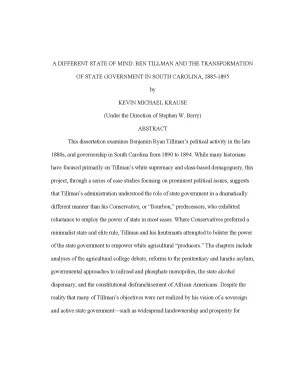
Tải xuống để đọc toàn bộA DIFFERENT STATE OF MIND: BEN TILLMAN AND THE TRANSFORMATION OF STATE GOVERNMENT IN SOUTH CAROLINA, 1885-1895 by KEVIN MICHAEL KRAUSE (Under the Direction of Stephen W. Berry) ABSTRACT This dissertation examines Benjamin Ryan Tillman’s political activity in the late 1880s, and governorship in South Carolina from 1890 to 1894. While many historians have focused primarily on Tillman’s white supremacy and class-based demagoguery, this project, through a series of case studies focusing on prominent political issues, suggests that Tillman’s administration understood the role of state government in a dramatically different manner than his Conservative, or “Bourbon,” predecessors, who exhibited reluctance to employ the power of state in most cases. Where Conservatives preferred a minimalist state and elite rule, Tillman and his lieutenants attempted to bolster the power of the state government to empower white agricultural “producers.” The chapters include analyses of the agricultural college debate, reforms to the penitentiary and lunatic asylum, governmental approaches to railroad and phosphate monopolies, the state alcohol dispensary, and the constitutional disfranchisement of African Americans.
Despite the reality that many of Tillman’s objectives were not realized by his vision of a sovereign and active state government—such as widespread landownership and prosperity for white, small farmers—his overall philosophy of the active and energetic state, which was in line with many Progressive-era conceptions of government, is worth taking seriously. INDEX WORDS: Benjamin Ryan Tillman, South Carolina, Disfranchisement, Prohibition, Dispensary, Railroad Regulation, Monopoly, State Government, Conservative, Wade Hampton, Phosphate, Southern Race Relations, Producerism, Reform, Clemson College, Agriculture A DIFFERENT STATE OF MIND: BEN TILLMAN AND THE TRANSFORMATION OF STATE GOVERNMENT IN SOUTH CAROLINA, 1885-1895 by KEVIN MICHAEL KRAUSE BA, University of South Carolina Upstate, 2006 MA, Clemson University, 2008 A Dissertation Submitted to the Graduate Faculty of The University of Georgia in Partial Fulfillment of the Requirements for the Degree DOCTOR OF PHILOSOPHY ATHENS, GEORGIA 2014 © 2014 Kevin Michael Krause All Rights Reserved A DIFFERENT STATE OF MIND: BEN TILLMAN AND THE TRANSFORMATION OF STATE GOVERNMENT IN SOUTH CAROLINA, 1885-1895 by KEVIN MICHAEL KRAUSE Major Professor: Stephen W. Berry Committee: John C. Cobb Rod Andrew, Jr.
Electronic Version Approved: Julie Coffield Interim Dean of the Graduate School The University of Georgia December 2014 iv DEDICATION I dedicate this dissertation to my parents, Maxie and Linda Krause. I would have never reached this point without their tireless support. Their love is unconditional and unwavering, and I am blessed to be their son. It was, however, not simply abstract love that helped me; it was also their tireless efforts of driving me to school and research facilities, making copies, taking pictures of dusty documents and books, and simply waiting on me for countless hours.
I hope they know that my love for them, and appreciation of them, is inexpressible. Secondly, I must also dedicate this in part to Dr. Rob McCormick, my first history professor at the University of South Carolina Upstate. I enrolled in his class only to fill a requirement, but his passion for teaching history inspired me and set me on the path to becoming a scholar and teacher.
Without knowing, he essentially helped me find direction and purpose at the time that I needed it most. He has since become a mentor and a wonderful friend to my family and me. v ACKNOWLEDGEMENTS Anyone who has ever taken on a project of this magnitude understands that one person does not accomplish it alone. At least, for us mere mortals, throughout the process of questioning, researching, and writing, we repeatedly find that our work improves substantially when we benefit from the invaluable experience and guidance of those who have trod the path before.
Therefore, I would like to thank Dr. Stephen Berry, my major professor (and valued friend) who has guided me through each step, from conceiving the embryonic idea, to forming and honing this final product. He continually challenged me to avoid complacency, to ask more probing questions, and to seek truth more deeply. The other members of my committee have also provided crucial help, counsel, constructive criticism, and friendship.
Rod Andrew, in addition to providing keen insight into South Carolina society and politics, was a great help in developing my Master’s thesis and applying for the Ph. program at the University of Georgia. James Cobb has, more than any professor I have ever worked with, forced me to become a more rigorous and careful writer. Earlier in my career as a graduate student, I found it difficult to accept criticism of my work, but Dr.
Cobb’s frank assessment of problematic issues has helped, I believe, to improve my research and writing skills immeasurably. John Inscoe has encouraged and supported me since my first visit to the department in 2009. I have benefited from his knowledge and scholarly guidance, and like Dr. Cobb, he has helped improve my writing as well.
It is, however, his character that has benefited me more than anything. His kindness, optimism, and genuine concern vi for the well-being of others has made a lasting impression on me, and many other students, I am sure. He and his wife have become cherished friends of my family, and we appreciate their friendship immensely. vii TABLE OF CONTENTS Page ACKNOWLEDGEMENTS.
1 CHAPTER 1 A GLASS FULL OF “BOURBON”: CONSERVATIVE RULE. 17 2 SCHOOL DAYS: OPPOSING CONCEPTIONS OF STATE COLLEGES. 54 3 WITHIN THESE WALLS: THE LUNATIC ASYLUM AND PENITENTIARY. 101 4 DOWN BY THE COOSAW: THE PHOSPHATE INDUSTRY AND MONOPOLY.
133 5 RIDING RAILS: CONSERVATIVES AND REFORMERS ON RAILROADS AND THE STATE. 172 6 RUM DEMONS AND WHISKEY RINGS: PROHIBITION TO THE STATE DISPENSARY. 206 7 WHITE MEN, BLACK LAWS: A WHITE SUPREMACIST STATE. 293 INTRODUCTION On a sweltering afternoon in the middle of August, 1892, a farmer from the upcountry of South Carolina hitched up his team of mules and drove a wagon full of produce to the nearest store in Clifton, a tiny, rural town eight miles east of the larger railroad junction of Spartanburg.
Upon reaching the country store, the farmer—a white man, most likely of modest means—remained perched on the driver’s seat and yelled towards the store. He wanted to know if the storekeeper was interested in purchasing his wagonload of melons. The proprietor stepped out the front door, briefly perused the contents of the wagon, looked at the farmer and asked, “What sort of melons have you?” The farmer, perplexed because the melons were in plain sight, answered that of course they were watermelons. Then the storeowner sternly replied, “I don’t mean that.
Are they Tillman melons?” The farmer then clearly understood the implications of the merchant’s question, but insisted that, “they [the melons] have nothing to do with that question,” and then honestly added, “but I’m not a Tillman man.” The storeowner eyed the farmer sternly; his curt reply was: “Drive on. We don’t want you, nor your melons.”1 The brief encounter described above is illustrative of the caustic sociopolitical polarization that consumed South Carolina in the 1880s and 1890s, as white citizens squared off against each other in political camps with seemingly zero chance of compromise or reconciliation. From a national perspective, since the end of Reconstruction—and the end of so-called “Negro domination”—the Palmetto State had 1This story is recounted in “Outcome of Tillmanism,” Anderson Intelligencer, August 17, 1892. 2 been a solid one-party bastion, Democratic and devoted to a paternalistic, yet unquestionable white supremacy.
By 1890, however, Benjamin Ryan Tillman’s ascendency to the governor’s chair had sundered the fragile bonds that had held together whites of disparate economic interests and classes. With little exception, South Carolinians were either “Tillmanites” or “Anti-Tillmanites”—also known respectively as Reformers or Conservatives. Evidently, so entrenched was the dichotomy that even watermelons were not immune from inheriting the stigma of their producer’s politics. “Pitchfork” Ben Tillman launched his political career in 1885 by verbally assaulting those wealthy and influential businessmen, lowcountry planters, and effete “dandies” that he insisted bent the state government against the interest of “simon-pure” farmers.
According to Tillman, Conservative leaders—elites who succeeded former Confederate general and governor, Wade Hampton, after “Redemption” in 1876—had encouraged corporate greed and kept a stranglehold on political offices for their own benefit, all at the expense of common farmers. Despite the fact that Tillman was a wealthy owner of more acreage than most farmers could ever dream of, and that his closest advisors were often businessmen and lawyers, his greatest electoral support came from the economically burdened white farmers of the upcountry. Throughout the late 1880s and 1890s, small farmers across the region struggled with scarce credit, falling crop prices, rising shipping rates, and periodic droughts and infestations. Accordingly, many latched on to the Tillman train, possibly because he focused the blame for their situation on someone other than themselves.2 2 For description of Ben Tillman and his administration, see Francis Butler Simkins, Pitchfork Ben Tillman: South Carolinian with a new Introduction by Orville Vernon Burton (Columbia, SC: University of South Carolina Press, 2002), original text 1944, Louisiana State University Press; Stephen Kantrowitz, Ben Tillman and the Reconstruction of White Supremacy (Chapel Hill: University of North Carolina Press, 3 Many farmers across the South and West sought to alleviate these strains through economic cooperation, and then through political activity.
In South Carolina, Tillman effectively co-opted the agricultural reform momentum—embodied in the Farmers’ Alliance and Populist Party—sweeping other southern and western states. Instead of flocking to the ranks of the Populists, the overwhelming majority of white farmers in South Carolina rested their hopes not on a third party, but on Tillman and his “Reform” Democrats. Conservative critics lamented Tillman’s exploitation of class divisions within white society. An Anderson newspaper editor bemoaned3: Factory hands are taught to distrust their employers; that they are dishonest, oppressive, cruel, tyrannical.
Laborers are taught that employers will cheat and defraud them. Country people are taught that their greatest enemies are town people, whether they live in a large or a small town. It is a fearful campaign of education, and it will require years of patient and conservative work to efface the evil that is being accomplished.4 Many of Tillman’s political foes considered him little more than a demagogue, and modern scholars generally agree that he was a fanatical racist, lower-class agitator, and political opportunist—one whose only effective “reform” was entrenching white supremacy in South Carolina for the better part of the twentieth century. To a great degree, these assessments are valid.
Tillman earned those labels through his violent rhetoric and tireless efforts to disfranchise African Americans. He also called for reforms 2000); Stephen Kantrowitz, “Ben Tillman and Hendrix McLane, Agrarian Rebels: White Manhood, “The Farmers,” and the Limits of Southern Populism,” The Journal of Southern History 66:3 (2000); Walter Edgar, South Carolina: A History, (Columbia, SC: University of South Carolina Press, 1998) 430-452; William J. Cooper, The Conservative Regime, South Carolina, 1887-1890 (Baltimore, MD: The Johns Hopkins Press, 1968), David Duncan Wallace, The History of South Carolina (New York: American Historical Society, Inc.,1934), Volume 3; William Watts Ball, The State that Forgot: South Carolina’s Surrender to Democracy (Indianapolis: The Bobbs-Merrill Company, 1932). 3 For detailed examinations of Populism and the Farmer’s Alliance see: John D.
Hicks, The Populist Revolt: A History of the Farmers’ Alliance and the People’s Party (Minneapolis: The University of Minnesota Press, 1931); Lawrence Goodwyn, The Populist Moment: A Short History of the Agrarian Revolt in America (New York: Oxford University Press, 1978); Robert C. McMath, Populist Vanguard: A History of the Southern Farmer’s Alliance (Chapel Hill: University of North Carolina Press, 1975); Charles Postel, The Populist Vision (New York: Oxford University Press, 2009). 4 Anderson Intelligencer, August 17, 1892 4 that many of his contemporaries and modern historians have deemed insufficient to meet the needs of the farmers he supposedly represented.
Nội dung được bảo vệ bản quyền — Tải xuống đầy đủ
Trích dẫn luận án này
Kevin Michael Krause (2014). Krause kevin m 201412 phd [Luận án tiến sĩ, The University of Georgia]. LuanAn.net. https://luanan.net/ly-luan-va-lich-su-giao-duc/triet-hoc-giao-duc/krause-kevin-m-2014-benjamin-ryan-tillman
Câu hỏi thường gặp
Luận án "Krause kevin m 201412 phd" nghiên cứu về vấn đề gì?
Luận án: Krause kevin m 201412 phd. Xem tóm tắt và tải về tại LuanAn.net
Luận án "Krause kevin m 201412 phd" được bảo vệ tại trường nào?
Luận án này được bảo vệ tại The University of Georgia. Năm bảo vệ: 2014.
Luận án "Krause kevin m 201412 phd" thuộc chuyên ngành gì?
Luận án "Krause kevin m 201412 phd" thuộc chuyên ngành History. Danh mục: Triết Học Giáo Dục.
Luận án "Krause kevin m 201412 phd" có bao nhiêu trang?
Luận án "Krause kevin m 201412 phd" có 318 trang. Bạn có thể xem trước một phần tài liệu ngay trên trang web trước khi tải về.
Cách tải luận án "Krause kevin m 201412 phd" về máy như thế nào?
Để tải luận án về máy, bạn nhấn nút "Tải xuống ngay" trên trang này, sau đó hoàn tất thanh toán phí lưu trữ. File sẽ được tải xuống ngay sau khi thanh toán thành công. Hỗ trợ qua Zalo: 0559 297 239.