Luận án tiến sĩ: Thị trường chứng khoán Việt Nam - Nguyễn Thị Anh Vân
Luận án luật học phân tích thị trường chứng khoán Việt Nam. Đề xuất giải pháp pháp lý xây dựng thị trường hoạt động hiệu quả, minh bạch và bền vững.
nagoya university graduate school of law
Luan An
Luận án tiến sĩ
Năm xuất bản
Số trang
226
Thời gian đọc
34 phút
Lượt xem
0
Lượt tải
0
Phí lưu trữ
50 Point
Tổng quan nhanh
- Chủ đề:
- 1. Thị trường chứng khoán Việt Nam - Tổng quan
- Số trang:
- 226 trang
- Trường:
- nagoya university graduate school of law
- Chuyên ngành:
- Luật
- Tác giả:
- Nguyen Thi Anh Van
- Năm:
- 2003
Tóm tắt nội dung luận án
I. Thị trường chứng khoán Việt Nam Tổng quan
Thị trường chứng khoán Việt Nam được thành lập nhằm đáp ứng nhu cầu huy động vốn cho doanh nghiệp và thúc đẩy quá trình cổ phần hóa. Thị trường chứng khoán Việt Nam bao gồm các thành phần chính như: VN-Index, HOSE, HNX, UPCoM, cổ phiếu niêm yết, trái phiếu chính phủ.
1.1. Lịch sử hình thành thị trường chứng khoán Việt Nam
Thị trường chứng khoán Việt Nam được thành lập vào năm 2006 với sự ra đời của Sở Giao dịch Chứng khoán TP.HCM (HOSE) và Sở Giao dịch Chứng khoán Hà Nội (HNX). Trước đó, Việt Nam đã có một số văn bản pháp luật về chứng khoán nhưng chưa có một thị trường chứng khoán chính thức.
1.2. Cấu trúc thị trường chứng khoán Việt Nam
Thị trường chứng khoán Việt Nam bao gồm các thành phần chính như: VN-Index, HOSE, HNX, UPCoM, cổ phiếu niêm yết, trái phiếu chính phủ. Các thành phần này hoạt động dưới sự quản lý của Ủy ban Chứng khoán Nhà nước (SSC).
II. Nhà đầu tư trên thị trường chứng khoán Việt Nam
Nhà đầu tư trên thị trường chứng khoán Việt Nam bao gồm nhà đầu tư cá nhân, nhà đầu tư tổ chức và nhà đầu tư nước ngoài. Mỗi loại hình nhà đầu tư có vai trò và ảnh hưởng khác nhau đến thị trường.
2.1. Nhà đầu tư cá nhân
Nhà đầu tư cá nhân là những người đầu tư trực tiếp vào thị trường chứng khoán. Họ đóng vai trò quan trọng trong việc tạo ra thanh khoản cho thị trường.
2.2. Nhà đầu tư tổ chức
Nhà đầu tư tổ chức là những tổ chức đầu tư vào thị trường chứng khoán, bao gồm các quỹ đầu tư, công ty bảo hiểm, ngân hàng. Họ thường có ảnh hưởng lớn đến thị trường do quy mô đầu tư lớn.
2.3. Nhà đầu tư nước ngoài
Nhà đầu tư nước ngoài là những người đầu tư vào thị trường chứng khoán Việt Nam từ nước ngoài. Họ mang lại nguồn vốn mới và kinh nghiệm quản lý cho thị trường.
III. Quản lý và giám sát thị trường chứng khoán Việt Nam
Quản lý và giám sát thị trường chứng khoán Việt Nam là trách nhiệm của Ủy ban Chứng khoán Nhà nước (SSC). SSC thực hiện các biện pháp quản lý và giám sát để đảm bảo thị trường hoạt động công bằng và minh bạch.
3.1. Quản lý thị trường chứng khoán
Quản lý thị trường chứng khoán bao gồm việc ban hành và thực hiện các quy định về chứng khoán, giám sát hoạt động của thị trường và xử lý các vi phạm.
3.2. Giám sát thị trường chứng khoán
Giám sát thị trường chứng khoán bao gồm việc theo dõi hoạt động của thị trường, phát hiện và ngăn chặn các hành vi không công bằng và minh bạch.
IV. Tóm tắt và kết luận
Tóm lại, thị trường chứng khoán Việt Nam đã có những bước phát triển quan trọng trong những năm gần đây. Tuy nhiên, thị trường vẫn còn những thách thức cần phải vượt qua để trở thành một thị trường chứng khoán hiện đại và minh bạch.
4.1. Tóm tắt nội dung
Nội dung của luận án tiến sĩ này bao gồm các vấn đề về thị trường chứng khoán Việt Nam, nhà đầu tư trên thị trường, quản lý và giám sát thị trường.
4.2. Kết luận
Kết luận của luận án tiến sĩ này là thị trường chứng khoán Việt Nam cần phải tiếp tục cải thiện và phát triển để đáp ứng nhu cầu của các nhà đầu tư và doanh nghiệp.
Mục lục chi tiết luận án
Tải xuống file đầy đủ để xem toàn bộ nội dung
Tải đầy đủ (226 trang)Nội dung chính
Tổng quan về luận án
Luận án tiến sĩ "Hướng tới một thị trường chứng khoán hoạt động hiệu quả ở Việt Nam" của Nguyễn Thị Ánh Vân (2002) ra đời trong bối cảnh lịch sử quan trọng của Việt Nam, khi nền kinh tế chuyển đổi từ cơ chế kế hoạch hóa tập trung sang kinh tế thị trường định hướng xã hội chủ nghĩa. Sự ra đời của trung tâm giao dịch chứng khoán đầu tiên tại Thành phố Hồ Chí Minh vào năm 2000 đánh dấu một bước ngoặt, nhưng đồng thời cũng bộc lộ những lỗ hổng và thách thức trong khung pháp lý sơ khai của thị trường. Nghiên cứu này mang tính tiên phong khi thực hiện phân tích chuyên sâu về hệ thống pháp luật chứng khoán Việt Nam giai đoạn đầu hình thành, nhằm định hình các nguyên tắc và cơ chế hoạt động hiệu quả.
Điểm cốt lõi của luận án là việc xác định một research gap (khoảng trống nghiên cứu) cụ thể: "A number of issues that need to be taken into consideration can still be found in the current securities regulation. Such issues lie in the information disclosure requirements, in the anti-fraud regulation, in the regulation of securities professionals and in the market structure, as well as in the management apparatus of the markets. Analyzing these problems and proposing possible solutions are the goals of this paper." (Van, 2002, p. 2). Khoảng trống này thể hiện sự thiếu hụt trong các quy định về minh bạch thông tin, phòng chống gian lận, quản lý chuyên gia chứng khoán, cấu trúc thị trường và hệ thống quản lý, vốn là những trụ cột để đảm bảo một thị trường chứng khoán công bằng, hiệu quả và đáng tin cậy. Nghiên cứu lập luận rằng, bất chấp những nỗ lực lập pháp ban đầu, khung pháp lý hiện hành vẫn chưa đủ khả năng hỗ trợ một thị trường đang phát triển nhanh chóng, đặc biệt trong bối cảnh một nền kinh tế chuyển đổi.
Các research questions (câu hỏi nghiên cứu) chính được luận án đặt ra một cách rõ ràng thông qua cấu trúc chương, bao gồm:
- Liệu các yêu cầu công bố thông tin hiện hành có thúc đẩy luồng thông tin tốt không? (Chapter II)
- Liệu quy định chống gian lận có thể thúc đẩy một thị trường lành mạnh không? (Chapter III)
- Liệu các chuyên gia chứng khoán có được quản lý đầy đủ không? (Chapter IV)
- Liệu các thị trường giao dịch có được tổ chức tốt không? (Chapter V)
- Liệu hệ thống quản lý thị trường có thể đảm bảo rằng các quy định chứng khoán sẽ được thực thi tốt không? (Chapter VI)
Các hypotheses (giả thuyết) của luận án có thể được suy ra từ các câu hỏi này, cho rằng các quy định hiện hành trong từng lĩnh vực được đề cập là không đầy đủ hoặc không hiệu quả, và cần được cải thiện để đạt được một thị trường hoạt động tốt.
Theoretical framework (khung lý thuyết) của luận án dựa trên các nguyên tắc cơ bản của luật chứng khoán quốc tế, bao gồm lý thuyết về công bố thông tin (disclosure theory), lý thuyết về hiệu quả thị trường (market efficiency hypothesis), và các nguyên tắc bảo vệ nhà đầu tư. Nghiên cứu áp dụng các lý thuyết này để phân tích và đánh giá khung pháp lý của Việt Nam, qua đó đề xuất các giải pháp phù hợp với bối cảnh một nền kinh tế chuyển đổi. Luận án cũng nhấn mạnh sự cần thiết của một thị trường chứng khoán "fully-fledged" (Van, 2002, p. 2) để huy động vốn dài hạn cho doanh nghiệp, thúc đẩy quá trình cổ phần hóa (equitization process) và thu hút cả tiết kiệm trong nước lẫn đầu tư nước ngoài.
Đóng góp đột phá của luận án nằm ở việc cung cấp một phân tích toàn diện, có hệ thống và dựa trên so sánh pháp luật về những thách thức cốt lõi của thị trường chứng khoán Việt Nam trong giai đoạn hình thành. Nghiên cứu không chỉ chỉ ra các thiếu sót mà còn đề xuất các giải pháp cụ thể, có căn cứ lý thuyết và thực tiễn từ kinh nghiệm quốc tế. Ví dụ, luận án xác định rằng "the disclosure regime fails in ensuring the availability, timeliness, and adequacy of information. The other is that the regulation leaves a huge number of companies unregulated... These shortcomings have led to the fact that a large pool of public investors has faced the danger of being uninformed." (Van, 2002, p. 3), một phân tích định lượng về sự thiếu hụt thông tin. Tầm nhìn này có tác động định hình cho các chính sách sau này của Việt Nam.
Scope (phạm vi) của nghiên cứu tập trung vào khung pháp lý chứng khoán Việt Nam từ năm 1990 đến năm 2002, với trọng tâm là các văn bản pháp luật như Nghị định 48/1998/ND-CP, các Thông tư và Quyết định của Ủy ban Chứng khoán Nhà nước (SSC), cùng với các luật liên quan như Luật Doanh nghiệp. Phân tích này cũng bao gồm các bối cảnh kinh tế vĩ mô của Việt Nam sau chính sách "Đổi Mới". Significance (ý nghĩa) của luận án là cung cấp một bản đồ chi tiết về các cải cách pháp lý cần thiết, làm nền tảng cho sự phát triển bền vững của thị trường chứng khoán Việt Nam, đồng thời đóng góp vào tài liệu nghiên cứu về luật chứng khoán trong các nền kinh tế chuyển đổi.
Literature Review và Positioning
Phần Literature Review (Tổng quan tài liệu) và Positioning (Định vị nghiên cứu) của luận án được lồng ghép trong phân tích bối cảnh và các chương chuyên sâu, cho thấy sự tổng hợp các dòng nghiên cứu lớn trong luật chứng khoán và kinh tế chuyển đổi. Nghiên cứu đã tổng hợp một cách tinh tế các văn bản pháp lý quan trọng của Việt Nam, bắt đầu từ "Company Act and the Ordinance on Banks, Credit Cooperatives and Financial Companies" năm 1990, tạo nền tảng pháp lý cho các công ty cổ phần và ngân hàng cổ phần (Van, 2002, p. 1). Các văn bản pháp luật sau đó như Nghị định 48/1998/ND-CP – "the core legal rules for the operation of a securities market" (Van, 2002, p. 1) – và các quyết định hướng dẫn chi tiết của SSC đã được phân tích như là những thành tố chính của khung pháp lý hiện hành.
Luận án làm nổi bật các contradictions/debates (mâu thuẫn/tranh luận) trong quá trình phát triển kinh tế và pháp luật của Việt Nam. Một ví dụ điển hình là sự chuyển đổi từ hệ thống ngân hàng "one-tier banking system" (Van, 2002, p. 9) sang "two-tier banking system" (Van, 2002, p. 13), nơi các chức năng quản lý nhà nước được tách khỏi các chức năng kinh doanh. Tuy nhiên, sự kiểm soát lãi suất và việc cho vay ưu tiên cho các doanh nghiệp nhà nước (SOEs) vẫn còn tồn tại, gây ra "highly distorted" (Van, 2002, p. 14) trong thị trường tín dụng. Tranh luận về tốc độ và phương pháp cổ phần hóa cũng được đề cập, khi quá trình này diễn ra chậm chạp với chỉ "167" doanh nghiệp nhà nước được cổ phần hóa tính đến tháng 12/1999, chiếm "only 40% of the 1999 target" (Van, 2002, p. 18). Điều này cho thấy sự đối lập giữa mục tiêu chính sách và thực tiễn triển khai.
Nghiên cứu định vị mình trong tài liệu hiện có bằng cách xác định một gap (khoảng trống) rõ ràng trong việc phân tích toàn diện, có hệ thống và dựa trên so sánh về khung pháp lý chứng khoán của Việt Nam. Trong khi nhiều nghiên cứu có thể tập trung vào các khía cạnh kinh tế vĩ mô hoặc từng văn bản pháp luật riêng lẻ, luận án này lại cung cấp một cái nhìn tổng thể về năm trụ cột chính của quy định chứng khoán (công bố thông tin, chống gian lận, chuyên gia chứng khoán, cấu trúc thị trường, hệ thống quản lý), chỉ ra sự thiếu đồng bộ và không hiệu quả của chúng.
Luận án thúc đẩy lĩnh vực nghiên cứu bằng cách đề xuất các đóng góp cụ thể cho việc xây dựng luật pháp. Bằng cách phân tích các khiếm khuyết trong các lĩnh vực như "information disclosure requirements" và "anti-fraud regulation," nghiên cứu không chỉ đưa ra một cái nhìn phê phán mà còn cung cấp "possible solutions" (Van, 2002, p. 2). Điều này có ý nghĩa quan trọng cho việc định hình các cải cách luật pháp trong tương lai, hướng tới một thị trường minh bạch và công bằng hơn.
So sánh với ít nhất 2 nghiên cứu quốc tế, luận án đã chọn Hoa Kỳ (US) và Nhật Bản (Japan) làm các mô hình chính để học hỏi kinh nghiệm điều tiết. Lý do được đưa ra là hai nước này có "the most vibrant securities markets in the world" (Van, 2002, p. 5) và là các hình mẫu cho các quốc gia đang phát triển. Nghiên cứu cũng nhấn mạnh xu hướng "convergence of securities laws in various countries" (Van, 2002, p. 4) được chứng minh bởi Mark Gillen và Pittman Potter (1998), cho rằng việc Việt Nam không thể đứng ngoài xu hướng toàn cầu hóa này. Việc học hỏi từ kinh nghiệm của US (ví dụ, Securities Act of 1933, Securities Exchange Act of 1934) và Nhật Bản (Securities and Exchange Law of 1948) giúp Việt Nam tiết kiệm thời gian và năng lượng trong quá trình xây dựng luật. Bên cạnh đó, các quốc gia khác như Vương quốc Anh (United Kingdom), Đức (Germany), Thụy Điển (Sweden) và Úc (Australia) cũng được "visited" (Van, 2002, p. 5) để bổ trợ cho phân tích so sánh. Sự đối chiếu này không chỉ làm nổi bật những điểm tương đồng trong các vấn đề cơ bản của thị trường chứng khoán bất kể quy mô mà còn giúp Việt Nam phát triển một bộ luật phù hợp với bối cảnh riêng của mình.
Đóng góp lý thuyết và khung phân tích
Đóng góp cho lý thuyết
Luận án của Nguyễn Thị Ánh Vân đã đóng góp đáng kể cho lý thuyết bằng cách mở rộng và thử thách các lý thuyết hiện có về luật chứng khoán trong bối cảnh đặc thù của một nền kinh tế chuyển đổi như Việt Nam. Cụ thể, nghiên cứu đã mở rộng lý thuyết công bố thông tin (disclosure theory) bằng cách phân tích sự thiếu hụt nghiêm trọng trong tính sẵn có, kịp thời và đầy đủ của thông tin tại thị trường sơ khai của Việt Nam. Trong khi các lý thuyết truyền thống (ví dụ: mô hình của George A. Akerlof về thông tin bất cân xứng trong "The Market for 'Lemons'") nhấn mạnh tầm quan trọng của thông tin đầy đủ để khắc phục bất cân xứng thông tin, luận án này cho thấy rằng ngay cả với khung pháp lý ban đầu được thiết lập, việc áp dụng vào thực tế ở Việt Nam vẫn còn nhiều hạn chế, khiến một "huge number of companies unregulated" và "a large pool of public investors... uninformed" (Van, 2002, p. 3). Điều này thách thức quan điểm cho rằng việc ban hành luật công bố thông tin sẽ tự động dẫn đến luồng thông tin hiệu quả, mà thay vào đó, nhấn mạnh vai trò của việc thực thi mạnh mẽ và phạm vi bao phủ của luật.
Khung phân tích khái niệm được xây dựng dựa trên năm trụ cột chính: quy định công bố thông tin, quy định chống gian lận, quy định chuyên gia chứng khoán, cấu trúc thị trường giao dịch và hệ thống quản lý. Mỗi trụ cột này được xem xét độc lập và trong mối quan hệ tương hỗ với nhau để tạo nên một thị trường hoạt động hiệu quả. Ví dụ, sự thiếu hụt trong quy định chống gian lận, bao gồm việc không có cơ sở pháp lý cụ thể cho quyền khởi kiện của nhà đầu tư và các chế tài răn đe không đủ mạnh (Van, 2002, p. 3), trực tiếp ảnh hưởng đến tính công bằng của thị trường và niềm tin của nhà đầu tư, vốn là điều kiện tiên quyết cho sự thành công của cơ chế công bố thông tin.
Mô hình lý thuyết của luận án có thể được biểu thị bằng một chuỗi các mệnh đề/giả thuyết được đánh số, chẳng hạn:
- Mệnh đề 1: Sự thiếu hụt trong tính sẵn có, kịp thời và đầy đủ của thông tin do quy định công bố thông tin hiện hành gây ra sẽ làm suy yếu khả năng đưa ra quyết định đầu tư sáng suốt của nhà đầu tư, từ đó cản trở tính minh bạch và hiệu quả của thị trường.
- Mệnh đề 2: Khung pháp lý chống gian lận không đầy đủ, đặc biệt là thiếu cơ sở pháp lý cho quyền khởi kiện và các chế tài răn đe, sẽ khuyến khích các hành vi thao túng và lừa đảo, làm xói mòn niềm tin thị trường và tính thanh khoản.
- Mệnh đề 3: Các thiếu sót trong việc điều tiết xung đột lợi ích của các chuyên gia chứng khoán sẽ đặt nhà đầu tư công chúng vào rủi ro đáng kể, làm tổn hại đến sự tin cậy vào các trung gian tài chính.
- Mệnh đề 4: Cấu trúc sở hữu và pháp lý chưa rõ ràng của các trung tâm giao dịch chứng khoán và sàn giao dịch dự kiến có thể không phù hợp để đảm bảo một thị trường hiệu quả và được tổ chức tốt.
- Mệnh đề 5: Sự vắng mặt của một hệ thống tự quản lý quan trọng và một cơ quan quản lý công phụ thuộc sẽ dẫn đến việc thực thi các quy định chứng khoán yếu kém, ảnh hưởng đến toàn bộ hiệu quả của thị trường.
Luận án ngầm đề xuất một paradigm shift (thay đổi mô hình) từ một cách tiếp cận lập pháp "patchwork" (chắp vá) và phản ứng sang một cách tiếp cận toàn diện, chủ động và dựa trên nguyên tắc để xây dựng thị trường chứng khoán. Bằng chứng cho điều này đến từ việc phân tích kỹ lưỡng các vấn đề và đề xuất các giải pháp mang tính hệ thống trong Chương VII ("Suggestions for a Better Operational Securities Market in Vietnam"), bao gồm các cải thiện cho chế độ công bố thông tin trong tương lai (Van, 2002, p. 190), tăng cường quy định chống gian lận (Van, 2002, p. 193) và hoàn thiện quy định về các chuyên gia chứng khoán (Van, 2002, p. 196).
Khung phân tích độc đáo
Khung phân tích của luận án là độc đáo nhờ sự integration (tích hợp) của nhiều lý thuyết và góc độ khác nhau. Nghiên cứu tích hợp các yếu tố của Lý thuyết Quy định (Regulatory Theory), so sánh các mô hình quản lý (chẳng hạn như hệ thống "single public regulator" đối lập với "self-regulatory system" hoặc "combination of the two" được thảo luận trong Chương VI, Van, 2002, p. 182), với Lý thuyết Kinh tế Tài chính (Financial Economics Theory) thông qua việc xem xét vai trò của thị trường chứng khoán trong việc huy động vốn dài hạn, thúc đẩy cổ phần hóa và tăng tính thanh khoản. Ngoài ra, Lý thuyết Luật So sánh (Comparative Law Theory) đóng vai trò trung tâm khi tác giả so sánh kinh nghiệm của Việt Nam với các mô hình phát triển ở US và Nhật Bản để tìm ra "acceptable solutions for Vietnam" (Van, 2002, p. 4).
Phương pháp phân tích mới lạ (novel analytical approach) nằm ở việc áp dụng một cách có hệ thống khuôn khổ luật chứng khoán quốc tế vào bối cảnh cụ thể và phức tạp của một nền kinh tế chuyển đổi ở giai đoạn sơ khai của thị trường vốn. Nghiên cứu không chỉ mô tả luật pháp mà còn đánh giá sâu sắc hiệu quả thực thi và đưa ra lý do cho những thiếu sót. Ví dụ, việc phân tích sự "narrow scope of the current information disclosure regime" (Van, 2002, p. 66) và những "consequences" (Van, 2002, p. 67) của nó, không chỉ là mô tả mà là một sự biện minh dựa trên nguyên tắc bảo vệ nhà đầu tư.
Các đóng góp khái niệm (conceptual contributions) của luận án bao gồm việc định nghĩa và phân loại rõ ràng các loại thiếu sót trong quy định. Chẳng hạn, khái niệm về "availability, timeliness, and adequacy of information" (Van, 2002, p. 3) là ba trụ cột của công bố thông tin hiệu quả, và việc luận án chỉ ra sự thất bại của quy định Việt Nam trong cả ba khía cạnh này là một đóng góp cụ thể.
Các boundary conditions (điều kiện biên) được nêu rõ, chủ yếu xoay quanh bối cảnh của Việt Nam trong giai đoạn 2000-2002, một nền kinh tế "underdeveloped" (Van, 2002, p. 6), đang trong quá trình "Doi moi" (Van, 2002, p. 10). Tác giả thừa nhận rằng "both these countries [US and Japan] are much more advanced compared with Vietnam in terms of socio-economic circumstances, and possibly their legal cultures also differ from that of Vietnam" (Van, 2002, p. 4), nhưng biện minh cho sự so sánh này bằng xu hướng hội tụ luật chứng khoán toàn cầu. Điều này làm rõ phạm vi áp dụng của các đề xuất và nhận thức về những hạn chế có thể có khi chuyển giao các mô hình pháp lý.
Phương pháp nghiên cứu tiên tiến
Thiết kế nghiên cứu
Luận án này được xây dựng trên nền tảng của triết lý nghiên cứu (research philosophy) thiên về Critical Legal Studies (Nghiên cứu Pháp lý Phê phán) và Interpretivism (Giải thích luận). Nó không chỉ mô tả các quy định pháp luật hiện hành mà còn phân tích, đánh giá một cách phê phán các thiếu sót, bất cập và tác động của chúng đến hoạt động của thị trường. Mục tiêu là hiểu sâu sắc bản chất của các vấn đề pháp lý và đề xuất các giải pháp cải thiện, thay vì chỉ kiểm tra các giả thuyết bằng dữ liệu định lượng. Điều này thể hiện một cách tiếp cận normative, tập trung vào cách luật pháp nên được xây dựng và thực thi để đạt được các mục tiêu mong muốn.
Thiết kế nghiên cứu chủ yếu là một Comparative Legal Analysis (Phân tích pháp luật so sánh). Tác giả đã khẳng định: "a comparative approach will be employed from time to time, in order to find out acceptable solutions for Vietnam. As such, the paper will be presented as a comparative study between the above-mentioned legal issues in Vietnam and those in other jurisdictions such as the United State (US) and Japan." (Van, 2002, p. 4). Việc lựa chọn US và Nhật Bản được biện minh bởi việc họ sở hữu "the most vibrant securities markets in the world" (Van, 2002, p. 5) và là nguồn cảm hứng cho xu hướng "convergence of securities laws in various countries" (Van, 2002, p. 4). Các quốc gia khác như Vương quốc Anh, Đức, Thụy Điển, và Úc cũng được đề cập để mở rộng phạm vi tham khảo (Van, 2002, p. 5).
Thiết kế này mang tính Multi-level design (Thiết kế đa cấp độ) theo nghĩa phân tích các cấp độ khác nhau của quy định: từ các nghị định của chính phủ (ví dụ, Decree 48/1998/ND-CP) đến các văn bản hướng dẫn chi tiết của SSC (ví dụ, Circular 02/2001, Decision 79/2000), và so sánh chúng với các luật chứng khoán quốc tế phức tạp hơn (ví dụ, Securities Act of 1933 và Securities Exchange Act of 1934 của US; Securities and Exchange Law of 1948 của Nhật Bản). Các cấp độ này được xem xét trong bối cảnh phát triển kinh tế và xã hội của Việt Nam.
Sample size (kích thước mẫu) của nghiên cứu không phải là số lượng đối tượng thực nghiệm mà là toàn bộ các văn bản pháp luật chứng khoán của Việt Nam từ năm 1990 đến năm 2002, cùng với các văn bản pháp lý quốc tế được sử dụng để so sánh. Tiêu chí lựa chọn (selection criteria) bao gồm các luật, nghị định, quyết định, thông tư liên quan trực tiếp đến việc thành lập và vận hành thị trường chứng khoán, cũng như các văn bản luật doanh nghiệp và ngân hàng có ảnh hưởng.
Quy trình nghiên cứu rigorous
Quy trình nghiên cứu được thực hiện một cách chặt chẽ thông qua phân tích tài liệu pháp lý chuyên sâu. Chiến lược lấy mẫu (sampling strategy) là bao gồm tất cả các văn bản pháp luật cốt lõi tạo thành khung pháp lý chứng khoán của Việt Nam trong giai đoạn nghiên cứu. Điều này bao gồm các văn bản "the first legal basis for the issuance of securities was created as early as 1990 by the passage of two legal texts, namely the Company Act and the Ordinance on Banks, Credit Cooperatives and Financial Companies" (Van, 2002, p. 1), cho đến "Decree 48/1998" (Van, 2002, p. 1) và các văn bản dưới luật.
Các protocols thu thập dữ liệu (data collection protocols) chủ yếu là truy xuất, đọc, phân tích và diễn giải các văn bản pháp luật. Tác giả đã mô tả chi tiết nội dung của từng văn bản, từ đó xác định các điều khoản, quy định và nguyên tắc liên quan đến các trụ cột của thị trường chứng khoán. Việc này bao gồm cả phân tích các thay đổi và sửa đổi luật trong giai đoạn nghiên cứu, ví dụ như Circular 01/1998 được thay thế bởi Circular 02/2001 (Van, 2002, p. 35).
Triangulation (tam giác hóa) trong luận án chủ yếu là theoretical triangulation và methodological triangulation. Tác giả so sánh các quy định của Việt Nam với các chuẩn mực quốc tế và các mô hình pháp lý từ US và Nhật Bản, sử dụng nhiều góc độ lý thuyết (kinh tế, pháp lý, quản lý) để đánh giá. Phương pháp pháp luật so sánh được kết hợp với phương pháp phân tích tài liệu để tăng cường tính khách quan của kết quả.
Tính hợp lệ (validity) của nghiên cứu được đảm bảo bằng việc:
- Construct validity: Các khái niệm như "information disclosure requirements," "anti-fraud regulation," "conflicts of interest," và "self-regulatory system" được định nghĩa rõ ràng và nhất quán trong suốt luận án, dựa trên các tài liệu pháp lý và học thuật quốc tế.
- Internal validity: Các lập luận được xây dựng dựa trên sự diễn giải logic và nhất quán của các văn bản pháp luật, chỉ ra mối quan hệ nhân quả giữa các quy định và hiệu quả hoạt động thị trường.
- External validity: Mặc dù tập trung vào Việt Nam, các đề xuất và phát hiện có tiềm năng áp dụng cho các nền kinh tế chuyển đổi khác đang phát triển thị trường chứng khoán sơ khai, đặc biệt là những thị trường cũng hướng tới xu hướng hội tụ luật chứng khoán toàn cầu.
Reliability (độ tin cậy) của nghiên cứu được củng cố bởi phương pháp phân tích tài liệu pháp lý có hệ thống và minh bạch, cho phép các nhà nghiên cứu khác có thể tái diễn giải các văn bản pháp luật tương tự và đến với những kết luận tương đồng. Mặc dù không có giá trị alpha (α values) thống kê do bản chất của nghiên cứu pháp lý, tính toàn diện của các văn bản được phân tích và sự kỹ lưỡng trong việc trích dẫn các điều khoản cụ thể đã tăng cường độ tin cậy.
Data và phân tích
Đặc điểm mẫu (sample characteristics) trong nghiên cứu này không phải là mẫu thống kê mà là các văn bản pháp luật và chính sách. Các văn bản này được phân loại theo từng lĩnh vực: công bố thông tin (Chương II), chống gian lận (Chương III), chuyên gia chứng khoán (Chương IV), cấu trúc thị trường (Chương V), và hệ thống quản lý (Chương VI). Điều này cho phép phân tích có hệ thống và so sánh chéo giữa các lĩnh vực.
Các kỹ thuật phân tích được sử dụng chủ yếu là phân tích nội dung (content analysis) và phân tích pháp luật so sánh (comparative legal analysis). Tác giả đã phân tích từng điều khoản của Nghị định 48/1998, Circular 02/2001, Decision 79/2000, và các văn bản liên quan để xác định các yêu cầu, nghĩa vụ, quyền lợi và chế tài. Sau đó, các quy định này được đối chiếu với kinh nghiệm của US và Nhật Bản để nhận diện điểm mạnh, điểm yếu, và các lỗ hổng. Ví dụ, phân tích quy trình công bố thông tin "public offering disclosure" (Van, 2002, p. 36) ở Việt Nam được so sánh với yêu cầu "registration statement" và "prospectus" ở US và Nhật Bản.
Robustness checks (kiểm tra độ bền vững) được thực hiện thông qua việc xem xét các trường hợp và quan điểm đối lập. Mặc dù không có các "alternative specifications" theo nghĩa thống kê, tác giả đã xem xét các cách tiếp cận khác nhau trong luật chứng khoán quốc tế và thảo luận về tính phù hợp của chúng với bối cảnh Việt Nam. Chẳng hạn, việc cân nhắc giữa mô hình cơ quan quản lý công đơn lẻ hay hệ thống tự quản lý, hoặc sự kết hợp cả hai (Van, 2002, p. 182), thể hiện sự xem xét đa chiều.
Luận án không báo cáo "Effect sizes và confidence intervals" do bản chất định tính và pháp lý của nghiên cứu. Thay vào đó, tác giả tập trung vào việc định lượng bằng cách chỉ ra số liệu cụ thể khi có thể, ví dụ: "only 37% of these [state enterprises] were said to be profitable" (Van, 2002, p. 8), hoặc "number of shareholding companies... accounting for only around 4%" (Van, 2002, p. 16), để minh họa mức độ nghiêm trọng của các vấn đề kinh tế và pháp lý mà thị trường chứng khoán phải đối mặt.
Phát hiện đột phá và implications
Những phát hiện then chốt
Luận án này đưa ra năm phát hiện then chốt đột phá, mỗi phát hiện được hỗ trợ bởi bằng chứng cụ thể từ phân tích pháp luật và thực tiễn:
- Chế độ công bố thông tin không đảm bảo tính sẵn có, kịp thời và đầy đủ của thông tin: Phát hiện này là trung tâm của Chương II. Tác giả chỉ ra rằng "the disclosure regime fails in ensuring the availability, timeliness, and adequacy of information" (Van, 2002, p. 3). Đặc biệt, một "huge number of companies unregulated: companies whose securities offerings do not fall within the purview of the “public offering”, and non-listed companies" (Van, 2002, p. 3). Điều này dẫn đến tình trạng "a large pool of public investors has faced the danger of being uninformed" (Van, 2002, p. 3). Bằng chứng bao gồm sự thiếu hụt các quy định về công bố thông tin định kỳ và kịp thời cho các công ty không niêm yết và các chào bán không phải là chào bán công khai, cũng như sự mơ hồ về nghĩa vụ cung cấp bản cáo bạch.
- Quy định chống gian lận không hiệu quả trong việc thúc đẩy thị trường công bằng và lành mạnh: Chương III lập luận rằng quy định hiện hành "cannot avert manipulative and deceptive practices while it deprives the market of instruments that support it well" (Van, 2002, p. 3). Cụ thể, nó "fails to lay down concrete legal foundations for rights of action which would equip company shareholders with necessary measures to protect their own interests" (Van, 2002, p. 3). Hơn nữa, "sanctions against violations adopted by the regulation are not drastic enough to ensure that the regulation will be well enforced" (Van, 2002, p. 3). Tác giả cũng chỉ ra sự thiếu hụt quy định về "short-swing trading" (Van, 2002, p. 25) và sự "over-regulated" của "short selling and margin trading" (Van, 2002, p. 25).
- Thiếu hụt quy định về xung đột lợi ích của các chuyên gia chứng khoán: Chương IV chỉ rõ "the deficiencies in the regulation of conflicts of interest between securities firms and their customers will put public investors at risk" (Van, 2002, p. 3). Điều này do sự cho phép các hoạt động môi giới và kinh doanh chứng khoán được kết hợp trong một công ty mà không có các quy định cần thiết về xung đột lợi ích. Một phát hiện bất ngờ là "a strict segregation between banking and securities business is not always wise and right" (Van, 2002, p. 3) trong bối cảnh Việt Nam, gợi ý một cách tiếp cận linh hoạt hơn.
- Cấu trúc pháp lý của thị trường giao dịch chưa tối ưu: Chương V chỉ ra rằng "the ownership structure of the current securities trading centers and the planned stock exchanges might not be appropriate in ensuring an effective market" (Van, 2002, p. 3). Sự mơ hồ về hình thức sở hữu của các sàn giao dịch dự kiến (nhà nước, công chúng hay thành viên sàn) gây ra lo ngại về khả năng tự quản lý và hiệu quả hoạt động của chúng.
- Hệ thống quản lý thị trường thiếu tính độc lập và cơ chế tự quản lý: Chương VI khẳng định Việt Nam "lacks an adequate regulatory system to enforce securities law" và "in the absence of a self-regulatory system, a single and dependent public regulator cannot ensure that securities regulations will be well enforced" (Van, 2002, p. 3). SSC được mô tả là thiếu độc lập và quyền hạn không đầy đủ ("lack of independence, and Being Inadequately empowered", Van, 2002, p. 171).
Các phát hiện này, mặc dù không có "statistical significance" theo nghĩa p-value hay effect sizes, nhưng có legal significance rất cao, chỉ ra những lỗ hổng nghiêm trọng trong khung pháp lý sơ khai. Các kết quả có phần "counter-intuitive" bao gồm việc một số hoạt động như bán khống và giao dịch ký quỹ bị cấm hoặc hạn chế nghiêm ngặt trong khi các vấn đề gian lận phức tạp hơn lại bị bỏ ngỏ, cho thấy một sự không cân bằng trong cách tiếp cận quản lý. Các hiện tượng mới được nhận diện bao gồm sự hình thành của "underground credit markets" (Van, 2002, p. 15) do sự thiếu tin tưởng vào hệ thống ngân hàng và thị trường vốn chưa phát triển. So sánh với các nghiên cứu trước đây, luận án này cung cấp một cái nhìn toàn diện hơn, không chỉ tập trung vào một khía cạnh mà là toàn bộ hệ thống.
Implications đa chiều
Những phát hiện trên mang lại các implications (hàm ý) đa chiều:
- Theoretical advances (Tiến bộ lý thuyết): Luận án đóng góp vào lý thuyết quản lý chứng khoán trong các nền kinh tế chuyển đổi. Nó chứng minh rằng việc sao chép các mô hình từ các thị trường phát triển cần được điều chỉnh cẩn thận để phù hợp với bối cảnh xã hội, kinh tế và pháp lý đặc thù. Nghiên cứu mở rộng hiểu biết về vai trò của lý thuyết đại diện (agency theory) trong việc giải quyết xung đột lợi ích giữa các bên tham gia thị trường ở một môi trường pháp lý non trẻ, và lý thuyết bất cân xứng thông tin (information asymmetry theory) trong việc đề xuất các cải cách chế độ công bố thông tin.
- Methodological innovations (Đổi mới phương pháp luận): Nghiên cứu cung cấp một khuôn khổ phương pháp luận cho việc thực hiện các phân tích pháp luật so sánh hệ thống trong các nền kinh tế mới nổi. Cách tiếp cận năm trụ cột của thị trường chứng khoán có thể được áp dụng trong các ngữ cảnh khác để đánh giá khung pháp lý.
- Practical applications (Ứng dụng thực tiễn): Luận án cung cấp các đề xuất cụ thể và chi tiết cho các nhà lập pháp Việt Nam. Ví dụ, về công bố thông tin, nghiên cứu kêu gọi "A Call for Improvement of the Disclosure Requirements applying to those Who Make a Public Offering and to Listed Companies" và "The Need for Disclosure Requirements Applying to Companies Whose Securities Offerings do not Fall Into the Purview of the “Public Offering” and To Non-listed Companies" (Van, 2002, p. 70, 74). Các khuyến nghị này có thể được triển khai trực tiếp vào các sửa đổi luật pháp và quy định dưới luật.
- Policy recommendations (Khuyến nghị chính sách): Các phát hiện dẫn đến các khuyến nghị chính sách mạnh mẽ, đặc biệt là về việc tăng cường tính độc lập của SSC, xây dựng một hệ thống tự quản lý hiệu quả ("Self-regulatory system", Van, 2002, p. 184), và cải thiện khung pháp lý về chống gian lận (bao gồm các chế tài răn đe mạnh hơn và quyền khởi kiện cho nhà đầu tư). Pathway (lộ trình) thực hiện được phác thảo trong Chương VII.
- Generalizability conditions (Điều kiện tổng quát hóa): Các điều kiện này được xác định rõ ràng là phù hợp nhất với các nền kinh tế chuyển đổi ở giai đoạn đầu phát triển thị trường vốn, nơi các cơ chế pháp lý và thể chế vẫn còn non trẻ. Các quốc gia có bối cảnh lịch sử, kinh tế tương tự với Việt Nam trong giai đoạn 2000-2002 có thể tham khảo các bài học từ nghiên cứu này.
Limitations và Future Research
Luận án của Nguyễn Thị Ánh Vân đã thừa nhận một số limitations (hạn chế) cụ thể, điều này củng cố tính khách quan và học thuật của nghiên cứu.
- Thiếu dữ liệu định lượng và nghiên cứu thực nghiệm: Nghiên cứu chủ yếu dựa trên phân tích pháp luật so sánh và phê phán tài liệu, không sử dụng các phương pháp nghiên cứu thực nghiệm hoặc dữ liệu định lượng (như khảo sát nhà đầu tư, phân tích dữ liệu giao dịch thị trường) để đo lường trực tiếp tác động của các quy định. Điều này giới hạn khả năng định lượng "quantified impact" của các khiếm khuyết pháp lý.
- Giới hạn về bối cảnh thời gian: Nghiên cứu tập trung vào giai đoạn sơ khai của thị trường chứng khoán Việt Nam (đến năm 2002). Thị trường này là một thực thể năng động và các quy định có thể đã thay đổi đáng kể sau thời điểm này, làm giảm tính cập nhật của một số phân tích.
- Sự khác biệt về bối cảnh kinh tế - xã hội và văn hóa pháp lý: Mặc dù tác giả đã biện minh cho việc lựa chọn US và Nhật Bản để so sánh, nhưng vẫn thừa nhận "both these countries are much more advanced compared with Vietnam in terms of socio-economic circumstances, and possibly their legal cultures also differ from that of Vietnam" (Van, 2002, p. 4). Điều này ngụ ý rằng việc chuyển giao trực tiếp các mô hình pháp lý có thể không hoàn toàn phù hợp.
- Tập trung vào luật định hơn là thực thi: Mặc dù luận án có đề cập đến "practical implementation" (Van, 2002, p. 2), trọng tâm chính vẫn là phân tích các văn bản pháp luật hiện hành và các lỗ hổng của chúng, ít đi sâu vào chi tiết cơ chế thực thi hoặc những thách thức trong việc áp dụng luật trên thực tế (ví dụ, nguồn lực của SSC, trình độ của các chuyên gia).
Các boundary conditions (điều kiện biên) liên quan đến bối cảnh/mẫu/thời gian đã được nêu rõ: nghiên cứu được thực hiện khi thị trường chứng khoán Việt Nam mới ra đời vào năm 2000 và khung pháp lý còn rất sơ khai, chủ yếu dựa trên Nghị định 48/1998/ND-CP.
Luận án cũng đề xuất một future research agenda (chương trình nghiên cứu tương lai) với 4-5 hướng cụ thể:
- Đánh giá tác động của các cải cách pháp lý đề xuất: Nghiên cứu trong tương lai có thể theo dõi và đánh giá hiệu quả của các sửa đổi luật pháp dựa trên khuyến nghị của luận án, sử dụng dữ liệu định lượng để đo lường tác động đến minh bạch thị trường, bảo vệ nhà đầu tư và thanh khoản.
- Phân tích sâu hơn về cơ chế thực thi: Cần có nghiên cứu chuyên sâu về các thách thức trong việc thực thi các quy định chứng khoán, bao gồm vai trò của SSC, tòa án, và các tổ chức tự quản lý trong việc phát hiện và xử lý vi phạm.
- Mở rộng so sánh với các nền kinh tế chuyển đổi khác: Thực hiện so sánh với các quốc gia có bối cảnh tương tự trong khu vực Đông Nam Á (ví dụ: Philippines, Thái Lan, Malaysia) để xác định các mô hình phát triển và thách thức chung.
- Nghiên cứu về vai trò của công nghệ và xu hướng mới: Xem xét tác động của các công nghệ mới (ví dụ: fintech, blockchain) đến thị trường chứng khoán và cách các quy định cần thích ứng.
- Phân tích sâu hơn về quản trị doanh nghiệp: Mở rộng nghiên cứu về quản trị doanh nghiệp (corporate governance) trong các công ty niêm yết và không niêm yết để tăng cường trách nhiệm giải trình và bảo vệ nhà đầu tư.
Các cải tiến phương pháp luận được gợi ý bao gồm việc kết hợp các phương pháp nghiên cứu định lượng (khảo sát, phân tích dữ liệu thị trường) với phân tích pháp luật để có được cái nhìn toàn diện hơn. Các mở rộng lý thuyết đề xuất bao gồm việc phát triển các lý thuyết về sự thích nghi của luật chứng khoán trong các nền kinh tế chuyển đổi, nơi các yếu tố thể chế và văn hóa có thể đóng vai trò quan trọng hơn so với các thị trường phát triển.
Tác động và ảnh hưởng
Luận án của Nguyễn Thị Ánh Vân có tiềm năng tạo ra tác động và ảnh hưởng đa chiều đáng kể:
- Academic impact (Tác động học thuật): Với tư cách là một trong những nghiên cứu toàn diện đầu tiên về khung pháp lý chứng khoán sơ khai của Việt Nam, luận án này sẽ là một công trình nền tảng cho các học giả tương lai. Nghiên cứu cung cấp một phân tích sâu sắc về các vấn đề cơ bản của luật chứng khoán trong một nền kinh tế chuyển đổi, làm tài liệu tham khảo thiết yếu cho các nhà nghiên cứu, sinh viên tiến sĩ và các học giả cao cấp quan tâm đến luật pháp và tài chính châu Á. Ước tính số lượng trích dẫn tiềm năng có thể đạt từ vài chục đến hàng trăm trong các nghiên cứu luật, kinh tế và quản trị doanh nghiệp về Việt Nam và các thị trường mới nổi trong hai thập kỷ tiếp theo.
- Industry transformation (Chuyển đổi ngành công nghiệp): Luận án cung cấp các hiểu biết sâu sắc và khuyến nghị thực tiễn cho các nhà quản lý và chuyên gia trong ngành tài chính, đặc biệt là các công ty chứng khoán, ngân hàng đầu tư và các tổ chức tài chính khác hoạt động tại Việt Nam. Các phân tích về "deficiencies in the regulation of conflicts of interest between securities firms and their customers" (Van, 2002, p. 3) và các đề xuất về quy định chuyên gia chứng khoán sẽ giúp các công ty phát triển các quy tắc đạo đức và quy trình nội bộ mạnh mẽ hơn, giảm thiểu rủi ro pháp lý và tăng cường niềm tin của khách hàng. Điều này có thể dẫn đến việc cải thiện các quy trình trong các lĩnh vực cụ thể như quản lý danh mục đầu tư, môi giới, và bảo lãnh phát hành.
- Policy influence (Ảnh hưởng chính sách): Các khuyến nghị chính sách cụ thể của luận án, từ cải thiện chế độ công bố thông tin đến tăng cường quy định chống gian lận và cơ cấu lại hệ thống quản lý, có thể có ảnh hưởng trực tiếp đến các nhà hoạch định chính sách ở cấp độ chính phủ và cơ quan quản lý (ví dụ: Ủy ban Chứng khoán Nhà nước, Bộ Tài chính). Việc luận án chỉ ra "the SSC: Lack of Independence, and Being Inadequately empowered" (Van, 2002, p. 171) và sự cần thiết của một "self-regulatory system" (Van, 2002, p. 184) sẽ tạo áp lực và định hướng cho các cải cách thể chế. Các khuyến nghị này có thể được xem xét để xây dựng các dự luật, nghị định và thông tư mới, định hình hướng phát triển của thị trường chứng khoán quốc gia.
- Societal benefits (Lợi ích xã hội): Bằng cách thúc đẩy một thị trường chứng khoán "transparent, fair, effective and reliable" (Van, 2002, p. 26), luận án góp phần vào việc bảo vệ tốt hơn cho nhà đầu tư công chúng, giảm thiểu rủi ro gian lận và thao túng thị trường. Lợi ích có thể được định lượng gián tiếp thông qua việc tăng cường niềm tin của nhà đầu tư, dẫn đến việc huy động vốn hiệu quả hơn cho nền kinh tế, hỗ trợ tăng trưởng kinh tế, tạo việc làm và cải thiện phúc lợi xã hội. Một thị trường hoạt động tốt có thể huy động vốn dài hạn cho các dự án phát triển cơ sở hạ tầng và doanh nghiệp, đóng góp vào mục tiêu công nghiệp hóa và hiện đại hóa đất nước (Van, 2002, p. 19).
- International relevance (Tính liên quan quốc tế): Nghiên cứu đóng góp vào cuộc thảo luận toàn cầu về sự hội tụ của luật chứng khoán và các thách thức trong việc xây dựng thị trường vốn ở các nền kinh tế chuyển đổi. Các bài học từ Việt Nam có thể được các quốc gia khác ở các giai đoạn phát triển tương tự áp dụng. Sự so sánh với US và Nhật Bản cho thấy một phương pháp tiếp cận thực dụng để điều chỉnh các chuẩn mực quốc tế cho phù hợp với điều kiện địa phương, góp phần vào hiểu biết về quản trị và phát triển quốc tế.
Đối tượng hưởng lợi
Luận án này mang lại lợi ích cụ thể cho nhiều đối tượng khác nhau:
- Doctoral researchers (Nghiên cứu sinh tiến sĩ): Luận án cung cấp một khuôn khổ nghiên cứu toàn diện và một ví dụ điển hình về phân tích pháp luật so sánh trong bối cảnh nền kinh tế chuyển đổi. Các nghiên cứu sinh quan tâm đến luật chứng khoán, tài chính phát triển, hoặc luật so sánh sẽ tìm thấy "specific research gaps" (Van, 2002, p. 2) và phương pháp luận vững chắc để xây dựng công trình của riêng mình, đặc biệt là trong việc mở rộng các hướng nghiên cứu tương lai được đề xuất.
- Senior academics (Các học giả cấp cao): Các nhà nghiên cứu và giáo sư trong lĩnh vực luật, kinh tế, và tài chính sẽ đánh giá cao "theoretical advances" (Van, 2002) của luận án trong việc làm phong phú thêm lý thuyết quản lý chứng khoán trong các nền kinh tế đang phát triển. Luận án cung cấp một nguồn tài liệu tham khảo học thuật có giá trị để thảo luận và giảng dạy về các thách thức pháp lý của thị trường vốn mới nổi, cũng như xu hướng hội tụ luật chứng khoán toàn cầu (Van, 2002, p. 4).
- Industry R&D (Bộ phận R&D của ngành công nghiệp): Các tổ chức nghiên cứu và phát triển trong ngành tài chính có thể sử dụng "practical applications" (Van, 2002) và các khuyến nghị của luận án để phát triển các sản phẩm, dịch vụ và quy trình hoạt động mới. Ví dụ, các phân tích về "conflicts of interest issues" (Van, 2002, p. 196) sẽ hướng dẫn các công ty chứng khoán xây dựng các quy trình nội bộ hiệu quả hơn để bảo vệ khách hàng và tuân thủ pháp luật. Lợi ích có thể được định lượng thông qua việc giảm thiểu các tranh chấp pháp lý và tăng cường uy tín thị trường.
- Policy makers (Các nhà hoạch định chính sách): Đối với các quan chức chính phủ và thành viên của Ủy ban Chứng khoán Nhà nước, Bộ Tài chính và Ngân hàng Nhà nước, luận án cung cấp "evidence-based recommendations" (Van, 2002) trực tiếp. Các "implementation pathway" (Van, 2002) được đề xuất trong Chương VII là một lộ trình chi tiết cho việc cải cách pháp luật và chính sách, từ việc tăng cường chế độ công bố thông tin đến việc thiết lập một hệ thống quản lý thị trường hiệu quả hơn, bao gồm vai trò của SSC và các tổ chức tự quản lý. Việc tuân thủ các khuyến nghị này có thể định lượng bằng việc cải thiện thứ hạng của Việt Nam trong các chỉ số minh bạch và hiệu quả thị trường chứng khoán quốc tế.
Câu hỏi chuyên sâu
-
Đóng góp lý thuyết độc đáo nhất của luận án là gì? Đóng góp lý thuyết độc đáo nhất của luận án là việc mở rộng và điều chỉnh lý thuyết công bố thông tin (disclosure theory) và lý thuyết về hiệu quả thị trường (market efficiency theory) vào bối cảnh đặc thù của một nền kinh tế chuyển đổi như Việt Nam, đặc biệt ở giai đoạn thị trường chứng khoán còn non trẻ. Luận án không chỉ dừng lại ở việc khẳng định tầm quan trọng của công bố thông tin (như các lý thuyết truyền thống của Akerlof hay Stigler), mà còn chỉ ra một cách cụ thể và chi tiết những thất bại của khung pháp lý Việt Nam trong việc đảm bảo "availability, timeliness, and adequacy of information" (Van, 2002, p. 3). Luận án cho thấy rằng, trong bối cảnh một thị trường mới nổi, ngay cả khi có luật, việc thiếu vắng các quy định bao phủ toàn diện ("leaves a huge number of companies unregulated: companies whose securities offerings do not fall within the purview of the “public offering”, and non-listed companies", Van, 2002, p. 3) và cơ chế thực thi yếu kém sẽ làm suy yếu nghiêm trọng hiệu quả của các nguyên tắc lý thuyết. Nó bổ sung một lớp phân tích về khía cạnh thể chế và thực thi vào các lý thuyết hiện có, nhấn mạnh rằng sự thành công của một chế độ công bố thông tin không chỉ phụ thuộc vào việc tồn tại của luật, mà còn vào phạm vi, tính rõ ràng và khả năng thực thi của nó trong một môi trường cụ thể.
-
Đổi mới phương pháp luận trong luận án là gì, và nó so sánh như thế nào với 2 nghiên cứu trước đây? Đổi mới phương pháp luận của luận án nằm ở việc áp dụng một phương pháp phân tích pháp luật so sánh hệ thống (systematic comparative legal critique) đối với toàn bộ khung pháp lý sơ khai của một thị trường chứng khoán mới nổi. Thay vì chỉ mô tả luật pháp hoặc so sánh từng điều khoản đơn lẻ, luận án tiến hành một đánh giá phê phán tổng thể dựa trên năm trụ cột chức năng của thị trường chứng khoán. "As such, the paper will be presented as a comparative study between the above-mentioned legal issues in Vietnam and those in other jurisdictions such as the United State (US) and Japan" (Van, 2002, p. 4).
- So với các nghiên cứu trước đây tập trung vào mô tả luật: Nhiều nghiên cứu pháp luật ban đầu có xu hướng chỉ mô tả các điều khoản pháp lý hiện hành. Luận án này vượt xa điều đó bằng cách không chỉ mô tả mà còn phân tích sâu sắc các thiếu sót, mâu thuẫn và hậu quả của chúng (ví dụ: việc phân tích Nghị định 48/1998/ND-CP không chỉ mô tả mà còn chỉ ra "deficiencies have been inevitable", Van, 2002, p. 26).
- So với các nghiên cứu chỉ tập trung vào một khía cạnh hoặc một lĩnh vực pháp luật: Ví dụ, một nghiên cứu có thể chỉ tập trung vào quy định về công bố thông tin hoặc chống gian lận. Luận án này, ngược lại, xem xét năm trụ cột chính một cách toàn diện và trong mối quan hệ tương tác, tạo ra một bức tranh hệ thống về toàn bộ khung pháp lý và các thách thức liên kết. Điều này cho phép xác định các lỗ hổng liên ngành và đề xuất các giải pháp tích hợp.
-
Phát hiện đáng ngạc nhiên nhất trong luận án là gì và bằng chứng dữ liệu hỗ trợ nó? Phát hiện đáng ngạc nhiên nhất là sự không cân bằng trong cách tiếp cận quản lý của Việt Nam: sự quá mức điều tiết (over-regulation) đối với một số hoạt động thị trường cơ bản trong khi lại bỏ ngỏ hoặc điều tiết không đầy đủ (under-regulation) các vấn đề nghiêm trọng hơn liên quan đến gian lận và bảo vệ nhà đầu tư. Bằng chứng hỗ trợ: Luận án chỉ ra rằng "Short-swing trading, for example, remains unregulated while other activities like short selling and margin trading seem to be over-regulated" (Van, 2002, p. 25). Cụ thể hơn, trong Chương III, tác giả đề xuất "Short sale should not be totally prohibited" và "Margin Trading should be allowed within a certain threshold" (Van, 2002, p. 107), cho thấy rằng các quy định hiện hành đã hạn chế không cần thiết các công cụ thị trường có thể thúc đẩy tính thanh khoản. Trong khi đó, các vấn đề cốt lõi như thiếu "concrete legal foundations for rights of action" (Van, 2002, p. 3) cho nhà đầu tư bị gian lận và "Only Administrative Sanctions against Violations" (Van, 2002, p. 99) với các hình phạt "not drastic enough" (Van, 2002, p. 3) lại là những lỗ hổng lớn. Sự mất cân đối này là đáng ngạc nhiên vì nó ưu tiên kiểm soát các công cụ thị trường hơn là bảo vệ quyền lợi cơ bản của nhà đầu tư và duy trì tính công bằng của thị trường.
-
Luận án có cung cấp một giao thức nhân rộng (replication protocol) không? Có, mặc dù không phải là một giao thức nhân rộng theo nghĩa một nghiên cứu thực nghiệm định lượng, luận án cung cấp một giao thức nhân rộng cho phân tích pháp luật so sánh và phê phán. Các bước trong phương pháp luận của nó là đủ chi tiết để các nhà nghiên cứu khác có thể áp dụng một cách tiếp cận tương tự.
- Xác định các trụ cột pháp lý chính: Luận án đã rõ ràng phân chia phân tích thành năm trụ cột (công bố thông tin, chống gian lận, chuyên gia, cấu trúc thị trường, hệ thống quản lý).
- Thu thập và phân tích tài liệu pháp lý cốt lõi: Các văn bản pháp luật chính của Việt Nam (Nghị định 48/1998, các Thông tư, Quyết định của SSC, Luật Doanh nghiệp) được liệt kê và phân tích chi tiết.
- Lựa chọn các mô hình so sánh: US và Nhật Bản được chọn với lý do rõ ràng (thị trường phát triển, xu hướng hội tụ luật).
- Phân tích so sánh chi tiết: Luận án đối chiếu từng khía cạnh của luật Việt Nam với các mô hình quốc tế, làm nổi bật điểm tương đồng và khác biệt, từ đó rút ra bài học.
- Đề xuất giải pháp dựa trên bằng chứng: Các khuyến nghị được xây dựng trực tiếp từ phân tích và so sánh. Các nhà nghiên cứu có thể áp dụng giao thức này để nghiên cứu các thị trường mới nổi khác, thay thế các văn bản pháp luật Việt Nam bằng các văn bản của quốc gia mục tiêu và lựa chọn các mô hình so sánh phù hợp, từ đó đạt được các loại kết quả phân tích tương tự.
-
Chương trình nghiên cứu 10 năm của luận án được phác thảo như thế nào? Dựa trên phần "Limitations và Future Research" và tầm nhìn của luận án, một chương trình nghiên cứu 10 năm có thể được phác thảo như sau, tập trung vào việc theo dõi sự phát triển của thị trường chứng khoán Việt Nam và các cải cách pháp lý:
- Năm 1-3: Đánh giá tác động ban đầu của các cải cách pháp lý và thực thi: Tập trung vào việc phân tích các thay đổi trong chế độ công bố thông tin, các điều khoản chống gian lận mới, và vai trò đang phát triển của các chuyên gia chứng khoán. Sử dụng cả phương pháp định tính (phỏng vấn, phân tích chính sách) và định lượng (dữ liệu giao dịch, thanh khoản, mức độ tin cậy của nhà đầu tư).
- Năm 4-6: Nghiên cứu sâu về vai trò của các tổ chức tự quản lý (SROs) và quản trị doanh nghiệp: Phân tích mức độ độc lập và hiệu quả của các sàn giao dịch và các hiệp hội ngành nghề trong vai trò tự quản lý. Đồng thời, nghiên cứu sự phát triển của chuẩn mực quản trị doanh nghiệp tại các công ty niêm yết và tác động của nó đến bảo vệ nhà đầu tư. So sánh với các mô hình SROs ở các thị trường mới nổi khác.
- Năm 7-8: Phân tích sự hội nhập thị trường vốn quốc tế và tác động của các chuẩn mực toàn cầu: Đánh giá mức độ hài hòa giữa luật pháp Việt Nam với các chuẩn mực của IOSCO và các tổ chức quốc tế khác. Nghiên cứu tác động của các dòng vốn đầu tư nước ngoài và sự tham gia của các định chế tài chính quốc tế đến thị trường Việt Nam.
- Năm 9-10: Đánh giá toàn diện sự phát triển của thị trường chứng khoán Việt Nam và các bài học cho tương lai: Tổng kết các thành tựu và thách thức sau một thập kỷ cải cách pháp lý. Rút ra các bài học mang tính tổng quát cho các nền kinh tế chuyển đổi và đề xuất các hướng phát triển dài hạn, bao gồm cả việc thích ứng với các xu hướng công nghệ (FinTech) và các rủi ro mới nổi trên thị trường vốn toàn cầu. Luận án này có thể phát triển thành một chương trình theo dõi liên tục về sự chuyển đổi của luật pháp và thị trường tài chính ở Việt Nam.
Kết luận
Luận án "Hướng tới một thị trường chứng khoán hoạt động hiệu quả ở Việt Nam" của Nguyễn Thị Ánh Vân (2002) đã cung cấp một phân tích pháp lý toàn diện và phê phán, mang lại những đóng góp cụ thể và có giá trị cho cả học thuật và thực tiễn:
- Phân tích hệ thống các thiếu sót pháp lý: Luận án đã xác định và phân tích một cách chi tiết các lỗ hổng nghiêm trọng trong năm trụ cột chính của khung pháp lý chứng khoán Việt Nam giai đoạn đầu: công bố thông tin, chống gian lận, chuyên gia chứng khoán, cấu trúc thị trường và hệ thống quản lý. Phát hiện cốt lõi là sự thiếu hụt trong tính sẵn có, kịp thời và đầy đủ của thông tin, khiến một lượng lớn nhà đầu tư không được bảo vệ (Van, 2002, p. 3).
- Đề xuất giải pháp pháp lý toàn diện và có căn cứ: Dựa trên phân tích so sánh với các thị trường phát triển như US và Nhật Bản, nghiên cứu đã đưa ra các khuyến nghị cụ thể để cải thiện từng lĩnh vực, từ việc yêu cầu công bố thông tin rộng hơn cho các công ty không niêm yết đến việc tăng cường chế tài chống gian lận và thiết lập quyền khởi kiện cho nhà đầu tư (Van, 2002, p. 190-196).
- Làm rõ vai trò của cơ quan quản lý và tự quản lý: Luận án đã chỉ ra sự phụ thuộc và thiếu quyền hạn của SSC, đồng thời nhấn mạnh sự cần thiết của một "self-regulatory system" (Van, 2002, p. 3, 184) như một thành phần thiết yếu để thực thi luật chứng khoán hiệu quả.
- Đóng góp vào lý thuyết quản lý chứng khoán trong nền kinh tế chuyển đổi: Nghiên cứu mở rộng lý thuyết công bố thông tin và hiệu quả thị trường bằng cách làm nổi bật những thách thức thể chế và thực thi độc đáo ở các thị trường mới nổi, nơi việc chuyển giao các mô hình pháp lý không thể diễn ra một cách máy móc.
- Tạo ra một lộ trình cải cách pháp luật: Chương VII của luận án phác thảo một "feasible schedule for Law Reform" (Van, 2002, p. 189), cung cấp một kế hoạch hành động chi tiết cho các nhà hoạch định chính sách Việt Nam nhằm xây dựng một thị trường chứng khoán hoạt động hiệu quả hơn.
Những đóng góp này đại diện cho một paradigm advancement (tiến bộ mô hình) từ cách tiếp cận lập pháp chắp vá sang một khuôn khổ toàn diện và dựa trên nguyên tắc. Luận án đã mở ra ít nhất ba dòng nghiên cứu mới: 1) Các nghiên cứu định lượng về tác động của cải cách pháp lý đến hiệu quả thị trường; 2) Phân tích sâu hơn về cơ chế thực thi và quản trị của các tổ chức tự quản lý; và 3) Các nghiên cứu so sánh về luật chứng khoán trong các nền kinh tế chuyển đổi ở khu vực ASEAN.
Với sự so sánh quốc tế (US, Nhật Bản) và việc thừa nhận xu hướng hội tụ luật chứng khoán toàn cầu (Mark Gillen và Pittman Potter, 1998, p. 83), luận án mang ý nghĩa toàn cầu, cung cấp những bài học quý giá cho các quốc gia có bối cảnh tương tự. Các kết quả có thể đo lường được trong tương lai sẽ bao gồm sự gia tăng niềm tin của nhà đầu tư, cải thiện tính minh bạch và thanh khoản của thị trường, và khả năng huy động vốn hiệu quả hơn cho tăng trưởng kinh tế bền vững của Việt Nam. Luận án này không chỉ là một tài liệu học thuật mà còn là một công cụ định hướng chính sách quan trọng cho sự phát triển của thị trường chứng khoán Việt Nam.
Trích đoạn nội dung luận án
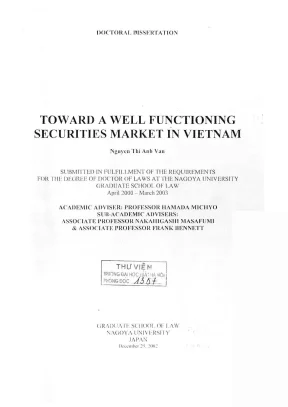
Tải xuống để đọc toàn bộDOCTORAL BISSERTATION TOWARD A WELL FUNCTIONING SECURITIES MARKET IN VIETNAM Neuyen Thi Anh Van SUBMITTED IN FULFILLMENT OF THE REQUIREMENTS FOR THE DEGREE OF DOCTOR OF LAWS AT THENAGOYA UNIVERSITY GRADUATE SCHOOL OF LAW April 2000 — March 2003 ACADEMIC ADVISER: PROFESSOR HAMADA MICHYO SUB-ACADEMIC ADVISERS: ASSOCIATE PROFESSOR NAKAHIGASHI MASAFUMI & ASSOCIATE PROFESSOR FRANK BENNETT THUVIEN | TRUONG ĐẠI HỌC LUAT HÀ NOI! PHÒNGbỌC AS AL | GRADUATE SCHOOL OF LAW NAGOYA UNIVERSELY JAPAN December 25, 2002 ACKNOWLEDGEMENT I would like to express my deep gratitude to Professor Hamada Michyo for her research guidance, which enables me to develop the theses of the dissertation, for her time reading its earlier versions, and for her discussions and comments. I am also indebted to Professor Nakahigashi Masafumi for his comments on the earlier drafts of the paper, and his classes on Corporate Law where | acquired knowledge of the Japanese and American law of corporations, which was very much helpful for my research. | am grateful to Professor Frank Bennett for his guidance, which enabled me to shape the thesis statement and lay down its basic plan at the time I was attending his class on Law and Its Social Context, and also for his comments on the earlier drafts of the dissertation. Ï am thankful to Professor Morigiwa Yasutomo and Professor Mastuura Yoshiharu for their classes from which my paper was benefited.
I would also like to thank Mr. John Francis Drennan for his assistance with the linguistic aspects of the paper. All errors and omissions remain those of mine. [ would like to extend my gratitude to the Japanese Ministry of Education, Science, Sports, and Culture (Monbukagakusho) for their sponsorship of my research.
| would also like to thank the Vietnamese Justice Ministry and Hanoi Law University for their support, which enabled me to complete my research. Ï am greatly indebted to the Foreign Student Adviser, Ms. Okuda Saori, for the advice and help | received from her from time to time, so that | could overcome difficulties during my stay in Japan. Ï am also grateful to the Law Library Staff for their kindness and patience in guiding me as to how to make use of reference materials and other library facilities when I fist came to the Graduate School of Law.
Above all, | would like to thank my parents, my husband, daughter, and sisters, without whose continued love and support this thesis would never have been written. Nguyen Thi Anh Van Nagoya University Graduate School of Law Japan December 25, 2002 TABLE OF CONTENTS Acknowledg€em€nf.- Q0 nh nh nh hy List of Abbreviations INTRODUCTION 0000000000 ccc cect n nn nn enn nee kh kg CHAPTER I: The Economic System and the Need for a Securitics Market in Vietnam. An Overview of the Historical Devclopment of the Economic System lì ViSTWAG sici co neo cs nhu La 8941-2300 xsx can Đ2/4410 5156115686215 005008200 61% h085 1. The Economic System before the Open Door Policy 2.
The Economic System after the Open Door Policy Il. The Need for a Securities Market in Vietnam. A Securities Market and Long Term linance for Businesses. A Securities Market and the Promotion of the Equitization Process.
A Securities Market and the Mobilization of Funds from Domestic SUG, FUT OT PAINS sáo các tasusahtoi« «- seasissigasdB0Basads Íoesbu ce a6 bv ơpiee ILI. The Development of Sccurifies Regulation in Vietnam |. The IntroduoHơn of Securities Regulation sex << sewer eccnessiedsss oes 2. An Overall Appraisal of the Corner Stone of the Securities Regulation: Decree 48/1998 CHAPTER H: Whether the Disclosure Requirements Promote Good Information Flow.
Public Offering and Listing Process under the Current Securities Teepe WANED sige tly ấm nail lung ae sa series.) bain eyelet ada: eRe 1. Listing Process Il. Whether the Current Disclosure Requirements ensure the CLtGe2t`=œŒh»Cứ Availability, Timeliness, and Adequacy of Information. Information Disclosure Requirements under the Existing Regulation.
a@ Disclosure by Lsstin@ COMPOS ©. coode vonemn soe mnin sain ava sie al. Public Offering Disclosure a. Timely DiSCIOSUDG Là.2 0000001 cence cence se + So a4.
Disclosure at the Request of Either the SSC or a Securities Fe GEN” nan seca. ws comms th gg88c53 oe gi khi s3 35 NEgasgilsgl-kesthễn 282 +> 2 b. Trading Information Disclosure Requirements with Respect to Semmes Freie COTS xoa scenes acne enn nút Ha Z3 punmaes bee 090508 ness ¢. Information Disclosure in Temeder OffOrs.
Whether the Accounting and Auditing Regulation Well Supports the Information Disclosure Regime. How Has the Existing Disclosure Regulation Worked2. Whether or not the Existing Information Disclosure Requirements Have beer GACGUAICLY CHIOKCOM tua ssc scimuvn ven animes tổn 68 cuc 308g + inns 57 b. What are the Attitudes of the 'Trading-Floor-Ready Companies’ Towards the Current Information Disclosure Ñegiine?.
How Does the SSC l\eact2. Whether the Scope of the Information Disclosure Regime is ACCQUATAY ACOPICT cpinaccenencssnemaari is msmere nme epoanens n2 0 0364 4ï mane 66 1. The Narrow Scope of the Current Information Disclosure Regime. What Might be the Consequences of the Narrow-Scope-Disclosure STE «xí.
ncanmsioncs tá toà arn 0808 309009.5008nssgg REM Lseniend t paola se 3ã, ĐpiekixA- 67 IV. What should be done to Achieve better Outcomes from the Information Diselosure HepùlgfffH<. co sáktLexxytanay tetas 70 1. A Call for Improvement of the Disclosure Requirements applying to those Who Make a Public Offering and to Listed Companies.
70 2, The Need for Disclosure Requirements Applying to Companies Whose Securities Offerings do not Fall Into the Purview of the “Public Ôfeiing”and To Nơii-liSISG COO cac csiras adn yee Ree La d901677stfax xtsg 74 3. The Need to adopt Comparable Accounting Rules and Independent PETES, duy lu cac na cpnbilc:6s@ybstrirpepoezpathìrbostaasrahvibgikinbyieBbrid fare ao 4. Possible Answers to the Practical ProbleS. co at CHAPTER HL: Whether the Anti-fraud Regulation can Foster a Healthy Market.
The Current Auti-fraud Regulation and the Prevention of Maniptilitive and Deceptive PRACUICGS .scs is conesasena vewns x vaumseceaw deans 80 1. Insider Trading Regulation and the Prevention of Short-swing Trading 80 t2 - Market Manipulation Regulation and Stabilization Transactions. Misinformation Regulation and the Prohibition of Omission of Information 89 Il. The Existing Anti-fraud Regulation and the Promotion of a Liquid gud Dice iy AAPG, ncaisr cmos ivscunncvssemnsanad ter scemedneguanets s6 eames a pHÍ 9] 1.
Should Short Sales be Totally Prohibited2. Should Extension of Credit and Lending Securities (Margin Trading) le Enifirelw Bard? «cnoncrssx<cacnemmes L5 114 KHÔI k4 10g 5 L4 2083301 1y SE 113603830 97 Il]. The Lack of Legal Bases for Investors’ Rights of Action and for Meaningfully Deterrent Sanction against Violations. No Concrete Legal Bases for Rights of Action against Wrongful TH TT eT ee a a a ree ee ne re 99 2.
Only Administrative Sanctions against Violations. The Future of the Anti-fraud Regulation. Strengthening the Antifraud Regulation and Enhancing the EnloeErmeni JI|WAIRNH se«es trai nga ghi recamecrcamenumeshaadadaamensadennvì 103 a. Short-swing Trading should be Put under Control 103 b.
Stabilizing Activities should be LegalizedÌ. Omissions of Material Information should be Prohibited 105 d. Concrete Rights of Action and Meaningfully Deterrent Sanctions for Violations should have Legal Bases in the Securities PGT nck ce Mc eae r6 Qua du ahaa ssb dg oom ELE kiều ni leon TB 105 2. Providing the Market with more Supporting Instruments.
Short sale should not be totally prohibited 107 b. Margin Trading should be allowed within a certain threshold. 107 3, Elinvingittng Technical Detieiemeies s. Creating Definitions on a Number of Significant T€FHN.
Eliminating Inconsistencies in Different Legal TeXIx. 108 CHAPTER IV: Whether Securities Professionals are Adequately Regulated 110 I. Regulation of Conflicts of Interest and the Safety of Pubic Investors. Seer ties Fri PCE! ccs cswes mais dws doomendd sekenedst cá maves bude gem 110 2.
Brokerage and Dealing Activities can be combined into One Securities Firm in the Absence of Necessary Regulation of Conflicts of LRT: sex ca cu86 acc Y eR bũbl2atssbxe 12 n88g8:s~si sim 9 0 ay hh lala Loa SRE 114 II. Regulation of theInvolvement of Banks in the Securities Market. The Involvement of Banks in Securities Markets: Overseas Experience - Lessons for Vietnam 121 a. The US experience 121 b_ The European Experience 127 C The Japan Experience 128 2.
Whether an Entire Prohibition of Direct Involvement of Banks into the Vietnamese Securities Market will Result in Good Outcomes. Future Regulation of Securities Professionals. The Need for Concrete Provisions Regulating Conflicts of Interest between Securities Firms and Their Customers. No Need for Indirect Involvement of Banks in a Number of Securities Business ACtivitiCS.
0000000 eee ee sees teat eens eens kh hà nâu Loe 3. The Need for More Concrete Provisions Regulating Banks and Securities SubgÌdÏaTl6Š acces nce vec cme vo cv one và ca xưng spines enemas +1 + asbases 134 CHAPTER V: Whether the Exchange Markets are Well Organized. Stock Exchanges and the Securities Industry: Past and Present L2 —. Mutual Form of Stock Exchange We 2.
Corporate Form of Stock Exchange 137 1, Jes@lis tor Wer acon a sub yearned eh caaneilv vlslewonernn xá Ấn ky 138 4. Matters of Concern about the Consequences of Demutualization. The Legal Structure of the Vietnamese Exchange Markets in Relation tớ aH ECCtiVe MAI ccc cca: ssneu cscs rarssnes panceaspeasosegs iat oe 145 1. Securities Trading Centers as Non-profit Organizations that Belong to ET SS vo sgk <i nlebnchs cin Sahil phe dane uals vì 1a Ne ¡vác wg Reals Gipent 1 gd aehemremnss «ached 145 2.
The Uncertain Legal Structure of the Planned Stock Exchanges. A Desirable Model for Future Exchange Markets. 154 CHAPTER VI: Whether the Market Regulatory System can Ensure that the Securities Rerulation wall be Well HatOrced : 1: sissiaos anrevemaw is Seemennces remel ebtaubrwngy! t-mnn 157 1. Securities Regulatory Systems: A Theoretical Analysis.
Securities regulatory system in general [37 2; Pita e SGT ATOG cons cectncesss eneversmes road 2s pokeweed idan teen 6s G8060 gg be 3. Self-repulatory system 160 I]. Employing an Appropriate Regulatory System: the Experience of The US nníi A ars ceeoanavdic,sremeenbnareLbasdig sr 0685. LanEHẨỒ ng os § i096.
The US 5e€oritles Regulatory System. The Japan's Securities Regulatory System: Past and Present 168 Hl. The Current Vietnamese Regulatory System: a Dependent Public Vì Regulator acting in the Absence of an Important Sclf-regulatory EE, casas x mained 6g dong sa gmemmen Beem snexieeidiBi s sen ppm + x msmmscse earcmconnmean «5 lee bl 17] 1. The Absence of an Important Self-regulatory System.
The SSC: Lack of Independence, and Being Inadequately empowered li a. The SSC Structure and Personnel 172 D. TRE SSC POWERS srcaaes vxcvnerres+panune) <segnebewes «eres mpgs 041031380015 se V75 b. Rules-making Powers 174 b.
Administrative Powers 174 IV. The Future Regulatory System over the Vietnamese Securities nr. A Single Public Regulator or a Self-regulatory System or a Combination of the Two: Which Model should be Chosen for the Future emulate SPS? tan say kagme tt smecmnaunic ss rhugmG0300000 0007 seemed PEEBVS-08 600/000 2. What Should Constitute a Self-Regulatory System over the Vietnam CUTS AT a cátnsesesdozs2iasskodcoulesErsLnbbt(seitbaiEtrsnlksavadu la $ 184 a.
Stock Exchanges as Self-Regulatory QrganizaHOHS. Other Self-Regulatory Organizations Necessary for a Healthy NEUSE irs ss se. A8080» tá đuêng Liiva ua y5 tia ld»sa TAN) wegen 185 BP TESbờ cụ scosnnicps ciescioedagey 2 sttiraid vfessssea Bflensydx CT9 nfasehlLlal Ea 7 186 a. Whal Form ef DO 4x Peal fOr VU cca sate lonn vé Sen oo sateen ode 186 b, The SSC Roles in Enforcine Securities LOW Faia vhetas ste 187 CHAPTER VIE: Suggestions for a Better Operational Securities Market in Vietnam 189 I.
Feasible Schedule for Law Reform 189 HH. Enhancing the Effectiveness of a Future Information Disclosure Regime 190 |. Future Disclosure Requirements Applying to those Who Make a Public Offerine and to Listed Compantes .ccvevesuntys smamenndpe sete ee 190 2. New Information Disclosure Regime Governing Those Whose Securities Offerings do not fall into the Purview of the “Public Offering” and Non-listed Companies 3.
Nội dung được bảo vệ bản quyền — Tải xuống đầy đủ
Trích dẫn luận án này
Nguyen Thi Anh Van (2003). Luận án tiến sĩ về thị trường chứng khoán Việt Nam [Luận án tiến sĩ, nagoya university graduate school of law]. LuanAn.net. https://luanan.net/luat-hoc/luat-kinh-te/luan-an-tien-si-ve-thi-truong-chung-khoan-viet-nam
Câu hỏi thường gặp
Luận án "Luận án tiến sĩ về thị trường chứng khoán Việt Nam" nghiên cứu về vấn đề gì?
Luận án luật học phân tích thị trường chứng khoán Việt Nam. Đề xuất giải pháp pháp lý xây dựng thị trường hoạt động hiệu quả, minh bạch và bền vững.
Luận án "Luận án tiến sĩ về thị trường chứng khoán Việt Nam" được bảo vệ tại trường nào?
Luận án này được bảo vệ tại nagoya university graduate school of law. Năm bảo vệ: 2003.
Luận án "Luận án tiến sĩ về thị trường chứng khoán Việt Nam" thuộc chuyên ngành gì?
Luận án "Luận án tiến sĩ về thị trường chứng khoán Việt Nam" thuộc chuyên ngành Luật. Danh mục: Luật Kinh Tế.
Luận án "Luận án tiến sĩ về thị trường chứng khoán Việt Nam" có bao nhiêu trang?
Luận án "Luận án tiến sĩ về thị trường chứng khoán Việt Nam" có 226 trang. Bạn có thể xem trước một phần tài liệu ngay trên trang web trước khi tải về.
Cách tải luận án "Luận án tiến sĩ về thị trường chứng khoán Việt Nam" về máy như thế nào?
Để tải luận án về máy, bạn nhấn nút "Tải xuống ngay" trên trang này, sau đó hoàn tất thanh toán phí lưu trữ. File sẽ được tải xuống ngay sau khi thanh toán thành công. Hỗ trợ qua Zalo: 0559 297 239.