Tetdedxjeanlouis temple 0225e 12011
Khám phá kiến trúc độc đáo của Tetdedxjeanlouis temple 0225e 12011. Tìm hiểu lịch sử, ý nghĩa và vẻ đẹp kiến trúc tại địa điểm đặc biệt này.
Temple University
Psychological, Organizational and Leadership Studies
Luan An
Luận án tiến sĩ
Năm xuất bản
Số trang
211
Thời gian đọc
32 phút
Lượt xem
0
Lượt tải
0
Phí lưu trữ
50 Point
Tổng quan nhanh
- Chủ đề:
- Tóm tắt Luận văn của Jean-Louis tại Temple University
- Số trang:
- 211 trang
- Trường:
- Temple University
- Chuyên ngành:
- Psychological, Organizational and Leadership Studies
- Tác giả:
- Gerardine Jean-Louis
- Năm:
- 2014
Tóm tắt nội dung luận án
I.Tóm tắt Luận văn của Jean Louis tại Temple University
1.1. Mục tiêu và bối cảnh nghiên cứu trọng tâm
Nghiên cứu của Gerardine Jean-Louis tập trung vào việc đánh giá các chiến lược học tập của sinh viên. Luận án Tiến sĩ này được hoàn thành tại Đại học Temple vào tháng 12 năm 2014. Nó giải quyết một vấn đề quan trọng trong giáo dục đại học: hỗ trợ sinh viên kém chuẩn bị. Sinh viên cần kiến thức và kỹ năng để thành công. Tỷ lệ bỏ học đại học ngày càng tăng. Các tổ chức sau trung học phải đảm bảo sinh viên sẵn sàng. Nghiên cứu này cung cấp cái nhìn sâu sắc về hiệu quả học tập.
1.2. Thách thức giáo dục sinh viên kém chuẩn bị
Các trường cao đẳng và đại học đối mặt với thách thức lớn. Đó là đáp ứng nhu cầu giáo dục của sinh viên kém chuẩn bị về mặt học thuật. Để giảm tỷ lệ bỏ học, cần có chiến lược hỗ trợ. Chương trình cầu nối mùa hè (SBP) là một giải pháp. Đây là chương trình chuyển tiếp từ trung học lên đại học kéo dài 6 tuần. SBP hướng đến sinh viên năm nhất có nguy cơ, chưa được chuẩn bị kỹ lưỡng. Mục đích là cung cấp các kỹ năng cần thiết.
1.3. Phương pháp nghiên cứu hỗn hợp và quy mô mẫu
Nghiên cứu sử dụng thiết kế giải thích phương pháp hỗn hợp hai giai đoạn. Giai đoạn 1 điều tra hồ sơ LASSI của 266 sinh viên SBP. LASSI là một bảng câu hỏi tự báo cáo gồm 80 mục. Nó đánh giá kiến thức và việc sử dụng các chiến lược nhận thức, động lực, và tự điều chỉnh. Giai đoạn 2 tiến hành phỏng vấn bán cấu trúc. Bốn sinh viên SBP được chọn lọc kỹ lưỡng tham gia. Các cuộc phỏng vấn diễn ra trong năm thứ hai đại học của họ. Phương pháp này cung cấp dữ liệu định lượng và định tính toàn diện.
II.Đánh giá Chiến lược Học tập Sinh viên Đại học Temple
2.1. Phân tích hồ sơ LASSI cho sinh viên cầu nối
Phân tích sâu rộng đã được thực hiện với Dữ liệu LASSI. Nghiên cứu này tại Đại học Temple sử dụng LASSI. Công cụ này đánh giá các chiến lược học tập và kỹ năng của sinh viên. Nó bao gồm các khía cạnh nhận thức, động lực và tự điều chỉnh. Các sinh viên tham gia chương trình cầu nối mùa hè (SBP) được khảo sát. Mục tiêu là hiểu rõ cách họ tiếp cận việc học. Điều này cung cấp cái nhìn về các kỹ năng học thuật.
2.2. Tầm quan trọng của động lực và tự điều chỉnh
Động lực là yếu tố cốt lõi trong thành công học tập. Nghiên cứu của Gerardine Jean-Louis nhấn mạnh tầm quan trọng này. Các chiến lược tự điều chỉnh cũng đóng vai trò quyết định. Sinh viên cần biết cách quản lý việc học của mình. Việc này bao gồm thiết lập mục tiêu và theo dõi tiến độ. Khả năng tự điều chỉnh giúp duy trì sự kiên trì. Nó đặc biệt quan trọng đối với sinh viên có nguy cơ.
2.3. Dữ liệu phỏng vấn hỗ trợ kết quả định lượng
Giai đoạn hai của nghiên cứu là các cuộc phỏng vấn định tính. Bốn sinh viên SBP được lựa chọn phỏng vấn. Các cuộc phỏng vấn bán cấu trúc mở rộng thêm kết quả định lượng. Chúng cung cấp bối cảnh và hiểu biết sâu sắc hơn. Dữ liệu này giúp lý giải tại sao một số chiến lược lại hiệu quả. Các câu chuyện cá nhân làm rõ hơn các yếu tố LASSI. Điều này hỗ trợ việc phát triển các chương trình hỗ trợ hiệu quả hơn.
III.Hàm ý Chính sách từ Nghiên cứu của Gerardine Jean Louis
3.1. Các yếu tố dự đoán hiệu suất học tập năm nhất
Nghiên cứu đã xác định các yếu tố quan trọng. Các chiến lược chọn lọc ý chính và chiến lược làm bài kiểm tra là yếu tố dự đoán. Chúng có mối quan hệ đáng kể với điểm GPA năm nhất. Sinh viên cần được đào tạo về các kỹ năng này. Điều này giúp cải thiện kết quả học tập ban đầu. Phát triển các kỹ năng này nên là trọng tâm của các chương trình hỗ trợ. Đại học Temple và các tổ chức khác có thể áp dụng.
3.2. Ảnh hưởng đến sự kiên trì trong giáo dục đại học
Động lực, như được đánh giá bởi LASSI, là yếu tố dự đoán mạnh mẽ. Nó liên quan đến sự kiên trì từ năm nhất đến năm hai. Sinh viên có động lực cao hơn có khả năng ở lại trường. Duy trì sự kiên trì là mục tiêu chính của giáo dục đại học. Các chương trình cần nuôi dưỡng động lực học tập. Điều này hỗ trợ giữ chân sinh viên. Các phát hiện này rất quan trọng đối với các nhà hoạch định chính sách.
3.3. Đề xuất cho các chương trình hỗ trợ sinh viên
Kết quả nghiên cứu có nhiều ý nghĩa cho chính sách và thực tiễn giáo dục. Cần tập trung vào việc dạy các kỹ năng cụ thể. Bao gồm cách chọn lọc ý chính và chiến lược làm bài thi. Các chương trình cầu nối mùa hè có thể tăng cường đào tạo này. Ngoài ra, việc xây dựng và duy trì động lực là thiết yếu. Các trường đại học như Đại học Temple có thể phát triển các can thiệp. Mục tiêu là nâng cao kỹ năng tự điều chỉnh và động lực cho sinh viên.
IV.Luận án Tiến sĩ tại Temple Nền tảng và Công nhận
4.1. Thông tin về Luận án của Gerardine Jean Louis
Luận án này đại diện cho một nghiên cứu học thuật quan trọng. Nó được Gerardine Jean-Louis trình lên Hội đồng Tốt nghiệp Đại học Temple. Việc hoàn thành vào tháng 12 năm 2014 đánh dấu việc đạt được bằng Tiến sĩ Triết học. Tài liệu cung cấp đóng góp quý giá. Nó làm phong phú thêm hiểu biết về các chiến lược học tập và thành công của sinh viên đại học. Luận án này là một tài liệu tham khảo quan trọng trong lĩnh vực giáo dục.
4.2. Ban Hội đồng Chuyên môn của Đại học Temple
Việc giám sát và đánh giá luận án được thực hiện bởi một ban hội đồng uy tín. Các thành viên bao gồm Tiến sĩ Joseph DuCette (Chủ tịch), Tiến sĩ Catherine Schifter, Tiến sĩ Frank Farley. Ngoài ra còn có các thành viên bên ngoài như Tiến sĩ Gerald Stahler và Tiến sĩ Doug Lombardi. Sự hỗ trợ và hướng dẫn của họ là vô cùng quan trọng. Ban hội đồng đảm bảo tính nghiêm ngặt và chất lượng học thuật. Họ đại diện cho các phòng ban khác nhau tại Đại học Temple.
4.3. Mã định danh tài liệu và giá trị nghiên cứu
Mỗi luận án có một mã định danh duy nhất. Mặc dù mã cụ thể "Tetdedxjeanlouis temple 0225e 12011" có thể là một định dạng nội bộ hoặc số tham chiếu, luận án của Gerardine Jean-Louis là một tài liệu có giá trị. Nó đóng góp vào cơ sở tri thức về giáo dục đại học. Đặc biệt, nó hữu ích cho các nghiên cứu về chương trình cầu nối và hỗ trợ sinh viên. Tài liệu này cung cấp số liệu tham chiếu quan trọng. Nó có thể được sử dụng bởi các nhà nghiên cứu và học viên.
Mục lục chi tiết luận án
Tải xuống file đầy đủ để xem toàn bộ nội dung
Tải đầy đủ (211 trang)Trích đoạn nội dung luận án
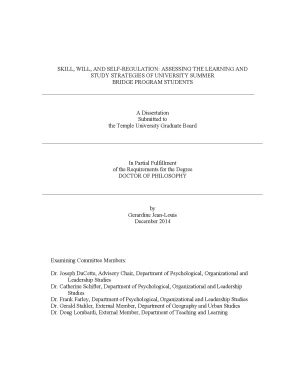
Tải xuống để đọc toàn bộSKILL, WILL, AND SELF-REGULATION: ASSESSING THE LEARNING AND STUDY STRATEGIES OF UNIVERSITY SUMMER BRIDGE PROGRAM STUDENTS A Dissertation Submitted to the Temple University Graduate Board In Partial Fulfillment of the Requirements for the Degree DOCTOR OF PHILOSOPHY by Gerardine Jean-Louis December 2014 Examining Committee Members: Dr. Joseph DuCette, Advisory Chair, Department of Psychological, Organizational and Leadership Studies Dr. Catherine Schifter, Department of Psychological, Organizational and Leadership Studies Dr. Frank Farley, Department of Psychological, Organizational and Leadership Studies Dr.
Gerald Stahler, External Member, Department of Geography and Urban Studies Dr. Doug Lombardi, External Member, Department of Teaching and Learning © Copyright 2014 by Gerardine Jean-Louis All Rights Reserved ii ABSTRACT Colleges and universities face a critical challenge in addressing the educational needs of their academically underprepared students. With college dropout rates increasingly rising, post-secondary institutions must ensure that these students have both the knowledge and the skills necessary to succeed in higher education and beyond. The aim of this study was to investigate the learning and study strategies and skills of students participating in a university summer bridge program (SBP), which is a 6-week, high- school-to-college transition program for academically underprepared, at-risk, first-year students (as defined by the university).
The relationships between SBP students’ learning and study strategies and two measures of college achievement (first-year GPA and first- to-second-year persistence) were investigated using a two-phase, mixed-methods explanatory design. In Phase 1 of the study, the Learning and Study Strategies Inventory (LASSI) profiles of SBP students (N = 266) were examined. The LASSI, an 80-item, self-report questionnaire, is used to assess students’ knowledge and use of various cognitive, motivational, and self-regulatory strategies that contribute to strategic learning. In Phase 2 of the study, semi-structured interviews were conducted to follow-up with purposefully selected SBP students (n = 4) during their sophomore year at the university.
Results of the study found that selecting main ideas and test strategies (LASSI) scales were significant predictors of first-year college GPA. Motivation, as assessed by the LASSI, was a significant predictor of first-to-second-year college persistence. Interviews conducted in Phase 2 of the study expand on these findings. Implications for educational policy and practice are highlighted.
iii ACKNOWLEDGMENTS First and foremost, I give all the glory, honor, and thanks to my Lord and Savior, Jesus Christ. The blessings and privileges that He has bestowed upon me are immeasurable. Without Him, none of my accomplishments could have been possible. Lord, you are my provider, my source of strength, my problem solver, my guide, my joy, my everything.
Your grace, goodness, and faithfulness truly endure. Next, I would like to thank my family and friends for their steady prayers and words of encouragement throughout my educational journey. To my parents, Gerard and Josette Jean-Louis, thank you for your unwavering love and support over the years. I am eternally grateful for the sacrifices you have both made to ensure that we, your children, achieved our dreams.
I love you both dearly. To my siblings, Jerry, Naomie, and Cathiana, thank you for all of the calls, messages, and loving hugs of support and encouragement. To Naomie especially, I couldn’t have done this without you! To my grandparents, aunts, uncles, cousins, the Maranatha Baptist Church family, and close friends, distance did not keep you from checking in with me periodically—sending love and raising up prayers on my behalf from your various locations. There are not enough words to express how much I love and appreciate you all.
The completion of my graduate studies may not have been possible without the guidance and support of my advisor, Dr. I am very grateful for all you have done for me over the years. Throughout the dissertation process, in particular, you served as an advisor, mentor, editor, proofreader, research supervisor, friend, and more— truly going above and beyond the call of duty. If I have not said it enough, I thank you.
iv To the other members of my advisory committee, Dr. Catherine Schifter and Dr. Frank Farley, I appreciate how readily you both agreed to join my committee and offer your feedback and guidance. Catherine, I thank you for your constant support and the genuine kindness you’ve shown me over the years.
Frank, what can I say? I love your passion and enthusiasm for psychology. Being a part of your research team was truly a great experience. On behalf of your team, I hope we’ve made you proud. To my external committee members, Drs.
Gerald Stahler and Doug Lombardi, thank you both for all of your guidance and support throughout the dissertation process. Gerald, I sincerely appreciate your willingness to serve on my committee and chair the oral defense. You’ve helped me close a major chapter in my life and for that I will always be grateful. Doug, I thank you not only for your help with this dissertation but also for granting me the opportunity to work as your research assistant these past 2 years.
I learned a great deal from the time that I spent with you. You’ve been a great mentor and a great friend. I wish you all the best life has to offer. I would also like to express my gratitude to a few current and former Temple students who helped me get through this graduate school experience.
Many of you paved the way and provided me with a clear roadmap to follow. Specifically to Drs. Tressa Aulenbach, Heather Jennings, Jaclyn Galbally, and Diana Wildermuth, I thank you for your friendship throughout my years at Temple. Our in-school research team meetings and out-of-school chats through Skype, Facebook, phone calls, and text messages have meant more to me than you will ever know.
To Diana especially, I thank you for keeping me motivated and on track these past few months. It was comforting to know that I had a traveling companion with me on this journey until the very end. I sincerely thank you. v To the director of the learning center referred to in the study, Mr.
Michael Stokes, and supporting staff, especially Ms. Felicia Woods, I sincerely appreciate all of your help with this research endeavor. To the summer bridge program students who donated their time to participate in this research study, I thank you. I would be remiss if I did not acknowledge the staff at Temple University’s office of Institutional Research and Assessment (IRA; formerly known as the Measurement and Research Center [MARC]).
To the staff at IRA/MARC (present and former), Sally, David, Kelly, John, Edwin, Sharon, Kim, Dorothy, Joanne, Janice, Francis, Justin, Amy, Saroya, Tolu, Victoria, Jaime, Nickala, and Monalisa, I will forever be indebted to you all, whom I now call my Temple family. The graduate externship that I was fortunate enough to obtain at IRA/MARC helped me grow both professionally and personally. My stay at Temple would not have been the same without all of you. A special thank you to Dana Kerr for your willingness to go above and beyond to help me stay calm during my most recent “panic moments.” Congratulations to you, fellow Temple graduate! Last but most certainly not least, I would like to thank Golbert Philippe for your daily words of encouragement.
You helped me to remain calm and have patience during moments when my frustrations were most high. You would not allow me to quit. You always believed that I could do this, even during the times when I truly did not believe it myself. You are my greatest supporter.
I could not have achieved this monumental goal without you. Thanks for everything, Chéri. vi I dedicate this dissertation to those whose prayers carried me through this challenging but rewarding educational journey. To all those who have goals and dreams that seem bigger than life itself, I leave you with the following Bible verses.
May the power behind these words give you the courage and strength needed to pursue all your dreams. Go ahead, dream big! “I can do all things through Christ, which strengtheneth me.” (Philippians 4:13, King James Version [KJV]) “ What shall we then say to these things? If God be for us, who can be against us? He that spared not his own Son, but delivered him up for us all, how shall he not with him also freely give us all things? Who shall lay any thing to the charge of God’s elect? It is God that justifieth. Who is he that condemneth? It is Christ that died, yea rather, that is risen again, who is even at the right hand of God, who also maketh intercession for us. Who shall separate us from the love of Christ? Shall tribulation, or distress, or persecution, or famine, or nakedness, or peril, or sword? As it is written, For thy sake we are killed all the day long; we are accounted as sheep for the slaughter.
Nay, in all these things we are more than conquerors through him that loved us. For I am persuaded, that neither death, nor life, nor angels, nor principalities, nor powers, nor things present, nor things to come, Nor height, nor depth, nor any other creature, shall be able to separate us from the love of God, which is in Christ Jesus our Lord.” (Romans 8:31-39, KJV) vii TABLE OF CONTENTS Page ABSTRACT. vii LIST OF TABLES. xiv LIST OF FIGURES .1 Background of the Problem .4 Destination: Postsecondary Degree Attainment .4 Academic Preparation for College: Roadmap to Success.6 Remedial Education: Detour or Dead End?.8 Significance of the Problem.9 Summer Bridge Programs: Survival Kit for the Underprepared .10 Present Study: The Road Ahead .13 Model of Strategic Learning (Brief Overview of Conceptual Framework).16 Purpose and Significance of the Study .19 Definitions of Key Terms .23 Learning Strategies and Achievement-Related Outcomes .24 Learning Strategies Defined .26 Types of Knowledge Needed for Effective/Strategic Learning.28 Characteristics of Strategic Learners .31 Model of Strategic Learning .36 Self-Regulation Component.50 Strategic Learning: Interaction of Skill, Will, Self-Regulation, and Academic Environment.51 Courses in Strategic Learning (Learning-to-Learn Courses).51 A Call for Further Research.53 Learning and Study Strategies Inventory, 2nd Edition (LASSI) .53 Skill Component Scales .56 Will Component Scales.56 Self-Regulation Component Scales .57 Learning Strategy Use Across Different Populations.59 ix Research Questions.59 Research Design: Mixed Methods .60 Phase 1: Quantitative Phase .63 Description of Individual LASSI Scales.66 Selecting main ideas .69 Psychometric Properties of the LASSI .72 Confidentiality and Anonymity .76 Phase 2: Qualitative Phase .78 Recruitment, Sample, and Data Collection.80 Qualitative Data Analysis .82 Categorical demographic variables.82 Continuous demographic variables.88 Continuous independent variables .92 Relationships Among Demographic Variables.92 Relationships Among Independent Variables.94 Relationships Among Independent Variables and Demographic Variables .96 Relationships Among Dependent Variables and Demographic Variables .103 Relationships Among Independent Variables and Dependent Variables.107 xi Primary Analysis.113 Coding and Organization of Relevant Findings.114 Academic Environment Theme .121 Self-Regulation Theme .122 Skill, Will, Self-Regulation, and Academic Environment.129 Research Question 1: Demographics .129 Research Question 2: Strengths and Challenges .132 Diagnostic Component: Group Strengths and Challenges as Assessed by the LASSI .133 Diagnostic Component: Strengths and Challenges in Comparison to Norm Population .137 Prescriptive Component: Suggested Tools for Improvement .140 Relationships Among DVs (Major Findings) .140 Relationships Among IVs (Major Findings).141 xii Relationships Among IVs and Demographic Variables (Major Findings) .142 Relationships Among DVs and Demographic Variables (Major Findings) .142 Relationships Among IVs and DVs (Major Findings) .145 Research Question 3: Predicting Achievement (Undergraduate GPA) .145 Research Question 4: Predicting Achievement (Persistence).149 Implications for Practice.
NEW STUDENT QUESTIONNAIRE (SELCECTED ITEMS). INTERVIEW PROTOCOL AND QUESTIONS. APPROVAL FOR RESEARCH LETTER. IRB APPROVED CONSENT FORMS.192 xiii LIST OF TABLES Table Page 2.1 Brief Descriptions of the Primary Components of Strategic Learning and Related LASSI Subscales.1 LASSI Scale Statistics .2 Variables in the Study.1 Frequencies and Percentages for Demographic Categorical Variables .2 Means and Standard Deviations for Continuous Demographic Variables of SBP Students .3 Minimum, Maximum, Means, and Standard Deviations for Continuous Independent Variables .4 Percentage of SBP Students Who Scored Below the 50th Percentile on Each LASSI Scale.6 Means and Standard Deviations for 10 LASSI Subscale Scores by Gender .
Nội dung được bảo vệ bản quyền — Tải xuống đầy đủ
Trích dẫn luận án này
Gerardine Jean-Louis (2014). Tetdedxjeanlouis temple 0225e 12011 [Luận án tiến sĩ, Temple University]. LuanAn.net. https://luanan.net/lich-su/lich-su-the-gioi/tetdedxjeanlouis-temple-0225e-12011
Câu hỏi thường gặp
Luận án "Tetdedxjeanlouis temple 0225e 12011" nghiên cứu về vấn đề gì?
Khám phá kiến trúc độc đáo của Tetdedxjeanlouis temple 0225e 12011. Tìm hiểu lịch sử, ý nghĩa và vẻ đẹp kiến trúc tại địa điểm đặc biệt này.
Luận án "Tetdedxjeanlouis temple 0225e 12011" được bảo vệ tại trường nào?
Luận án này được bảo vệ tại Temple University. Năm bảo vệ: 2014.
Luận án "Tetdedxjeanlouis temple 0225e 12011" thuộc chuyên ngành gì?
Luận án "Tetdedxjeanlouis temple 0225e 12011" thuộc chuyên ngành Psychological, Organizational and Leadership Studies. Danh mục: Lịch Sử Thế Giới.
Luận án "Tetdedxjeanlouis temple 0225e 12011" có bao nhiêu trang?
Luận án "Tetdedxjeanlouis temple 0225e 12011" có 211 trang. Bạn có thể xem trước một phần tài liệu ngay trên trang web trước khi tải về.
Cách tải luận án "Tetdedxjeanlouis temple 0225e 12011" về máy như thế nào?
Để tải luận án về máy, bạn nhấn nút "Tải xuống ngay" trên trang này, sau đó hoàn tất thanh toán phí lưu trữ. File sẽ được tải xuống ngay sau khi thanh toán thành công. Hỗ trợ qua Zalo: 0559 297 239.