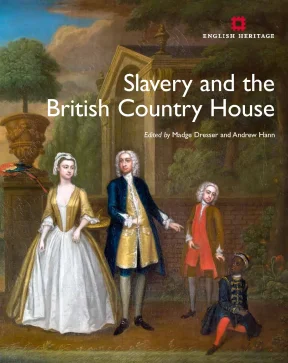
Slavery and the british country house web
Khám phá mối liên hệ phức tạp giữa chế độ nô lệ và kiến trúc, lịch sử các dinh thự Anh. Hiểu rõ hơn về nguồn gốc tài sản và di sản.
Năm xuất bản
Số trang
164
Thời gian đọc
25 phút
Lượt xem
0
Lượt tải
0
Phí lưu trữ
50 Point
Tổng quan nhanh
- Chủ đề:
- 1. Slavery and Country House
- Số trang:
- 164 trang
- Chuyên ngành:
- Lịch sử
- Tác giả:
- Madge Dresser
- Năm:
- 2013
Tóm tắt nội dung luận án
I. Slavery and Country House
Nhiều ngôi nhà nước Anh có liên quan đến buôn bán nô lệ. Các gia đình quý tộc và thương gia đã kiếm được tài sản từ việc buôn bán nô lệ và đầu tư vào các trang trại ở Caribe.
1.1. Atlantic Slave Trade
Buôn bán nô lệ qua Đại Tây Dương là một phần quan trọng của nền kinh tế thế giới vào thế kỷ 18. Các nước châu Âu như Anh, Pháp và Hà Lan đã tham gia vào việc buôn bán nô lệ.
1.2. Colonial Wealth
Tài sản thu được từ buôn bán nô lệ và các trang trại ở Caribe đã giúp các gia đình quý tộc và thương gia Anh trở nên giàu có.
II. Country House và Slavery
Nhiều ngôi nhà nước Anh có liên quan đến buôn bán nô lệ. Các gia đình quý tộc và thương gia đã kiếm được tài sản từ việc buôn bán nô lệ và đầu tư vào các trang trại ở Caribe.
2.1. Slave Derived Profits
Lợi nhuận thu được từ buôn bán nô lệ đã giúp các gia đình quý tộc và thương gia Anh trở nên giàu có.
2.2. Aristocratic Families
Các gia đình quý tộc Anh đã tham gia vào việc buôn bán nô lệ và đầu tư vào các trang trại ở Caribe.
III. Merchant Class
Các thương gia Anh đã kiếm được tài sản từ việc buôn bán nô lệ và đầu tư vào các trang trại ở Caribe.
3.1. West Indies Connections
Các thương gia Anh đã thiết lập mối quan hệ với các trang trại ở Caribe và tham gia vào việc buôn bán nô lệ.
3.2. Abolition Movement
Phong trào bãi nô đã giúp chấm dứt việc buôn bán nô lệ ở Anh.
IV. Legacy of Slavery
Di sản của buôn bán nô lệ vẫn còn ảnh hưởng đến xã hội Anh ngày nay.
4.1. Caribbean Sugar Plantations
Các trang trại đường ở Caribe đã được thiết lập bởi các thương gia Anh và đã trở thành một phần quan trọng của nền kinh tế thế giới.
4.2. English Heritage
Di sản Anh đã giúp bảo tồn và trưng bày lịch sử của các ngôi nhà nước Anh và mối quan hệ của chúng với buôn bán nô lệ.
Mục lục chi tiết luận án
Tải xuống file đầy đủ để xem toàn bộ nội dung
Tải đầy đủ (164 trang)Trích đoạn nội dung luận án
Tải xuống để đọc toàn bộSlavery and the British Country House Edited by Madge Dresser and Andrew Hann Slavery and the � British Country House � Edited by Madge Dresser and Andrew Hann Published by English Heritage, The Engine House, Fire Fly Avenue, Swindon SN2 2EH www.uk English Heritage is the Government’s lead body for the historic environment. © Individual authors 2013 The views expressed in this book are those of the authors and not necessarily those of English Heritage.9 are all based on Ordnance Survey mapping © Crown copyright and database right 2011. All rights reserved. Ordnance Survey Licence number 100024900.
First published 2013 ISBN 978 1 84802 064 1 Product code 51552 British Library Cataloguing in Publication data A CIP catalogue record for this book is available from the British Library. � The right of the authors to be identified as authors of this work has been asserted by them in accordance with the Copyright, Designs and Patents Act 1988. � All rights reserved No part of this publication may be reproduced or transmitted in any form or by any means, electronic or mechanical, including photocopying, recording, or any information storage or retrieval system, without permission in writing from the publisher. Application for the reproduction of images should be made to English Heritage.
Every effort has been made to trace the copyright holders and we apologise in advance for any unintentional omissions, which we would be pleased to correct in any subsequent edition of this book. For more information about images from the English Heritage Archive, contact Archives Services Team, The Engine House, Fire Fly Avenue, Swindon SN2 2EH; telephone (01793) 414600. Brought to publication by Jess Ward and Victoria Trainor, Publishing, English Heritage. Additional historic research by Miranda Kaufmann Edited by Toynbee Editorial Services Indexed by Ann Hudson Page layout by Andrea Rollinson, Ledgard Jepson Ltd.
Graphics by John Vallender Hardback printed in the UK by Butler Tanner and Dennis Ltd. 4 8 Atlantic slavery and classical List. 5 culture at Marble Hill and Acknowledgements. 9 Northington Grange Notes.
13 9 Slavery and the sublime: the 1 � Slave ownership and the British Atlantic trade, landscape aesthetics country house: the records of the and tourism Slave Compensation Commission Victoria Perry. 98 as evidence Nicholas Draper. 17 10 West Indian echoes: Dodington House, the Codrington family 2 � Slavery and West Country houses and the Caribbean heritage Madge Dresser. 106 3 Rural retreats: Liverpool slave 11 Contesting the political legacy of traders and their country houses slavery in England’s country houses: Jane Longmore.
43 a case study of Kenwood House and Osborne House 4 Lodges, garden houses and villas: Caroline Bressey. 114 the urban periphery in the early modern Atlantic world 12 Representing the East and West India Roger H Leech. 54 links to the British country house: the London Borough of Bexley and 5 Slavery’s heritage footprint: links the wider heritage picture between British country houses Cliff Pereira. 123 and St Vincent plantations, 1814–1834 Simon D Smith.
59 13 Re:Interpretation: the representation of perspectives on slave trade 6 An open elite? Colonial commerce, history using creative media the country house and the case Rob Mitchell and Shawn Sobers. 132 of Sir Gilbert Heathcote and Normanton Hall Notes. 71 7 Property, power and authority: the implicit and explicit slavery connections of Bolsover Castle and Brodsworth Hall in the 18th century Sheryllynne Haggerty and Susanne Seymour. 78 Foreword � There are few things more emblematic of England’s heritage than the great country houses which grace our landscape.
However, such properties are not to be viewed simply as objects of architectural and curatorial or artistic interest. They are also expressions of wealth, power and privilege, and as new questions are being asked of England’s historic role in the Atlantic world, and in particular about slavery, new connections are being unearthed between the nation’s great houses and its colonial past. In 2007 English Heritage commissioned initial research by Miranda Kaufmann into links with transatlantic slavery or its abolition among families who owned properties now in its care. This was part of the commitment by English Heritage to commemorate the bicentenary of the abolition of the British transatlantic slave trade with work that would make a real difference to our understanding of the historic environment in the longer term.
This scoping report surveyed 33 properties and found 26 which had some connection to slavery or abolition, and so stimulated many interesting questions for further research. As a result, more detailed surveys of four sites (Bolsover Castle [Derbyshire], Brodsworth Hall [South Yorkshire], Marble Hill [Twickenham, London] and Northington Grange [Hampshire]) were commissioned in 2008. Their findings and those of other scholars and heritage practitioners were presented at the ‘Slavery and the British Country House’ conference at the London School of Ecomonics in 2009, which English Heritage co-organised with the University of the West of England and the National Trust. This conference brought together academics, heritage professionals, country house owners and community researchers from across Britain to explore how country houses might be reconsidered in the light of their slavery linkages and how such links have been and might be presented to visitors.
Since then the conference papers have been updated and reworked into a cutting-edge volume which represents the most current and comprehensive consideration of slavery and the British country house as yet undertaken. English Heritage is proud to be publishing work on which historians, educators and heritage professionals can all build to develop new understandings of this challenging and important part of our national story. Baroness Andrews Chair,.Heritage 4 List of Contributors � Caroline Bressey graduated from the University of Cambridge with BA Honours in Geography in 1997. In 1998 she joined the University College London Geography department as postgraduate student and was awarded her PhD ‘Forgotten Geographies: Historical Geographies of Black Women in Victorian and Edwardian London’ in 2003.
For the following four years she researched the Black Presence in Victorian Britain and the role of the anti-racist community as an Economic and Social Research Council postdoctoral student and research fellow. In 2007 she became a lecturer in human geography and founded the Equiano Centre to support research into the Black Presence in Britain. For the bicentenary she contributed to the new gallery ‘London, Sugar and Slavery’ at the Museum of London Docklands and also wrote the gallery trail ‘Portraits, People and Abolition’ for the National Portrait Gallery, London. Laurence Brown is Lecturer in Migration History at the University of Manchester.
Having completed his doctorate at the University of York in 1999, he has taught at the University of the West Indies (Barbados), the American University of Paris and the Australian National University. He has written widely on the history of the Eastern Caribbean, particularly on migration and collective memory. He is currently finishing two projects exploring migrations in the Caribbean during slavery and freedom, and post-1940 Caribbean immigration to Manchester. Nick Draper is a member of the team of historians at University College London (UCL) working on the Structure and Significance of British Slave-ownership 1763–1833 project, and was a Research Associate in the Legacies of British Slave-ownership project, also at UCL.
His publications include ‘The rise of a new planter class? Some countercurrents from British Guiana and Trinidad 1807–33’ (Atlantic.Emancipation (Cambridge University Press, 2010), ‘“Possessing slaves”: ownership, compensation and metropolitan society in Britain at the time of Emancipation, 1834–1840’ (History.Journal 2007) and ‘The City of London and slavery: evidence from the first docks companies’ (Economic. He acted as consultant to the Museum of London Docklands’ Slavers of Harley Street exhibition in 2008–9. Prior to academia, he worked for 25 years in the City. Madge Dresser is Associate Professor of History at the University of the West of England in Bristol.
Her published works include her monograph Slavery.Bristol (Continuum, 2001 reprinted Redcliffe Press, 2007), ‘Statues and Slavery in London’ in History.Journal (2007) and ‘Slavery and popular memory in Bristol’ in the journal Slavery. She has also acted as historical consultant and advisor to slavery exhibitions at the British Empire & Commonwealth Museum and the Bristol Museum Service, the Economic and Social Research Council Legacies of British Slave-ownership project at UCL and numerous slavery websites and public history projects. She is currently writing a book on links between slave-owning families in Britain and Colonial America for the History Press. Sheryllynne Haggerty is Associate Professor in Early Modern History in the Department of History, University of Nottingham and received her PhD in 2002 from the University of Liverpool.
Her research interests include the business culture and trading communities of the British Atlantic in the 18th century, including the role of women. Her first monograph, The.Goods (Brill Press, 2006) explored the relationship between the trading communities of Liverpool and Philadelphia. Her second, ‘Merely.1750–1815 (Liverpool University Press, 2012) is an interdisciplinary study looking at the importance of business culture to Britain’s economic success 5 in the Atlantic world. She has been published in Business.
Sheryllynne is also a Council Member of the Association of Business Historians, and of the British Commission for Maritime History, and is on the editorial board of Essays. Andrew Hann is Properties Historians’ Team Leader at English Heritage with particular responsibility for researching and writing about the country houses in their care. Before joining English Heritage in 2007 he worked for a number of years as an academic. His research interests centre on the history of retailing, consumption and material culture.
Roger H Leech is a graduate of the Universities of Cambridge and of Bristol. He was the first Director of the Cumbria and Lancashire Archaeological Unit in the University of Lancaster (1979–84), moving then to the Royal Commission on the Historical Monuments of England (now merged with English Heritage), first as Head of the former Ordnance Survey Archaeology Division and then as Head of Archaeology. He has been President of both the Society for Post-Medieval Archaeology and the Bristol and Gloucestershire Archaeological Society, and is now Visiting Professor of Archaeology in the University of Southampton. His work on Bristol includes the first two volumes of an intended series on the topography of the city published by the Bristol Record Society and a study of Bristol town houses to be published by English Heritage in association with the City of Bristol.
His work in the Eastern Caribbean has been linked to the University of Southampton’s Nevis Heritage Project, funded in part by the British Academy, and also to the St Kitts and Nevis Digital Archaeology Initiative undertaken in collaboration with the Digital Archaeological Archive for Comparative Slavery at Monticello and the University of Virginia funded by JISC and the National Endowment for the Humanities, with publications to date in the monograph series of the Society for Post-Medieval Archaeology, Perspectives.Architecture and the Barbados. Jane Longmore is Professor of Urban History and Deputy Vice-Chancellor of Southampton Solent University. Her research interests focus mainly on north-west England in the 18th and early 19th centuries. Her recent publications include ‘Civic Liverpool: 1680–1800’ in J Belchem (ed.
She has a longstanding interest in the teaching of history in universities and currently chairs the national History Forum of the Higher Education Academy. Rob Mitchell, a founding member of Firstborn Creatives in Bristol, is a Creative Media Producer who works across print, audio-visual and digital media in the television, community, arts and public sectors. He has produced programmes for ITV, BBC and Channel 4, and was Creative Director for the ‘me deya’ exhibition at the British Empire & Commonwealth Museum in 2007. His body of work shows a particular interest in learning, community creativity and personal development.
He was the first Chair of the Bristol Black Archives Partnership (BBAP) and former Chair of Black Pyramid Film & Video project, Rob Mitchell is also a poet and media consultant. Cliff Pereira is a widely published writer, historical geographer, curator and community facilitator.
Nội dung được bảo vệ bản quyền — Tải xuống đầy đủ
Trích dẫn luận án này
Madge Dresser, Andrew Hann (2013). Slavery and the british country house web [Luận án tiến sĩ]. LuanAn.net. https://luanan.net/lich-su/lich-su-the-gioi/slavery-and-the-british-country-house-web
Câu hỏi thường gặp
Luận án "Slavery and the british country house web" nghiên cứu về vấn đề gì?
Khám phá mối liên hệ phức tạp giữa chế độ nô lệ và kiến trúc, lịch sử các dinh thự Anh. Hiểu rõ hơn về nguồn gốc tài sản và di sản.
Luận án "Slavery and the british country house web" thuộc chuyên ngành gì?
Luận án "Slavery and the british country house web" thuộc chuyên ngành Lịch sử. Danh mục: Lịch Sử Thế Giới.
Luận án "Slavery and the british country house web" có bao nhiêu trang?
Luận án "Slavery and the british country house web" có 164 trang. Bạn có thể xem trước một phần tài liệu ngay trên trang web trước khi tải về.
Cách tải luận án "Slavery and the british country house web" về máy như thế nào?
Để tải luận án về máy, bạn nhấn nút "Tải xuống ngay" trên trang này, sau đó hoàn tất thanh toán phí lưu trữ. File sẽ được tải xuống ngay sau khi thanh toán thành công. Hỗ trợ qua Zalo: 0559 297 239.