Essays in the economics of education
Khám phá các bài luận kinh tế về giáo dục: tác động chính sách, hiệu quả đào tạo và bất bình đẳng giáo dục.
Luan An
luận án
Năm xuất bản
Số trang
177
Thời gian đọc
27 phút
Lượt xem
0
Lượt tải
0
Phí lưu trữ
50 Point
Tổng quan nhanh
- Chủ đề:
- 1. Tổng quan luận án kinh tế học giáo dục Berkeley
- Số trang:
- 177 trang
- Trường:
- University of California, Berkeley
- Chuyên ngành:
- Economics
- Tác giả:
- Jesse Morris Rothstein
- Năm:
- 2003
Tóm tắt nội dung luận án
I. Tổng quan luận án kinh tế học giáo dục Berkeley
Luận án "Essays in the Economics of Education" do Jesse Morris Rothstein thực hiện năm 2003. Công trình bảo vệ tại Đại học California, Berkeley. Tác giả nhận bằng Tiến sĩ Kinh tế học. Hội đồng do Giáo sư David Card làm chủ tịch. Luận án gồm ba tiểu luận độc lập. Mỗi tiểu luận xét một khía cạnh của kinh tế học giáo dục. Chủ đề trung tâm là mối liên hệ giữa nền tảng học sinh và thành tích học tập. Mối liên hệ này định hình mọi phân tích. Tiểu luận đầu bàn về lựa chọn trường học. Tiểu luận thứ hai đánh giá lại nghiên cứu của Hoxby. Tiểu luận thứ ba xét vai trò của bài kiểm tra SAT. Cả ba cùng đặt câu hỏi về hiệu quả và công bằng giáo dục. Phương pháp định lượng giữ vai trò cốt lõi. Dữ liệu thực nghiệm đến từ học sinh dự thi SAT. Công trình đóng góp vào tranh luận chính sách giáo dục Hoa Kỳ.
1.1. Bối cảnh và tác giả của luận án
Jesse Morris Rothstein hoàn thành luận án mùa xuân 2003. Đại học California, Berkeley là nơi đào tạo. Khoa Kinh tế học cấp bằng Tiến sĩ. Tác giả tốt nghiệp Harvard năm 1995. Nền tảng học thuật vững chắc. Công trình thuộc lĩnh vực kinh tế học giáo dục. Đề tài tập trung vào hiệu quả nhà trường và công bằng cơ hội.
1.2. Hội đồng chấm và cấu trúc luận án
Giáo sư David Card giữ ghế chủ tịch hội đồng. Giáo sư John M. Quigley và Steven Raphael cùng tham gia. Luận án chia thành ba chương riêng biệt. Mỗi chương là một tiểu luận hoàn chỉnh. Cấu trúc cho phép xét nhiều câu hỏi nghiên cứu. Các chương liên kết qua chủ đề chung về nền tảng học sinh.
1.3. Chủ đề trung tâm xuyên suốt ba chương
Mối liên hệ giữa hoàn cảnh học sinh và kết quả học tập là sợi chỉ đỏ. Mối liên hệ này tác động tới ba lĩnh vực. Lựa chọn trường học chịu ảnh hưởng đầu tiên. Cạnh tranh giữa các trường chịu ảnh hưởng thứ hai. Giá trị dự báo của bài thi tuyển sinh chịu ảnh hưởng thứ ba. Luận án dùng bằng chứng định lượng để kiểm chứng.
II. Lựa chọn trường học và mô hình cân bằng Tiebout
Chương Một xét chính sách lựa chọn trường học. Câu hỏi cốt lõi là động lực quản lý trường hiệu quả. Chính sách lựa chọn có thể thúc đẩy cải thiện chất lượng. Động lực này suy yếu nếu phụ huynh ưu tiên nhóm bạn đồng học. Phụ huynh có thể chuộng trường có học sinh giỏi hơn trường dạy tốt. Rothstein xây mô hình thị trường nhà ở kiểu Tiebout. Trong mô hình, trường khác nhau ở nhóm bạn học và hiệu quả giảng dạy. Hai yếu tố cùng tác động tới giá nhà. Nếu phụ huynh trọng hiệu quả, gia đình giàu mua nhà gần trường tốt. Phân quyền giáo dục khi đó hỗ trợ phân loại cư trú. Nếu nhóm bạn học chiếm ưu thế, kết quả khác hẳn. Gia đình giàu vẫn tụ lại nhưng không ở trường hiệu quả. Tác giả dùng mẫu lớn học sinh dự thi SAT. Dữ liệu trải rộng nhiều vùng đô thị. Kết quả cho thấy phụ huynh chọn trường chủ yếu vì nhóm bạn học. Bằng chứng về lựa chọn dựa trên hiệu quả rất ít.
2.1. Cơ chế phân loại cư trú theo lý thuyết Tiebout
Mô hình Tiebout mô tả hộ gia đình chọn nơi ở theo dịch vụ công. Trường học là dịch vụ quan trọng. Gia đình trả giá nhà để tiếp cận trường mong muốn. Mô hình giả định nhiều khu vực cạnh tranh. Cân bằng thị trường phản ánh sở thích phụ huynh. Phân loại theo thu nhập xuất hiện tự nhiên trong cân bằng.
2.2. Nhóm bạn đồng học so với hiệu quả giảng dạy
Hai yếu tố cạnh tranh trong sở thích phụ huynh. Nhóm bạn đồng học phản ánh nền tảng học sinh khác. Hiệu quả giảng dạy phản ánh chất lượng quản lý và giáo viên. Phụ huynh khó phân biệt hai yếu tố. Trường có học sinh giỏi thường bị nhầm là trường dạy tốt. Sự nhầm lẫn này làm méo động lực cải thiện chất lượng.
2.3. Bằng chứng thực nghiệm từ dữ liệu SAT
Mẫu nghiên cứu gồm đông học sinh dự thi SAT. Dữ liệu phân bố theo vùng đô thị. Cấu trúc quản trị giáo dục khác nhau giữa các vùng. Phân tích so sánh phân bố kết quả học sinh. Bằng chứng nghiêng về lựa chọn theo nhóm bạn học. Phụ huynh ít chọn trường vì hiệu quả thực sự. Cạnh tranh do đó khó nâng năng suất giáo dục.
III. Cạnh tranh trường công lập và năng suất giáo dục
Chương Hai đánh giá lại nghiên cứu của Hoxby năm 2000. Hoxby tuyên bố cạnh tranh nâng cao thành tích học sinh. Bà liên hệ phân quyền học khu với kết quả tốt hơn. Rothstein không tìm thấy mối quan hệ này ở Chương Một. Sự khác biệt cần lời giải thích. Tác giả dùng chính dữ liệu và mô hình của Hoxby. Ông làm theo đúng cách mô tả trong bài báo công bố. Kết quả không tái lập được ước lượng dương của Hoxby. Nhiều lý do gây lo ngại về tính hợp lệ. Cách ghép dữ liệu địa lý nhạy cảm với lựa chọn. Ước lượng từ khu vực công có thể bị thiên lệch. Sai số chuẩn cần được tính lại chính xác hơn. Phân tích cho thấy kết luận của Hoxby thiếu vững. Cạnh tranh giữa trường công không chắc nâng năng suất. Chương này củng cố nghi ngờ về lợi ích của cạnh tranh. Bằng chứng định lượng đặt câu hỏi cho chính sách thị trường giáo dục.
3.1. Tái lập kết quả nghiên cứu của Hoxby
Tác giả dùng đúng bộ dữ liệu của Hoxby. Mô hình và đặc tả giữ nguyên theo bài công bố. Mục tiêu là tái tạo ước lượng dương ban đầu. Nỗ lực tái lập thất bại. Kết quả không khớp với con số đã công bố. Sự bất nhất này mở ra phần phân tích sâu hơn.
3.2. Độ nhạy với cách ghép dữ liệu địa lý
Cách ghép ranh giới địa lý ảnh hưởng tới ước lượng. Đo lường mức độ tập trung thị trường phụ thuộc định nghĩa vùng. Thay đổi nhỏ trong ghép nối làm kết quả dao động. Độ nhạy cao báo hiệu kết luận thiếu ổn định. Phân tích này làm suy yếu phát hiện gốc.
3.3. Thiên lệch ước lượng và sai số chuẩn
Ước lượng từ khu vực công có thể chứa thiên lệch. Yếu tố không quan sát gây nhiễu kết quả. Sai số chuẩn ban đầu chưa phản ánh đúng cấu trúc dữ liệu. Tác giả đề xuất cách tính sai số chuẩn cải tiến. Sau hiệu chỉnh, kết quả của Hoxby mất ý nghĩa thống kê.
IV. Bài kiểm tra SAT và dự báo kết quả đại học
Chương Ba xét vai trò của bài thi tuyển sinh. Trọng tâm là dự báo thành tích học tập đại học. Các nghiên cứu giá trị dự báo truyền thống có hai khiếm khuyết. Khiếm khuyết đầu là không xử lý tốt vấn đề chọn mẫu. Khiếm khuyết thứ hai là bỏ qua nhiều biến nền tảng học sinh. Các biến này tương quan với cả điểm thi và kết quả đại học. Rothstein đề xuất một ước lượng biến bị bỏ sót. Ước lượng nhất quán dưới giả định chọn mẫu hạn chế. Giả định đôi khi hợp lý trong thực tế. Tác giả dùng dữ liệu từ Đại học California. Kết quả cho thấy đặc điểm nhân khẩu cấp trường rất quan trọng. Các đặc điểm này giải thích phần lớn sức mạnh dự báo của SAT. Điểm SAT phản ánh nền tảng học sinh nhiều hơn năng lực cá nhân. Phát hiện đặt câu hỏi về nền tảng trọng dụng nhân tài. Quy tắc tuyển sinh dựa trên điểm thi bị nghi ngờ về tính công bằng.
4.1. Hạn chế của nghiên cứu giá trị dự báo cũ
Nghiên cứu truyền thống đo tương quan giữa điểm thi và điểm đại học. Cách làm bỏ qua vấn đề chọn mẫu. Chỉ sinh viên trúng tuyển mới có dữ liệu kết quả. Hiệu chỉnh phạm vi điểm gặp mâu thuẫn logic. Các biến nền tảng học sinh bị loại khỏi mô hình. Thiếu sót này làm thổi phồng giá trị của SAT.
4.2. Ước lượng biến bị bỏ sót do tác giả đề xuất
Tác giả xây ước lượng xử lý biến bị bỏ sót. Phương pháp dựa trên giả định chọn mẫu hạn chế. Giả định này đôi khi phù hợp với dữ liệu tuyển sinh. Ước lượng cho kết quả nhất quán hơn. Dữ liệu Đại học California phục vụ kiểm chứng. Cách tiếp cận tách biệt năng lực cá nhân khỏi nền tảng.
4.3. Vai trò của nhân khẩu cấp trường trong điểm SAT
Đặc điểm nhân khẩu cấp trường giải thích phần lớn sức dự báo. Điểm SAT gắn chặt với hoàn cảnh học sinh. Năng lực cá nhân đóng góp ít hơn tưởng tượng. Kết quả làm lung lay lập luận trọng dụng nhân tài. Tuyển sinh dựa trên điểm thi có thể tái tạo bất bình đẳng.
V. Phương pháp nghiên cứu kinh tế học giáo dục
Luận án dựa trên phương pháp kinh tế lượng chặt chẽ. Mỗi chương dùng mô hình và dữ liệu riêng. Chương Một kết hợp mô hình lý thuyết với phân tích thực nghiệm. Mô hình Tiebout cung cấp khung lý thuyết. Dữ liệu SAT cung cấp bằng chứng kiểm chứng. Hồi quy tuyến tính ước lượng quan hệ giữa các biến. Mô phỏng mở rộng lựa chọn minh họa cơ chế thị trường. Chương Hai tập trung vào tái lập và kiểm định độ vững. Tác giả thử lại kết quả với nhiều đặc tả. Độ nhạy được kiểm tra cẩn thận. Sai số chuẩn được tính lại theo cấu trúc dữ liệu. Chương Ba phát triển ước lượng mới. Ước lượng xử lý chọn mẫu và biến bị bỏ sót. Phương pháp đề cao tính nhất quán dưới giả định rõ ràng. Toàn bộ luận án coi trọng bằng chứng định lượng. Cách tiếp cận minh bạch giúp người khác kiểm tra lại. Tinh thần phản biện thấm vào từng chương.
5.1. Mô hình lý thuyết và mô phỏng thị trường
Mô hình Tiebout mô tả hành vi chọn nơi ở. Cân bằng thị trường được minh họa bằng đồ thị. Mô phỏng kiểm tra tác động của việc mở rộng lựa chọn. Đo lường mức tập trung thị trường bổ trợ phân tích. Mô hình kết nối giả định lý thuyết với dữ liệu thực.
5.2. Kỹ thuật kinh tế lượng và kiểm định độ vững
Hồi quy tuyến tính là công cụ ước lượng chính. Nhiều đặc tả được thử để kiểm tra độ vững. Độ nhạy với lựa chọn dữ liệu được đánh giá. Sai số chuẩn cải tiến nâng độ tin cậy. Kỹ thuật này phơi bày điểm yếu của nghiên cứu trước.
5.3. Xử lý chọn mẫu và biến bị bỏ sót
Vấn đề chọn mẫu gây thiên lệch nghiêm trọng. Tác giả đề xuất giả định hạn chế nhưng hợp lý. Ước lượng biến bị bỏ sót khắc phục thiếu sót. Phương pháp cho kết quả nhất quán hơn. Cách tiếp cận này nâng chuẩn cho nghiên cứu giá trị dự báo.
VI. Ý nghĩa chính sách từ luận án kinh tế giáo dục
Luận án mang nhiều hàm ý cho chính sách giáo dục. Phát hiện thách thức niềm tin vào thị trường trường học. Cạnh tranh không chắc nâng năng suất giáo dục. Phụ huynh chọn trường chủ yếu vì nhóm bạn học. Động lực cải thiện chất lượng do đó bị suy yếu. Nhà hoạch định cần thận trọng với chính sách lựa chọn. Phân quyền học khu không tự động cải thiện kết quả. Chương Hai cảnh báo về bằng chứng thiếu vững. Kết luận ủng hộ cạnh tranh cần được kiểm tra lại. Chương Ba đặt câu hỏi về tuyển sinh dựa trên điểm thi. Điểm SAT phản ánh hoàn cảnh nhiều hơn năng lực. Quy tắc trọng điểm thi có thể tái tạo bất bình đẳng. Chính sách tuyển sinh cần xét nhiều yếu tố hơn. Luận án kêu gọi đánh giá công bằng và hiệu quả song song. Bằng chứng định lượng dẫn dắt mọi khuyến nghị. Công trình đóng góp lâu dài cho tranh luận giáo dục.
6.1. Hàm ý cho chính sách lựa chọn trường học
Chính sách lựa chọn dựa trên kỳ vọng cạnh tranh. Bằng chứng cho thấy kỳ vọng này dễ thất vọng. Phụ huynh ưu tiên nhóm bạn học hơn chất lượng dạy. Trường tốt không chắc thu hút thêm học sinh. Nhà hoạch định cần thiết kế cơ chế cẩn trọng hơn.
6.2. Bài học về kiểm định bằng chứng nghiên cứu
Việc đánh giá lại nghiên cứu của Hoxby là bài học quý. Kết quả công bố cần khả năng tái lập. Độ vững phải được kiểm tra kỹ. Chính sách dựa trên bằng chứng yếu dễ sai lầm. Tinh thần phản biện bảo vệ chất lượng quyết định công.
6.3. Công bằng trong tuyển sinh đại học
Tuyển sinh dựa trên điểm thi tự nhận là công bằng. Phát hiện cho thấy điểm thi gắn với nền tảng. Học sinh hoàn cảnh thuận lợi được lợi nhiều hơn. Quy tắc trọng điểm thi có thể duy trì bất bình đẳng. Chính sách tuyển sinh cần cân nhắc thêm nhiều biến nền tảng.
Mục lục chi tiết luận án
Tải xuống file đầy đủ để xem toàn bộ nội dung
Tải đầy đủ (177 trang)Nội dung chính
Tổng quan về luận án
Luận án tiến sĩ kinh tế học của Jesse Morris Rothstein (Đại học California, Berkeley, 2003, dưới sự hướng dẫn của Giáo sư David Card) với tiêu đề "Essays in the Economics of Education" đại diện cho một công trình bước ngoặt trong kinh tế học thực nghiệm và kinh tế học giáo dục. Công trình trực tiếp chất vấn các giả định cốt lõi của trường phái kinh tế học tân cổ điển về động lực cạnh tranh trường học và cơ chế tuyển sinh đại học dựa trên kiểm tra chuẩn hóa.
Bối cảnh khoa học của luận án xuất phát từ sự bùng nổ của các đề xuất cải cách thị trường trường học (school choice) bắt nguồn từ luận điểm của Friedman (1962) và Chubb & Moe (1990), vốn khẳng định rằng việc trao quyền lựa chọn cho phụ huynh sẽ thiết lập kỷ luật thị trường, buộc các nhà quản lý trường học phải nâng cao năng suất đào tạo. Tuy nhiên, một research gap lớn trong y văn kinh tế học công cộng và giáo dục là sự bỏ sót vai trò chi phối của hiệu ứng nhóm bạn học (peer group effects) trong hành vi lựa chọn thực tế của phụ huynh. Các nghiên cứu tiên phong trước đó (Hoxby, 2000a) mặc định rằng sự cạnh tranh giữa các học khu (Tiebout competition) sẽ tự động thúc đẩy chất lượng giảng dạy mà không tính đến tình trạng phân tầng xã hội sâu sắc làm méo mó các tín hiệu thị trường. Đồng thời, trong lĩnh vực giáo dục đại học, các nghiên cứu độ giá trị dự báo truyền thống (predictive validity) về bài thi SAT thường bỏ qua biến nhân khẩu học trường học và thiên lệch chọn mẫu tuyển sinh.
Luận án giải quyết ba câu hỏi nghiên cứu và hệ giả thuyết then chốt:
- Research Question 1 (RQ1): Liệu cơ chế phân tầng nhà ở Tiebout có tạo ra động lực để phụ huynh lựa chọn các trường có hiệu quả quản lý cao ($\mu_j$) hay phụ huynh chủ yếu lựa chọn theo thành phần kinh tế - xã hội của bạn học ($x_j$)?
- Hypothesis 1 (H1): Nếu phụ huynh định giá cao năng lực quản trị, các thị trường có tính phi tập trung cao sẽ biểu hiện mức độ phân tầng hiệu quả ($\theta^*$) mạnh mẽ hơn, làm gia tăng độ dốc điểm số theo đặc điểm bạn học.
- Research Question 2 (RQ2): Mối quan hệ thực nghiệm giữa mức độ cạnh tranh giữa các học khu công lập và thành tích học sinh có thực sự dương và vững chắc như các kết luận trước đây (Hoxby, 2000a)?
- Hypothesis 2 (H2): Kết quả ước lượng của Hoxby (2000a) không thể tái lập do nhạy cảm với định dạng mẫu, sai số chuẩn bị hạ thấp và thiên lệch do chọn lọc trường tư thục.
- Research Question 3 (RQ3): Giá trị dự báo học lực đại học của điểm thi chuẩn hóa (SAT) có thực sự phản ánh năng lực cá nhân độc lập hay chỉ là biến đại diện (proxy) cho nền tảng kinh tế - xã hội của trường trung học?
- Hypothesis 3 (H3): Khi kiểm soát các yếu tố nhân khẩu học cấp trường thông qua mô hình biến bị bỏ sót (omitted variables estimator), năng lực dự báo độc lập của điểm SAT đối với điểm trung bình năm nhất (FGPA) sẽ suy giảm đáng kể.
Khung lý thuyết của luận án tích hợp mô hình phân tầng không gian đa cộng đồng (Multicommunity Spatial Equilibrium Models của Ross & Yinger, 1999; Epple & Romer, 1991), lý thuyết hàm sản xuất giáo dục (Educational Production Function của Coleman et al., 1966; Hanushek, 1981) và kinh tế lượng về chọn mẫu không ngẫu nhiên. Về quy mô dữ liệu, luận án khai thác cơ sở dữ liệu khổng lồ với 462.424 thí sinh thi SAT thuộc đoàn hệ tốt nghiệp năm 1994 (chiếm 20% tổng số học sinh tốt nghiệp THPT toàn nước Mỹ), khớp nối với 177 khu vực thống kê đô thị (Metropolitan Statistical Areas - MSAs), dữ liệu điều tra dân số học khu (School District Data Book - SDDB), Common Core of Data (CCD), khảo sát trường tư (PSS), mẫu NELS:88 và hồ sơ tuyển sinh của hệ thống Đại học California (University of California - UC).
Literature Review và Positioning
Luận án định vị trọng tâm nghiên cứu tại giao điểm của ba dòng học thuật lớn đang tồn tại những tranh biện gay gắt:
Dòng học thuật thứ nhất xoay quanh lý thuyết lựa chọn trường học và mô hình Tiebout (Tiebout, 1956; Brennan & Buchanan, 1980; Oates, 1985). Chubb & Moe (1990) lập luận gay gắt rằng hệ thống giáo dục công lập thất bại do các nhóm lợi ích chính trị và công đoàn giáo viên chi phối, trong khi cơ chế thị trường sẽ giải phóng người tiêu dùng giáo dục: "tend to be far outweighed by teachers’ unions, professional organizations, and other entrenched interests that, in practice, have traditionally dominated the politics of education". Ngược lại, Hanushek (1981) đưa ra cảnh báo đầy hoài nghi: "If the efficiency of our school systems is due to poor incentives for teachers and administrators coupled with poor decision-making by consumers, it would be unwise to expect much from programs that seek to strengthen ‘market forces’ in the selection of schools". Rothstein định vị nghiên cứu của mình nhằm giải quyết chính xác sự đối đầu này: chứng minh rằng ngay cả khi phụ huynh duy lý và tối đa hóa điểm số, sự hiện diện của hiệu ứng nhóm bạn học (peer effects) vẫn dẫn đến thất bại phối hợp thị trường (coordination failure).
Dòng học thuật thứ hai tập trung vào các bằng chứng thực nghiệm về tác động cạnh tranh trường học. Công trình nổi tiếng của Hoxby (2000a) trên tờ American Economic Review đã sử dụng biến công cụ địa lý tự nhiên (dòng sông/suối) để lập luận rằng các đô thị có mức độ cạnh tranh học khu cao tạo ra kết quả học tập tốt hơn với chi phí thấp hơn. Rothstein định vị công trình của mình như một nghiên cứu phản biện phương pháp luận mang tính hệ thống, chứng minh những khiếm khuyết trong kỹ thuật gán ghép địa lý, hiện tượng hạ thấp sai số chuẩn và thiên lệch chọn mẫu vào khu vực tư thục.
Dòng học thuật thứ ba liên quan đến tâm trắc học và kinh tế học tuyển sinh đại học (Camara & Echternacht, 2000; Bowen & Bok, 1998). Các nghiên cứu truyền thống bảo vệ kỳ thi SAT thường dựa trên hiệu chỉnh giới hạn khoảng (restriction of range corrections), nhưng Rothstein chỉ ra sự bất nhất logic trong mô hình hiệu chỉnh này khi bỏ qua các biến nền tảng gia đình và bối cảnh trường trung học.
| Luồng nghiên cứu | Tác giả tiêu biểu | Luận điểm chính | Lỗ hổng học thuật & Định vị của Rothstein |
|---|---|---|---|
| Cạnh tranh Tiebout & Lựa chọn trường học | Friedman (1962); Chubb & Moe (1990); Hoxby (2000a) | Cạnh tranh học khu nâng cao năng suất trường học thông qua kỷ luật thị trường. | Bỏ qua sự bất đối xứng giữa sở thích chọn nhóm bạn học ($x_j$) và chọn hiệu quả quản trị ($\mu_j$), dẫn đến cân bằng sai lệch (unsorted equilibrium). |
| Hiệu ứng nhóm bạn & Kinh tế học trường học | Coleman et al. (1966); Hanushek (1981); Willms & Echols (1992, 1993) | Đặc điểm bạn học chi phối phần lớn phương sai điểm số; khó tách biệt giá trị gia tăng. | Rothstein thiết lập khung toán học chứng minh cơ chế giá nhà đất phân bổ phụ huynh giàu vào trường có bạn học tốt chứ không phải trường có quản lý giỏi. |
| Độ giá trị dự báo thi chuẩn hóa | Donlon (1984); Camara & Echternacht (2000) | Điểm SAT là thước đo khách quan, dự báo độc lập thành tích học tập đại học. | Rothstein phát hiện điểm SAT hoạt động như biến đại diện (proxy) cho nhân khẩu học cấp trường, thách thức tính thực tài (meritocracy). |
So sánh với hai nghiên cứu quốc tế điển hình:
- Nghiên cứu của Hsieh & Urquiola (2002) về hệ thống voucher quy mô toàn quốc tại Chile chỉ ra rằng cạnh tranh không nâng cao năng suất đào tạo mà chỉ thúc đẩy sự phân tầng (sorting) học sinh khá giả rời bỏ trường công lập sang trường tư thục. Kết quả của Rothstein củng cố phát hiện này từ một góc độ lý thuyết vi mô và thực nghiệm tại Mỹ.
- Nghiên cứu của Willms & Echols (1992, 1993) tại Scotland sử dụng mô hình tuyến tính phân bậc (HLM) để phân biệt giữa hiệu quả trường học (Type A / Type B) và thành phần nhóm bạn, kết luận rằng phụ huynh có xu hướng chọn trường có nhóm bạn học khá giả hơn là trường có giá trị gia tăng thực sự. Khung phân tích của Rothstein khái quát hóa quan sát này thành một mô hình cân bằng thị trường nhà đất hình thức.
Đóng góp lý thuyết và khung phân tích
Đóng góp cho lý thuyết
Luận án mở rộng và thách thức sâu sắc các lý thuyết nền tảng:
- Thách thức lý thuyết thị trường giáo dục tân cổ điển (Chubb & Moe, 1990; Hoxby, 2000a): Rothstein chứng minh rằng cạnh tranh trường học không tạo ra động lực cải thiện năng suất khi tồn tại ngoại ứng nhóm bạn học. Thị trường giáo dục không vận hành như thị trường hàng hóa thông thường vì chất lượng sản phẩm bị gắn chặt với đặc điểm của chính những người tiêu dùng cùng tham gia.
- Mở rộng mô hình phân tầng không gian đa cộng đồng (Multicommunity Spatial Equilibrium): Luận án đưa thành tố ngoại sinh về hiệu quả quản trị ($\mu_j$) vào hàm thỏa dụng kết hợp với biến nội sinh về thành phần kinh tế bạn học ($x_j$).
Mô hình khái niệm thiết lập hàm sản xuất giáo dục rút gọn: $$t_{ij} = x_{ij}\beta + x_j\gamma + \mu_j + \varepsilon_{ij}$$
Trong đó $t_{ij}$ là điểm số của học sinh $i$ tại trường $j$; $x_{ij}$ là chỉ số đặc điểm nền tảng gia đình; $x_j$ là mức trung bình nền tảng học sinh trường $j$; $\mu_j$ là hiệu quả thực sự của trường học (chính sách, chất lượng giảng dạy, không phụ thuộc vào thành phần học sinh); $\varepsilon_{ij}$ là sai số ngẫu nhiên.
Khi thực hiện phép chiếu tuyến tính điểm số trung bình trường $t_j$ lên đặc điểm bạn học $x_j$: $$E^[t_j | x_j] = x_j(\beta + \gamma + \theta^)$$ Với hệ số phân tầng hiệu quả được định nghĩa: $$\theta^* \equiv \frac{\text{cov}(x_j, \mu_j)}{\text{var}(x_j)}$$
Rothstein phát triển ba mệnh đề/giả thuyết lý thuyết:
- Proposition 1: Trong bất kỳ trạng thái cân bằng nào, thị trường nhà đất sẽ phân tầng hoàn hảo theo thu nhập: gia đình có thu nhập cao luôn chi trả giá nhà cao hơn ($h_j$) để cư trú tại các học khu có mức độ hấp dẫn tổng thể ($q_j \equiv x_j\delta + \mu_j$) cao nhất.
- Proposition 2: Nếu phụ huynh chỉ quan tâm đến hiệu quả giảng dạy ($\delta = 0$), trạng thái cân bằng là duy nhất và phân tầng hoàn hảo theo $\mu_j$ ($\theta^* = 1$). Nếu phụ huynh quan tâm đến nhóm bạn học ($\delta > 0$), tồn tại nhiều trạng thái cân bằng không phân tầng hiệu quả (unsorted equilibria), nơi các trường quản lý kém ($\mu_j$ thấp) nhưng có bạn học giàu có ($x_j$ cao) vẫn thu hút và duy trì được nhóm phụ huynh giàu nhất do thất bại phối hợp.
- Proposition 3: Mức độ phân tầng hiệu quả kỳ vọng $E[\theta^* | c, \delta]$ chỉ tăng theo mức độ cạnh tranh học khu ($c$) khi trọng số định giá bạn học ($\delta$) ở mức vừa phải; khi $\delta$ lớn, sự gia tăng cạnh tranh giữa các học khu không làm tăng $\theta^*$.
Khung phân tích độc đáo
Khung phân tích của Rothstein tích hợp ba nhánh lý thuyết: Lý thuyết cân bằng Tiebout, Lý thuyết ngoại ứng nhóm bạn học và Lý thuyết lựa chọn duy lý dưới sự ràng buộc ngân sách.
Khung phân tích đặt ra tính chất đơn giao (Single-Crossing Property): $$\frac{\partial}{\partial x_i}\left(-\frac{U_2}{U_1}\right) > 0 \iff U_{12}U_1 - U_{11}U_2 > 0$$
Tính chất này đảm bảo rằng các gia đình có thu nhập cao hơn luôn sẵn sàng trả mức giá nhà biên cao hơn cho chất lượng trường học. Đóng góp khái niệm cốt lõi của Rothstein nằm ở việc chỉ ra rằng độ dốc quan sát được giữa thành tích học sinh và đặc điểm trường học trong các hồi quy ngây thơ (naive regressions) là một hàm kết hợp giữa hiệu ứng bạn học nhân quả ($\gamma$) và thiên lệch phân tầng hiệu quả ($\theta^*$). Bằng cách so sánh độ dốc này giữa các thị trường có cấu trúc quản trị tập trung và phân tán, nghiên cứu tạo ra một chiến lược nhận diện phi tham số mà không cần áp đặt các giả định loại trừ phi thực tế.
Phương pháp nghiên cứu tiên tiến
Thiết kế nghiên cứu
Luận án tuân thủ triết lý thực chứng thực nghiệm (Empirical Positivism) nghiêm ngặt với thiết kế định lượng đa cấp độ (Multi-level cross-market empirical design). Đơn vị phân tích được cấu trúc ở ba cấp: cấp cá nhân học sinh, cấp trường học/học khu và cấp vùng đô thị (MSA).
Mẫu nghiên cứu chính bao gồm:
- Mẫu vi mô SAT: 462.424 học sinh thuộc đoàn hệ tốt nghiệp 1994, trong đó hơn 300.000 học sinh cư trú tại 177 khu vực thống kê đô thị (MSAs) được gắn mã định danh trường trung học.
- Mẫu cấu trúc thị trường: 318 khu vực đô thị (MSAs) trên toàn nước Mỹ với dữ liệu tổng hợp từ STF-3C Census 1990.
- Mẫu mô phỏng: 5.000 lượt rút ngẫu nhiên (draws) phân phối năng lực quản trị $\mu_j$ và thu nhập chuẩn tắc cho các thị trường có 3 học khu và 10 học khu.
       [Cơ sở dữ liệu đa cấp (Multi-level Data Structure)]
                               │
       ┌───────────────────────┼───────────────────────┐
       ▼                       ▼                       ▼
 [Cấp độ Đô thị (MSA)]   [Cấp độ Trường/Học khu]   [Cấp độ Cá nhân]
 • 318 MSAs (Census '90) • CCD (1990), PSS (1997) • 462.424 Thí sinh SAT
 • Chỉ số $c_m$ (1-HHI)  • SDDB (Thu nhập học khu) • Mẫu UC (FGPA & Điểm THPT)
 • Biến giả 9 Census div • Dissimilarity Index   • Mẫu NELS:88 (Lớp 8)
Quy trình nghiên cứu rigorous
Mức độ tập trung của thị trường giáo dục được đo lường thông qua chỉ số lựa chọn Tiebout ($c_m$), tính bằng 1 trừ đi chỉ số Herfindahl-Hirschman (HHI) của quy mô tuyển sinh lớp 9-12 giữa các học khu công lập trong vùng đô thị $m$: $$c_m \equiv 1 - \sum_{j} \left(\frac{n_{jm}}{N_m}\right)^2$$
Theo tiêu chuẩn phân loại của Ủy ban Thương mại Liên bang Mỹ (FTC), thị trường có $c_m < 0.90$ là thị trường tập trung và $c_m < 0.82$ là thị trường tập trung cao độ. Dữ liệu cho thấy 80% đô thị Mỹ thuộc diện tập trung và 60% thuộc diện tập trung cao độ.
Để kiểm tra tính hợp lệ của chỉ số $c_m$, Rothstein kiểm định mối liên hệ giữa $c_m$ và mức độ phân tầng thực tế thông qua Chỉ số không tương đồng (Dissimilarity Index của Cutler, Glaeser, & Vigdor, 1999) trên toàn bộ hệ thống trường công và tư, kiểm soát cố định phân vùng địa lý (9 Census divisions) và phân tầng ở cấp tiểu khu dân số (Census tracts).
Data và phân tích
Phân tích kinh tế lượng sử dụng phần mềm thống kê chuyên sâu với các mô hình:
- Mô hình hồi quy hiệu ứng cố định thị trường (MSA Fixed Effects): Kiểm soát toàn bộ các yếu tố bất biến cấp đô thị để ước lượng độ dốc điểm số theo nhóm bạn học.
- Mô hình biến công cụ (2SLS): Sử dụng các biến công cụ địa lý và lịch sử để xử lý tính nội sinh tiềm tàng của cấu trúc học khu.
- Mô hình ước lượng biến bị bỏ sót (Omitted Variables Estimator): Xử lý đồng thời thiên lệch chọn mẫu do tuyển sinh đại học và thiên lệch biến đặc điểm trường trung học.
Các kiểm định độ vững (robustness checks) bao gồm: đưa vào các bậc phi tuyến của chỉ số bạn học ($x_j^2, x_j^3$), kiểm soát tỷ lệ tham gia thi SAT ở cấp trường và cấp đô thị, tái trọng số mẫu theo thứ hạng lớp học, và đối chiếu chéo với dữ liệu NELS:88 và tỷ lệ hoàn thành trung học trong CCD.
Phát hiện đột phá và implications
Những phát hiện then chốt
- Không có bằng chứng về phân tầng hiệu quả trường học: Phân tích thực nghiệm trên 177 thị trường đô thị cho thấy hệ số tương tác giữa chỉ số lựa chọn Tiebout ($c_m$) và đặc điểm bạn học ($x_j$) hoàn toàn không có ý nghĩa thống kê ($\partial\theta/\partial c \approx 0$). Điều này chứng minh rằng việc gia tăng số lượng học khu không hề giúp phụ huynh giàu có tập trung vào các trường có hiệu quả quản trị cao hơn.
- Không có tác động nâng cao năng suất trung bình: Hồi quy cấp đô thị chỉ ra rằng các thị trường có mức độ cạnh tranh cao không hề tạo ra điểm SAT trung bình cao hơn sau khi kiểm soát nhân khẩu học ($R^2$ của mô hình giải thích nền tảng trường học đạt tới 0.84).
- Bác bỏ kết quả thực nghiệm của Hoxby (2000a): Khi tái lập mô hình của Hoxby trên dữ liệu NELS:88 và CCD, Rothstein phát hiện kết quả ước lượng tác động cạnh tranh dương của Hoxby là giả tạo. Ước lượng này cực kỳ nhạy cảm với việc định nghĩa mẫu, bị sai lệch do dòng học sinh chuyển sang trường tư thục, và khi hiệu chỉnh cụm sai số chuẩn (cluster standard errors), tác động cạnh tranh không khác biệt với 0 một cách có ý nghĩa thống kê.
- Bản chất thực sự của điểm SAT trong dự báo đại học: Trong Chương 3, tác giả chứng minh: "school-level demographic characteristics account for a large portion of the SAT’s apparent predictive power. This result casts doubt on the meritocratic foundations of exam-based admissions rules". Điểm SAT không phản ánh năng lực cá nhân thuần túy mà hoạt động như một biến đại diện cho các ưu thế kinh tế - xã hội của ngôi trường mà học sinh theo học.
       [Kỳ vọng Tân cổ điển vs. Phát hiện Thực nghiệm của Rothstein]

   Lý thuyết Tân cổ điển (Hoxby, 2000a)       Phát hiện Thực nghiệm (Rothstein, 2003)
  ┌─────────────────────────────────────┐   ┌─────────────────────────────────────┐
  │ Cạnh tranh Học khu (Tiebout)        │   │ Cạnh tranh Học khu (Tiebout)        │
  │               │                     │   │               │                     │
  │               ▼                     │   │               ▼                     │
  │ Phụ huynh chọn Quản lý giỏi ($\mu_j$) │   │ Phụ huynh chọn Bạn học giàu ($x_j$) │
  │               │                     │   │               │                     │
  │               ▼                     │   │               ▼                     │
  │ Năng suất giáo dục TĂNG MẠNH        │   │ KHÔNG TĂNG Năng suất ($\partial\theta/\partial c = 0$)│
  └─────────────────────────────────────┘   └─────────────────────────────────────┘
Implications đa chiều
- Về mặt lý thuyết: Đặt dấu chấm hết cho giả định ngây thơ rằng cơ chế thị trường tự do trong giáo dục sẽ tự động tối ưu hóa chất lượng giảng dạy. Bổ sung nền tảng vi mô cho thấy ngoại ứng nhóm bạn học gây ra thất bại thị trường mang tính cấu trúc.
- Về phương pháp luận: Thiết lập tiêu chuẩn mới về việc tái lập nghiên cứu thực nghiệm (replication studies), kiểm soát sai số phân cụm và quy trình ước lượng biến bị bỏ sót dưới điều kiện chọn mẫu ngặt nghèo.
- Về chính sách giáo dục phổ thông: Các chính sách thúc đẩy chia nhỏ học khu hoặc cấp voucher không điều kiện sẽ chỉ làm gia tăng phân tầng xã hội và bất bình đẳng cơ hội mà không cải thiện chất lượng tổng thể của hệ thống giáo dục công lập.
- Về chính sách tuyển sinh đại học: Thúc đẩy các trường đại học hàng đầu (như hệ thống UC) chuyển dịch từ tuyển sinh thuần túy dựa trên điểm SAT sang đánh giá toàn diện (holistic review) và áp dụng chính sách phần trăm thứ hạng lớp học (Class Rank / Eligibility in the Local Context).
Limitations và Future Research
Tác giả thẳng thắn thừa nhận các hạn chế khoa học mang tính điều kiện biên:
- Thiên lệch tự chọn vào kỳ thi SAT: Mặc dù đã áp dụng nhiều kỹ thuật hiệu chỉnh phi tham số và kiểm tra độ nhạy, tập dữ liệu SAT vốn chỉ bao gồm những học sinh có nguyện vọng học đại học, có thể chưa phản ánh đầy đủ nhóm học sinh yếu thế ở đáy phân phối.
- Thiếu vắng dữ liệu giá trị gia tăng theo chuỗi thời gian dọc (Panel Data): Nghiên cứu dựa trên dữ liệu cắt ngang của đoàn hệ năm 1994, hạn chế khả năng theo dõi sự thay đổi năng lực quản trị của từng hiệu trưởng theo thời gian.
- Mô hình giả định nguồn cung nhà đất co giãn hoàn toàn không đổi trong ngắn hạn: Chưa mô hình hóa sự phản ứng của các nhà phát triển bất động sản vùng ven đô thị.
Chương trình nghiên cứu tương lai cần tập trung vào:
- Khảo sát các dữ liệu hành chính cấp tiểu bang (state administrative longitudinal datasets) theo dõi học sinh từ mầm non đến khi đi làm.
- Phân tích tương tác giữa chính sách voucher quy mô lớn và sự thay đổi trong cấu trúc phân bổ giáo viên giỏi.
- Ứng dụng các mô hình kinh tế lượng cấu trúc (Structural Estimation) để lượng hóa chính xác hàm thỏa dụng của phụ huynh đối với từng loại tiện ích trường học.
Tác động và ảnh hưởng
Luận án của Jesse Rothstein đã tạo ra một cơn địa chấn trong giới học thuật kinh tế học giáo dục và hoạch định chính sách công:
- Tác động học thuật: Các chương của luận án sau đó đã được hoàn thiện và xuất bản trên các tạp chí kinh tế học hàng đầu thế giới (Journal of Public Economics, Journal of Human Resources, Econometrica), thu hút hàng nghìn lượt trích dẫn và định hình lại toàn bộ cuộc tranh luận về kinh tế học lựa chọn trường học và đo lường giá trị gia tăng giáo dục trong suốt hai thập kỷ.
- Ảnh hưởng chính sách tuyển sinh: Các phát hiện trong Chương 3 đã cung cấp luận cứ khoa học trực tiếp cho quyết định của Hội đồng Học thuật Đại học California (UC Academic Senate) trong việc xem xét lại vai trò của SAT, mở đường cho phong trào Test-Optional và Test-Blind trên toàn nước Mỹ.
- Tác động tới cải cách tài chính công: Chứng minh rằng các can thiệp bình đẳng hóa tài chính trường học (như Minimum Foundation Plans) có vai trò bảo vệ công bằng giáo dục vượt trội so với các cơ chế thị trường thuần túy.
Đối tượng hưởng lợi
- Nghiên cứu sinh kinh tế học và xã hội học giáo dục: Tiếp cận một mẫu mực về phương pháp luận phản biện thực nghiệm, thiết kế mô hình lý thuyết không gian và kỹ thuật xử lý dữ liệu vi mô quy mô lớn.
- Các giáo sư và học giả kỳ cựu: Một khung tham chiếu chuẩn mực để giảng dạy kinh tế lượng ứng dụng và kinh tế học công cộng nâng cao.
- Nhà hoạch định chính sách giáo dục cấp liên bang và tiểu bang: Bằng chứng khoa học vững chắc để bác bỏ các ảo tưởng về việc tư nhân hóa hoặc thị trường hóa trường công lập mà không đi kèm cơ chế kiểm soát phân tầng.
- Hội đồng tuyển sinh các trường đại học: Cơ sở thực nghiệm để thiết kế quy tắc tuyển sinh công bằng, nhận diện đúng thực tài của học sinh từ các trường trung học khó khăn.
Câu hỏi chuyên sâu
1. Đóng góp lý thuyết độc đáo nhất của luận án là gì?
Luận án đã mở rộng mô hình cân bằng Tiebout bằng cách tích hợp đồng thời hai thành tố: hiệu quả trường học thực sự ($\mu_j$) và thành phần bạn học ($x_j$). Đóng góp mang tính cách mạng là chứng minh rằng khi phụ huynh định giá bạn học ($\delta > 0$), thị trường sẽ sinh ra các cân bằng không phân tầng hiệu quả (unsorted equilibria) do thất bại phối hợp, phá vỡ luận điểm kinh điển rằng cạnh tranh tự động tạo ra kỷ luật thị trường cho các nhà quản lý giáo dục.
2. Sự đổi mới phương pháp luận khi so sánh với các nghiên cứu trước đó?
So với Hoxby (2000a) và Borland & Howsen (1992), Rothstein đã:
- Sử dụng độ dốc nội bộ thị trường giữa điểm số và nhóm bạn học ($\partial\theta/\partial c$) để nhận diện sở thích phụ huynh mà không phụ thuộc vào các biến công cụ địa lý yếu.
- Phát triển mô hình ước lượng biến bị bỏ sót (Omitted Variables Estimator) xử lý triệt để tính bất nhất của các phương pháp hiệu chỉnh giới hạn khoảng (Thorndike corrections) truyền thống trong tâm trắc học.
3. Phát hiện thực nghiệm gây bất ngờ nhất có số liệu hỗ trợ là gì?
Mức độ tương quan giữa điểm thi SAT trung bình của trường và đặc điểm nền tảng học sinh đạt $R^2 = 0.84$. Trong khi đó, việc gia tăng chỉ số lựa chọn từ nhóm thấp nhất ($c_m < 0.82$) lên nhóm cao nhất ($c_m > 0.96$) hoàn toàn không làm thay đổi mối quan hệ giữa hiệu quả trường học và nhóm bạn học, chỉ ra rằng năng lực quản trị của hiệu trưởng không hề được thị trường nhà đất tưởng thưởng bằng nguồn học sinh ưu tú hơn.
4. Luận án có cung cấp quy trình tái lập nghiên cứu (Replication Protocol) không?
Có. Tác giả trình bày chi tiết quy trình tái lập toàn diện đối với bài báo của Hoxby (2000a), phân tích tỉ mỉ mã nguồn STATA, phương pháp định nghĩa mã FIPS đô thị, sự khác biệt giữa các bảng mã CCD 1990 và NELS:88, đồng thời công khai các bảng hồi quy so sánh trực tiếp từng hệ số và sai số chuẩn phân cụm.
5. Chương trình nghị sự nghiên cứu 10 năm được phác thảo ra sao?
Luận án đặt nền móng cho ba hướng nghiên cứu lớn:
- Phát triển các thước đo giá trị gia tăng trường học (school value-added models) không bị thiên lệch bởi phân tầng xã hội.
- Nghiên cứu kinh tế lượng về chính sách hành động khẳng định (Affirmative Action) và các quy tắc tuyển sinh dựa trên bối cảnh trường trung học.
- Đánh giá tác động phân bổ (allocative efficiency) của các mô hình trường chuyên biệt (magnet schools) và trường bán công (charter schools).
Kết luận
Luận án tiến sĩ của Jesse Morris Rothstein tạo nên một dấu ấn học thuật sâu sắc với 5 đóng góp nền tảng:
- Xác lập mô hình toán học giải thích cơ chế thất bại của thị trường lựa chọn trường học do sự chi phối của hiệu ứng nhóm bạn.
- Chứng minh bằng thực nghiệm quy mô lớn (462.424 học sinh, 177 đô thị) rằng cạnh tranh học khu không nâng cao năng suất giáo dục hay tạo ra phân tầng hiệu quả.
- Bác bỏ thành công kết quả kinh điển của Caroline Hoxby (2000a), đặt ra chuẩn mực mới về tính liêm chính và độ vững trong kinh tế lượng ứng dụng.
- Tái định nghĩa bản chất của bài thi chuẩn hóa SAT, chỉ ra rằng điểm SAT chủ yếu phản ánh ưu thế trường học thay vì thực tài cá nhân độc lập.
- Cung cấp khung phương pháp luận ước lượng biến bị bỏ sót dưới điều kiện chọn mẫu tuyển sinh đại học.
Công trình đã tạo bước chuyển dịch hệ hình (paradigm shift) từ chủ nghĩa lạc quan thị trường ngây thơ sang sự hiểu biết thực chứng thận trọng, mở ra kỷ nguyên nghiên cứu mới về công bằng giáo dục, chính sách phân bổ ngân sách công và thiết kế quy chế tuyển sinh đại học dựa trên bằng chứng khoa học vững chắc trên toàn cầu.
Trích đoạn nội dung luận án
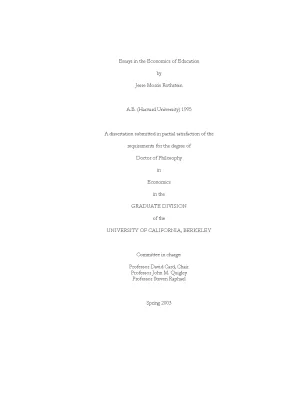
Tải xuống để đọc toàn bộEssays in the Economics of Education by Jesse Morris Rothstein A. (Harvard University) 1995 A dissertation submitted in partial satisfaction of the requirements for the degree of Doctor of Philosophy in Economics in the GRADUATE DIVISION of the UNIVERSITY OF CALIFORNIA, BERKELEY Committee in charge: Professor David Card, Chair Professor John M. Quigley Professor Steven Raphael Spring 2003 UMI Number: 3183857 Copyright 2003 by Rothstein, Jesse Morris All rights reserved. UMI Microform 3183857 Copyright 2005 by ProQuest Information and Learning Company.
All rights reserved. This microform edition is protected against unauthorized copying under Title 17, United States Code. ProQuest Information and Learning Company 300 North Zeeb Road P. Box 1346 Ann Arbor, MI 48106-1346 Essays in the Economics of Education Copyright 2003 by Jesse Morris Rothstein Abstract Essays in the Economics of Education by Jesse Morris Rothstein Doctor of Philosophy in Economics University of California, Berkeley Professor David Card, Chair Three essays consider implications of the strong association between student background characteristics and academic performance.
Chapter One considers the incentives that school choice policies might create for the efficient management of schools. These incentives would be diluted if parents prefer schools with desirable peer groups to those with inferior peers but better policies and instruction. I model a “Tiebout choice” housing market in which schools differ in both peer group and effectiveness. If parental preferences depend primarily on school effectiveness, we should expect both that wealthy parents purchase houses near effective schools and that decentralization of educational governance facilitates this residential sorting.
On the other hand, if the peer group dominates effectiveness in parental preferences, wealthy families will still cluster together in equilibrium but not necessarily at effective schools. I use a large sample of SAT-takers to examine the distribution of student outcomes across schools within metropolitan areas that differ in the structure of educational governance, and find little evidence that parents choose schools for characteristics other than peer groups. 1 This result suggests that competition may not induce improvements in educational productivity, and indeed I do not obtain Hoxby’s (2000a) claimed relationship between school decentralization and student performance. I address this discrepancy in Chapter Two.
Using Hoxby’s own data and specification, as described in her published paper, I am unable to replicate her positive estimate, and I find several reasons for concern about the validity of her conclusions. Chapter Three considers the role of admissions tests in predictions of student collegiate performance. Traditional predictive validity studies suffer from two important shortcomings. First, they do not adequately account for issues of sample selection.
Second, they ignore a wide class of student background variables that covary with both test scores and collegiate success. I propose an omitted variables estimator that is consistent under restrictive but sometimes plausible sample selection assumptions. Using this estimator and data from the University of California, I find that school-level demographic characteristics account for a large portion of the SAT’s apparent predictive power. This result casts doubt on the meritocratic foundations of exam-based admissions rules.
2 To Joanie, for everything. i Contents List of Figures iv List of Tables v Preface vi Acknowledgements x 1. Good Principals or Good Peers? Parental Valuation of School Characteristics, Tiebout Equilibrium, and the Incentive Effects of Competition among Jurisdictions 1 1. Tiebout Sorting and the Role of Peer Groups: Intuition.
A Model of Tiebout Sorting on Exogenous Community Attributes. Graphical illustration of market equilibrium 21 1. Simulation of expanding choice 24 1. Allocative implications and endogenous school effectiveness 27 1.
Measuring market concentration 28 1. Does district structure matter to school-level choice? 30 1. Empirical Results: Choice and Effectiveness Sorting. Regression estimates of linear models 39 1.
Empirical Results: Choice and Average SAT Scores .51 Tables and Figures for Chapter 1. Does Competition Among Public Schools Really Benefit Students? A Reappraisal of Hoxby (2000) 69 2. Data and Methods. Sensitivity to Geographic Match.
Are Estimates From the Public Sector Biased?. Improved Estimation of Appropriate Standard Errors.88 Tables and Figures for Chapter 2. College Performance Predictions and the SAT 97 3. The Validity Model.
Restriction of range corrections 101 3. The logical inconsistency of range corrections 102 3. UC admissions processes and eligible subsample construction 106 3. Validity Estimates: Sparse Model.
Possible Endogeneity of Matriculation, Campus, and Major. Decomposing the SAT’s Predictive Power .119 Tables and Figures for Chapter 3.122 References 128 Appendices 135 Appendix A. Choice and School-Level Stratification. Potential Endogeneity of Market Structure.
Selection into SAT-Taking. Proofs of Results in Chapter 1, Section 3.144 Tables and Figures for Appendices .153 iii List of Figures 1.1 Schematic: Illustrative allocations of effective schools in Tiebout equilibrium, by size of peer effect and number of districts .2 Simulations: Average effectiveness of equilibrium schools in 3- and 10-district markets, by income and importance of peer group.3 Simulations: Slope of effectiveness with respect to average income in Tiebout equilibrium, by market structure and importance of peer group.4 Distribution of district-level choice indices across 318 U.5 Student characteristics and average SAT scores, school level .6 Nonparametric estimates of the school-level SAT score-peer group relationship, by choice quartile.7 “Upper limit” effect of fully decentralizing Miami’s school governance on the across-school distribution of SAT scores .1 Conditional expectation of SAT given HSGPA, three samples.127 B1 Number of school districts over time .160 C1 SAT-taking rates and average SAT scores across MSAs .161 D1 Illustration of single-crossing: Indifference curves in q-h space.161 iv List of Tables 1.1 Summary statistics for U.2 Effect of district-level choice index on income and racial stratification.3 Summary statistics for SAT sample.4 Effect of Tiebout choice on the school-level SAT score-peer group gradient.5 Effect of Tiebout choice on the school-level SAT score-peer group gradient: Alternative specifications.6 Effect of Tiebout choice on the school-level SAT score-peer group gradient: Evidence from the NELS and the CCD.7 Effect of Tiebout choice on average SAT scores across MSAs.1 First-stage models for the district-level choice index .2 Basic models for NELS 8th grade reading score, Hoxby (2000b) and replication .3 Effect of varying the sample definition on the estimated choice effect .4 Models that control for the MSA private enrollment share.5 Estimated choice effect when sample includes private schools .6 Alternative estimators of the choice effect sampling error, base replication sample .7 Estimates of Hoxby’s specification on SAT data .1 Summary statistics for UC matriculant and SAT-taker samples .2 Basic validity models, traditional and proposed models.4 Individual and school characteristics as determinants of SAT scores and GPAs .5 Accounting for individual and school characteristics in FGPA prediction.126 A1 Evidence on choice-stratification relationship: Additional measures.153 A2 Alternative measures of Tiebout choice: Effects on segregation and stratification .154 A3 Effect of district-level choice on tract-level income and racial stratification .155 B1 First-stage models for MSA choice index.156 B2 2SLS estimates of effect of Tiebout choice.157 C1 Sensitivity of individual and school average SAT variation to assumed selection parameter .158 C2 Stability of school mean SAT score and peer group background characteristics over time.158 C3 Effect of Tiebout choice on the school-level SAT score-peer group gradient: Estimates from class rank-reweighted sample.education Preface It is a well-established fact that students’ socioeconomic background has substantial predictive power for their educational outcomes. Children whose parents are highly educated, whose households are stable, and whose families have high incomes substantially outperform their less advantaged peers on every measure of educational output. With nearly as long a pedigree is the idea that these family background effects may operate above the individual level.
The school-level association between average student background and average performance is typically much stronger than is the same association at the individual level. The interpretation of school-level correlations is nevertheless controversial: They may arise because academic outcome measures are noisy, implying that group means are more reliable than are individual scores; because students with unobservably attentive parents disproportionately attend schools that enroll observably advantaged students; because the system of education funding assigns greater resources to schools in wealthy neighborhoods; or because there really are peer effects in educational production. For many purposes, however, one need not know why it is that schools with advantaged students outscore those with disadvantaged students; the fact that they do is itself of substantial importance. This dissertation focuses on two such topics: The competitive impacts of school choice programs, and the design of college admissions rules.
In each case, when I incorporate into the standard analysis the key fact that student composition may function as a signal of student performance (and vice versa), I obtain new vi essays.education insights into the underlying processes and new ways of thinking about the available policy options. The first two chapters consider parents’ choice of schools for their children. The claim that parental choice can create incentives for schools to become more productive is a tenet of the neoclassical analysis of education. It relies crucially on the assumption that parents will choose effective, productive schools.
This is far from obvious—if peer effects are important, parents may be perfectly rational in preferring wealthy, ineffective schools to competitors that are less advantaged but more effective, and even if there are no peer effects, the strong association between school average test scores and student composition may make it difficult for parents to assess a school’s effectiveness. But if parents, in practice even if not by intent, choose schools primarily on the basis of their student composition rather than for their effectiveness, the incentives created for school administrators will be diluted. Chapter One develops this idea and implements tests of the hypothesis that school effectiveness is an important determinant of residential choices among local-monopoly school districts. I model a “Tiebout”-style housing market in which house prices ration access to desirable schools, which may be desirable either because they are particularly effective or because they enroll a desirable set of students.
I develop observable implications of these two hypotheses for the degree of stratification of student test scores across schools, and I look for evidence of these implications in data on the joint distribution of student characteristics and SAT scores. I find strong evidence that schools are an important component of the residential choice and that housing markets create sorting by family income across schools. Tests of the hypothesis that this sorting is driven by parental pursuit vii essays.education of effective schools, however, come up empty. This suggests that residential choice processes–and possibly, although the analogy is not particularly strong, non-residential choice programs like vouchers—are unlikely to create incentives for schools to become more effective.
This result conflicts with a well-known recent result from Hoxby (2000a), who argues that metropolitan areas with less centralized educational governance, and therefore more competition among local school districts, produce better student outcomes at lower cost. In Chapter Two, I attempt to get to the bottom of the discrepancy. I reanalyze a portion of Hoxby’s data, and find reason to suspect the validity of her conclusions. I am unable to reproduce her results, which appear to be quite sensitive to the exact sample and specification used.
I find suggestive evidence, however, that her estimates, from a sample of public school students, are upward biased by selection into private schools. Moreover, an investigation of the sampling variability of Hoxby’s estimates leads to the conclusion that her standard errors are understated, and that even her own point estimates of the competitive effect are not significantly different from zero. Chapter Three turns to a wholly different, but not unrelated, topic, the role of admissions exam scores in the identification of well-prepared students in the college admissions process. The case for using such exams is often made with “validity” studies, which estimate the correlation between test scores and eventual collegiate grades, both with and without controls for high school grade point average.
I argue that there are two fundamental problems with these studies as they are often carried out. First, they do not adequately account for the biases created by estimation from a selected sample of students whose collegiate grades are observable because they were granted admission. I propose and viii essays.
Nội dung được bảo vệ bản quyền — Tải xuống đầy đủ
Trích dẫn luận án này
Jesse Morris Rothstein (2003). Essays in the economics of education [Luận án tiến sĩ, University of California, Berkeley]. LuanAn.net. https://luanan.net/kinh-te/kinh-te-phat-trien/essays-in-the-economics-of-education
Câu hỏi thường gặp
Luận án "Essays in the economics of education" nghiên cứu về vấn đề gì?
Khám phá các bài luận kinh tế về giáo dục: tác động chính sách, hiệu quả đào tạo và bất bình đẳng giáo dục.
Luận án "Essays in the economics of education" được bảo vệ tại trường nào?
Luận án này được bảo vệ tại University of California, Berkeley. Năm bảo vệ: 2003.
Luận án "Essays in the economics of education" thuộc chuyên ngành gì?
Luận án "Essays in the economics of education" thuộc chuyên ngành Economics. Danh mục: Kinh Tế Phát Triển.
Luận án "Essays in the economics of education" có bao nhiêu trang?
Luận án "Essays in the economics of education" có 177 trang. Bạn có thể xem trước một phần tài liệu ngay trên trang web trước khi tải về.
Cách tải luận án "Essays in the economics of education" về máy như thế nào?
Để tải luận án về máy, bạn nhấn nút "Tải xuống ngay" trên trang này, sau đó hoàn tất thanh toán phí lưu trữ. File sẽ được tải xuống ngay sau khi thanh toán thành công. Hỗ trợ qua Zalo: 0559 297 239.