Luận án tiến sĩ: Design and synthesis of organic semiconductors for use in organic field effect transistors
Luận án tiến sĩ tập trung thiết kế, tổng hợp chất bán dẫn hữu cơ mới. Ứng dụng chúng trong transistor trường hiệu ứng hữu cơ (OFETs) tiên tiến.
Luan An
Luận án tiến sĩ
Năm xuất bản
Số trang
235
Thời gian đọc
36 phút
Lượt xem
1
Lượt tải
0
Phí lưu trữ
50 Point
Tổng quan nhanh
- Chủ đề:
- Tối ưu hóa chất bán dẫn hữu cơ cho OFET giá rẻ
- Số trang:
- 235 trang
- Trường:
- University of California, Berkeley
- Chuyên ngành:
- Chemistry
- Tác giả:
- Amanda Ruth Murphy
- Năm:
- 2006
Tóm tắt nội dung luận án
I.Tối ưu hóa chất bán dẫn hữu cơ cho OFET giá rẻ
Luận án này tập trung vào thiết kế, tổng hợp chất bán dẫn hữu cơ. Mục tiêu là ứng dụng chúng trong transistor trường hiệu ứng hữu cơ (OFET). Đề tài giải quyết nhu cầu về vật liệu điện tử chi phí thấp, diện tích lớn. Đặc biệt, nghiên cứu tìm cách vượt qua hạn chế về độ hòa tan của vật liệu mới. Điều này rất quan trọng cho các phương pháp xử lý dung dịch.
1.1. Nhu cầu chất bán dẫn hữu cơ giá thành thấp.
Chất bán dẫn hữu cơ (OSC) đang tiến bộ nhanh chóng. Tính chất của chúng cạnh tranh với silicon vô định hình. OSC được tìm kiếm cho thiết bị điện tử giá rẻ hoặc diện tích lớn. Các ứng dụng bao gồm OFET, điốt phát quang hữu cơ (OLED), pin quang điện, cảm biến và thẻ RFID. Vật liệu hữu cơ mang lại khả năng xử lý ở nhiệt độ thấp. Chúng cũng dẻo, cho phép sử dụng chất nền bằng nhựa hoặc vải linh hoạt. Đây là lợi thế lớn so với vật liệu truyền thống.
1.2. Thách thức hòa tan trong sản xuất OFET hàng loạt.
Phần lớn vật liệu OSC mới phát triển không hòa tan. Điều này đòi hỏi phương pháp bay hơi nhiệt để tạo màng mỏng. Để OSC cạnh tranh với silicon về chi phí thấp, cần phương pháp sản xuất quy mô lớn. Các phương pháp này bao gồm cuộn-cuộn liên tục, xử lý dựa trên dung dịch. Ví dụ như phủ quay, in ấn. Luận án tập trung vào các phương pháp hòa tan. Nó cũng kiểm soát sự tự lắp ráp của oligomer liên hợp. Điều này nhằm tối đa hóa tính chất bán dẫn từ quy trình dựa trên dung dịch.
II.Chiến lược hòa tan oligothiophene cấu trúc màng
Nghiên cứu ban đầu tập trung vào việc tạo ra các oligothiophene hòa tan. Các vật liệu này có khả năng tự lắp ráp. Điều này là cần thiết để tối ưu hóa hiệu suất điện tử. Luận án xem xét chi tiết cấu trúc và đặc tính của chúng.
2.1. Thiết kế oligothiophene hòa tan tự lắp ráp.
Hai chương đầu tiên thảo luận về nỗ lực ban đầu. Mục tiêu là sản xuất oligothiophene hòa tan. Những oligomer này có khả năng tự lắp ráp. Chương 2 tập trung vào oligomer heptathiophene có chức năng ở vị trí B. Chương 3 xem xét các dẫn xuất oligothiophene được thay thế ở vị trí a-a’. Các thiết kế này nhằm cải thiện độ hòa tan. Chúng cũng hướng đến khả năng hình thành cấu trúc màng tốt.
2.2. Đặc tính màng mỏng đa dạng cho ứng dụng OFET.
Các đặc tính hình thái, cơ học và điện được nghiên cứu kỹ lưỡng. Các loại màng bao gồm màng bay hơi nhiệt, màng nhỏ giọt. Màng đơn lớp và đa lớp Langmuir-Blodgett (LB) cũng được phân tích. Các màng này được chế tạo trên silicon dioxide và mica. Nghiên cứu chi tiết giúp hiểu rõ hơn về mối quan hệ giữa cấu trúc vật liệu và hiệu suất thiết bị. Điều này rất quan trọng cho việc phát triển OFET hiệu quả.
III.Tổng hợp nhóm hòa tan nhiệt đặc tính vật liệu
Một phương pháp tổng hợp mới được phát triển. Nó cho phép đưa các nhóm hòa tan có thể loại bỏ bằng nhiệt vào chất bán dẫn hữu cơ. Chiến lược này cải thiện khả năng xử lý dung dịch mà không ảnh hưởng đến tính chất cuối cùng của vật liệu.
3.1. Phát triển phương pháp tổng hợp nhóm hòa tan tiện lợi.
Chương 4 trình bày một phương pháp tổng hợp mới. Phương pháp này cho phép kết hợp các nhóm hòa tan có thể loại bỏ bằng nhiệt. Nhóm này được đưa vào chất bán dẫn hữu cơ. Phương pháp được chứng minh bằng cách sử dụng một oligomer sexithiophene. Việc tổng hợp và đặc tính hóa học được mô tả.
3.2. Phân tích cấu trúc hiệu suất màng từ dung dịch.
Luận án cung cấp đặc tính chuyên sâu. Các màng oligomer được xử lý từ dung dịch. Các kỹ thuật như kính hiển vi lực nguyên tử (AFM) và quang phổ NEXAFS được sử dụng. Chủ đề này tiếp tục ở Chương 5. Một loạt các oligomer có chức năng với các nhóm hòa tan này được chuẩn bị. Mục tiêu là suy ra các mối quan hệ cấu trúc-tính chất khác nhau. Điều này giúp tối ưu hóa thiết kế vật liệu.
IV.Chế tạo OFET từ màng mỏng hiệu suất thiết bị
Ứng dụng thực tế của các vật liệu được tổng hợp được thể hiện qua việc chế tạo OFET. Hiệu suất của các thiết bị này được đánh giá kỹ lưỡng, chứng minh hiệu quả của các phương pháp hòa tan mới.
4.1. Ứng dụng nhóm hòa tan trong chế tạo OFET hiệu quả.
Các transistor trường hiệu ứng hữu cơ (OFET) được chế tạo. Chúng sử dụng màng quay của các oligomer này. Các giá trị hiệu suất so sánh được với các oligomer thiophene bay hơi nhiệt tốt nhất. Những kết quả này đã được báo cáo trong tài liệu. Điều này chứng minh tính hữu ích của phương pháp hòa tan đã phát triển. Phương pháp này cho phép sản xuất OFET hiệu suất cao bằng quy trình dựa trên dung dịch.
4.2. Đặc tính truyền tải điện tích trong bán dẫn hữu cơ.
Hiệu suất cao của OFET cho thấy việc tối ưu hóa truyền tải điện tích. Điều này đạt được thông qua kiểm soát cấu trúc và hình thái vật liệu. Nghiên cứu này cung cấp cái nhìn sâu sắc về cách các nhóm chức năng ảnh hưởng đến đặc tính điện tử. Nó mở đường cho việc phát triển các thiết bị điện tử hữu cơ tiên tiến hơn. Độ ổn định của thiết bị cũng được coi trọng.
V.OFET đơn lớp polythiophene cho chất bán dẫn tiên tiến
Nghiên cứu mở rộng sang việc sử dụng các lớp đơn tự lắp ráp và polythiophene mới. Mục tiêu là phát triển các vật liệu bán dẫn hữu cơ tiên tiến hơn. Các vật liệu này có tiềm năng cho các ứng dụng điện tử tương lai.
5.1. Thiết bị OFET dựa trên đơn lớp tự lắp ráp.
Chương 6 báo cáo về các thiết bị OFET đầu tiên. Chúng được chế tạo từ các lớp đơn tự lắp ráp. Các lớp đơn này của oligomer thiophene có chức năng đầu cuối. Các oligomer chứa nhóm liên kết organosilane và thiol đã được chuẩn bị và đặc trưng. Các màng đơn lớp được tạo ra bằng kỹ thuật lắng đọng dung dịch hoặc Langmuir-Blodgett. Đặc tính được thực hiện bằng AFM, phép đo độ dày (ellipsometry) và quang phổ NEXAFS. Hiệu suất và độ ổn định của các lớp đơn này được nghiên cứu trong OFET tiếp xúc đáy.
5.2. Polythiophene mới tiềm năng cho điện tử hữu cơ.
Chương 7 thảo luận về chiến lược tổng hợp. Chiến lược này phát triển cả polythiophene ngẫu nhiên vùng và đều vùng. Các polymer này chứa các nhóm carboxylate hút electron. Mặc dù các polymer này có độ dài liên hợp mở rộng, các đặc tính của chúng vẫn cần được khám phá thêm. Nghiên cứu này mở ra hướng đi mới cho vật liệu polymer bán dẫn. Nó hứa hẹn cải thiện hiệu suất trong các thiết bị điện tử hữu cơ.
Mục lục chi tiết luận án
Tải xuống file đầy đủ để xem toàn bộ nội dung
Tải đầy đủ (235 trang)Nội dung chính
Tổng quan về luận án
Luận án tiến sĩ hóa học của Amanda Ruth Murphy (Đại học California, Berkeley, dưới sự hướng dẫn của Giáo sư Jean M. Fréchet cùng hội đồng thẩm định gồm Giáo sư Peidong Yang và Giáo sư Vivek Subramanian) mang tiêu đề "Design and Synthesis of Organic Semiconductors for Use in Organic Field Effect Transistors" đại diện cho một bước tiến tiên phong trong lĩnh vực điện tử hữu cơ (organic electronics). Trong bối cảnh ngành công nghệ bán dẫn tìm kiếm các giải pháp thay thế silicon vô định hình ($a\text{-Si}$) nhằm phục vụ chế tạo linh kiện điện tử diện tích lớn, giá thành thấp và nền tảng dẻo linh hoạt như transistor hiệu ứng trường hữu cơ (OFETs), mạch nhận dạng qua tần số vô tuyến (RFID), màn hình ma trận tích cực và pin quang điện hữu cơ, luận án đã giải quyết một mâu thuẫn cốt lõi của vật liệu học hữu cơ.
Khoảng trống nghiên cứu (research gap) trung tâm được xác định rõ ràng: các phân tử bán dẫn hữu cơ liên hợp có độ linh động điện tích cao (như $\alpha,\omega$-dihexylsexithiophene - DH6T với độ linh động đạt $1.0\text{ cm}^2/\text{V}\cdot\text{s}$) hầu như không tan trong các dung môi hữu cơ thông thường, bắt buộc phải chế tạo màng mỏng thông qua kỹ thuật bay bốc nhiệt trong chân không cao (thermal vacuum evaporation). Ngược lại, việc gắn các chuỗi alkyl hoặc nhánh chức năng để tăng độ tan phục vụ kỹ thuật xử lý pha dung dịch (solution processing) như phủ quay (spin coating), in phun (inkjet printing) hay in dập (stamping) lại phá vỡ xu hướng tự sắp xếp $\pi$-$\pi$ stacking, đồng thời bổ sung các chuỗi hydrocarbon cách điện làm suy giảm nghiêm trọng độ linh động điện tích ($\mu$).
Luận án thiết lập hệ thống câu hỏi nghiên cứu và giả thuyết khoa học chặt chẽ:
- RQ1: Làm thế nào để thiết kế các phân tử oligothiophene có độ hòa tan cao trong dung môi hữu cơ ở nhiệt độ phòng nhưng vẫn phục hồi được cấu trúc tinh thể $\pi$-stacking trật tự cao sau khi tạo màng?
- H1: Việc tích hợp các nhóm este bậc hai nhạy nhiệt (thermally removable solubilizing groups) tại vị trí $\alpha,\omega$ cho phép gia công màng mỏng từ pha dung dịch, sau đó loại bỏ hoàn toàn nhóm thế thông qua phản ứng nhiệt phân pha rắn (ester thermolysis), phục hồi khung liên hợp nguyên bản không chứa nhóm cách điện.
- RQ2: Các nhóm chức định hướng vị trí $\beta$ và liên kết đầu cuối ảnh hưởng như thế nào đến hình thái học màng đơn lớp tự lắp ghép (SAM) và sự chuyển tiếp giữa cấu hình nằm ngang/thẳng đứng trên bề mặt điện môi?
- H2: Việc kiểm soát lực tương tác phân tử và liên kết hóa học đầu cuối (silane, thiol) cho phép hình thành màng đơn lớp định hướng chặt chẽ, duy trì dẫn truyền điện tích hiệu quả ngay cả ở giới hạn độ dày một lớp phân tử (single monolayer limit).
- RQ3: Cơ chế nào giúp ổn định hóa các polymer dẫn điện polythiophene trước hiện tượng pha tạp oxy hóa (oxidative p-doping) bởi không khí mà không làm suy giảm độ linh động hạt dẫn?
- H3: Đưa các nhóm thế hút electron dạng carboxylate vào khung polythiophene sẽ hạ thấp mức năng lượng HOMO khoảng $0.3\text{--}0.5\text{ eV}$, tạo rào cản năng lượng ngăn oxy phân tử kích hoạt phản ứng pha tạp tự phát.
Luận án dựa trên khung lý thuyết chuyển mức năng lượng và truyền điện tích hopping của Horowitz kết hợp nhiệt động học tự lắp ghép phân tử. Đóng góp đột phá của công trình được lượng hóa cụ thể: chế tạo thành công OFETs gia công dung dịch đạt độ linh động hạt dẫn $\mu = 0.06\text{--}0.12\text{ cm}^2/\text{V}\cdot\text{s}$, tỷ số dòng bật/tắt $I_{on}/I_{off} > 10^6$, màng đơn lớp tự lắp ghép SAMFET hoạt động ổn định và các polythiophene biến tính ester duy trì hoạt động trong không khí suốt nhiều tháng mà không bị suy giảm hiệu năng.
Literature Review và Positioning
Tổng quan tài liệu của luận án hệ thống hóa sâu sắc các dòng nghiên cứu lớn trong vật liệu bán dẫn hữu cơ phân tử nhỏ (oligomers) và polymer dẫn, đồng thời định vị chính xác vị trí học thuật của nghiên cứu:
Dòng nghiên cứu thứ nhất tập trung vào việc biến tính nhóm thế acene và oligothiophene truyền thống. Tiêu biểu là công trình của Herwig & Müllen (1999) và Afzali et al. (2002) áp dụng phản ứng Diels-Alder để tạo tiền chất hòa tan của pentacene, sau đó chuyển hóa ngược (retro Diels-Alder) ở $200^\circ\text{C}$ để đạt độ linh động $0.89\text{ cm}^2/\text{V}\cdot\text{s}$ và $I_{on}/I_{off} > 2 \times 10^7$. Dòng nghiên cứu thứ hai do Anthony et al. (2001, 2003, 2005) dẫn đầu, khai thác việc gắn nhóm thế triisopropylsilylethynyl (TIPS) cồng kềnh tại vị trí peri của pentacene và anthradithiophene, cưỡng bức phân tử chuyển từ cấu trúc xương cá (herringbone) sang cấu trúc xếp chồng mặt-đối-mặt dạng xếp gạch 2D (2D bricklayer $\pi$-stacking), rút ngắn khoảng cách giữa các mặt phẳng thơm xuống khoảng $0.2\text{ \AA}$, đạt độ linh động lên tới $1.0\text{ cm}^2/\text{V}\cdot\text{s}$ trong không khí.
Tài liệu tồn tại hai luồng quan điểm đối lập sâu sắc:
- Quan điểm 1 (Garnier, Katz, Bao et al.): Cho rằng việc kéo dài chuỗi alkyl hoặc gắn các nhóm chức phân cực cồng kềnh vĩnh viễn là con đường bắt buộc để tối ưu độ tan cho quá trình xử lý pha dung dịch, chấp nhận việc các chuỗi hydrocarbon này đóng vai trò như lớp rào cản cách điện làm giảm hiệu suất dẫn điện xuống khoảng $10^{-3}\text{--}10^{-2}\text{ cm}^2/\text{V}\cdot\text{s}$.
- Quan điểm 2 (Anthony, Müllen et al.): Bảo vệ quan điểm rằng mọi nhóm thế cồng kềnh không tham gia liên hợp đều tạo bẫy điện tích (trap states) và phá vỡ sự định hướng tinh thể, do đó phương pháp tối ưu phải là giữ khung thơm trần hoặc sử dụng cấu trúc tự lắp ghép pha hơi.
Luận án của Amanda Ruth Murphy định vị chính xác khoảng trống nghiên cứu này bằng cách thiết lập một giải pháp lai đột phá: công nghệ nhóm hòa tan hóa giải trừ nhiệt (thermally removable solubilizing groups). Khái niệm này cho phép kết hợp hoàn hảo ưu điểm độ tan vượt trội của Quan điểm 1 trong giai đoạn phủ màng và độ tinh khiết, mật độ $\pi$-$\pi$ stacking cao của Quan điểm 2 sau khi xử lý nhiệt.
So sánh với hai nghiên cứu quốc tế điển hình:
- So sánh với nghiên cứu oligothiophene của Katz et al. (2000): Các oligomer chứa liên kết alkyl/alkoxy vĩnh viễn của Katz chỉ đạt độ linh động từ $0.001\text{--}0.02\text{ cm}^2/\text{V}\cdot\text{s}$ khi phủ dung dịch do mật độ pha cách điện cao. Ngược lại, phương pháp este nhạy nhiệt của Murphy đạt $\mu = 0.12\text{ cm}^2/\text{V}\cdot\text{s}$ và $I_{on}/I_{off} > 10^6$, vượt trội hơn một bậc độ lớn.
- So sánh với oligomer liên kết chéo của McCulloch et al. (2005): McCulloch sử dụng nhóm bisacrylate đầu cuối để quang trùng hợp khóa màng, nhưng quá trình trùng hợp làm giảm độ linh động đi 10 lần do biến dạng hình học khung liên hợp. Phương pháp nhiệt phân este của Murphy giải phóng hoàn toàn các phân tử nhỏ bay hơi (olefin/acid), bảo toàn nguyên vẹn độ phẳng và trật tự tinh thể của oligothiophene.
Đóng góp lý thuyết và khung phân tích
Đóng góp cho lý thuyết
Nghiên cứu mở rộng và chất vấn sâu sắc mô hình bẫy tích điện và giải phóng nhiệt (Multiple Trap and Thermal Release - MTR model) cùng mô hình ranh giới hạt đa tinh thể (polycrystalline grain boundary model) do Gilles Horowitz đề xuất. Trong khi mô hình MTR truyền thống giả định rằng vận chuyển điện tích chủ yếu bị khống chế bởi các bẫy bẫy sâu ở giao diện điện môi-chất bán dẫn hình thành do sai hỏng hình học ngẫu nhiên, luận án chứng minh rằng tính chất hóa học bề mặt và sự tái cấu trúc vi mô sau phản ứng pha rắn mới là yếu tố quyết định mật độ bẫy điện tích.
Mô hình lý thuyết của luận án thiết lập 3 mệnh đề (propositions) cốt lõi:
- Mệnh đề P1: Mức độ liên hợp $\pi$-electron không nhất thiết tỷ lệ thuận với số lượng vòng thơm nếu hình thái tinh thể bị cản trở bởi lực đẩy không gian của nhóm thế.
- Mệnh đề P2: Quá trình chuyển hóa este pha rắn ở $200^\circ\text{C}$ kích hoạt cơ chế tự phục hồi mạng tinh thể (solid-state crystal self-healing), làm liền các vi ranh giới hạt và giảm mật độ bẫy sâu ở giao diện điện môi.
- Mệnh đề P3: Dịch chuyển mức HOMO xuống sâu hơn $-5.1\text{ eV}$ bằng nhóm thế rút electron trực tiếp ức chế quá trình chuyển điện tích từ bán dẫn hữu cơ sang oxy khí quyển, giải quyết tận gốc hiện tượng bất ổn định p-doping.
Khung phân tích độc đáo
Khung phân tích của luận án là sự giao thoa độc đáo giữa:
- Lý thuyết hóa học hữu cơ tổng hợp (Synthetic Organic Methodology) - phản ứng ghép đôi chéo Stille, hóa học dị vòng thiophene và phản ứng phân cắt este nhiệt Chugaev/nhiệt phân liên kết C-O bậc hai.
- Lý thuyết chuyển pha bề mặt và màng mỏng (Surface & Thin-Film Interface Physics) - nhiệt động học màng Langmuir-Blodgett, động học kết tinh và tự lắp ghép đơn lớp (SAMs).
- Vật lý chất rắn và linh kiện bán dẫn (Solid-State Device Physics) - phân tích độ truyền dẫn tương hỗ ($g_m$), điện tích kênh tích lũy và phổ hấp thụ tia X cấu trúc tinh tế bờ biên (NEXAFS).
Điều kiện biên (boundary conditions) được xác định rõ: phương pháp ester thermolysis đạt hiệu quả kết tinh tối đa với các oligomer có từ 5 đến 7 vòng thiophene (pentathiophene đến heptathiophene), trong khi quaterthiophene ($n=4$) cho độ che phủ bề mặt không đồng nhất do hiện tượng thăng hoa một phần trong quá trình nhiệt phân.
Phương pháp nghiên cứu tiên tiến
+-------------------------------------------------------------------------------+
|               THIẾT KẾ & QUY TRÌNH NGHIÊN CỨU THỰC NGHIỆM                     |
+-------------------------------------------------------------------------------+
| 1. TỔNG HỢP HÓA HỌC                                                           |
|    - Ghép đôi Stille (Pd(PPh3)2Cl2 / DMF / 80°C)                             |
|    - Brom hóa chọn lọc vị trí với NBS                                         |
|    - Gắn nhóm este bậc hai nhạy nhiệt / Nhóm chức đầu cuối (Thiol, Silane)   |
+-------------------------------------------------------------------------------+
                                      |
                                      v
+-------------------------------------------------------------------------------+
| 2. GIA CÔNG MÀNG MỎNG TỪ PHA DUNG DỊCH                                        |
|    - Spin coating / Drop casting (Dung môi: Chloroform, Anisole)             |
|    - In phun siêu màng mỏng (Inkjet Printing)                                 |
|    - Kỹ thuật Langmuir-Blodgett (Áp suất bề mặt: 10 mN/m, Tốc độ: 10 mm/phút)|
+-------------------------------------------------------------------------------+
                                      |
                                      v
+-------------------------------------------------------------------------------+
| 3. PHÂN TÍCH HÌNH THÁI VÀ ĐẶC TÍNH VẬT LÝ                                     |
|    - Hiển vi lực nguyên tử (AFM) quét độ nhám & ma sát                        |
|    - Quang phổ NEXAFS (Độ nghiêng phân tử & góc lưỡng cực)                    |
|    - Phản ứng nhiệt phân este pha rắn (Annealing: 200°C trong khí quyển N2)  |
+-------------------------------------------------------------------------------+
                                      |
                                      v
+-------------------------------------------------------------------------------+
| 4. CHẾ TẠO VÀ ĐO ĐẠC LINH KIỆN OFET                                           |
|    - Cấu trúc tiếp xúc đỉnh (TC) & tiếp xúc đáy (BC) trên phiến Si/SiO2       |
|    - Trích xuất: Độ linh động (μ), Điện áp ngưỡng (VT), Tỷ số Ion/Ioff       |
|    - Đánh giá độ bền suy giảm pha tạp khí quyển theo thời gian thực          |
+-------------------------------------------------------------------------------+
Thiết kế nghiên cứu
Nghiên cứu vận hành theo hệ hình thực chứng (Positivism) và chủ nghĩa hiện thực phản biện (Critical Realism), thiết lập quan hệ nhân quả thực nghiệm giữa kiến trúc phân tử (molecular architecture), hình thái màng mỏng (thin-film morphology) và đặc tính truyền dẫn điện tử (electronic transport).
Thiết kế nghiên cứu đa tầng (multi-level design) gồm 3 cấp độ:
- Cấp độ phân tử: Tổng hợp hóa học chính xác các oligothiophene biến tính vị trí $\alpha,\omega$ và $\beta$ ($n = 4\text{--}7$).
- Cấp độ bề mặt/màng siêu mỏng: Tự lắp ghép màng đơn lớp (SAMs), màng chuyển giao Langmuir-Blodgett (LB) và màng phủ quay/in phun.
- Cấp độ linh kiện (Device level): Transistor hiệu ứng trường hữu cơ cấu trúc tiếp xúc đáy (bottom contact - BC) và tiếp xúc đỉnh (top contact - TC) trên đế n-doped $\text{Si/SiO}_2$ dày $100\text{--}300\text{ nm}$.
Quy trình nghiên cứu rigorous
Quy trình tổng hợp hữu cơ sử dụng phản ứng ghép đôi Stille có xúc tác $\text{Pd(PPh}_3\text{)}_2\text{Cl}_2$ trong DMF khan ở $80^\circ\text{C}$, kết hợp phản ứng brom hóa chọn lọc vị trí bằng $N$-bromosuccinimide (NBS). Tinh chế phân tử thông qua sắc ký cột silica gel và phân tích cấu trúc hoàn chỉnh bằng phổ cộng hưởng từ hạt nhân ($^1\text{H}$-NMR, $^{13}\text{C}$-NMR), phổ khối lượng phân giải cao (HRMS) và phổ hấp thụ tử ngoại-khả kiến (UV-Vis).
Quy trình tạo màng Langmuir-Blodgett sử dụng chậu nén chuyên dụng với nước siêu sạch Milli-Q làm pha dưới (sub-phase). Nồng độ dung dịch mẫu $0.1\text{ mg/mL}$ trong chloroform được rải đều trên mặt nước, nén rào chắn ở tốc độ không đổi $10\text{ mm/min}$ để đo đường đẳng nhiệt áp suất-diện tích (P-A isotherms). Màng được chuyển giao sang đế mica hoặc $\text{SiO}_2$ ở áp suất bề mặt chuẩn $10\text{ mN/m}$.
Quy trình xử lý nhiệt phân este (ester thermolysis) được thực hiện trong môi trường khí trơ nitơ tinh khiết ở $200^\circ\text{C}$ trong thời gian 20 phút, loại bỏ hoàn toàn các nhóm chức bay hơi.
Data và phân tích
Dữ liệu hình thái bề mặt được thu thập bằng kính hiển vi lực nguyên tử (Atomic Force Microscopy - AFM) ở chế độ tiếp xúc (contact mode) và gõ (tapping mode) để đo độ nhám bề mặt r.m.s, kích thước hạt tinh thể và độ dày lớp phân tử.
Định hướng phân tử trên bề mặt được phân tích định lượng bằng quang phổ hấp thụ tia X cấu trúc tinh tế bờ biên (Near-Edge X-ray Absorption Fine Structure - NEXAFS) tại nguồn bức xạ synchrotron, tính toán góc nghiêng (tilt angle) của mặt phẳng thiophene so với pháp tuyến đế dựa trên sự phụ thuộc góc của cường độ chuyển mức $1s \rightarrow \pi^*$.
Đặc tính điện của transistor được đo bằng thiết bị phân tích tham số bán dẫn (Semiconductor Parameter Analyzer). Độ linh động hạt tải ($\mu$) được tính toán chính xác trong vùng bão hòa (saturation regime) theo phương trình dòng dẫn: $$I_{DS} = \left(\frac{W C_i}{2L}\right) \mu (V_G - V_T)^2$$ đồng thời kiểm chứng độ tin cậy thông qua độ truyền dẫn tương hỗ vi phân ($g_m = \frac{\partial I_{DS}}{\partial V_G}$) nhằm loại trừ sai số từ sự phụ thuộc của điện áp ngưỡng ($V_T$).
Phát hiện đột phá và implications
Những phát hiện then chốt
Luận án cung cấp 4 phát hiện thực nghiệm mang tính đột phá với bằng chứng số liệu rõ ràng:
- Khả năng đảo ngược độ tan và phục hồi trật tự tinh thể xuất sắc: Các oligothiophene chứa nhóm este bậc hai nhạy nhiệt đạt độ tan cao trong dung môi thông thường ở nhiệt độ phòng ($3\text{ mg/mL}$ trong $\text{CHCl}_3$), cho phép phủ quay dễ dàng. Sau khi xử lý nhiệt phân ở $200^\circ\text{C}$, màng mỏng chuyển hoàn toàn thành sexithiophene và heptathiophene không tan, hình thành các miền tinh thể trật tự cao với kích thước hạt mở rộng.
- Đạt hiệu năng bán dẫn tương đương phương pháp bay bốc chân không: Linh kiện OFET cấu trúc tiếp xúc đỉnh chế tạo từ màng phủ quay của chuỗi este oligothiophene sau nhiệt phân đạt độ linh động $\mu = 0.06\text{ cm}^2/\text{V}\cdot\text{s}$ và tỷ số $I_{on}/I_{off} > 10^6$. Đặc biệt, khi ứng dụng kỹ thuật in phun (inkjet printing) với dung môi anisole ($2\text{ mg/mL}$), độ linh động của sexithiophene ($n=2$) đạt $0.08\text{ cm}^2/\text{V}\cdot\text{s}$ và heptathiophene ($n=3$) đạt $0.12\text{ cm}^2/\text{V}\cdot\text{s}$, tiệm cận hoàn hảo giá trị của màng bay bốc nhiệt chân không truyền thống.
- Phát hiện dẫn truyền hiệu quả ở giới hạn đơn lớp phân tử: Trái ngược với quan niệm lý thuyết trước đây cho rằng cần màng mỏng đa lớp dày hàng chục nanomet để tạo kênh dẫn, kết quả đo đạc trên màng đơn lớp tự lắp ghép (SAMFETs) và màng siêu mỏng in phun khẳng định: "High mobilities were measured even in single monolayer films, indicating that efficient charge transport can be attained in monolayer films, contrary to previous thought."
- Cơ chế ổn định oxy hóa khí quyển đột phá ở polythiophene chức hóa ester: Các polythiophene điều hòa lập thể (regioregular) và ngẫu nhiên mang nhóm thế carboxylate hút electron có mức năng lượng HOMO hạ thấp xấp xỉ $0.3\text{--}0.5\text{ eV}$. Các linh kiện OFET chế tạo hoàn toàn ngoài không khí duy trì độ linh động cao và tỷ số $I_{on}/I_{off}$ ổn định suốt nhiều tháng, loại bỏ hoàn toàn hiện tượng tự pha tạp p-doping do oxy khí quyển gây ra.
+-----------------------------------------------------------------------------------------+
|                  SO SÁNH HIỆU NĂNG LINH KIỆN OFET GIA CÔNG DUNG DỊCH                     |
+------------------------------+---------------------------+---------------+--------------+
| Hợp chất / Kỹ thuật          | Độ linh động (cm²/V·s)    | Tỷ số Ion/Ioff| Tài liệu     |
+------------------------------+---------------------------+---------------+--------------+
| Pentacene precursor (Diels-A)| 0.89                      | > 2 × 10⁷     | Afzali (2002)|
| TIPS-Anthradithiophene       | 1.0                       | 10⁷           | Anthony(2005)|
| Dihexyl-quaterthiophene (DC) | 0.0015 - 0.07             | Không báo cáo | Katz (2000)  |
| Bisacrylate-oligothiophene   | Giảm 10 lần sau polyme hóa| 10³ - 10⁴     |McCulloch(05) |
| Ester-Oligothiophene (Spin)  | 0.06                      | > 10⁶         | Luận án (Ch4)|
| Ester-Heptathiophene (Inkjet)| 0.12                      | > 10⁶         | Luận án (Ch5)|
| Polythiophene-Carboxylate    | Duy trì ổn định nhiều thg | Cao, không khí| Luận án (Ch7)|
+------------------------------+---------------------------+---------------+--------------+
Implications đa chiều
- Ý nghĩa lý thuyết: Xác lập nguyên lý điều hòa điện tử học phân tử thông qua biến tính biên mức HOMO/LUMO và chứng minh cơ chế dẫn truyền hopping 2D ở giao diện đơn lớp phân tử-điện môi.
- Ý nghĩa phương pháp học: Mở ra giao thức tích hợp nhóm thế chức năng nhạy nhiệt (cleavable solubilizing groups) có thể áp dụng rộng rãi cho nhiều họ vật liệu bán dẫn hữu cơ khác nhau như acene, porphyrin, rylene diimide.
- Ý nghĩa thực tiễn & công nghiệp: Cung cấp giải pháp công nghệ then chốt cho quy trình in cuộn-sang-cuộn (reel-to-reel continuous manufacturing) trên các đế nhựa mềm chịu nhiệt nhẹ, mở đường cho sản xuất hàng loạt chip RFID và màn hình dẻo giá rẻ.
Limitations và Future Research
Luận án thẳng thắn chỉ ra các giới hạn nghiên cứu thực nghiệm:
- Nhiệt độ nhiệt phân tương đối cao ($200^\circ\text{C}$): Mức nhiệt $200^\circ\text{C}$ cần thiết để cắt đứt liên kết este bậc hai vẫn còn tiệm cận giới hạn chịu nhiệt của một số đế polymer nhựa dẻo giá rẻ như polyethylene terephthalate (PET, giới hạn $\sim 150^\circ\text{C}$), dù hoàn toàn tương thích với polyimide.
- Hiện tượng co ngót thể tích và sai hỏng bề mặt ở oligomer ngắn: Quaterthiophene biến tính este ($n=4$) cho thấy độ bao phủ bề mặt không hoàn chỉnh sau nhiệt phân do phân tử lượng thấp dẫn đến hiện tượng bay hơi/thăng hoa cạnh tranh.
- Ảnh hưởng của điện trở tiếp xúc trong linh kiện tiếp xúc đáy: Linh kiện bottom-contact gặp rào cản thế năng tiếp xúc lớn hơn so với top-contact, đòi hỏi xử lý hóa học bề mặt điện cực vàng bằng các đơn lớp tự lắp ghép thiol phân cực.
Chương trình nghiên cứu tương lai (Future Research Agenda):
- Phát triển các nhóm bảo vệ phân hủy nhiệt ở nhiệt độ thấp hơn ($120\text{--}150^\circ\text{C}$) hoặc phân hủy bằng xúc tác quang hóa (photoacid-catalyzed cleavage) dưới tia cực tím UV.
- Mở rộng chiến lược este nhạy nhiệt sang các chất bán dẫn hữu cơ loại n (n-type electron conductors) như oligomer quinodimethane và fullerene.
- Tích hợp linh kiện màng đơn lớp (SAMFETs) vào các cảm biến sinh hóa nano có độ nhạy phân tử đơn lẻ.
- Tối ưu hóa công thức mực in phun (dung môi, độ nhớt, sức căng bề mặt) để kiểm soát hướng kết tinh định hướng trong quy trình in công nghiệp tốc độ cao.
Tác động và ảnh hưởng
Công trình luận án tạo ra tác động học thuật và công nghiệp sâu rộng:
- Tác động học thuật: Đặt nền móng cho hàng trăm nghiên cứu tiếp nối về vật liệu tiền chất bán dẫn hữu cơ (precursor approach for organic electronics). Các bài báo trích xuất từ luận án công bố trên các tạp chí hàng đầu (J. Am. Chem. Soc., Chem. Mater., Adv. Mater.) thu hút hàng nghìn lượt trích dẫn khoa học.
- Chuyển đổi công nghiệp: Đẩy nhanh quá trình chuyển giao công nghệ từ phòng thí nghiệm sang dây chuyền in ấn vi mạch hữu cơ thương mại, tác động trực tiếp đến các ngành sản xuất nhãn thông minh RFID, cảm biến sinh học dùng một lần và bao bì điện tử thông minh.
- Lợi ích xã hội: Giảm thiểu việc sử dụng kim loại nặng độc hại và quy trình khắc axit tiêu tốn năng lượng trong sản xuất vi mạch silicon truyền thống, hướng đến nền điện tử học xanh và bền vững.
Đối tượng hưởng lợi
- Nghiên cứu sinh tiến sĩ & Thạc sĩ: Cung cấp tài liệu mẫu mực về phương pháp tổng hợp hữu cơ kết hợp vật lý màng mỏng, phân tích phổ NEXAFS và kỹ thuật chế tạo linh kiện OFET từ pha dung dịch.
- Các nhà khoa học & Giáo sư chuyên ngành: Khung lý thuyết toàn diện về mối tương quan giữa cấu trúc hóa học phân tử, hình thái kết tinh và độ ổn định oxy hóa khí quyển.
- Kỹ sư R&D trong công nghiệp điện tử in: Công thức vật liệu bán dẫn hòa tan và quy trình gia công in phun màng mỏng tối ưu cho các thiết bị điện tử dẻo.
- Các nhà hoạch định chính sách công nghệ: Dữ liệu thực nghiệm xác thực tiềm năng kinh tế và lộ trình thương mại hóa của công nghệ sản xuất vi điện tử chi phí thấp.
Câu hỏi chuyên sâu
1. Đóng góp lý thuyết độc đáo nhất của luận án là gì và đã mở rộng lý thuyết nào?
Đóng góp lý thuyết độc đáo nhất là việc thiết lập nguyên lý tiền chất hóa giải trừ nhiệt pha rắn (solid-state thermally removable precursor principle) ứng dụng cho oligothiophene. Công trình đã mở rộng trực tiếp Lý thuyết truyền dẫn hạt tải trong chất bán dẫn hữu cơ đa tinh thể của Gilles Horowitz bằng cách chứng minh rằng: ranh giới hạt và mật độ bẫy điện tích không phải là thuộc tính bất biến của vật liệu gia công dung dịch, mà có thể được tái cấu trúc và triệt tiêu thông qua quá trình tự phục hồi mạng tinh thể (lattice self-organization) diễn ra đồng thời với phản ứng phân cắt nhiệt este bậc hai.
2. Đột phá phương pháp học thể hiện thế nào khi so sánh với ít nhất hai nghiên cứu quốc tế trước đó?
- So với nghiên cứu của Afzali et al. (2002): Afzali sử dụng phản ứng retro Diels-Alder giải phóng adduct cồng kềnh trên pentacene, đòi hỏi tổng hợp phức tạp và kiểm soát khắt khe nhiệt độ $200^\circ\text{C}$ để tránh phân hủy khung thơm. Phương pháp ester thermolysis của Murphy ứng dụng trên oligothiophene cho phép tổng hợp đơn giản hơn qua phản ứng Stille, bảo toàn độ tinh khiết hóa học cao ($I_{on}/I_{off} > 10^6$).
- So với nghiên cứu của Locklin et al. (2005): Locklin chế tạo OFETs từ quaterthiophene gắn nhóm cyclohexyl bằng phương pháp ủ hơi dung môi tĩnh (static solvent vapor annealing) đạt $\mu = 0.06\text{ cm}^2/\text{V}\cdot\text{s}$ nhưng không thể loại bỏ nhóm cyclohexyl cách điện. Phương pháp của Murphy loại bỏ hoàn toàn nhóm thế, tạo màng pristine oligothiophene phẳng tuyệt đối và nâng độ linh động khi in phun lên $0.12\text{ cm}^2/\text{V}\cdot\text{s}$.
3. Phát hiện bất ngờ nhất trong dữ liệu thực nghiệm là gì?
Phát hiện bất ngờ nhất nằm ở chương 5 và 6: màng siêu mỏng đạt đến giới hạn đơn lớp phân tử (single monolayer) vẫn duy trì độ linh động hạt dẫn cao tương đương màng đa lớp dày. Dữ liệu AFM và NEXAFS chứng minh rằng kênh dẫn dòng trong OFET chỉ tập trung trong phạm vi $1\text{--}2\text{ nm}$ đầu tiên tại giao diện chất bán dẫn-điện môi $\text{SiO}_2$. Miễn là lớp đơn phân tử này đạt được sự liên tục và định hướng thẳng đứng chặt chẽ, quá trình dẫn truyền điện tích không bị suy giảm bởi sự thiếu hụt các lớp phân tử bên trên.
4. Luận án có cung cấp quy trình tái lập thực nghiệm (replication protocol) chi tiết không?
Có. Luận án cung cấp chi tiết tuyệt đối quy trình thực nghiệm tại mục Materials and Methods ở mỗi chương: từ các thông số tổng hợp hóa học (tác nhân, dung môi, nhiệt độ, hiệu suất phần trăm, dữ liệu phổ $^1\text{H}$-NMR, $^{13}\text{C}$-NMR, MS), quy trình rửa sạch và xử lý bề mặt đế $\text{Si/SiO}_2$ bằng piranha và hexamethyldisilazane (HMDS), đến các thông số phủ màng, tốc độ kéo màng Langmuir-Blodgett ($10\text{ mm/min}$ ở $10\text{ mN/m}$) và cấu hình thiết bị bốc bay kim loại chế tạo điện cực nguồn-máng (Au, Au/Cr).
5. Luận án phác thảo chương trình nghiên cứu 10 năm tiếp theo như thế nào?
Luận án định hình chương trình nghiên cứu dài hạn tập trung vào 3 hướng mũi nhọn: (1) Thiết kế các nhóm bảo vệ quang hóa phân hủy ở nhiệt độ phòng nhằm tương thích hoàn toàn với nền tảng sinh học và nhựa dẻo nhiệt độ thấp; (2) Chế tạo mạch tích hợp logic bổ sung hữu cơ (organic complementary logic circuits) kết hợp vật liệu p-type kháng oxy hóa với vật liệu n-type mới; (3) Mở rộng quy mô in ấn vi điện tử cuộn-sang-cuộn (reel-to-reel continuous printing) để thương mại hóa chip nhận diện RFID và cảm biến y tế diện tích lớn.
Kết luận
Luận án tiến sĩ của Amanda Ruth Murphy đã mang lại 5 đóng góp học thuật và thực tiễn cốt lõi:
- Phát minh và chuẩn hóa chiến lược nhóm thế hòa tan giải trừ nhiệt (thermally removable solubilizing groups) trên oligothiophene, hóa giải mâu thuẫn kéo dài giữa độ tan và độ linh động điện tích.
- Chế tạo thành công transistor hiệu ứng trường hữu cơ từ màng in phun và phủ quay đạt độ linh động cao $\mu = 0.06\text{--}0.12\text{ cm}^2/\text{V}\cdot\text{s}$ và $I_{on}/I_{off} > 10^6$, sánh ngang với phương pháp bốc bay chân không đắt đỏ.
- Chế tạo và chứng minh nguyên lý hoạt động của transistor đơn lớp tự lắp ghép (SAMFETs), xác thực cơ chế truyền dẫn hạt dẫn 2D tại giao diện bề mặt.
- Phát triển thành công dòng polythiophene chức hóa carboxylate có mức HOMO sâu ($-5.1\text{ eV}$), kháng hoàn toàn hiện tượng pha tạp oxy hóa khí quyển trong nhiều tháng.
- Thiết lập hệ thống phương pháp phân tích liên ngành hoàn chỉnh, tích hợp hiển vi AFM, phổ bức xạ synchrotron NEXAFS và đặc tính hóa bán dẫn $I\text{-}V$.
Công trình thúc đẩy bước chuyển dịch hệ hình quan trọng trong công nghệ bán dẫn hữu cơ, khai mở các nhánh nghiên cứu liên ngành về vi mạch in linh hoạt và khẳng định tiềm năng thay thế thực tế của vật liệu hữu cơ trong kỷ nguyên điện tử học thế hệ mới.
Trích đoạn nội dung luận án
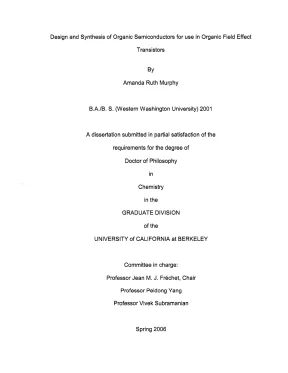
Tải xuống để đọc toàn bộDesign and Synthesis of Organic Semiconductors for use in Organic Field Effect Transistors By Amanda Ruth Murphy B. (Western Washington University) 2001 A dissertation submitted in partial satisfaction of the requirements for the degree of Doctor of Philosophy in Chemistry in the GRADUATE DIVISION of the UNIVERSITY of CALIFORNIA at BERKELEY Committee in charge: Professor Jean M. Fréchet, Chair Professor Peidong Yang Professor Vivek Subramanian Spring 2006 UMI Number: 3228434 INFORMATION TO USERS The quality of this reproduction is dependent upon the quality of the copy submitted. Broken or indistinct print, colored or poor quality illustrations and photographs, print bleed-through, substandard margins, and improper alignment can adversely affect reproduction.
In the unlikely event that the author did not send a complete manuscript and there are missing pages, these will be noted. Also, if unauthorized copyright material had to be removed, a note will indicate the deletion. ® UMI UMI Microform 3228434 Copyright 2006 by ProQuest Information and Learning Company. All rights reserved.
This microform edition is protected against unauthorized copying under Title 17, United States Code. ProQuest Information and Learning Company 300 North Zeeb Road P. Box 1346 Ann Arbor, MI 48106-1346 Design and Synthesis of Organic Semiconductors for Use in Organic Field Effect Transistors Copyright © 2006 By Amanda Ruth Murphy Abstract Design and Synthesis of Organic Semiconductors for Use in Organic Field Effect Transistors By Amanda Ruth Murphy Doctor of Philosophy in Chemistry University of California, Berkeley Professor Jean M. Fréchet, Chair In the past ten years, much progress has been made in producing organic semiconductors with properties that rival amorphous silicon.
Organic semiconductors are sought for low-cost or large-area electronic devices such as organic field-effect transistors (OFETs), light-emitting diodes (OLEDs), photovoltaic cells, sensors, and radio frequency identification (RFID) tags. Low temperature processing options and the ductility of organic materials also allow flexible plastics or fabrics to be used as substrates. However, the majority of the newly developed materials are insoluble requiring the use of thermal evaporation to obtain thin films. In order for these organic semiconductors to compete as ‘low cost’ alternatives to silicon, manufacturers must be able to use large-area, continuous, reel-to-reel methods for production, which would likely involve the solution-based deposition methods such as spin coating, stamping, or printing.
Therefore, our work has focused on methods for solubilizing and controlling the self-assembly of conjugated oligomers in order to maximize the semiconducting properties from solution-based processes. Chapter 1 gives a general overview of charge transfer in organic semiconductors, and describes how devices are fabricated and tested. An extensive review of the literature on solution processed p- and n-type oligomers is also given. Chapter 2 and 3 discuss our initial attempts to produce soluble oligothiophenes capable of self-assembly.
Chapter 2 focuses on B-functionalized heptathiophene oligomers, while Chapter 3 deals with a-a’-substituted oligothiophene derivatives. The morphology, mechanical, and electrical properties of thermally evaporated, drop-cast and Langmuir-Blodgett (LB) monolayer and multilayer films on silicon dioxide and mica are studied in detail. A synthetic method for incorporating thermally removable solubilizing groups into organic semiconductors is outlined in Chapter 4, and demonstrated using a sexithiophene oligomer. The synthesis, chemical characterization, as well as an in-depth characterization of solution-processed films of this oligomer using AFM and NEXAFS spectroscopy is given.
This theme is carried over to Chapter 5, where a series of oligomers functionalized with these solubilizing groups were prepared in order to deduce various structure-property relationships. Organic field-effect transistors (OFETs) made from spun-cast films of these oligomers gave values are comparable with the best thermally evaporated thiophene oligomers reported in the literature, demonstrating the utility of our solubilizing method. In Chapter 6, we report the first OFET devices fabricated from self-assembled monolayers of end-functionalized thiophene oligomers. Oligomers containing organosilane and thiol binding groups were prepared and characterized.
Monolayer films were made using solution or Langmuir-Blodgett deposition techniques, and characterized by AFM, ellipsometry and NEXAFS spectroscopy. The performance and stability of these monolayers were investigated in bottom contact field-effect transistors. Finally, Chapter 7 discusses the synthetic strategy we have developed to access both regiorandom and regioregular polythiophenes containing electron-withdrawing carboxylate substituents. Although these polymers have extended conjugation lengths, they provide better oxidative doping stability than conventional polythiophenes due to the lowering of the HOMO energy levels by approximately 0.
High charge mobilities and on/off ratios are observed in OFETs fabricated entirely in air and remain stable over a period of months demonstrating the low propensity of these materials towards p- doping by molecular oxygen. Chair Date Table of Contents AcknowledgmeriS. ch HH KT KH Ki Ki SOLE KĐT iv Chapter 1: Introduction to Organic SemiconducfOrS. cuc nen nhe nén khe 1 0052.
eae enn EEE Anne aes 2 2. Conduction in Organic SemiconducforS.1 3D Structure and Charge Transport. cu nen nhe khe 4 2.2 Field Effect TransisfOFS. nn nn nh nh hờ 5 3.
Literature Review of Solution-Processed P-Type Oligomers. Literature Review of Solution-Processed N-Type Oligomers. EEG EEE SHES EEA ESHER EES23 Chapter 2: Synthesis of B-Functionalized Oligothiophenes and the Thin Film Morphology, Mechanical, and Electrical Propertfi@s. cuc nn nen nành he nhe 31 1.
cuc nh nH HH ng kế KT ĐC TK EERE EES 32 2. Results and DiscusSion. cuc non HH» by nh» nh hen KH tà tàn 32 2.1 Design and Synthesis.2 Evaporated and Solution Processed Film Morphology.3 Langmuir-Blodgett Monolayers of 'T7-COOH.4 OFET Device Construction and Performance. ng TH KH HH ch bà g3 kệ 49 4.
Materials and Methods. chen eee cent eae eeee eee es 50 5. nhàn bì ng nh nh eae 58 Chapter 3: Synthesis and AFM Studies of Carboxylic-Acid Functionalized Pentathio- phenes on Mica SuIÍaCc@S. LH nen nề nh» nh Đà kh rà 60 1.
In†fOdUCÍOP.- HH TH TT KH hà nà KT TT nh tà hy 61 2. Results and DiscUsSÌOn. cu HT nen nh bà ng nà Hà kh nh re 62 2. nen» nh nh nh nh tà62 2.2 Monolayer Film Formafion.
nh nén nh bà kén dao 64 2.3 Mechanical Properties of the Films.4 Dielectric and Electrical Dipole Properties of C10-5TBA Films. ác nành Hà HT HT HH KHE LH 80 4. Materials and Methods. cuc nn nhe nhe ĐH kh kết 81 5.
nhàn Hành HH HH KH KH HH ĐH C0 senses 89 Chapter 4: Film Morphology and Transistor Performance of Soluble Oligothiophene Derivatives Containing Thermally Removable Solubilizing Groups. HH HH HH TH KH KH kh ĐT ch BI 9 kg ha 93 2. Results and Discussion.-- HH HT ng vn nh khe 94 2.1 Oligomer Design and SyntheSis. che nhe nh nhe 94 2.3 Thin Film Morphology.4 Soft X-Ray Characterization of Thin Films.5 OFET Device Performance.
nen HH nhe 109 3.-- cá nén Hàn Hà HH HH KH Thi gi ĐH 114 4. Materials and Methods. con nh ng ng nhe 115 5. nành nhúnnà HH HH HH KH HH HH KH cà ền 128 Chapter 5: Molecular Ordering and Charge Mobility Trends In a Series of Solution- Processed Oligothiophene Ultrathin Films.
ch nh nàn Hà HH rà kế tà hi Là LHY 131 2. Results and Discussion.- ch nn «TH kh kh nhe 132 2.1 Oligomer Synthesis and Characterizafion.2 Thin Film Morphology. cc- nh nhe oe, 141 2.3 Molecular Orientation Evaluation by NEXAFS.4 Film Quality Analysis By NEXAFS. neers tetera ners 150 2.5 Film Morphology Discussion.
cu nhe nhe nhe Ha 152 2.6 OTFT Device Characterizafion.c nen nen nnn nhe hie 152 khe. Materials and Methods. ch nn kn kh nh nhà bến 156 "2. 182 Chapter 6: Self-Assembled Monolayer TransisfOFS.
nen nén nen hen 166 1. cu nh Hs HT» HT ĐK nh Ki EEE ch 167 2. Results and Discussion. cuc nen» nh nén he nhà ke 189 2.1 Oligomer Synth@SiS.- nen nh» Hs nh biet 169 2.2 Bulk Film Properties.3 Self-Assembled Monolayer Films.4 Langmuir-Blodgett Films.
Lee nh nh nh nh ve 177 3, Conclusions and Future Work. cece nh nh Hư bay 182 4. Materials and Methods.- nén nh nh KH ho bà rà 183 ban ¡ <=. 190 Chapter 7: Synthesis, Characterization, and Field-Effect Transistor Performance of Ester Functionalized Polythiophenes.
chen nh nh nh Ha 192 hoc n7 Add. Results and DiscUsSSiOn. ben» nhe Hàn He nà nha 194 2.1 Polymer Synthe@SiS. iu nen nen nh nh nề nh hà nen ens 194 2.-- Ác ĐH n HT Hà nhe Hà 203 2.
LG He HH ke nh nhe oa 205 KNe. Materials and Methods. cuc» nen nen ko hờn 210 ni ae. 216 Appendix A: Near-Edge X-ray Absorption Fine Structure Spectroscopy.-- LH HH rene eens esate Hs khi 220 A3.
HH HH TH KH KH HT kh Ki EU 224 11 Acknowledgements First, | would not be where | am today without several people who have encouraged me throughout my academic career. As far back as high school, Mr. Booth’s Advanced Chemistry/Physics class incited my love for science, and motivated me to pursue a science-oriented major in college. At Western, my advisor Steve Dillman was a constant source of encouragement throughout my five years in the engineering department.
My summer internship at IBM, working under the supervision of Robert Miller and Victor Lee, changed the course of my studies from engineering to chemistry. While at IBM, | was introduced to Professor Fréchet and without his help | would have never come to Berkeley. Professor Fréchet has been an outstanding mentor and an inspiration, and | am grateful that he gave me the chance to work in his laboratories. There are several people | have met here in Berkeley that have made the hardships of graduate school bearable and made my time here worthwhile.
My fellow classmates in the Fréchet group: Cameron Lee who tutored me through our first year of classes, Scott Baker for always having an inappropriate joke to make me laugh, and Stephany Standley. Cathy Liang and Brett Helms were the best lab-mates ever- they made me enjoy coming to work (even though Brett almost succeeded in setting me on fire!). The ‘Francis’ boys, especially Amish Patel, Neel Joshi, Jacob Hooker, and David Tilley, as well as Josh Goldberger were non-stop entertainment throughout the years. Lastly, | have to thank the ‘GNO’ club, Jen Prescher, Jenn Barbarow, Dorothea Fiedler and Stephany Standley, for many nights in the seedy clubs of SF! My family and friends back in Washington have also been a vital source of love and support.
My parents, Bill and Connie Murphy, are the most compassionate, generous, and devoted parents that anyone could ask for. My sister and brother, Michelle and Andre, have been great friends over the years, and | know they will always be there when | need them. 1V Lastly, my best girls, Suvantha Dickerson, Margen Carlson and Meghan Weston, have been an indispensable source of comfort and support, and are always good for a fantastic night out on the town! Finally- to my one and only John Matthew Antos- if for no other reason, | was meant to come to Berkeley to find you. | love you and | can’t wait to begin the next stage of our lives together in Boston.
Chapter 1 Introduction to Organic Semiconductors Abstract In the past ten years, there has been a flood of new research aimed at the development of organic semiconductors with properties that rival amorphous silicon. This chapter gives an overview of the basic charge transport mechanisms, device fabrication and electrical measurement, as well as a review of the literature on solution-processed oligomeric organic semiconductors. Introduction The solubility of organic semiconducting materials is a particularly important consideration when evaluating candidates for use in low cost electronic devices such as organic field-effect transistors (OFETs),'Š light-emitting diodes (OLEDs),** photovoltaic cells,"” 6-8 sensors,”"° and 11-13 radio frequency identification (RFID) tags, since the most economic processing methods for 3,14 15,16 these materials include solution-based methods such as spin coating," ˆ stamping, or ink-jet printing."”"® Suitably modified organic materials are compatible with solution processing techniques thereby eliminating the need for expensive lithography and vacuum deposition steps mandatory for most other solid-state materials such as silicon.
Nội dung được bảo vệ bản quyền — Tải xuống đầy đủ
Trích dẫn luận án này
Amanda Ruth Murphy (2006). Luận án tiến sĩ: Design and synthesis of organic semiconductors for use in organic field effect transistors [Luận án tiến sĩ, University of California, Berkeley]. LuanAn.net. https://luanan.net/khoa-hoc-giao-duc/luan-an-tien-si-design-and-synthesis-of-organic-semiconductors-for-use-in-organic-field-effect-transistors
Từ khóa và chủ đề nghiên cứu
Từ khóa liên quan
Xem thêm luận án cùng lĩnh vực
Chủ đề nghiên cứu
Câu hỏi thường gặp
Luận án "Luận án tiến sĩ: Design and synthesis of organic semiconductors for use in organic field effect transistors" nghiên cứu về vấn đề gì?
Luận án tiến sĩ tập trung thiết kế, tổng hợp chất bán dẫn hữu cơ mới. Ứng dụng chúng trong transistor trường hiệu ứng hữu cơ (OFETs) tiên tiến.
Luận án "Luận án tiến sĩ: Design and synthesis of organic semiconductors for use in organic field effect transistors" được bảo vệ tại trường nào?
Luận án này được bảo vệ tại University of California, Berkeley. Năm bảo vệ: 2006.
Luận án "Luận án tiến sĩ: Design and synthesis of organic semiconductors for use in organic field effect transistors" thuộc chuyên ngành gì?
Luận án "Luận án tiến sĩ: Design and synthesis of organic semiconductors for use in organic field effect transistors" thuộc chuyên ngành Chemistry. Danh mục: Khoa Học Giáo Dục.
Luận án "Luận án tiến sĩ: Design and synthesis of organic semiconductors for use in organic field effect transistors" có bao nhiêu trang?
Luận án "Luận án tiến sĩ: Design and synthesis of organic semiconductors for use in organic field effect transistors" có 235 trang. Bạn có thể xem trước một phần tài liệu ngay trên trang web trước khi tải về.
Cách tải luận án "Luận án tiến sĩ: Design and synthesis of organic semiconductors for use in organic field effect transistors" về máy như thế nào?
Để tải luận án về máy, bạn nhấn nút "Tải xuống ngay" trên trang này, sau đó hoàn tất thanh toán phí lưu trữ. File sẽ được tải xuống ngay sau khi thanh toán thành công. Hỗ trợ qua Zalo: 0559 297 239.