Using contents and containers to investigate problem solving stra
Luận án: Using contents and containers to investigate problem solving stra. Xem tóm tắt và tải về tại LuanAn.net
University of Northern Iowa
Educational Psychology / Doctor of Education
Luan An
Luận án
Năm xuất bản
Số trang
175
Thời gian đọc
27 phút
Lượt xem
0
Lượt tải
0
Phí lưu trữ
50 Point
Tổng quan nhanh
- Chủ đề:
- 1. Nghiên cứu Chiến lược Giải quyết Vấn đề ở Trẻ nhỏ
- Số trang:
- 175 trang
- Trường:
- University of Northern Iowa
- Chuyên ngành:
- Educational Psychology / Doctor of Education
- Tác giả:
- Zaid Alkouri
- Năm:
- 2016
Tóm tắt nội dung luận án
I. Nghiên cứu Chiến lược Giải quyết Vấn đề ở Trẻ nhỏ
Nghiên cứu này tập trung vào các chiến lược giải quyết vấn đề của trẻ mới biết đi. Nó sử dụng phương pháp định tính, thiết kế nghiên cứu tình huống. Mục tiêu chính là quan sát hành vi của trẻ khi khám phá các vật liệu "Contents and Containers". Đây là một khía cạnh quan trọng của giải quyết vấn đề nhận thức ở giai đoạn đầu đời. Nghiên cứu điều tra sự khác biệt cá nhân và giữa các cá nhân trong cách trẻ tiếp cận vấn đề. Việc này cung cấp một cái nhìn sâu sắc về quá trình tư duy ban đầu của trẻ.
1.1. Mục tiêu và Trọng tâm Học thuật
Tài liệu này là một luận văn tiến sĩ được xuất bản bởi Zaid Alkouri. Nghiên cứu đóng góp vào lĩnh vực tâm lý học giáo dục. Nó cung cấp cái nhìn sâu sắc về cách trẻ nhỏ phát triển chiến lược giải quyết vấn đề. Việc sử dụng "Contents and Containers" tạo ra một môi trường mở. Môi trường này cho phép quan sát tự do. Nó giúp hiểu rõ hơn về cách trẻ xây dựng tư duy logic ban đầu. Trọng tâm là phân tích các hành vi cụ thể mà trẻ thể hiện. Các hành vi này phản ánh khả năng giải quyết vấn đề ở các độ tuổi khác nhau.
1.2. Nền tảng Lý thuyết và Phương pháp Tiếp cận
Nghiên cứu được xây dựng trên nền tảng của tâm lý học phát triển. Nó áp dụng phương pháp định tính để nắm bắt sự phức tạp của hành vi trẻ. Thiết kế nghiên cứu tình huống cho phép quan sát chi tiết từng cá nhân. Nó giúp khám phá các mẫu hành vi trong bối cảnh tự nhiên. Đây là cách hiệu quả để nghiên cứu các mô hình tư duy mới hình thành. Việc này tạo cơ sở cho việc hiểu sâu hơn về quá trình phát triển nhận thức.
II. Phương pháp Tiếp cận và Thiết kế Nghiên cứu
Nghiên cứu tuân thủ một quy trình nghiêm ngặt. Việc này đảm bảo tính khách quan và đáng tin cậy của dữ liệu. Các đối tượng tham gia được lựa chọn cẩn thận. Quy trình quan sát được tiêu chuẩn hóa. Nó giúp thu thập dữ liệu phong phú về hành vi giải quyết vấn đề của trẻ. Vật liệu sử dụng đơn giản nhưng hiệu quả. Nó khuyến khích sự tương tác tự do và khám phá.
2.1. Đối tượng Tham gia và Quy trình Quan sát
Nghiên cứu bao gồm ba trẻ mới biết đi, 18, 21 và 23 tháng tuổi. Trẻ tham gia từ một trung tâm giữ trẻ. Trung tâm này ở một thị trấn cỡ trung tại miền Trung Tây nước Mỹ. Dữ liệu được thu thập từ các video ghi hình. Video được quay hai lần mỗi tuần trong năm tuần. Tổng cộng có mười buổi, mỗi buổi kéo dài một giờ. Quy trình này cung cấp một lượng lớn dữ liệu quan sát. Nó giúp phân tích sâu sắc các hành vi của trẻ.
2.2. Vật liệu và Phân tích Dữ liệu Hệ thống
"Contents and Containers" là một chương trình giảng dạy mở. Nó sử dụng các đồ vật sẵn có. Bao gồm các hộp nhựa có kích cỡ khác nhau. Nhà nghiên cứu phân tích dữ liệu video hiện có. Quy trình phân tích này đòi hỏi sự tổ chức thông tin có hệ thống. Nó giúp xây dựng một biểu diễn tri thức chi tiết về hành vi của trẻ. Sự tương tác tự do của trẻ với vật liệu cung cấp dữ liệu phong phú. Dữ liệu này giúp hiểu rõ hơn về các mô hình tư duy của trẻ trong các nhiệm vụ phức tạp. Nó cũng giúp nhận diện các chiến lược giải quyết vấn đề ban đầu.
III. Hành vi Khám phá và Kết quả Chính về Vấn đề
Các phát hiện từ nghiên cứu rất đáng chú ý. Chúng cung cấp cái nhìn sâu sắc về cách trẻ nhỏ tương tác với thế giới. Trẻ thể hiện một loạt các hành vi khi đối mặt với thách thức. Sự đa dạng này phản ánh khả năng học hỏi và thích nghi nhanh chóng của trẻ. Nó cũng cho thấy sự phát triển của giải quyết vấn đề nhận thức ở giai đoạn sơ sinh.
3.1. Phổ hành vi Giải quyết Vấn đề
Kết quả nghiên cứu chỉ ra rằng trẻ mới biết đi thể hiện nhiều hành vi. Các hành vi này trong quá trình giải quyết vấn đề rất đa dạng. Chúng bao gồm khám phá vật liệu. Trẻ lặp lại các hành động. Trẻ thực hiện thử nghiệm khác nhau. Các hành vi này thể hiện sự phát triển của giải quyết vấn đề nhận thức. Trẻ không ngừng tìm cách tương tác với môi trường. Hành vi này là cơ sở cho việc học hỏi. Chúng cũng cho thấy khả năng tự điều chỉnh và tìm hiểu của trẻ.
3.2. Chiến lược Chủ động và Thích nghi ban đầu
Trẻ tìm giải pháp thông qua các chiến lược. Chiến lược thử và sai được quan sát rõ ràng. Phương pháp phân tích phương tiện-mục tiêu cũng xuất hiện. Đây là những chiến lược giải quyết vấn đề cơ bản. Chúng giúp trẻ vượt qua thách thức. Trẻ học cách giảm tải nhận thức bằng cách lặp lại hành động thành công. Việc này cũng giúp trẻ hình thành các heuristic ban đầu. Các heuristic này đơn giản nhưng hiệu quả. Chúng là những ví dụ điển hình về quá trình ra quyết định sớm.
IV. Chuyển đổi Chiến lược và Các Chủ đề Nổi bật
Nghiên cứu không chỉ ghi nhận các chiến lược. Nó còn chỉ ra sự thay đổi trong việc sử dụng chúng. Sự phát triển này rất quan trọng. Nó cho thấy sự tiến bộ trong tư duy của trẻ. Các chủ đề mới nổi lên cũng làm phong phú thêm hiểu biết về quá trình giải quyết vấn đề ở trẻ nhỏ.
4.1. Sự phát triển trong Sử dụng Chiến lược
Nghiên cứu ghi nhận sự thay đổi trong việc sử dụng chiến lược. Sự chuyển đổi này diễn ra cả trong bản thân mỗi trẻ và giữa các trẻ. Trẻ dần chuyển từ chiến lược thử và sai. Chúng hướng tới việc sử dụng phân tích phương tiện-mục tiêu. Sự thay đổi này diễn ra trong suốt mười buổi. Nó cho thấy sự phát triển của mô hình tư duy linh hoạt. Trẻ học cách lập kế hoạch và thực hiện mục tiêu. Điều này phản ánh khả năng ra quyết định ngày càng tinh vi.
4.2. Khám phá Các Chủ đề Quan trọng mới
Nhiều chủ đề quan trọng khác đã nổi lên. Chúng bao gồm chủ đích, năng lực, sự tò mò. Sự kiên trì cũng là một chủ đề mạnh mẽ. Nghiên cứu cũng nhấn mạnh tương tác qua lại. Đó là tương tác giữa chơi và kỹ năng. Các chủ đề này tạo nên một khuôn khổ khái niệm toàn diện. Chúng giúp hiểu sâu hơn về quá trình giải quyết vấn đề của trẻ. Các chủ đề này là nền tảng cho tư duy hệ thống ở trẻ.
4.3. Động lực quá trình Ra quyết định
Sự kiên trì và chủ đích của trẻ rất đáng chú ý. Chúng cho thấy quá trình ra quyết định đang hình thành. Trẻ đưa ra các lựa chọn dựa trên khám phá. Điều này thể hiện khả năng giải quyết các vấn đề nhỏ. Khả năng này quan trọng cho sự phát triển nhận thức. Trẻ học cách đánh giá tình huống và điều chỉnh hành vi.
V. Ứng dụng Thực tiễn và Đề xuất Nghiên cứu Tương lai
Nghiên cứu này có những hàm ý quan trọng cho thực tiễn. Nó cung cấp hướng dẫn cho người chăm sóc và giáo dục trẻ. Đồng thời, nó mở ra những con đường mới cho nghiên cứu trong tương lai. Các ứng dụng này giúp hỗ trợ sự phát triển toàn diện của trẻ.
5.1. Hàm ý cho Các nhà giáo dục và Phụ huynh
Nghiên cứu này có những hàm ý quan trọng. Chúng dành cho phụ huynh, người trông trẻ và giáo viên mầm non. Nó nhấn mạnh tầm quan trọng của việc nuôi dưỡng tư duy giải quyết vấn đề. Đồng thời hỗ trợ hành vi giải quyết vấn đề ở trẻ mới biết đi. Khuyến khích sự tò mò và tạo môi trường khám phá. Điều này giúp trẻ phát triển các chiến lược giải quyết vấn đề hiệu quả. Nó củng cố khuôn khổ khái niệm về hỗ trợ phát triển trẻ em.
5.2. Hướng nghiên cứu Tiếp theo và Phát triển Hệ thống
Nghiên cứu cũng đưa ra các đề xuất. Các đề xuất này cho hướng nghiên cứu tương lai. Mục tiêu là xây dựng và mở rộng các phát hiện hiện tại. Cần phân tích sâu hơn về cách trẻ phát triển hệ thống tư duy. Việc này giúp hoàn thiện khuôn khổ khái niệm về phát triển nhận thức. Nghiên cứu tiếp theo có thể khám phá thêm về thay đổi nhận thức theo thời gian. Nó cũng có thể điều tra ảnh hưởng của các yếu tố xã hội lên giải quyết vấn đề nhận thức.
Mục lục chi tiết luận án
Tải xuống file đầy đủ để xem toàn bộ nội dung
Tải đầy đủ (175 trang)Trích đoạn nội dung luận án
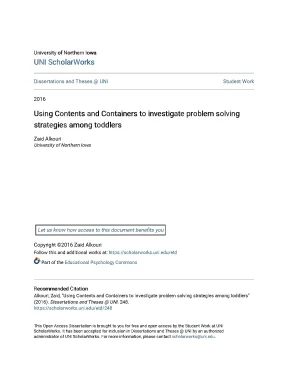
Tải xuống để đọc toàn bộUniversity of Northern Iowa UNI ScholarWorks Dissertations and Theses @ UNI Student Work 2016 Using Contents and Containers to investigate problem solving strategies among toddlers Zaid Alkouri University of Northern Iowa Let us know how access to this document benefits you Copyright ©2016 Zaid Alkouri Follow this and additional works at: https://scholarworks.edu/etd Part of the Educational Psychology Commons Recommended Citation Alkouri, Zaid, "Using Contents and Containers to investigate problem solving strategies among toddlers" (2016). Dissertations and Theses @ UNI.edu/etd/248 This Open Access Dissertation is brought to you for free and open access by the Student Work at UNI ScholarWorks. It has been accepted for inclusion in Dissertations and Theses @ UNI by an authorized administrator of UNI ScholarWorks. For more information, please contact scholarworks@uni.
Copyright by ZAID ALKOURI 2016 All Rights Reserved USING CONTENTS AND CONTAINERS TO INVESTIGATE PROBLEM SOLVING STRATEGIES AMONG TODDLERS An Abstract of a Dissertation Submitted In Partial Fulfillment of the Requirements for the Degree Doctor of Education Approved: _______________________________________ Dr. Radhi Al-Mabuk, Committee Chair _______________________________________ Dr. Dhanwada Dean of the Graduate College Zaid Alkouri University of Northern Iowa May 2016 ABSTRACT This study focused on the use of problem-solving strategies among toddlers using a qualitative research approach, and more specifically the case-study research design. The following three research questions were investigated: (1) What behaviors do toddlers exhibit as they begin their exploration with Contents and Containers?; (2a) What intrapersonal differences, if any, do toddlers display in their problem-solving approaches with Contents and Containers materials over the ten-session period?; and (2b) What interpersonal differences, if any, do the three toddlers display in their problem-solving approaches with Contents and Containers materials over the ten-session period? The participants of this study consisted of three toddlers ages 18, 21, and 23 months who attended a daycare center in a mid-size town in a Midwestern state.
The toddlers interacted freely with Contents and Containers, which is an open-ended curriculum using commonly available materials including plastic containers of various sizes. The researcher analyzed existing data in the form of video recordings of the toddlers using materials twice each week for five weeks, yielding ten one-hour long sessions. The toddlers had been videotaped for a research project conducted by an early childhood center affiliated with a state university. Findings from this study indicated that toddlers’ problem-solving included a range of behaviors such as exploration, repetition, experimentation and finding solutions through strategies such as trial and error and means-ends analysis.
Changes in problem- solving strategy use, namely from trial and error to means-ends analysis were observed both within and between the toddlers over the ten-session period. There were also themes that emerged from this study about problem solving including intentionality, competence, curiosity, perseverance, and reciprocal interaction between play and skills. Implications for parents, daycare providers and preschool teachers for fostering and supporting problem-solving thinking and behavior among toddlers are provided. Also, recommendations for future research directions to build upon and extend the findings of the present study are offered.
USING CONTENTS AND CONTAINERS TO INVESTIGATE PROBLEM SOLVING STRATEGIES AMONG TODDLERS A Dissertation Submitted In Partial Fulfillment of the Requirements for the Degree Doctor of Education Approved: ____________________________________________ Dr. Radhi Al-Mabuk, Chair ___________________________________________ Dr. Jill Uhlenberg, Co-Chair ___________________________________________ Dr. Bill Callahan, Committee Member ___________________________________________ Dr.
Suzanne Freedman, Committee Member Zaid Alkouri University of Northern Iowa May 2016 ii ACKNOWLEDGEMENTS Completing this dissertation would not have been possible without the help and continued support of my family, committee members, and friends. It is therefore befitting to express gratitude to them all. I begin by thanking my parents for their unconditional love and support throughout my life and for instilling in me the love for learning and value of hard work. To my dear wife, I say thank you for your unremitting support and patience while I was enduring the ups and downs of the demands of graduate school especially during the long dissertation phase.
I am truly unable to express in words my heart-felt appreciation for your limitless understanding and abundant encouragement. This dissertation would not have been started, let alone completed, without your encouragement, gentle support, and faith in me. To my dear daughters, Salma & Reem, I dedicate this dissertation as they taught me much about how children solve problems—and above all how to love! Deep thanks to my wonderful brothers and sisters. Also, a very special thank you to my father-in-law, Abu Belal, and mother-in- law, Um Belal, for your support and encouragement.
This dissertation project would not have been possible without the gentle guidance and support of my advisor and dissertation chair, Dr. Radhi Al-Mabuk. I will never forget your kind support, encouragement, and fine example. You have been by my side since I started my master degree patiently guiding, supporting, assisting, and encouraging me.
Thank you my dear advisor and chair for your professionalism, expertise, attention to detail, sensitivity, skill, concern, and, above all, friendship. Also, a iii genuine thank you to my dissertation co-chair, Dr. Jill Uhlenberg, who has generously given much of her time and expertise throughout the writing of this dissertation. Thank you for your patience and understanding and for supporting me while in the doctoral program.
A special thank you to Dr. Callahan who has been so supportive of me since I came to UNI through offering me a graduate assistantship when I started my master of arts education program at UNI, and throughout the dissertation process. Special thanks also go to my professor, Dr. Suzanne Freedman, who willingly agreed to join the committee in a very short notice.
Thank you, Dr. Freedman, for your kind support and input into my dissertation. Acknowledgements to the committee would not be complete without expressing sincere thanks to Dr. Betty Zan who has supported and guided me during my work as a graduate assistant at the Regent Center and for invaluable insights into the different chapters of this dissertation.
I would like to thank all my colleagues at the Regent Center for their friendship, mentoring, support, and for allowing me to use a gathered set of data for my study. Thank you especially to Dr. Zan and Dr. A special thank you goes to my dear friend Harun Parpucu who has been a solid source of support and encouragement since we started graduate school at UNI in the fall of 2008.
I would like to also express my gratitude to my friend Chris Neuhaus from the staff at Rod Library at UNI who selflessly gave of his time and expertise throughout my dissertation journey. These acknowledgements would not be complete without expressing my heart-felt gratitude to Janet Witt, who offered helpful editorial and iv formatting assistance that made the manuscript more organized and easier to read. Thank you Janet for all your help and kind guidance. For you all: my beloved family, esteemed dissertation committee members and dear friends, I am so very grateful for all you have done for me.
I shall forever be indebted to you. Thank you! For you all: my beloved family, esteemed dissertation committee members and dear friends, I am so very grateful for all you have done for me. I shall forever be indebted to you. Thank you! v TABLE OF CONTENTS PAGE LIST OF TABLES .1 Statement of the Problem .2 Significance of the Problem .5 Definition of Terms.8 Research Questions /Hypotheses.10 Organization of the Study.
REVIEW OF LITERATURE .12 Definitions of Problem Solving .12 Theories of Problem Solving .15 Information-Processing Model .19 The Early Conceptions Approach .22 vi Process of Problem Solving .23 Problem-Solving Strategies .24 Types of Problems .25 Developmental Changes in Problem Solving Ability .27 Review of Related Studies .30 Constructivism and Toddlers .34 Obstacles to Problem Solving Among Toddlers .40 Participants and Study Materials .40 Coding and Instrument .45 Inter-Rater Reliability .46 Research Design, Data Collection and Analysis.48 vii Data Collection. RESULTS AND DISCUSSION .56 Summary of Session 1 .58 Summary of Session 2 .61 Summary of Session 4 .63 Summary of Session 5 .66 Summary of Session 6 .69 Summary of Session 8 .70 Summary of Session 9 .71 viii Summary of Session 10 .72 Toddler 1 Summary Table Description.73 Research Question 2a for Toddler 1 .80 Summary of Session 1 .83 Summary of Session 2 .85 Summary of Session 3 .86 Summary of Session 4 .88 Summary of Session 5 .89 Summary of Session 6 .90 Summary of Session 7 .91 Summary of Session 9 .94 ix Summary of Session 10 .94 Research Question 2a for Toddler 2 .99 Summary of Session 1 .106 Summary of Session 2 .108 Summary of Session 3 .112 Summary of Session 4 .115 Summary of Session 6 .116 Summary of Session 7 .119 Summary of Session 8 .120 Summary of Session 9 .120 Summary of Session 10 .121 x Research Question 2a for Toddler 3 .125 Emerging Themes from the Study .136 Reciprocal Interaction of Play and Skills. IMPLICATIONS, LIMITATIONS AND FUTURE DIRECTIONS.143 Limitations of the Study.149 APPENDIX A: CODING INSTRUMENT .157 APPENDIX B: LIST OF MATERIALS.159 xi LIST OF TABLES TABLE PAGE 1 Criteria of the Strategies .76 3 Problem-Solving Type: Toddler 1 .95 5 Problem-Solving Type: Toddler 2 .121 7 Problem-Solving Type: Toddler 3 .122 8 Integrative Problem-Solving Type for the Three Toddlers.126 9 Cycle of Learning .136 1 CHAPTER 1 INTRODUCTION As toddlers develop physically, socially, and emotionally, they are also making big strides in their ability to think and solve problems as well as communicate with those around them. Toddlers’ inborn thirst to understand things and propensity to solve problems can easily be observed during play, which is their way to find out about and explore their world., Piaget, 1965) have long pointed out that toddlers learn about their world through sensory experience.
Children naturally explore the world around them and experiment with objects they encounter with their eyes, ears, noses, mouths, and hands in order to make sense of and organize their world. Toddlers wonder what things are called, how they work, and why things happen. The toddler, in a sense, acts like a miniature scientist—loves to conducts “experiments” with cause and effect. Like scientists, they also do not believe results the first time they try something—they repeat and repeat to see if results are consistent.
The daily-life settings become their laboratory in which they carry out their experiments. For example, while sitting down for a meal, toddlers will experiment with their food, mashing and squishing it with their fingers, throwing it repeatedly around from their highchairs, and watching what will happen (DeAngelis, 2014). This natural way of learning presents parents and early childhood educators with the opportunity to nurture children’s curiosity and support their natural tendency to inquire, explore, and solve problems. Promoting and fostering toddlers’ sense of curiosity about the natural world around them can engender a lifelong 2 interest in it.
The aim of this study is to investigate problem-solving strategies toddlers (18 to 23 months of age) use during free play with contents and containers. Statement of the Problem Problem solving is an important skill that develops in a variety of ways early in life. Toddlers have an innate desire to explore their worlds, and during their exploration, they often encounter many ways that could help them in their quest for knowledge and skills (Babbington, 2003, 2006). Toddlers’ problem solving skills and competence develop through actively engaging in experiences, and they need the opportunity to solve the problems they encounter on their own.
The natural exploration of toddlers can be fostered or impeded by adults depending on what they do for or to toddlers. Toddlers see the adults in their surroundings, like parents, daycare providers, and early-childhood educators, as both magical and all powerful (Lansbury, 2014). Adults can create or deprive toddlers of the opportunity to solve problems by what they do.
Nội dung được bảo vệ bản quyền — Tải xuống đầy đủ
Trích dẫn luận án này
Zaid Alkouri (2016). Using contents and containers to investigate problem solving [Luận án tiến sĩ, University of Northern Iowa]. LuanAn.net. https://luanan.net/giao-duc-hoc/phuong-phap-giang-day/using-contents-and-containers-to-investigate-problem-solving-stra
Câu hỏi thường gặp
Luận án "Using contents and containers to investigate problem solving" nghiên cứu về vấn đề gì?
Luận án: Using contents and containers to investigate problem solving stra. Xem tóm tắt và tải về tại LuanAn.net
Luận án "Using contents and containers to investigate problem solving" được bảo vệ tại trường nào?
Luận án này được bảo vệ tại University of Northern Iowa. Năm bảo vệ: 2016.
Luận án "Using contents and containers to investigate problem solving" thuộc chuyên ngành gì?
Luận án "Using contents and containers to investigate problem solving" thuộc chuyên ngành Educational Psychology / Doctor of Education. Danh mục: Phương Pháp Giảng Dạy.
Luận án "Using contents and containers to investigate problem solving" có bao nhiêu trang?
Luận án "Using contents and containers to investigate problem solving" có 175 trang. Bạn có thể xem trước một phần tài liệu ngay trên trang web trước khi tải về.
Cách tải luận án "Using contents and containers to investigate problem solving" về máy như thế nào?
Để tải luận án về máy, bạn nhấn nút "Tải xuống ngay" trên trang này, sau đó hoàn tất thanh toán phí lưu trữ. File sẽ được tải xuống ngay sau khi thanh toán thành công. Hỗ trợ qua Zalo: 0559 297 239.