Uhler uncg 0154d 12958
Luận án từ Đại học North Carolina at Greensboro. Công trình nghiên cứu học thuật trình bày phân tích chuyên sâu, đánh giá chi tiết kết quả khoa học.
The University of North Carolina at Greensboro
Musical Arts
Luan An
Dissertation
Năm xuất bản
Số trang
141
Thời gian đọc
22 phút
Lượt xem
0
Lượt tải
0
Phí lưu trữ
40 Point
Tổng quan nhanh
- Chủ đề:
- Examining Music's Role in Juvenile Rehabilitation, Uhler UNCG
- Số trang:
- 141 trang
- Trường:
- The University of North Carolina at Greensboro
- Chuyên ngành:
- Musical Arts
- Tác giả:
- Bethany Shaune Uhler
- Năm:
- 2020
Tóm tắt nội dung luận án
I.Examining Music s Role in Juvenile Rehabilitation Uhler UNCG
Mỗi năm, khoảng 600.000 thanh thiếu niên bị giam giữ. Tỷ lệ tái phạm cao, từ 50% đến 80% sau khi được thả. Đa số thanh thiếu niên này trải qua chấn thương nghiêm trọng. Họ cần phục hồi chức năng và kỹ năng xã hội chuyên nghiệp. Các biện pháp can thiệp hành vi hiệu quả rất quan trọng. Âm nhạc có thể đóng vai trò chất xúc tác. Nó thúc đẩy sự phát triển cá nhân và giao tiếp. Luận án của Bethany Shaune Uhler tại UNCG khám phá điều này. Nghiên cứu này thuộc University of North Carolina at Greensboro archives. Nó là một phần của Uhler collection UNC Greensboro, tài liệu 0154d 12958 UNCG. Luận án này góp phần vào UNC Greensboro library holdings. Nó cung cấp cái nhìn sâu sắc về can thiệp âm nhạc.
1.1. Bối cảnh giam giữ vị thành niên
Hàng trăm nghìn thanh thiếu niên vào các cơ sở giam giữ. Điều này xảy ra hàng năm. Tỷ lệ tái phạm sau khi ra tù đáng báo động. Nhiều thanh thiếu niên đối mặt với chấn thương. Nhu cầu phục hồi là rất lớn. Các chương trình hỗ trợ phát triển kỹ năng xã hội rất cần thiết.
1.2. Âm nhạc là chất xúc tác phục hồi
Âm nhạc mang lại lợi ích tiềm năng. Nó hỗ trợ sự phát triển cá nhân. Nó cải thiện kỹ năng giao tiếp. Nhiều nghiên cứu trước đây đã gợi ý điều này. Luận án Uhler UNCG tiếp tục khám phá khả năng này. Nó chứng minh vai trò của âm nhạc trong phục hồi chức năng.
II.Nghiên cứu Uhler UNCG Thiết kế chương trình dây cho thanh thiếu niên
Luận án này phát triển một chương trình dây. Chương trình này được đặt tại một trung tâm phát triển thanh thiếu niên. Mục đích là khám phá vai trò của âm nhạc. Nó phục vụ trong quá trình phục hồi. Đây là một nghiên cứu định tính. Nó đặt ra câu hỏi về lợi ích của việc tham gia. Chương trình gọi là "Chatham Strings". Tám thành viên tự nguyện tham gia. Các em tuổi từ 13 đến 17. Nghiên cứu Uhler UNCG thu thập dữ liệu qua phỏng vấn. Các thành viên thanh thiếu niên, nhân viên cơ sở đều được phỏng vấn. Các ghi chú thực địa cũng là một phần dữ liệu. Tài liệu này là một phần quan trọng của UNCG Special Collections. Nó là Uhler family papers UNCG.
2.1. Phương pháp nghiên cứu định tính
Nghiên cứu sử dụng phương pháp định tính. Phương pháp này tập trung vào trải nghiệm. Nó khám phá ý nghĩa của việc tham gia. Dữ liệu bao gồm phỏng vấn sâu rộng. Phỏng vấn với thanh thiếu niên và nhân viên. Ghi chú thực địa hỗ trợ việc phân tích.
2.2. Hồ sơ đối tượng tham gia chương trình
Tám thành viên tham gia "Chatham Strings". Họ có độ tuổi từ 13 đến 17. Các em thuộc nhiều nhóm dân tộc khác nhau. Không ai có kinh nghiệm chơi nhạc cụ dây trước đó. Điều này cho thấy tính tiếp cận của chương trình.
III.Phát hiện chính từ dự án âm nhạc Uhler UNCG
Bốn chủ đề chính nổi lên từ phân tích dữ liệu. Chủ đề thứ nhất là "Tiếp xúc và Trải nghiệm Mới". Chủ đề này ghi lại hành trình của thanh thiếu niên. Họ chuyển từ kháng cự sang tham gia. Sau đó đạt được thành công trong chương trình dây. Chủ đề thứ hai là "Niềm tự hào và Sự công nhận". Thanh thiếu niên trải nghiệm sự hài lòng. Họ nhận ra tiềm năng tích cực của mình. Họ nhận được sự củng cố tích cực. Họ làm cho những người thân yêu tự hào. Đây là những phát hiện quan trọng của Uhler UNCG. Luận án này bổ sung vào manuscript collections UNCG. Nó là tài liệu 0154d 12958 UNCG.
3.1. Tiếp xúc và trải nghiệm mới
Thanh thiếu niên ban đầu có thể kháng cự. Việc tham gia chương trình dần thay đổi thái độ. Họ trải nghiệm những điều mới mẻ. Sự thành công trong chương trình mang lại sự tự tin. Điều này đánh dấu một hành trình phát triển cá nhân.
3.2. Phát triển cá nhân và liên cá nhân
Tham gia chương trình dây cải thiện nhiều khía cạnh. Nó giải tỏa cảm xúc tốt hơn. Nó điều chỉnh hành vi hiệu quả. Khả năng chịu đựng sự thất vọng tăng lên. Kỹ năng quản lý thời gian được cải thiện. Kỹ năng giao tiếp trở nên tốt hơn. Thanh thiếu niên sẵn sàng giúp đỡ người khác. Đây là những dấu hiệu rõ ràng về sự phát triển.
IV.UNCG Uhler Tác động chương trình âm nhạc đến công lý phục hồi
Chủ đề thứ tư của nghiên cứu Uhler UNCG liên quan đến nhân viên. Nó thể hiện rằng chương trình dây đóng góp vào nỗ lực cộng đồng. Nỗ lực này hướng tới công lý phục hồi. Các nhân viên cơ sở nhận thấy giá trị của chương trình. Họ coi nó là một công cụ phục hồi. Nó giúp tạo ra môi trường tích cực hơn. Niềm tự hào và sự công nhận là yếu tố then chốt. Thanh thiếu niên đạt được thành công. Họ nhận được sự động viên từ người khác. Điều này củng cố lòng tự trọng của họ. Nó khuyến khích hành vi tích cực. Luận án này làm phong phú thêm digital collections UNCG. Nó cung cấp bằng chứng thực nghiệm.
4.1. Cảm giác tự hào và được công nhận
Thanh thiếu niên tìm thấy sự hài lòng trong thành công. Họ nhận ra khả năng làm điều tích cực. Phản hồi tích cực từ người khác rất quan trọng. Việc làm cho người thân tự hào mang lại giá trị lớn. Những yếu tố này thúc đẩy sự thay đổi.
4.2. Vai trò của nhân viên trong hỗ trợ thanh thiếu niên
Nhân viên cơ sở là người quan sát trực tiếp. Họ thấy được tác động của âm nhạc. Chương trình âm nhạc là một phần của công lý phục hồi. Nó xây dựng cộng đồng hỗ trợ. Nhân viên đóng vai trò quan trọng trong việc hỗ trợ. Họ khuyến khích sự tham gia.
V.Ý nghĩa và khuyến nghị từ luận án Uhler UNCG
Nghiên cứu của Bethany Shaune Uhler có nhiều ý nghĩa. Nó cung cấp hiểu biết sâu sắc. Nó chỉ ra vai trò của âm nhạc. Đặc biệt là trong các chương trình phục hồi tại trại giam. Các cuộc thảo luận tập trung vào ứng dụng. Các bài học rút ra có thể áp dụng rộng rãi. Các chương trình nghệ thuật trại giam có thể hưởng lợi. Các khuyến nghị được đưa ra. Chúng nhằm mục đích cải thiện các can thiệp tương lai. Tài liệu này, Uhler uncg 0154d 12958, là một đóng góp quan trọng. Nó thuộc archival records UNCG. Luận án này được đệ trình lên The University of North Carolina at Greensboro. Đây là yêu cầu để lấy bằng Doctor of Musical Arts.
5.1. Bài học cho các chương trình âm nhạc trại giam
Kết quả nghiên cứu cung cấp hướng dẫn. Các chương trình âm nhạc tương lai có thể học hỏi. Việc khuyến khích sự tham gia là cần thiết. Việc tạo ra môi trường hỗ trợ rất quan trọng. Các chương trình này có thể thúc đẩy sự phát triển toàn diện.
5.2. Luận án của Bethany Shaune Uhler
Luận án này được hoàn thành vào năm 2020. Nó được đệ trình tại UNCG. Nó phản ánh nghiên cứu chuyên sâu. Nó góp phần vào kiến thức về phục hồi chức năng. Tài liệu này có sẵn trong UNC Greensboro library holdings. Nó là một phần của Uhler family papers UNCG.
Mục lục chi tiết luận án
Tải xuống file đầy đủ để xem toàn bộ nội dung
Tải đầy đủ (141 trang)Trích đoạn nội dung luận án
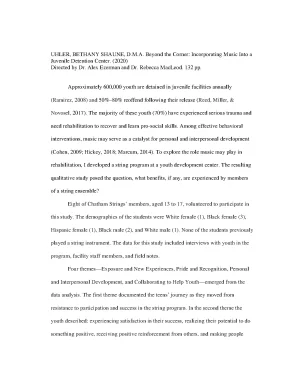
Tải xuống để đọc toàn bộUHLER, BETHANY SHAUNE, D. Beyond the Corner: Incorporating Music Into a Juvenile Detention Center. (2020) Directed by Dr. Alex Ezerman and Dr.
Approximately 600,000 youth are detained in juvenile facilities annually (Ramirez, 2008) and 50%–80% reoffend following their release (Reed, Miller, & Novosel, 2017). The majority of these youth (70%) have experienced serious trauma and need rehabilitation to recover and learn pro-social skills. Among effective behavioral interventions, music may serve as a catalyst for personal and interpersonal development (Cohen, 2009; Hickey, 2018; Marcum, 2014). To explore the role music may play in rehabilitation, I developed a string program at a youth development center.
The resulting qualitative study posed the question, what benefits, if any, are experienced by members of a string ensemble? Eight of Chatham Strings’ members, aged 13 to 17, volunteered to participate in this study. The demographics of the students were White female (1), Black female (3), Hispanic female (1), Black male (2), and White male (1). None of the students previously played a string instrument. The data for this study included interviews with youth in the program, facility staff members, and field notes.
Four themes—Exposure and New Experiences, Pride and Recognition, Personal and Interpersonal Development, and Collaborating to Help Youth—emerged from the data analysis. The first theme documented the teens’ journey as they moved from resistance to participation and success in the string program. In the second theme the youth described: experiencing satisfaction in their success, realizing their potential to do something positive, receiving positive reinforcement from others, and making people they loved proud. In the third theme, youth reflected that participation in the string program improved emotional release, behavior regulation, frustration tolerance, time management, communication skills, and willingness to help others.
The fourth theme, which was specific to staff participants, expressed that the string program contributed to the community effort of restorative justice. Implications for prison music programs are discussed. BEYOND THE CORNER: INCORPORATING MUSIC INTO A JUVENILE DETENTION CENTER by Bethany Shaune Uhler A Dissertation Submitted to the Faculty of The Graduate School at The University of North Carolina at Greensboro in Partial Fulfillment of the Requirements for the Degree Doctor of Musical Arts Greensboro 2020 Approved by Committee Co-Chair Committee Co-Chair APPROVAL PAGE This dissertation, written by Bethany Shaune Uhler, has been approved by the following committee of the Faculty of The Graduate School at The University of North Carolina at Greensboro. Committee Co-Chair Committee Co-Chair Committee Member Date of Acceptance by Committee Date of Final Oral Examination ii ACKNOWLEDGMENTS This research was certainly not conducted in a vacuum, and I am indebted to a great host of people who have unstintingly given of their time and resources to help me.
I never could have developed this program or conducted this study without my committee. Many thanks to Dr. Alex Ezerman for his wisdom, patience, kindness, creative thinking, support, encouragement, nurture, and for always being a safe person with whom I could think and brainstorm; to Dr. Rebecca MacLeod for her energy, encouragement, help in charting much unknown territory, and invaluable aid with so many details; and to Dr.
Scott Rawls for his encouragement and kindness. I am indebted to Mr. Charles Dingle and the staff at Chatham Youth Development Center. All of them have been not only helpful and accommodating, but supportive and enthusiastic, giving me their invaluable input and perspective as the primary caregivers of the youth.
Special thanks to Mr. Dingle, who enthusiastically gave me a chance, to Mr. Dingle, and Mr. McLean for their insights in the interviews, and to Ms.
Miller for organizing the overview day at Chatham to help me experience life there. Thanks, also, to Matthew Jenkins, the communications officer at NC Juvenile Justice Central Office for his support and documentation of Chatham Strings. I never could have launched or sustained Chatham Strings the support and kindness of all of these fine people who devote their lives to helping our youth. I also want to thank the accomplished and inspirational researchers and prison arts program directors who, though I was a stranger to them, graciously and generously gave iii me their time and wisdom, especially Dr.
Maud Hickey, Dr. Mary Cohen, and Ms. Many thanks to my family—Dad, Mom, Atan, Rachel, Hannah, Kara, Leah, Bobby, Sara, Elias, Samuel, Seth, and Melisa—for all their love and support, and to Uncle Darin, who unintentionally helped me start to think about this type of work, and who has supported and encouraged the program that grew out of those musings. My gratitude also goes to Lemaro, who came at the end of this process and gave me so much encouragement and love.
And last, but very far from least, I am grateful for the students who participate in Chatham Strings. I have come to care about each one, and the opportunity to learn with them is one I do not take lightly. My special thanks go to the eight students who participated in individual and focus group interviews to give me their unique and valuable perspectives. If participating in music making affects their lives for the good, even in the smallest way, I will count all of this work a success.
iv TABLE OF CONTENTS Page CHAPTER I. INTRODUCTION: KELLI’S STORY. THE STATUS OF JUVENILE DETENTION IN THE UNITED STATES—AN OVERVIEW .4 Juvenile Offenders Defined .4 Average Length of Stay .5 Age at Admittance .9 Contributing Factors to Crime Involvement .11 Rehabilitation: Success or Failure?. REVIEW OF LITERATURE .16 Overview of Chapter .16 Needs of Juvenile Offenders .16 Prison Music Program Overview: A Rehabilitative Approach.17 Composition and Song Writing .18 Facilitating Trauma Recovery and Emotional Regulation.19 Providing Positive Educational Experiences .21 Positive Association with Learning and Authority .22 Involvement in an Activity with Positive Outcomes .24 Sense of Achievement.25 Fostering Interpersonal Development .26 Collaborating in a Musical Setting .28 Developing Pro-Social Skills .33 Altering Societal Perceptions of the Incarcerated .34 The Other Side—The Invisible Victim .38 Research Method—The Nature of Case Study Research .38 v Description of the Research Site—Chatham Youth Development Center .39 Description of the Program—Chatham Strings .44 Description of Participants .45 Description of PI .53 Delimitations and Limitations of the Study .55 Four Emergent Themes .55 Theme 1: Exposure and New Experiences .55 Being Discouraged from Learning New Things .56 Being Given an Opportunity to Learn Something New.58 Enjoying New Experiences .59 Transferring ‘Openness to New Things’ into Other Domains .63 Being Given Another Chance to Engage Differently with Life .65 Theme 2: Pride and Recognition.68 Pride: Acquiring a Skill that Could be Shared with Others .68 Pride: Collaborating with Peers in a Positive Endeavor .69 Pride: Taking Satisfaction in Success .70 Pride: Recognizing Their Potential to do Good Things in Life .71 Pride: Overcoming the Pressures of Performance .71 Recognition: Receiving Positive Reinforcement from Others .73 Recognition: Making People They Love Proud.74 Recognition: Receiving Attention for Something Positive, Not Negative.76 Theme 3: Personal and Interpersonal Development .76 Personal Development: Releasing Emotions .77 Personal Development: Regulating Behavior .77 Personal Development: Dealing with Frustrations and Persevering .78 Personal Development: Using Time More Productively .81 Interpersonal Development: Improving Communication Skills .82 Interpersonal Development: Improving Patience and Emotional Impulse Control .83 Interpersonal Development: Accepting Feedback .85 vi Interpersonal Development: Recognizing the Interdependence of Ensemble Playing .86 Interpersonal Development: Helping Peers .87 Interpersonal Development: Kindness .88 Theme 4: Collaborating to Help Youth (Staff Only) .88 Another Perspective: My Journey at Chatham .90 Getting to Chatham .91 Understanding Chatham’s Youth.
DISCUSSION AND CONCLUSION .107 Connecting Study Results to Prior Research .107 Possible Benefits of Chatham Strings. INTERVIEW PROTOCOL AND QUESTIONS. IRB APPROVAL LETTER. CHATHAM YOUTH DEVELOPMENT CENTER DIRECTOR LETTER.
“ON THE SCENE” DIGEST ARTICLE 1. “ON THE SCENE” DIGEST ARTICLE 2.131 vii 1 CHAPTER I INTRODUCTION: KELLI’S STORY Kelli’s dad taught her to play the drums and a little guitar, and she sang in her middle school chorus. Her mom passed away when she was young, and by the time she was 13 or 14, various factors and her decisions landed her in a juvenile detention facility. Kelli spent most of her teen years in the justice system, transferred from facility to facility.
She refers to directors of various facilities as her “parents.” By the time she walked into my string class at Chatham Youth Development Center, she had been in detention facilities for about 4 years, with a year remaining before her 18th birthday and release. Kelli is reserved but pleasant, with a slow, warm smile. Like Kelli, youth in juvenile detention centers are typical young people, the ones you see at the store or in your neighborhood. They played basketball in the park down the street.
They went to the middle school near your house. However, many did not go to school often enough to play in the band or on a sports team. Many live in poverty (Sickmund & Puzzanchera, 2014) and some have been involved with gangs (Daykin, De Viggiani, Pilkington, & Moriarty, 2012; Rameriz, 2008); others have substance addiction issues (Marcum, 2014; Sickmund & Puzzanchera, 2014). One out of three has been physically and/or sexually abused (Sickmund & Puzzanchera, 2014).
Seven out of ten have experienced severe trauma, such as observing a murder (Sickmund & Puzzanchera, 2014). Some of them have been involved in trafficking. All have committed an offense, 2 and usually multiple offenses. Each one is a face among the approximately 600,000 U.
youth (Ramirez, 2008) who spend time in juvenile detention facilities each year. These youth are the faces of the United States’ future generation of nurses, factory workers, poets, teachers, and voters, who, like Kelli, will reenter society facing major life decisions at a vulnerable age. This case study chronicles the development of a string program (Chatham Strings) in a juvenile detention facility, a program that interacted with Kelli during her last year of confinement. The vision for Chatham Strings was to expose youth in detention to something new and challenge them to try something outside of their experience.
Youth placed in juvenile centers tend to be resistant to new experiences, but as a veteran staff member commented, “If you keep a kid in the corner, they know the corner.” Furthermore, if that corner involved a cycle of poverty, violence, abuse, and crime, returning to what is comfortable and normative is a serious problem. Many juvenile offenders re-offend after release (50-80%) because they return to the difficult situations from which many were taken. In order for these children to successfully reenter society and become productive citizens, we must break this vicious cycle. Music programs in the correctional system may be one way to try and help these young people experience something new and move forward.
Chatham Strings is just one small piece of a more extensive network of help and support in the lives of juveniles, a network comprised of dedicated professionals who invest deeply in them. This study focused on the 20 young people who participated in the music program, specifically following the experience of eight youth who agreed to participate in personal interviews. As I interacted with these 3 youth weekly, I asked the questions: What benefits, if any, do students gain from playing in the string ensemble? Does the program have a part in helping individuals like Kelli acquire perspective and skills beyond the corner? 4 CHAPTER II THE STATUS OF JUVENILE DETENTION IN THE UNITED STATES—AN OVERVIEW Juvenile Offenders Defined According to the 2014 Juvenile Crime and Victim report, about 24% of the U. population, approximately 74,181,500 people, were under the age of 18 in 2010 (Sickmund & Puzzanchera, 2014) and thus considered juveniles.
The term juvenile offender refers to the approximated 0.05% of America’s juvenile population who have committed a legal offense. The term crime is being eradicated from juvenile justice vocabulary to reflect the paradigm shift in how youth are viewed within the correctional system.6 million juvenile arrests are reported each year (Sickmund & Puzzanchera, 2014).
Nội dung được bảo vệ bản quyền — Tải xuống đầy đủ
Trích dẫn luận án này
Bethany Shaune Uhler (2020). Uhler uncg 0154d 12958 [Luận án tiến sĩ, The University of North Carolina at Greensboro]. LuanAn.net. https://luanan.net/giao-duc-hoc/phuong-phap-giang-day/uhler-uncg-0154d-12958
Câu hỏi thường gặp
Luận án "Uhler uncg 0154d 12958" nghiên cứu về vấn đề gì?
Luận án từ Đại học North Carolina at Greensboro. Công trình nghiên cứu học thuật trình bày phân tích chuyên sâu, đánh giá chi tiết kết quả khoa học.
Luận án "Uhler uncg 0154d 12958" được bảo vệ tại trường nào?
Luận án này được bảo vệ tại The University of North Carolina at Greensboro. Năm bảo vệ: 2020.
Luận án "Uhler uncg 0154d 12958" thuộc chuyên ngành gì?
Luận án "Uhler uncg 0154d 12958" thuộc chuyên ngành Musical Arts. Danh mục: Phương Pháp Giảng Dạy.
Luận án "Uhler uncg 0154d 12958" có bao nhiêu trang?
Luận án "Uhler uncg 0154d 12958" có 141 trang. Bạn có thể xem trước một phần tài liệu ngay trên trang web trước khi tải về.
Cách tải luận án "Uhler uncg 0154d 12958" về máy như thế nào?
Để tải luận án về máy, bạn nhấn nút "Tải xuống ngay" trên trang này, sau đó hoàn tất thanh toán phí lưu trữ. File sẽ được tải xuống ngay sau khi thanh toán thành công. Hỗ trợ qua Zalo: 0559 297 239.