Luận án Tiến sĩ: Lắng nghe tiếng nói sinh viên về bài tập về nhà
Phân tích sâu sắc các khía cạnh của bài tập về nhà: tác động, ưu nhược điểm và đề xuất giải pháp thay thế hiệu quả.
Loyola Marymount University
Luan An
Luận án tiến sĩ
Năm xuất bản
Số trang
246
Thời gian đọc
37 phút
Lượt xem
1
Lượt tải
0
Phí lưu trữ
50 Point
Tổng quan nhanh
- Chủ đề:
- 1. Phân tích phê phán bài tập về nhà: tiếng nói học sinh
- Số trang:
- 246 trang
- Trường:
- Loyola Marymount University
- Chuyên ngành:
- Education
- Tác giả:
- Michael Bates
- Năm:
- 2013
Tóm tắt nội dung luận án
I. Phân tích phê phán bài tập về nhà tiếng nói học sinh
Nghiên cứu tiến hành phân tích phê phán bài tập về nhà, tập trung lắng nghe tiếng nói học sinh. Công việc này đặt câu hỏi về các mô hình giáo dục truyền thống. Nghiên cứu đánh giá hiệu quả bài tập hiện tại. Mục đích thực sự của bài tập được xem xét kỹ lưỡng. Nhiều học sinh cảm thấy áp lực học tập từ bài tập. Bài tập về nhà có thể gây ra tác động tiêu cực không mong muốn. Sự cần thiết của việc xem xét lại vai trò của bài tập là rất rõ ràng.
1.1. Nghiên cứu vai trò của bài tập từ góc nhìn học sinh
Phân tích chi tiết quan điểm của học sinh về bài tập. Học sinh chia sẻ kinh nghiệm hàng ngày. Nhiều học sinh đối mặt với thách thức trong việc hoàn thành bài tập. Thiếu động lực nội tại là vấn đề phổ biến. Tiếng nói học sinh cung cấp dữ liệu quý giá. Việc này giúp hiểu rõ hơn mặt trái của bài tập về nhà. Nghiên cứu khuyến khích lắng nghe và hành động dựa trên những chia sẻ đó.
1.2. Phơi bày những hạn chế của phương pháp truyền thống
Các phương pháp bài tập truyền thống thường thiếu sự đổi mới. Việc làm các bài tập lặp đi lặp lại không thúc đẩy tư duy phản biện. Học sinh có thể chỉ ghi nhớ thông tin mà không thực sự hiểu. Bài tập ít khi kết nối với cuộc sống thực tế. Việc đánh giá hiệu quả bài tập cần xem xét khía cạnh này. Cần tránh việc chỉ làm theo sách giáo khoa một cách máy móc.
1.3. Nhu cầu về một mô hình giáo dục mới
Cần xây dựng một hệ thống giáo dục khuyến khích sự tò mò. Học sinh cần được phát triển tư duy phản biện. Việc tạo ra niềm vui trong học tập là ưu tiên. Giảm áp lực học tập từ bài tập là cần thiết. Giáo dục nên hướng tới sự công bằng xã hội. Mục đích thực sự của bài tập là phát triển con người toàn diện, không phải gây căng thẳng.
II. Đánh giá tác động tiêu cực của bài tập về nhà
Nghiên cứu đánh giá tác động tiêu cực của bài tập về nhà. Các mặt trái của bài tập về nhà được làm rõ. Gánh nặng này ảnh hưởng đến nhiều khía cạnh trong cuộc sống học sinh. Thời gian rảnh của học sinh bị thu hẹp đáng kể. Tình trạng này gây ra những hệ quả lâu dài. Cần nhận thức rõ về những ảnh hưởng này. Việc xem xét lại bài tập là cần thiết.
2.1. Gánh nặng thời gian và thời gian rảnh của học sinh
Bài tập về nhà thường chiếm hết buổi tối của học sinh. Thời gian dành cho các hoạt động ngoại khóa bị cắt giảm. Học sinh ít có cơ hội thư giãn, chơi thể thao, hoặc theo đuổi sở thích cá nhân. Điều này ảnh hưởng đến sự cân bằng cuộc sống. Học sinh cần thời gian nghỉ ngơi để tái tạo năng lượng. Thiếu thời gian rảnh có thể dẫn đến kiệt sức.
2.2. Ảnh hưởng đến sự phát triển toàn diện của cá nhân
Sự phát triển toàn diện của học sinh bị cản trở. Ít thời gian tham gia các hoạt động xã hội. Các kỹ năng mềm như giao tiếp, làm việc nhóm bị hạn chế. Việc khám phá bản thân và phát triển năng khiếu cá nhân cũng bị ảnh hưởng. Bài tập quá nhiều không cho phép điều đó. Cần có một môi trường khuyến khích sự phát triển đa chiều.
2.3. Thiếu vắng tư duy phản biện trong bài tập
Nhiều bài tập về nhà chỉ yêu cầu học sinh ghi nhớ kiến thức. Chúng ít khi khuyến khích tư duy phân tích hoặc sáng tạo. Học sinh thường không được thử thách giải quyết vấn đề thực tế. Việc thiếu tư duy phản biện là một tác động tiêu cực lớn. Giáo dục cần tập trung vào việc hình thành khả năng đặt câu hỏi.
III. Áp lực học tập và sức khỏe tinh thần học sinh
Bài tập về nhà là nguồn gây áp lực học tập lớn. Nó ảnh hưởng nghiêm trọng đến sức khỏe tinh thần học sinh. Tình trạng lo âu và căng thẳng ngày càng phổ biến. Nghiên cứu nhấn mạnh sự cần thiết của việc giảm bớt gánh nặng này. Sức khỏe tinh thần của học sinh cần được ưu tiên hàng đầu. Tác động tiêu cực của bài tập cần được giải quyết.
3.1. Stress và lo âu do yêu cầu bài tập quá tải
Khối lượng bài tập quá lớn gây ra stress. Học sinh cảm thấy lo âu khi không thể hoàn thành. Nỗi sợ bị điểm kém hoặc bị phê bình tăng cao. Áp lực học tập từ bài tập làm giảm sự tự tin. Điều này ảnh hưởng đến niềm vui học hỏi. Cần có sự cân bằng hợp lý để tránh tình trạng quá tải.
3.2. Ngủ không đủ giấc và tác động sức khỏe
Học sinh thường phải thức khuya để làm bài tập. Tình trạng thiếu ngủ diễn ra thường xuyên. Giấc ngủ không đủ ảnh hưởng đến khả năng tập trung. Sức khỏe thể chất và tinh thần đều suy giảm. Sự mệt mỏi kéo dài làm giảm hiệu suất học tập. Cần bảo đảm học sinh có đủ thời gian nghỉ ngơi.
3.3. Quan hệ gia đình bị ảnh hưởng bởi áp lực
Áp lực bài tập có thể gây căng thẳng trong gia đình. Phụ huynh thường phải hỗ trợ con làm bài tập. Điều này có thể dẫn đến tranh cãi hoặc xung đột. Thời gian chất lượng bên gia đình bị ảnh hưởng. Sức khỏe tinh thần học sinh và bài tập có mối liên hệ mật thiết với môi trường gia đình.
IV. Bất bình đẳng giáo dục từ thực tiễn bài tập
Bài tập về nhà có thể làm trầm trọng thêm bất bình đẳng trong giáo dục. Thực tiễn bài tập hiện tại tạo ra những khoảng cách đáng kể. Học sinh từ các hoàn cảnh khác nhau nhận được sự hỗ trợ khác nhau. Điều này ảnh hưởng đến cơ hội thành công của học sinh. Cần xem xét cách bài tập tác động đến sự công bằng. Mặt trái của bài tập về nhà rõ rệt hơn ở những cộng đồng khó khăn.
4.1. Sự chênh lệch nguồn lực hỗ trợ tại nhà
Không phải mọi học sinh đều có môi trường học tập lý tưởng. Một số học sinh thiếu không gian yên tĩnh hoặc internet. Sự hỗ trợ từ phụ huynh cũng không đồng đều. Điều này tạo ra một rào cản lớn. Những học sinh không có nguồn lực này gặp bất lợi. Đây là một vấn đề nghiêm trọng về bất bình đẳng giáo dục.
4.2. Khoảng cách học thuật và địa vị xã hội
Bài tập về nhà thường làm tăng khoảng cách học thuật. Học sinh có sự hỗ trợ tại nhà tốt hơn có xu hướng đạt kết quả cao hơn. Điều này liên quan đến địa vị kinh tế xã hội. Những học sinh có hoàn cảnh khó khăn bị bỏ lại phía sau. Việc đánh giá hiệu quả bài tập cần tính đến yếu tố này.
4.3. Vai trò của phụ huynh trong quá trình hỗ trợ
Vai trò của phụ huynh trong bài tập là rất quan trọng. Phụ huynh có trình độ học vấn cao hơn có thể hỗ trợ con tốt hơn. Họ cũng có nhiều thời gian và nguồn lực hơn. Ngược lại, phụ huynh bận rộn hoặc ít học vấn gặp khó khăn. Điều này trực tiếp ảnh hưởng đến kết quả học tập của con em.
V. Mục đích thực sự và tương lai của bài tập về nhà
Nghiên cứu thách thức mục đích thực sự của bài tập về nhà. Cần định nghĩa lại vai trò của nó trong giáo dục hiện đại. Đánh giá hiệu quả bài tập đòi hỏi cái nhìn mới. Tương lai của bài tập về nhà cần hướng tới sự phát triển toàn diện. Nó không nên chỉ là gánh nặng. Cần tạo ra các giải pháp sáng tạo.
5.1. Đặt câu hỏi về giá trị cốt lõi của bài tập
Giá trị cốt lõi của bài tập cần được xem xét lại. Liệu bài tập có thực sự củng cố kiến thức? Nó có thúc đẩy sự độc lập trong học tập? Nhiều nghiên cứu cho thấy hiệu quả thấp của bài tập truyền thống. Cần một sự phân tích bài tập về nhà sâu sắc hơn.
5.2. Chuyển đổi trọng tâm từ số lượng sang chất lượng
Thay vì giao nhiều bài tập, cần tập trung vào chất lượng. Bài tập nên mang tính thử thách và hấp dẫn. Các hoạt động cần khuyến khích sự sáng tạo và tư duy phản biện. Giảm số lượng để tăng cường giá trị giáo dục. Mục đích thực sự của bài tập là học sâu, không phải làm nhiều.
5.3. Định hình giáo dục lấy học sinh làm trung tâm
Giáo dục cần đặt học sinh vào trung tâm. Bài tập nên được thiết kế để khơi gợi niềm đam mê. Nó cần thúc đẩy động lực nội tại của học sinh. Sức khỏe tinh thần học sinh và bài tập cần được cân bằng. Tương lai của bài tập là tạo ra những công dân có tư duy phản biện.
Tải xuống file đầy đủ để xem toàn bộ nội dung
Tải đầy đủ (246 trang)Trích đoạn nội dung luận án
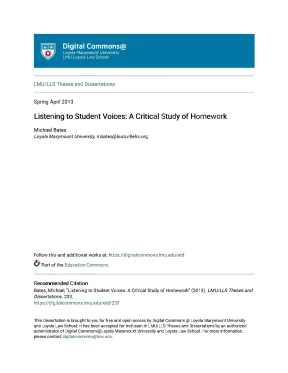
Tải xuống để đọc toàn bộLMU/LLS Theses and Dissertations Spring April 2013 Listening to Student Voices: A Critical Study of Homework Michael Bates Loyola Marymount University, mbates@louisvillehs.org Follow this and additional works at: https://digitalcommons.edu/etd Part of the Education Commons Recommended Citation Bates, Michael, "Listening to Student Voices: A Critical Study of Homework" (2013). LMU/LLS Theses and Dissertations.edu/etd/233 This Dissertation is brought to you for free and open access by Digital Commons @ Loyola Marymount University and Loyola Law School. It has been accepted for inclusion in LMU/LLS Theses and Dissertations by an authorized administrator of Digital Commons@Loyola Marymount University and Loyola Law School. For more information, please contact digitalcommons@lmu.
LOYOLA MARYMOUNT UNIVERSITY Listening to Student Voices: A Critical Study of Homework by Michael Bates A dissertation presented to the Faculty of the School of Education, Loyola Marymount University, in partial satisfaction of the requirements for the degree Doctor of Education 2013 Listening to Student Voices: A Critical Study of Homework Copyright © 2013 by Michael Bates Loyola Marymount University School of Education Los Angeles, CA 90045 This dissertation written by Michael Bates, under the direction of the Dissertation Committee, is approved and accepted by all committee members, in partial fulfillment of requirements for the degree of Doctor of Education. ii ACKNOWLEDGMENTS Nightly across America, students take the work of school home. As a student, teacher, and now as a parent, I have lived the costs of the stresses of homework–and, I am not alone. I have been a successful student, not because of grades or homework, but because of my parents, teachers, moments, literature, and films which have caused me to look beyond traditional models of school.
Because of a nagging cognitive dissonance, I have tried to understand what might be my homework for critical consciousness. To do so, I needed to venture past the isolation of homework in dialogue with wisdom of family and fellow learners. I gratefully acknowledge the support, help, and care that have shaped my thoughts and the culmination of this study: To each student in this study, your voice matters. Know that I hear you, and I hope many take you seriously in the effort to address the role and purpose of homework in schools.
To Professor Antonia Darder, by your dedication to students and by your example of justice, gentleness, and wisdom, you have challenged me to pursue excellence and to craft a work honoring student voice. Ani Shabazian, for your insight about intrinsic motivation, locus of control, and social reproduction, you have helped me keep my focus on the importance of school as a process for the development of wonder. Elizabeth Brewer, for your humor, your consistent challenge, and genuine encouragement, perspective to this pursuit you have helped me bring. Karie Huchting, for your boundless energy and joy, you helped me develop a true appreciation for quantitative methods and for excellent teaching.
To Cohort 7 and to my LMU professors, thank you for challenging me to lead for Social Justice. Particularly, to Drs. Jill Bickett, Beth Stoddard, and Shane Martin, your support and care of me from day one in this program have helped me to persevere and to seek my best self. To the school and its staff at which this study took place, you gave me the chance to grow professionally and academically; know that I am most grateful for this opportunity.
To Mohandas Gandhi, Martin Luther King, Jr., Oscar Romero, Sr., Daniel Smith-Christopher, Howard Zinn, Pedro Arrupe, S., Elie Wiesel, Upton Sinclair, Mark Twain, Charles Dickens, John Steinbeck, Dalton Trumbo, Alfie Kohn, John Buell, Denise Pope, Sir Ken Robinson, Mihalyi Csíkszentmihályi, Daniel Pink, Charles Kernaghan, and Michael Moore, you have inspired me to think critically, to question traditional practices of schooling, and to seek justice and peace despite the perpetual drumbeats of war and consumption. I dedicate this dissertation to: My parents, John and Maureen, who have sacrificed their lives for their children. My partner, Nancy, for her love and unyielding support to me throughout our relationship, and especially these past three years of research. To our children, Brian and Peter, who give me a daily serendipity of inspiration, joy, laughter, and humility.
This research is for you, and for all students…may your time be spent living your joy and seeking justice, not doing worksheets, or stressing over book reports, or memorizing facts you will not need. May you be critical thinkers in love and en paz with the good of life and community. iii TABLE OF CONTENTS ACKNOWLEDGMENTS. iii LIST OF TABLES .x CHAPTER ONE: INTRODUCTION .3 Statement of the Problem .8 Purpose of the Study .9 Significance of the Study .14 Intrinsic Motivation, Social Reproduction, and Critical Pedagogy .15 Research Design and Methodology .18 Definitions of Terms .19 Organization of the Study .20 CHAPTER TWO: LITERATURE REVIEW ON HOMEWORK .22 Definition of Homework .22 History of Homework in the United States .23 Early History of Homework.
Board of Education (1977) .25 The Progressive Era .26 California Ban on Homework .28 Fair Labor Standards Act (1938) .29 The Cold War to Present .30 Modern Legal Trends in Homework.31 Free Appropriate Public Education (FAPE) .31 Privacy, Divorce, Termination, and Prison .38 Current Legal Trends in Homework .40 Pro-Homework Research .40 The Ten Minute Rule .41 Types of Homework .43 Homework and Achievement .45 Gender and Catholic Schools .45 Homework as Work .47 Costs of Homework .48 Motivation and Homework .50 Gap in the Homework Literature .51 Pro-Homework Books .52 Research Challenging Homework Practice .54 The Case Against Homework .55 Punished by Rewards .60 Catching Up or Leading the Way .62 CHAPTER THREE: THE CONCEPTUAL FRAMEWORK .68 Self-Determination Theory .68 Locus of Control .71 Autonomy, Mastery, and Purpose.73 Passion and Aptitude.81 Role of Education in Capitalist Society .82 Education for Future Citizenry .85 Banking Concept of Education .88 Isolation and Disengagement .92 Student Voice in the Research of Homework .94 v Significance of Student Voice .95 Student Perspectives, If Ignored .97 Student Voice and School Reform.99 Quantitative Student Voice .100 Advocate for Students .102 CHAPTER FOUR: METHODOLOGY .103 Rationale for the Methodology .105 Duration of Study.107 Role of Researcher .121 CHAPTER FIVE: FINDINGS .123 Findings of Research Questions.125 Quantitative Survey Results.125 Qualitative Survey Results.128 Focus Group Findings .136 Conditioned to Do Homework .137 Cost of Homework .148 Piece of Paper .150 Purpose of School .151 Quality of Homework .152 Quantity of Homework .157 Unthinking, Auto Pilot Zombies .159 Weekends Minus Homework is Our Life .162 Final Summary of Data .165 CHAPTER SIX: ANALYSIS OF FINDINGS.167 Isolation and Disengagement .169 Punished by Rewards, Doing School, and the Job of Childhood .172 Cost of Homework .173 Irony of Autonomy .175 Ten Minute Rule .175 Motivation and Homework .176 Gender and Catholic School .177 Thousands of Hours .178 Hope for Educators? .180 Agency or Auto Pilot? .180 Catching Up or Leading the Way .182 Essentialized Practice of Homework .182 Homework for Critical Consciousness .186 CHAPTER SEVEN: CONCLUSION .187 Context of Homework.189 Recommendations for Homework Practice .190 Echoes of Scholars .191 vii Purpose and Motivation .192 Stress and Wonder .198 APPENDIX A: Student Survey .220 APPENDIX B: Focus Group Guiding Questions.223 APPENDIX C: Survey Script for Teacher/Proctor .226 APPENDIX E: Focus Group Signup Sheet .227 APPENDIX F: Parent Letter .228 APPENDIX G: Informed Consent and Assent Form .229 APPENDIX H: 1901 California Ban on Homework.233 viii LIST OF TABLES Table 1: Grade Level of Survey Respondents .114 Table 2: Grade Point Average (GPA) .115 Table 3: Reported Hours of Homework.115 Table 4: Reported Hours of Sleep per Night .116 Table 5: Reported Percentage of Semester Grade Based on Homework.116 Table 6: Reported Minutes of Exercise per Day .116 Table 7: GPA of Focus Group Participants .117 Table 8: Characteristics of Each Focus Group .117 Table 9: Student Responses to Questions About Homework .125 Table 10: Pearson’s Correlations of Composites, Stress, and Fun .126 Table 11: Response to Questions by GPA Group.127 ix ABSTRACT Listening to Student Voices: A Critical Study of Homework by Michael Bates In a culture of meritocracy and an increasing emphasis on global competition, student learning has become more fully aligned with a belief in the value and effectiveness of homework. Amidst the incessant drive toward competition and an unrelenting push toward an increasing use of homework as commonplace educational practice, there also exist clarion calls to question, reform, and abolish this practice. From student stress to overarching challenges to the nature of education, there exist unexamined discourses that critically challenge current beliefs in the significance of homework practice in the United States. Through employing discussions of student voice and theoretical lenses of intrinsic motivation, social reproduction, and critical pedagogy, this study examined how homework practices impact high school students, by engaging directly with their perceptions.
The purpose of this mixed methods study is to better understand how homework affects high school students, beyond measures of student achievement within the current context of education in the United States. The study was x conducted in an all-female, Catholic, college preparatory high school, utilizing student survey and focus groups. Findings of the study are explored and discussed with respect to public policy implications related to the future development, assignment, and role of homework practices in the academic formation of high school students in this setting and beyond. Keywords: homework, high school, student voice, education, stress, intrinsic motivation, social reproduction theory, critical pedagogy, critical consciousness xi CHAPTER ONE: INTRODUCTION In 1887, in DeWitt County, Texas, a 13-year-old pupil challenged the authority of his public school teacher to assign him homework (Bolding v.
On two consecutive days, the boy refused to do his homework assignments, despite his teacher’s warning that he would be whipped if he continued to disobey. After the second refusal, the teacher decided to carry out the threatened punishment. But after ‘one blow with a switch’, the unrepentant pupil ‘drew a butcher knife, and stabbed the teacher under the shoulder blade, and in the thigh.’ While considering the validity of the pupil’s conviction for aggravated assault, the Texas appellate court discussed the teacher’s authority to require homework. The court concluded that the teacher’s authority extends…to the prescribing and enforcement of reasonable rules and requirements, even while the pupils are at their homes.
(as cited in Gill & Schlossman, 2003b, p. 849) This case is a disturbing reminder of the ways in which the practice of homework historically silences student voice and confirms the power of teachers and schools over student lives. In a very graphic way, the story above describes the reality of a frustrated student who was silenced in his protest to homework. When his voice was ignored, he resorted to physical violence, not unlike the physical violence of his reprimanding teacher.
Though the violence exhibited could have many causes, what can be gleaned from this story for the purpose of this study is the importance of valuing the perspective of student voices. It is a concrete, albeit graphic, reminder of why it is important that we, as teachers, listen to students and take seriously their concerns about school, and specifically about homework. 1 Today, students continue to have little voice to challenge the practice of homework (Buell, 2004; Kohn, 2006a; Kralovec & Buell, 2000; Warton, 2001; Xu, 2004). Where the story above emphasizes the physical power of the teacher and force of law behind the promotion of homework, today it is by consensual practice that parents and students allow schools and teachers to prescribe work to be completed at home (McLaren, 2009).
Where the story above is about brute violence, today the reality of homework is about a more subtle, complex violence. This violence is manifested in the ways students cheat, copy assignments, stress out, lose sleep, procrastinate, scream at their parents, and succeed or fail with grades by how they complete their homework. As Antonia Darder (1991) posits, “there is an ever-present consciousness of resistance that engages, consciously or unconsciously, in an ongoing struggle with the external social forces of domination and the internal human forces that seek humanization” (p.
Nội dung được bảo vệ bản quyền — Tải xuống đầy đủ
Trích dẫn luận án này
Michael Bates (2013). Nghiên cứu phê phán về bài tập về nhà [Luận án tiến sĩ, Loyola Marymount University]. LuanAn.net. https://luanan.net/giao-duc-hoc/phuong-phap-giang-day/nghien-cuu-phe-phan-ve-bai-tap-ve-nha
Câu hỏi thường gặp
Luận án "Nghiên cứu phê phán về bài tập về nhà" nghiên cứu về vấn đề gì?
Phân tích sâu sắc các khía cạnh của bài tập về nhà: tác động, ưu nhược điểm và đề xuất giải pháp thay thế hiệu quả.
Luận án "Nghiên cứu phê phán về bài tập về nhà" được bảo vệ tại trường nào?
Luận án này được bảo vệ tại Loyola Marymount University. Năm bảo vệ: 2013.
Luận án "Nghiên cứu phê phán về bài tập về nhà" thuộc chuyên ngành gì?
Luận án "Nghiên cứu phê phán về bài tập về nhà" thuộc chuyên ngành Education. Danh mục: Phương Pháp Giảng Dạy.
Luận án "Nghiên cứu phê phán về bài tập về nhà" có bao nhiêu trang?
Luận án "Nghiên cứu phê phán về bài tập về nhà" có 246 trang. Bạn có thể xem trước một phần tài liệu ngay trên trang web trước khi tải về.
Cách tải luận án "Nghiên cứu phê phán về bài tập về nhà" về máy như thế nào?
Để tải luận án về máy, bạn nhấn nút "Tải xuống ngay" trên trang này, sau đó hoàn tất thanh toán phí lưu trữ. File sẽ được tải xuống ngay sau khi thanh toán thành công. Hỗ trợ qua Zalo: 0559 297 239.