Địa lý Tưởng tượng, Pháp lý Phương Tây & Luật: Tác động đến Nhận diện, Đa dạng và Thiểu số
Luận văn 2015 Gilani Sabrina 0832377: Phân tích chuyên sâu, khám phá các khía cạnh độc đáo của chủ đề nghiên cứu.
King's College London
Law
Luan An
Luận án tiến sĩ
Năm xuất bản
Số trang
303
Thời gian đọc
46 phút
Lượt xem
0
Lượt tải
0
Phí lưu trữ
60 Point
Tổng quan nhanh
- Chủ đề:
- Nghiên cứu học thuật Sabrina Gilani: Địa lý tưởng tượng & Pháp luật
- Số trang:
- 303 trang
- Trường:
- King's College London
- Chuyên ngành:
- Law
- Tác giả:
- Sabrina Gilani
- Năm:
- 2022
Tóm tắt nội dung luận án
I.Nghiên cứu học thuật Sabrina Gilani Địa lý tưởng tượng Pháp luật
Luận văn điện tử này giới thiệu luận án tiến sĩ của Sabrina Gilani. Nghiên cứu học thuật này khám phá mối quan hệ phức tạp giữa các khái niệm địa lý tưởng tượng, hệ thống pháp luật. Nó cũng phân tích tác động của chúng đến sự công nhận, đa dạng và các nhóm thiểu số trong xã hội tự do. King's College London đã cấp bằng cho công trình này vào năm 2015. Đây là một bài nghiên cứu khoa học quan trọng đóng góp vào lĩnh vực luật và địa lý. Luận án nhấn mạnh cách không gian địa lý được kiến tạo thông qua các cấu trúc quản trị pháp lý và chính trị. Tác phẩm của Sabrina Gilani cung cấp một cái nhìn sâu sắc. Nó cho thấy cách các quan niệm về không gian đã định hình thế giới. Luận văn đại học này là một phần của kho lưu trữ số của King's Research Portal. Ấn phẩm học thuật này có ý nghĩa to lớn đối với nghiên cứu sau đại học. Nó là tài liệu tham khảo giá trị.
1.1. Mục tiêu và phạm vi luận án tiến sĩ
Luận án của Sabrina Gilani có mục tiêu phân tích cách các địa lý tưởng tượng trở thành hiện thực. Điều này diễn ra thông qua các cấu trúc quản trị chính trị và pháp lý. Phạm vi luận văn 2015 tập trung vào các cuộc gặp gỡ ban đầu giữa người châu Âu và phi châu Âu. Các cuộc gặp gỡ này từ giữa thế kỷ 15. Luận án điều tra cách không gian địa lý được hình dung và vận hành. Nó xem xét các hệ quả đối với các xã hội tự do.
1.2. Phương pháp phân tích lịch sử văn học
Luận án điện tử này sử dụng phương pháp phân tích lịch sử văn học. Phương pháp này giúp theo dõi cách các khái niệm không gian được hình thành. Nó phân tích các văn bản từ những nhà hàng hải, nhà thám hiểm và tác nhân chính trị châu Âu. Điều này làm sáng tỏ nguồn gốc của các quan niệm hiện đại về lãnh thổ. Nó cung cấp một nền tảng vững chắc cho nghiên cứu học thuật.
1.3. Nền tảng học thuật của Sabrina Gilani
Sabrina Gilani đã hoàn thành luận án tiến sĩ về Luật tại King's College London. Nghiên cứu của cô được tài trợ bởi Hội đồng Nghiên cứu Khoa học Xã hội và Nhân văn Canada (SSHRC). Giải thưởng Sir James Lougheed cũng đóng góp. Đây là một ấn phẩm học thuật có giá trị cao. Nó thể hiện cam kết của tác giả đối với nghiên cứu sau đại học.
II.Khái niệm Pháp chế Phương Tây không gian địa lý
Luận án này giới thiệu và phát triển khái niệm "Pháp chế Phương Tây". Đây là một thuật ngữ quan trọng trong nghiên cứu học thuật của Sabrina Gilani. Khái niệm này đề cập đến các xu hướng định vị không gian. Nó cho thấy cách các quan niệm về không gian được sở hữu, giới hạn và phân chia văn hóa. "Pháp chế Phương Tây" được sử dụng để phân tích các cấu trúc quản trị. Việc này trong bối cảnh thuộc địa và hậu thuộc địa. Luận văn 2015 này làm rõ cách các cấu trúc này tạo ra một tầm nhìn về không gian. Tầm nhìn này hiện gắn liền với "lãnh thổ". Luận án điện tử của Sabrina Gilani cung cấp một khung phân tích mới. Khung này hữu ích cho các nghiên cứu sau đại học về luật và địa lý. Ấn phẩm học thuật này thách thức các quan niệm truyền thống về không gian. Nó mở ra hướng thảo luận mới.
2.1. Định nghĩa Pháp chế Phương Tây trong luận án
"Pháp chế Phương Tây" trong luận án của Sabrina Gilani chỉ các xu hướng định vị không gian. Xu hướng này bắt nguồn từ cách các nhà thám hiểm châu Âu hình dung không gian địa lý. Khái niệm này sau đó được vận hành thông qua các cấu trúc chính trị và pháp lý. Nó tạo ra một quan niệm về không gian được sở hữu và phân chia văn hóa. Khái niệm này rất quan trọng đối với bài nghiên cứu khoa học.
2.2. Sự hình thành không gian địa lý tưởng tượng
Nghiên cứu này theo dõi cách không gian địa lý được hình dung. Các nhà thám hiểm, hàng hải và tác nhân chính trị châu Âu đã hình dung không gian. Điều này xảy ra trong các cuộc gặp gỡ ban đầu giữa châu Âu và phi châu Âu. Ý tưởng về không gian "được sở hữu, giới hạn, và phân chia văn hóa" đã nổi lên. Điều này tạo nền tảng cho sự phát triển của Pháp chế Phương Tây.
2.3. Mối liên hệ với khái niệm lãnh thổ
Luận án của Sabrina Gilani chứng minh rằng "Pháp chế Phương Tây" tạo ra một tầm nhìn về không gian. Tầm nhìn này ngày nay được liên kết với khái niệm "lãnh thổ". Nó tiết lộ cách các khái niệm không gian này tái xuất hiện trong các địa lý văn hóa đương đại. Các ví dụ bao gồm Khu bảo tồn thổ dân và các "khu vực được bảo vệ". Đây là một phát hiện quan trọng từ luận văn 2015.
III.Phân tích tác động luật pháp đến công nhận đa dạng
Luận án tiến sĩ này không chỉ định nghĩa các khái niệm. Nó còn phân tích sâu rộng các tác động của Pháp chế Phương Tây. Tác động này liên quan đến sự công nhận, đa dạng và các nhóm thiểu số trong xã hội tự do. Nghiên cứu học thuật của Sabrina Gilani làm nổi bật cách các cấu trúc pháp lý có thể định hình bản sắc. Nó cũng ảnh hưởng đến quyền của các nhóm dân cư khác nhau. Luận văn 2015 này chỉ ra cách các địa lý tưởng tượng có thể tạo ra sự phân biệt. Điều này gây ra những hệ quả đáng kể cho sự hòa nhập xã hội. Đây là một bài nghiên cứu khoa học quan trọng cho các nhà hoạch định chính sách. Nó cũng hữu ích cho những người nghiên cứu công lý xã hội. Ấn phẩm học thuật này khuyến khích suy nghĩ lại về các khuôn khổ pháp lý hiện có. Nó hướng đến một xã hội công bằng hơn.
3.1. Hệ quả đối với các nhóm thiểu số
Luận án điện tử này khám phá cách các xu hướng định vị không gian tạo ra sự phân biệt. Điều này ảnh hưởng đến các nhóm thiểu số và cộng đồng. Nó chứng minh rằng các địa lý thuộc địa vẫn tiếp tục ảnh hưởng. Ảnh hưởng này diễn ra trong các khuôn khổ pháp lý và xã hội hiện đại. Luận án nhấn mạnh sự cần thiết của sự công nhận.
3.2. Ảnh hưởng đến sự công nhận xã hội
Nghiên cứu của Sabrina Gilani làm nổi bật những thách thức trong việc công nhận. Các thách thức này đối với các nhóm dân tộc và văn hóa khác nhau. Các cấu trúc Pháp chế Phương Tây có thể cản trở sự công nhận. Nó giới hạn quyền tự quyết và bản sắc của các nhóm. Luận án đại học này cung cấp bằng chứng cho những thách thức này.
3.3. Thảo luận về xã hội tự do
Luận án 2015 thảo luận về vai trò của luật trong các xã hội tự do. Nó đặt câu hỏi liệu các khuôn khổ pháp lý hiện hành có thực sự thúc đẩy đa dạng hay không. Nghiên cứu này gợi ý những cải cách tiềm năng. Các cải cách này nhằm mục đích tạo ra một xã hội bao trùm hơn. Đây là một đóng góp quan trọng từ bài nghiên cứu khoa học này.
IV.Luận án 2015 Bối cảnh thuộc địa và hậu thuộc địa
Luận án điện tử này đi sâu vào lịch sử phức tạp của không gian địa lý. Nó đặc biệt tập trung vào bối cảnh thuộc địa và hậu thuộc địa. Bài nghiên cứu khoa học của Sabrina Gilani theo dõi cách các khái niệm không gian được hình thành. Các khái niệm này được sử dụng trong thời kỳ thuộc địa và sau đó. Luận văn 2015 này cho thấy sự liên tục của các khuôn mẫu không gian thuộc địa. Các khuôn mẫu này vẫn tồn tại trong các cấu trúc đương đại. Điều này giúp hiểu rõ hơn về nguồn gốc của các xung đột lãnh thổ hiện nay. Nó cũng làm sáng tỏ các vấn đề về quyền của người bản địa. Đây là một nghiên cứu sau đại học có giá trị cao. Nó cung cấp phân tích lịch sử sâu sắc. Ấn phẩm học thuật này đóng góp vào lý thuyết hậu thuộc địa.
4.1. Lịch sử thuộc địa và không gian địa lý
Luận án của Sabrina Gilani theo dõi cách không gian địa lý được hình dung. Nó đã được vận hành thông qua các cấu trúc chính trị và pháp lý. Điều này diễn ra trong các thiết lập thuộc địa và hậu thuộc địa. Sự phân chia không gian đã tạo ra các hệ thống bất bình đẳng. Nó là một phần không thể thiếu của quá trình thuộc địa hóa.
4.2. Cơ cấu quản trị chính trị và pháp lý
Luận văn điện tử này khám phá vai trò của quản trị chính trị và pháp lý. Các cấu trúc này đã củng cố các địa lý tưởng tượng. Các nhà thám hiểm và chính trị gia châu Âu đã áp đặt các ranh giới. Những ranh giới này định hình sự phân chia xã hội và văn hóa. Đây là một cơ chế quan trọng của Pháp chế Phương Tây.
4.3. Các ví dụ địa lý văn hóa đương đại
Luận án 2015 tiết lộ cách các khái niệm không gian này tái xuất hiện. Điều này xảy ra thông qua các địa lý văn hóa đương đại. Các ví dụ bao gồm Khu bảo tồn thổ dân. Các khu vực "được bảo vệ" của công viên quốc gia cũng là ví dụ. Sự phân chia công/tư cũng thể hiện điều này. Nó cho thấy sự liên tục của các khuôn mẫu thuộc địa.
V.Kho lưu trữ số King s College London Luận văn điện tử
Luận văn điện tử "Occidental Legality, Imagined Geographies, and Law" của Sabrina Gilani được lưu trữ tại King's Research Portal. Đây là một phần của kho lưu trữ số của King's College London. Ấn phẩm học thuật này là một ví dụ về nghiên cứu sau đại học chất lượng cao. Nó được King's College London cấp bằng tiến sĩ Luật vào năm 2015. Việc truy cập vào luận án này tuân thủ các điều khoản cấp phép. Điều này đảm bảo quyền tác giả và việc sử dụng hợp lý. Sự tồn tại của luận án trong kho lưu trữ số giúp phổ biến kiến thức. Nó hỗ trợ các nghiên cứu học thuật trong tương lai. Bài nghiên cứu khoa học này có giá trị tham khảo cho nhiều lĩnh vực. Nó thể hiện cam kết của King's College London đối với học thuật mở.
5.1. Nguồn gốc tài trợ và hỗ trợ nghiên cứu
Nghiên cứu này nhận được hỗ trợ tài chính đáng kể. Các nhà tài trợ bao gồm Hội đồng Khoa học Xã hội và Nhân văn Canada (SSHRC). Giải thưởng Sir James Lougheed Award of Distinction cũng đóng góp. Trường Luật Dickson Poon tại King's College London cũng tài trợ. Sự hỗ trợ này rất quan trọng cho việc hoàn thành luận án. Nó cho phép Sabrina Gilani thực hiện nghiên cứu chuyên sâu.
5.2. Quyền tác giả và giấy phép sử dụng
Quyền tác giả của luận văn điện tử này thuộc về Sabrina Gilani. Việc sử dụng tài liệu tuân theo giấy phép Creative Commons Attribution-NonCommercial-NoDerivatives 4.0. Điều này cho phép sao chép và phân phối phi thương mại. Tuy nhiên, không được phép chỉnh sửa hoặc tạo tác phẩm phái sinh. Các điều kiện này đảm bảo tính toàn vẹn của ấn phẩm học thuật.
5.3. Quy trình truy cập và chính sách gỡ bỏ
Luận án này có thể được tải xuống từ cổng thông tin nghiên cứu của King's College London. Người dùng phải tuân thủ các điều khoản cấp phép. Nếu có bất kỳ vi phạm bản quyền nào, người dùng có thể liên hệ thư viện. Trường sẽ điều tra và gỡ bỏ tài liệu nếu cần. Chính sách này đảm bảo quyền sở hữu trí tuệ và tuân thủ pháp luật.
Mục lục chi tiết luận án
Tải xuống file đầy đủ để xem toàn bộ nội dung
Tải đầy đủ (303 trang)Trích đoạn nội dung luận án
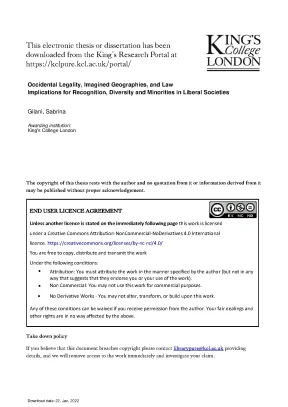
Tải xuống để đọc toàn bộThis electronic thesis or dissertation has been downloaded from the King’s Research Portal at https://kclpure.uk/portal/ Occidental Legality, Imagined Geographies, and Law Implications for Recognition, Diversity and Minorities in Liberal Societies Gilani, Sabrina Awarding institution: King's College London The copyright of this thesis rests with the author and no quotation from it or information derived from it may be published without proper acknowledgement. END USER LICENCE AGREEMENT Unless another licence is stated on the immediately following page this work is licensed under a Creative Commons Attribution-NonCommercial-NoDerivatives 4.org/licenses/by-nc-nd/4.0/ You are free to copy, distribute and transmit the work Under the following conditions: Attribution: You must attribute the work in the manner specified by the author (but not in any way that suggests that they endorse you or your use of the work). Non Commercial: You may not use this work for commercial purposes. No Derivative Works - You may not alter, transform, or build upon this work.
Any of these conditions can be waived if you receive permission from the author. Your fair dealings and other rights are in no way affected by the above. Take down policy If you believe that this document breaches copyright please contact librarypure@kcl.uk providing details, and we will remove access to the work immediately and investigate your claim. 2022 “Occidental Legality, Imagined Geographies, and Law: Implications for Recognition, Diversity and Minorities in Liberal Societies” Sabrina Gilani Doctor of Philosophy in Law Page 1 Acknowledgements This research could not have been possible without the generous financial support of the Social Sciences and Human Rights Research Council of Canada (SSHRC), the Sir James Lougheed Award of Distinction, and the Dickson Poon School of Law at King’s College London.
I would like to extend my deepest gratitude to my supervisory team, made up of Professor Maleiha Malik and Professor Aileen McColgan. Maleiha has been a tremendous support throughout the life of this project, and her enthusiasm for my research was all that kept me going for most of the last six months. Maleiha’s constant encouragement and foresight has helped move the project into new and innovative terrains and for that I am deeply grateful. I would also like to thank Aileen for starting this journey with me four years ago and seeing it through to the end.
I would like to thank Dr. Cian Murphy for his feedback on earlier drafts of this thesis, and a number of presentations that were drafted on the idea of Occidental Legality over the last four years. I am also deeply indebted to Dr. Henrique Carvalho, Dr.
Sabrina Germain, and Dr. Anastasia Chamberlen for their insightful comments and consistent support in these last few years. The opportunity to share the successes and tragedies of this often alienating process with Sabrina, Ana and Henrique made the process of writing this thesis so much more enjoyable. Their words of wisdom, support, and encouragement have meant more to me than I can ever express.
I am also grateful to Professor Christiane Wilke, who taught me during my undergraduate years at Carleton University and urged me to move into academia. Her belief in me has been deeply influential throughout my academic career. Wilke is both a mentor and an inspiration. I would like to thank my parents for being so supportive, and particularly for their kind words of encouragement and compassion over the last, very stressful, few weeks of this project.
Lastly, I am deeply lucky to have Farhan Gilani, Carmie Nicolas, and Cairo Ali Nicolas-Gilani in my life. Thank you so much for the much needed comedic relief, laughter, and words of motivation over the last few months. Page 2 Abstract This thesis discusses how imagined geographies are made real through structures of political and legal governance. Using a method of historical literary analysis, this thesis analyses how geographic space was imagined by European voyagers, explorers, and political agents during the first encounters between European and non-European people in the mid-fifteenth century.
It traces how this – owned, bounded, culturally-divisible – notion of geographic space was later operationalised through political and legal structures of governance in the colonial and postcolonial setting. I use the term Occidental Legality to refer to these spatialising tendencies and demonstrate how they produce a vision of space that we now associate with ‘territory’. This thesis reveals how an owned, bounded, and culturally-divisible notion of space emerges time and again through contemporary cultural geographies, in particular the Aboriginal Reservation, the ‘protected areas’ of national parks, and the public/private divide. Over the course of this work I trace how geographies are the product of jurisdictional struggles between normative communities, and demonstrate how colonial geographies continue to have an influence on how we manage cultural pluralism today.
In so doing, I draw a connection between the exclusionary history of the colonial experience and contemporary forms of minority protection. By drawing attention to the mutually-constitutive relationship between law and geography, I argue that a focus on territorial forms of autonomy tends to displace the issue that is at the heart of minority demands for cultural and legal recognition. This is the demand for coeval recognition. This thesis concludes by developing the notion of coeval recognition and introducing crucial modifications that need to be made to liberal law and forms of governance if contemporary societies are to ensure better protection for their minority communities.
Coeval recognition must be pursued through an acknowledgement of hybridity, a focus on sustaining conditions for self-reflexive intercultural dialogue, and more robust policies to reduce limitations on the mobility of minority communities. Page 3 List of Figures Figure 2.1 – d’Anville’s map of Africa (1749). Retrieved from: http://www.2 - The British Colonies in North America 1763-1775. Image retrieved from: http://www.edu/maps/historical/shepherd/british_colonies_1763-76.3 – Cartouche from Rennell’s Map of Hindoostan (1782).
Retrieved from: http://memory.gov/cgi-bin/map_item.4 Human-drawn Palanquin Used for Travelling during the Earlier Periods of British India – Retrieved from: http://delhidiary.in/whats-new_detail.php?wid=nGw Figure 4.1 – Map of Pakistan Demarcating the FATA and NWFP (now known as the Khyber Pakhtunkhwa Province). Retrieved from: http://www.org/pakistan/fata-and- nwfp-map Figure 4.2 – Chart of Settled, Provincially Administered, and Federally Administered Tribal Areas of Pakistan Figure 4.3 – Colonial Map of British-India. Retrieved from: http://3.com/_2ZXSsLYde8U/TJuIxtVzLxI/AAAAAAAADgQ/WqbjEHLz0I0/s1600/ british-india-map.jpg Page 4 Contents Introduction 1. Occidental Legality and the Production of Territory.
The Concept of ‘Territory’. Place, Space, Geography and Territory. Critical Legal Enterprise. The Use of ‘Postcolonial’.
Contributions to Postcolonial Thinking. Situating the Current Research. 35 Chapter One: The 'Spatial Turn' in the Social Sciences 1. Charting the Course.
The Politics of Space. The Power View of Space. Lafebvrian Space and Space as a Political ‘Strategy’. The Relational View of Space and Socialising the Spatial Form.
Making Spaces into ‘Places’. Place-Making and the Natural Environment. 59 Table of Contents Page 5 i. The Imaginative Geographies of ‘Orientalism’.
Examining the Intersection of Law and Geography. Legal Geography and its ‘Critical’ Turn. The ‘Law-in-Space’ Approach. The ‘Space-in-Law’ Approach.
70 Chapter Two: Mapping the Imperial Indigenous Encounters 1. Overview of Chapter. Concepts of Clarification. The Treaty of Tordesillas as an Envisioning of European Conquest.
Potential Spaces, Imagined Places. Techniques of Territoriality and European Experiences of Overseas Travel. Emptying Geographic Space of its Normative Content. Witnessing the Pristine Wilderness.
Tropes of Discovery and European Benevolence. Mapping Cultural Knowledge onto Geographic Space. Maps as a Method of ‘Coming to Terms with’ Difference. The Discourse of Tropicality.
The Aesthetics of Mapping. Grounding Identities in Geographic Space. Identity and the Natural Environment. Foreign Geographies as Sites of European Identity-Formation.
99 Table of Contents Page 6 D. Temporalising Geographies of Difference. The Re-writing and Erasure of Native History. The Fluidity of Space and the Potential for Native Civilisation.
Conclusion: the Social Production of Territory. 105 Chapter Three: The Political and Legal Construction of Territory 1. Colonial Possession & the Linking of Legal Regulation to Geographies of Difference. Markers of Colonial Possession.
Legitimising Colonial Possession: Vitoria’s Notion of Jus Gentium. Legal Narratives as Expressions of ‘Imperial Witnessing’. Tracing the Idea of Territory through Native-Imperial Conflict in British India. Ordering Relations through the Public/Private Distinction.
Legal Difference Anchored in Cultural Difference. ‘Territoriality’ and the Ethicalness of European Rule. Reproducing Territory through Postcolonial Governance in Australia & Canada. Why Canada and Australia?.
Constructing the Modern State: Embracing Plurality and Rejecting Difference. Constitutional Developments and (dis)Locating the Political Community. Situating Native Identity through Claims for Aboriginal Rights and Title. Immobilising the Native Body.
The Aboriginal Reserve System. Aboriginal Mobility and the Australian ‘Desert-lands’. Protecting the ‘Pristine Wilderness’. Anxieties of Proximity.
Aboriginal Perspectives on the Relationship between Law, Land, and ‘Territory’. Land, Aboriginal Identity, and Reciprocal Relations of Sovereignty. Territory and its Denial of Aboriginal Sovereignty. 165 Table of Contents Page 7 B.
Treaty-Making between Sovereign Nations. Misrepresenting Demands for Sovereignty as Demands for Property. Concluding Remarks: Law’s Reproduction of Space as Territory. 176 Chapter Four: The Operation of Occidental Legality in the Tribal Areas of Pakistan 1.
The Space-Identity Matrix of Power. Imagining the Buffer and Spatialising the ‘Frontier’. Naturalising the Buffer. Imagining the Pakhtun ‘Tribesmen’.
Frontier Landscape and Pakhtun Temperament. Making the ‘Primitive’ Substantiating the Modern. Identifying Space and Spacing Identities and the Exercise of Power. Postcolonial Law-Making & the Legal Status of the FATA.
The Constitutionally Anomalous Status of the Tribal Areas. Tribal Rights of Autonomy. Liminality and the North-West Frontier. Analysing Pakhtun Autonomy: Testing the Limits of Multiculturalism.
Fragmentary Solutions for Cultural Diversity. Places of Legal Excess. Space for Opposition. Pakistan and the Dislocation of ‘the Orient’.
218 Chapter Five: Coeval Recognition of Plurality 1. The Emancipatory and Regulatory Function of Law. 224 Table of Contents Page 8 3. ‘Recognising’ the Native and Producing the ‘Subaltern’.
Legal Recognition and Mutuality. Coeval Recognition and the Plasticity of the Human Body. Acknowledging the Potential of Hybridity. Self-Reflexive Intercultural Dialogue.
Incorporating the ‘Self-Reflexive’ Component. Forums and Strategies for Intercultural Self-Reflexive Dialogue. Contesting the Political and Economic Immobilisation of the Native Body. Occidental Legality and the Production of a Territorial Vision of Space.
Unsettling the Foundations of Territory. Broader Debates of Human Geography. Imagined Geographies and Discursive Power. Timeless Geographies, Progressive Geographies & Hybrid Geographies.
Disembodied Identities and Native Subjectivity. Law as a Cultural Process. Prospects for Further Research. 279 Table of Contents Page 9 Introduction The Spatial Tendencies of the Colonial Gaze Occidental Legality and the Territorialisation of Geographic Space If myth and fantasy touch on levels outside the conscious mind, then simply to point out the falsity of one’s imagination leaves untouched the psychic investments which determine the formation of the fiction that sustains the world we live and act within.
To recognise the instability of the divide between fantasy and reality, fiction and facts is to begin the difficult and painful task of constructing alternative futures. Occidental Legality and the Production of Territory The greatest measure of a social group’s political power is predominantly perceived in terms of its territory - the space in which it exercises its autonomous decision-making capacity. Territory is traditionally imagined as a demarcated geographic zone within which a particular group is said to have exclusive governing capacity. By determining the features and qualities of those that are included within, excluded from, and contained by a space (and the relationships and resources that it contains) groups are able to operationalise their governing power.2 Conceptually, therefore, territory is partially understood as a political and legal construct that is underwritten by specific rules of access and diversity, and designed to keep some people out and others within.
As a concept, territory materialised during the colonial period and was the product of European attempts to lay claim to newly discovered land.
Nội dung được bảo vệ bản quyền — Tải xuống đầy đủ
Trích dẫn luận án này
Sabrina Gilani (2022). Địa lý Tưởng tượng, Pháp lý Phương Tây & Đa dạng [Luận án tiến sĩ, King's College London]. LuanAn.net. https://luanan.net/giao-duc-hoc/phuong-phap-giang-day/2015-gilani-sabrina-0832377-ethesis
Câu hỏi thường gặp
Luận án "Địa lý Tưởng tượng, Pháp lý Phương Tây & Đa dạng" nghiên cứu về vấn đề gì?
Luận văn 2015 Gilani Sabrina 0832377: Phân tích chuyên sâu, khám phá các khía cạnh độc đáo của chủ đề nghiên cứu.
Luận án "Địa lý Tưởng tượng, Pháp lý Phương Tây & Đa dạng" được bảo vệ tại trường nào?
Luận án này được bảo vệ tại King's College London. Năm bảo vệ: 2022.
Luận án "Địa lý Tưởng tượng, Pháp lý Phương Tây & Đa dạng" thuộc chuyên ngành gì?
Luận án "Địa lý Tưởng tượng, Pháp lý Phương Tây & Đa dạng" thuộc chuyên ngành Law. Danh mục: Phương Pháp Giảng Dạy.
Luận án "Địa lý Tưởng tượng, Pháp lý Phương Tây & Đa dạng" có bao nhiêu trang?
Luận án "Địa lý Tưởng tượng, Pháp lý Phương Tây & Đa dạng" có 303 trang. Bạn có thể xem trước một phần tài liệu ngay trên trang web trước khi tải về.
Cách tải luận án "Địa lý Tưởng tượng, Pháp lý Phương Tây & Đa dạng" về máy như thế nào?
Để tải luận án về máy, bạn nhấn nút "Tải xuống ngay" trên trang này, sau đó hoàn tất thanh toán phí lưu trữ. File sẽ được tải xuống ngay sau khi thanh toán thành công. Hỗ trợ qua Zalo: 0559 297 239.