Luận án Tiến sĩ của Letha Rain Alicia Cranford-Goméz: Câu chuyện Gumbo Banaha và Bản địa Louisiana
"Phân tích và đề xuất mô hình cải tiến hiệu quả trong xử lý ngôn ngữ tự nhiên theo nghiên cứu của Letha Rain vào năm 2014 tại Cranford Gomez."
Năm xuất bản
Số trang
308
Thời gian đọc
47 phút
Lượt xem
1
Lượt tải
0
Phí lưu trữ
60 Point
Tổng quan nhanh
- Chủ đề:
- Louisiana Indigenous Narratives: A Doctoral Thesis
- Số trang:
- 308 trang
- Trường:
- University of Oklahoma
- Chuyên ngành:
- English
- Tác giả:
- Letha Rain Alicia Cranford-Gómez
- Năm:
- 2014
Tóm tắt nội dung luận án
I.Louisiana Indigenous Narratives A Doctoral Thesis
Letha Rain Alicia Cranford-Gómez’s 2014 university dissertation explores "Gumbo Banaha Stories." This academic research provides a critical examination of Louisiana indigenieties. It situates these within the complex framework of the Transnational South. The scholarly publication fulfills the requirements for a Doctor of Philosophy degree. It represents a significant contribution to higher education and Indigenous studies. This doctoral thesis was completed at the University of Oklahoma.
1.1. Gumbo Banaha Stories Core Research Focus
The dissertation title, "Gumbo Banaha Stories," signals the central theme. It focuses on the narratives of Indigenous peoples in Louisiana. This PhD study delves into their unique experiences and cultural expressions. The academic writing uncovers layers of identity and belonging. It offers a new perspective on regional Indigenous histories. The research contributes to a deeper understanding of Southern Indigenous cultures.
1.2. Indigenous Identity and the Transnational South
This graduate work investigates the formation and performance of Indigenous identities. It specifically addresses communities within Louisiana. The research connects these local narratives to broader Transnational South concepts. It analyzes how Indigenous experiences transcend national borders. The scholarly publication provides insights into cultural resilience and adaptation. It highlights the importance of place in Indigenous identity.
II.Exploring Transnational South Indigenous Identities
The dissertation by Cranford-Gómez offers an in-depth look at Indigenous identities. It examines their presence within the Transnational South. This academic research broadens the scope of Indigenous studies. It challenges conventional understandings of Southern identity. The PhD study brings forward voices often marginalized in historical accounts. It underscores the ongoing relevance of Indigenous perspectives.
2.1. Weaving Indigenous Perspectives in Higher Education
This university dissertation is a product of higher education commitment to diverse scholarship. It integrates a multiplicity of Indigenous viewpoints. The academic writing explores complex cultural landscapes. It provides a platform for underrepresented narratives. The scholarly publication enhances the discourse on Southern Indigenous identity. It showcases rigorous research methodology in action.
2.2. Contextualizing Louisiana s Unique Indigenous History
The research provides crucial context for Louisiana’s distinct Indigenous heritage. It acknowledges federally recognized, state-recognized, and unrecognized communities. This doctoral thesis highlights their struggles and triumphs. The graduate work emphasizes the deep historical roots of Indigenous presence. It offers a comprehensive literature review of the region's cultural complexities. The study serves as a vital resource for future academic research.
III.University of Oklahoma Graduate Academic Research
The dissertation represents a key achievement from the University of Oklahoma Graduate College. It embodies the rigorous standards of PhD study. This academic research was submitted in partial fulfillment of doctoral requirements. It reflects years of dedicated scholarship and academic writing. The university's support for this scholarly publication is evident. It highlights a commitment to diverse fields of study within higher education.
3.1. Fulfilling Requirements for a Doctor of Philosophy
Successful completion of this university dissertation marks a significant academic milestone. It required extensive research methodology and analysis. The Doctor of Philosophy degree signifies expertise in the chosen field. This graduate work demonstrates advanced critical thinking and scholarly contribution. It solidifies the author's position within higher education and academic research.
3.2. English Department s Contribution to Native Literature
The Department of English approved this doctoral thesis. It reinforces its role in fostering Native American literature scholarship. The academic writing contributes significantly to the field. It provides valuable insights for future literary studies. This scholarly publication reflects the department's academic rigor. It encourages diverse perspectives within PhD study programs.
IV.Scholarly Publication Research Community Engagement
This scholarly publication emphasizes the community-oriented nature of academic research. Dissertation writing is described as a collaborative endeavor. It involves cooperation, negotiation, and family-making. This perspective informs the research methodology. It highlights the interconnectedness of academia and community. The graduate work draws strength from diverse networks.
4.1. Collaborative Spirit in Academic Writing Research
The academic writing process benefited from extensive community support. This included mentors, family, and Indigenous communities. Such collaboration enhances the depth and authenticity of the doctoral thesis. It showcases a holistic approach to higher education. This aspect is crucial for responsible scholarly publication. It ensures research is grounded in real-world experiences.
4.2. Mentorship and Expert Guidance for PhD Study
A distinguished committee approved the dissertation. Dr. Geary Hobson served as chair. Committee members included Dr. Kimberly Roppolo, Dr. Joshua Nelson, Dr. Rhonda Harris Taylor, and Dr. Andrew Jolivétte. Additional 'Shadow Committee' members also provided valuable feedback. This expert guidance ensured the rigor of the PhD study. Such mentorship is vital for high-quality academic research and writing.
V.Honoring Louisiana Indigenous Peoples in Research
The dissertation is dedicated to the Indigenous Peoples of Louisiana. This includes communities federally recognized, state recognized, or struggling for recognition. This dedication underlines the ethical foundation of the academic research. It prioritizes the voices and experiences of these communities. The scholarly publication serves as an act of recognition and advocacy. It contributes to their visibility within higher education.
5.1. Dedication to Indigenous Communities and Voices
The doctoral thesis centers Indigenous perspectives. Its dedication highlights a commitment to community-based research. This approach is fundamental to ethical academic writing. It ensures the research is relevant and impactful. The graduate work acts as a resource for Indigenous self-determination. It exemplifies responsible scholarly publication practices.
5.2. Interdisciplinary Exploration of Regional Cultures
The research draws on diverse sources of knowledge. These include academic, cultural, and ancestral insights. This interdisciplinary lens enriches the literature review. It connects various aspects of Gulf-shores and bayou cultures. The university dissertation bridges different knowledge systems. It offers a comprehensive understanding of Louisiana's Indigenous cultures and their transnational linkages. This enhances the depth of the PhD study.
Tải xuống file đầy đủ để xem toàn bộ nội dung
Tải đầy đủ (308 trang)Trích đoạn nội dung luận án
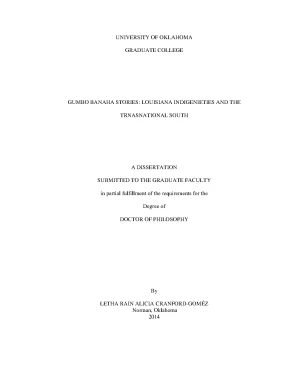
Tải xuống để đọc toàn bộUNIVERSITY OF OKLAHOMA GRADUATE COLLEGE GUMBO BANAHA STORIES: LOUISIANA INDIGENIETIES AND THE TRNASNATIONAL SOUTH A DISSERTATION SUBMITTED TO THE GRADUATE FACULTY in partial fulfillment of the requirements for the Degree of DOCTOR OF PHILOSOPHY By LETHA RAIN ALICIA CRANFORD-GOMÉZ Norman, Oklahoma 2014 GUMBO BANAHA STORIES: LOUISIANA INDIGENITIES AND THE TRANSNATIONAL SOUTH A DISSERTATION APPROVED FOR THE DEPARTMENT OF ENGLISH BY ______________________________ Dr. Geary Hobson, Chair ______________________________ Dr. Kimberly Roppolo ______________________________ Dr. Joshua Nelson ______________________________ Dr.
Rhonda Harris Taylor ______________________________ Dr. Andrew Jolivétte © Copyright by LETHA RAIN ALICIA CRANFORD GOMÉZ 2014 All Rights Reserved. This dissertation is dedicated to the Indigenous Peoples of Louisiana be they federally recognized, state recognized, or struggling for recognition… The completing of writing of a dissertation is a community-building activity. It is assuredly an act of cooperation, negotiation, and family-making.
My ability to weave from a multiplicity of communities, to make meaning from them in languages known, forgotten, alphanumerical, sung, tactile, material, and silenced would not be possible without the people and communities that have surrounded me. These people have come together from academia, homespaces, Gulf-shores, bayous, prairies, Southern plains, Pacific coasts (from the relocation diaspora), Great Lakes, and in the whispered words of memory (from ancestors who have walked on). I take this time to thank them now. Geary Hobson, my professor, mentor, and dissertation chair, your encouragement and support has meant the world to me.
You are a living legend in American Indian literature as a literary critic and an author, as well as a molder of academics and creative writers. So many of us, students and authors, have benefited from your wisdom, guidance, and plain ol’ love. Your knowledge of not only Indigenous literature but American literature and history, is breathtaking to witness. I cannot say enough about what your belief in my work and giving that work back into my family and homespace means to me.
Moreover, your writings drive me to be better. I can only aspire to be half the teacher, mentor, and author you are one day. With thanks for the friendship, mentorship, support, and siblinghood of Andrew Jolivétte and Kimberly Wieser (Roppolo), who have taught by community lead example. I am in awe of both of your hearts, your minds, and your unending brilliance.
I am grateful to have you on my side and on my committee. I could never get where I am going without each of you on either side of me. So, I go forward knowing I have been supported by amazing Indian-Creole and Indian mentors—and I owe y’all a dinner of shrimp and grits as well as a pot of seafood gumbo. There will never be enough words to express my love and gratitude.
To Rhonda Harris Taylor, from our first meeting in Albuquerque to our time at OU, we came together over basketry and Choctaw culture. Your warmth, knowledge, giving spirit, and dedication to students are something for which I am forever grateful. I have been blessed to know you and my work is better for your guidance. Joshua Nelson, your attention to detail, theory, and pragmatism are a needed balance to my creative wants to wander.
You also gave me some of the best practical advice while writing my dissertation and have been the theory “go to man.” We Native literature students are better for it. With thanks to my “Shadow Committee” those who read various potions of this manuscript and offered reading suggestions, feedback, and talked to me about my concept and thoughts as I worked on this project: To Keith Cartwright, whose insight, feedback, and depth of knowledge on Southeastern Indigenous and Creole studies have been invaluable. Your grasp of literature to land, spiritual to water, blood to kinship, and ability to weave a cacophony of voices into sentient speech is awe-inspiring. I cannot thank-you enough for your mentorship, support, and understanding of Gulf lovin, fishin mojo, loquat lovin, turtle juju.
To Carolyn (Carrie) Marie Dunn, as a professor of American Indian literature, author, and as my dearest sister-cousin: I have complete reverence for the magnificence of your scholarship, your talent, and your ability to connect to our homespaces in shuffle steps and calls and response across time and space. Your valiant love, support, humor, wisdom, and always home-centered advice have been irreplaceable. It is good to have another family member in this with me. For that I can never thank-you enough.
You have grounded me and kicked me back into play when I was ready to run back into our bayou. Jeanetta Calhoun Mish, I thank you for sharing your feedback, exaltation, editing skills, friendship, talent and endless support. Your wit, smarts, and experience have been irreplaceable. As an editor, friend, Mvskogean-sister, and advisor I have been truly blessed.
Most especially on a personal note, I thank my mother, father, my sister Tee, brother Bill, and their children, my paternal and maternal grandparents, and my sister-cousin Tracey and her children. When I entered into academia again I feared losing my center. My family, our stories, the children, our laughter, gave me a centering place. I couldn’t have done any of this without you all.
I also know our grandparents, Nana, Papa, Grandmother are watching, and are finally seeing what they knew and hoped I would finally do. I also know that all our relations are with us, from our Pierite and Beridon, to Prud’homme and Metoyer relations, from Jeanne de la Grand Terre to Falayatubby, and everyone in-between— they are with me on this journey. To Mom and Dad— the strength I am, the power I have to stand solid in the knowledge of my peoples and my place in this universe I owe to you. I give thanks for your teaching me the meaning of love and grace with every action.
You are my blood, my heart, and testimony to our survivals across generations, and our beautiful brackish blood. I also must give thanks to the Tunica-Biloxi, Chitimacha, Coushatta, Jena Band of Choctaw, Adais Caddo Indians, Biloxi-Chitimacha-Choctaw Confederation of Muskogee, Choctaw-Apache of Ebarb, Clifton Choctaw, Four Winds Tribe (Louisiana Cherokee Confederacy), Point-Au-Chien Tribe, the United Houma Nation, and the Creole peoples of Louisiana (particularly Cane River and Opelousas). Additionally, I extend thanks to the Creole Heritage Center in Natchitoches Louisiana, Native Writers’ Circle of the Americas, and Wordcraft Circle of Native Writers and Storytellers, for their fellowship, support, and community. To the sixty-seven tribal nations that have called Oklahoma lands home and the thirty-eight federally recognized tribes who currently reside in the state, many of them due to relocation.
The sustainability of Indigenous nations is a strong and lasting thing. With thanks to the Caddo, Osage, Quapaw, and Wichita, whose lands we currently live upon and the University of Oklahoma occupies. Lastly I would like to give thanks to the following people whose support, mentorship, community, and/or various lessons have impacted and/or influenced me during the writing and or conception of this dissertation: Eric Gary Anderson, Damián Baca, Sara Sutler-Cohen, Janet Ravare Colson, Jeffery U. Darensbourg, Sara Day, Lee Francis III, Bosha Green, Vic Gomez, LeAnne Howe, Rachel Jackson, Honorée Fanonne Jeffers, Catherine John, Brian Klopotek, Christophe Landry, Thomas Parrie, Michelle Pichon, Malea Powell, Kirstin Squint, and Lizz Toombs, Jen Tucker.
Yakoke, Mési, Mvto, Wopida~Thanks Y’all! Acknowledgements With thanks to the editors of the following journals and anthologies in which these chapters, sometimes in different forms, have appeared: Chapter II appears in a slightly different form as “Sassafras Stories Digging for Roots: Louisiana Indigeneities in Literary Expressions,” in Louisiana Folklife Journal (2013). Portions of Chapter IV appear in a slightly different form as ““Brackish Bayou Blood: Weaving Mixedblood Indian Creole Identity Outside the Written Record” in American Indian Culture and Research Journal. An edited small selection of Chapter VI appears as "Crossin’ the Log: Death, Regionality, and Race in Jeremy Love’s Bayou." Undead Souths: The Gothic and Beyond. Eric Gary Anderson, Daniel Turner, and Taylor Hagood.
Louisiana State Un Press. —2015: forthcoming — Portions of Chapter VII appear in different form as “Hachotakni Zydeco’s Round’a Loop Current: Indigenous, African, & Caribbean Mestizaje in Louisiana Literatures” in The Southern Literary Journal: Gulf Coast Special Issue. —April 2014: forthcoming — iv Table of Contents Acknowledgements. iv List of Figures.vii Chapter 1Binary Basketry: Absent Indians Done Gone.
1 Chapter 2 Kitchen Table Tableaus: The Physics of Re-Imagining Place, Story, Survivance & Southern Indigeneity………………………………………….34 Chapter 3 Poundin’ Kafi, Makin’ Filé: Louisiana NDN-Creole Indigeneities in The Last of the Ofos. 66 Chapter 4 Beads & Baskets: Mestizaje, NDNs, & Peoplehood in the Physics of Survivance. 97 Chapter 5 Red on Black Doubleweave: Red/Black Rhetorics and Literary Historiography ………………………………………………………………. 126 Chapter 6 Red on Blindian Culture and Pain: Choctawan Geographies and Red/Black Bodies ……………………………………………………………….
184 Chapter 7 Hachotakni Zydeco’s Round’a Loop Current: Louisiana Transnational Literary Traces ………………………………………………………………. 259 Appendix II FAP BIA Criteria….……………………………………………………283 Appendix II: UN Declaration Indigenous Definition. 289 v List of Figures Chapter 2:Figure 1: Atom Model. 84 Chapter4: Figure 1Teche: .……………………………………………………………121 Chapter4: Figure 2Teche: .……………………………………………………………121 Chapter4: Figure 3Blackbird's eye……………………………………………………121 Chapter4: Figure 4Blackbird's eye and Broken braids.………………………………121 Chapter4: Figure 5Broken braids.……………………………………………………121 Chapter4: Figure 6 Bayuk Lwizyàn Memories.………………………………………122 Chapter4: Figure 7 Smoked Mullet Cornbread Crawdad Memory.…………………122 Chapter4: Figure 8 Tee Shawnee……………………………….…………………122 vi Abstract Post devastation of hurricanes Katrina and Rita, Louisiana has again become a popular exoticized presence in the American entertainment machine.
As a result, scholarly studies have renewed interest in the historic ethnic diversity of Louisiana’s complex chronicles and the Southern gothic tropes associated with the state. However, few have sought to connect the Indigenous diasporas of Louisiana’s Native and Creole peoples with its textual productions, unveiling, or unsilencing our own narratives about ourselves as Indigenous peoples: Native, Creole, and/or Cajun. Partly in response to renewed sensationalism surrounding the Pelican State, yet mostly driven from Indigenous ties to land and preservation of culture in the face of continued erasure— this project focuses on issues of reinserting Louisiana Indigenous presence into texts of Southern literary expression in the modern era. In the broadest sense, it addresses issues of Indigenous (Choctaw/Caddo/ Houma/Chitimacha/Tunica-Biloxi) tribal peoples, within the Southern diaspora and their relationships with Louisiana Creole (primarily) and Cajun (secondarily) Indigeneity as manifested through textual representations.
This research locates Louisiana Creoles as mestiza/os whose culture rises out of an Indigenous experience through a similar history of dominance as Mexican/Chicana/o culture, and other mestiza/o peoples of the Caribbean and Gulf of Mexico Latinidad through applying a lens of Indigenous cultural theory, regional studies, history, and critical mixed race studies. Starting with uncovering the emblematic problem of assumptive Indigenous absence in popular Southern fiction, highlighting Gone with the Wind as a seminal text which assumes Indigenous narratives of absence. In response to assumptions of absence I offer a counter narrative examining issues of survivance through physics definition of friction and theoretical applications of place-centered vii story, applying this analysis through self-reflexivity and highlighting established and emerging poets within Louisiana. The text continues to explore complexities of survivance and place-centered story in the face of Indigenous marginalization and federal erasure for Louisiana Indians in Geary Hobson’s The Last of the Ofos and within the material culture of baskets and beadwork within Louisiana landbase.
Next, a historiography of Red/Black rhetorics offers an overview of key African American and Native American texts, Red/Black authors, and publications. This establishes the complex history of African/Native cooperation, contestation, and co-authorship needed when negotiating the history of Louisiana Creoles; people who are members of both the African and Native diaspora. Next, the text moves to modern literary and cultural Red/Black rhetorical repercussions of trauma, Choctawan landbase, and violence evidenced in LeAnne Howe’s Miko Kings and Jeremy Love’s Bayou. Lastly, tracing the ways in which tribe, nation, Peoplehood, race, and travel have impacted both land and literary migrations, the final section ends with contemporary transnational or trans- Peoplehood Indigenous intertextualities, dialoguing works by Carolyn Dunn, LeAnne Howe, Sybil Kein, MonaLisa Saloy, Coco Robicheaux, and Roger Stouff.
Nội dung được bảo vệ bản quyền — Tải xuống đầy đủ
Trích dẫn luận án này
Letha Rain Alicia Cranford-Gómez (2014). Câu chuyện Gumbo Banaha: Bản địa Louisiana và Miền Nam xuyên quốc gia [Luận án tiến sĩ, University of Oklahoma]. LuanAn.net. https://luanan.net/giao-duc-hoc/2014-cranford-gomez-letha-rain-dissertation
Câu hỏi thường gặp
Luận án "Câu chuyện Gumbo Banaha: Bản địa Louisiana và Miền Nam xuyên quốc gia" nghiên cứu về vấn đề gì?
"Phân tích và đề xuất mô hình cải tiến hiệu quả trong xử lý ngôn ngữ tự nhiên theo nghiên cứu của Letha Rain vào năm 2014 tại Cranford Gomez."
Luận án "Câu chuyện Gumbo Banaha: Bản địa Louisiana và Miền Nam xuyên quốc gia" được bảo vệ tại trường nào?
Luận án này được bảo vệ tại University of Oklahoma. Năm bảo vệ: 2014.
Luận án "Câu chuyện Gumbo Banaha: Bản địa Louisiana và Miền Nam xuyên quốc gia" thuộc chuyên ngành gì?
Luận án "Câu chuyện Gumbo Banaha: Bản địa Louisiana và Miền Nam xuyên quốc gia" thuộc chuyên ngành English. Danh mục: Giáo Dục Học.
Luận án "Câu chuyện Gumbo Banaha: Bản địa Louisiana và Miền Nam xuyên quốc gia" có bao nhiêu trang?
Luận án "Câu chuyện Gumbo Banaha: Bản địa Louisiana và Miền Nam xuyên quốc gia" có 308 trang. Bạn có thể xem trước một phần tài liệu ngay trên trang web trước khi tải về.
Cách tải luận án "Câu chuyện Gumbo Banaha: Bản địa Louisiana và Miền Nam xuyên quốc gia" về máy như thế nào?
Để tải luận án về máy, bạn nhấn nút "Tải xuống ngay" trên trang này, sau đó hoàn tất thanh toán phí lưu trữ. File sẽ được tải xuống ngay sau khi thanh toán thành công. Hỗ trợ qua Zalo: 0559 297 239.