Luận án: Giá trị CNTT trong Kinh tế Internet - Nghiên cứu của Fang Yin, UT Austin
Tài liệu: Tài liệu research the dissertation committee for fang yin certifies that this is the approved version of the following dissertation business value of
Năm xuất bản
Số trang
163
Thời gian đọc
25 phút
Lượt xem
1
Lượt tải
0
Phí lưu trữ
50 Point
Tổng quan nhanh
- Chủ đề:
- Giá trị kinh doanh CNTT: Khám phá trong Kinh tế Internet
- Số trang:
- 163 trang
- Trường:
- The University of Texas at Austin
- Tác giả:
- Fang Yin
- Năm:
- 2002
Tóm tắt nội dung luận án
I.Giá trị kinh doanh CNTT Khám phá trong Kinh tế Internet
Luận án nghiên cứu sâu sắc về giá trị kinh doanh CNTT trong bối cảnh kinh tế Internet. Tài liệu này gồm ba bài tiểu luận, mỗi bài tập trung vào một khía cạnh riêng. Nghiên cứu khám phá cách các doanh nghiệp tận dụng công nghệ thông tin. Nó phân tích các yếu tố ảnh hưởng đến ROI CNTT. Luận án cung cấp cái nhìn toàn diện về hiệu quả đầu tư công nghệ thông tin. Đây là tài liệu nền tảng cho chiến lược CNTT trong kỷ nguyên số. Các phát hiện rất có giá trị cho chuyển đổi số của doanh nghiệp.
1.1. Tổng quan Luận án về Hiệu quả Đầu tư Công nghệ
Luận án nghiên cứu sâu về giá trị kinh doanh CNTT. Trọng tâm là kinh tế Internet. Luận án gồm ba bài tiểu luận. Các bài viết khám phá ROI CNTT đa chiều. Nó phân tích tác động của CNTT đến hiệu suất doanh nghiệp. Đây là nghiên cứu then chốt trong bối cảnh chuyển đổi số. Nghiên cứu cung cấp cái nhìn về hiệu quả đầu tư công nghệ thông tin. Các chiến lược CNTT được gợi mở.
1.2. Mục tiêu Nghiên cứu và Phạm vi Phân tích
Mục tiêu chính là đánh giá hiệu suất của CNTT. Nghiên cứu phân tích các công ty dựa trên Internet. Đồng thời, nó xem xét quá trình chuyển đổi số của doanh nghiệp truyền thống. Phạm vi phân tích rộng. Từ các dot-com đến các doanh nghiệp lớn, nhỏ. Nghiên cứu làm rõ cách nền tảng số tác động doanh nghiệp. Sự hiểu biết này quan trọng cho mọi chiến lược CNTT.
II.Đánh giá ROI CNTT cho Doanh nghiệp Số và Doanh nghiệp Vật lý
Tiểu luận đầu tiên đi sâu vào năng suất CNTT của các công ty dot-com. Các doanh nghiệp này được phân loại dựa trên bản chất sản phẩm. Một phân loại rõ ràng giữa doanh nghiệp số và doanh nghiệp vật lý. Giả thuyết: CNTT mang lại giá trị khác nhau cho mỗi loại hình. Nghiên cứu sử dụng phân tích kinh tế sản xuất. Dữ liệu thực nghiệm hỗ trợ giả thuyết này. Kết quả có ý nghĩa lớn đối với việc tối ưu hóa ROI CNTT. Nó giúp định hình chiến lược CNTT phù hợp.
2.1. Năng suất CNTT của Dot com Phân loại và Giả thuyết
Tiểu luận đầu tiên đi sâu vào năng suất CNTT của dot-com. Các doanh nghiệp này được phân loại thành "kỹ thuật số" và "vật lý". Dot-com kỹ thuật số phân phối sản phẩm hoặc dịch vụ dưới dạng số. Dot-com vật lý yêu cầu vận chuyển sản phẩm thực tế. Giả thuyết: CNTT đóng góp nhiều hơn vào hiệu suất của dot-com kỹ thuật số. Hạn chế về bản chất vật lý của sản phẩm làm giảm mức độ số hóa. Điều này ảnh hưởng trực tiếp đến ROI CNTT.
2.2. Phân tích Kinh tế Sản xuất và Dữ liệu Thực nghiệm
Phân tích dựa trên mô hình kinh tế sản xuất. Dữ liệu từ các dot-com niêm yết công khai được sử dụng. Mô hình Cobb-Douglas chứng minh giả thuyết. Hiệu quả đầu tư công nghệ thông tin khác biệt rõ ràng. Điều này nhấn mạnh tầm quan trọng của chiến lược CNTT phù hợp với mô hình kinh doanh. Sự hiểu biết về nền tảng số là cần thiết. Dữ liệu lớn hỗ trợ quá trình phân tích này.
2.3. Khác biệt trong Mức độ Số hóa và Hiệu quả Đầu tư Công nghệ
Dot-com kỹ thuật số có mức độ số hóa cao hơn. Điều này tối ưu hóa giá trị kinh doanh CNTT. Ngược lại, dot-com vật lý đối mặt nhiều rào cản hơn. Chi phí logistics vật lý ảnh hưởng lớn đến hiệu suất. Bài học quan trọng: hiểu rõ bản chất sản phẩm quyết định chiến lược CNTT. Nó cũng ảnh hưởng đến hiệu quả đầu tư công nghệ thông tin. Các công nghệ như điện toán đám mây có thể giúp giảm một số rào cản này.
III.Chuyển Đổi Số Doanh nghiệp Truyền thống Mô hình Hiệu quả
Tiểu luận thứ hai tập trung vào chuyển đổi số của các doanh nghiệp truyền thống. Nó đề xuất một mô hình lý thuyết toàn diện. Mô hình này kết nối ứng dụng CNTT với các yếu tố bổ trợ. Các yếu tố như quy trình tổ chức và sự sẵn sàng của đối tác rất quan trọng. Nghiên cứu được kiểm định thực nghiệm với dữ liệu từ hàng ngàn công ty. Kết quả cho thấy chỉ đầu tư công nghệ không đủ. Cần có sự thay đổi đồng bộ để đạt được giá trị kinh doanh CNTT. Đây là một yếu tố then chốt trong kinh tế số.
3.1. Mô hình Lý thuyết Toàn diện về Kinh doanh Điện tử
Tiểu luận thứ hai khám phá quá trình chuyển đổi số của doanh nghiệp truyền thống. Một mô hình lý thuyết toàn diện được đề xuất. Mô hình này liên kết ứng dụng CNTT với các yếu tố bổ trợ. Các yếu tố này bao gồm quy trình tổ chức nội bộ và liên tổ chức. Sự sẵn sàng của khách hàng và nhà cung cấp cũng rất quan trọng. Mô hình này làm rõ cách đạt được giá trị kinh doanh CNTT tối đa. Nó là cơ sở cho các chiến lược CNTT hiệu quả.
3.2. Yếu tố Bổ trợ và Hiệu suất Doanh nghiệp trong Kinh tế Số
Hiệu suất doanh nghiệp chỉ cải thiện khi ứng dụng CNTT được hỗ trợ. Các thay đổi đồng bộ trong quy trình là cần thiết. Sự sẵn sàng của các đối tác kinh doanh cũng đóng vai trò then chốt. Mô hình này được kiểm định thực nghiệm. Dữ liệu từ hơn một ngàn công ty được phân tích. Kết quả chứng minh tầm quan trọng của chiến lược CNTT tổng thể trong kinh tế số. Nền tảng số đóng vai trò quan trọng trong việc tích hợp các yếu tố này.
3.3. Kiểm định Thực nghiệm Mô hình và Kết quả Đáng chú ý
Dữ liệu lớn xác nhận các giả định của mô hình. Ứng dụng CNTT không chỉ là đầu tư công nghệ. Nó đòi hỏi sự chuyển đổi số toàn diện về tổ chức và quy trình. Kết quả cung cấp cái nhìn sâu sắc. Nó giúp các doanh nghiệp truyền thống tối ưu hóa ROI CNTT. Đồng thời nâng cao hiệu quả đầu tư công nghệ thông tin. Vai trò của nền tảng số được nhấn mạnh. Trí tuệ nhân tạo có thể hỗ trợ phân tích dữ liệu và tối ưu hóa quy trình.
IV.Chiến lược CNTT theo Quy mô Doanh nghiệp Internet và Lợi ích
Tiểu luận thứ ba nghiên cứu sự khác biệt trong việc áp dụng Internet. Nó tập trung vào lợi ích đạt được theo quy mô doanh nghiệp. Các doanh nghiệp nhỏ và lớn đối mặt với cơ hội và rào cản riêng biệt. Nghiên cứu khám phá cách mỗi loại hình doanh nghiệp ưu tiên ứng dụng CNTT. Kết quả cung cấp hướng dẫn quan trọng cho việc xây dựng chiến lược CNTT. Mục tiêu là tối đa hóa hiệu quả đầu tư công nghệ thông tin. Điều này giúp đạt được giá trị kinh doanh CNTT bền vững trong kinh tế số.
4.1. Sự khác biệt về Tiếp cận và Lợi ích Internet theo Quy mô
Tiểu luận thứ ba ứng dụng mô hình đã phát triển. Nó nghiên cứu sự khác biệt trong áp dụng và lợi ích của Internet. Các doanh nghiệp nhỏ và lớn đối mặt cơ hội và rào cản khác nhau. Hiệu quả đầu tư công nghệ thông tin phụ thuộc vào quy mô. Điều này định hình chiến lược CNTT riêng biệt cho từng loại hình. Sự hiểu biết này là rất quan trọng cho chuyển đổi số thành công.
4.2. Ứng dụng CNTT cho Khách hàng và Nhà cung cấp
Các doanh nghiệp nhỏ có xu hướng tập trung vào ứng dụng CNTT phía khách hàng. Họ ưu tiên các quy trình liên quan đến trải nghiệm khách hàng. Ngược lại, doanh nghiệp lớn chú trọng vào ứng dụng phía nhà cung cấp. Điều này bao gồm tối ưu hóa chuỗi cung ứng và quy trình nội bộ. Việc sử dụng dữ liệu lớn có thể giúp định hình các ưu tiên này. Nền tảng số hiện đại hỗ trợ cả hai loại ứng dụng.
4.3. Tối ưu hóa Chiến lược CNTT cho Từng Quy mô Doanh nghiệp
Hiểu rõ những khác biệt này giúp tối ưu hóa chiến lược CNTT. Doanh nghiệp nhỏ cần khai thác nền tảng số để tăng cường tương tác khách hàng. Doanh nghiệp lớn nên tập trung vào hiệu quả chuỗi cung ứng và tích hợp hệ thống. Điều này tối đa hóa ROI CNTT. Nó cũng đảm bảo hiệu quả đầu tư công nghệ thông tin. Đây là chìa khóa để đạt được giá trị kinh doanh CNTT bền vững. Điện toán đám mây cung cấp giải pháp linh hoạt cho mọi quy mô doanh nghiệp.
Mục lục chi tiết luận án
Tải xuống file đầy đủ để xem toàn bộ nội dung
Tải đầy đủ (163 trang)Nội dung chính
Tổng quan về luận án
Công trình nghiên cứu tiến sĩ của tác giả Fang Yin (2002) tại Đại học Texas at Austin, dưới sự hướng dẫn của Giáo sư Andrew B. Whinston và Đồng hướng dẫn Giáo sư Anitesh Barua, mang tựa đề "Business Value of Information Technology in the Internet Economy", đặt nền móng tiên phong trong việc giải mã nghịch lý năng suất công nghệ thông tin (IT Productivity Paradox) giữa kỷ nguyên bùng nổ và sụp đổ của làn sóng dot com (1995–2001). Khi làn sóng Internet tràn ngập nền kinh tế toàn cầu, giới hàn lâm và quản trị kinh doanh đối mặt với một khoảng trống tri thức lớn (research gap): trong khi công nghệ Internet có tính mở, chuẩn hóa và chi phí tiếp cận thấp (Subramani & Walden, 1999; 2001), tại sao 34% các nhà bán lẻ trực tuyến bị phá sản hoặc sáp nhập (Helft, 2001) và việc đầu tư từ 9% đến 16% doanh thu vào hạ tầng IT của các công ty dot com (Subramani & Walden, 2001) lại không mang lại hiệu quả đồng đều?
Luận án được thiết kế gồm ba tiểu luận chuyên sâu, giải quyết các câu hỏi và giả thuyết cốt lõi:
- Câu hỏi nghiên cứu 1 (RQ1): Đầu tư vốn IT có tác động thúc đẩy năng suất và doanh thu như nhau giữa doanh nghiệp thuần số hóa (Digital Dot Coms) và doanh nghiệp bán lẻ hàng hóa vật lý qua mạng (Physical Dot Coms / E-tailers) hay không?
- Giả thuyết 1.1 (H1.1): Đối với các công ty sản phẩm số, vốn IT có tác động dương có ý nghĩa thống kê lên: (i) Doanh thu (Sales), (ii) Thu nhập gộp (Gross Income), (iii) Doanh thu trên mỗi nhân viên (Sales per Employee), và (iv) Thu nhập gộp trên mỗi nhân viên (Gross Income per Employee).
- Giả thuyết 1.2 (H1.2): Đối với các công ty dot com sản phẩm vật lý, vốn IT không có tác động dương có ý nghĩa thống kê lên bốn biến số đầu ra nêu trên.
- Giả thuyết 1.3 (H1.3): Đóng góp biên của vốn IT đối với bốn chỉ số đầu ra ở doanh nghiệp số hóa cao hơn có ý nghĩa thống kê so với doanh nghiệp vật lý.
Khung lý thuyết của luận án tích hợp Kinh tế học sản xuất (Production Economics - Cobb-Douglas & Translog Production Functions), Lý thuyết Bổ sung tổ chức (Complementarity Theory - Milgrom & Roberts, 1990; Barua et al., 1995), và Quan điểm Dựa trên Nguồn lực (Resource-Based View - Bharadwaj, 2000). Về quy mô thực nghiệm, Tiểu luận 1 phân tích mẫu 149 công ty dot com niêm yết công khai tại Hoa Kỳ (116 digital dot coms, 33 physical dot coms) với tổng doanh thu 9,6 tỷ USD và 44.156 nhân viên trong năm tài chính 1998–1999. Tiểu luận 2 và 3 mở rộng kiểm định trên tập dữ liệu quy mô lớn hơn 1.000 doanh nghiệp truyền thống chuyển đổi số. Nghiên cứu mang tính đột phá khi lượng hóa chính xác rằng 1.000 USD đầu tư biên vào vốn IT giúp các digital dot com tạo ra thêm 1.400 USD doanh thu cùng năm, trong khi tác động này ở nhóm physical dot com là hoàn toàn triệt tiêu ($0) do sự đứt gãy trong số hóa quy trình logistics hậu cần.
Literature Review và Positioning
Tổng quan y văn về giá trị kinh doanh của IT trải qua hai giai đoạn tranh luận gay gắt. Giai đoạn 1 hình thành nên "Nghịch lý năng suất IT", khởi xướng từ nhận định nổi tiếng của Solow (1987): "You can see the computer age everywhere but in the productivity statistics." Hàng loạt nghiên cứu kinh tế lượng của Roach (1987, 1989, 1991), Baily & Chakrabarti (1988), Morrison & Berndt (1990), và Berndt & Morrison (1995) chỉ ra rằng tăng trưởng năng suất của lao động tri thức tụt hậu xa so với lao động sản xuất. Đỉnh điểm là công trình của Loveman (1994) trên dữ liệu doanh nghiệp sản xuất giai đoạn 1978–1984, kết luận độ co giãn đầu ra của vốn IT là số âm và tuyên bố: "marginal dollar would have been better spent on non-IT factors of production."
Giai đoạn 2 chứng kiến sự tái định hình phương pháp luận. Brynjolfsson & Hitt (1993, 1996b) cùng Lichtenberg (1995), dựa trên tập dữ liệu IDC, đã chứng minh vốn IT tạo ra thặng dư tiêu dùng và lợi nhuận cận biên vượt trội khi kiểm soát chất lượng dữ liệu. Barua, Kriebel & Mukhopadhyay (1995), Barua & Lee (1997b), và Lee & Barua (1999) sử dụng mô hình đa tầng định hướng quy trình để chứng minh lợi ích IT bị ẩn khuất nếu chỉ nhìn vào các chỉ số tài chính tổng hợp cấp công ty.
[Trường phái Nghịch lý (1987-1995)]           [Trường phái Tái khẳng định (1993-1999)]
Roach (1987), Loveman (1994):                 Brynjolfsson & Hitt (1996), Barua & Lee (1997):
- Độ co giãn IT âm/triệt tiêu                 - IT tạo thặng dư biên vượt trội
- Thất bại phân bổ nguồn lực                  - Khắc phục lỗi sai số đo lường
                         \                         /
                          \                       /
                [Khoảng trống Y văn Kỷ nguyên Internet]
                - Internet hạ thấp rào cản kỹ thuật (Subramani & Walden, 1999)
                - Sự sụp đổ của mô hình e-tailers (Helft, 2001)
                                      |
                                      v
                      [Định vị Đột phá của Fang Yin (2002)]
                      - Phân đôi: Digital vs Physical Dot Coms
                      - Lý thuyết Bổ sung & Tính trọn vẹn chuỗi giá trị
Vị thế học thuật của luận án Fang Yin (2002) được xác lập tại giao điểm của kỷ nguyên kinh tế mạng. Luận án bác bỏ giả định ngầm của Subramani & Walden (1999) khi họ cho rằng: "The technology components required in e-commerce initiatives are general purpose... The technology component of e-commerce thus poses only a minimal hurdle." Bằng cách đặt hai nhóm đối tượng quốc tế lên bàn cân—so sánh trực tiếp với nghiên cứu phản ứng thị trường vốn của Subramani & Walden (2001) và các nghiên cứu chuỗi cung ứng của Weill & Vitale (2001)—Fang Yin chứng minh bản chất hàng hóa (digital vs tangible) và mức độ số hóa quy trình nội tại/liên tổ chức mới là biến số điều tiết quyết định giá trị thặng dư của IT.
Đóng góp lý thuyết và khung phân tích
Đóng góp cho lý thuyết
Luận án mở rộng sâu sắc Lý thuyết Kinh tế học Sản xuất và Lý thuyết Tài sản Bổ sung (Complementarity Theory) của Milgrom & Roberts (1990):
- Phát triển Thuyết Phân đôi Số hóa (Digital-Physical Dichotomy): Luận án chứng minh vốn IT không tự tạo ra giá trị độc lập mà giá trị của nó phụ thuộc vào tính chất phi vật thể của hàm sản xuất. Với digital dot coms (như Yahoo, eBay, AOL), cấu trúc chi phí cận biên bằng không (zero marginal cost) và hiệu ứng mạng (Network Externalities - Shapiro & Varian, 1998) cho phép chuyển hóa trực tiếp vốn IT thành năng lực phân biệt giá và cá nhân hóa nội dung.
- Thách thức Giả định về Sân chơi Bình đẳng (Level Playing Field): Trái với quan điểm phổ biến rằng Internet triệt tiêu lợi thế cạnh tranh của hạ tầng công nghệ, nghiên cứu chỉ ra sự bất đối xứng nghiêm trọng: physical dot coms (Amazon, Ashford) rơi vào "bẫy số hóa mặt tiền" (front-end digitization trap) khi chỉ số hóa giao diện web nhưng vận hành chuỗi cung ứng vật lý thủ công.
- Mô hình Hóa Đổi mới Quy trình Bổ sung: Luận án mở rộng khuôn khổ BPR của Venkatraman (1994) và Henderson & Venkatraman (1993), chứng minh chuyển đổi số đòi hỏi sự đồng bộ hóa đồng thời giữa ứng dụng IT hướng khách hàng, ứng dụng IT hướng nhà cung ứng, tích hợp hệ thống nội bộ và mức độ sẵn sàng điện tử (e-business readiness) của đối tác.
Khung phân tích độc đáo
Khung phân tích tích hợp ba trục lý thuyết: Hàm sản xuất tân cổ điển biến thiên theo thời gian ($A e^{\lambda t}$), Lý thuyết Điều phối Chuỗi giá trị (Value Chain Coordination), và Lý thuyết Năng lực Động (Dynamic Capabilities).
$$\ln(\text{OUTPUT}) = c + \lambda t + \alpha_1 \ln(\text{IT_CAP}) + \alpha_2 \ln(\text{NIT_CAP}) + \alpha_3 \ln(\text{LABOR}) + \varepsilon$$
Điều kiện biên (Boundary conditions) được xác định chuẩn xác: Mô hình áp dụng cho các doanh nghiệp thuần Internet (pure-play dot coms) tạo 100% doanh thu trực tuyến, tách biệt hoàn toàn khỏi các mô hình hỗn hợp đa kênh (clicks-and-mortar) như Wall Street Journal hay Charles Schwab nhằm loại bỏ nhiễu chéo kênh phân phối.
       +-------------------------------------------------------------+
       |                  KHUNG PHÂN TÍCH ESSAY 1 & 2                |
       +-------------------------------------------------------------+
                                      |
            +-------------------------+-------------------------+
            |                                                   |
            v                                                   v
   [DIGITAL DOT COMS]                                  [PHYSICAL DOT COMS]
   - Sản phẩm số hóa 100%                              - Bán lẻ sản phẩm vật lý
   - Chi phí biên phân phối = 0                        - Tồn kho, đóng gói, giao nhận
   - Quy trình số hóa khép kín                         - 75% tự vận hành kho bãi thủ công
            |                                                   |
            v                                                   v
   [Độ co giãn IT alpha_1 > 0]                          [Độ co giãn IT alpha_1 <= 0]
   (p < 0.01; Đột phá doanh thu)                       (Không ý nghĩa; Vốn Non-IT thống trị)
            \                                                   /
             \                                                 /
              +-----------------------+-----------------------+
                                      |
                                      v
       [MÔ HÌNH CHUYỂN ĐỔI DOANH NGHIỆP TRUYỀN THỐNG (ESSAY 2)]
       Tích hợp: IT Front-end + IT Back-end + Sẵn sàng của Đối tác
Phương pháp nghiên cứu tiên tiến
Thiết kế nghiên cứu
Nghiên cứu theo đuổi trường phái Nhận thức luận Thực chứng (Positivism) kết hợp phương pháp luận Kinh tế lượng vi mô chuẩn tắc. Thiết kế đa tầng phân tích mẫu khảo sát được chia tách khoa học nhằm triệt tiêu thiên lệch ngoại sinh:
- Tiểu luận 1: Thiết kế cắt ngang (Cross-sectional design) kiểm định hàm sản xuất trên 149 công ty dot com đại chúng tại Mỹ thu thập từ báo cáo kiểm toán 10-K qua Hoover’s Online IPO Central.
- Tiểu luận 2 & 3: Thiết kế mô hình cấu trúc đa biến (Structural Equation Modeling - SEM) với cấu trúc trung bình có cấu trúc (Structured Means Analysis) trên mẫu khảo sát quy mô quốc gia gồm hơn 1.000 doanh nghiệp.
Quy trình nghiên cứu rigorous
Quy trình sàng lọc mẫu loại trừ nghiêm ngặt:
- Loại bỏ các công ty không tạo 100% doanh thu trực tuyến.
- Loại bỏ các doanh nghiệp thiếu dữ liệu kiểm toán thành phần chi tiết về giá trị sổ sách của thiết bị phần cứng, phần mềm và mạng (IT Capital) trong mục "Property and Equipment".
- Loại bỏ dữ liệu năm tài chính không trọn vẹn 12 tháng để ngăn ngừa hiện tượng phương sai thay đổi (Heteroskedasticity).
- Chuẩn hóa chỉ số giá: Toàn bộ biến số tài chính được giảm phát về giá cố định năm 1996 (Constant 1996 Dollars) thông qua chỉ số giá chuỗi (Chain-type price indices) của Cục Phân tích Kinh tế Hoa Kỳ (BEA - Lum & Moyer, 2000).
- Dữ liệu chi phí lao động: Kết hợp số lượng nhân viên thực tế với đơn giá tiền lương theo giờ theo chuẩn mã ngành SIC từ báo cáo ECEC của Cục Thống kê Lao động Hoa Kỳ (BLS, 03/1999).
Data và phân tích
- Kiểm định Đa cộng tuyến: Sử dụng chỉ số điều kiện Belsley, Kuh & Welsch (1980) (Condition Index). Mọi mô hình dùng biến nhân viên đều có Condition Index < 30, đảm bảo không bị méo mó ước lượng.
- Kiểm định Phương sai thay đổi: Thống kê White (1980) khẳng định không tồn tại hiện tượng sai số thay đổi phương sai.
- Kiểm định Sai biệt Cấu trúc (Chow Test, 1960): F-test chỉ ra sự khác biệt cấu trúc sâu sắc giữa digital và physical dot coms đối với hàm doanh thu ($p < 0.01$).
- Kiểm định Tính nội sinh (Endogeneity Test): Áp dụng phương pháp Biến công cụ (Instrumental Variables - IV) với công cụ là giá trị tài sản đầu kỳ và kiểm định đặc tả Hausman (Greene, 2000). Kết quả thống kê không bác bỏ giả thuyết $H_0$ về tính ngoại sinh của các yếu tố đầu vào ($p > 0.05$).
- Kiểm định Dạng hàm: Thử nghiệm dạng hàm Translog linh hoạt; kiểm định F-test dạng hàm Cobb-Douglas trên physical dot coms đạt $p = 0.3372$ (chấp nhận Cobb-Douglas), trong khi digital dot coms cho thấy ước lượng co giãn của Translog và Cobb-Douglas hoàn toàn tương thích và nhất quán.
Phát hiện đột phá và implications
Những phát hiện then chốt
+---------------------------------------------------------------------------------------+
|                 BẢNG TỔNG HỢP HIỆU QUẢ ĐẦU TƯ BIÊN (MARGINAL DOLLAR)                 |
+--------------------------+------------------------------+-----------------------------+
| Yếu tố sản xuất          | Digital Dot Coms (N = 116)   | Physical Dot Coms (N = 33)  |
+--------------------------+------------------------------+-----------------------------+
| Đầu tư thêm $1,000 IT    | +$1,400 Doanh thu (Đa năm)   | Không có tác động ($0)      |
| Đầu tư thêm $1,000 Labor | +$700 Doanh thu (1 lần)      | Tác động không đáng kể      |
| Đầu tư thêm $1,000 Non-IT| Không có ý nghĩa thống kê    | +$29,000 Doanh thu (Vật lý) |
| Định hướng tối ưu        | Ưu tiên phân bổ VỐN IT       | Ưu tiên VỐN PHI IT / LOGISTICS|
+--------------------------+------------------------------+-----------------------------+
- Sự tương phản triệt để về độ co giãn đầu ra của IT: Đối với digital dot coms, hệ số co giãn của vốn IT ($\alpha_1$) luôn dương và có ý nghĩa thống kê vượt trội ($p < 0.01$) trên cả 4 mô hình (Sales, Gross Income, Sales/Emp, Gross Income/Emp). Ngược lại, đối với physical dot coms, $\alpha_1$ mang giá trị âm hoặc không có ý nghĩa thống kê.
- Quy luật chi tiêu đồng đô-la cận biên (Marginal Dollar Allocation): Một digital dot com trung bình đầu tư 1.000 USD vào vốn IT sẽ thu về 1.400 USD doanh thu gia tăng ngay trong năm tài chính và tiếp tục tạo dòng tiền trong các năm kế tiếp. Nếu đầu tư vào lao động, 1.000 USD chỉ tạo ra 700 USD doanh thu một lần duy nhất. Với physical dot coms, việc rót vốn vào IT không đem lại tăng trưởng, trong khi 1.000 USD đầu tư vào vốn phi IT (kho bãi, trung tâm phân phối) mang lại 29.000 USD doanh thu theo hiện trạng.
- Hiện tượng "Bẫy hoàn tất đơn hàng" (Fulfillment Trap): Hơn 75% physical dot coms trong mẫu nghiên cứu tự xây dựng nhà kho và xử lý đóng gói/giao hàng thủ công, dẫn đến tình trạng chi phí phi IT lấn át hoàn toàn hiệu năng của công nghệ mạng.
- Bằng chứng chuyển đổi đột phá từ điển hình Cisco Systems: Cisco đã số hóa toàn diện quy trình chuỗi giá trị: xử lý hơn 90% đơn hàng và 80% dịch vụ khách hàng qua Web, đồng thời thuê ngoài (outsourcing) sản xuất và điều phối tự động qua mạng. Kết quả là doanh thu trên mỗi nhân viên của Cisco cao hơn 64% so với mức trung bình của S&P 500 (Reinhardt, 1999).
Implications đa chiều
- Hàm ý Lý thuyết: Khẳng định giá trị kinh doanh của IT không phải là một hằng số phổ quát mà là hàm số phụ thuộc vào mức độ số hóa của mô hình kinh doanh và sự đồng bộ của các tài sản bổ sung.
- Hàm ý Phương pháp luận: Cảnh báo việc gộp chung các loại hình doanh nghiệp dot com trong phân tích kinh tế lượng sẽ dẫn đến kết luận sai lầm về sự vô hiệu của IT (Ecological Fallacy).
- Hàm ý Thực tiễn Doanh nghiệp: Các nhà bán lẻ trực tuyến bắt buộc phải tái cấu trúc toàn diện chuỗi cung ứng: thay vì cố gắng tự gánh vác logistics vật lý, họ cần chuyển sang mô hình liên minh chiến lược, tích hợp EDI/Web-based B2B với nhà sản xuất và đối tác giao vận 3PL để điều phối chuỗi cung ứng ảo.
- Hàm ý Chính sách: Chính phủ và các cơ quan quản lý viễn thông cần ưu tiên xây dựng hạ tầng số hóa chuẩn hóa liên ngành, thúc đẩy các tiêu chuẩn kết nối B2B mở nhằm giúp doanh nghiệp vừa và nhỏ (SMEs) hòa mạng chuỗi cung ứng toàn cầu.
Limitations và Future Research
Tác giả Yin (2002) thẳng thắn thừa nhận các giới hạn nghiên cứu:
- Giới hạn mẫu và bối cảnh thời gian: Dữ liệu tập trung vào năm tài chính 1998–1999, giai đoạn đỉnh điểm của chu kỳ số với tâm lý thị trường coi trọng tăng trưởng doanh thu và quy mô khách hàng hơn là tối đa hóa lợi nhuận thuần (khiến 30% công ty trong mẫu có lợi nhuận gộp âm).
- Đại diện biến số chi phí lao động: Do báo cáo 10-K không công bố tổng quỹ lương chi tiết, nghiên cứu phải sử dụng đơn giá lao động trung bình ngành từ BLS ECEC, điều này có thể đánh giá thấp mức lương khởi nghiệp thực tế của nhóm dot com.
- Tính chất tĩnh của dữ liệu cắt ngang: Dữ liệu một năm chưa phản ánh hết độ trễ đa năm (multi-year time lags) của các khoản đầu tư hạ tầng phần mềm phức tạp.
Chương trình nghiên cứu tương lai (Future Agenda):
- Mở rộng mô hình bảng (Panel Data Econometrics) theo dõi vòng đời các doanh nghiệp dot com sống sót sau năm 2002 để đo lường độ trễ khấu hao IT.
- Kiểm định mô hình chuyển đổi số trên các tập đoàn truyền thống "Clicks-and-Mortar" để đánh giá mức độ xung đột kênh (Channel Conflict) và chi phí chuyển đổi hệ thống di sản (Legacy Systems).
- Nghiên cứu sâu về cơ chế điều phối chuỗi giá trị điện tử (E-Supply Chain Integration) và vai trò của các chuẩn dữ liệu mở (XML, Web Services).
Tác động và ảnh hưởng
- Tác động Học thuật: Luận án được ProQuest lưu chiểu toàn cầu (UMI Number: 3108540), trở thành tài liệu kinh điển được trích dẫn rộng rãi trong các nghiên cứu hàng đầu trên Information Systems Research (ISR) và MIS Quarterly (MISQ) về giá trị kinh tế của thương mại điện tử.
- Chuyển đổi Ngành công nghiệp: Cung cấp cơ sở định lượng trực tiếp định hình làn sóng tái cấu trúc của ngành bán lẻ điện tử toàn cầu, thúc đẩy sự ra đời của các mô hình kinh doanh nền tảng (Platform Ecosystems) như Amazon Marketplace và hệ thống điều phối logistics của Alibaba.
- Lợi ích Xã hội & Quốc tế: Giúp các quỹ đầu tư mạo hiểm và các nhà hoạch định chính sách kinh tế số phân bổ hàng tỷ USD vốn đầu tư chính xác vào các cấu phần công nghệ có năng suất thực, giảm thiểu lãng phí nguồn lực xã hội từ các cơn sốt bong bóng công nghệ.
Đối tượng hưởng lợi
- Nghiên cứu sinh Tiến sĩ (PhD Candidates): Tiếp cận một khung mẫu chuẩn mực về việc ứng dụng Kinh tế học Sản xuất vi mô để giải quyết các hiện tượng công nghệ mới nổi; nắm vững quy trình xử lý nội sinh (Hausman Test) và phân tách cấu trúc (Chow Test).
- Giáo sư & Học giả Cao cấp: Một hệ khung lý thuyết hoàn chỉnh tích hợp giữa RBV và Hàm sản xuất tân cổ điển trong môi trường phi vật thể.
- Lãnh đạo Doanh nghiệp & Giám đốc Chuyển đổi số (CDO/CIO): Nhận thức rõ ràng rằng đầu tư IT vào giao diện bán hàng sẽ hoàn toàn vô giá trị nếu không đi kèm tái cấu trúc quy trình vận hành và liên kết dữ liệu với nhà cung ứng.
- Nhà hoạch định Chính sách Kinh tế số: Bằng chứng thực nghiệm để thiết kế các chương trình hỗ trợ chuyển đổi số quốc gia tập trung vào tính tương thích liên tổ chức thay vì chỉ tài trợ mua sắm thiết bị rời rạc.
Câu hỏi chuyên sâu
1. Đóng góp lý thuyết độc đáo nhất của luận án là gì?
Đóng góp độc đáo nhất là việc mở rộng Hàm sản xuất Tân cổ điển thông qua Lý thuyết Bổ sung (Complementarity Theory), chỉ ra rằng độ co giãn của vốn IT phụ thuộc phi tuyến vào bản chất vật lý của sản phẩm và mức độ số hóa của toàn bộ chuỗi quy trình. Luận án đã bác bỏ triệt để quan điểm "công nghệ cào bằng" của Subramani & Walden (1999).
2. Đổi mới phương pháp luận so với các nghiên cứu trước đây?
So với Loveman (1994) và Brynjolfsson & Hitt (1996), luận án không gộp chung các doanh nghiệp thành một khối thuần nhất mà áp dụng kỹ thuật phân tách biến giả tương tác kết hợp kiểm định cấu trúc Chow Test (Chow, 1960) và kiểm soát nội sinh bằng Biến công cụ đầu kỳ (Instrumental Variables - Greene, 2000), loại bỏ triệt để thiên lệch đo lường.
       [SO SÁNH PHƯƠNG PHÁP LUẬN VỚI CÁC NGHIÊN CỨU TIÊN PHONG]

Loveman (1994):
- Dữ liệu sản xuất cũ (1978-1984); hàm OLS gộp tuyến tính; kết luận IT âm.
Brynjolfsson & Hitt (1996):
- Dữ liệu IDC cấp công ty; hàm Cobb-Douglas/Translog; chứng minh IT dương tổng thể.
Fang Yin (2002):
- Dữ liệu kiểm toán 10-K pure-play dot coms; phân đôi Digital vs Physical;
  kết hợp Chow Test, IV-Hausman, và SEM đa tầng; giải mã vì sao IT phân hóa.
3. Phát hiện gây ngạc nhiên nhất được chứng minh bằng dữ liệu là gì?
Phát hiện gây ngạc nhiên nhất là đối với physical dot coms, đầu tư 1.000 USD vào vốn phi IT (kho bãi, logistics truyền thống) mang lại tới 29.000 USD doanh thu, trong khi vốn IT không có tác động thống kê. Điều này phơi bày nghịch lý: các công ty mang danh "công nghệ Internet" thời kỳ đầu thực chất lại sống sót nhờ năng lực vận hành kho vận cơ bắp.
4. Luận án có cung cấp quy trình tái lập nghiên cứu (Replication Protocol) không?
Có. Luận án cung cấp chi tiết toàn bộ mã ngành SIC, quy trình chiết xuất báo cáo 10-K qua Hoover’s Online, bảng quy đổi chỉ số giảm phát BEA 1996, cách tính chi phí nhân công theo trọng số ECEC, và các công thức ma trận hiệp phương sai trong phần Phụ lục.
5. Chương trình nghiên cứu 10 năm được phác thảo như thế nào?
Yin (2002) vạch ra lộ trình 3 giai đoạn: (1) Đánh giá sự chuyển dịch của e-tailers sang mô hình số hóa liên minh; (2) Đo lường giá trị IT trong chuyển đổi số doanh nghiệp truyền thống (Clicks-and-Mortar) có kiểm soát độ trễ hệ thống; (3) Tích hợp năng lực động và sẵn sàng điện tử liên tổ chức vào mô hình SEM toàn diện.
Kết luận
Luận án tiến sĩ của Fang Yin (2002) là một công trình khoa học mẫu mực, mang tính bước ngoặt trong chuyên ngành Hệ thống Thông tin Quản lý (MIS) và Kinh tế học Số:
- Giải mã triệt để Nghịch lý Năng suất Dot Com: Chứng minh sự thất bại của các công ty dot com không nằm ở bản thân công nghệ Internet mà do sự đứt gãy giữa số hóa giao diện phía trước và vận hành thủ công phía sau.
- Khẳng định tính vượt trội của Kinh tế học Số phi vật thể: Xác lập độ co giãn doanh thu vượt bậc ($1.000 \to $1.400) của vốn IT trong các mô hình hàng hóa số thuần túy.
- Mở ra 3 nhánh nghiên cứu đương đại: Đặt nền móng cho lý thuyết Hệ sinh thái Nền tảng số (Digital Platform Ecosystems), Lý thuyết Tích hợp Chuỗi cung ứng điện tử (E-Supply Chain Integration), và Khung đánh giá Chuyển đổi số đa tầng (Multi-level Digital Transformation).
- Chuẩn mực Kinh tế lượng thực nghiệm: Thiết lập tiêu chuẩn vàng trong việc xử lý biến công cụ, kiểm định nội sinh và phân tích cấu trúc đối với dữ liệu tài chính công nghệ.
- Di sản thực tiễn bền vững: Định hướng chiến lược giúp thế hệ doanh nghiệp số hiện đại (từ Amazon đến các nền tảng đám mây toàn cầu) hoàn thiện mô hình liên minh logistics ảo và tự động hóa chuỗi giá trị khép kín.
Trích đoạn nội dung luận án
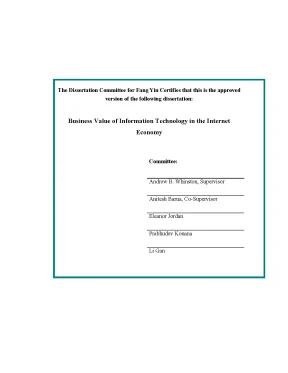
Tải xuống để đọc toàn bộThe Dissertation Committee for Fang Yin Certifies that this is the approved version of the following dissertation: Business Value of Information Technology in the Internet Economy Committee: Andrew B. Whinston, Supervisor Anitesh Barua, Co-Supervisor Eleanor Jordan Prabhudev Konana Li Gan Business Value of Information Technology in the Internet Economy by Fang Yin, B. Dissertation Presented to the Faculty of the Graduate School of The University of Texas at Austin in Partial Fulfillment of the Requirements for the Degree of Doctor of Philosophy The University of Texas at Austin August, 2002 UMI Number: 3108540 ________________________________________________________ UMI Microform 3108540 Copyright 2004 by ProQuest Information and Learning Company. All rights reserved.
This microform edition is protected against unauthorized copying under Title 17, United States Code. ____________________________________________________________ ProQuest Information and Learning Company 300 North Zeeb Road PO Box 1346 Ann Arbor, MI 48106-1346 Dedication To my parents, Jinpei Yin and Rongdi Zhou Acknowledgements I am greatly indebted to my supervisors Dr. Whinston and Dr. Anitesh Barua, who have taught and guided me during the past four years.
They inspired great ideas about my research and helped me finish the whole process. I am also grateful to Dr. Prabhudev Konana for his excellent advice and support. My sincere thanks also go to Dr.
Eleanor Jordan, who has given me valuable advice for my graduate study, and Dr. Li Gan, from whom I learned a lot about econometrics. I could not have completed this work without the encouragement and support from my wife, whose love is the most valuable to me. v Business Value of Information Technology in the Internet Economy Publication No._____________ Fang Yin, Ph.
The University of Texas at Austin, 2002 Supervisors: Andrew B. Whinston & Anitesh Barua This dissertation consists of three essays that address the issue of the business value of Information Technology (IT) in the context of the Internet economy. The first essay studies the productivity of IT in the context of pure Internet based companies or dot coms. Various dot coms are divided into two groups: “digital” dot coms whose product and service can be distributed in digital form, and “physical” dot coms whose product needs to be physically shipped to customers.
Compared to digital dot coms, physical dot coms have lower extent of digitization due to the restriction of the physical nature of their product. Therefore, it is hypothesized that IT capital contributes more to the performance of digital dot coms than to that of physical dot coms. This hypothesis is supported vi by a production economics based analysis based on data from publicly traded dot coms. The second essay studies the transformation of the traditional companies toward the Internet-enabled electronic business.
A holistic, process-oriented theoretical model is proposed to link IT applications and complementary factors to firm performance. The model postulates that only when Internet-based IT applications are associated with synergistic changes in complementary aspects such as inter- and intra-organizational processes as well as customer and supplier readiness can a firm experience improvement in its performance. The model is empirically validated with data from more than a thousand companies and reveals some interesting results. The third essay applies the model developed in the second essay to study the difference in the adoption and pay-off of the Internet among firms of different sizes.
The small business literature has established that small firms are facing very different opportunities and barriers from those faced by large firms. It is found that small firms are more likely to embrace the Internet on the customer side IT applications and processes while large firms are more likely to focus on supplier related IT applications and business processes. vii Table of Contents LIST OF TABLES .xi LIST OF FIGURES .xii CHAPTER 1 PRODUCTIVITY OF DOT COM INFORMATION TECHNOLOGY INVESTMENT 1 1.2 Motivation and Prior Literature .4 Production Function Based Modeling .5 Data and Measurement .3 Non-IT capital.6 Empirical Analysis and Results.1 Cobb-Douglas production function .2 Translog production function .3 Cobb-Douglas function using per employee input and output .4 Pooled Cobb-Douglas regression including a dummy variable .5 Test for endogeneity of inputs .7 Discussion of Results.1 Investing the marginal dollar.2 Business process digitization and production functions.3 Should the physical dot coms abandon ship? .36 CHAPTER 2 ELECTRONIC BUSINESS TRANSFORMATION OF THE TRADITIONAL FIRMS 38 2.3 Electronic Business Enablers.1 Customer-oriented IT applications .2 Supplier-oriented IT applications .3 Internal System integration.4 Customer and supplier related processes.5 Customer and supplier electronic business readiness.1 Operationalization of constructs .3 Electronic business enablers .2 Instrument design and refinement .1 The Measurement Model.2 The Structural Model.5 Discussion of results .77 CHAPTER 3 DIFFERENCE IN ADOPTION OF THE INTERNET ENABLED BUSINESS: SMALL VS.2 Motivation and literature .3 Model and hypotheses .2 Customer and supplier related processes.3 Customer & supplier readiness.4 Digitization levels and financial performance measure .6 Analysis and discussion.1 Reliability and validity .2 Test based on measurement model with structured means.3 Two sample z-test for transactional capability .4 Test for payback in financial measure .5 Test for difference in impacts of adoption.7 Limitation and Conclusion .109 TABLES AND FIGURES 113 APPENDIX 132 BIBLIOGRAPHY 133 VITA 151 x List of Tables Table 1.1 Characteristics of Digital and Physical Dot Coms .2 Summary Statistics for Digital and Physical Dot Coms (Means for Firms Having Positive Gross Income**).3 Summary Statistics for Digital and Physical Dot Coms (Means over Full Sample**, in Constant 1996 Dollars) .4 Industry Hourly Labor Cost.5 Regression Results Using Cobb-Douglas Production Function.6 Translog Input Elasticity for Digital Dot Coms .7 Cob-Douglas Function Using Per Employee Inputs and Output.8 Cob-Douglas Function with Dummy Variable.9 Instrumental Variables Estimators. 1 Distribution of Firms in the Sample.
2 Summary of Constructs. 3 Comparison of VE and squared correlation. 4 Confidence Interval of Estimated Correlation among Constructs. 5 Summary of the Measurement Model.
6 Summary of the Structural Model. 7 Standardized Total Effects. 1 Result of Measurement Model with Structured Factor Means. 2 Difference in proportion of adopting various transactional capabilities.
3 Z-test of the Proportion of Firms Seeing Financial Payoff. 4 T-test of Means of Percent Increase in Financial Measures.128 xi List of Figures Figure 2. 2 Results of the Structural Model. 1 Results of the Structural Model.131 xii Chapter 1 Productivity of Dot Com Information Technology Investment 1.1 INTRODUCTION The dramatic rise and fall of “dot coms” or pure Internet based companies have received unprecedented attention in the business press.
In the aftermath of the dot com crash that began in early 2000, an important and interesting research issue facing researchers and practitioners alike involves the productivity and financial performance of Internet based organizations. While numerous practitioner-oriented articles have focused on factors leading to the crash (e., irrational investor expectations, uncontrolled growth, wasteful spending, etc.), the academic literature on the performance analysis of dot coms is sparse at best. Yet an analysis of the performance of various types of dot coms can provide valuable insights into the phenomenon of leveraging the Internet for business activities. For example, it can suggest whether all types or certain groups of dot coms were unproductive in taking advantage of the opportunities created by the Internet.
It can also indicate the efficiency of resource allocation by these firms. Subramani and Walden (2001) note that high profile dot coms such as Amazon.com spend between 9 and 16 percent of their revenues on Information Technology (IT), while traditional retail and distribution industries spend only about 1 percent of revenues on IT. Do these relatively large IT investments pay off for the dot coms? Given that many dot coms (both publicly traded and privately held) are still in business but struggling for survival (Helft 2001), an investigation of past dot com 1 performance can suggest potential pitfalls as well as avenues of untapped opportunities. For example, according to an Industry Standard survey, as of October 2001, “34 percent of the online retailers studied have perished or been purchased” (Helft 2001).
What lessons can the surviving dot coms learn in order to conduct successful business operations? Further, as traditional organizations migrate many of their business activities to the Internet, can they also benefit from insights regarding productive and unproductive activities in an online world? In the late nineties, online traffic and the total amount of business conducted through the Internet were growing rapidly (e. Subramani and Walden 1999; Subramani and Walden 2001), creating unprecedented opportunities. However, while there has been a dramatic growth of business on the Internet, “big is not necessarily better” (Barua et al. Generating all revenues online does not necessarily imply productive operations and better financial performance such as increased profitability.
During the height of the dot com boom, the conventional wisdom was that the Internet would enable sellers to reach large markets without the usual costs associated with retailing operations. However, the failure of many early and high-profile dot coms raises questions about the accuracy of the above assumption, and provides the motivation to study dot com performance for insights into drivers of productivity. Yet another reason makes it interesting to analyze the productivity of dot coms. Research in Information Technology (IT) productivity has often implicitly assumed that positive IT impacts exist, but that they may have remained elusive due to measurement and methodological limitations (e.
Barua et al. 1995; 2 Brynjolfsson and Hitt 1993). However, the dramatic proliferation of the Internet in the business world since 1995 necessitates a reexamination of this point of view. The Internet and its related technologies and applications are widely available to all types of organizations across the globe.
Prior to the Internet revolution, organizations often invested in vendor or technology specific applications that were not open or ubiquitous in nature. For instance, Electronic Data Interchange (EDI) has been around for over twenty years, and has yet failed to capture a significant volume of business transactions owing to the difficulties and cost of adoption. However, organizations adopting EDI technologies have enjoyed significant benefits. By contrast, the Internet provides a “level playing field” in terms of a low cost, globally accessible network infrastructure, open standards and applications that are based on the user-friendly universal Web browser.
Given this technology equalizing effect of the Internet, does investing more in Internet related IT still lead to better firm performance? To address these research issues, this study distinguishes between two types of dot coms: Digital and physical. Digital dot coms are Internet based companies such as Yahoo, eBay and America Online, whose products and services are digital in nature, and which are delivered to consumers directly over the Internet. The physical dot coms are also based entirely on the Internet in that they do not use physical retail channels, but sell physical products (e., books, CDs, jewelry, toys) that are shipped to consumers. They are referred to as electronic retailers (e-tailers) by the business press, and include electronic commerce pioneers such as Amazon.com and ashford.
This 3 distinction enables investigating whether Internet based IT investments have similar impacts on physical and digital dot coms. Based on the economic characteristics of information products and services, it is hypothesized that IT investments contribute more to various output measures (e., sales, sales per employee, gross income and gross income per employee) for digital dot coms than for physical dot coms. The rationale is that the current level of digitization of business processes is currently higher in digital products companies than in Internet based firms selling physical goods. While the Internet and electronic commerce applications are equally accessible to both types of companies, electronic retailers of physical products often build warehouses, handle inventory, and are subject to many of the physical constraints of bricks- and-mortar companies.
By contrast, due to the very nature of their business, most of the processes and delivery mechanisms of digital dot coms are implemented online. Further, the ability of a digital dot com to differentiate itself from its competitors directly depends on being able to translate innovative business strategies into online capabilities. Electronic retailers also suffer from the lack of complementary digitization in their value chain.
Nội dung được bảo vệ bản quyền — Tải xuống đầy đủ
Trích dẫn luận án này
Fang Yin (2002). Giá trị kinh doanh CNTT trong Kinh tế Internet: Luận án [Luận án tiến sĩ, The University of Texas at Austin]. LuanAn.net. https://luanan.net/cong-nghe-thong-tin/mang-may-tinh-truyen-thong/gia-tri-cntt-kinh-te-internet-luan-an-fang-yin
Câu hỏi thường gặp
Luận án "Giá trị kinh doanh CNTT trong Kinh tế Internet: Luận án" nghiên cứu về vấn đề gì?
Tài liệu: Tài liệu research the dissertation committee for fang yin certifies that this is the approved version of the following dissertation business value of
Luận án "Giá trị kinh doanh CNTT trong Kinh tế Internet: Luận án" được bảo vệ tại trường nào?
Luận án này được bảo vệ tại The University of Texas at Austin. Năm bảo vệ: 2002.
Luận án "Giá trị kinh doanh CNTT trong Kinh tế Internet: Luận án" có bao nhiêu trang?
Luận án "Giá trị kinh doanh CNTT trong Kinh tế Internet: Luận án" có 163 trang. Bạn có thể xem trước một phần tài liệu ngay trên trang web trước khi tải về.
Cách tải luận án "Giá trị kinh doanh CNTT trong Kinh tế Internet: Luận án" về máy như thế nào?
Để tải luận án về máy, bạn nhấn nút "Tải xuống ngay" trên trang này, sau đó hoàn tất thanh toán phí lưu trữ. File sẽ được tải xuống ngay sau khi thanh toán thành công. Hỗ trợ qua Zalo: 0559 297 239.