Toward a unified computer learning theory critical techno constr
Khám phá lý thuyết học máy thống nhất, tư duy phản biện về công nghệ. Hướng tới tương lai AI.
Loyola Marymount University
Educational Technology
Luan An
Luận án
Năm xuất bản
Số trang
289
Thời gian đọc
44 phút
Lượt xem
1
Lượt tải
0
Phí lưu trữ
50 Point
Tổng quan nhanh
- Chủ đề:
- Toward Unified Computer Learning Theory: Foundations
- Số trang:
- 289 trang
- Trường:
- Loyola Marymount University
- Chuyên ngành:
- Educational Technology
- Tác giả:
- Bryan Philip Sanders
- Năm:
- 2019
Tóm tắt nội dung luận án
I.Toward Unified Computer Learning Theory Foundations
This document explores the development of a unified computer learning theory. It addresses fundamental questions regarding Artificial Intelligence Foundations. Current approaches in computational learning theory often remain fragmented. A comprehensive framework is essential for advancing AI capabilities. This research integrates diverse perspectives. It seeks to build a coherent understanding of how machines learn. The goal is a more robust and adaptable AI. Existing paradigms face limitations. New theoretical constructs are proposed. The work examines the nature of intelligence in machines. It considers both symbolic and connectionist models. This unified theory aims to provide a stronger basis for future AI development. It offers a fresh lens for evaluating learning algorithms. The dissertation contributes to the broader discourse on machine intelligence. It lays groundwork for general artificial intelligence.
1.1. Core Concepts in Computational Learning Theory
Computational Learning Theory examines the process of learning by computation. It quantifies the efficiency and feasibility of learning algorithms. Key concepts include PAC learning, VC-dimension, and probably approximately correct bounds. This theory provides mathematical frameworks for understanding how much data is needed. It also defines how much computation is required for a learner to generalize effectively. Challenges arise in extending these concepts to complex, real-world scenarios. Traditional computational learning theory often focuses on well-defined problems. Modern Artificial Intelligence Foundations demand theories applicable to ambiguous and dynamic environments. This section delves into these core concepts. It analyzes their strengths and limitations. Insights from various theoretical models are synthesized. A robust understanding of these foundations is critical for any unified theory. It helps in identifying gaps in current knowledge. It also guides the development of more powerful learning systems.
1.2. Challenges for Unified AI Theories
Developing unified AI theories faces significant hurdles. The field of Artificial Intelligence is vast and multidisciplinary. Diverse paradigms, from symbolic AI to deep learning, exist. Each has its own assumptions and methodologies. Integrating these disparate approaches is complex. Semantic gaps often separate different research communities. A unified theory must reconcile these differences. It needs to provide a common language and framework. Overfitting, bias, and interpretability are persistent challenges in Machine Learning Theory. A unified theory must offer solutions or new perspectives on these issues. Furthermore, defining "intelligence" itself remains a philosophical debate. Any grand theory of intelligence needs to address this ambiguity. The aim is to create a theory that transcends specific algorithms. It must offer general principles applicable across various AI architectures. This section outlines these challenges. It proposes strategies for overcoming them.
1.3. New Models for Artificial Intelligence Foundations
This research proposes new models for Artificial Intelligence Foundations. It moves beyond incremental improvements to existing algorithms. The focus is on fundamental theoretical shifts. These models incorporate elements from cognitive science and philosophy. They aim to address limitations of current Machine Learning Theory. One key aspect is the integration of knowledge representation with learning processes. This contrasts with systems where these components are often separate. The new models emphasize adaptivity and emergent behavior. They seek to explain how complex intelligence arises from simpler computational units. Considerations for ethical AI are embedded from the outset. This ensures responsible development. The models provide a blueprint for creating more general and robust AI. They serve as a starting point for future investigations. This section details the specifics of these proposed models. It highlights their potential impact on AI research.
II.Critical Techno Constructivism Principles Praxis
This dissertation introduces Critical Techno Constructivism as a theoretical lens. It analyzes computer learning not merely as a technical process. Instead, it views learning as socially embedded and culturally shaped. This approach draws heavily from Critical Technology Studies. It examines the power structures inherent in AI development. The constructivist element emphasizes that knowledge is actively built, not passively received. This applies to both human and machine learning. Critical Techno Constructivism questions assumptions about neutrality in AI systems. It highlights how design choices reflect human values and biases. This framework offers a method for critically evaluating AI's impact. It informs the development of more equitable and transparent AI. Understanding these principles is vital for responsible innovation.
2.1. Unpacking Critical Technology Studies
Critical Technology Studies provides the foundation for this theoretical approach. It critically examines the role of technology in society. This field scrutinizes how technology shapes, and is shaped by, social relations, power, and culture. It challenges deterministic views of technological progress. Instead, it emphasizes human agency in technology's design and deployment. For Artificial Intelligence Foundations, this means questioning the 'inevitability' of certain AI trajectories. It demands an investigation into who benefits and who is harmed by AI systems. Critical Technology Studies reveals the political and ethical dimensions of technological artifacts. It calls for participatory approaches to AI development. This section explores key tenets of this field. It connects these principles to the design and implementation of learning algorithms. It identifies areas where critical perspectives are most urgently needed.
2.2. Constructivism in AI System Design
Constructivism posits that learners actively construct knowledge and meaning. This perspective traditionally applies to human learning. This research extends constructivist principles to AI system design. It suggests that machine learning algorithms do not simply 'discover' patterns. Instead, they 'construct' representations based on data and programmed biases. This has profound implications for Machine Learning Theory. It means AI systems are not neutral mirrors of reality. They are active interpreters, shaped by their training environments and architectural choices. Implementing constructivist principles in AI design encourages iterative learning. It promotes systems capable of adapting and re-evaluating their internal models. This approach fosters more flexible and robust AI. It also helps in understanding how biases become embedded. The section details how constructivist tenets can inform the creation of self-improving AI.
2.3. Evaluating AI s Epistemological Frameworks
Critical Techno Constructivism necessitates evaluating AI's epistemological frameworks. Epistemology concerns the nature of knowledge, its acquisition, and justification. How do AI systems "know"? What constitutes valid "knowledge" for a machine? These questions are central to AI Ethics. Current AI systems often operate within implicit epistemological assumptions. They treat data as objective truth and patterns as discovered facts. This research challenges these assumptions. It argues that AI's knowledge is constructed, contingent, and often partial. Examining these frameworks reveals potential sources of bias and error. It guides the development of more transparent and explainable AI. A critical evaluation fosters a deeper understanding of AI's limitations. It also paves the way for AI systems capable of self-reflection. This section delves into the philosophical underpinnings of AI knowledge. It proposes methods for a critical epistemological assessment.
III.Bridging Machine Learning Cognitive Science Gaps
This research explores the synergy between Machine Learning Theory and Cognitive Science. Significant gaps currently exist between these disciplines. Machine learning models often achieve impressive performance without human-like understanding. Cognitive Science, conversely, studies human intelligence, learning, and perception. Bridging these gaps offers mutual benefits. It can lead to more human-centric AI designs. It also provides computational models to test cognitive theories. A deeper integration can unlock new pathways for Artificial Intelligence Foundations. Understanding biological intelligence informs artificial intelligence development. This interdisciplinary approach seeks to create AI that not only performs tasks but also understands contexts. It moves beyond purely statistical pattern recognition. The goal is to develop AI systems exhibiting more robust and flexible intelligence.
3.1. Integrating Human and Machine Learning Theory
Integrating human and Machine Learning Theory is a core focus. Human learning is characterized by flexibility, adaptation, and generalization from limited data. Machine learning often requires vast datasets for equivalent performance. This section explores how principles from cognitive development can inform AI. Concepts like transfer learning, curriculum learning, and few-shot learning gain new insights. It examines how humans build hierarchical representations of knowledge. Translating these insights into computational models is crucial. The goal is to create AI that learns more efficiently and effectively. This integration moves towards Grand Theories of Intelligence that encompass both biological and artificial forms. It addresses limitations where current machine learning struggles. The aim is to develop AI that understands underlying causal structures. This section outlines specific strategies for this theoretical convergence.
3.2. Cognitive Science Perspectives on AI Learning
Cognitive Science offers critical perspectives on AI learning mechanisms. It investigates how perception, memory, reasoning, and language interact. These processes are fundamental to human intelligence. Applying these insights helps to explain AI's successes and failures. For instance, studies on human concept formation can guide AI in developing more abstract representations. Research on decision-making under uncertainty informs robust AI agents. This section draws parallels between human cognitive architectures and AI systems. It considers how cognitive biases manifest in both. The goal is to design AI that can reason more like humans. It aims for systems that can learn from sparse data, akin to human experience. This cross-pollination enriches both fields. It contributes to a more holistic understanding of intelligence.
3.3. Advancing General AI Capabilities
Bridging these disciplinary gaps significantly advances general AI capabilities. Current specialized AI excels in narrow domains. True artificial general intelligence requires broad, adaptive learning. Incorporating Cognitive Science principles moves AI beyond pattern matching. It pushes towards systems that can reason, plan, and understand context. A unified understanding of learning, both human and machine, is essential for this leap. This includes developing AI that learns continuously. It involves systems that can explain their reasoning. Such capabilities are vital for safe and effective deployment. This section discusses specific design principles. These principles integrate insights from both fields. They outline pathways for creating more versatile and robust AI systems. This fosters progress towards Grand Theories of Intelligence. It contributes to developing truly intelligent machines.
IV.AI Ethics and Societal Impact A Critical View
The development of advanced AI necessitates a critical examination of AI Ethics. This dissertation foregrounds the Societal Impact of AI. It acknowledges that technological progress is not value-neutral. AI systems embed human biases, perpetuate inequalities, and raise complex ethical dilemmas. This section explores these issues through the lens of Critical Technology Studies. It advocates for a proactive approach to ethical AI design and deployment. Understanding the potential for harm is paramount. Responsible innovation requires continuous ethical reflection. This critical view ensures AI development aligns with human values. It seeks to mitigate unintended consequences. The aim is to foster AI that benefits all members of society. This perspective is integral to building public trust.
4.1. Ethical Implications of Autonomous Systems
Autonomous systems present profound ethical implications. These systems make decisions without direct human intervention. This raises questions of accountability, responsibility, and control. Who is liable when an autonomous vehicle causes an accident? How do AI systems decide on resource allocation in critical situations? This research explores frameworks for addressing these dilemmas. It examines the ethical principles that should guide autonomous system design. Concepts like fairness, transparency, and human oversight are crucial. The focus is on embedding AI Ethics from the inception phase. This includes considering the potential for discrimination and harm. A critical analysis of these implications is vital. It informs policies and regulations for future AI development. This section proposes strategies for ethical autonomy.
4.2. Addressing Societal Impact of AI Algorithms
The Societal Impact of AI algorithms extends across numerous domains. These algorithms influence employment, privacy, justice, and democracy. Bias in training data can lead to discriminatory outcomes. Algorithmic transparency is often lacking. This hinders public understanding and accountability. This dissertation investigates how AI shapes social structures. It examines the amplification of existing inequalities. Critical Technology Studies offers tools for analyzing these impacts. The research proposes methods for identifying and mitigating algorithmic bias. It emphasizes the importance of diverse perspectives in AI development. Understanding these societal ramifications is essential. It ensures AI serves collective well-being. This section details various societal impacts. It offers recommendations for responsible AI governance.
4.3. Responsible AI Development and Deployment
Responsible AI development and deployment are imperative. This involves a commitment to ethical guidelines and best practices. It requires consideration of AI's long-term effects. Transparency, explainability, and fairness are key tenets. This research advocates for robust impact assessments before deployment. Continuous monitoring of AI systems is also crucial. It emphasizes interdisciplinary collaboration, including policymakers, ethicists, and affected communities. The goal is to ensure AI technologies are developed safely and equitably. This section explores strategies for fostering responsible innovation cultures. It highlights the importance of public education regarding AI's capabilities and limitations. Promoting AI Ethics actively safeguards against misuse. This critical approach contributes to building trust in AI.
V.Reimagining AI Philosophy Grand Theories of Intelligence
Reimagining Artificial Intelligence necessitates a deep dive into its philosophical underpinnings. This dissertation explores how Philosophy of AI can inform new directions. It seeks to develop Grand Theories of Intelligence that transcend current limitations. The goal is to move beyond mere technological advancements. It asks fundamental questions about the nature of intelligence, consciousness, and learning. Current AI paradigms often operate without explicit philosophical grounding. This can lead to conceptual ambiguities. Integrating philosophical thought provides a clearer roadmap. It helps in defining what true intelligence might entail. This approach aims for a more profound understanding of AI's potential. It offers a framework for conceptualizing future intelligent systems.
5.1. Philosophical Foundations of Artificial Intelligence
The philosophical foundations of Artificial Intelligence are critical for its future. Questions regarding mind-body dualism, consciousness, and free will directly impact AI design. Is AI merely simulating intelligence, or can it genuinely possess it? This section examines classic and contemporary debates in the Philosophy of AI. It explores topics like the Chinese Room argument and the hard problem of consciousness. These discussions inform the ethical and epistemic limits of AI. They also guide the development of more nuanced Machine Learning Theory. Understanding these foundations helps in avoiding pitfalls. It promotes a more reflective approach to building intelligent machines. The research synthesizes these philosophical insights. It applies them to the creation of robust and ethically sound AI systems.
5.2. Pursuing Grand Theories of Intelligence
The pursuit of Grand Theories of Intelligence is a long-standing goal. This endeavor aims to unify our understanding of all forms of intelligence. This includes human, animal, and artificial intelligence. Such theories seek universal principles governing learning, adaptation, and problem-solving. This dissertation contributes to this pursuit. It proposes a framework integrating insights from computational learning theory, cognitive science, and critical technology studies. The aim is to move beyond domain-specific models. It seeks to explain how diverse forms of intelligence emerge and function. Developing such theories requires interdisciplinary collaboration. It involves re-evaluating existing definitions of intelligence. This section outlines the components of a potential grand theory. It discusses its implications for designing truly general AI.
5.3. Future Trajectories for Unified AI Theories
This research identifies future trajectories for unified AI theories. It projects how current advancements can lead to more comprehensive frameworks. The emphasis is on building AI systems that are not only intelligent but also wise. This involves integrating ethical reasoning and social awareness into AI's core. Future unified theories must account for the dynamic interaction between AI and society. They need to address evolving challenges like data privacy and algorithmic governance. This section proposes research agendas for the next generation of AI development. It highlights areas requiring further theoretical and empirical investigation. This includes exploring novel architectures and learning paradigms. The ultimate goal is to foster Artificial Intelligence Foundations capable of supporting complex societal needs.
Mục lục chi tiết luận án
Tải xuống file đầy đủ để xem toàn bộ nội dung
Tải đầy đủ (289 trang)Trích đoạn nội dung luận án
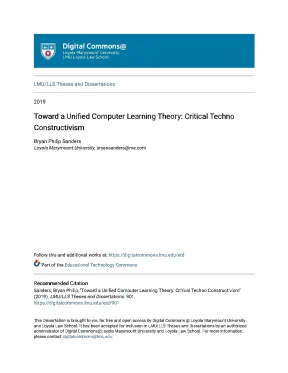
Tải xuống để đọc toàn bộLMU/LLS Theses and Dissertations 2019 Toward a Unified Computer Learning Theory: Critical Techno Constructivism Bryan Philip Sanders Loyola Marymount University, bryansanders@me.com Follow this and additional works at: https://digitalcommons.edu/etd Part of the Educational Technology Commons Recommended Citation Sanders, Bryan Philip, "Toward a Unified Computer Learning Theory: Critical Techno Constructivism" (2019). LMU/LLS Theses and Dissertations.edu/etd/901 This Dissertation is brought to you for free and open access by Digital Commons @ Loyola Marymount University and Loyola Law School. It has been accepted for inclusion in LMU/LLS Theses and Dissertations by an authorized administrator of Digital Commons@Loyola Marymount University and Loyola Law School. For more information, please contact digitalcommons@lmu.
LOYOLA MARYMOUNT UNIVERSITY Toward a Unified Computer Learning Theory: Critical Techno Constructivism by Bryan Philip Sanders A dissertation presented to the Faculty of the School of Education, Loyola Marymount University, in partial satisfaction of the requirement for the degree Doctor of Education 2019 Toward a Unified Computer Learning Theory: Critical Techno Constructivism Copyright © 2019 by Bryan Philip Sanders ii ACKNOWLEDGMENTS I have many people to thank for their intellectual, emotional, and financial support through this process. The daily inspiration that my wife, Lorraine, provided me is something that I could not have mustered on my own. Thank you, my dearest partner, for sustaining me. You light a fire in me each day and I am grateful for your love and care.
I am lost without you. I love you, Lorri. And to my beloved son, Florian, thank you for your running commentary on my progress as a doctoral student and for your ever-present sense of what is wrong and right, bad and good, for your level head is one that I admire and look to as a model of how best to live. You are far along on your path to becoming the greatest version of yourself, which I know will far surpass me.
Not a day goes by that I don’t love and care for everything that you do and say. I love you, Florian. Our family dog, Wolfie, I thank you for tolerating me as I woke you up endless times during your many naps to burrow my face into your fluffiness and relieve some stress that inevitably arose from this process. Wolfie, you are a sweet and great pal.
To my mother, Elizabeth, thank you for paying for me to go back to school and for believing in me to improve my career options. Your tales and quips of wisdom and balance are always ricocheting inside my skull and have kept me calm throughout this process. I am on my way to becoming something that I am impressed with and I owe so much to you. I love you, mom.
To my aunt, Rela, thank you for your endless supply of positivity and turkey burgers. I would be depressed and hungry without you. You are very important to me and my family. To Richard, I thank you for not giving Kenny the black Lexus––let's just hope he believes that story you invented about the busted transmission.
And truly, thank you for always helping me and my family with all the various pieces of mundane life that never stopped happening while I was in iii this process. To my brother and sister-in-law, Kenny and Karen, thank you for going into debt while I attended college. I hope you think it was worth it. And to my father, Harvey, who would have given Kenny the black Lexus, I wish you could see what I am up to because I could not have imagined it when I started my career as an educator––that was the same year that you died and it still feels like it just happened.
I don’t think you’re looking down on me because you never taught me to believe in heaven and angels and god, but I do think that you are inside of me and I am grateful for that. I just wish that you would answer when I try to call, so could you please work on that? To my mentors and friends and people I met on Twitter, everything that you have said and done is part of my journey and process. I am always thinking about your questions and comments. Please never stop goading me because it is in those moments of contention that my strength rises and seeks the challenge of what is before me.
Elizabeth Reilly, you are the embodiment and model of the tough and tender scholar, researcher, and human that I wish to become. I know that with you guiding my work that I will find success. Thank you for welcoming me into your home, feeding my soul and my stomach, and for believing in my work and me. I am typically a loner, but I have found great comfort and inspiration in your companionship and sharp intellectual insights.
Liza Mastrippolito, you are the one who told me to formally ask Dr. Reilly to be my chair––it was pretty obvious, but I totally missed it, (silly man that I am) and I would not have had the support I needed if you didn’t first catch it. I am grateful for your friendship in our time together in this cohort and now graduating together. Thank you! iv To Dr.
Shane Martin, it is really your fault that I am here in the first place, and for that I am eternally grateful. You dared me into a doctoral degree when I came to you looking for new ideas about where to work––turns out that you were right, for I can see my path more clearly now. I think fondly about when we met in 1997 during my master's degree program at LMU and continue to hold you in the highest regard. You are an essential part of my story as an educator.
Your belief in me for all these years has helped me to stand tall and believe in myself. I met you as I began my career and lost my father. You may never know the value of your patronage, but I know you can imagine it. Thank you, dear friend.
Philip Molebash and Ernesto Colín, I am honored to have you both on my team as I complete this project. Your wisdom is unparalleled, and your accomplishments are diverse. I am inspired when you speak and gain insight into the nitty gritty of my topic, and really any topic, when you share ideas and citations. I especially enjoy listening to you both debate and engage in respectful disagreement.
You are models of excellence that I hold as pure examples of that scholar that I wish to become. Please keep sending me articles to read and challenging my assumptions. You are both deep wells of wisdom and inspiration. Jill Bickett, I thank you for never giving up on me and for even finding me funny at times.
I am forever indebted that you accepted me into the program and helped me to find my way and thrive. You are an incredible leader who knows how to handle even the most difficult of students. I have learned a lot from your patience and care and tutelage. And to everyone I did not name in this acknowledgment section, I am grateful to have you in my life and I care for you deeply.
I have a very full life because you are in it. Thank you for accepting me into your homes, your conversations, your meals, your vacations, your v classrooms, your gatherings, and your lives. Ours is a world of ideas and creatures––I love being alive with all of you creatures and your ideas. Here is to the unknown unknown––may it continue to breed imagination.
Bryan Philip Sanders, 2019 vi TABLE OF CONTENTS ACKNOWLEDGMENTS .iii LIST OF TABLES. ix LIST OF FIGURES. xi CHAPTER 1: BACKGROUND OF THE STUDY. 1 The Problem of Behaviorism and Cognitivism.
1 Background of the Problem. 3 Human Success Cannot Be Predetermined. 4 Having Computers Does Not Mean the Future Has Arrived. 4 Statement of the Problem.
6 Purpose of the Study. 8 Significance of the Study. 14 Assumptions, Limitations, and Delimitations. 14 Definition of Terms.
19 CHAPTER 2: REVIEW OF HISTORY AND LITERATURE. 22 Distance Learning and Development of Computer. 22 A History of Distance Learning. 22 A History of Computers and Classrooms.
25 The teaching machine. 29 Computer assisted instruction. 35 Literature Review, Major Concepts of Extant Theories. 52 Disrupt the Traditional Reality of Schools by Augmenting It.
54 Tying Ideas Together and Leading to Connectivism. 56 What is a 3DVLE?. 60 Constructivism at The Woods Hole Conference, 1959. 71 Issues in Educational Technology.
73 Congressional Hearing in 1995, Technology in Education. 81 CHAPTER 3: METHODOLOGY AND FRAMEWORK. 87 Collect the Research Evidence. 87 Organize the Concepts.
90 Align the History. 92 Evaluate Seminal Works. 93 Synthesize Concepts via Document Analysis. 94 CHAPTER 4: STUDY OF SEMINAL WORKS: DOCUMENT ANALYSIS.
97 John Dewey’s Democracy and Education (1916). 98 Paulo Freire’s Pedagogy of the Oppressed (1970). 158 Seymour Papert’s Mindstorms: Children, Computers, and Powerful Ideas (1980). 233 CHAPTER 5: CRITICAL TECHNO CONSTRUCTIVISM.
234 Critical Techno Constructivism. 237 Critical Techno Constructivist Mindset. 243 What is Next?. 269 viii LIST OF TABLES Table Page 1.
Existing Theoretical Precepts. Conversion of Theoretical Precepts to Excerpting Codes. Instances of “Technoconstructivism” in Full Text Searches. Significant Instances of Code Co-Occurrence.
Significant Instances of Code Pair Co-Occurrence. Tenets of Critical Techno Constructivism. Number of Times Each Code in Dedoose on Excerpts from Seminal Works. Types and Examples of Educational software.
257 ix LIST OF FIGURES Figure Page 1. Proposed main topics for unified learning theory. The cycles of information moving from appropriation to individualization. Cycles of information including spirals of time.
58 x ABSTRACT Toward a Unified Computer Learning Theory: Critical Techno Constructivism by Bryan Philip Sanders Why did we ever purchase computers and place them along the wall or in the corner of a classroom? Why did we ever ask students to work individually at a computer? Why did we ever dictate that students should play computer games or answer questions built from a narrow data set? And why are we still doing this with computers in classrooms today? This approach has contributed to a systemic problem of low student engagement in course materials and little inclusion of student voice, particularly for traditionally underrepresented students. New transformational tools and pedagogies are needed to nurture students in developing their own ways of thinking, posing problems, collaborating, and solving problems. Of interest, then, is the predominance in today’s classrooms of programmed learning and teaching machines that we dub 21st century learning. We have not yet fully harnessed the transformational power and potential of the technology that schools already possess and that many students are bringing on their own.
This dissertation aims to address what is missing in best practices of technology in the classroom. Herein these pages will be performed a document analysis of cornerstone books xi written by John Dewey, Paulo Freire, and Seymour Papert. This analysis will be in the form of annotations comprised of the author’s experience as an experienced educator and researcher, and founded in the extant relevant theories of critical theory, technology, and constructivism. The three philosophers were selected for their contributions to constructivism and their urgings to liberate the student from an oppressive system.
With a different approach to educational technology, students could be working towards something greater than themselves or the coursework, something with a passionate purpose derived from student inquiry. Instead of working at the computer and having a “one and done” experience, students could be actively transforming their studies and their world.
Nội dung được bảo vệ bản quyền — Tải xuống đầy đủ
Trích dẫn luận án này
Bryan Philip Sanders (2019). Toward a unified computer learning theory critical techno co [Luận án tiến sĩ, Loyola Marymount University]. LuanAn.net. https://luanan.net/cong-nghe-thong-tin/khoa-hoc-may-tinh/toward-a-unified-computer-learning-theory-critical-techno-constr
Câu hỏi thường gặp
Luận án "Toward a unified computer learning theory critical techno co" nghiên cứu về vấn đề gì?
Khám phá lý thuyết học máy thống nhất, tư duy phản biện về công nghệ. Hướng tới tương lai AI.
Luận án "Toward a unified computer learning theory critical techno co" được bảo vệ tại trường nào?
Luận án này được bảo vệ tại Loyola Marymount University. Năm bảo vệ: 2019.
Luận án "Toward a unified computer learning theory critical techno co" thuộc chuyên ngành gì?
Luận án "Toward a unified computer learning theory critical techno co" thuộc chuyên ngành Educational Technology. Danh mục: Khoa Học Máy Tính.
Luận án "Toward a unified computer learning theory critical techno co" có bao nhiêu trang?
Luận án "Toward a unified computer learning theory critical techno co" có 289 trang. Bạn có thể xem trước một phần tài liệu ngay trên trang web trước khi tải về.
Cách tải luận án "Toward a unified computer learning theory critical techno co" về máy như thế nào?
Để tải luận án về máy, bạn nhấn nút "Tải xuống ngay" trên trang này, sau đó hoàn tất thanh toán phí lưu trữ. File sẽ được tải xuống ngay sau khi thanh toán thành công. Hỗ trợ qua Zalo: 0559 297 239.